

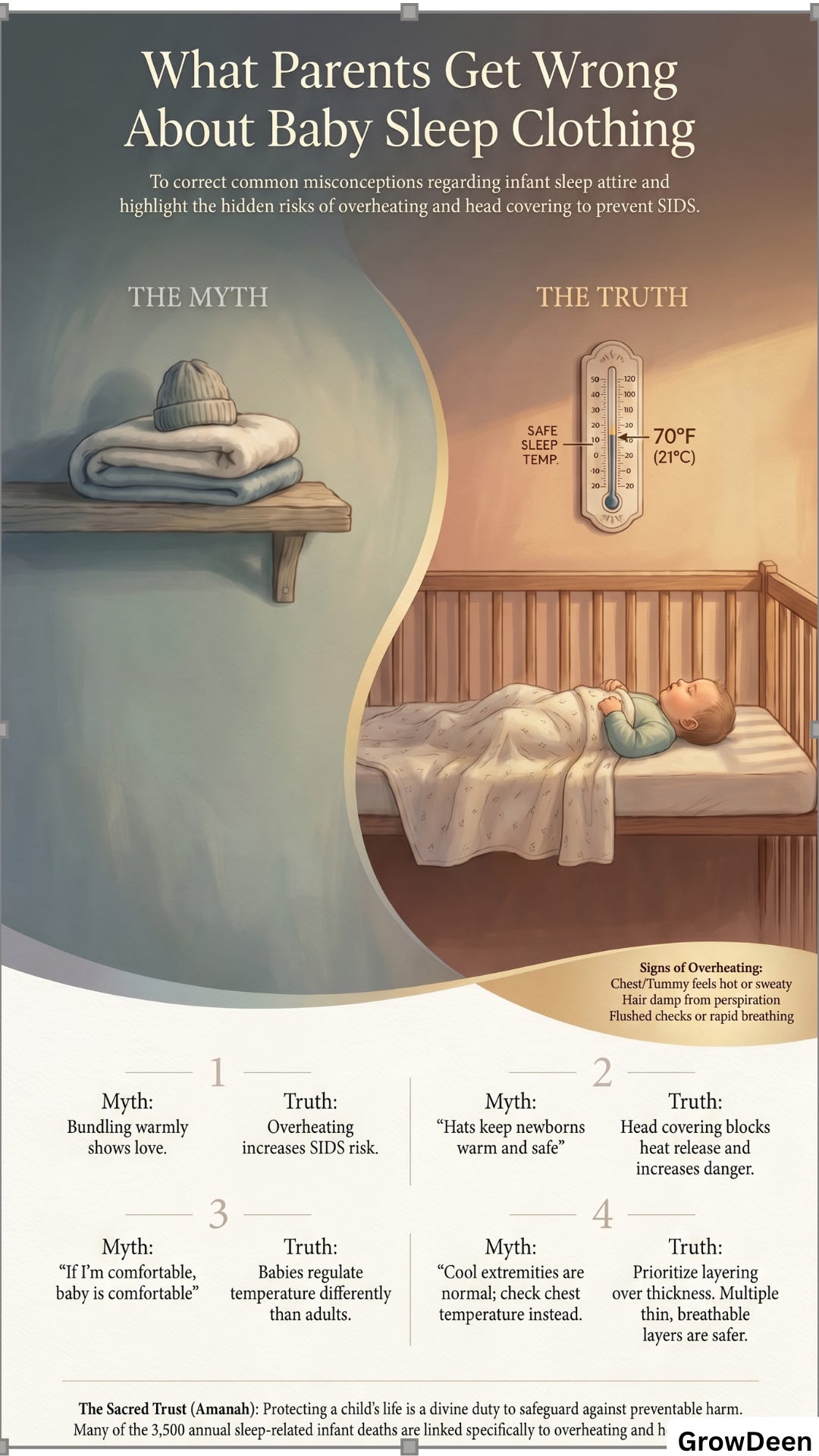
The AAP’s 2022 safe sleep guidelines found that approximately 3,500 infants die annually in the United States from sleep-related deaths, many linked to overheating from improper sleep clothing, head covering, or excessive layering [1].
The nursery is perfect. The cot is empty—no bumpers, no pillows, no stuffed animals. Your baby is on their back. You’ve done everything right.
Except maybe one thing you haven’t thought about: what they’re wearing.
I know you’re careful. You researched safe sleep guidelines. You removed every soft object. You’re vigilant.
But here’s what many parents miss: overheating is one of the clearest risk factors for sudden unexpected death in infancy (SUDI), including SIDS [2]. And the way we dress our babies for sleep—those thick pajamas, that adorable hat, “just one more blanket”—can turn a safe sleep space into a dangerous one faster than you’d think.
Why This Guide Is Different From Generic Sleep Safety Lists
Science-backed temperature regulation: Every recommendation comes from peer-reviewed research on infant thermoregulation and SUDI risk factors, not just generic parenting advice.
Islamic framework integrated: This isn’t just about keeping babies comfortable—it’s about honoring the amanah (sacred trust) of protecting the life Allah entrusted to us through both practical wisdom and spiritual awareness.
Actionable decision tool included: You’ll get a free Baby Sleep Clothing Decision Guide (3-page PDF) that shows you exactly what to dress your baby in based on room temperature—not guesswork, but a visual flowchart you can reference at bedtime.
Why Layering Matters More Than Thickness
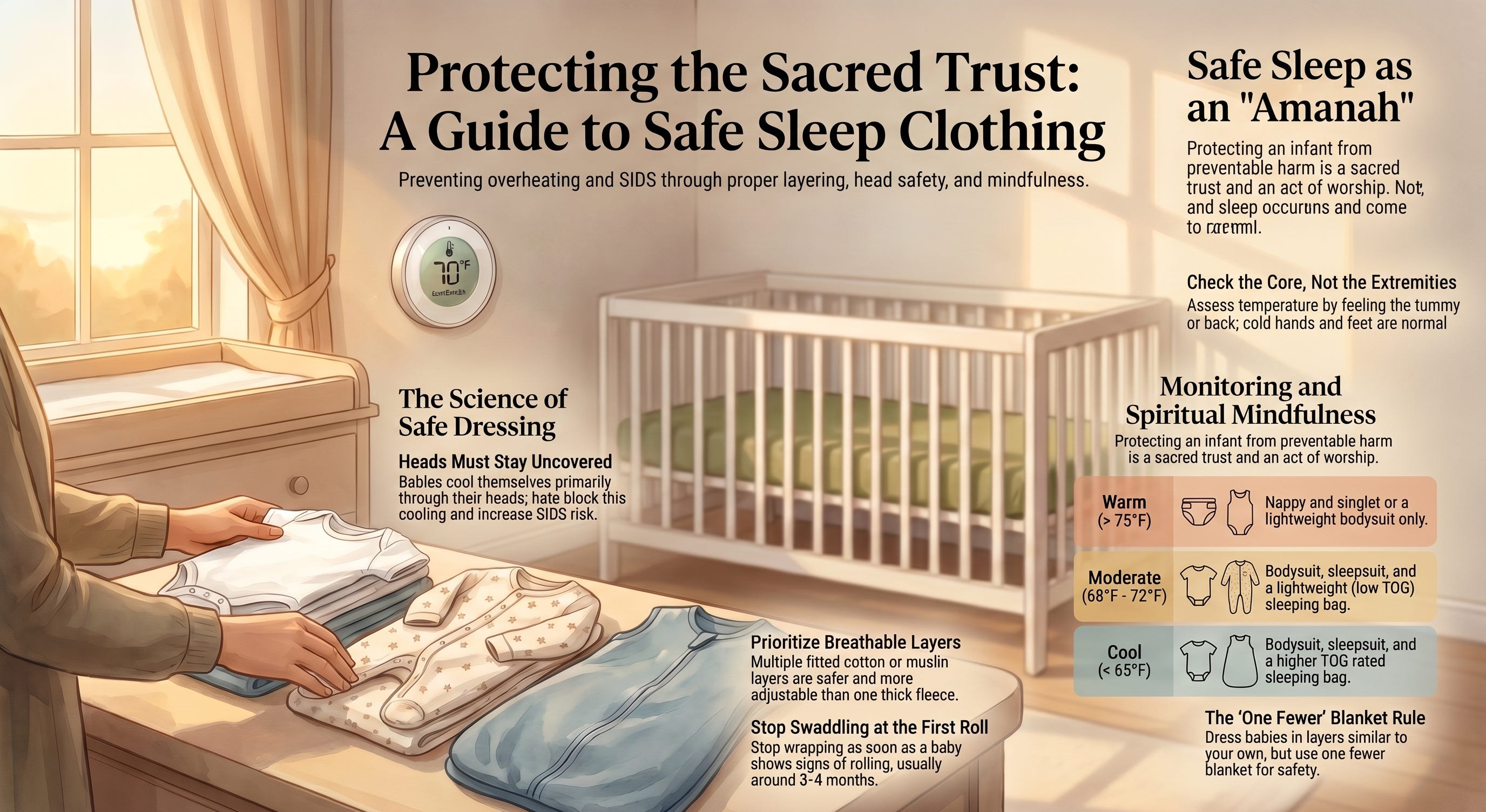
The instinct when you see your baby is to keep them warm. But babies can’t regulate temperature the way we can—and more importantly, they cool themselves primarily through their heads and faces [3].
When we dress them in one thick layer, we can’t adjust. Room gets warmer overnight? They’re stuck. Room cools down? They’re still stuck.
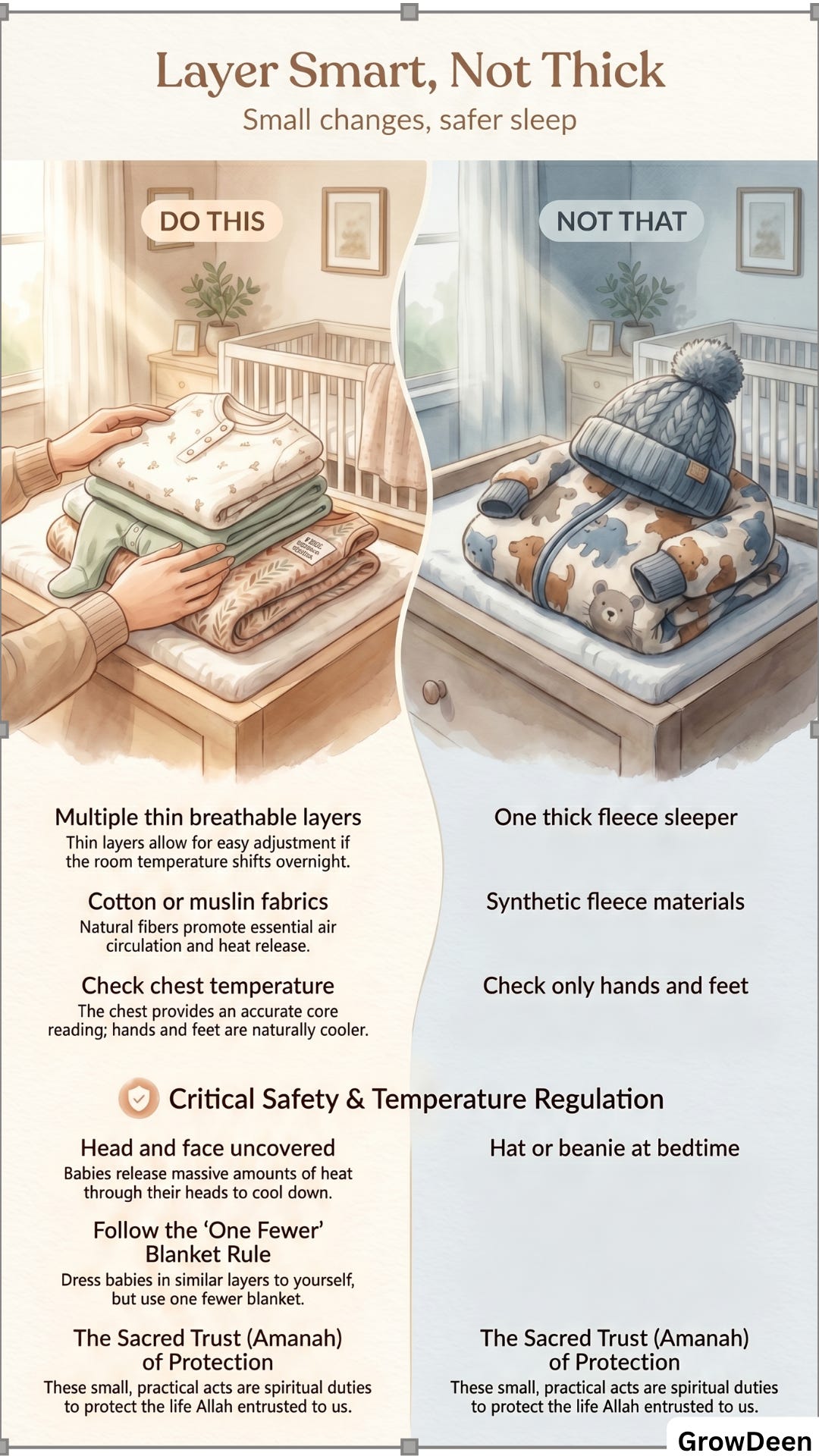
Layering solves this. Multiple fitted layers mean you can add or subtract without disrupting sleep. A bodysuit, then a sleepsuit, then maybe a lightweight sleeping bag if needed. Each layer you can see, touch, and remove if your baby feels too warm.
Here’s what surprised me when I studied the research: the number of layers doesn’t matter as much as the type of layers. Fitted cotton or muslin beats one thick fleece every time. Breathability matters. Air circulation matters. Your baby being able to release heat through their head matters most of all [3].
The Head Covering Rule: Non-Negotiable
Never let your baby sleep wearing a hat, cap, or beanie [4]. This isn’t about style. It’s about survival.
Babies release massive amounts of heat through their heads—it’s their primary cooling mechanism [3]. A hat blocks that. Even a lightweight one. Even a cotton one. Even “just for a few minutes.”
Research shows head covering is a major modifiable risk factor for SUDI [4]. When a baby can’t cool down through their head, their body temperature rises. Overheating follows. And overheating has been strongly linked to increased SIDS risk [2][5].
There’s another danger: hats slip. A hat that’s fine when you put your baby down can shift during sleep and cover their face. That’s a suffocation risk on top of an overheating risk.
Keep your baby’s head and face uncovered. Always. The research on this is unambiguous.
How to Check If Your Baby Is Dressed Appropriately
Don’t check their hands and feet—those are often cool even when baby’s core temperature is perfect. Instead, gently feel the skin on their tummy or back [6].
They should feel warm, but not hot. Not sweaty. Not damp.
If their chest feels hot to the touch, or you notice damp hair, flushed cheeks, or rapid breathing, they’re too warm. Remove a layer immediately and reassess after a few minutes.
The room temperature matters more than you think. Rather than constantly adjusting heating or cooling, adjust what your baby wears [6]. A room that feels comfortable to you in light clothing should work for your baby with appropriate layers.
Here’s a practical test I learned: dress your baby in a similar number of layers to what you’d wear to be comfortable in that room. If you’re comfortable in a t-shirt and pants, your baby might need a bodysuit and sleepsuit. If you’d add a cardigan, maybe add a lightweight sleeping bag. Your comfort is a reasonable guide—with one important caveat: they need one fewer blanket than you’d use, because their sleep surface should be clear [6].
I know this feels like a lot to remember, especially when you’re managing nighttime wakings and trying to figure out if it’s too cold or too warm. That’s exactly why I created a free Baby Sleep Clothing Decision Guide—a 3-page visual flowchart that shows you exactly what to dress your baby in based on room temperature and age. Keep reading to download it at the end of this article—it’s designed to stay with you right where bedtime actually happens.
Wrapping: When It’s Safe and How to Do It Right
Wrapping (swaddling) can help settle babies and reduce startle-reflex waking [7]. But timing and technique matter.
When to wrap: From birth until your baby shows signs of rolling from back to tummy, usually around 3 to 4 months [7]. Once rolling begins, stop wrapping immediately. A wrapped baby who rolls onto their stomach faces significantly increased suffocation risk.
How to wrap safely: Use lightweight cotton or muslin, never thick blankets. The wrap should never extend above your baby’s shoulders or cover any part of their head, ears, or chin. High wraps obstruct breathing and cause overheating [7].
Make sure it’s snug but not tight. Your baby should be able to breathe comfortably and move their legs into a natural, slightly bent position. Tight wrapping can lead to hip dysplasia and breathing difficulties [7][8].
What to wear under the wrap: In warm weather, just a nappy and singlet. In cooler weather, add a lightweight jumpsuit [7]. Remember: the wrap itself provides insulation. If you add too many layers underneath, you’re creating the overheating risk you’re trying to avoid.
If your wrapped baby needs extra warmth, add a thin, lightweight blanket tucked securely at chest level—never higher [7].
Blankets and Sleeping Bags: What Actually Works
You can use thin, lightweight blankets from birth if your baby doesn’t like wrapping, or once they’ve outgrown wrapping around 3 to 4 months [9].
Position your baby feet-first at the bottom of the cot, then tuck blankets securely at chest level [9]. This “feet to foot” position prevents them from wriggling down under bedding. Make absolutely sure blankets can’t shift upward to cover their face or head.
Here’s the safety principle: dress your baby in enough clothing to keep them warm, then use only a thin blanket for additional covering [9]. That way, if they wriggle free overnight, they won’t become dangerously cold.
Support Muslim Parenting Lab ❤️
Would you like a deed that keeps earning for you after you die? Start one in a few seconds with the button below.
The Prophet ﷺ named ongoing charity and beneficial knowledge among the three things that keep counting after death. (Sahih Muslim 1631)
Sleeping Bags: A Safer Alternative
A safe infant sleeping bag is fitted with armholes or sleeves, a fitted neck, and no hood [10]. It keeps your baby warm without the risks of loose blankets, and ensures their head and face stay uncovered [10].
You can start using one from birth if your baby doesn’t like wrapping, or when they outgrow wrapping [10]. Once they start pulling themselves up to stand (often 10-11 months), it’s time to transition away from sleeping bags [10].
Check the fit: the bag should be appropriately sized so your baby can’t slip down inside and become completely covered. When they lift their arms, their face shouldn’t be covered by excess material [10].
Some sleeping bags have TOG (thermal overall grade) ratings, which indicate warmth level [11]. These can help you choose the right bag for different temperatures, but they’re guides, not safety standards [11]. Always consider the actual temperature of the room where your baby sleeps, and check their body temperature regularly.
The Islamic Framework: Protecting the Amanah of Our Children
As Muslim parents, we carry a sacred responsibility—an amanah—to protect our children in every way, including the details of how we prepare them for sleep.
Allah says in the Qur’an:
“O you who have believed, protect yourselves and your families from a Fire whose fuel is people and stones, overseen by formidable and severe angels, who never disobey whatever Allah orders—always doing as commanded.” (Qur’an 66:6)
According to Tafsir Ibn Kathir, this verse places upon us the duty to safeguard our families from both spiritual and physical harm [12]. Ibn ‘Abbas explained: “Work in the obedience of Allah, avoid disobedience of Allah, and order your families to remember Allah, then Allah will save you from the Fire” [12].
When we check our baby’s temperature at night, when we remove that extra blanket, when we ensure their head stays uncovered—we’re answering this divine call. We’re protecting them from preventable harm. We’re fulfilling the trust Allah placed in our hands.
The Prophet Muhammad ﷺ taught us clearly:
“Every one of you is a shepherd and is responsible for his flock. A man is the guardian of his family and he is responsible for them. A woman is the guardian of her husband’s home and his children and she is responsible for them.” (Sahih al-Bukhari 7138, Sahih Muslim 1829)
Our babies cannot adjust their own clothing when they’re too warm. They cannot remove a hat that’s slipped over their face. They rely entirely on us. This helplessness is precisely why Allah emphasizes our duty so strongly.
These small, tender acts—dressing our baby in breathable layers, checking their temperature, keeping their head uncovered—are not burdens. They’re acts of worship. Expressions of the mercy and care Islam calls us to embody.
May Allah grant us the wisdom and diligence to fulfill this amanah with excellence, and may He protect our children and make them among the righteous. Ameen.
Your Free Baby Sleep Clothing Decision Guide
If you’ve read this far, you’re the kind of parent who takes sleep safety seriously—not as paranoia, but as protective love.
Inside the Baby Sleep Clothing Decision Guide (one comprehensive PDF, 3 pages):
Page 1: Temperature-Based Clothing Flowchart — A visual decision tree showing exactly what to dress your baby in based on room temperature (60°F to 75°F) and age (newborn to 12 months)—designed as a quick reference card you can keep on your nightstand or nursery wall.
Page 2: Seasonal Safety Checklist — Month-by-month guidance on what changes as the weather shifts, plus a “too hot” vs. “too cold” symptom guide so you can quickly assess and adjust—so you’re never guessing at 2 AM.
Page 3: The Three Quls for Sleep — The three protective surahs the Prophet ﷺ encouraged reciting before sleep, with references, bedtime usage, and a gentle step by step method for parents to use with their baby tonight. This page helps parents build a calm Islamic bedtime routine by combining Qur’anic protection, loving touch, and trust in Allah before sleep.
This guide takes what used to require research, worry, and second-guessing, and turns it into a 30-second decision you can make with confidence.
If this resonated with you, I’d love for you to join the GrowDeen community. We’re building a library of evidence-based, Islamically-grounded parenting guidance covering everything from infant care to toddler discipline to family wellness—all designed to support Muslim families raising children with both knowledge and eman.
One Small Action You Can Take Tonight
Before you put your baby down for sleep tonight, do a 5-minute temperature check:
Feel the room—is it comfortable for you in light clothing?
Check what your baby is wearing—count the layers
Feel their tummy or back (not hands/feet) after they’ve been asleep for 30 minutes
Adjust if needed: too warm? Remove a layer. Too cool? Add one lightweight layer.
That’s it. Five minutes to verify you’ve got it right. Small action, massive peace of mind.
Share This With Someone Who Needs It
Think of a parent you know—maybe a sister, cousin, or friend—who’s navigating the overwhelming world of newborn care right now. Someone who’s probably googling “how to dress baby for sleep” at 2 AM because nothing feels certain.
Send them this article. It might be exactly what they need.
Frequently Asked Questions
Q: My baby’s hands and feet always feel cold. Should I add more layers?
No—cold hands and feet are normal in babies and don’t indicate overall body temperature. Instead, feel the skin on your baby’s tummy or back. That’s where you’ll get an accurate read. If their core feels warm (not hot), they’re fine even if their extremities feel cool.
Q: Can I use a blanket if my baby is in a sleeping bag?
Not recommended. Sleeping bags are designed to replace blankets entirely. Adding both creates an overheating risk and defeats the safety purpose of the sleeping bag. If your baby seems cold despite the sleeping bag, check the TOG rating and consider whether you need a warmer bag rather than adding layers on top.
Q: What if the room temperature changes overnight?
This is why layering is so important. If you know the room will cool down significantly (like in winter when heating turns off), dress your baby in one extra lightweight layer at bedtime so they’re still comfortable even if the temperature drops. Check on them periodically, especially during seasonal transitions.
Q: At what temperature should I stop using a sleeping bag entirely?
If the room temperature is consistently above 75°F (24°C), a sleeping bag may be too warm. In very hot weather, a bodysuit or lightweight sleepsuit alone may be sufficient. Always check your baby’s temperature and watch for signs of overheating (damp hair, flushed cheeks, rapid breathing).
Q: How do I know if my wrapping technique is safe?
The wrap should be snug enough to stay in place but loose enough that you can fit 2-3 fingers between the wrap and your baby’s chest. Your baby’s hips should be able to bend and their legs should move freely into a “frog” position. If the wrap restricts hip movement or breathing, it’s too tight.
Q: Is it okay to dress my baby in fleece pajamas for warmth?
Fleece is thick and doesn’t breathe well, which increases overheating risk. Stick to cotton or muslin sleepsuits in layers. If the room is very cold, use a higher TOG sleeping bag over cotton layers rather than thick fleece pajamas.
References
[1] Task Force on Sudden Infant Death Syndrome. (2022). Sleep-related infant deaths: Updated 2022 recommendations for reducing infant deaths in the sleep environment. Pediatrics, 150(1), e2022057990. https://doi.org/10.1542/peds.2022-057990
[2] Task Force on Sudden Infant Death Syndrome. (2016). SIDS and other sleep-related infant deaths: Evidence base for 2016 updated recommendations for a safe infant sleeping environment. Pediatrics, 138(5), Article e20162940. https://doi.org/10.1542/peds.2016-2940
[3] Alessandra, G.W., & Finlay, F. (2019). Can infant sleeping bags be recommended by medical professionals as protection against sudden infant death syndrome? Archives of Disease in Childhood, 104(3), 305. https://doi.org/10.1136/archdischild-2018-316093
[4] Blair, P.S., Mitchell, E.A., Heckstall-Smith, E.M., & Fleming, P.J. (2008). Head covering: A major modifiable risk factor for sudden infant death syndrome: A systematic review. Archives of Disease in Childhood, 93(9), 778-783. https://doi.org/10.1136/adc.2007.136366
[5] Trachtenberg, F.L., Haas, E.A., Kinney, H.C., Stanley, C., & Krous, H.F. (2012). Risk factor changes for sudden infant death syndrome after initiation of Back-To-Sleep campaign. Pediatrics, 129(4), 630-638. https://doi.org/10.1542/peds.2011-1419
[6] Task Force on Sudden Infant Death Syndrome. (2005). The changing concept of sudden infant death syndrome. Pediatrics, 116, 1245-1255. https://doi.org/10.1542/peds.2005-1499
[7] van Sleuwen, B.E., Engelberts, A.C., Boere-Boonekamp, M.M., Kuis, W., Schulpen, T.W.J., & L’Hoir, M.P. (2007). Swaddling: A systematic review. Pediatrics, 120(4), e1097-e1106. https://doi.org/10.1542/peds.2006-2083
[8] Mahan, S.T., & Kasser, J.R. (2008). Does swaddling influence developmental dysplasia of the hip? Pediatrics, 121(1), 177-178. https://doi.org/10.1542/peds.2007-1618
[9] Blair, P.S., & Ball, H.L. (2004). The prevalence and characteristics associated with parent-infant bed-sharing in England. Archives of Disease in Childhood, 89(12), 1106-1110. https://doi.org/10.1136/adc.2003.038067
[10] McDonnell, E., & Moon, R.Y. (2014). Infant deaths and injuries associated with wearable blankets, swaddle wraps, and swaddling. Journal of Pediatrics, 164(5), 1152-1156. https://doi.org/10.1016/j.jpeds.2013.12.045
[11] Meyer, L.E., & Erler, T. (2011). Swaddling: A traditional care method rediscovered. World Journal of Pediatrics, 7(2), 155-160. https://doi.org/10.1007/s12519-011-0268-6
[12] Tafsir Ibn Kathir, commentary on Surah At-Tahrim (66:6). Retrieved from https://www.alim.org/quran/tafsir/ibn-kathir/surah/66/6/
[13] Sahih al-Bukhari 7138, Sahih Muslim 1829. Retrieved from https://sunnah.com/bukhari:7138
We combine scientific research with Qur’an and authentic Sunnah, and we cite our sources. Even so, this is general guidance and no substitute for a doctor who can examine your child.