

A 2017 systematic review in BMC Public Health found consistent links between daily active play and healthy motor development in children under four [1]. Here’s exactly what that looks like month by month, plus the handful of genuinely Islamic-friendly toys worth knowing about, and what the Prophet ﷺ modeled about a small child’s movement, even during prayer.
Your baby is on the mat, face red, straining to push up onto two little forearms.
The head lifts. One second. Maybe two. Then it drops back down, and your baby looks almost surprised at themselves.
You’ve watched this happen fifty times this week and started to wonder if it’s actually doing anything.
Here’s what I want you to know before you read another word: that second of lifted head is not a cute moment to photograph and move past. It’s your baby’s body, quite literally, building the strength it will use for the rest of this year — rolling, sitting, crawling, standing, maybe even a first wobbling step before their birthday [1,2].
Why This Guide Is Different
Scientific research + current data. Every recommendation traces back to peer-reviewed research and public health guidance from sources like the Australian Government’s 24-Hour Movement Guidelines and the Canadian Paediatric Society [1,7,8].
Islamic framework, genuinely integrated. This isn’t safety tips with a verse tacked on. It’s honoring the amanah of your baby’s growing body — the same growth Allah describes as moving from weakness into strength.
Actionable resources you’ll actually use. You’ll get The Little Mover’s Companion Pack free — a month-by-month tracker, a real (verified) Islamic toy resource list, and a reflection card — not just information, but tools to print and keep.
Why This Everyday Struggle Actually Matters
Every reach, every push, every red-faced strain toward a toy strengthens the exact muscles your baby needs for the next milestone. The neck and shoulder work of tummy time becomes the foundation for sitting. Sitting becomes the base for crawling. Crawling builds the coordination behind standing [1,2].
It’s a stack. Each layer resting on the one below it.
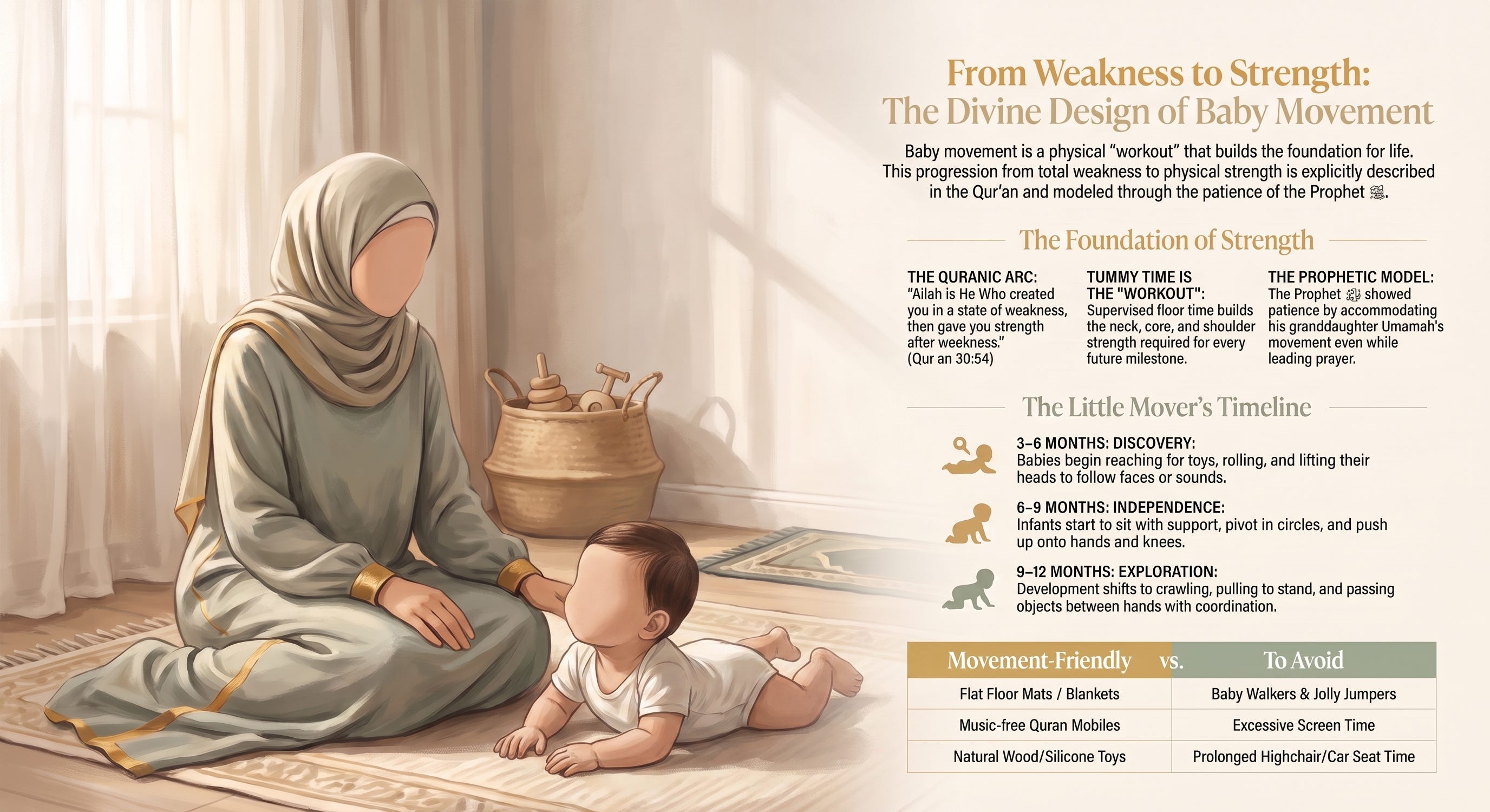
Here’s the part that surprised me when I sat with this topic: the Qur’an describes this exact arc — weakness giving way to strength, strength eventually giving way to weakness again — as one of the fundamental patterns Allah has written into every human life.
“Allah is He Who created you in a state of weakness, then gave you strength after weakness, then after strength gave weakness and grey hair.” (Qur’an 30:54)
According to Tafsir Ibn Kathir, this verse traces the entire arc of a person’s life — from the total powerlessness of a newborn, through the strength gradually granted in childhood and youth, back eventually to frailty in old age. Your baby’s shaky first push-up isn’t a small thing happening off to the side of “real” development. It’s the beginning of a design Allah put in motion.
What Movement Actually Looks Like, Month by Month
Every baby moves at their own pace. That range is wide, and it’s completely normal. Still, it helps to know roughly what tends to come first [2].
Three to six months. Most babies start reaching for toys, rolling onto their back mid-tummy-time, bringing hands to their mouth, and occasionally managing a full roll from front to back — and back again.
Six to nine months. A lot of babies actually start to prefer being on their tummy. They can reach further, pivot in a circle chasing a toy, push up onto hands and knees, sit with a little support, and stand while holding onto you.
Nine to twelve months. Many babies are crawling, pulling to stand, sitting independently while reaching for toys without toppling, and starting to use both hands together — passing an object from one to the other, banging two things together.
When was the last time you actually watched — not supervised, watched — one full minute of your baby’s floor time? Try it today. You’ll likely see two or three of these in progress at once.
Tummy Time Is Still the Foundation
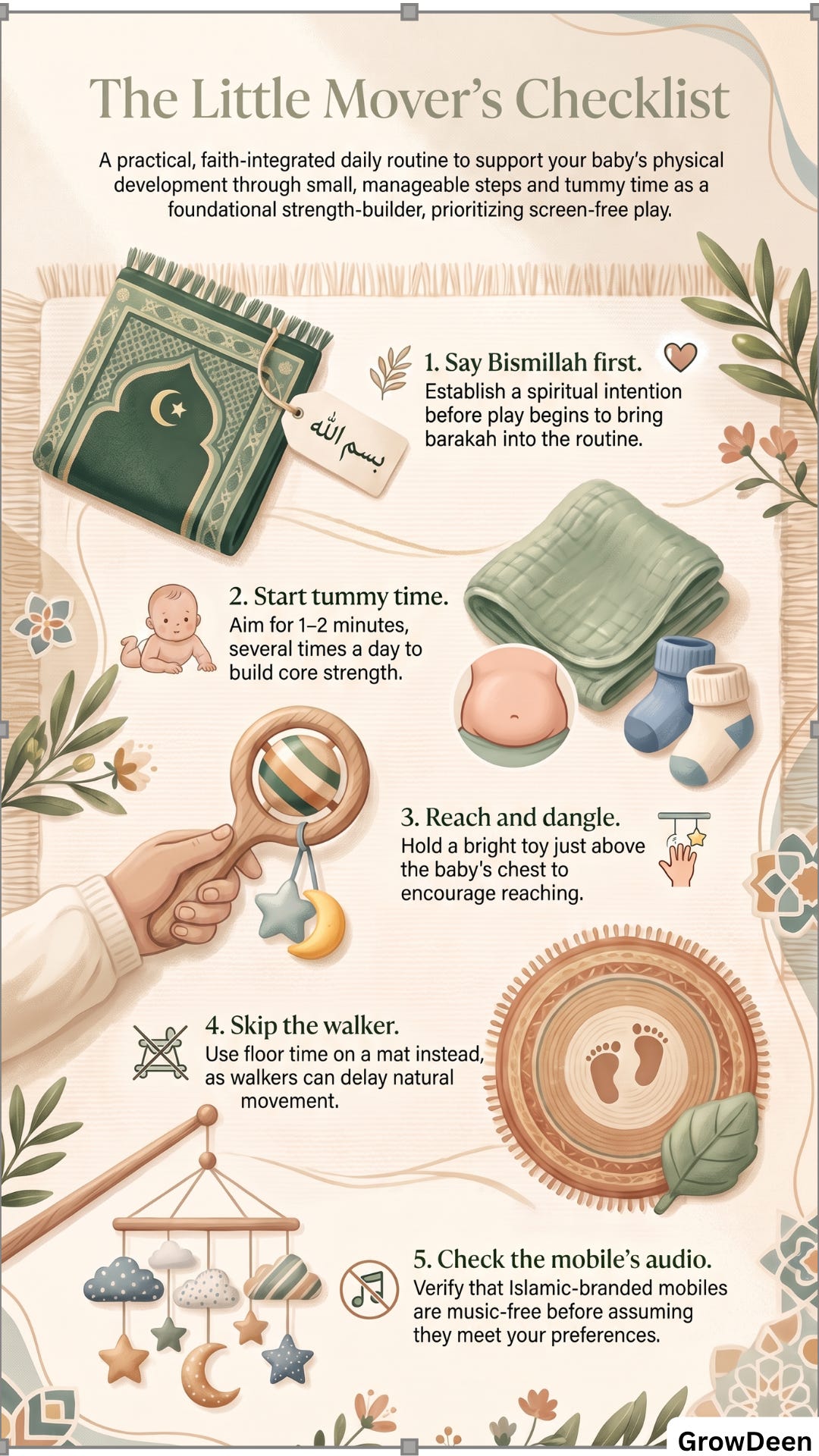
Tummy time — supervised time on the stomach while awake — remains the single most useful thing you can offer your baby’s developing body. It builds the neck, shoulder, and core strength behind almost everything that follows [3,4].
If your baby resists it, that’s common. Not a red flag.
But here’s the thing: you don’t have to do it the “textbook” way to get the benefit. Try it on your chest or across your lap first — this takes pressure off the stomach and lets your baby see your face. Get down on the floor at eye level. Speak softly, recite a short surah, stroke their back. Start with a minute or two and build up gradually to ten or fifteen, spread across the day.
If your baby consistently vomits during tummy time, resists it strongly every single time regardless of position, or shows no movement progress at all over several months, that’s worth a conversation with your child’s doctor [3].
The Prophetic Example: Physical Closeness, Even During Worship
One of the most tender images in the Sunnah is of the Prophet ﷺ carrying his young granddaughter, Umamah, on his shoulder — even while leading the prayer. Abu Qatada (may Allah be pleased with him) reported:
“I saw the Messenger of Allah ﷺ leading the people in prayer, carrying Umamah bint Abi al-’As on his shoulder. When he bowed, he put her down, and when he stood up from prostration, he picked her up again.” (Sahih al-Bukhari 516; also Sahih Muslim 543)
Down, up, down, up. Through an entire prayer.
Scholars point to this hadith as evidence that a small child’s physical presence wasn’t a disruption for the Prophet ﷺ to minimize — it was something worth accommodating, again and again, with patience. When you scoop your baby up mid-play, or hold their hands while they pull to stand, you’re echoing a small piece of that same rhythm.
I know it’s hard to remember all of this while you’re also managing feeding schedules, naps, and everything else. That’s exactly why I put together The Little Mover’s Companion Pack — a printable guide with a month-by-month movement tracker, a genuinely Islamic-friendly play and toy resource list, and a reflection card built around the hadith above. Keep reading to download it at the end of this article — it’s designed to live on your fridge or in your diaper bag, not buried in a folder somewhere.
Play Ideas by Age — With Islamic-Friendly Toy Options Where They Genuinely Exist
0–6 months
Recite short surahs softly, say gentle adhkar, or simply talk and hum as your baby follows your face. This builds neck strength through head-turning, and fills their earliest hearing with the remembrance of Allah rather than music [7].
Hang bright, safe toys just above your baby to encourage reaching. A few Islamic-branded crib mobiles exist for exactly this use — moon-and-star Qur’an mobiles from stores like Desi Doll Company, Muslim Memories, and Anafiya Gifts include light projection for visual tracking alongside recitation of short surahs [12]. QuranCube’s cot mobile explicitly states “no music, no instruments” in its own product description — worth looking for specifically, since not every “Islamic” mobile makes that claim clearly [13]. Check each listing rather than assuming.
6–12 months
Place a toy just out of reach to encourage stretching. Try sound exploration without music — wooden spoons on pots, a sealed container of beads, or simply hands clapping.
Silicone stacking blocks and sensory balls (widely available, not always specifically Islamic-branded) pair naturally with an Islamic frame at home — counting to ten in Arabic while stacking, saying Bismillah before handing a toy over. Lala + Mo runs a collection specifically curated as “Islamic Baby Toys, 0–10 Months,” combining Montessori-style materials with Arabic and Qur’an themes — a useful starting point if you’d rather buy something ready-made than improvise [12].
Sit your baby upright with support and roll a ball toward them. Encourage pulling to stand near secured furniture. Place toys on the floor for a standing baby to squat and reach for. Build a crawling tunnel from a cardboard box or a row of chairs.
A note worth sitting with: none of these toys are essential. A cardboard box works just as well developmentally as anything purchased. What a genuinely Islamic toy can offer is a way to fold recitation, Arabic, or Qur’anic imagery into play that’s already happening — not a replacement for the play itself.
Support Muslim Parenting Lab ❤️
Would you rather give a small amount that never stops than a large one you keep postponing? Set a monthly amount you are comfortable with, in a few seconds, using the button below.
The Prophet ﷺ said the deed most beloved to Allah is the most constant, even if little. (Sahih al-Bukhari 6464)
What to Avoid
Baby walkers and jolly jumpers aren’t recommended. They can delay progress toward crawling and walking, and carry injury risk near stairs and hot surfaces [1,8]. A blanket or mat on the floor does more for development than any walker.
Long, repeated stretches in highchairs, car seats, or strollers also limit the free movement your baby’s body needs each day [8,9]. And current guidance still holds that screens have no real place before age two, aside from video calls with familiar family [7].
A Practical Home Routine
A few minutes of tummy time, several times a day, building up gradually. Bismillah before playtime begins, and a quiet moment of du’a for your baby’s strength and wellbeing. A mix of floor time, reaching games, and supported standing. Soft recitation or spoken rhythm in place of music. Unstructured floor time, free of walkers and prolonged seat time.
The Islamic Framework for Movement: Weakness Into Strength, By Allah’s Design
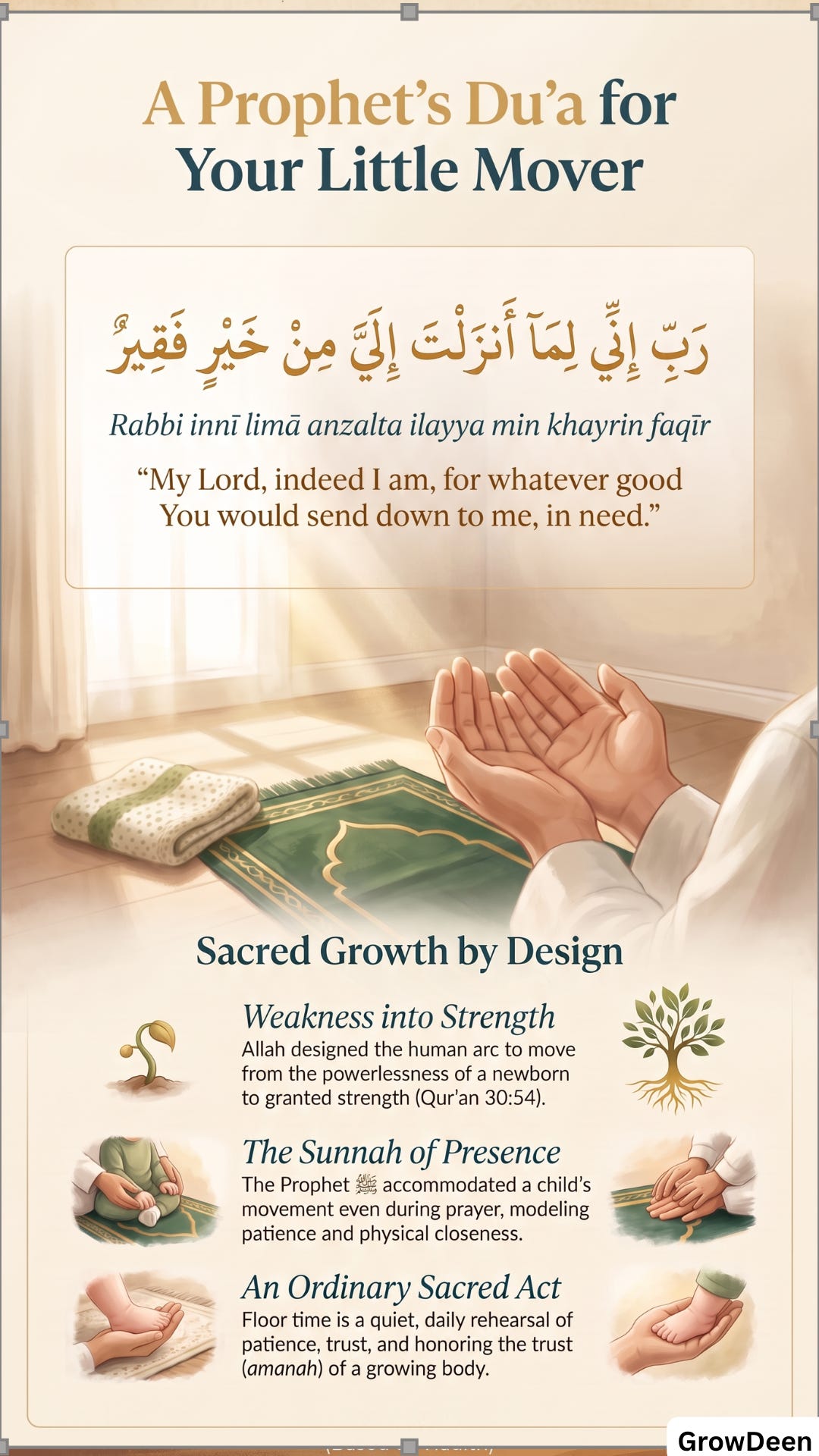
As Muslim parents, it’s easy to see tummy time and floor play as purely physical milestones — boxes to check on a chart. But when I sit with the verse where Allah says, “Allah is He Who created you in a state of weakness, then gave you strength after weakness” [Qur’an 30:54], I’m reminded this was never just biology. According to Tafsir Ibn Kathir, this verse maps the entire arc of a human life — from the total powerlessness of birth, through the strength granted in childhood and youth, back eventually to frailty in old age. Your baby’s shaky first push-up is Allah’s design already in motion.
The Prophet ﷺ modeled something just as striking. Abu Qatada reported seeing him lead the prayer while carrying his granddaughter Umamah — putting her down at each bowing and prostration, then lifting her again as he rose [Sahih al-Bukhari 516; Sahih Muslim 543]. Down, up, down, up, through an entire prayer, without treating her presence as an interruption.
What strikes me is how naturally these two things sit together — the theology of gradual, Allah-given strength, and a Prophet ﷺ who made room, physically and patiently, for a small child’s movement even during worship. Floor time with your baby isn’t separate from faith. It’s a quiet, daily rehearsal of the same patience and trust.
Your Little Mover’s Companion Pack
If you’ve read this far, you’re the kind of parent who takes your baby’s physical development seriously — not as a race against a chart, but as something worth understanding. That tells me something beautiful about you.
Inside The Little Mover’s Companion Pack (one comprehensive PDF, 3 pages):
Page 1: The Little Mover’s Milestone Tracker — A month-by-month reference across 3–6, 6–9, and 9–12 months, matching each movement milestone to one specific play activity that builds it — designed as a fridge-friendly card you can keep in your kitchen or nursery.
Page 2: The Islamic-Friendly Play & Toy Guide — A verified list of genuinely Islamic-branded toys and resources for this exact age range (crib mobiles, Montessori-Islamic sensory toys, and a specific “no music/no instruments” mobile option), alongside free, no-purchase play ideas — so you can decide in under 10 minutes what’s actually worth buying versus what your living room already has.
Page 3: The Sunnah of Playful Presence Reflection Card — The hadith of the Prophet ﷺ carrying Umamah during prayer, paired with Qur’an 30:54, formatted as a short daily reflection — something you can glance at during floor time to remember why this ordinary moment matters.
This isn’t just a PDF to download and forget. It’s a tool designed to stay in your nursery or diaper bag — where you’ll actually use it when you need it most.
This companion pack is what every subscriber receives with each article. We cover the full journey of raising Muslim children, all backed by scientific research and rooted in Islamic wisdom.
One Thing You Can Do in the Next 5 Minutes
Put your baby on the floor right now — no toys, no walker, just a blanket. Get down at eye level with them and say Bismillah before you start. Watch what they try to do with their own body in the next 60 seconds. That’s the whole exercise.
May Allah place barakah in your effort, accept your intention, and make the care you give more protective, more merciful, and more rewarded than it feels in the moment.
Someone You Know Needs This
Think of one person right now: the new mother in your family who mentioned her baby “just lies there” during tummy time, a friend who’s been buying every trending baby gadget without knowing which ones actually help, a sister who feels guilty every time she hands her baby a toy instead of “doing more.”
This article could ease that guilt with something real. Share it with them today — not as advice-giving, but as support. Sometimes the most loving thing we can do is pass along what actually helped.
Frequently Asked Questions
Is it normal for my baby to hate tummy time?
Completely normal, and it doesn’t mean anything is wrong. Try it on your chest or lap first, get down to eye level, and build up the time gradually — see the Tummy Time section above for the full approach.
How much tummy time does my baby actually need each day?
Start with 1–2 minutes and build toward 10–15 minutes total, spread across several short sessions rather than one long stretch [3].
Are baby walkers actually bad, or is that outdated advice?
Current guidance still doesn’t recommend them — they can delay progress toward crawling and walking and carry injury risk near stairs and hot surfaces [1,8]. Floor time on a mat supports development better.
Do I need to buy special toys for my baby to develop movement skills?
No. A cardboard box, a wooden spoon, or your own hands work just as well developmentally as anything purchased. Islamic-branded toys (see Page 2 of the companion pack) can add a spiritual layer, but they’re not required for development.
Are Islamic baby mobiles with Qur’an recitation actually music-free?
Not always — check each product’s description individually. QuranCube’s cot mobile specifically states “no music, no instruments” in its listing, which is a useful model to look for [13].
When should I actually worry about my baby’s movement and talk to a doctor?
If tummy time is refused every single time regardless of positioning, your baby vomits consistently during it, or there’s no movement progress at all over several months, that’s worth a doctor’s visit [3].
Is screen time ever okay for babies this age?
Current guidance recommends no screen time under age two, aside from video calls with familiar family members [7].
References
[1] Carson, V., Lee, E-Y., Hewitt, L., Jennings, C., Hunter, S., Kuzik, N., Stearns, J.A., Powley Unrau, S., Poitras, V.J., Gray, C., Adamo, K.B., Janssen, I., Okely, A.D., Spence, J.C., Timmons, B.W., Sampson, M., & Tremblay, M.S. (2017). Systematic review of the relationships between physical activity and health indicators in the early years (0-4 years). BMC Public Health, 17(Suppl. 5), Article 854. https://doi.org/10.1186/s12889-017-4860-0
[2] Gallahue, D.L., Ozmun, J.C., & Goodway, J.D. (2019). Understanding motor development: Infants, children, adolescents, adults (8th edn). Jones & Bartlett Learning.
[3] Williams, E., & Galea, M. (2023). Another look at ‘tummy time’ for primary plagiocephaly prevention and motor development. Infant Behavior & Development, 71, Article 101839. https://doi.org/10.1016/j.infbeh.2023.101839
[4] Leung, A., Mandrusiak, A., Watter, P., Gavranich, J., & Johnston, L.M. (2018). Impact of parent practices of infant positioning on head orientation profile and development of positional plagiocephaly in healthy term infants. Physical & Occupational Therapy in Pediatrics, 38(1), 1-14. https://doi.org/10.1080/01942638.2017.1287811
[5] Carson, V., Zhang, Z., Predy, M., Pritchard, L., & Hesketh, K.D. (2022). Longitudinal associations between infant movement behaviours and development. International Journal of Behavioral Nutrition and Physical Activity, 19, Article 10. https://doi.org/10.1186/s12966-022-01248-6
[6] Hnatiuk, J., Salmon, J., Campbell, K.J., Ridgers, N.D., & Hesketh, K.D. (2013). Early childhood predictors of toddlers’ physical activity: Longitudinal findings from the Melbourne InFANT Program. International Journal of Behavioral Nutrition and Physical Activity, 10, Article 123. https://doi.org/10.1186/1479-5868-10-123
[7] Canadian Paediatric Society & Digital Health Task Force. (2018). Screen time and young children: Promoting health and development in a digital world. Paediatrics & Child Health, 22(8), 461-477. https://doi.org/10.1093/pch/pxx123
[8] Australian Government Department of Health and Aged Care. (2017). Australian 24-hour movement guidelines for the early years (birth to 5 years). Commonwealth of Australia. https://www.health.gov.au/sites/default/files/documents/2021/05/24-hour-movement-guidelines-birth-to-5-years-brochure.pdf
[9] Downing, K.L., del Pozo Cruz, B., Sanders, T., Zheng, M., Hnatiuk, J.A., Salmon, J., & Hesketh, K.D. (2022). Outdoor time, screen time and sleep reported across early childhood: Concurrent trajectories and maternal predictors. International Journal of Behavioral Nutrition and Physical Activity, 19(1), Article 160. https://doi.org/10.1186/s12966-022-01386-x
[10] Qur’an 30:54, with Tafsir Ibn Kathir (verified via Alim.org)
[11] Sahih al-Bukhari 516; also Sahih Muslim 543 (verified via sunnah.com and hadeethenc.com)
[12] Lala + Mo. “Islamic Baby Toys 0–10 Months” collection. https://lalaandmo.com/collections/baby-0-10-months (illustrative resource, not a paid endorsement — verify materials, safety certification, and audio content independently before purchasing)
[13] QuranCube. Islamic Cot Mobile product listing (moon/stars/Kaaba, stated “no music/no instruments”). https://qurancube.com/products/islamic-cot-mobile
We combine scientific research with Qur’an and authentic Sunnah, and we cite our sources. Even so, this is general guidance and no substitute for a doctor who can examine your child.