

The CDC reports that an estimated 1,200 to 1,400 children are injured or killed by shaking every year in the U.S. [6] This guide shows you exactly how to tell healthy rough-and-tumble play from real danger — and the one rule that should never bend.
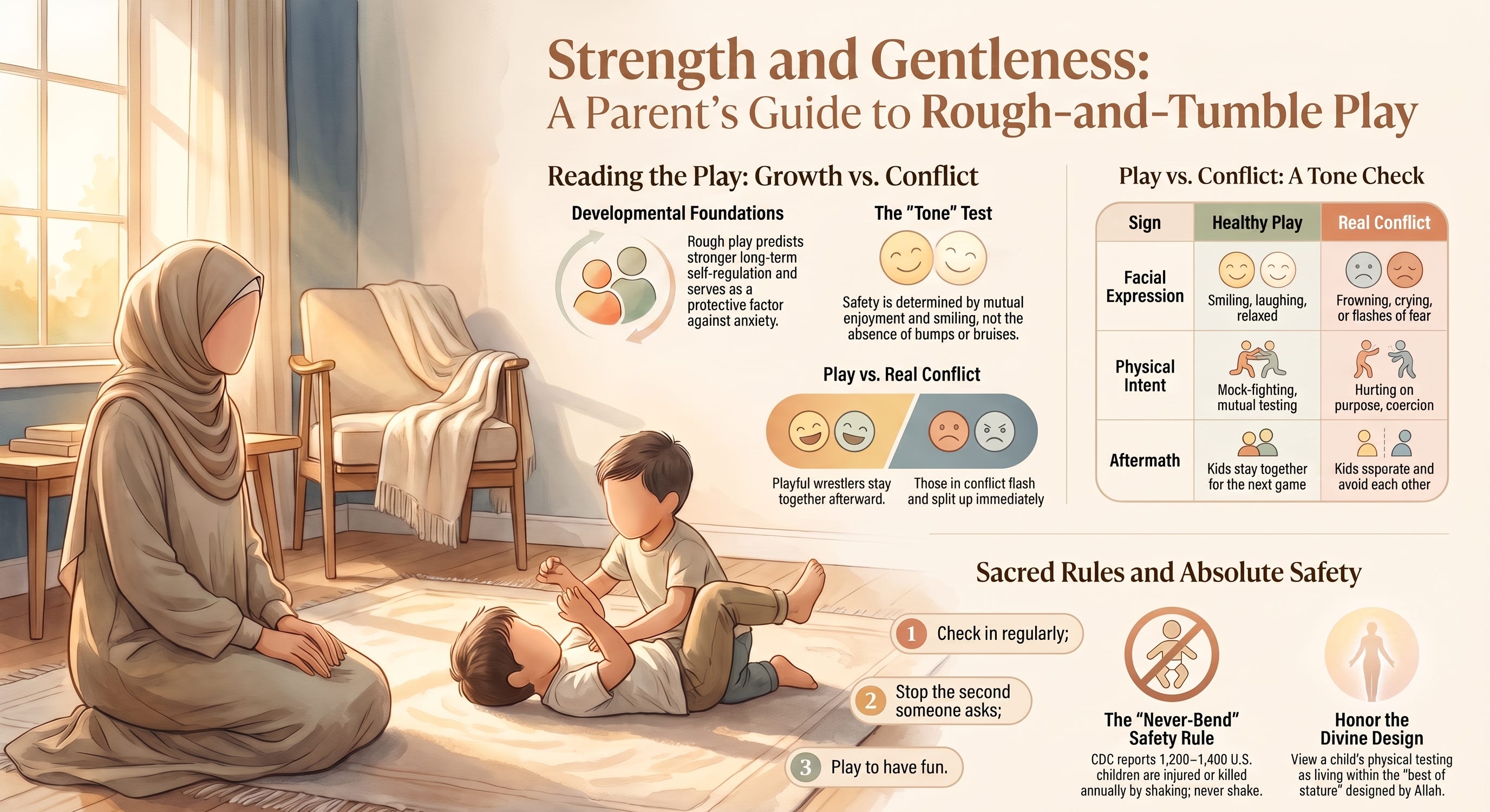
Your kids are on the living room floor again. One’s got the other in a headlock. Someone just got flipped onto a couch cushion. It’s loud, it’s chaotic, and your first instinct is to walk in and break it up.
Don’t, necessarily.
That thumping, shrieking wrestling match might be one of the most useful things happening in your house all day.
You’re doing everything right by paying attention to it — that’s not paranoia, that’s good instinct. But here’s the thing: most parents are watching for the wrong signal. They’re watching the roughness. What actually matters is something else entirely, and once you know what it is, you’ll never look at a wrestling match the same way again.
What Rough Play Actually Does
Rough-and-tumble play — the wrestling, the climbing on top of each other, the mock-fighting on the rug — shows up in almost every study of children’s play, across cultures and generations [4]. It isn’t a phase. It isn’t a problem behavior in disguise. Researchers who study it describe it as instinctive, and they’ve traced real, measurable benefits back to it: children learn the outer edge of their own strength, get a felt sense of how their body moves through space, and — this is the part that matters most for supervision — learn through direct trial and error what a playmate will and won’t tolerate [1][4].
Here’s a number that stopped me when I first read it: a study following a large group of Australian toddlers and preschoolers over several years found that time spent in free play predicted stronger self-regulation years later [1]. Not right away. Years down the line. Something in that floor-wrestling is laying groundwork most parents never think to credit.
There’s a related body of research on what scientists call “adventurous” or risky play — climbing too high, running too fast, wrestling someone bigger — that frames it as a possible protective factor against childhood anxiety. The logic holds up: a child who’s repeatedly put their body into a slightly uncertain physical situation and come out fine builds a kind of confidence you can’t hand them any other way [2]. Broader reviews of risky play link it to stronger emotional regulation and social functioning in kids who get enough of it [3].
None of this costs anything. It needs floor space, a soft surface, and permission.
And permission is exactly where most of us get stuck.
A systematic review of how adults think about risk in children’s active play found something worth sitting with: a persistent instinct among caregivers to minimize any risk at all — even when the research doesn’t support that level of caution [5]. The kids in those studies weren’t asking for danger. They were asking to test themselves. Learning to see the difference is, honestly, most of the work.
The One Thing That Actually Tells You If It’s Safe
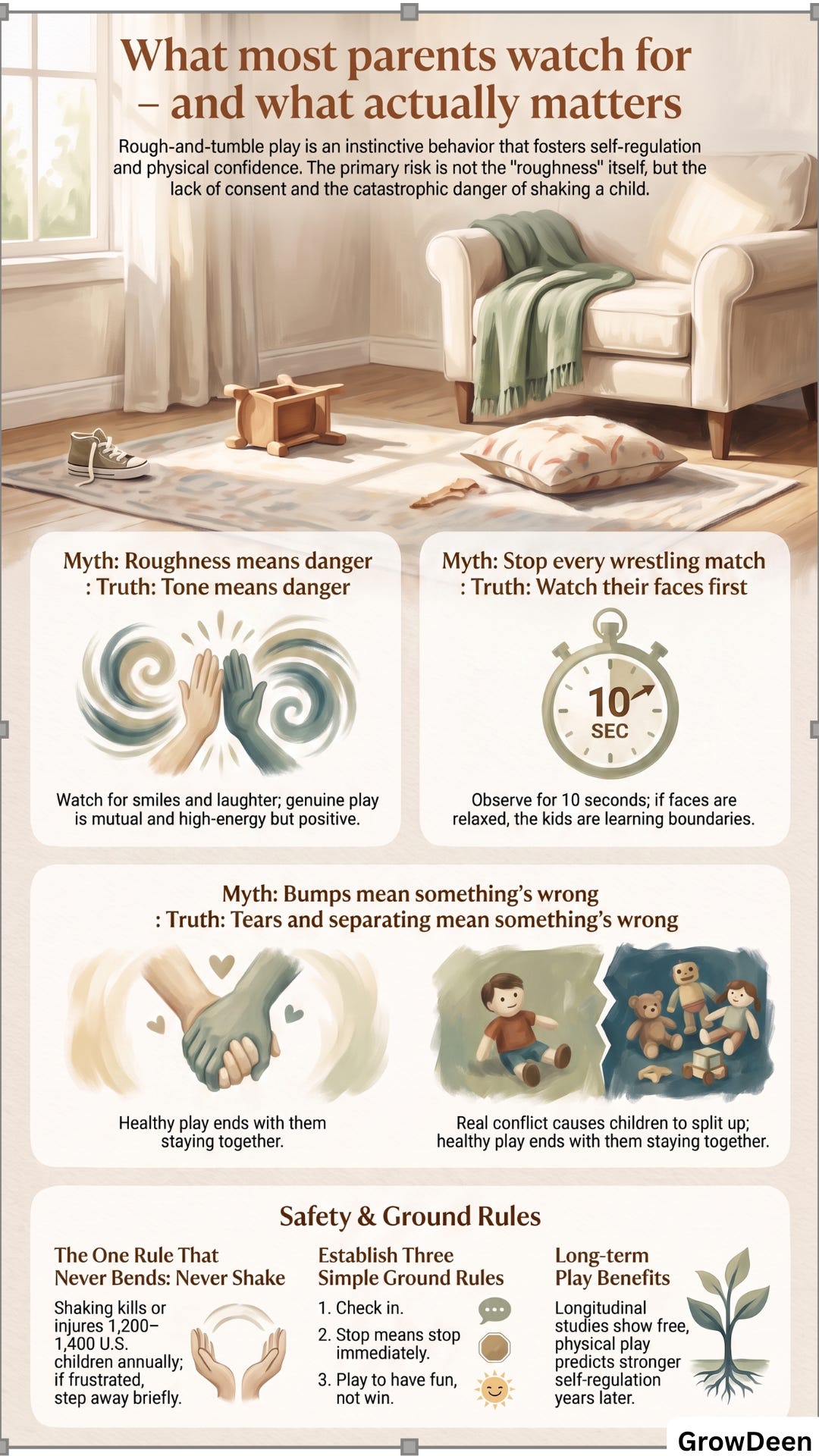
So if roughness itself isn’t the warning sign, what is?
Tone. Every time.
Genuine play-fighting comes with smiling, laughing, obvious enjoyment on both sides. Nobody’s being coerced, nobody’s getting hurt on purpose, and — this is the real tell — the kids usually stay together once it’s over. They slide right into the next game.
Real conflict looks completely different. Frowning. Crying. A flash of fear or actual anger. And afterward, they split up instead of continuing to play.
Bumps happen either way — a knee catches a chin, someone lands wrong. That’s not proof something went wrong. It’s proof two kids were moving fast. What you’re actually watching for is whether the fun is mutual, not whether anyone walked away with a bruise.
Build the Rules Together — Not Just For Them
The single most useful thing you can do isn’t hovering nearby ready to intervene. It’s sitting down with your child beforehand and building two or three simple rules with them.
Check in with each other. If you’re not sure the other person’s still having fun, ask.
Stop the second someone says stop — no finishing the round first.
Play to have fun, not to win. A little roughness is part of it. Hurting someone on purpose never is.
A child who learns to catch a playmate’s face falling mid-wrestle and stop immediately — no argument, no “just one more” — is learning something much bigger than wrestling etiquette. They’re learning that someone else’s comfort outranks the game. That lesson doesn’t stay in the living room.
What This Looks Like, Age by Age
Babies and very young toddlers mostly want gentle bouncing, swaying, being lifted — as long as they feel secure the whole time. Keep it slow and controlled. Their neck still needs real support, and this is exactly the age where the rule below isn’t optional.
Toddlers gravitate toward chasing, spinning, dancing, light wrestling on something soft underfoot. It goes best when they’re alert and fed, not winding down toward a nap — overtired plus overstimulated is a rough combination [4].
Primary-school-aged kids are usually the most enthusiastic wrestlers of the bunch, especially with each other, often going at it on a rug or mat where a fall gets cushioned. This is the age to have the “what makes good rough play good” conversation out loud, not just model it and hope it sticks [5].
I know this feels like a lot to hold in your head, especially in the middle of an actual wrestling match with two kids yelling over each other. That’s why I put together a free Rough Play Ground Rules Pack — a printable card set with the exact language to teach your kids and a quick reference for telling play from conflict at a glance. Keep reading — you’ll be able to download it at the end of this article, and it’s built to live on your fridge or in your kids’ room, right where the wrestling actually happens.
Support Muslim Parenting Lab ❤️
Would you like the most rewarded kind of charity there is? Use the button below now, while you are well, rather than later.
Asked which charity is best, the Prophet ﷺ said the one given while you are healthy, not deferred until death is near. (Sahih al-Bukhari 1419)
One Rule That Never Bends
However physical it gets, there’s a line that stays fixed at every age: a baby or child must never be shaken. Even briefly. Even in frustration rather than anger. The CDC identifies abusive head trauma — shaking, essentially — as a leading cause of death from child abuse in children under five, and an estimated 1,200 to 1,400 children are injured or killed by shaking every year in the U.S. [6]
If you feel your patience slipping in a hard moment with your baby, the safest thing you can do is set them down somewhere secure and step into another room for a minute before going back. That’s not failure. That’s exactly the right call.
The Sacred Trust of the Body Allah Gave This Child
As Muslim parents, it’s easy to think of our children’s bodies as something to manage and protect — and they are that. But they’re also something Allah made with real, deliberate intention. When I sit with the verse where Allah says, “We have certainly created man in the best of stature” [7], I think about how specific that phrasing is. According to Tafsir Ibn Kathir, this describes a human being formed in the finest image and shape — upright, every limb proportioned exactly to its purpose. Not an afterthought. A design.
A child wrestling their sibling on the living room floor, testing how hard they can push and how fast they can move, is living inside that design, not working against it. That’s worth remembering the next time it looks like chaos instead of what it actually is.
There’s a hadith that grounds how I think about the gentleness underneath all of this. ʿAʾishah رضي الله عنها reported that the Messenger of Allah ﷺ never struck anyone with his hand — not a woman, not a servant [8]. A man known for real strength, who never once let that strength tip into harm, even with those most vulnerable to him. When we referee our children’s rough play with that same instinct — strong hands used only to steady, never to hurt — we’re modeling something they’ll carry long after the wrestling match ends. What strikes me is how naturally the science and the Sunnah agree here: strength and gentleness were never meant to be opposites.
If you’ve read this far, you’re the kind of parent who takes your child’s physical play seriously — not as chaos to shut down, but as something worth understanding. That tells me something good about you.
Inside the Rough Play Ground Rules Pack (one comprehensive PDF, 3 pages):
Page 1: Play or Fight? At-a-Glance Card — A side-by-side visual comparing the signs of real play (smiling, staying together) against real conflict (tears, separating afterward) — designed as a card you can glance at from across the room without breaking stride.
Page 2: Ground Rules + Age-by-Age Guide — The exact three ground rules to teach your kids in language they’ll actually remember, plus a quick reference for what rough play looks like at each age — so you can set expectations in under 5 minutes before the wrestling even starts.
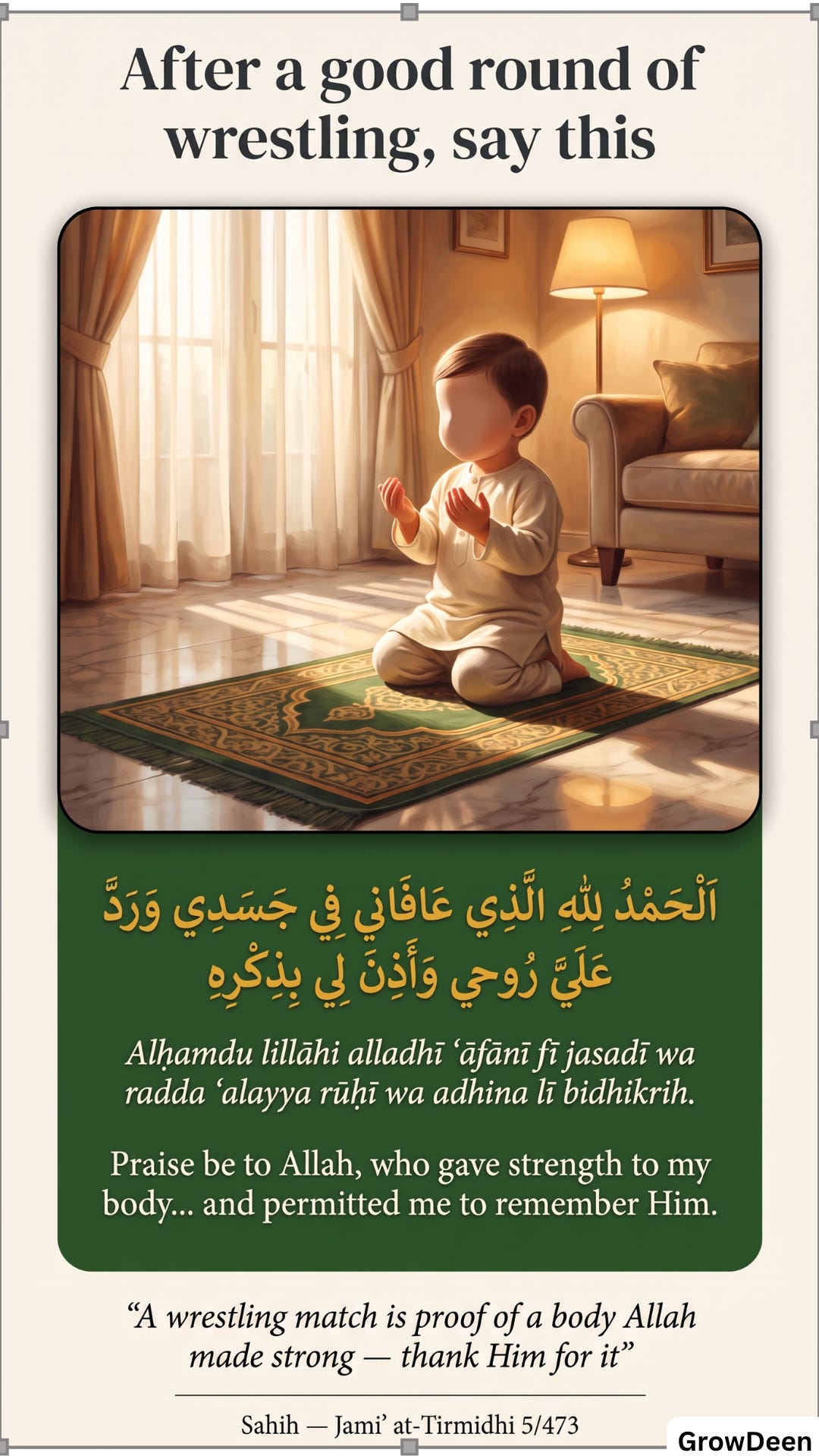
Page 3: The Body Allah Gave Them — A Reflection Card — Qur’an 95:4 on the human form created in the best of stature, paired with the Prophetic example of strength paired with gentleness — something to read with your child after a good round of wrestling, turning the moment into gratitude instead of just cleanup.
This isn’t just a PDF to download and forget. It’s a tool designed to live on your fridge or in your kids’ playroom — where you’ll actually reach for it mid-chaos.
This Rough Play Ground Rules Pack is what every subscriber receives with each article. We cover the full journey of raising Muslim children — from newborns to school-age — all backed by research and rooted in wisdom.
If you’re a Muslim parent who wants both evidence-based guidance and Islamic perspective, subscribe for free so future resources arrive in your inbox before you need them.
Subscribe free for parenting resources backed by both science and Sunnah — guidance so specific, you won’t find it anywhere else — no spam, no clutter, just resources that matter.
Before you keep scrolling: next time your kids start wrestling, don’t walk in to stop it. Watch their faces for ten seconds first. That’s it. That’s the whole practice.
May Allah place barakah in your effort, accept your intention, and make the care you give more protective, more merciful, and more rewarded than it feels in the moment.
One More Thing
Think of one person right now: a sibling with two boys who never seem to stop wrestling, a friend at the masjid who just told you she’s exhausted from refereeing her kids all day, a brother whose kids you’ve watched go from giggling to genuinely upset without him noticing the shift.
This article could change how they see what’s happening on their living room floor. Share it with them today — not because you’re being preachy, but because you care. Sometimes the most loving thing we can do is pass along a way of seeing that makes the hard moments easier to read.
Frequently Asked Questions
Q: Is rough play bad for kids?
A: No — quite the opposite. Research links regular free and physical play to stronger self-regulation, emotional regulation, and social skills later on [1][3]. The roughness itself isn’t the concern; how it’s supervised is. See “What Rough Play Actually Does” above for the full picture.
Q: How can I tell if my kids are really playing or actually fighting?
A: Watch their faces, not their movements. Smiling, laughing, and staying together afterward means it’s play. Frowning, crying, or splitting up once it ends means it isn’t [4]. That’s the single clearest signal you have.
Q: At what age can toddlers start rough-and-tumble play?
A: Toddlers can start light wrestling and chasing games on a soft surface as soon as they’re steady on their feet, ideally when they’re alert and fed rather than close to nap time [4]. Babies and very young toddlers do better with gentle bouncing and lifting instead of true wrestling.
Q: Is it okay for my child to wrestle with adults, like a parent or older sibling?
A: Yes, as long as the adult stays in control of their own strength and stops the moment the child isn’t enjoying it. This is actually a great opportunity to model the gentleness-paired-with-strength described in the Islamic Perspective section above.
Q: Can rough play turn into real bullying or aggression over time?
A: It can, occasionally, which is exactly why setting ground rules together — checking in, stopping immediately when someone says stop — matters so much [4]. Watch for a pattern where one child consistently avoids playing with another afterward; that’s worth a closer look.
Q: Is it ever okay to shake a baby a little, just to calm them down?
A: No — never, under any circumstance, even gently or briefly. Shaking can cause internal bleeding in the brain and permanent damage, and the CDC identifies it as a leading cause of death from child abuse in children under five [6]. If you’re struggling in a hard moment, set your baby down somewhere safe and step away for a minute instead.
References
[1] Colliver, Y., Brown, J.E., Harrison, L.J., & Humburg, P. (2022). Free play predicts self-regulation years later: Longitudinal evidence from a large Australian sample of toddlers and preschoolers. Early Childhood Research Quarterly, 59, 148–161.
[2] Dodd, H.F., & Lester, K.J. (2021). Adventurous play as a mechanism for reducing risk for childhood anxiety: A conceptual model. Clinical Child and Family Psychology Review, 24, 164–181.
[3] Sandseter, E.B.H., Kleppe, R., & Kennair, L.E.O. (2022). Risky play in children’s emotion regulation, social functioning, and physical health: An evolutionary approach. International Journal of Play, 12(1), 127–139.
[4] Hart, J.L., & Tannock, M. (2018). Rough play: Past, present, and potential. In P.K. Smith & J.L. Roopnarine (Eds.), The Cambridge Handbook of Play: Developmental and Disciplinary Perspectives (pp. 200–221). Cambridge University Press.
[5] Jerebine, A., Fitton-Davies, K., Lander, N., Eyre, E.L.J., Duncan, M.J., & Barnett, L.M. (2022). Children are precious cargo; we don’t let them take any risks: Hearing from adults on safety and risk in children’s active play in schools: A systematic review. International Journal of Behavioural Nutrition and Physical Activity, 19, Article 111.
[6] Centers for Disease Control and Prevention. About Abusive Head Trauma. cdc.gov; National Center on Shaken Baby Syndrome / Don’t Shake.
[7] Qur’an 95:4 (Surah At-Tin), verified via Tafsir Ibn Kathir.
[8] Sahih Muslim 2328a, Book of Virtues, verified via sunnah.com.
We combine scientific research with Qur’an and authentic Sunnah, and we cite our sources. Even so, this is general guidance and no substitute for a doctor who can examine your child.