


Research published in Pediatrics shows that children who receive structured early developmental support before age 3 achieve significantly better long-term outcomes than those who begin support later — yet studies suggest the average age at referral for developmental assessment in many countries remains above 3 years. [1] This guide explains what developmental delay actually means, what the signs are, and the one step that changes everything.
It starts with a feeling. Not a diagnosis.
A moment at the park where another child does something yours hasn’t done yet. A pause when the paediatrician asks a question and you think, I don’t know. A quiet worry that keeps surfacing even when you push it down.
You’re not panicking. You’re paying attention.
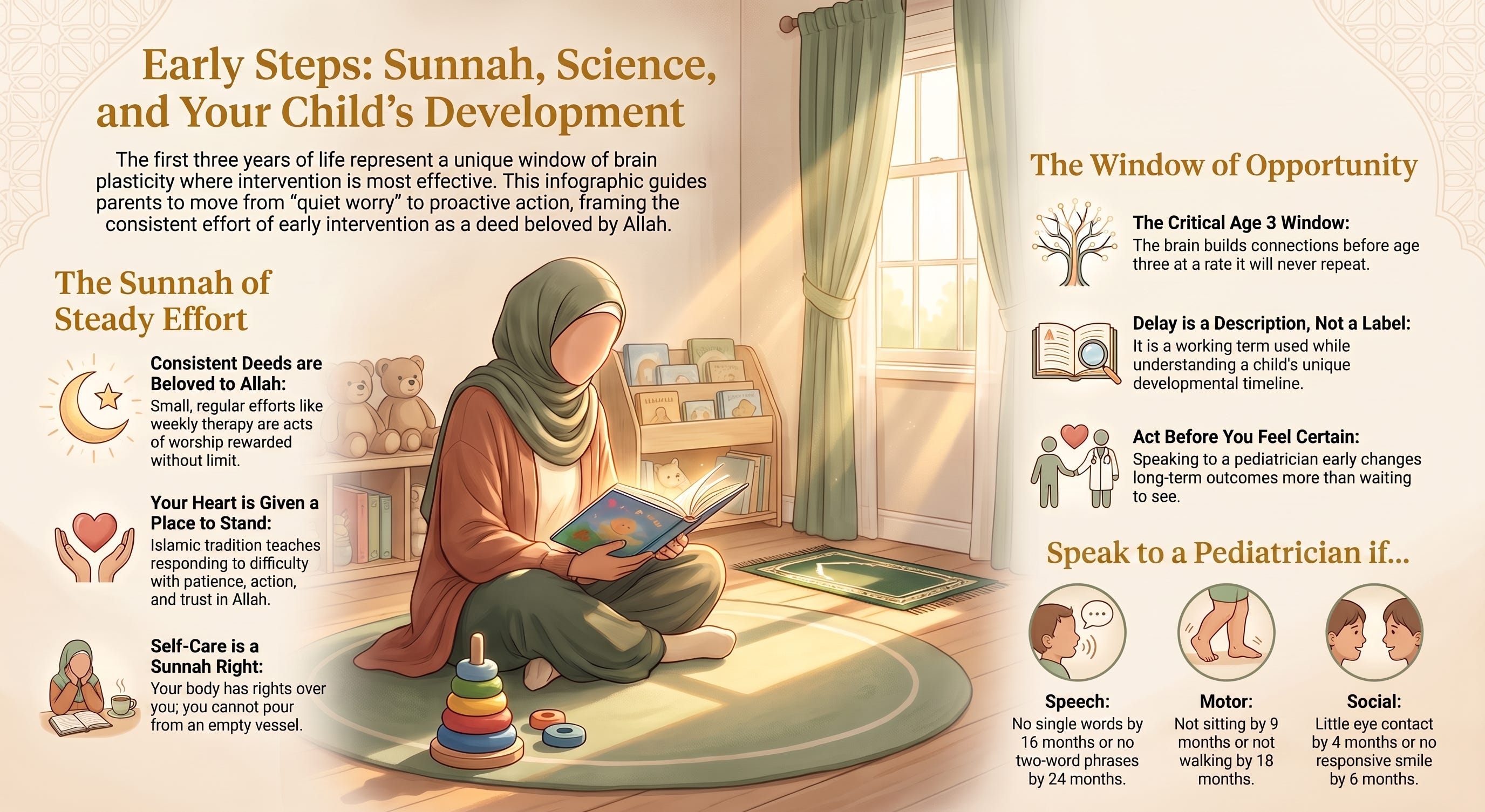
Here’s what I want you to know before we go any further: noticing is not the same as catastrophising. The parents who notice early — who trust that feeling and act on it — are the ones who open the right doors at the right time. And in child development, timing is everything.
Here’s why that matters:
When I studied the research from Pediatrics on developmental surveillance and screening, the finding that stopped me cold was this: the brain in early childhood is building connections at a rate it will never repeat. [3] The first three years are a window — not a deadline, but a window — when intervention does its most powerful work. Every month of early, targeted support translates into gains that become harder to achieve later. [3, 4]
So. If something doesn’t feel right — let’s talk about it.
Why This Guide Is Different From Generic Developmental Advice
Every sign and recommendation here is drawn from peer-reviewed paediatric research, including Pediatrics 2020 and the Nelson Textbook of Paediatrics — not parenting forums or opinion pieces. [1, 5]
This isn’t just a list of milestones. It’s a framework that combines what the science says with what Islamic tradition teaches about responding to difficulty with patience, action, and trust in Allah’s wisdom.
You’ll leave with a free downloadable Early Steps Family Guide — a printable three-page resource with a milestone reference card, a professional team guide, and an Islamic support card you can keep on your fridge.
What Does “Developmental Delay” Actually Mean?
Let me clear something up first, because the phrase carries weight it doesn’t always deserve.
“Developmental delay” is a descriptive term. It means a child is taking longer than expected to develop skills across one or more areas — movement, communication, social connection, thinking, or self-care. [1] It’s not a label for life. It’s not a verdict.
Doctors use it while they’re still in the process of understanding what’s happening. If a specific cause is identified — a genetic condition, a hearing issue, a chromosomal difference — they’ll use more precise language. But while they’re still looking, “developmental delay” is the working description. [1]
And here’s something I want you to hold on to: even without a cause identified, support can begin. Progress can happen. The cause doesn’t have to be found before help can start.
What to Watch For
Development follows a sequence in most children — sitting before standing, babbling before talking — but the timing varies widely. One child walking at 10 months and another at 18 months are both within normal range. [1] What raises clinical concern is when a child is significantly behind across multiple areas, over several months.
Motor Development
Not sitting by 9 months, not standing with support by 12 months, not walking by 18 months, or significant asymmetry in how both sides of the body are used.
Speech and Language
No babbling by 12 months. No single words by 16 months. No two-word combinations by 24 months. — or — loss of language skills a child already had. That last one is always urgent.
Social and Emotional
Little eye contact by 3–4 months. No responsive smile by 6 months. Limited interest in people by 12 months. Difficulty with emotional regulation that seems far more intense than peers.
Cognitive Development
Not exploring objects by 6 months. No pointing or gesturing by 12 months. Difficulty with simple problem-solving compared to same-age peers.
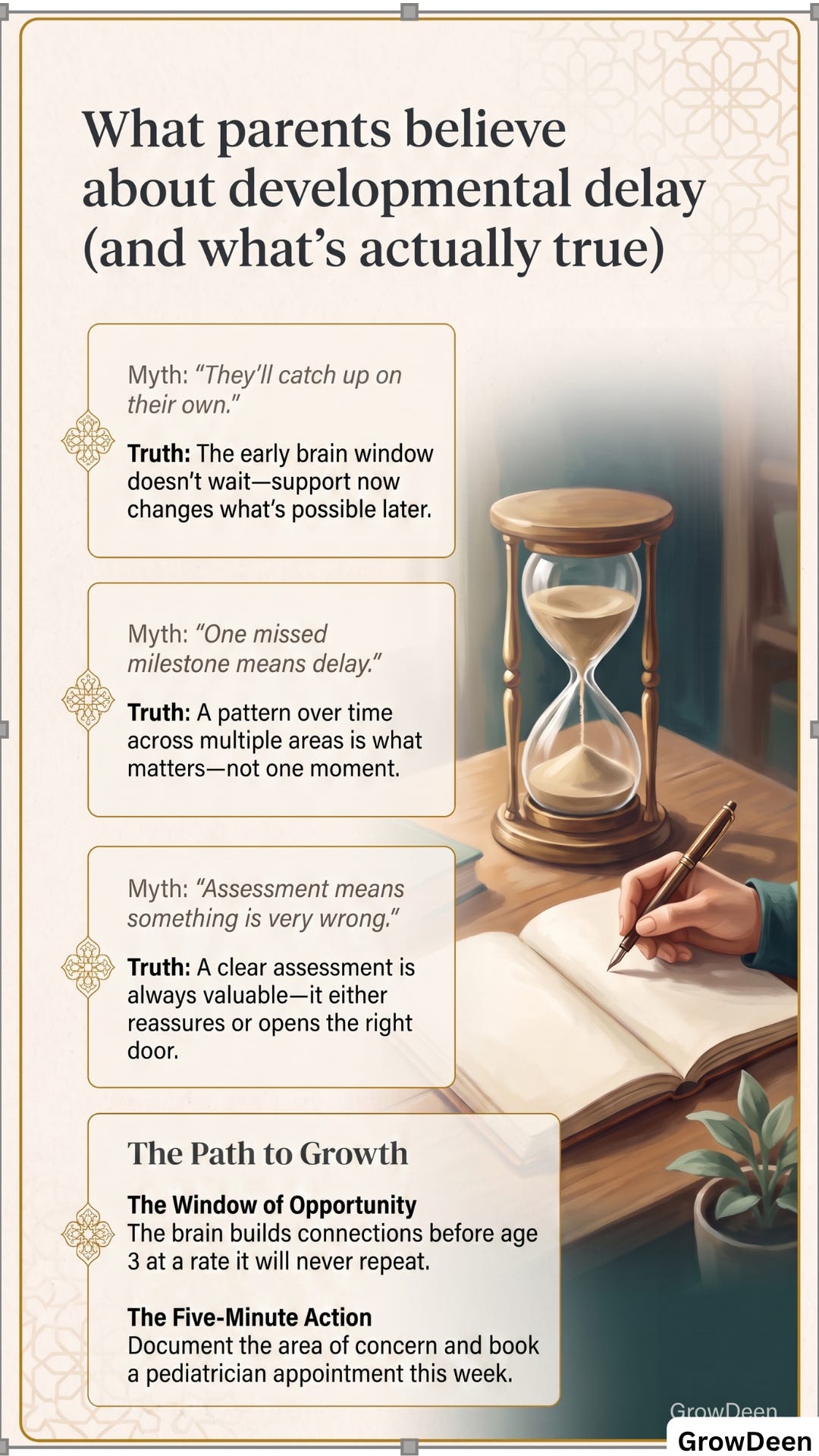
One missed milestone is rarely cause for alarm. A pattern, over time, across multiple areas — that’s what a paediatrician needs to know.
The One Thing That Changes Outcomes
I know what some of you are thinking: But maybe they’ll catch up on their own.
Some children do. And if a thorough assessment comes back clear, that’s wonderful news and the appointment was worth every minute.
But here’s the thing about waiting to see: the brain’s most adaptable window doesn’t wait with you. Research consistently shows that the earlier structured support begins, the greater the gains — especially in language and social development. [3, 4]
The action that changes outcomes is simple, but it requires acting before you feel fully certain.
Speak to a paediatrician. Now. Not next month.
They’ll conduct a developmental assessment, make referrals where needed, and help you understand what you’re looking at. Whether that turns out to be nothing significant or the start of a support journey, you’ll know you acted at the right time.
Who Will Help You
Depending on what the assessment finds, your child may be supported by some or all of these professionals: [1]
A paediatrician coordinates the process. An audiologist checks hearing — undetected hearing loss is one of the most common and most treatable causes of apparent language delay. A speech therapist works on communication. An occupational therapist addresses fine motor skills and sensory needs. A physiotherapist supports movement. A psychologist supports cognitive assessment and — importantly — the family’s wellbeing through the process.
Early intervention specifically targets these areas during the window when the brain’s plasticity is highest. It’s not just therapy. It’s brain-shaping, done at exactly the right moment. [3]
There’s a lot here to hold — and more details behind each of these professionals and their roles than I can do justice to in one article. That’s why I put together a free downloadable resource specifically for families who’ve just started this road. Keep reading — it’s waiting for you at the end.
The Islamic Frame: Qadr, the Steadied Heart, and the Deed That Keeps Coming
When I reflect on Qur’an 64:11 — “No disaster strikes except by permission of Allah. And whoever believes in Allah — He will guide his heart” [6] — I think about what it actually means to have your heart guided in the middle of something unexpected.
According to Tafsir Ibn Kathir, Ibn Abbas explained this verse as the promise of divine guidance to certainty and steadiness for the person who receives a calamity knowing it came from Allah’s decree and stays patient, awaiting His reward. That’s not toxic positivity. It’s a completely different thing. It’s the heart being given a place to stand when the floor moves.
And the Prophet ﷺ said something that lands differently when you’re deep in a long, steady effort: “Do good deeds within your capacity — Allah does not tire of giving rewards until you tire; and the most beloved deed to Allah is the one done regularly.” [7]
Here’s what this means in practice:
Early intervention is the definition of regular, within-capacity effort. Showing up to therapy every week. Practising the exercises on Tuesday evening when you’re tired. Making the call to the school. None of it is dramatic. All of it counts — and all of it is loved by Allah and rewarded without limit.
What’s beautiful is that Islamic wisdom and developmental science agree: the most powerful thing is not the heroic single effort. It’s the quiet, steady, consistent showing up. May Allah give us that.
Caring for Yourself on This Road
This is not optional advice.
Islam is clear: your body has rights over you. Your mental health matters. Your ability to care for your child over the long run depends on having something left in you to give.
If you are pouring everything into your child and leaving nothing for your salah, your rest, your relationships — you are building on sand. The parents who sustain this journey are the ones who take care of themselves too. Connect with other parents who understand. Accept help when it’s offered. And if the weight feels too heavy, speak to someone.
You cannot pour from an empty vessel. And your child needs you present for a long time.
The One Step to Take in the Next 5 Minutes
If you’ve had a concern about your child’s development — even a quiet one — write it down right now.
Milestone. Area. When you first noticed. How long it’s been.
That’s it. Three or four sentences. Then book the pediatrician appointment this week.
You don’t need all the answers before you make the call. You just need to make the call.
Your Free Early Steps Family Guide
If you’ve read this far, you’re the kind of parent who takes their child’s wellbeing seriously — not because you’re anxious, but because you’re attentive. That already says a great deal about you.
I created something specifically for families at the beginning of this road:
Inside the Early Steps Family Guide (one comprehensive PDF, 3 pages):
Page 1: Developmental Milestones at a Glance — a clean, domain-by-domain reference card covering motor, speech, social, and cognitive milestones from birth to age 4, with clear “speak to a paediatrician if...” markers — designed as a laminated card to keep on your fridge or in your nappy bag, so you have reliable information at hand when questions arise.
Page 2: Your Child’s Professional Support Team — a concise guide to each specialist in the early intervention team (what they do, what to expect at a first appointment, what questions to ask) — so you walk into every referral prepared and confident, not lost.
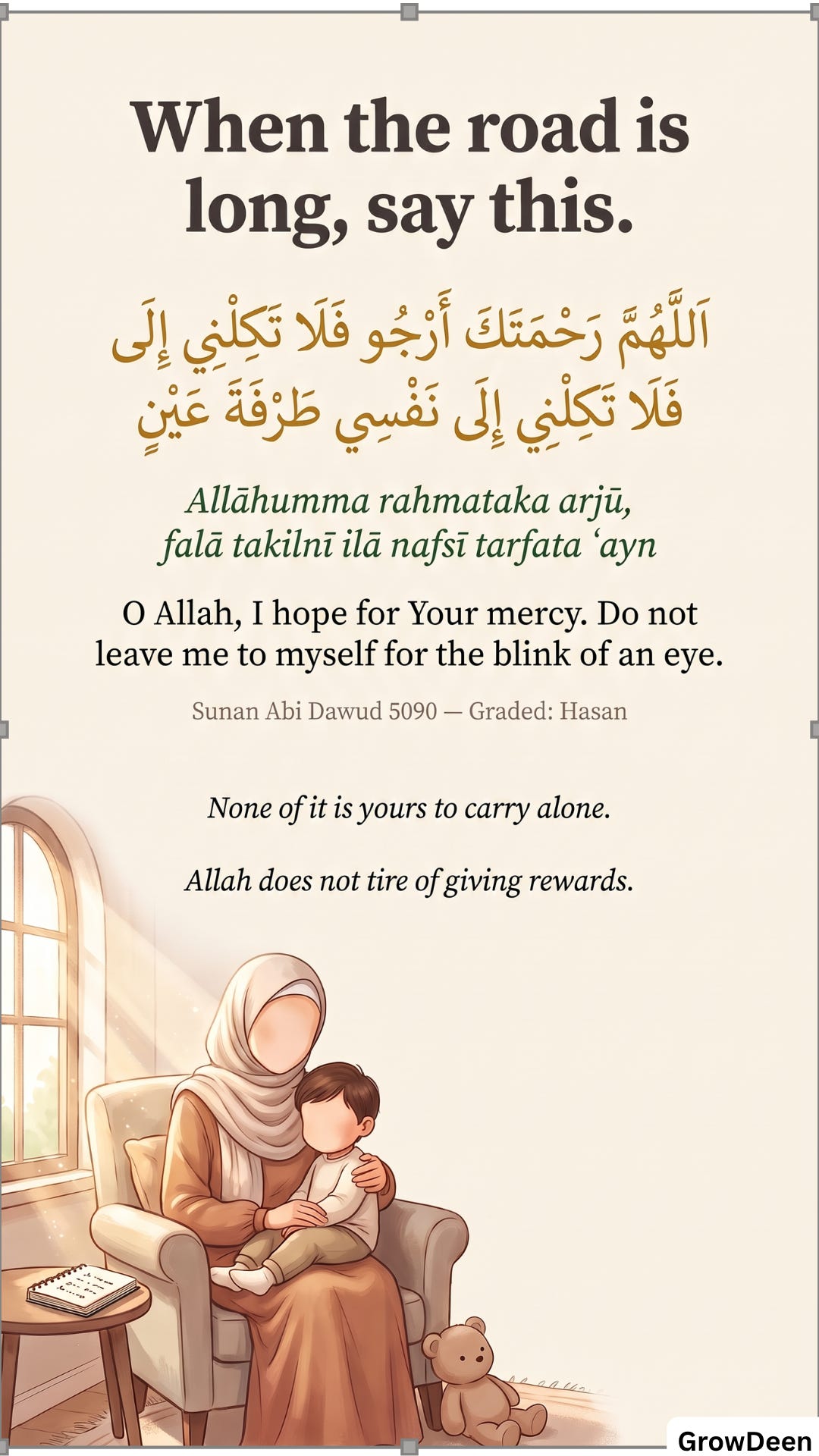
Page 3: Steadying the Heart — An Islamic Tarbiyah Card for Difficult Seasons — featuring the du’a “Allāhumma rahmataka arjū, falā takilnī ilā nafsī tarfata ‘ayn” (O Allah, I hope for Your mercy; do not leave me to myself for the blink of an eye) from Sunan Abi Dawud 1510, graded Hasan — with full Arabic, transliteration, translation, and a brief reflection on what it means to seek Allah’s sustained presence when the parenting road is long and uncertain.
This isn’t a PDF to download and forget. It’s a tool designed to stay with you — in the places where the questions actually arise, and in the quiet moments when you need to be reminded that you are not alone and your effort is not unseen.
This Early Steps Family Guide is what every subscriber receives with each article. At Muslim Parenting Lab by GrowDeen Education, we cover the full journey of raising Muslim children — from newborns through school age — combining peer-reviewed research with Islamic wisdom from the Qur’an and Sunnah.
If you’re a Muslim parent who wants guidance that is both evidence-based and Islamically grounded, subscribe for free so future resources reach you before you need them.
Subscribe free — Sunnah-rooted, science-backed parenting guidance you genuinely can’t find anywhere else. No spam. No clutter. Just resources that matter.
Think of One Person Right Now
Think of one person right now: a sister whose child is a little behind and who keeps saying “I’m sure it’s nothing” while you can see the worry behind her eyes. A friend who mentioned at the masjid that their toddler’s speech is delayed but they don’t know where to start. A cousin who has been watching and waiting for six months and hasn’t yet made the call.
This article could open the door for their child. Share it with them today — not because you’re diagnosing anything, but because you care. Sometimes the most loving thing we can do is put the right information in someone’s hands at the right moment.
Frequently Asked Questions
Q: What is the difference between a developmental delay and autism?
A: Developmental delay describes a child who is slower to reach milestones across one or more areas — it’s a descriptive term, not a specific diagnosis. Autism is a specific neurodevelopmental condition with its own diagnostic criteria, including differences in social communication and the presence of repetitive behaviours or restricted interests. [1] A child can have developmental delay without autism, and vice versa — though some children with autism are also identified through developmental delay screening. A paediatrician or developmental specialist can clarify the distinction after a proper assessment.
Q: My child missed a milestone but seems to be catching up. Do I still need to see a doctor?
A: Yes — it’s still worth mentioning to your paediatrician. A child catching up is often reassuring, but a professional assessment will give you a clearer picture of whether the gap is fully closed and whether any targeted support would help consolidate the gains. One appointment doesn’t mean you’re committing to anything; it means you’re informed.
Q: At what age should I be concerned if my child isn’t talking?
A: Most children have single words by 16 months and two-word combinations by 24 months. [1] If your child has no words by 16 months, no two-word phrases by 24 months, or loses language they previously had at any age — speak to a paediatrician promptly. For the full breakdown of speech milestones by age, see the “What to Watch For” section above.
Q: What does early intervention actually involve — what happens in therapy?
A: It depends on the area of concern and which professionals are involved. Speech therapy typically involves communication games, parent coaching on how to support language at home, and specific exercises to develop verbal skills. Occupational therapy might work on how a child grasps objects, tolerates sensory input, or manages self-care tasks. Physiotherapy addresses movement, strength, and coordination. [1] Most early intervention also involves significant work with parents — you become the most important person in the process, because you’re with your child every day.
Q: Can a child with global developmental delay live a normal life?
A: Many can and do — particularly with early support that builds on the brain’s natural plasticity during the first years of life. [3, 4] Outcomes vary widely depending on the underlying cause, the extent of delay, and the timing and quality of support received. Some children who receive robust early intervention require little or no additional support by school age; others continue to need support throughout their lives but go on to build meaningful, connected, purposeful lives. The research is clear that earlier support improves outcomes significantly — which is exactly why acting early matters.
Q: Is developmental delay hereditary?
A: It depends on the cause. Some causes — including certain genetic conditions like Down syndrome or Fragile X syndrome — have a hereditary component. [4] Many other causes, including prematurity, infections during pregnancy, or unknown factors, are not hereditary. A paediatrician or geneticist can discuss your specific situation if family history is a concern.
References
[1] Raising Children Network. (2024). Developmental delay. https://raisingchildren.net.au/guides/a-z-health-reference/developmental-delay
[2] Bélanger, S.A., & Caron, J. (2018). Evaluation of the child with global developmental delay and intellectual disability. Paediatrics and Child Health, 23(6), 403–410. https://doi.org/10.1093/pch/pxy093
[3] Lipkin, P.H., & Macias, M. (2020). Promoting optimal development: Identifying infants and young children with developmental disorders through developmental surveillance and screening. Pediatrics, 145(1), Article e20193449. https://doi.org/10.1542/peds.2019-3449
[4] Wojcik, M.H., Stewart, J.E., Waisbren, S.E., & Litt, J.S. (2020). Developmental support for infants with genetic disorders. Pediatrics, 145(5), Article e20190629. https://doi.org/10.1542/peds.2019-0629
[5] Glascoe, F.P., Marks, K.P., & Bauer, N. (2024). Developmental behavioral surveillance and screening. In R. Kliegman & J. St Geme (Eds), Nelson Textbook of Paediatrics (22nd edn, Chapter 28). Elsevier.
[6] Qur’an, Surah At-Taghabun, 64:11 — https://quran.com/64/11
[7] Sahih al-Bukhari 43. Book of Belief (Iman). Narrated by Aisha (may Allah be pleased with her). Graded: Sahih — https://sunnah.com/bukhari:43
[8] Sunan Abi Dawud 1510. Book of Prayer (Witr). Graded: Hasan — https://sunnah.com/abudawud:1510