

Two complete years is the Qur'anic term for nursing, and Ibn Kathir holds that weaning before that carries no sin where both parents agree it after consulting each other [12]. Globally, UNICEF finds only three in five children aged 12 to 23 months still receiving breast-milk, and calls that too few [1]. So the mothers who do reach year two are weaning a child who can argue back, and almost nobody tells them the method is completely different.
Four nights in, she was still screaming.
You did it the gentle way. You read about it first. You dropped one feed rather than all of them, and you held her instead of feeding her. On night four she was still at your knees at eleven o’clock, and you were sitting on the bathroom floor wondering what you had done wrong.
The reassuring answer is probably nothing about your intentions. Your daughter is not difficult and you are not doing it badly. But something in the mechanics went sideways, and it is almost always one of a small number of things.
So carry this question through the rest of the article. Two mothers can follow what looks like the identical plan, and one of them finishes in a quiet fortnight while the other is in tears by night three. Same age of child. Same number of feeds dropped. Same gentleness of intention.
The difference is not luck, and it is not temperament. It comes down to three specific decisions, and most weaning advice mentions none of them.
What Makes This Guide Different
Built on current clinical sources. The pacing, the mastitis warnings and the dental guidance come from the 2022 AAP breastfeeding policy, the Academy of Breastfeeding Medicine’s 2022 mastitis protocol, and the AAPD’s early childhood caries policy [2][3][4].
Islamically grounded, not Islamically decorated. The argument for going gradually is not borrowed from parenting blogs; it is a principle Aisha (may Allah be pleased with her) stated outright about how the Qur’an itself was revealed [5].
Comes with the Weaning a Toddler Toolkit. A free three page PDF with a map for sequencing your own child’s feeds and the exact sentences to say when she asks, so none of this has to live in your head.
Two Years, and No Deadline After That
One thing to settle before anything else: the timing. The Qur’an sets two complete years as the full nursing term for parents who wish to complete it. Commenting on that verse, Ibn Kathir holds that where both parents agree on weaning before the two years end, after genuine consultation and for a benefit they have discussed, there is no sin in it, and he adds on the authority of Ath-Thawri that neither parent may take that decision alone [12]. Continuing past two years remains permitted, though two years is regarded as sufficient [13]. Medicine sits alongside all of that rather than against it. Everything that follows assumes one thing: that you and your husband have already talked it through and decided together that the time has come.
You Are Not Taking Away a Feed
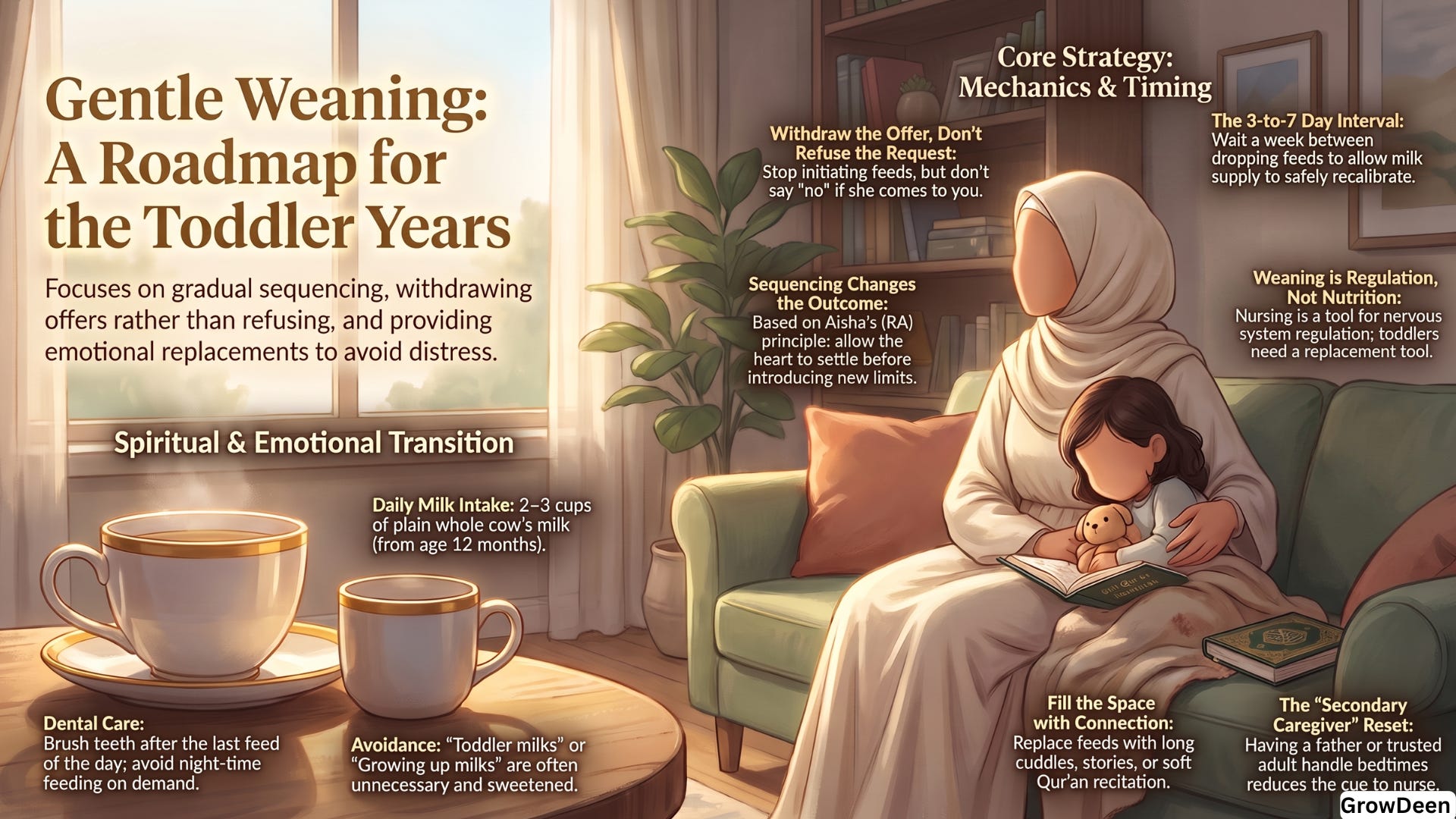
This is where the argument starts, because everything else follows from it.
By the second year, breastmilk has already handed the nutritional job to solid food. It still contributes: preliminary data reviewed by the American Academy of Pediatrics show human milk continuing to supply macronutrients and immune factors into the second year, which is part of why the Academy revised its policy in 2022 to support breastfeeding to two years and beyond [2][6]. The World Health Organization has said the same for longer [7].
But nutrition is not why your toddler crossed the room at three in the afternoon.
Think about when she actually asks. After she falls off the step in the garden. Halfway through a tantrum that has already run out of fuel. In the fifteen minutes after you walk in the door from somewhere loud.
She is not eating. She is regulating.
That is the whole thing. A nursing session is the fastest and most reliable tool your daughter owns for bringing an overloaded nervous system back down to baseline. Take the tool away in a single week and she does not have a replacement yet. What you are seeing on night four is a child holding an empty toolbox.
That is the first of the three decisions.
The First Decision: Did You Withdraw the Offer, or Refuse the Request?
Most parents hear “stop breastfeeding” and translate it into “say no when she asks.” Those are not the same action, and the gap between them explains a startling amount.
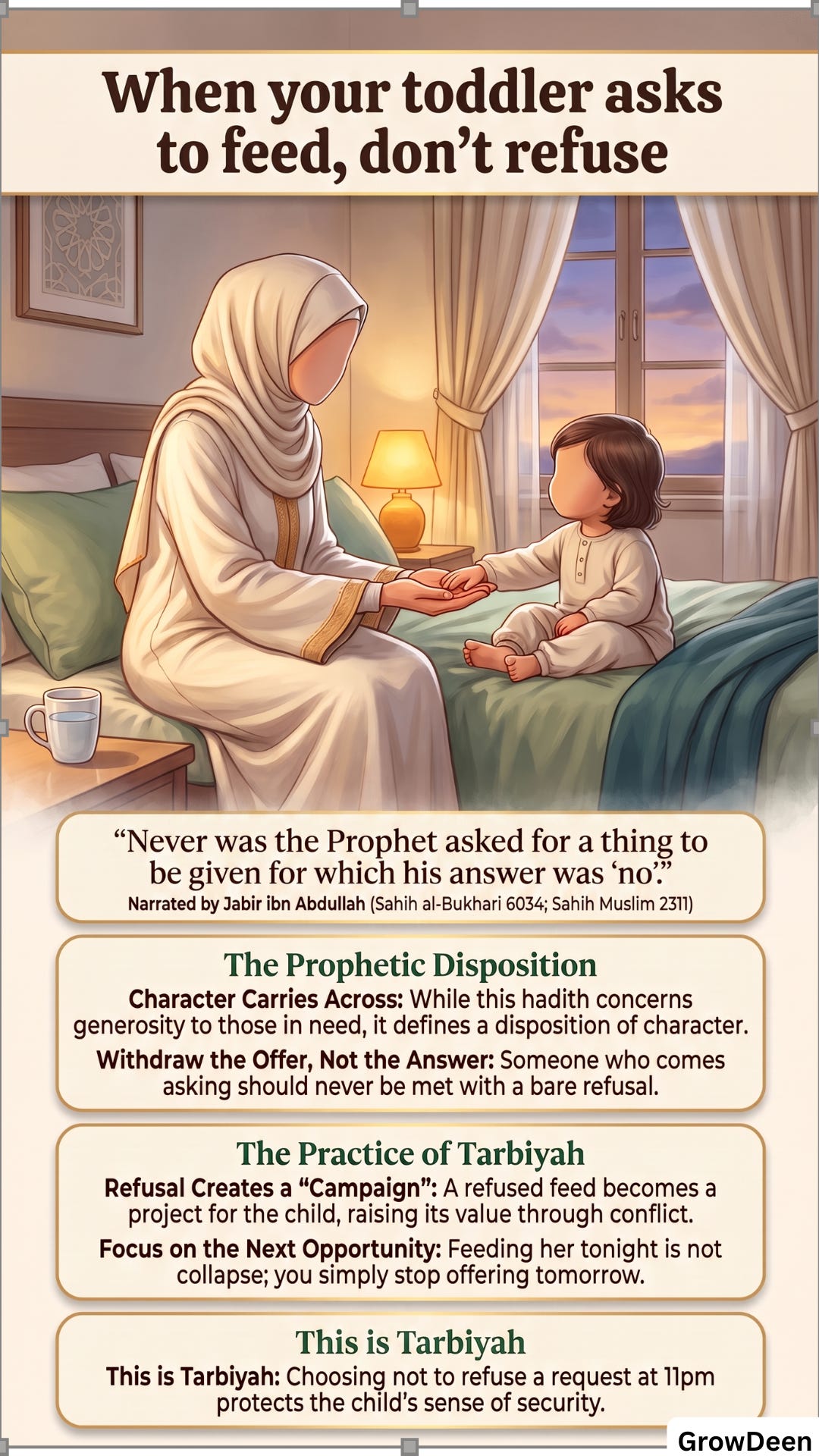
You stop offering. You do not turn her down when she comes.
Watch what happens in each case. A refused feed instantly becomes something she has to campaign for, and the campaign raises its value in her mind. She now has a project. An unoffered feed just quietly falls out of the shape of the day, and no confrontation ever occurs, because there was never a moment for one. Plenty of toddlers forget two or three feeds this way inside a fortnight and never raise them again.
So the sequencing matters:
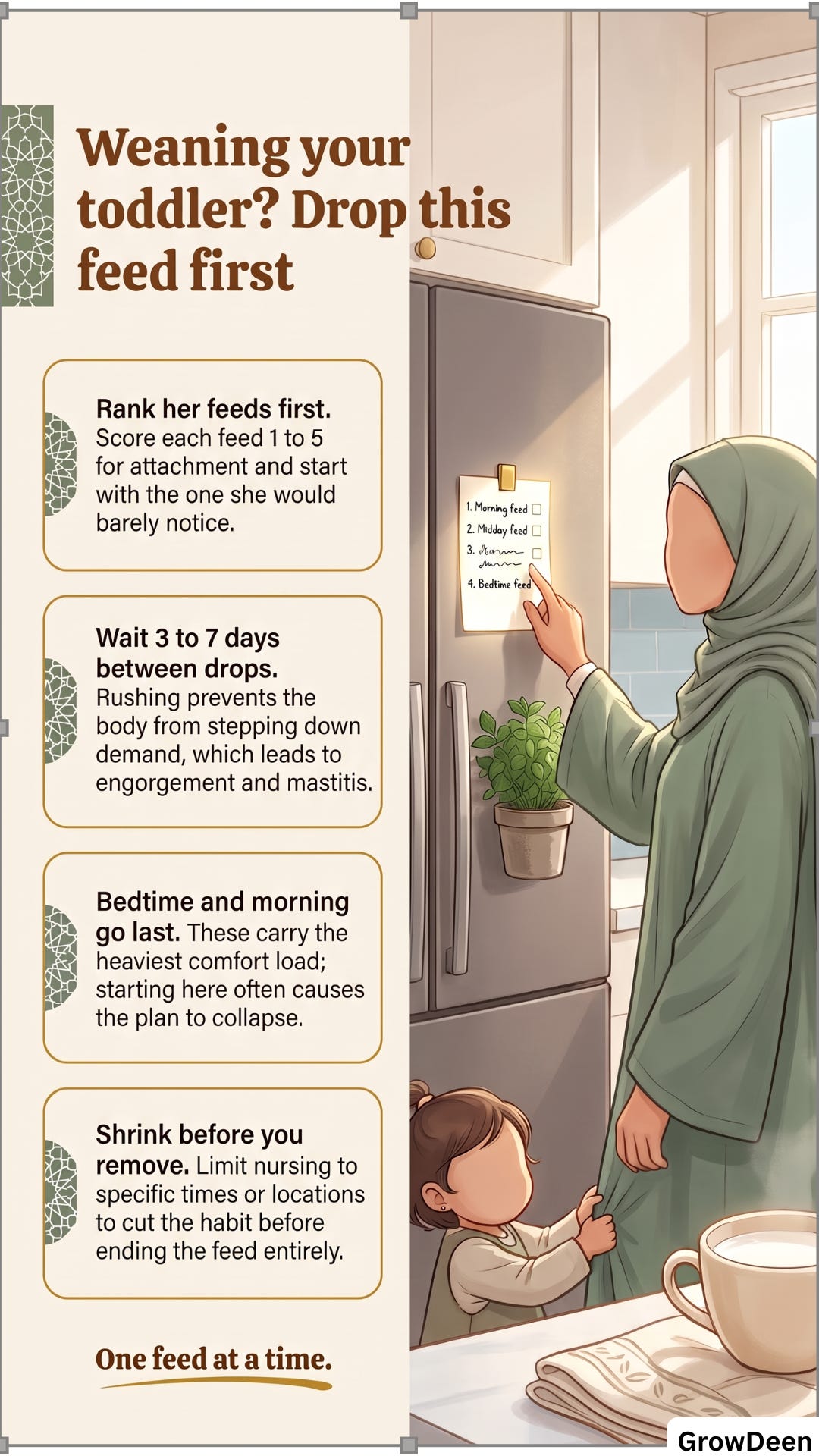
Start with the feed she cares least about. Usually mid morning or mid afternoon, sitting in a stretch of the day she barely tracks.
Leave three to seven days before the next one goes. Your supply needs to step down in line with demand, and that interval is what protects you from the engorgement that opens the door to blocked ducts and mastitis [3].
Keep bedtime and early morning for last. They carry the heaviest comfort load and are the hardest to replace. Beginning with them is how a plan collapses.
Shrink before you remove. Feeding only at home, or only after the midday meal, cuts the habit down without ending it. If a removal feels premature, use a limit instead and buy yourself time.
Let her lead where she will. Some toddlers simply lose interest once the offers stop appearing. If that happens, take it gratefully and stop managing.
Now, the second decision is the one nobody warns you about, and it has nothing to do with technique.
The Second Decision: What Else Was Happening That Month?
Look at the rest of your child’s life before you drop anything at all.
Weaning is a loss, however kindly you do it. A child who is simultaneously learning to use the toilet, absorbing a new baby, starting childcare, or adjusting to a different house has already spent most of her emotional budget elsewhere. Adding one more loss on top is the most dependable way to convert a manageable transition into weeks of clinginess and broken nights.
Wait for a plain stretch. Nothing new starting, no travel booked. The duller the month, the better this goes, and there is no prize for doing it during a hard season.
There is a third decision, and it is the one that carries the Islamic weight of this whole subject. Before that, something that will make the practical side much easier to hold onto.
Something to Keep on the Fridge
This is a lot to remember at nine at night when you are already running on interrupted sleep, and none of it works if it stays in an article you read once.
That is exactly why the free Weaning a Toddler Toolkit exists: a printable three page guide with a map for sequencing your own child’s feeds, the actual sentences to say to her, and a reflection page for the hard weeks. Keep reading and you can download it at the end. It is built to live on your fridge, where you will actually reach for it.
Give Her the Words Before You Take the Feed
Children take in far more than they can say back.
So weeks before the first feed disappears, start naming what is coming. None of this needs a sit down conversation. A sentence dropped into an ordinary moment does the work: “When you’re a bit bigger, you’ll have milk in a cup, like your brother.” Later, closer to the change: “We feed when the sun is up. When the sun goes to sleep, we have cuddles.”
Say it calmly. Repeat it without ceremony. You are giving her time to absorb an idea instead of handing her a fact she must accept on the spot.
And whatever you tell her, follow through on. A child who learns that her mother’s words hold will believe the next thing her mother says, and that credit is worth a great deal in the fortnight ahead.
And there is something in the Islamic tradition that explains the mechanism better than any parenting research does.
What the Prophet ﷺ Showed Us About Never Turning Away the One Who Asks
You already know the feeling of the moment she asks. Your instinct is to hold the line, because giving in feels like going backwards. But what if holding the line is the thing making this harder?
Jabir ibn Abdullah (may Allah be pleased with him) reported that the Prophet ﷺ was never asked for something and answered no [8]. Al-Bukhari places it among reports of good character and generosity, and its setting is giving to people in need rather than parenting, so the link works at the level of character rather than as a ruling. What the narration preserves is a disposition: someone who came asking was never met with a bare refusal.
That disposition is precisely what the method above protects. A mother who withdraws the offer has changed the shape of her day. A mother who refuses has turned her child away at the moment of asking, and a two year old cannot tell the difference between a refused feed and a refused mother.
The same principle explains why gradual works at all. Aisha (may Allah be pleased with her) described the ordering of revelation: the earliest surahs spoke of Paradise and the Fire, and the rulings on the lawful and unlawful came only once people had settled into Islam. Had the prohibition of intoxicants arrived first, she said, the answer would have been: “We will never leave alcoholic drinks” [5].
The instruction was correct either way. Sequencing changed the outcome.
Your daughter runs on the same wiring, scaled down.
Support Muslim Parenting Lab ❤️
Would you like the reward of every parent who acts on what they read here? Fund it with the button below and it is yours.
The Prophet ﷺ said whoever guides to good has a reward like the one who does it. (Sahih Muslim 1893a)
The Third Decision: What Did You Put in the Space?
A feed that vanishes with nothing in its place leaves a hole she will find, usually at bedtime, usually loudly. Fill it on purpose.
Hold her. A long cuddle, or sitting on your lap with a book and no requirement to talk about any of it. Much of the oxytocin she was getting from nursing is available from being held.
Send someone else at night. When she wakes asking to feed, her father or another trusted adult can settle her with a cuddle and a cup of water. Children ask less when the person who arrives is not the person who feeds.
Change how bedtime ends. If she has always fed to sleep, that link has to come apart before the feed can go. Move the feed earlier and into a different room, then take her to the bedroom for stories and the bedtime adhkar said quietly over her. Many families find that once soft Qur’an recitation becomes the fixed ending, the child starts asking for that instead.
Fill the day. A child who is out of the house or absorbed in something is not thinking about feeding. Build the newly free stretch of the afternoon around going somewhere.
Adjust the practical things. Dress out of her sight, and wear clothing that does not offer easy access. It sounds too small to matter. It measurably cuts how often the idea occurs to her.
For the morning feed specifically, be up and dressed before she wakes, then take her straight to breakfast. A large share of that feed is triggered by finding you horizontal beside her. For bedtime, break the pattern rather than fighting inside it: a night or two at her grandparents’ house can reset the entire sequence, and so can handing bedtime to her father for a week.
The Teeth Conversation Nobody Includes
This belongs in any honest discussion of dropping night feeds, and gentle weaning advice almost always leaves it out.
Once the first teeth are through and other carbohydrates are in the diet, unrestricted feeding through the night carries a real dental cost. The AAPD’s policy on early childhood caries advises against on demand nocturnal breast and bottle feeding once the first primary tooth erupts, and specifically recommends cleaning the teeth of a child who has fallen asleep feeding before putting them down [4].
Read that as a reason for two habits rather than a reason to rush. Brush at bedtime after the last feed of the day. Clean her teeth if she has fallen asleep at the breast. Where both are in place, the picture changes considerably.
If night feeds are still running past eighteen months, mention it at her next dental check so the risk gets assessed rather than guessed at.
What Goes in the Cup
From twelve months, plain pasteurised whole cow’s milk from a cup, along with water, covers what a healthy toddler needs. The AAP puts it at roughly two to three cups of whole milk daily until she turns two, alongside a varied diet [9].
Toddler milks and growing up milks are not part of that picture. The AAP’s clinical report on these products found no benefit over ordinary cow’s milk for most children past twelve months, and noted that many carry added sugars [10]. If cow’s milk is out because of allergy or lactose intolerance, that is a conversation with your doctor or a dietitian rather than a decision made in a supermarket aisle.
Worth pausing on as she learns to hold that cup: Allah draws attention to milk in Surah An-Nahl, describing what comes from cattle as “pure milk, palatable to drinkers” [11]. According to Tafsir Ibn Kathir, the milk emerges free of blood and pure in its whiteness, taste and sweetness, separated cleanly from everything around it in the animal’s body, and it goes down without causing anyone to choke [11]. She is moving from one milk Allah provided to another He named as a sign worth noticing. Teaching her to say Bismillah over it turns a logistical change into the start of a lifelong habit.
Your Half of This
Weaning happens to two people, and the mother’s half gets a fraction of the attention it deserves.
Your breasts need time to recalibrate. Fullness and a few tender or lumpy patches in the days after a dropped feed are expected. Express only enough to take the pressure off, never enough to empty, because full drainage reads as demand.
Speak to a doctor promptly about any of these, since they can signal mastitis, which treats well but should not be left [3]:
Fever or flu like symptoms
Redness in the breast that is spreading
A painful lump that has not settled within a day
Pain that is getting worse rather than easing
If mastitis is already there, resolve it before you carry on weaning [3].
Expect a mood dip as well. Prolactin and oxytocin fall as feeding reduces, and a wave of sadness after a final feed is common even among mothers who picked the moment and felt entirely ready [3]. A slower wean flattens that curve, which is one more argument against rushing. If low mood or anxiety settles in rather than passing through, take it to a doctor instead of carrying it quietly. Your cycle may also return quickly, so if breastfeeding has been doing contraceptive work, ask about what replaces it.
Nothing here replaces the judgement of a doctor who knows your child. Where their advice differs, follow theirs.
Your Weaning a Toddler Toolkit
If you have read this far, you are the kind of mother who wants to do this properly rather than quickly. That says something worth knowing about you.
Inside the Weaning a Toddler Toolkit (one comprehensive PDF, 3 pages):
Page 1: Your Feed Retirement Map: a fill in worksheet where you list your child’s actual daily feeds, rank each one by how attached she is to it, and set the drop order with dates, so you are working from your own child’s pattern rather than a generic age chart. Designed as a fridge sheet you update as you go.
Page 2: What to Say and What to Do Instead: the exact sentences for the weeks before, the moment she asks, and the night she protests, paired with a specific replacement for every feed slot in the day. So you are never improvising a script at bedtime when you are already depleted.
Page 3: Two Reflections for the Hard Weeks: the narration of Jabir (may Allah be pleased with him) on the Prophet ﷺ never answering a request with no, and Aisha’s (may Allah be pleased with her) account of why revelation came in stages, each with its source, grading and a short reflection connecting it to what you are doing. English only, printed to be read at eleven at night when you are wondering whether to give in.
This isn’t just a PDF to download and forget. It’s a tool designed to stay on your fridge, where you’ll actually use it when you need it most.
The Weaning a Toddler Toolkit is what every subscriber receives with each article. Muslim Parenting Lab covers the full course of raising Muslim children, from newborn feeding through to school age behaviour, all backed by current research and rooted in Islamic wisdom.
One Thing to Do Tonight
Before bed, work out which single feed your daughter cares about least. Not the one you most want gone. The one she would barely notice. Write it on a scrap of paper and stick it to the fridge. That is your starting point, and you have now done the hardest part of the planning.
May Allah place barakah in your effort and make this transition gentler for both of you than it currently feels.
Share This With Someone Who Needs It
Think of one person right now: the sister at the masjid who mentioned she is still feeding her two year old and does not know how to stop, the friend whose voice notes at midnight all say the same tired thing, the cousin who weaned abruptly last year and ended up with mastitis and no idea why.
This could save them a fortnight of tears. Send it to them today, not as advice giving, but as care. Sometimes the most loving thing we can do is hand someone the piece nobody told us either.
Frequently Asked Questions
Q: How do I wean my 2 year old off breastfeeding?
A: Stop offering feeds, but never refuse her when she asks. Drop the feed she is least attached to first, leave three to seven days before the next one, and keep bedtime and morning until last. For the full sequencing, see “The First Decision” above.
Q: How long does it take to wean a toddler?
A: With one feed dropped every three to seven days, a toddler on four or five feeds a day usually takes four to six weeks. Going faster raises your risk of engorgement and mastitis, and gives her less time to build a replacement for the comfort [3].
Q: Is it bad to breastfeed a 2 year old?
A: No. Two complete years is the Qur’anic term, and beyond that it remains permitted, though two years is regarded as sufficient [13]. Ibn al-Qayyim held that a mother may extend nursing into the third year, and the AAP and WHO both support continuing as long as mother and child are willing, with no evidence that a third year harms a child [2][7][14].
Q: What can I give my toddler instead of breastmilk?
A: From twelve months, plain whole cow’s milk from a cup and water cover what she needs, at roughly two to three cups of milk a day until she turns two [9]. Toddler milks are unnecessary and often sweetened [10].
Q: How do I stop breastfeeding at night without crying?
A: Send someone else. When her father or another trusted adult settles her with a cuddle and a cup of water, most toddlers ask far less than they do when the person arriving is the one who feeds. Move the last feed earlier and into a different room so it stops being welded to sleep.
Q: Does night breastfeeding cause tooth decay?
A: It can, once teeth are through and other carbohydrates are in the diet. The AAPD advises against unrestricted night feeding after the first tooth erupts and recommends cleaning the teeth of a child who falls asleep feeding [4]. See “The Teeth Conversation Nobody Includes” above.
Q: Why do I feel so sad after weaning?
A: Prolactin and oxytocin drop as feeding reduces, and a wave of sadness is common even in mothers who chose the timing and felt ready [3]. A slower wean softens it. If it settles in rather than passing, speak to your doctor.
References
[1] UNICEF. (2025). Breastfeeding: Continued breastfeeding (12–23 months). UNICEF Data. https://data.unicef.org/topic/nutrition/breastfeeding/
[2] Meek, J.Y., & Noble, L. (2022). Policy Statement: Breastfeeding and the Use of Human Milk. Pediatrics, 150(1), e2022057988. American Academy of Pediatrics. https://doi.org/10.1542/peds.2022-057988
[3] Mitchell, K.B., Johnson, H.M., Rodríguez, J.M., Eglash, A., Scherzinger, C., Zakarija-Grkovic, I., Cash, K.W., Berens, P., & Miller, B. (2022). Academy of Breastfeeding Medicine Clinical Protocol #36: The Mastitis Spectrum, Revised 2022. Breastfeeding Medicine, 17(5), 360 to 376. https://doi.org/10.1089/bfm.2022.29207.kbm
[4] American Academy of Pediatric Dentistry. (2024). Policy on Early Childhood Caries: Classifications, Consequences, and Preventive Strategies. AAPD. https://www.aapd.org/research/oral-health-policies--recommendations/early-childhood-caries-classifications-consequences-and-preventive-strategies/
[5] Sahih al-Bukhari 4993, Book of the Virtues of the Qur’an. Narrated by Yusuf bin Mahk from Aisha (may Allah be pleased with her). Graded Sahih. https://sunnah.com/bukhari:4993
[6] Meek, J.Y., & Noble, L. (2022). Technical Report: Breastfeeding and the Use of Human Milk. Pediatrics, 150(1), e2022057989. American Academy of Pediatrics. https://doi.org/10.1542/peds.2022-057989
[7] World Health Organization. (2023). WHO Guideline for Complementary Feeding of Infants and Young Children 6 to 23 Months of Age. WHO. https://www.who.int/publications/i/item/9789240081864
[8] Sahih al-Bukhari 6034, Book of Good Manners (Al-Adab). Narrated by Jabir ibn Abdullah (may Allah be pleased with him). Also Sahih Muslim 2311. Muttafaqun Alayhi. Graded Sahih. https://sunnah.com/bukhari:6034
[9] American Academy of Pediatrics. (2023). Healthy Beverage Quick Reference Guide. AAP. https://downloads.aap.org/AAP/PDF/HealthyBeverageQuickReferenceGuideDownload.pdf
[10] Fuchs, G.J., et al. (2023). Older Infant to Young Child “Formulas”. Pediatrics, 152(5), e2023064050. American Academy of Pediatrics. https://doi.org/10.1542/peds.2023-064050
[11] Qur’an, Surah An-Nahl 16:66. Tafsir Ibn Kathir. https://quran.com/16:66/tafsirs/en-tafisr-ibn-kathir
[12] Qur’an, Surah Al-Baqarah 2:233. Tafsir Ibn Kathir. https://quran.com/al-baqarah/233/tafsirs
[13] Al-Munajjid, M.S. (1998). Is It Prohibited to Breastfeed after 2 Years in Islam? Islam Question & Answer, fatwa 721. https://islamqa.info/en/answers/721
[14] Al-Hajj, H. (2024). Is It Haram to Breastfeed after 2 Years in Islam? About Islam, Ask the Scholar. https://aboutislam.net/counseling/ask-the-scholar/women-issues/can-breastfeed-baby-2-years/
We combine scientific research with Qur’an and authentic Sunnah, and we cite our sources. Even so, this is general guidance and no substitute for a doctor who can examine your child.