

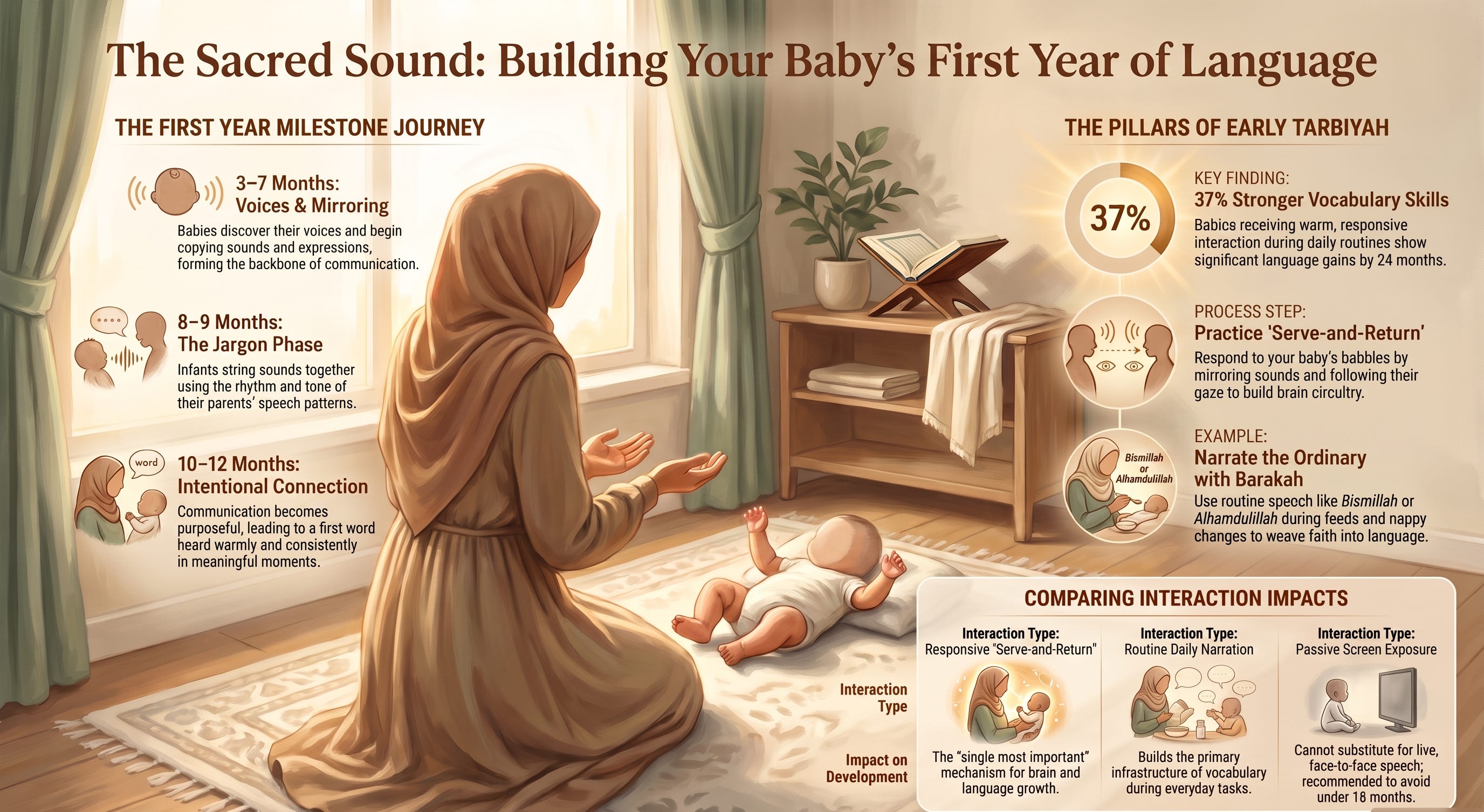
Babies who receive warm, responsive verbal interaction in their first year develop vocabulary skills nearly 37% stronger than those who don’t — and the window is earlier than most parents realise. [1]
Your baby isn’t waiting to understand words before they start building them. The listening started in the womb. The patterns are already forming. And what you say — and how you say it — right now, in this season, is laying down neural scaffolding that will support every word, every sentence, every du’a they ever speak.
Here’s what stopped me when I first read the research: by twelve months, a baby’s comprehension can be running months ahead of their speech. [2] They understand your “no.” They know their name. They recognise the tone that means something beautiful is about to happen. All of that — before a single intentional word comes out.
I know you’re probably exhausted, and I know “talk to your baby more” sounds like one more thing on an already impossible list. But this is different. Keep reading.
Why This Guide Is Different From Generic Baby Development Advice
Every milestone in this guide is backed by peer-reviewed research from developmental linguists and paediatric specialists — not parenting blogs or anecdotal advice.
This isn’t just science — it’s tarbiyah. We connect the research directly to the Islamic tradition of filling your home with words that matter, rooted in Qur’anic wisdom.
You’ll receive a free “Your Baby’s Listening Years Companion Pack” — a printable 3-page PDF with a month-by-month reference card, a daily talking prompt guide, and an Islamic First Words reflection card you can keep where feeds and nappy changes happen.
What’s Actually Happening Month by Month
Most parents think language starts when babbling starts. It doesn’t.
Here’s what the research shows. [2, 3]
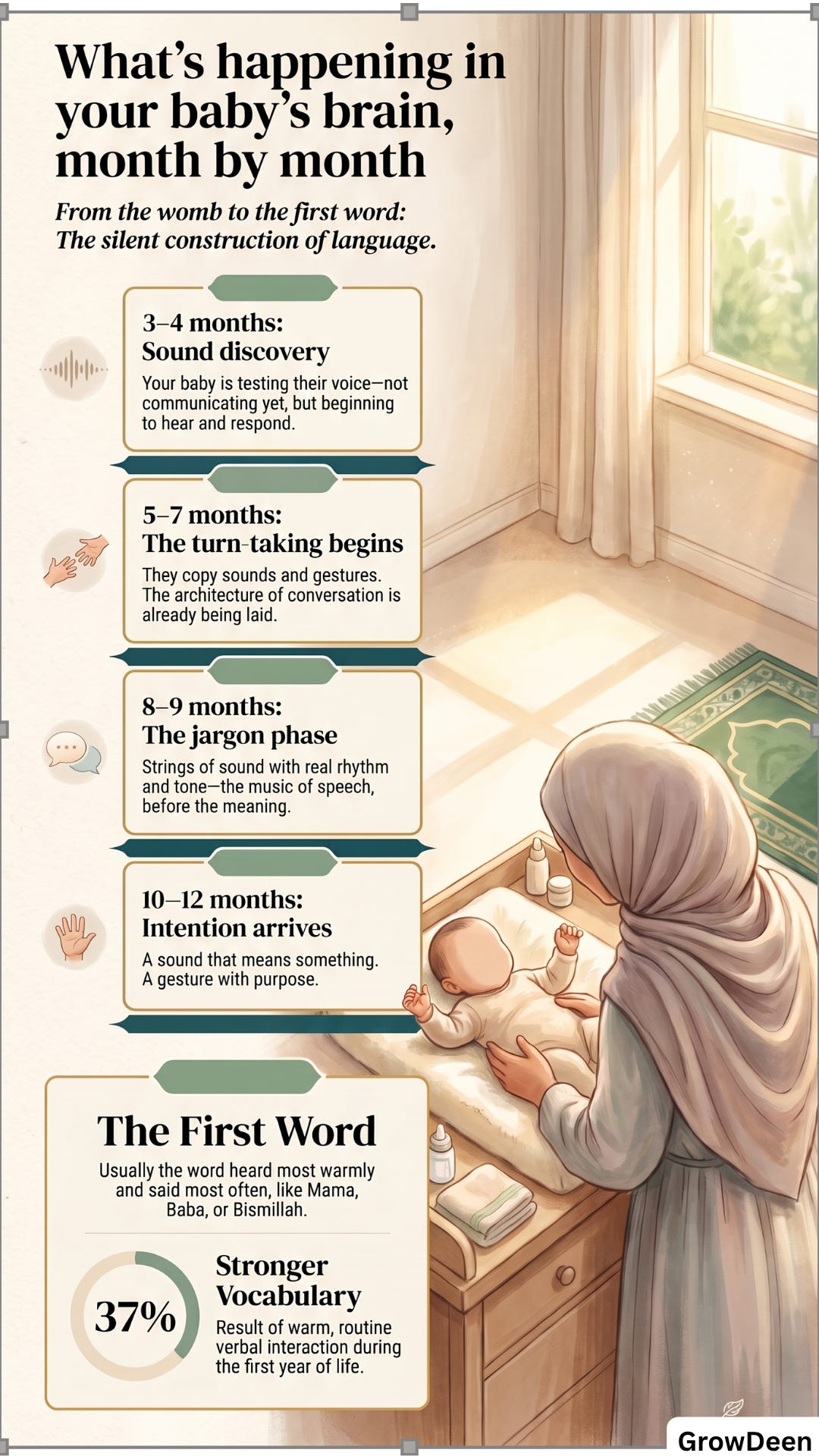
3–4 months: Your baby discovers their voice. Those “ah-goo” sounds, the “ga-ga-ga” chains — these aren’t random. They’re your baby testing what their mouth can do. Eye contact during this phase is not just sweet; it’s the architecture of conversation being laid.
5–7 months: Something remarkable happens. Your baby starts copying you. Not words — sounds, coughs, clicks, expressions. This is the beginning of turn-taking, the backbone of all human communication. [2] When you babble back, you’re not playing. You’re teaching.
8–9 months: Welcome to the jargon phase. Your baby strings together sounds with your tone, your rhythm, your pauses — with almost no real words yet. It sounds like a tiny person having an urgent conversation in a language only they know. That’s exactly what’s happening.
10–12 months: The shift. Communication becomes intentional. A sound that means “I want that.” A gesture that means “pick me up.” And then — first word. Usually somewhere between ten and fourteen months. Usually the word they’ve heard said warmly, consistently, in moments that mattered. [2]
Here’s the aha: the words your baby learns first are not the ones in baby books. They’re the ones that showed up in emotionally warm, repetitive, connected moments. Bismillah before every feed. Alhamdulillah after every nappy change. Baba and Mama whispered a thousand times.
Here’s something I want you to sit with before we go further.
A 2019 study published in Child Development found that babies whose caregivers directed warm, routine speech at them during everyday home activities — feeds, baths, getting dressed — showed vocabulary skills approximately 37% stronger by 24 months compared to those who received less language interaction. [1] Not enrichment classes. Not flashcards. Everyday moments, spoken out loud.
You’re already doing this. You just need to know that it’s working.
What Actually Supports Language in the First Year
There are three things the research agrees on, consistently. [1, 2, 4]
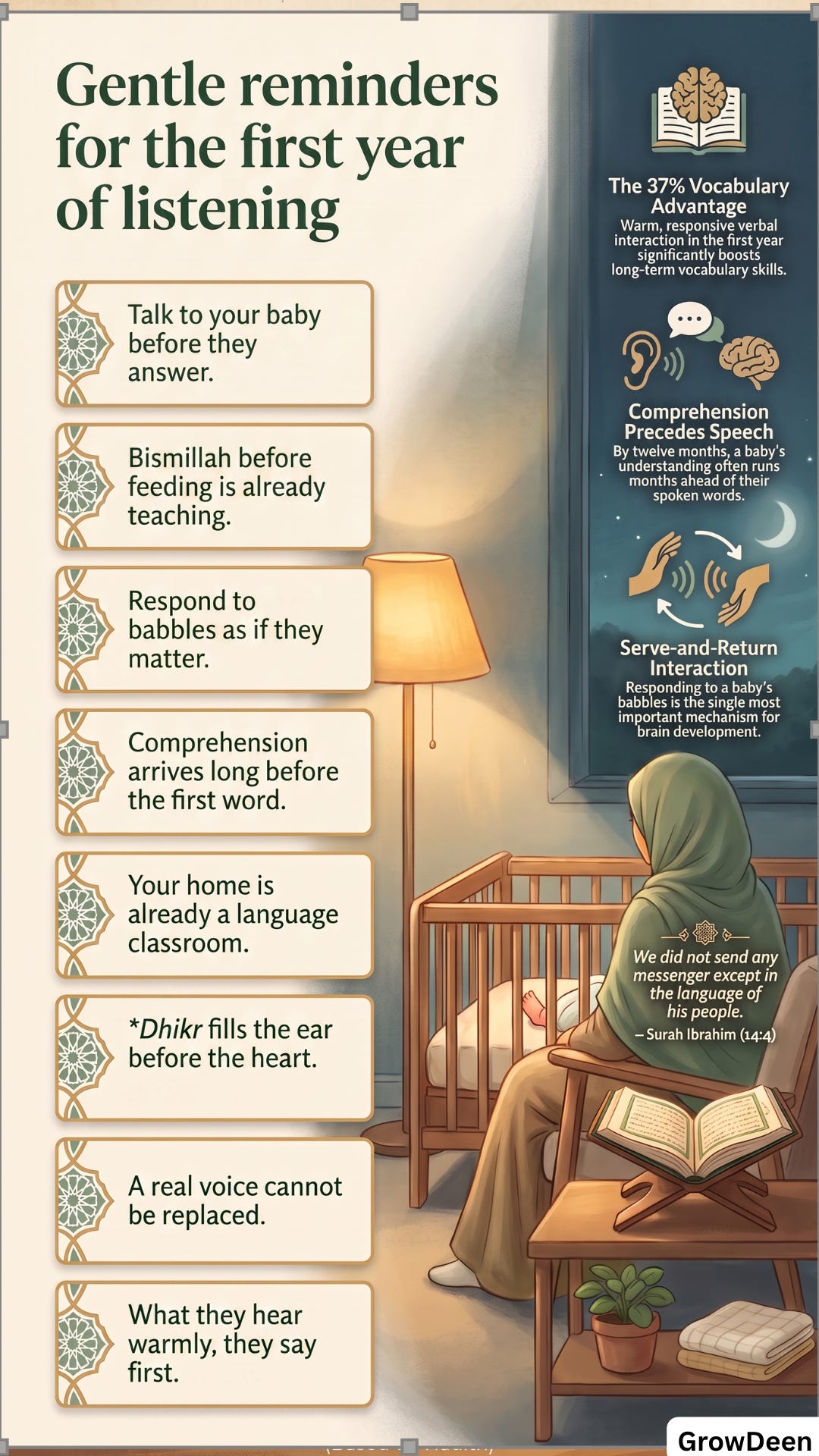
Responding matters more than teaching. When your baby babbles and you babble back — name what they pointed to, mirror the sound, follow their gaze — you create what Harvard’s Center on the Developing Child calls “serve-and-return” interaction. [4] It is, they say, the single most important mechanism for early brain and language development. Not expensive toys. This.
Routine speech is the real curriculum. The nappy change narration (”Now we’re lifting your little legs — SubhanAllah, look at those tiny toes”). The walking commentary on the way to the kitchen. These feel silly. They are not silly. They are building the very infrastructure of your child’s language. [1]
Screens cannot substitute. Live, responsive, face-to-face speech is what the developing brain needs. [6] A parent talking to their baby is irreplaceable in a way no content can match.
I know this is a lot to hold onto when you’re in the middle of feeds and sleepless nights. That’s exactly why I put it all into one printable resource.
The “Your Baby’s Listening Years Companion Pack” is a free 3-page PDF designed to stay near where you actually spend your time — the changing table, the feeding chair, the kitchen counter. Keep reading to find it at the end of this article.
What the Qur’an Teaches About Language as a Vehicle of Understanding
When I read Surah Ibrahim, one verse keeps pulling me back.
Allah ﷻ says: “We did not send any messenger except in the language of his people, that he might make clear to them.” [Qur’an 14:4] [7]
According to Tafsir Ibn Kathir, this verse is about Allah’s mercy in communication — He always sent guidance in a tongue the recipients could receive, because understanding flows through a language familiar to the listener.
I think about that when I’m feeding my baby at two in the morning, saying Bismillah quietly into the dark.
My baby doesn’t understand it yet. But they are receiving it. The rhythm. The warmth. The consistency. Ibn Kathir’s commentary makes clear that language is not incidental — it is the divinely chosen medium through which meaning reaches another heart.
This is tarbiyah. And it starts now. Long before anyone understands a word.
May Allah ﷻ make our words a source of light for our children and fill our homes with His remembrance.
Your Free Companion Pack
If you’ve read this far, you’re the kind of parent who doesn’t just want to do things right — you want to understand why they’re right. That already tells me something about the home you’re building.
Inside the Your Baby’s Listening Years Companion Pack (one comprehensive PDF, 3 pages):
Page 1: Baby Language Milestone Reference Card (3–12 Months) — a month-by-month visual guide showing what to listen for and what to try at each stage, from early cooing to first intentional words — designed as a laminated reference card you can keep near the changing table or feeding chair so you can check in without Googling.
Page 2: The Muslim Parent’s Daily Language Prompt Guide — 21 warm, specific talking prompts organised by daily routine (morning wake-up, feeds, nappy changes, bath time, prayer time, and bedtime), so you never run out of things to say and every ordinary moment becomes a language-building one.
Page 3: First Words of Barakah — An Islamic Reflection Card — the 7 Sunnah phrases to weave into your baby’s first year (Bismillah, Alhamdulillah, SubhanAllah, MashaAllah, Allahu Akbar, Assalamu Alaykum, and La ilaha illallah), each with Arabic text, transliteration, English meaning, when to use it, and why it matters — designed as a card parents can pin up in the nursery.
This isn’t a PDF to download and forget. It’s a tool built for the spaces where your baby’s language actually develops — the quiet, close, ordinary moments you’re already living.
Every subscriber receives a resource like this with each article. We cover the full journey of raising Muslim children — from the first year through school age — always backed by research and always rooted in wisdom.
If you’re a Muslim parent who wants both evidence-based guidance and Islamic perspective, subscribe free so future resources arrive in your inbox before you need them.
Subscribe free — Sunnah-rooted, science-backed parenting guidance you genuinely can’t find anywhere else. No spam, no clutter. Just what matters.
Your 5-Minute Action
Before you do anything else today: the next time you’re changing a nappy or doing a feed, narrate it. Out loud. Warmly. In your language. “Now we’re putting on your clean clothes. MashaAllah, look at your little feet.” Say it like you mean it. That’s it. That’s the whole practice. Start there.
Share This With Someone Who Needs It
Think of one person right now: the new mother in your masjid community who keeps saying her baby is “quiet” and she’s not sure if that’s normal, your sister whose WhatsApp messages show she’s spending her nights Googling baby milestones in a panic, a friend who’s just returned from the hospital with her first baby and is doing everything right but doesn’t know it yet.
This article could ease their mind — and give them the one thing that actually builds language. Share it with them today. Not as advice-giving. As company.
Frequently Asked Questions
Q: When should babies start babbling?
A: Most babies begin producing consonant-vowel chains (”ba-ba,” “ma-ma,” “ga-ga”) around 4 months, with more complex babbling by 6–7 months. [3] If your baby isn’t babbling at all by 9 months, it’s worth mentioning to your paediatrician — not to worry, but to act early if support is needed.
Q: Is it normal for babies to understand words before they can say them?
A: Completely normal — in fact, it’s how development is supposed to work. By 12 months, babies often understand dozens of words they can’t yet produce. [2] The gap between comprehension and production can feel puzzling, but it’s a sign of healthy development, not delay.
Q: Does talking to my baby in more than one language confuse them?
A: No. Research consistently shows that bilingual and multilingual environments do not delay language development — babies simply build two or more phonological systems simultaneously. [1] For Muslim families, exposing babies to Arabic alongside your home language is a gift, not a burden.
Q: What counts as a baby’s first word?
A: Developmental researchers define a first word as a sound produced consistently and intentionally to refer to something specific — not just babbling that happens to sound like “mama.” [2] First words typically appear between 10 and 14 months. “Baba,” “mama,” “more,” and the names of familiar objects or people are common firsts.
Q: Do screen-based programmes help babies learn language?
A: Research is clear that passive screen exposure does not produce the same language gains as live, responsive interaction. [6] The American Academy of Pediatrics recommends avoiding screen use for babies under 18 months (except video calls). Real conversation with a real caregiver cannot be replaced.
Q: When should I be concerned about my baby’s language development?
A: Contact your paediatrician if by 12 months your baby isn’t babbling, doesn’t respond to their name, shows no interest in communication, or has lost a skill they previously had. Early support makes a real difference — seeking it isn’t overreacting, it’s good parenting. [2]
References
[1] Tamis-LeMonda, C.S., Custode, S., Kuchirko, Y., Escobar, K., & Lo, T. (2019). Routine language: Speech directed to infants during home activities. Child Development, 90(6), 2135–2152. https://doi.org/10.1111/cdev.13089
[2] Reilly, S., Eadie, P., Bavin, E.L., Wake, M., Prior, M., Williams, J., Bretherton, L., Barrett, Y., & Ukoumunne, O.C. (2006). Growth of infant communication between 8 and 12 months: A population study. Journal of Paediatrics and Child Health, 42, 764–770. https://doi.org/10.1111/j.1440-1754.2006.00974.x
[3] Lieberman, M., & Lohmander, A. (2014). Observation is a valid way of assessing common variables in typical babbling and identifies infants who need further support. Acta Paediatrica, 103(12), 1251–1257. https://doi.org/10.1111/apa.12776
[4] Harvard Center on the Developing Child. (2018). Serve and return interaction shapes brain circuitry. https://developingchild.harvard.edu/science/key-concepts/serve-and-return/
[5] Levine, D., Strother-Garcia, K., Golinkoff, R.M., & Hirsh-Pasek, K. (2016). Language development in the first year of life: What deaf children might be missing before cochlear implantation. Otology & Neurotology, 37(2), e56–e62. https://doi.org/10.1097/MAO.0000000000000908
[6] American Academy of Pediatrics (AAP). (2016). Media and young minds. Pediatrics, 138(5), e20162591. https://doi.org/10.1542/peds.2016-2591
[7] The Noble Qur’an, Surah Ibrahim (14:4). Tafsir: Ibn Kathir (Abridged). https://quran.com/14/4