

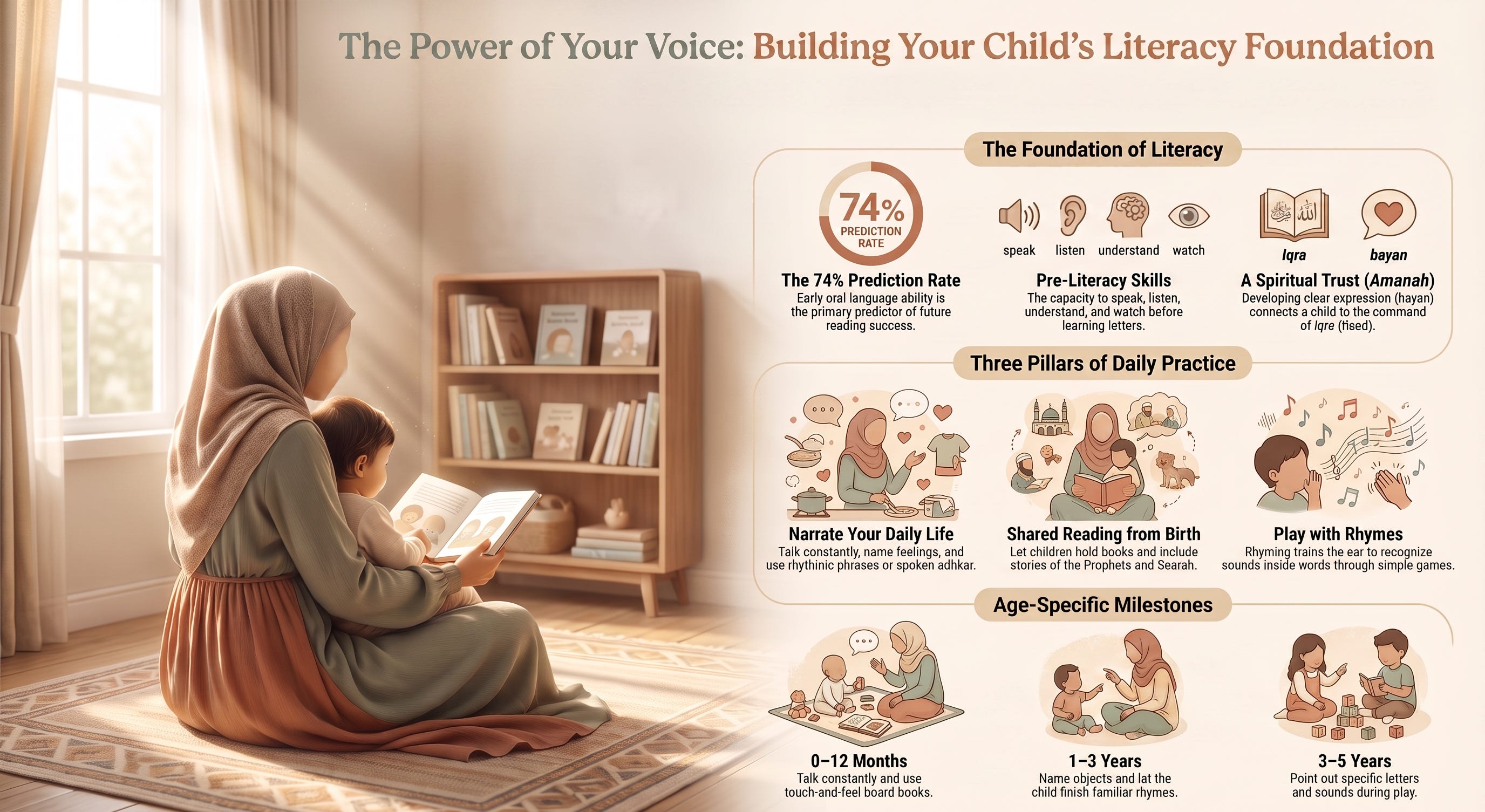
University of Kansas researchers found that a child’s oral language ability between birth and age five — not letters, not flashcards — predicts up to 74% of how well that child reads years later. [1] Why talking, reading, and rhyming in the early years matter more than any “reading program” and what the Sunnah has to say about the words you use every day.
Here’s something that surprised me the first time I read the research properly: reading doesn’t begin with letters. It begins with a voice.
Not a curriculum. Not flashcards. A voice — yours, specifically — narrating the cereal box out loud, reading the same board book for the ninth night running because “again” is apparently a complete sentence to a two-year-old, playing a silly rhyming game stuck in traffic without even meaning to teach anything.
That 74% figure isn’t a footnote. It’s the two-year-old who gets talked to and read to constantly, quietly outbuilding almost anything a formal program could do later.
Why This Guide Is Different
It’s not about teaching your toddler to read. It’s about the three ordinary habits — talking, reading, rhyming — that build the ear and brain a future reader depends on, years before letters matter.
It doesn’t ask you to add anything new. Every strategy fits inside things you’re already doing: mealtimes, car rides, bedtime.
It treats the Islamic dimension as real, not decorative. The first word revealed to the Prophet ﷺ was a command to read — this guide treats that as genuinely relevant to how you talk to your toddler, not a quote tacked on at the end.
The skills before the skill
Researchers call this pre-literacy: the capacity to speak, listen, understand, watch, and draw. A baby needs to hear a word — really hear it, attached to the thing it names — dozens or hundreds of times before it means anything. A three-year-old starts noticing that letters don’t look like pictures, that print carries meaning on its own, and that spoken words break apart into smaller sounds. That last one is phonological awareness, and it shows up first as play: hearing that “cat” and “hat” rhyme, or clapping out wa-ter-mel-on.
Researchers describe two distinct tracks feeding into this: “inside-out” skills like phonological awareness and letter knowledge, and “outside-in” skills like vocabulary and general language, and both develop from different everyday experiences at different points [8]. None of it feels like instruction while it’s happening. That’s the point.
The American Academy of Pediatrics takes it seriously enough to make it formal policy — every family should be counselled to start shared reading from birth and keep it going through kindergarten [3]. A review of the research on what’s been called “language nutrition” found the same pattern: the quality and quantity of everyday talk, interaction, and shared reading directly shapes a young child’s language and cognitive development [9]. Every bit of talking, rhyming, scribbling, and reading you do together is quietly wiring the brain architecture your child will spend a lifetime thinking with [2].
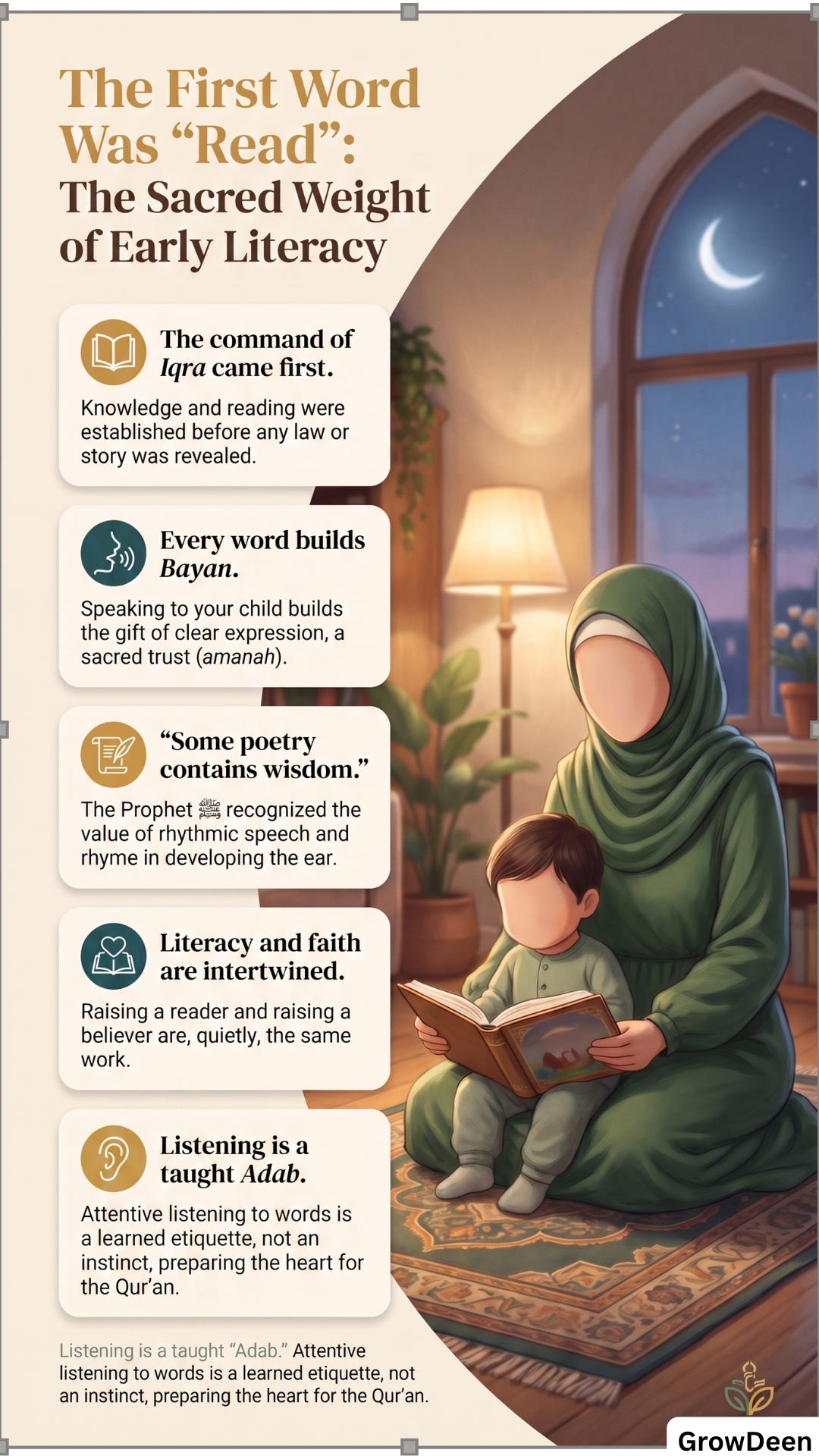
There’s a spiritual layer here too. The first word revealed to the Prophet Muhammad ﷺ wasn’t a story or a law — it was a command: Iqra, Read. In Islam, the capacity to read, understand, and speak isn’t a neutral academic skill; it’s bound up with a human being’s ability to receive guidance and pass knowledge on. Narrating the grocery list, reading the ninth bedtime book, playing a rhyming game in traffic — none of it is only school prep. It’s building bayan, the capacity for clear expression, the same faculty that will one day let your child read Qur’an and put words to their own faith. This is amanah: a trust carried in ordinary words.
The three things that actually build it
1. Talk — as much as you possibly can
Talking is the cheapest, most powerful literacy tool you have — a child can’t read a word she’s never heard. Narrate what you’re doing: “I’m cutting the apple small so it’s easier for you.” It floods her with vocabulary and sentence structure. Name feelings, not just objects — “You look frustrated the tower fell” — because that builds the emotional vocabulary she’ll later use to understand a story character. Stretch words out or clap syllables — “Look, a b-a-ll!” — the direct ancestor of sounding words out later.
Follow her lead. Let her try the word first, even wrong. Resist correcting directly — hand the right word back inside your own sentence: “Yes, that’s a rabbit!” Tell family stories; narrative sense is exactly what she’ll need for books.
Instead of songs, you have a built-in substitute doing the same rhythmic work: spoken adhkar, gentle rhythmic phrases, du’as repeated slowly. And there’s a documented prophetic habit worth borrowing — the Prophet ﷺ would repeat important words up to three times so his listeners understood clearly. Speaking slowly, with deliberate repetition, to a small child mirrors something he ﷺ actually did.
2. Read together — daily, from the start
Shared reading shows a child that books hold pleasure and information, teaches the sounds letters make, stretches vocabulary, sharpens problem-solving, and hands over new concepts about the world [2][3]. A landmark national review of reading research reached a similar conclusion from a different angle: children arrive at school far more ready to read when their preschool years included rich, stimulating language environments — read-aloud time chief among them [10].
Read daily — five minutes counts, consistency matters more than length. For younger children, lift-the-flap or touch-and-feel books hold attention where plain text won’t. Let her hold the book and turn pages. Trace your finger under the words so left-to-right print direction registers without ever being explained. Pause on pictures, ask what happens next, tie the story to her own life, explain new words simply. Visit the library if one’s within reach.
For a Muslim family, this is also the most natural door into a lifelong relationship with the Qur’an. Board books about the Prophets and simple Seerah retellings belong on the same shelf as anything else, so a love of stories and a love of Islamic knowledge grow up as one thing.
A few genuinely useful Islamic resources exist if you want this content on the shelf: Learning Roots’ My Touch and Feel Alif Baa Taa (a sensory board book introducing Arabic letters), Noorart (Arabic alphabet flashcards and wooden puzzle boards), and Muzakkir or The Islamic Kid Store (rhyming Islamic board books, touch-and-feel titles for 0–3). Check reviews for translation quality, keep small puzzle pieces away from under-3s, and check shipping/return policies before ordering internationally.
3. Rhyme — a skill wearing a game’s clothes
Rhyming trains a child’s ear to pick out sounds inside words — the exact sound-to-print link reading depends on later. Play rhyming games anywhere: “What rhymes with mat? Cat! Bat! Sat!” Try tongue twisters once she’s older. Read rhyming books and pause right before the rhyming word, letting her guess it.
There’s a hadith worth sitting with here. The Prophet ﷺ said, “Some poetry contains wisdom” [Sahih al-Bukhari 6145] — a plain acknowledgment that rhythmic, patterned language carries real value, not as amusement but as a vehicle for wisdom worth remembering. Arabic leans on rhyme and rhythm in ways that make it unusually memorable, which is part of why generations of children have carried long portions of the Qur’an in memory: pattern helps language stick. A silly rhyming game in the car is, in a small way, tuning that child’s ear for a lifetime of hearing — and, in sha Allah, one day reciting — the Qur’an itself.
That gives rhyme-time a natural adab attached. When Qur’an is actually being recited nearby, the instruction is different: “When the Qur’an is recited, listen to it attentively and be silent, so you may be shown mercy” [Qur’an 7:204]. Helping a child notice, gently and gradually, that there’s a particular kind of listening reserved for the Qur’an — distinct from playful rhyming — teaches a real distinction without making either moment heavy.
Before we go further — a quick word about what I’m building for you
I know this is a lot to hold while you’re also managing nap schedules and everything else. That’s why I put together a free Talk, Read, Rhyme: Early Literacy Companion Pack — daily prompts, age-by-age milestones, and an Islamic adab card, all in one place. Keep reading — it’s ready to download at the end.
Age by age, briefly
0–12 months: talk constantly, read touch-and-feel board books, say short adhkar aloud during care routines. 1–2 years: name everything, read daily and let her turn pages, start simple rhyming in the bath or car. 2–3 years: let her finish sentences in familiar rhymes, ask open-ended questions, introduce short Prophet stories. 3–5 years: point out letters and sounds, play syllable-clapping games, connect story choices to Islamic manners. 5–8 years: support her sounding words out herself, but keep reading aloud anyway — comprehension keeps growing through listening long after she can decode alone.
Support Muslim Parenting Lab ❤️
Think your amount is too small to matter? Give whatever you have with the button below.
The Prophet ﷺ said to shield yourself from the Fire even with half a date. (Sahih al-Bukhari 1417)
What tends to get in the way — and when to ask someone
Screens can’t replicate the back-and-forth a child’s language needs. Correcting pronunciation head-on tends to make children hesitant to speak; modelling the right word works better. Turning every reading session into a quiz drains the joy fast. And waiting until a child seems “old enough” misses the point — this begins from birth.
A slower start isn’t automatically a red flag, but it’s worth a conversation with a doctor or speech-language professional if a child shows little interest in books, struggles to follow simple instructions, has vocabulary well behind peers, or shows no emerging sense of rhyme by preschool age. Asking early is the protective choice, not a sign anything’s gone wrong.
The Sacred Weight of a Parent’s Ordinary Words
It’s easy to think the “big” spiritual work happens at the masjid or in formal Qur’an lessons — and to miss that most of it is happening in the kitchen, at bath time, in the back seat of the car.
When I sit with “When the Qur’an is recited, listen to it attentively and be silent, so you may be shown mercy” [Qur’an 7:204], I’m reminded Allah gave listening its own instruction, its own adab. According to Tafsir Ibn Kathir, this verse establishes a posture of respectful, attentive silence toward the Qur’an, in contrast to those who deliberately drowned it out. That’s a high standard — one a small child only grows into gradually, through years of first learning to listen well to us.
That’s what makes “Some poetry contains wisdom” [Sahih al-Bukhari 6145] sit so close to home. It’s a small statement with real weight — rhythm and rhyme aren’t decoration, they’re a vehicle wisdom travels in. Every rhyming game in the car is quietly training the same ear that will one day, in sha Allah, be trained enough to sit still for the Qur’an itself.
What I find reassuring is how naturally the research and the deen point the same direction: the science says a child’s ear for rhythm and sound predicts later reading; the deen says that same trained ear is what lets a heart receive the Qur’an with the stillness it’s owed. We’re not choosing between raising a reader and raising someone who loves Allah’s speech. Every rhyme, every shared page, is quietly doing both.
Parent checklist
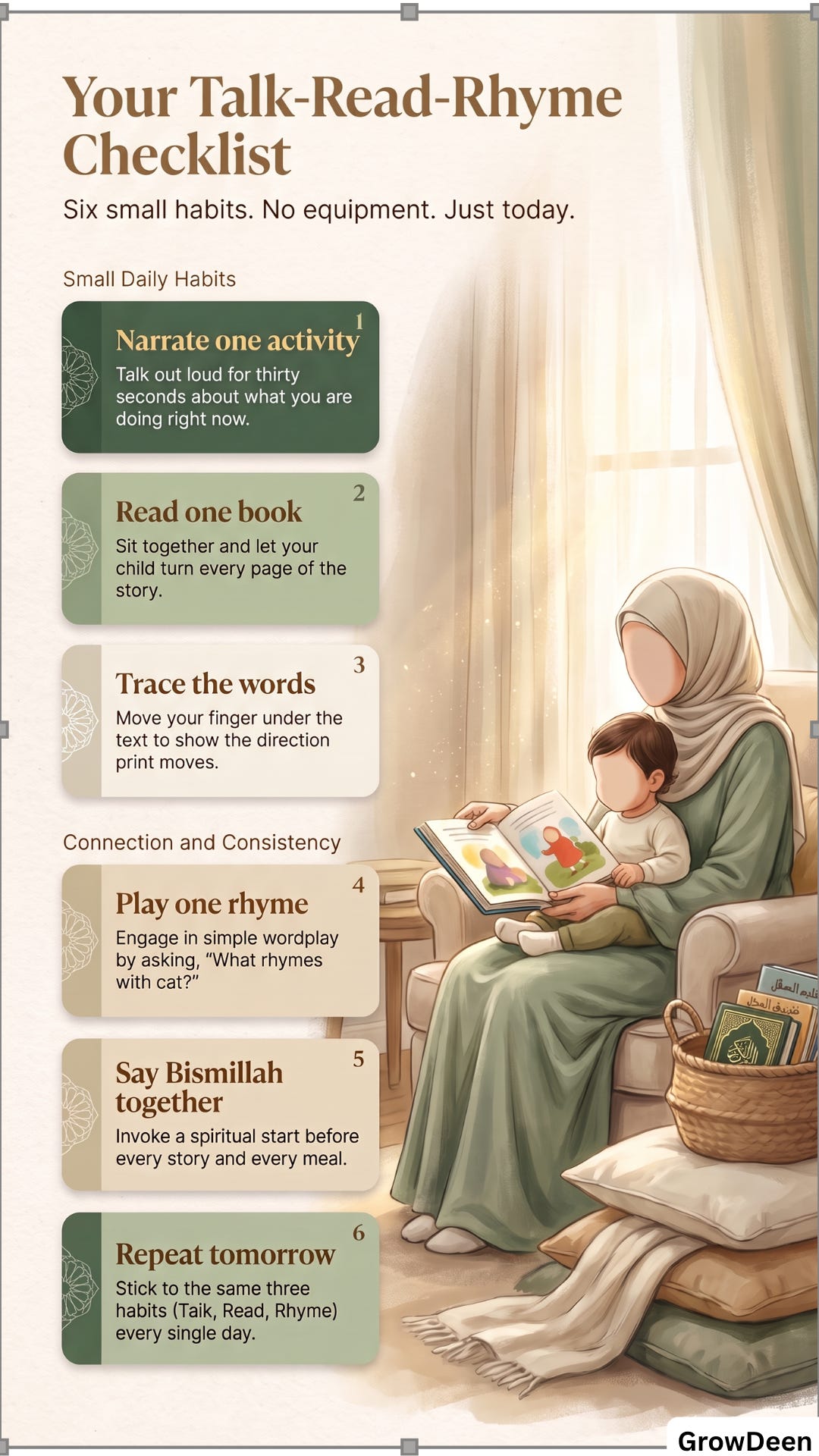
I talk to my child throughout the day, narrating what we’re doing.
I read with my child at least once daily and let her hold the book.
I play rhyming games during ordinary moments — the car, the shop, the table.
I model correct pronunciation gently rather than correcting directly.
I include Islamic picture books, Seerah stories, and gentle adhkar in our routine.
I know the signs that would prompt a conversation with a doctor or early childhood professional.
Your Talk, Read, Rhyme: Early Literacy Companion Pack
If you’ve read this far, you’re the kind of parent who takes your child’s early years seriously — not as something to optimise, but as a season to be present in. That tells me something beautiful about you.
Inside the Talk, Read, Rhyme: Early Literacy Companion Pack (one comprehensive PDF, 3 pages):
Page 1: Talk-Read-Rhyme Daily Practice Card — A three-column quick-reference card with concrete age-flexible prompts for each pillar — designed as a card you can keep on the fridge or in the diaper bag.
Page 2: Pre-Literacy Milestones & Book Choice Guide — An age-banded table (0–1, 1–2, 2–3, 3–5, 5–8) showing what to expect and what books suit each stage, plus the verified Islamic literacy resources mentioned above and the “signs to watch for” box — so you’re never left guessing.
Page 3: The Adab of Listening & the Wisdom of Rhyme — A Sunnah adab card pairing the poetry hadith [Sahih al-Bukhari 6145] with the ayah on listening to the Qur’an [Qur’an 7:204], with a short reflection you can read with your child as they get older.
This isn’t just a PDF to download and forget. It’s a tool designed to stay on your fridge or in your bag — where you’ll actually use it when you need it most.
This companion pack is what every subscriber receives with each article. We cover the full journey of raising Muslim children, all backed by scientific research and rooted in Islamic wisdom.
Before you keep reading anything else today, do this: pick one thing your child is doing right now — even just sitting near you — and narrate it out loud to her for thirty seconds. That’s it. That’s the whole practice, in miniature.
May Allah place barakah in your effort, accept your intention, and make every word you speak to your child more formative than it feels in the moment.
Think of one person right now: the friend whose toddler is glued to a tablet because bedtime is already exhausting enough, the sister at the masjid who mentioned she “isn’t a reader” and worries that means her kids won’t be either, the new mother who has no idea board books even exist for six-month-olds.
This article could change how they spend the next five years of ordinary moments with their child. Share it with them today — not because you’re being preachy, but because you care.
Frequently Asked Questions
Q: At what age should I start reading to my baby?
A: From birth. The AAP recommends shared reading starting at birth and continuing through kindergarten [3]. Even a newborn benefits from the rhythm and closeness of your voice.
Q: My toddler won’t sit still for a whole book. Am I doing something wrong?
A: No — that’s normal. A few pages, or just naming pictures, still counts. Consistency matters more than finishing every book. See “Read together” above.
Q: Is it bad to use screens or apps for early literacy?
A: Screens can’t replicate the responsive, back-and-forth exchange a developing brain needs. Fine in small amounts, but shouldn’t substitute for talking, reading, and rhyming.
Q: How do I know if my child has a speech or language delay?
A: Watch for little interest in books, trouble following simple instructions, vocabulary well behind peers, or no emerging sense of rhyme by preschool age. See “What tends to get in the way” above.
Q: What’s the difference between talking to my child and “teaching” her language?
A: Barely any in practice. Ordinary narration — describing what you’re doing, naming feelings, telling family stories — is one of the most powerful literacy-building tools there is [8][9].
Q: Are Islamic books and toys necessary for building early literacy?
A: No — your voice and shared reading time matter most, regardless of content. Islamic literacy resources are a bonus, not a requirement.
References
[1] Catts, H. W., Nielsen, D. C., Bridges, M. S., Liu, Y. S., & Bontempo, D. E. (2015). Early Identification of Reading Disabilities Within an RTI Framework. Journal of Learning Disabilities, 48(3), 281–297. (University of Kansas.)
[2] National Early Literacy Panel. (2009). Developing Early Literacy: Report of the National Early Literacy Panel. National Institute for Literacy.
[3] Council on Early Childhood. (2014). Literacy Promotion: An Essential Component of Primary Care Pediatric Practice. Pediatrics, 134(2), 404–409.
[4] Coffey, K., & Snedeker, J. (2025). Early word learning and syllable segmentation in young children. Journal of Child Language.
[5] American Academy of Pediatrics. Policy statement on early literacy promotion and shared reading from birth.
[6] Tafsir Ibn Kathir, commentary on Surah Al-A’raf (7:204), via alim.org.
[7] Sahih al-Bukhari, Hadith 6145. Verified via sunnah.com.
[8] Whitehurst, G. J., & Lonigan, C. J. (1998). Child Development and Emergent Literacy. Child Development, 69(3), 848–872.
[9] Zauche, L. H., Thul, T. A., Darcy Mahoney, A. E., & Stapel-Wax, J. L. (2016). Influence of Language Nutrition on Children’s Language and Cognitive Development: An Integrated Review. Early Childhood Research Quarterly, 36, 318–333.
[10] Snow, C. E., Burns, M. S., & Griffin, P. (Eds.) (1998). Preventing Reading Difficulties in Young Children. Committee on the Prevention of Reading Difficulties in Young Children, National Research Council, chaired by Catherine E. Snow of the Harvard Graduate School of Education. Washington, DC: National Academy Press.
We combine scientific research with Qur’an and authentic Sunnah, and we cite our sources. Even so, this is general guidance and no substitute for a doctor who can examine your child.