

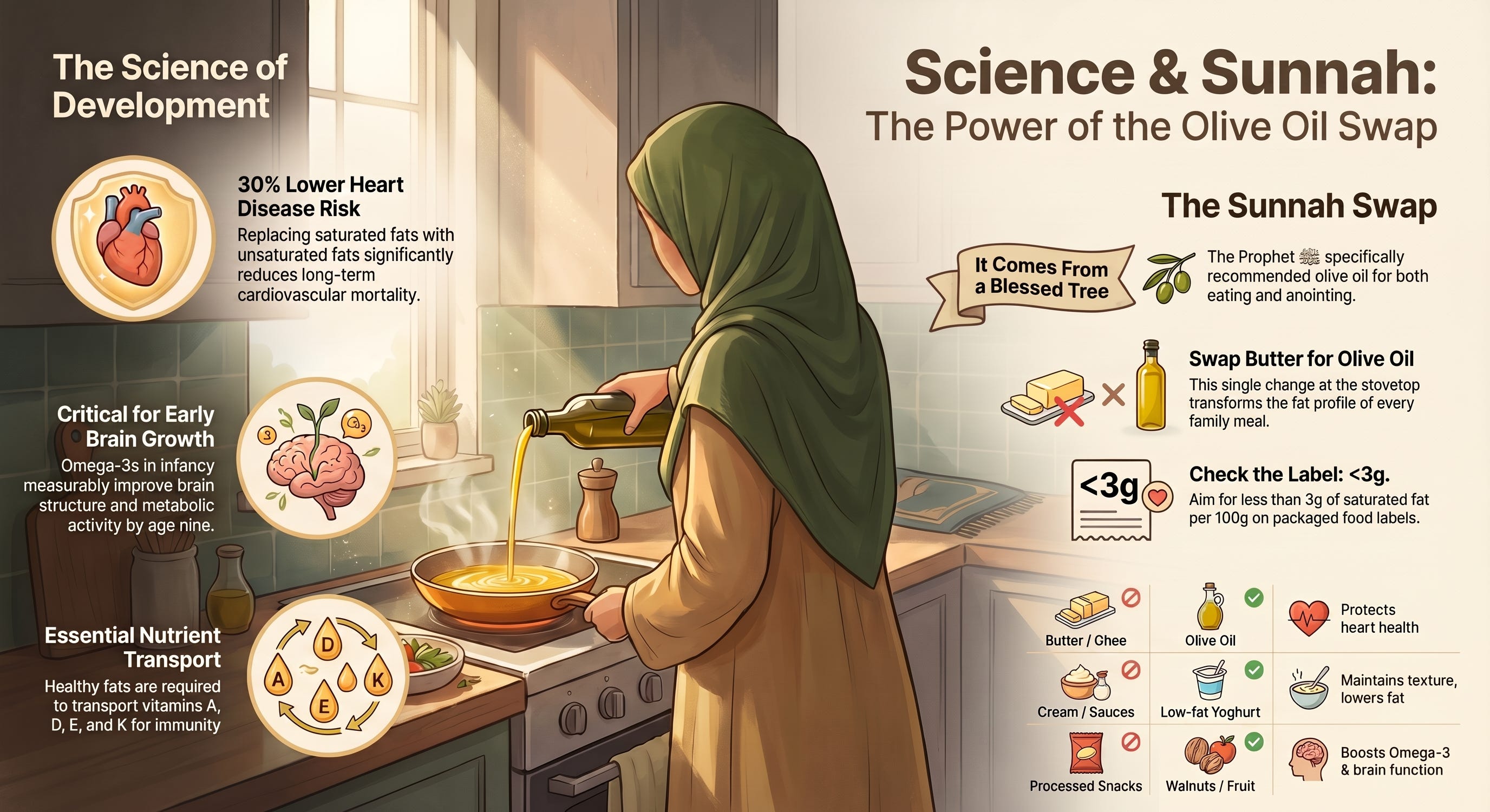
A landmark 2021 meta-analysis of 61 studies found that replacing saturated fat with unsaturated fat was associated with approximately 30% lower cardiovascular disease mortality. [1] This guide shows you which fats actually matter for your child’s brain and heart and the simple swaps that make the difference.
I used to keep butter on the counter. Every morning, every meal, every piece of bread. Nobody told me it was wrong. It was just what we did.
Then I read something that stopped me. A 2019 study tracked children who received omega-3 supplementation in their first year of life — and followed up with them at age nine. The children who had more omega-3s showed measurable differences in brain function, brain structure, and metabolic activity. [2] Not marginal differences. Detectable ones. In nine-year-olds. From what they were fed as babies.
That changes things.
Here’s the honest truth: the question for Muslim families isn’t whether to give children fat. It’s which fat. And the answer the research points to is the same one the Prophet ﷺ pointed to fourteen centuries ago.
Why This Guide Is Different From Generic Nutrition Advice
It’s research-backed and specific: Every recommendation draws from peer-reviewed journals and dietary guidelines — including a 2021 systematic review of 61 prospective cohort studies — not general healthy eating blogs. [1]
It’s grounded in Islamic guidance: This isn’t just nutrition advice — it connects the Prophetic recommendation of olive oil, mentioned in Sunan Ibn Majah, with what nutritional science now confirms about unsaturated fats. [3]
It comes with a printable tool: You’ll get the free Family Healthy Fats Guide at the end — a 3-page PDF with a kitchen swap checklist, an age-by-age fat guide, and an Islamic mealtime card your family can use right now.
What Your Child’s Body Actually Does With Fat
Fat isn’t optional. It transports the vitamins A, D, E, and K that build your child’s immune system and bones. It produces the hormones that regulate growth. And above all, it feeds the brain — which is, in its early years, essentially made of fat. [4]
But here’s what surprised me most: not all fat does the same job. Some types actively protect the heart. Others quietly damage it over years. And the difference isn’t about how much fat your family eats — it’s about which kind.
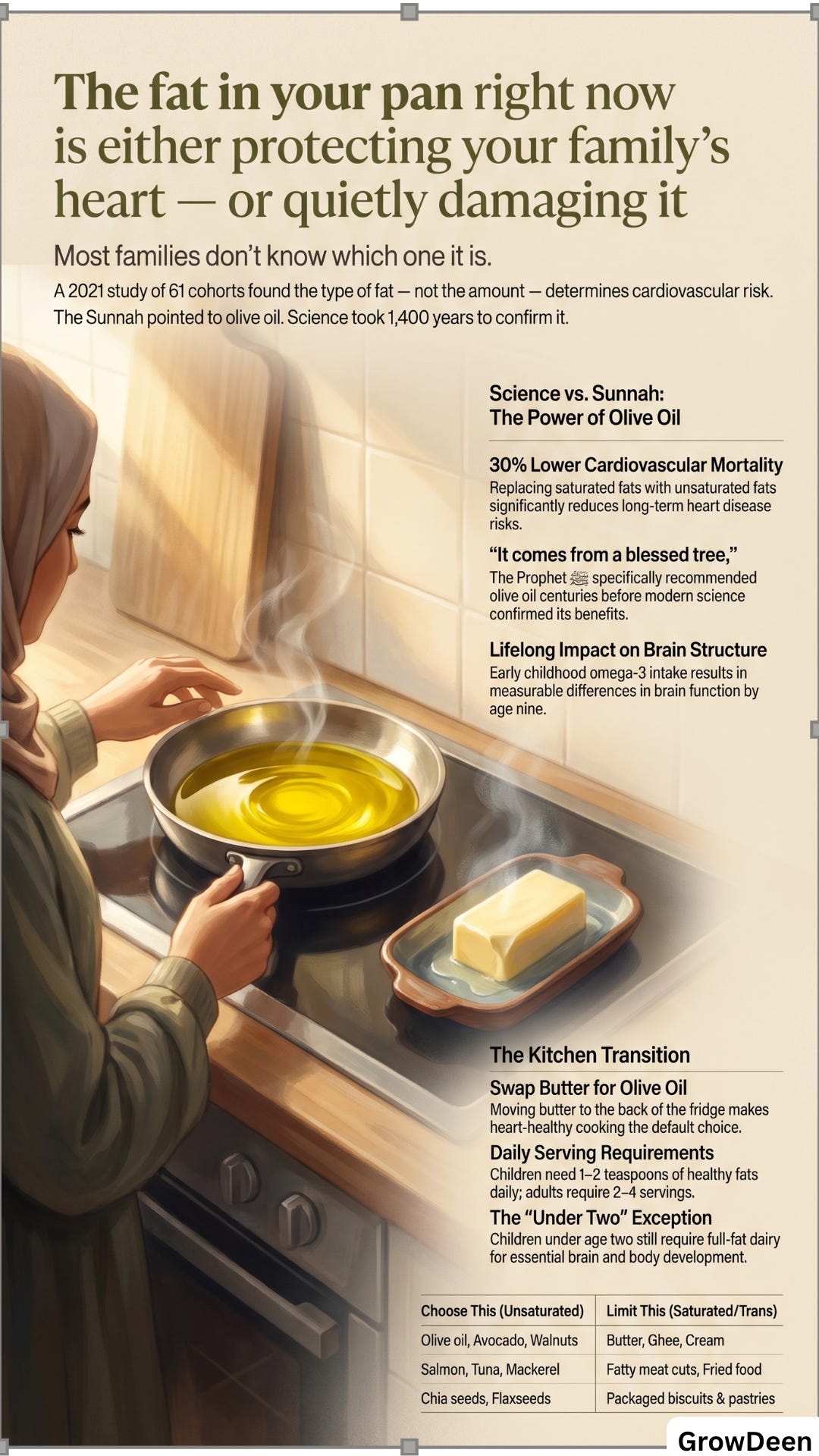
Unsaturated fats — the healthy kind — keep arteries clear, support good cholesterol production, and reduce harmful cholesterol when they replace saturated fat in your family’s diet. [1] They come from olive oil, avocado, nuts, seeds, and oily fish.
Omega-3 fatty acids deserve a separate mention. Found in salmon, tuna, mackerel, walnuts, chia seeds, and flaxseeds, they are the type most connected to brain development, immune function, and mental wellbeing in children. [2]
The fats to reduce? Saturated fat (the white fat on meat, butter, cream, commercially fried food) and trans fat (the industrial fat in many packaged biscuits, pastries, and fast food) raise harmful cholesterol and are directly linked to cardiovascular risk. [1]
I know this is a lot to track in a busy kitchen.
That’s exactly why I created the free Family Healthy Fats Guide — a 3-page printable PDF with a kitchen swap checklist, a child-friendly age-by-age fat guide, and an Islamic nourishment card your family can use every day. Keep reading — you’ll find it at the end of this article.
How Much Is Enough? The Simple Numbers
You don’t need to obsess over grams. You need to know what one serve of healthy fat looks like — so you can include it consistently, not accidentally.
One serve equals roughly 1–2 teaspoons of olive oil, a teaspoon or two of nut butter, or a tablespoon of avocado. [4] Children aged 1–11 need roughly 1 serve per day. Teens need 1.5–2 serves. Adults need 2–4 depending on age and sex.
One critical note: children under two need full-fat dairy. Switching to low-fat milk or yoghurt too early removes fat they genuinely need for brain and body development. [4] Don’t do it before age two.
The Swaps That Actually Move the Needle
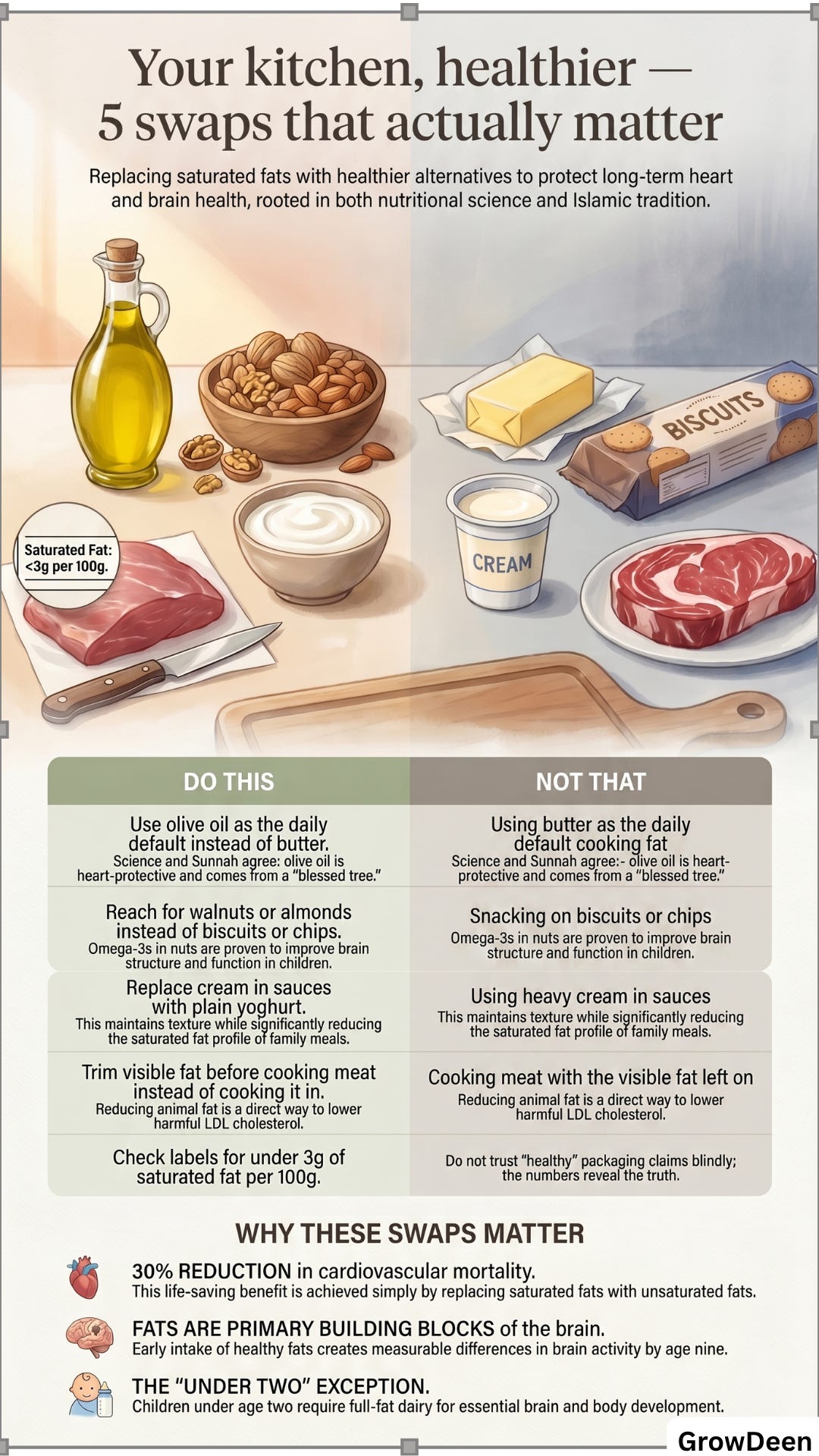
You don’t need a whole new pantry. These five swaps are the ones with real impact:
Butter for cooking → olive oil. This one change touches every meal.
Cream in sauces → low-fat yoghurt. The texture holds. The fat profile transforms.
Biscuits and chips as snacks → walnuts, almonds, or fruit. The snack habit is where most hidden saturated fat lives.
Fatty meat cuts → lean mince and trimmed cuts. Ask your butcher.
Deep-fried → roasted, baked, or steamed. The flavour doesn’t suffer when spices are used well.
And when you read food labels — which is worth starting to do — look for less than 3 g saturated fat per 100 g for most foods, and less than 15 g per 100 g for cheese. [4]
Start meals with Bismillah and end them with Alhamdulillah. These moments slow the family down, connect nourishment to its source, and build the habit of gratitude that Islam teaches us to carry through every provision.
What the Olive Tree Teaches Us About Nourishing Our Families
When I first read the verse in Surah Al-Mu’minun — where Allah ﷻ describes “a tree growing out of Mount Sinai that produces oil and a condiment for those who eat” [Quran 23:20] [5] — I didn’t think of it as a nutrition verse. I thought of it as provision.
But reading Tafsir Ibn Kathir on this passage, I noticed something. Ibn Kathir connects this verse directly to the hadith: “Eat olive oil and anoint yourselves with it, for it comes from a blessed tree.” Narrated by Abu Asid al-Ansari, recorded in Sunan Ibn Majah 3319, graded Hasan Sahih by Al-Albani. [3]
The Prophet ﷺ did not just mention olive oil in passing. He recommended it directly. And what nutritional science now tells us — that olive oil is among the most heart-protective fats we know of, central to the Mediterranean diet that has the strongest evidence base for cardiovascular health [1] — arrived fourteen centuries later at the same place.
What’s beautiful isn’t that Islam predicted the research. It’s that the care for our bodies was already there, built into the guidance we were given. When we cook with olive oil, we’re not just making a healthy choice. We’re following a Sunnah-rooted practice.
The Family Healthy Fats Guide — Your Free Companion Pack
If you’ve read this far, you’re the kind of parent who takes your family’s health seriously — not as anxiety, but as love. That tells me something meaningful about you.
Inside the Family Healthy Fats Guide (one comprehensive PDF, 3 pages):
Page 1: The Healthy Fats Kitchen Swap Card — A quick-reference checklist covering the 7 most common saturated fat swaps for Muslim family kitchens — butter to olive oil, cream to yoghurt, fried to roasted, and more — designed as a laminated card you can stick on your fridge or pantry door, so the decision is made before you’re standing at the stove.
Page 2: Age-by-Age Fat Needs Guide — A clean visual reference showing exactly how many serves of healthy fat each family member needs per day, from toddlers to adults, with specific food examples at each stage — so you can plan meals knowing each person’s needs, not guessing.
Page 3: The Wholesome Nourishment Card — Built around the post-meal du’a the Prophet ﷺ taught: “Al-hamdu lillahilladhi at’amana wa saqana wa ja’alana muslimin” (Praise be to Allah who fed us, gave us drink, and made us Muslims), recorded in Sunan Abi Dawud 3851, graded Hasan by Al-Albani — with full Arabic text, transliteration, and translation, alongside a one-line reminder of the Islamic intention behind feeding our families well. A card the whole family can see and begin to memorise.
This isn’t just a PDF to download and forget. It’s a tool designed to stay in your kitchen — where you’ll actually use it when you need it most.
This Family Healthy Fats Guide is what every subscriber receives with each article. At Muslim Parenting lab, we cover the full journey of raising healthy Muslim children — all backed by current research and rooted in Islamic wisdom.
If you’re a Muslim parent who wants guidance that honours both your values and the evidence, subscribe free so future resources arrive in your inbox before you need them.
Subscribe free — guidance backed by both science and Sunnah, delivered to your inbox. No spam, no daily emails, just resources that genuinely matter.
Your Micro-Action for Tonight
Before you cook your next meal, do one thing: move the butter to the back of the fridge and put your olive oil at the front of the stove. That’s it. One swap, one meal, one act of intention.
You don’t have to fix everything at once. Start where you are.
May Allah place barakah in the nourishment you provide, accept your intention to care for these bodies He has entrusted to you, and make it a source of reward in this life and the next.
Share This With Someone Who Needs It
Think of one person right now: your sister who cooks for a toddler and doesn’t think twice about the butter she uses, a friend whose family lives mostly on takeaway and packaged snacks, a new mum in your family who wants to do things well but doesn’t know where to start.
This guide could protect their child’s heart. Share it with them today — not as advice-giving, but as care. Sometimes the most loving thing we can do is pass along knowledge before it becomes something we wish we’d known sooner.
Frequently Asked Questions
Q: Is olive oil safe to cook with at high temperatures?
A: Olive oil is best for medium-heat cooking — sautéing, roasting at moderate temperatures, dressings, and dips. For very high-heat frying, avocado oil or rice bran oil are better options since they have higher smoke points. Extra-virgin olive oil retains the most nutritional benefit and flavour at lower heats.
Q: Can children eat nuts and nut butters safely?
A: Yes — nuts and natural nut butters are excellent sources of healthy fats for children. For children under 4, whole nuts are a choking risk; serve nut butters spread thinly on bread or stirred into porridge instead. [4] Always introduce new foods one at a time and watch for any allergic reaction.
Q: Is ghee healthy or unhealthy?
A: Ghee is a saturated fat, so it falls into the “use occasionally, not daily” category. It’s not harmful in small amounts as part of an otherwise balanced diet, but it shouldn’t be the primary cooking fat. Swapping ghee for olive oil for everyday cooking is one of the most impactful changes a family can make.
Q: Do children really need omega-3 supplements, or is food enough?
A: If your family eats oily fish (salmon, mackerel, tuna, sardines) two or more times a week, and includes walnuts, chia, or flax seeds regularly, food sources can be sufficient. [2] If fish isn’t regularly eaten, an omega-3 supplement for children is worth discussing with your doctor — especially for younger children in whom brain development is most active. [2] For breastfed infants, the mother’s omega-3 intake matters directly.
Q: What’s the difference between saturated fat and trans fat?
A: Both raise harmful LDL cholesterol, but trans fat is worse — it also lowers protective HDL cholesterol at the same time. [1] Saturated fat comes mainly from animal products and some tropical oils. Trans fat comes mostly from industrially processed foods like packaged biscuits, pastries, and fast food. Reducing trans fat is the more urgent priority.
Q: How do I know how much saturated fat is too much when reading food labels?
A: The practical rule is less than 3 g of saturated fat per 100 g for most foods, less than 10 g total fat per 100 g, and less than 15 g saturated fat per 100 g for cheese. [4] If a packaged snack exceeds these numbers, it’s worth reducing how frequently it’s offered.
References
[1] Kim, Y., Je, Y., & Giovannucci, E.L. (2021). Association between dietary fat intake and mortality from all-causes, cardiovascular disease, and cancer: A systematic review and meta-analysis of prospective cohort studies. Clinical Nutrition, 40(3), 1060–1070. https://doi.org/10.1016/j.clnu.2020.07.007
[2] Lepping, R.J., Honea, R.A., Martin, L.E., Liao, K., Choi, I-Y., Lee, P., Papa, V.B., Brooks, W.M., Shaddy, D.J., Carlson, S.E., Colombo, J., & Gustafson, K.M. (2019). Long-chain polyunsaturated fatty acid supplementation in the first year of life affects brain function, structure, and metabolism at age nine years. Developmental Psychobiology, 61(1), 5–16. https://doi.org/10.1002/dev.21780
[3] Abu Asid al-Ansari narrated that the Messenger of Allah ﷺ said: “Season your food with olive oil and anoint yourselves with it, for it comes from a blessed tree.” Sunan Ibn Majah, 3319. Graded Hasan Sahih by Al-Albani. https://sunnah.com/ibnmajah:3319
[4] National Health and Medical Research Council (NHMRC). (2013). Eat for Health: Australian Dietary Guidelines. NHMRC. https://www.eatforhealth.gov.au/sites/default/files/files/the_guidelines/n55a_australian_dietary_guidelines_summary_book.pdf
[5] Qur’an, Surah Al-Mu’minun (23:20).
[6] Kapoor, B., Kapoor, D., Gautam, S., Singh, R., & Bhardwaj, S. (2021). Dietary polyunsaturated fatty acids (PUFAs): Uses and potential health benefits. Current Nutrition Reports, 10(3), 232–242. https://doi.org/10.1007/s13668-021-00363-3
[7] Abu Dawud, Sunan Abi Dawud, Hadith 3851. Narrated by Abu Umamah. Graded Hasan by Al-Albani. https://sunnah.com/abudawud:3851