

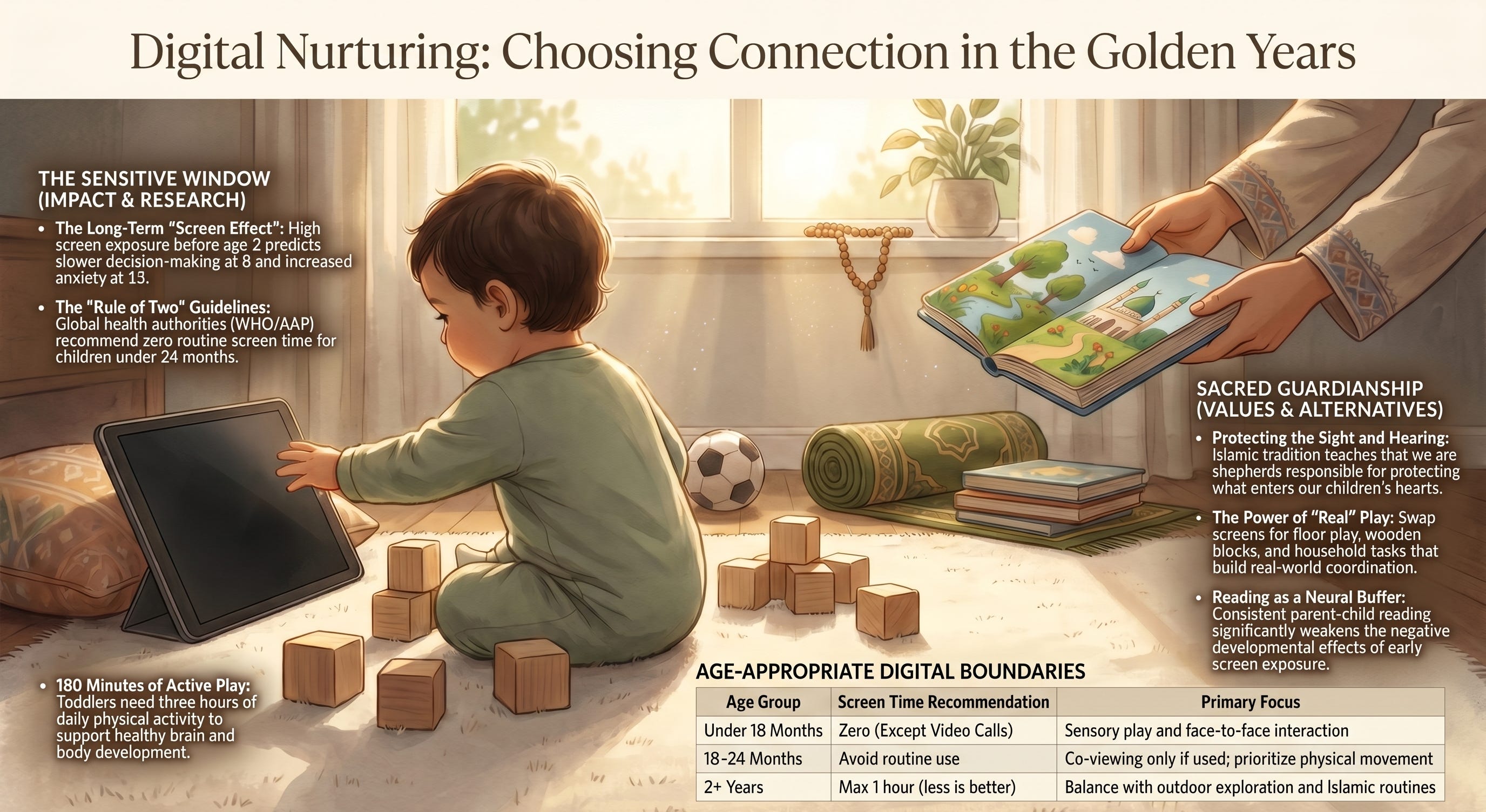
Research from multiple authoritative sources shows infants need zero routine screen time before age 2, with WHO recommending 180+ minutes of physical activity daily for ages 1-2 and less than 1 hour of screen time maximum at age 2 if used at all. [1][2][3] More critically, recent longitudinal studies tracking children for over a decade found that high screen exposure before age 2 is linked to altered brain development, slower decision-making at age 8, and increased anxiety by age 13. [42][44] This guide shows you what to do instead — and why it matters for both brain development and spiritual formation.
I know what you’re thinking when you see another article about screen time.
You’re exhausted. Your toddler won’t sit still. You have emails to answer and dinner to make. And that tablet buys you fifteen minutes of peace.
I’m not here to shame you. I’m here because new research has shown us something we didn’t fully understand before: the first two years of life aren’t just sensitive for brain development — they’re a critical window where screen exposure creates neural patterns that only show up years later.
When neuroscientists tracked the same children from infancy through adolescence, they discovered that babies exposed to high screen time before age 2 showed changes in brain networks governing emotional regulation and cognitive control. By age 13, those changes correlated with measurable increases in anxiety. [42][44]
But here’s what gives me hope: parent-child reading significantly weakened those negative effects. The kind of back-and-forth engagement, language exposure, and emotional connection that happens when you read together provided what passive screens never can. [42][44]
This isn’t about perfection. It’s about understanding what screens quietly replace — and choosing differently when you can.
Why This Guide Is Different
This isn’t another fear-based “screens are evil” article. Here’s what makes this guide unique:
1. Evidence-Based + Spiritually Grounded — We combine the latest medical research (AAP 2022, WHO 2024, longitudinal brain studies through 2025) with Islamic principles about protecting what enters the heart, creating guidance that respects both science and your values as a Muslim parent.
2. Focused on Replacement, Not Restriction — Instead of just saying “limit screens,” we give you a full menu of alternatives: floor play routines, Qur’an-centered soundscapes, outdoor noticing scripts, real household participation ideas, and age-appropriate Islamic practices that fill the gap screens leave.
3. Actionable Companion Pack Included — Every reader gets the Screen-Free Parenting Starter Kit (described at the end) — a 3-page PDF with age-specific activity lists, screen-time decision flowchart, and Islamic home atmosphere guide you can reference when you’re tempted to hand over the device.
What the Research Actually Says About Babies and Screens
The American Academy of Pediatrics is clear: children younger than 2 learn best through hands-on exploration and social interaction with trusted adults, not screens. [1]
The World Health Organization recommends infants engage in physical activity several times daily through interactive floor-based play. For ages 1-2, WHO recommends at least 180 minutes of varied physical activity spread throughout the day. WHO explicitly states sedentary screen time is not recommended for 1-year-olds, and for 2-year-olds, less than 1 hour is the maximum (with less being better). [2]
The Canadian Paediatric Society recommends no screen time for children under 2, except video-chatting with family. [3]
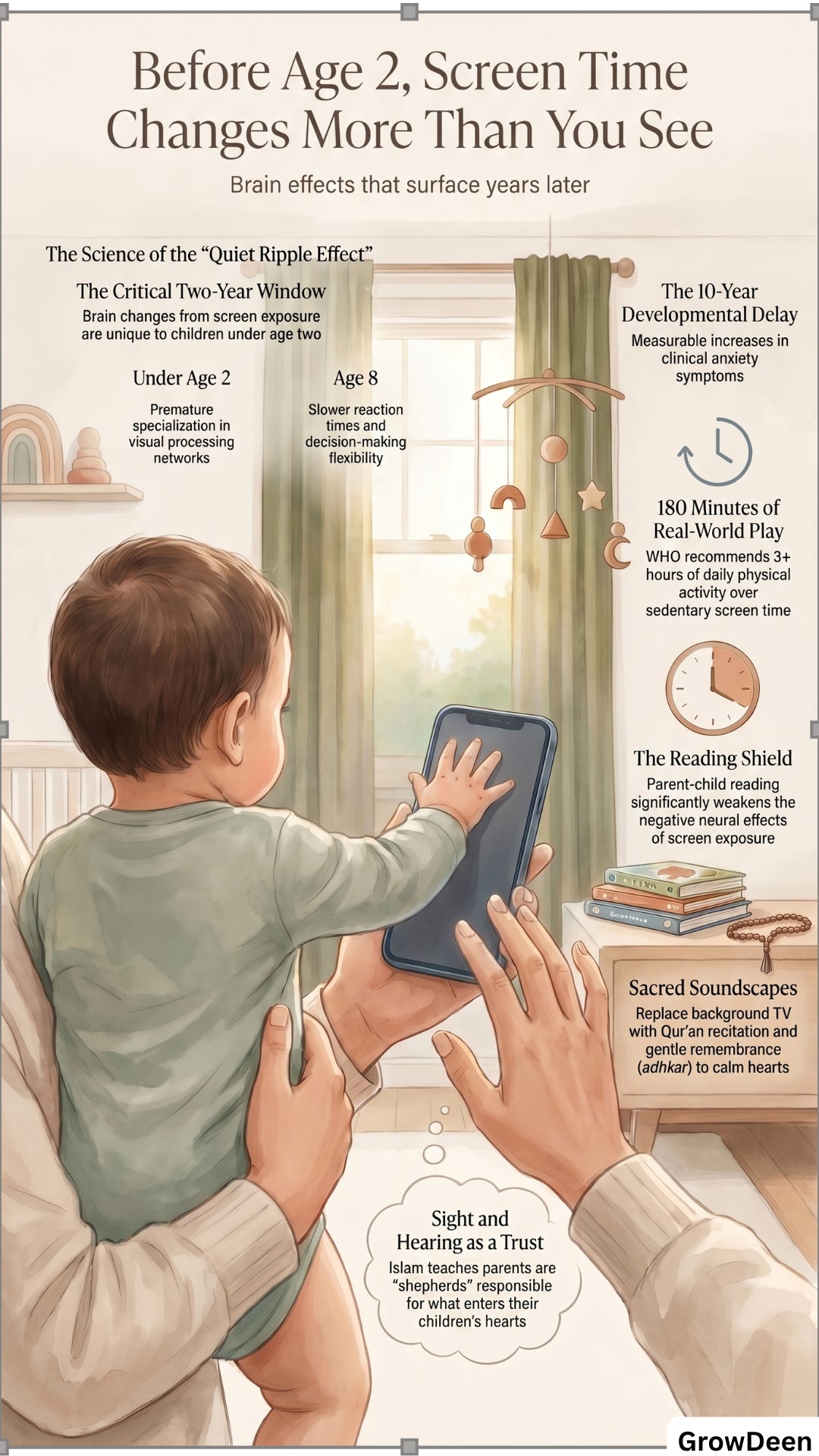
But here’s what’s new: Recent research tracking children for over a decade found that infant screen time is associated with premature specialization in brain networks involved in visual processing and cognitive control. This early specialization reduced flexibility during thinking tasks years later, showing up as slower reaction times at age 8 and higher anxiety at age 13. [42][44]
The critical finding? Infancy appears to be a uniquely sensitive period — screen exposure before age 2 predicted these long-term changes, but screen time at ages 3 or 4 did not. [44]
The practical takeaway: For babies and toddlers, no routine screen time before age 2 isn’t just a guideline — it’s backed by longitudinal evidence of how early screens shape developing brains.
The Islamic Lens: What Enters Through the Eyes and Ears
Here’s what grounds me when I’m tempted to justify “just a little bit” of screen time:
Allah says: “Do not follow what you have no knowledge of — indeed, the hearing, the sight, and the heart will all be questioned.” (Qur’an 17:36) [14]
According to Tafsir Ibn Kathir, this verse teaches that we will be asked about how we used our faculties of hearing, sight, and heart. [13] A screen enters through the eyes and ears, but its effects reach behavior, attention, speech patterns, and desires.
Allah also commands: “O believers! Protect yourselves and your families from a Fire whose fuel is people and stones.” (Qur’an 66:6) [15] This isn’t about literal fire from a tablet — it’s about active protection. In today’s world, digital boundaries are part of how we fulfill that command.
The Prophet ﷺ taught: “Every one of you is a shepherd and responsible for his flock.” (Sahih Muslim 1829a) [16] For parents, this guardianship includes the media environment.
This doesn’t mean harshness. It means intentionality. A Muslim home should not allow an algorithm to decide what a baby sees, hears, imitates, or loves.
The Real Question: What Is This Screen Replacing?
For babies and toddlers, the question isn’t “how much screen time can I allow?”
The better question is: “What is this screen replacing?”
If the screen is replacing your voice, crawling practice, outdoor exploration, books, sleep, family meals, Qur’an recitation, or affectionate connection, then the cost is too high.
Babies don’t learn from screens the way they learn from real life. They need:
Real faces that respond to their expressions
Real objects they can touch, drop, stack, and throw
Real voices that answer their babbles
Real movement that builds muscles and coordination
Real boredom that teaches them to self-soothe
Researchers emphasize the importance of interactive floor-based play and replacing sedentary screen time with reading, storytelling, and caregiver interaction. [2]
This is why a cardboard box, a wooden spoon, or a walk outside beats any “educational” video for a one-year-old.
Background Screens: The Hidden Problem
A baby doesn’t need to be watching for screens to affect your home.
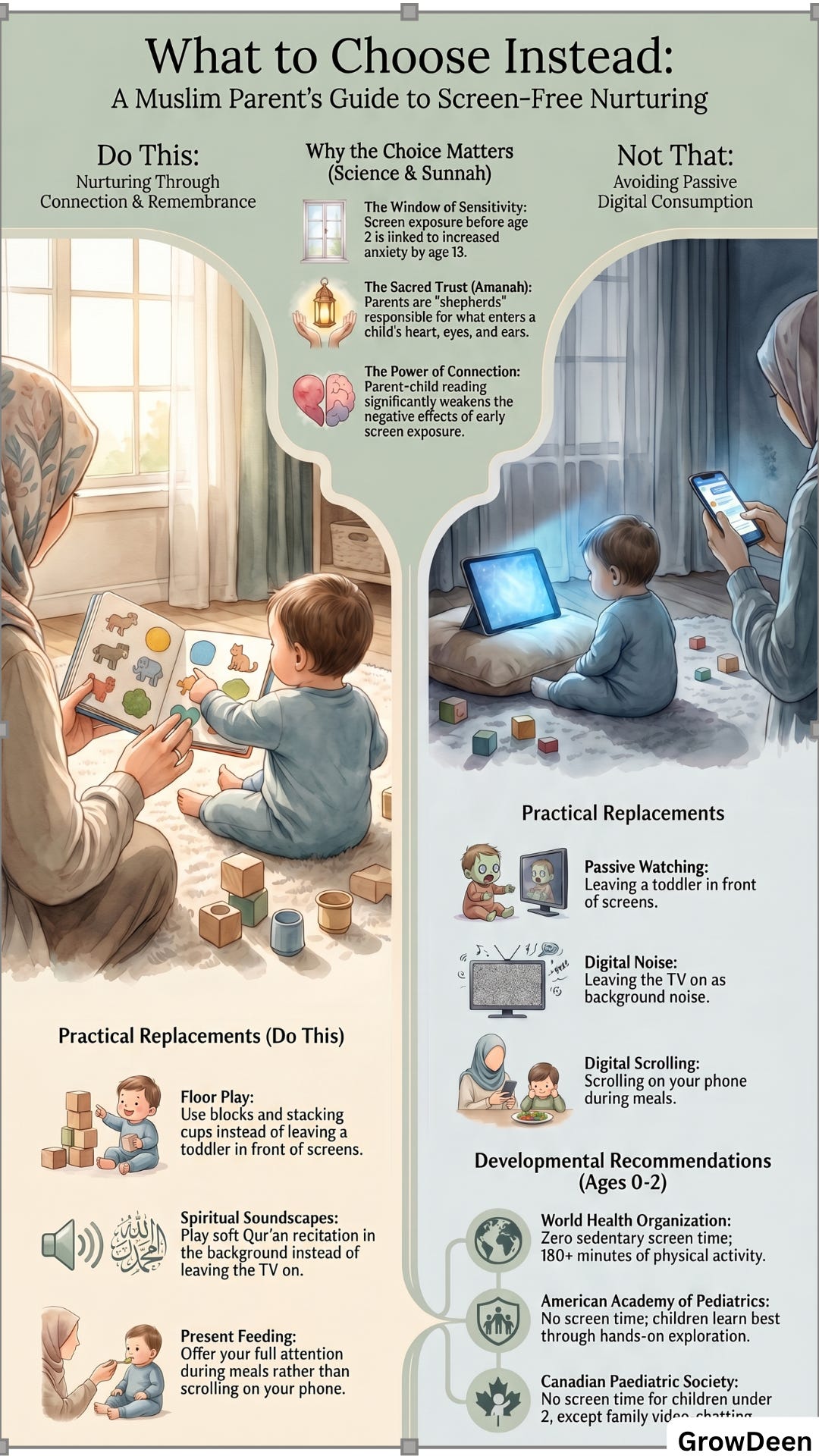
Background screens — TVs on during meals, phones scrolling while the baby plays — can distract babies from play, reduce parent-child conversation, and expose them to images, sounds, or themes that are unsuitable.
Background screens may also introduce music, inappropriate visuals, disrespectful speech, or values that don’t match a Muslim home.
A better rule: No background screens around babies and toddlers.
Instead, let the home soundscape include parent conversation, Qur’an recitation, gentle adhkar, storytelling, and natural household sounds.
The Qur’an says: “Those who have believed and whose hearts are assured by the remembrance of Allah. Unquestionably, by the remembrance of Allah hearts are assured.” (Qur’an 13:28) [17] According to Tafsir Ibn Kathir, hearts find comfort, tranquility, and rest in the remembrance of Allah. [31]
Video Calls with Family: The One Exception
Video-chatting with grandparents or relatives is different from passive screen watching because it involves real people, familiar voices, and back-and-forth interaction.
Research shows video chat can support joint attention and family connection when interactive and adult-supported. [7][8]
For Muslim families living far from extended family, short video calls help children recognize relatives and maintain ties of kinship — a value Islam strongly emphasizes.
Keep it short, warm, and interactive. Sit beside your child. Point. Narrate. Encourage responses. “Say Assalamu Alaikum.” “Can you wave to Nana?” “She’s saying mashAllah.”
Video-chatting should remain relationship time, not screen time.
Support Muslim Parenting Lab ❤️
Worried that giving will leave you with less? Give an amount you will not feel, with the button below.
The Prophet ﷺ said charity does not decrease wealth. (Sahih Muslim 2588)
Your Phone Habits Matter More Than You Think
Even if your baby isn’t using screens, your baby is watching how you use them.
Research has found that adults’ own screen behavior influences their practices around children’s screen time. [13] In simple terms: your habits shape your child’s habits.
Try these family rules:
Phones away during meals
Phones away during feeding
Phones away during floor play
No scrolling while your baby looks at you
No phone as your first response to crying
If you must use your phone, explain briefly: “I’m sending one message, then I’ll put it away.” This models self-control.
What to Do Instead: A Practical Replacement Menu
When you’re tempted to hand over a screen, try:
Floor play: Soft blocks, stacking cups, balls, cushions, safe kitchen items (wooden spoons, plastic bowls)
Reading: Board books, Islamic picture books, books about Allah’s creation, simple Prophet stories
Qur’an atmosphere: Short recitation, morning/evening adhkar, simple duas, gentle repetition of Bismillah, Alhamdulillah, SubhanAllah
Real household participation: Toddlers love helping. Let them put spoons on the table, carry a diaper, place books in a basket, bring a prayer mat.
Outdoor noticing: Go outside and say: “Allah made the sky. Allah made the tree. Can you hear the birds? SubhanAllah.”
Quiet boredom: A child doesn’t need constant entertainment. Boredom leads to exploration, pretend play, problem-solving, creativity, and self-regulation. A toddler always rescued by a screen may struggle to sit, wait, imagine, or play independently.
A Simple Age-Based Guide
Under 18 months: No routine screen time. Exception: brief video-chatting with close family, supported by a parent.
18-24 months: Still avoid routine screen time as much as possible. If used rarely, keep it brief, co-view, choose calm content, connect it to real life.
Around age 2: If the family chooses limited screen use, keep it well under 1 hour (less is better), watch together, and balance with much more movement, reading, outdoor play, and Islamic routines. [2][3]
I know this is a lot to remember, especially when you’re managing meals, naps, and trying to keep your sanity. That’s why I’ve created a free Screen-Free Parenting Starter Kit — a 3-page printable guide with age-specific activity lists, a screen-time decision flowchart, and an Islamic home atmosphere guide. Keep reading to download it at the end — it’s designed to stay in your kitchen or on your fridge where you’ll actually use it when temptation hits.
Start Small
You don’t have to overhaul your entire life today.
Pick one thing:
Put your phone away during meals
Remove background screens for one week
Read one book daily
Go outside for ten minutes
Say Bismillah before activities
Play Qur’an recitation softly during play time
Let your child hear your voice more than any device.
That’s where early development and Islamic nurturing meet.
May Allah place barakah in your effort, make the care you give more protective and merciful than it feels in the moment, and grant you children whose hearts know His remembrance before they know any screen.
The Screen-Free Parenting Starter Kit
If you’ve read this far, you’re the kind of parent who takes your child’s development seriously — not as paranoia, but as protective love. That tells me something beautiful about you.
I know remembering all this when your toddler is melting down feels impossible. That’s why I created something practical.
Inside the Screen-Free Parenting Starter Kit (one comprehensive PDF, 3 pages):
Page 1: Age-Specific Screen-Free Activity Lists — Over 40 activities organized by age (0-6 months, 6-12 months, 12-18 months, 18-24 months, 2+ years) that take 5 minutes or less to set up — designed as a quick reference card you can keep on your fridge or in your diaper bag when you need an alternative fast.
Page 2: Screen-Time Decision Flowchart — A visual guide that walks you through: “Toddler asking for screen → Ask these 3 questions → Choose this alternative → Still struggling? Try this backup plan” — so you can make confident decisions in under 60 seconds, even when you’re exhausted.
Page 3: Islamic Home Atmosphere Guide — Simple duas, prophetic practices, and Qur’an-centered soundscape ideas to replace entertainment noise with remembrance — including morning/evening adhkar for families, mealtime duas toddlers can learn, and a bedtime routine incorporating Bismillah and Islamic calm you can start using tonight.
This isn’t just a PDF to download and forget. It’s a tool designed to stay in your kitchen or on your phone — where you’ll actually use it when you need it most.
This Screen-Free Parenting Starter Kit is what every subscriber receives with each article. We cover the full journey of raising Muslim children — from newborns through school-age — all backed by scientific research and rooted in Islamic wisdom.
One Thing You Can Do Right Now
Before you close this tab, do this:
Go to your phone settings. Turn off notifications for social media. Right now. I’ll wait.
This doesn’t mean you can’t check — it means the apps won’t interrupt your next meal, your next cuddle session, or your next moment of eye contact with your child.
Your child doesn’t need you to be perfect. Your child needs you to be present.
Share This With Someone Who Needs It
Think of one person right now: the exhausted parent at the masjid scrolling on their phone while their toddler tugs at their sleeve, your sister whose child won’t look up from the tablet during family gatherings, a friend whose WhatsApp messages reveal they’re using screens more than they feel comfortable with.
This article could change how they see those fifteen minutes of screen time. Share it with them today — not as judgment, but as support. Sometimes the most loving thing we can do is pass along knowledge that protects childhood.
Frequently Asked Questions
Q: Is video-chatting with family considered screen time?
A: Video-chatting is different from passive screen watching because it involves live interaction and relationship-building. Research shows video chat can support family connection when an adult helps make it meaningful. [7][8] Sit with your child, point, narrate, encourage responses. Keep calls short and purposeful. For more detail, see “Video Calls with Family: The One Exception” above.
Q: What if my toddler has already been using screens daily?
A: You can change course at any time. Reduce gradually but firmly. Replace screen time with connection — read together, go outside, involve them in household tasks. Expect pushback for a few days, then watch as they rediscover play. The key is offering your presence, not just removal.
Q: Are “educational” apps okay for toddlers?
A: The AAP is clear: children under 2 learn best through hands-on exploration and social interaction with trusted adults, not screens — even “educational” ones. [1] Toddlers need real-life context, repetition, movement, and adult explanation that apps can’t provide. The real world is the best educational program.
Q: How do I handle screens when I’m completely exhausted?
A: I understand — you’re human. If you genuinely need fifteen minutes to breathe, set up a safe play space, put on soft Qur’an recitation, and let your child play independently. That’s different from screens. True rest for you might mean letting go of perfection, not reaching for a device. And if a screen happens occasionally? Forgive yourself and choose differently next time.
Q: What about screen time during long car rides or flights?
A: Travel is a reasonable exception for older toddlers (2+), but make it short, parent-selected, and a last resort after books, snacks, window-watching, and talking have been tried. For babies under 18 months, even during travel, screens aren’t necessary — they’re just learning that boredom exists, which is actually valuable.
Q: Can background TV harm my baby if they’re not watching it?
A: Yes. Background screens can distract babies from play, reduce parent-child conversation, and expose them to inappropriate content. [Research] shows even background television affects attention and language development. The better choice: turn it off. Let your home soundscape include your voice, Qur’an, natural sounds — not digital noise.
References
[1] American Academy of Pediatrics. Screen Time for Infants. American Academy of Pediatrics. https://www.aap.org/en/patient-care/media-and-children/center-of-excellence-on-social-media-and-youth-mental-health/qa-portal/qa-portal-library/qa-portal-library-questions/screen-time-for-infants/
[2] World Health Organization. Guidelines on Physical Activity, Sedentary Behaviour and Sleep for Children under 5 Years of Age. World Health Organization, 2019. https://www.ncbi.nlm.nih.gov/books/NBK541173/
[3] Canadian Paediatric Society. Screen time and preschool children: Promoting health and development in a digital world. Canadian Paediatric Society. https://cps.ca/en/documents/position/screen-time-and-preschool-children
[4] Australian Institute of Family Studies. Too much time on screens? Screen time effects and guidelines for children and young people. AIFS, 2024. https://aifs.gov.au/resources/short-articles/too-much-time-screens
[6] Bruijns, B. A., Truelove, S., Johnson, A. M., Gilliland, J., and Tucker, P. (2020). Infants’ and toddlers’ physical activity and sedentary time as measured by accelerometry: A systematic review and meta-analysis. International Journal of Behavioral Nutrition and Physical Activity, 17, 1–14. https://doi.org/10.1186/s12966-020-0912-4
[7] McClure, E. R., Chentsova-Dutton, Y. E., Holochwost, S. J., Parrott, W. G., and Barr, R. (2018). Look at that! Video chat and joint visual attention development among babies and toddlers. Child Development, 89(1), 27–36. https://doi.org/10.1111/cdev.12833
[8] Strouse, G. A., McClure, E., Myers, L. J., Zosh, J. M., Troseth, G. L., Blanchfield, O., Roch, E., Malik, S., and Barr, R. (2021). Zooming through development: Using video chat to support family connections. Human Behavior and Emerging Technologies, 3(4), 552–571. https://doi.org/10.1002/hbe2.268
[13] Schoeppe, S., Rebar, A. L., Short, C. E., Alley, S., Van Lippevelde, W., and Vandelanotte, C. (2016). How is adults’ screen time behaviour influencing their views on screen time restrictions for children? A cross-sectional study. BMC Public Health, 16, Article 201. https://doi.org/10.1186/s12889-016-2789-3
[14] Qur’an, Surah Al-Isra 17:36. Hearing, sight, and the heart will be questioned. https://quran.com/17/36
[15] Qur’an, Surah At-Tahrim 66:6. Believers are commanded to protect themselves and their families. https://quran.com/66/6
[16] Sahih Muslim 1829a. The Prophet ﷺ taught that every person is a shepherd and responsible for those under their care. https://sunnah.com/muslim:1829a
[17] Qur’an, Surah Ar-Raʿd 13:28. Hearts find comfort in the remembrance of Allah. https://quran.com/13/28
[31] Tafsir Ibn Kathir on Surah Ar-Ra’d 13:28. Hearts find comfort and rest in remembrance of Allah. https://surahquran.com/tafsir-english-aya-28-sora-13.html
[42] Medical Xpress. (2025). Too much screen time too soon? Study links infant screen exposure to brain changes and teen anxiety. https://medicalxpress.com/news/2025-12-screen-links-infant-exposure-brain.html
[44] Neuroscience News. (2025). Early Screen Time Linked to Long-Term Brain Changes, Teen Anxiety. https://neurosciencenews.com/anxiety-neurodevelopment-screen-time-30079/
We combine scientific research with Qur’an and authentic Sunnah, and we cite our sources. Even so, this is general guidance and no substitute for a doctor who can examine your child.