

The Lancet’s 2016 analysis found that iron deficiency alone affects an estimated 2 billion people globally, with young children among the highest-risk groups — often with no visible symptoms until real damage has already begun. [1] This guide explains what your child’s body actually needs, which deficiencies are most worth watching for, and what to do when diet alone may not be enough.
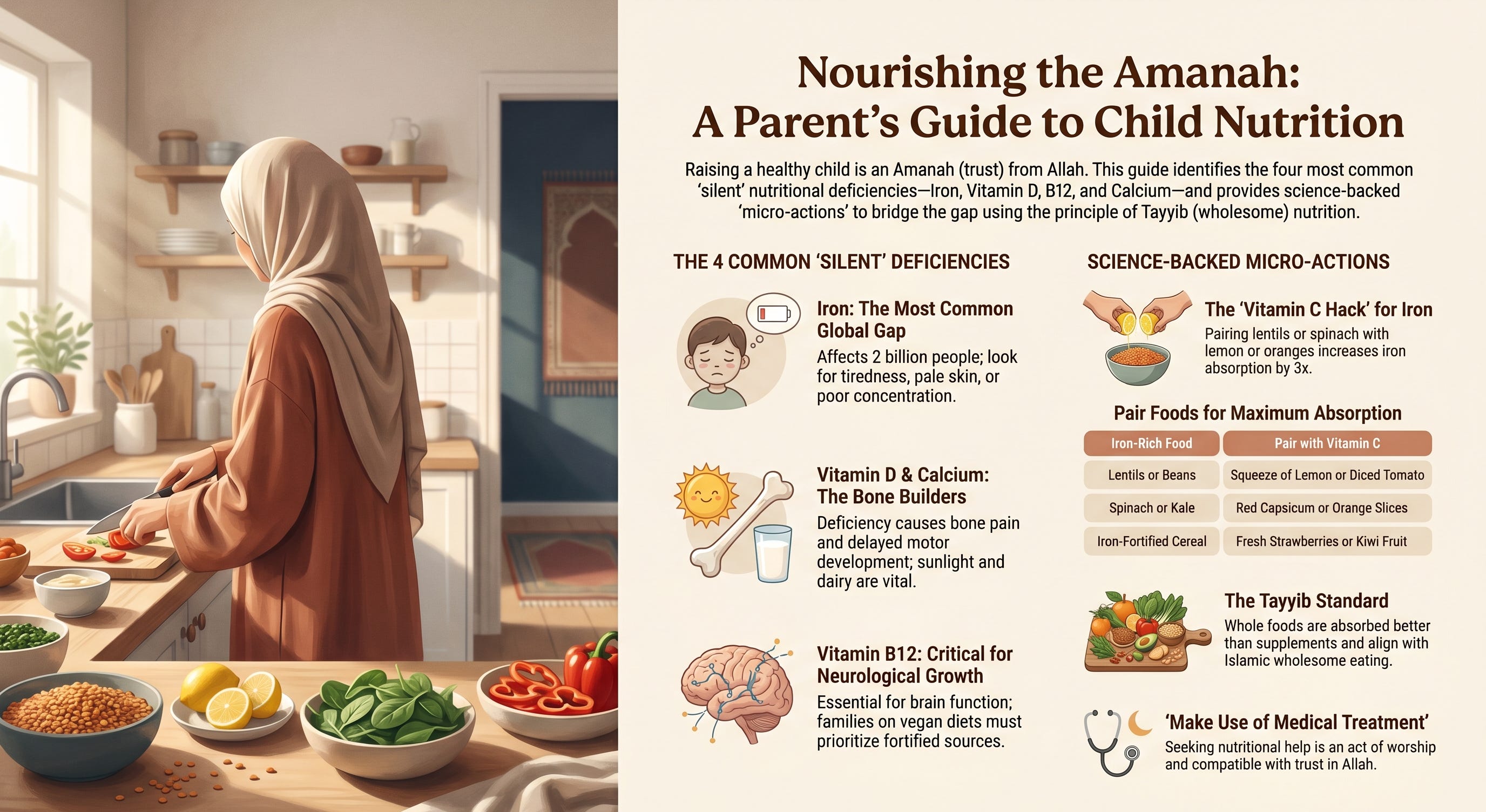
Here’s something that surprised me when I first looked into this: the nutrients most likely to be missing from your child’s diet are not the exotic ones. They’re the ordinary ones. Iron. Vitamin D. Calcium. B12 in some cases. Things we assume our children are getting — until a routine blood test says otherwise.
I know you’re already doing so much. And I’m not here to add another layer of worry. What I want to give you is clarity — because nutritional deficiency in children is genuinely one of those things where knowing what to look for makes an enormous difference.
When I looked at The Lancet’s research, what stopped me wasn’t just the scale of iron deficiency worldwide. It was the quiet part. Toddlers with low iron don’t announce it. They just seem a little tired. A little slower. A little harder to engage. And in severe cases, the research links it to long-term effects on brain development. [1]
That’s not to scare you. It’s to say: this is worth understanding.
Why This Guide Is Different From Generic Child Nutrition Advice
Every recommendation is backed by peer-reviewed research and clinical guidelines — with specific numbers, not vague reassurances.
This isn’t just a nutrient list. It connects food choices to the Islamic principle of eating what is halal and tayyib — wholesome and genuinely good — and to the amanah of raising a healthy child.
You’ll receive a free Growing Right Companion Pack — a printable 3-page PDF with a deficiency warning signs card, a food-pairing guide, and an Islamic du’a for your child’s health and provision — so this knowledge stays with you beyond the article.
The Foundation Your Child’s Body Is Built On
Growing children need vitamins and minerals for almost everything: strong bones, a sharp mind, immune defence, and the quiet ongoing work of development that parents rarely see but bodies are always doing.
The research is consistent. Variety is the single most powerful nutritional tool available to families. [2] Not superfoods. Not supplements. A rotating range of whole foods across the five groups: vegetables and legumes, fruit, whole grains, protein foods, and dairy or fortified alternatives.
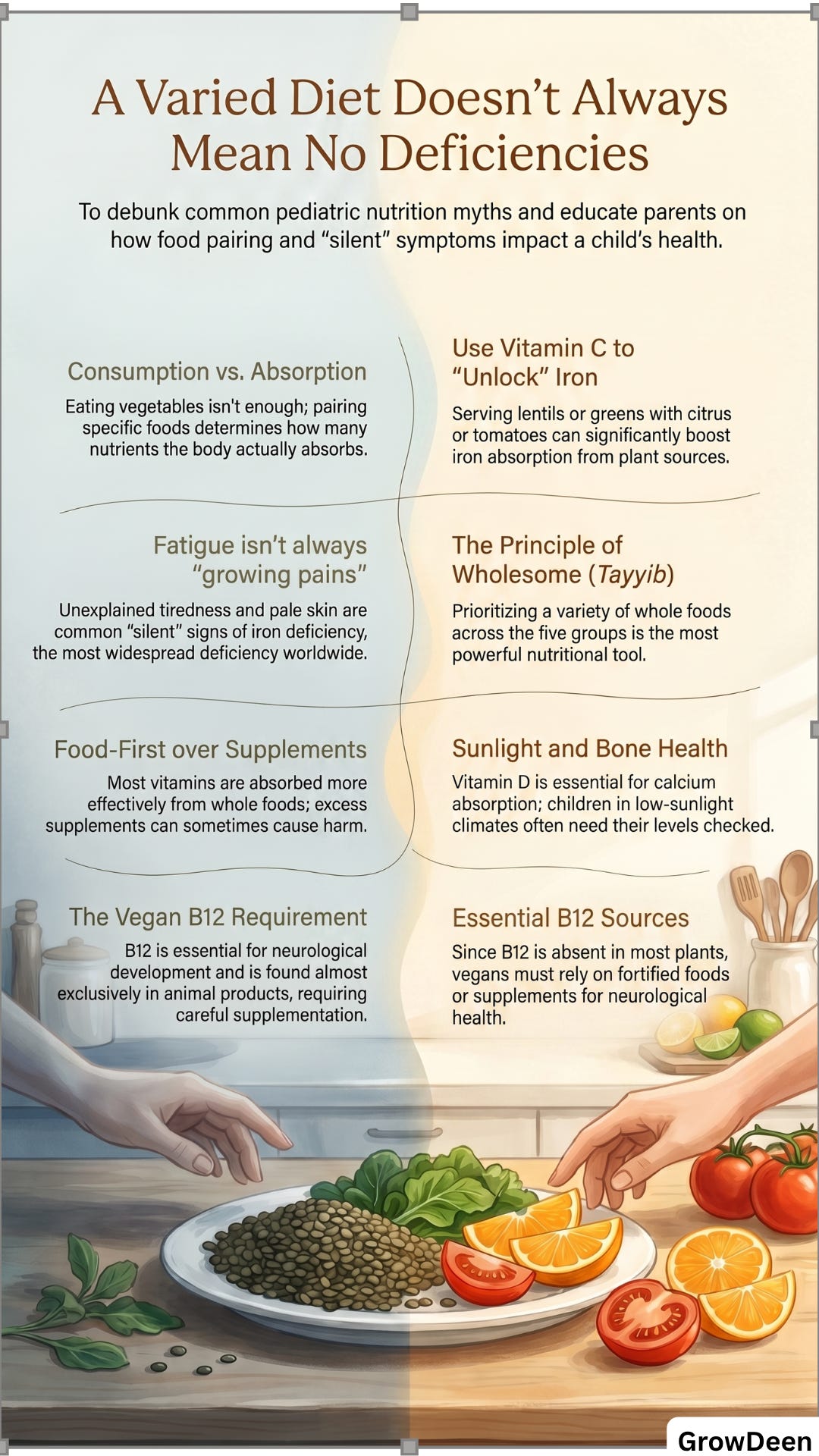
Here’s why that matters practically: most vitamins and minerals are also absorbed more effectively from food than from supplements. [3] The body recognizes them in their natural form. This is one reason why the tayyib standard our deen set for us — food that is genuinely wholesome — is not just spiritually meaningful but nutritionally real.
What the Research Says About Each Key Nutrient
Vitamin A — from leafy greens, orange vegetables, oily fish, eggs, and full-fat dairy — supports vision, immunity, and growth. [3] Because it’s fat-soluble and stored in the body, food sources are safer than high-dose supplements.
The B vitamins work as a team. B1, B2, and B3 help the body release energy from food. B6 supports brain function and red blood cell production. B12 — found almost entirely in animal products — is essential for growth and neurological development. [3]
Here’s the thing about B12: if your family eats vegan, this one conversation with your doctor is genuinely important. B12 deficiency in children on vegan diets is a real risk, and it can lead to a form of anaemia with neurological consequences. [4] Fortified foods or supplements need to be part of the plan, consistently, not just occasionally.
Vitamin C does two jobs most parents don’t know about. Yes, it supports immunity. But it also significantly boosts iron absorption from plant sources. [5] A squeeze of lemon over lentils. Orange slices alongside a bean dish. These aren’t just nice additions — they genuinely change how much iron your child’s body absorbs.
Vitamin D is mostly made by the body through direct sunlight. Small amounts come from oily fish, egg yolks, and mushrooms grown in UV light. [3] Without enough, calcium simply cannot build bone properly. Serious deficiency causes rickets, delayed motor development, and bone pain. [6]
Children who spend most time indoors, live in lower-sunlight climates, or whose skin is more deeply pigmented may need their levels checked. Ask your doctor.
Calcium builds the bones your child will carry for the rest of their life. Getting it right in childhood directly affects bone density in adulthood. [7] Sources: dairy products, fortified dairy alternatives, tofu, sardines with edible bones, and some leafy greens.
Iron — the most commonly deficient mineral in children globally [1] — carries oxygen throughout the body and is essential for brain function. Signs of low iron: unusual tiredness, poor concentration, paler skin. In severe cases, iron deficiency anaemia has been linked to long-term effects on cognitive development in toddlers. [1]
Children most at risk: those eating vegan or vegetarian diets, limited variety diets, those with coeliac disease, or girls experiencing heavy periods in adolescence.
Zinc supports growth, wound healing, and immunity. [3] Toddlers on restricted diets are most vulnerable — zinc deficiency can visibly slow a child’s growth.
I know this is a lot to hold in your head, especially when you’re planning meals, managing mealtimes, and trying to get a toddler to eat anything other than plain bread. That’s exactly why I created the Growing Right Companion Pack — a free printable PDF designed to keep this knowledge where you’ll actually use it. Keep reading to download it at the end.
The Deficiencies Most Worth Watching For
Not everything needs equal attention. These four are genuinely more common:
Iron deficiency is the most widespread nutritional deficiency in children worldwide — often silent until it’s significant. [1]
Vitamin D deficiency is common in children with limited outdoor time or who live in lower-sunlight environments. Serious deficiency causes bone disease and delayed development. [6]
Vitamin B12 deficiency is a real risk for children on vegan diets, with potential neurological consequences. [4]
Calcium deficiency over years leads to weaker bones and increased fracture risk; in severe cases, rickets. [7]
If your child has a restricted diet, a chronic condition like coeliac disease that affects gut absorption, or you’ve noticed the warning signs above, a blood test is the most useful next step.
What Islam Teaches About Caring for the Body We’ve Been Given
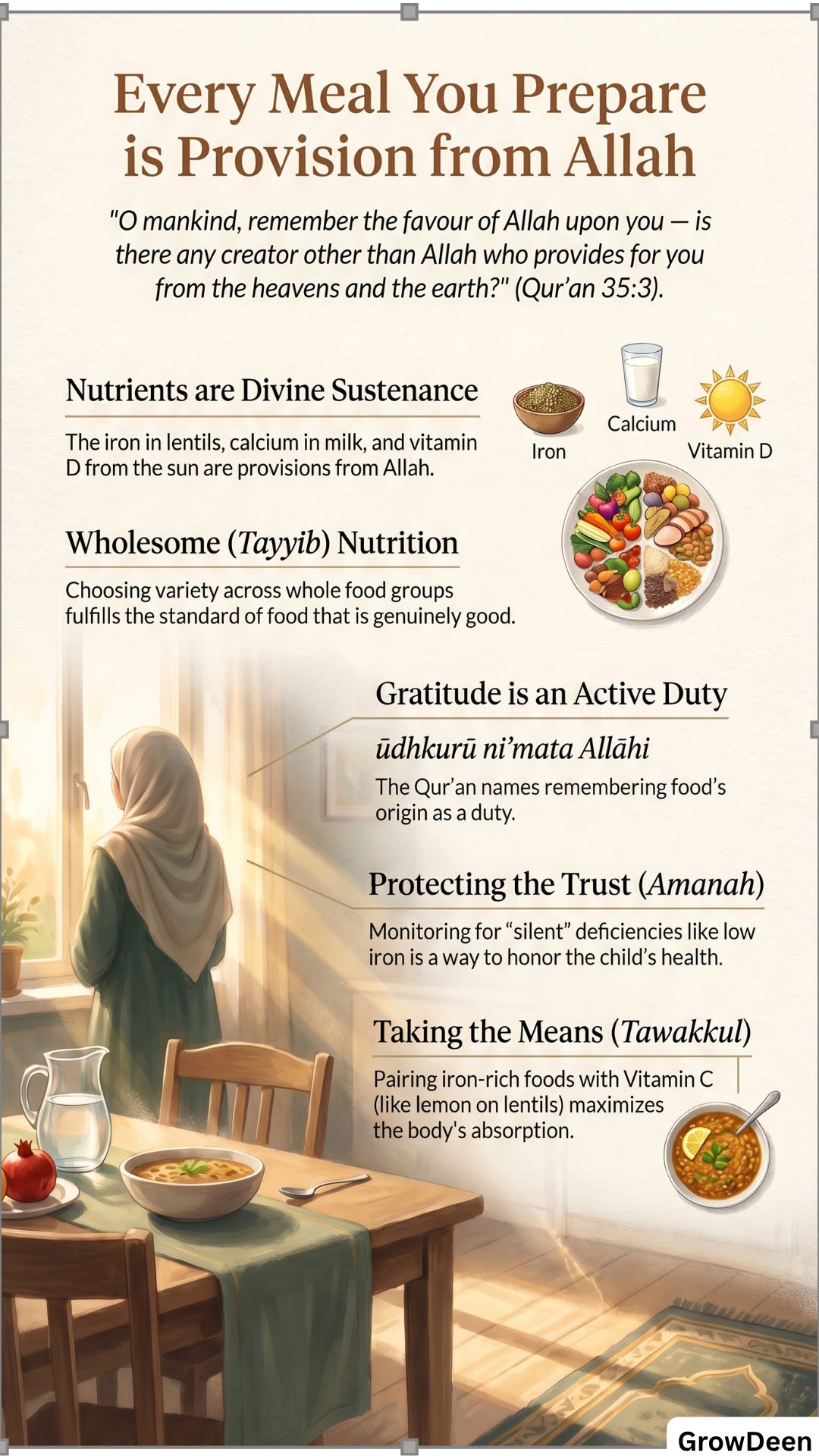
When I think about what Islam asks of us as parents, there’s a verse I keep returning to. In Surah Fatir, Allah says: “O mankind, remember the favour of Allah upon you. Is there any creator other than Allah who provides for you from the heavens and the earth?” [Qur’an 35:3]
According to Tafsir Ibn Kathir, this verse is a direct call to gratitude — not to forget that every provision, every nourishing food, every means of sustenance, comes from Allah alone. What strikes me about it in the context of this article is how active that gratitude is meant to be. Not just saying Alhamdulillah over a plate, but actually using what He has provided with knowledge and care.
The Prophet ﷺ was asked whether the Companions should seek medical treatment. He said: “Make use of medical treatment, for Allah has not made a disease without appointing a remedy for it.” [Sunan Abi Dawud 3855 — Sahih] [12] Scholars note that this hadith affirms the compatibility of seeking remedy with tawakkul — taking the means and trusting Allah is not a contradiction; it is the Sunnah.
Nutritional deficiency is a medical condition. Getting a blood test, adjusting the diet, asking a dietitian for help — these are the means. Doing it with intention, Bismillah, and trust in Allah is what makes the effort an act of worship.
The Growing Right Companion Pack
If you’ve read this far, you’re the kind of parent who thinks carefully about what goes into their child’s body — not as anxiety, but as love. That already says something beautiful about you.
Inside the Growing Right Companion Pack (one comprehensive PDF, 3 pages):
Page 1: The Deficiency Warning Signs Card — A quick-reference card listing the 4 most common deficiencies in children with their most likely warning signs (tiredness for iron, bone pain for vitamin D, slow growth for zinc, pale skin and concentration issues for B12) — designed as a laminated card to keep on the fridge or in a kitchen drawer, so you have it when something feels off.
Page 2: The Iron + Vitamin C Pairing Guide — A practical guide showing which iron-rich foods pair best with which vitamin C sources to maximise absorption — designed as a simple two-column reference card so you can build this habit into everyday meals without having to remember rules.
Page 3: Du’a for Your Child’s Health and Provision — The Prophet ﷺ made this du’a specifically for a child, asking Allah to bless the child’s provision and what He has given them. [Sahih al-Bukhari 1982] With Arabic text, transliteration, and English meaning — a card to keep in your kitchen or recite when you serve a meal, as a reminder that every plate you set down is an act of amanah.
This isn’t a PDF to download and forget. It’s designed to stay in your kitchen — where the nourishing actually happens.
This Growing Right Companion Pack is what every subscriber receives with each article. MPL covers the full journey of raising Muslim children — everything backed by research and rooted in Islamic wisdom.
If you’re a Muslim parent who wants both evidence-based guidance and Islamic perspective, subscribe for free so future resources arrive in your inbox before you need them.
Subscribe free for parenting resources backed by both science and Sunnah — guidance so unique, you literally can’t get it anywhere else — no spam, no clutter, just resources that matter.
Your Micro-Action
Tonight at dinner, try this: serve whatever iron-rich food you’re having — lentils, beans, meat, dark leafy greens — alongside something with vitamin C. A squeeze of lemon. A handful of cherry tomatoes. Some sliced orange on the side. That one combination meaningfully increases how much iron your child absorbs. [5] You don’t need to overhaul anything. Just this one thing, tonight.
May Allah bless your efforts, place barakah in every meal you prepare, and make the children in your care healthy, strong, and beloved to Him.
Think of One Person
Think of one person right now: a sister whose toddler is fussy and always tired, a friend whose new baby is approaching the stage where diet starts mattering, a mother at the masjid who mentioned her child “doesn’t really eat much.”
This article could help them. Share it with them today — not as advice-giving, but as care. Sometimes the most loving thing we can do is pass along something that might help before a problem develops.
Frequently Asked Questions
Q: How do I know if my child is iron deficient? A: The most common signs are unusual tiredness, difficulty concentrating, and paler skin than usual. In toddlers, slowed development can also be a sign. [1] A simple blood test from your doctor can confirm it — if you’re concerned, that’s always the right first step. For more detail, see the Iron section above.
Q: Does my child need a multivitamin? A: Most children eating a varied diet across the five food groups don’t need one. Vitamins and minerals are absorbed better from food than supplements. [2] If your child has a restricted diet (especially vegan), a chronic condition, or a confirmed deficiency, your doctor may recommend one appropriate for their age. [3] Don’t supplement without checking first — some vitamins accumulate in the body at high doses.
Q: Is vitamin D deficiency really that common in children? A: Yes — more common than most parents expect, particularly in children who spend significant time indoors or live in lower-sunlight climates. [6] It’s worth discussing with your doctor if your child fits that profile, especially in autumn and winter.
Q: My child eats a vegetarian diet. What should I be most careful about? A: Iron and zinc are the most common concerns in vegetarian diets, since non-haem iron (from plants) is absorbed less efficiently than haem iron (from meat). [1] Pairing plant-based iron sources with vitamin C foods is essential. If your child eats vegan rather than vegetarian, B12 and calcium need close attention too — speak with a paediatric dietitian for a complete plan. [4]
Q: Can vitamin and mineral supplements interact with medicines? A: Yes. If your child is on any prescribed medication and you want to add a supplement, always let the prescribing doctor know before starting. [3] This is important enough to check every time.
Q: At what age should I start thinking about my child’s nutrient intake? A: From the introduction of solid foods — around 6 months — is when it starts to matter practically. Iron is a particular priority from this point because breast milk doesn’t provide enough for rapid growth. [1] For older children and teenagers, the key watchpoints shift to calcium (for bone development), iron (especially for girls), and vitamin D throughout.
References
[1] Lopez, A., Cacoub, P., Macdougall, I.C., & Peyrin-Biroulet, L. (2016). Iron deficiency anaemia. The Lancet, 387(10021), 907–916. https://doi.org/10.1016/S0140-6736(15)60865-0
[2] National Health and Medical Research Council (NHMRC). (2018). Nutrient reference values for Australia and New Zealand. Retrieved from https://www.eatforhealth.gov.au/nutrient-reference-values
[3] Moses, G. (2021). The safety of commonly used vitamins and minerals. Australian Prescriber, 44(4), 119–123. https://doi.org/10.18773/austprescr.2021.029
[4] Da Silva Lopes, K., Yamaji, N., Rahman, M.O., Suto, M., Takemoto, Y., Garcia-Casal, M.N., & Ota, E. (2021). Nutrition-specific interventions for preventing and controlling anaemia throughout the life cycle: An overview of systematic reviews. Cochrane Database of Systematic Reviews, 9, CD013092. https://doi.org/10.1002/14651858.CD013092.pub2
[5] Das, J.K., Salam, R.A., Mahmood, S.B., Moin, A., Kumar, R., Mukhtar, K., Lassi, Z.S., & Bhutta, Z.A. (2019). Food fortification with multiple micronutrients: Impact on health outcomes in general population. Cochrane Database of Systematic Reviews, 12, CD011400. https://doi.org/10.1002/14651858.CD011400.pub2
[6] Kirby, M., & Danner, E. (2009). Nutritional deficiencies in children on restricted diets. Pediatric Clinics of North America, 56(5), 1085–1103. https://doi.org/10.1016/j.pcl.2009.07.003
[7] Australian Bureau of Statistics. (2013). Australian health survey: Biomedical results for nutrients, 2011–12. Commonwealth of Australia. Retrieved from https://www.abs.gov.au/ausstats/abs@.nsf/Lookup/4364.0.55.006Chapter1202011-12
[8] National Health and Medical Research Council (NHMRC). (2013). How much do we need each day? Retrieved from https://www.eatforhealth.gov.au/food-essentials/how-much-do-we-need-each-day
[9] Australian Bureau of Statistics. (2017). Australian health survey: Consumption of food groups from the Australian dietary guidelines, 2011–12. Commonwealth of Australia. Retrieved from https://www.abs.gov.au/AUSSTATS/abs@.nsf/Lookup/4364.0.55.012Main+Features100032011-12
[10] Moses, G. (2021). (Cited as [3]; re-cited here for supplement interaction context.)
[11] The Noble Qur’an. Surah Fatir, 35:3. Translation: Sahih International. Tafsir Ibn Kathir confirmed via Alim.org: “Do not be ungrateful — do not forget that whatever you have has been given by Allah.” Ibn Kathir explains this verse calls all people to recognise that provision from heaven and earth comes from Allah alone.
[12] Sunan Abi Dawud 3855. Narrated by Usamah ibn Sharik. Book 29 (Kitab al-Tibb), Hadith 1. Graded Sahih by Sheikh Al-Albani. Verified at Sunnah.com: https://sunnah.com/abudawud:3855
[13] Sahih al-Bukhari 1982; Sahih Muslim 660. The Prophet ﷺ made du’a for Anas ibn Malik: “Allahumma akthir malahu wa waladahu, wa barik lahu fima a’taitahu” — O Allah, increase his wealth and offspring, and bless him in what You have given him. Verified in both Sahih al-Bukhari and Sahih Muslim.