

Up to 5% of children experience breath-holding spells before age 6, according to a peer-reviewed paediatric review (Current Pediatric Reviews, 2019). [1] This guide shows you exactly what’s happening in your child’s body and the 5-step response that takes the panic out of 60 terrifying seconds.
Your toddler is crying. Then — silence.
Their lips are turning blue. They’ve gone completely still. They’re not breathing. And you’re frozen there, convinced something is very, very wrong.
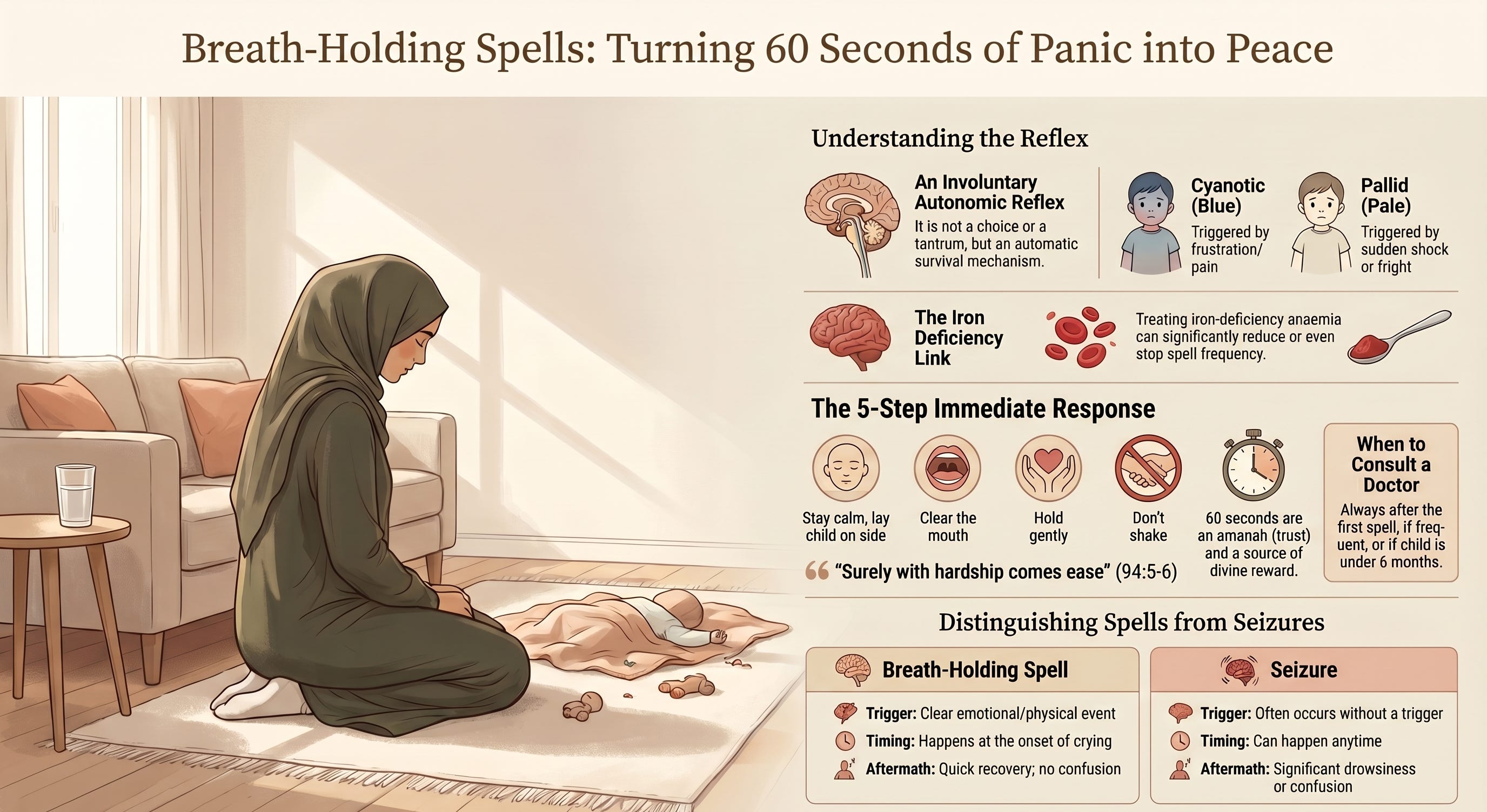
Here’s what you need to hear right now: this is a breath-holding spell, and it is not dangerous.
Your child is not choosing this. Their body triggered an involuntary reflex — as automatic as a blink. They cannot stop it. And in almost every case, it ends on its own within 60 seconds, without any intervention from you. [1]
That doesn’t make it easy to watch. But knowing what it actually is — the physiology, the pattern, the signs that truly need medical attention — means you can move through it with knowledge instead of terror.
And honestly? That changes everything. For them, and for you.
Why This Guide Is Different From Generic Parenting Advice
It explains the biology, not just the reassurance. Most people tell you “it’s harmless, don’t worry” and stop there. That’s not enough. Understanding why it happens is what makes the calm real — not performed.
It gives you an ordered action plan for the moment it happens. Specific steps, in sequence, that you can follow even when your hands are shaking.
You’ll also get the free Breath-Holding Spell Parent Toolkit — a printable 3-page guide designed to stay in your first aid drawer and share with every caregiver who looks after your child.
What Is Actually Happening in the Body?
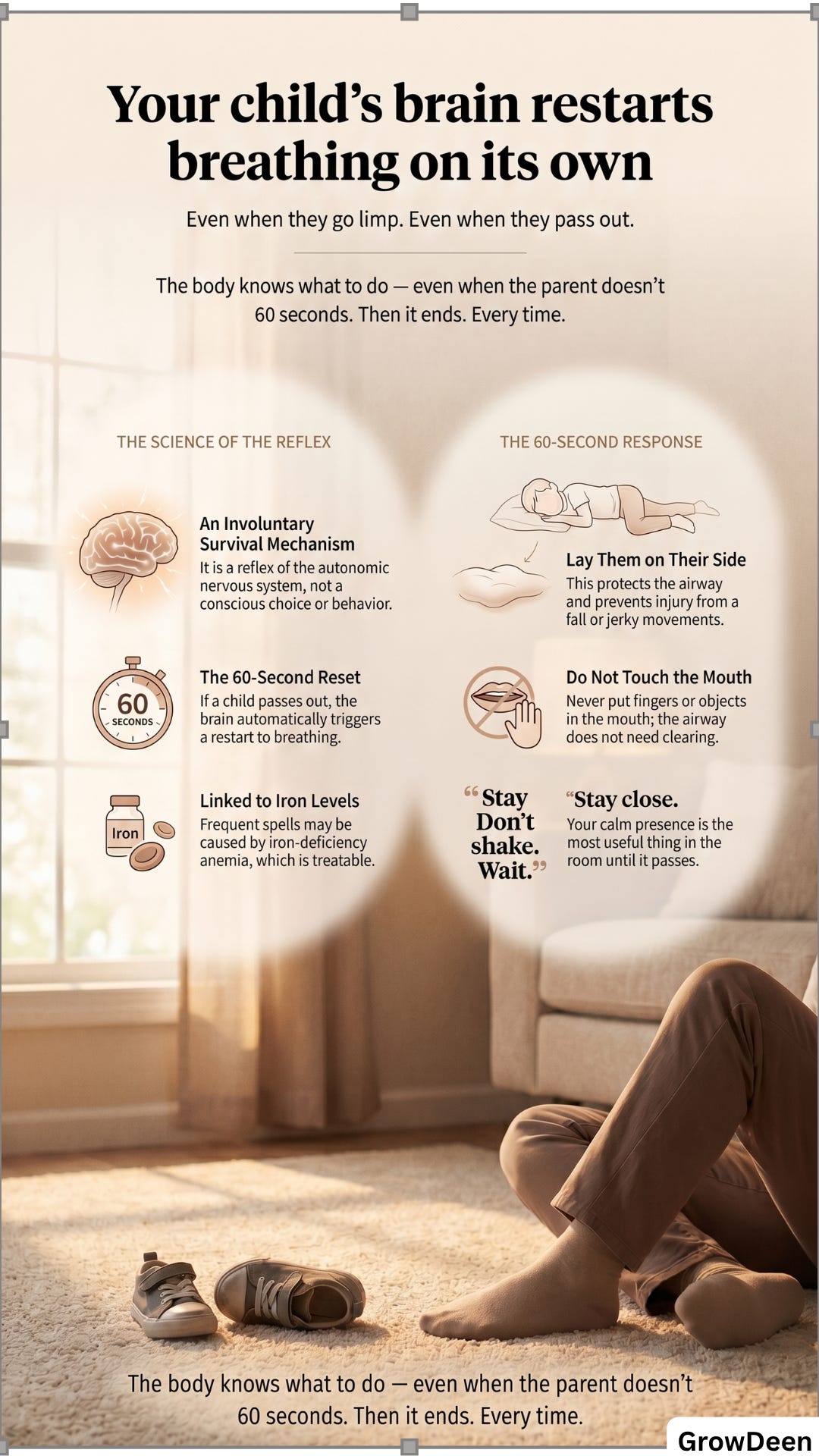
Here’s why it looks so frightening: breath-holding spells involve the autonomic nervous system — the part of your body that controls heartbeat and breathing without any conscious input. When your child cries intensely, experiences sudden pain, or gets a sharp fright, their breathing involuntarily stops at the peak of exhale. It’s a reflex, not a decision. [1]
There are two types.
Cyanotic breath-holding (the common kind) is triggered by emotional upset — frustration, pain, a big cry. The child exhales hard, holds it, and within seconds the face and lips turn a bluish-purple colour as blood oxygen briefly drops. [1]
Pallid breath-holding is less common and different in feel. It’s usually triggered by sudden shock — a knock to the head, cold water on the face. The child may not even cry. Instead, the heart rate slows sharply, the skin goes pale, and they may sweat. [1]
Both end on their own. Here’s the thing most parents are never told: if a child loses consciousness during a spell, the brain’s own survival mechanism automatically restarts breathing. There is no lasting harm. No brain damage. Consistent research confirms this, even in spells where consciousness is lost entirely. [1]
Who Gets Them and When Does It Stop?
Breath-holding spells affect around 5% of children, with roughly equal rates in boys and girls. [1] They can begin as early as 6 months, are most common between 6 and 18 months, and the vast majority of children stop having them entirely by age 6.
Here’s a finding that surprises most parents: iron-deficiency anaemia is directly linked to more frequent spells. Studies have shown that treating iron deficiency — sometimes with simple supplementation under medical guidance — can significantly reduce spell frequency, and in some cases stop them completely. [2][3] If your child is having spells more than once a week, ask your doctor for a blood test. It may be the most practical step you can take.
One more thing: there’s a genetic link. Around 25% of children with breath-holding spells have a family member who had them too. [4] If you held your breath as a child, this context might bring unexpected peace.
What To Do During a Spell — In Order
I know that remembering this in the middle of a spell feels impossible. That’s exactly why I’ve created the free Breath-Holding Spell Parent Toolkit — a printable quick-reference card designed to stay in your first aid drawer and hand to every person who cares for your child. Keep reading to download it at the end.
But for now: here are the 5 steps.
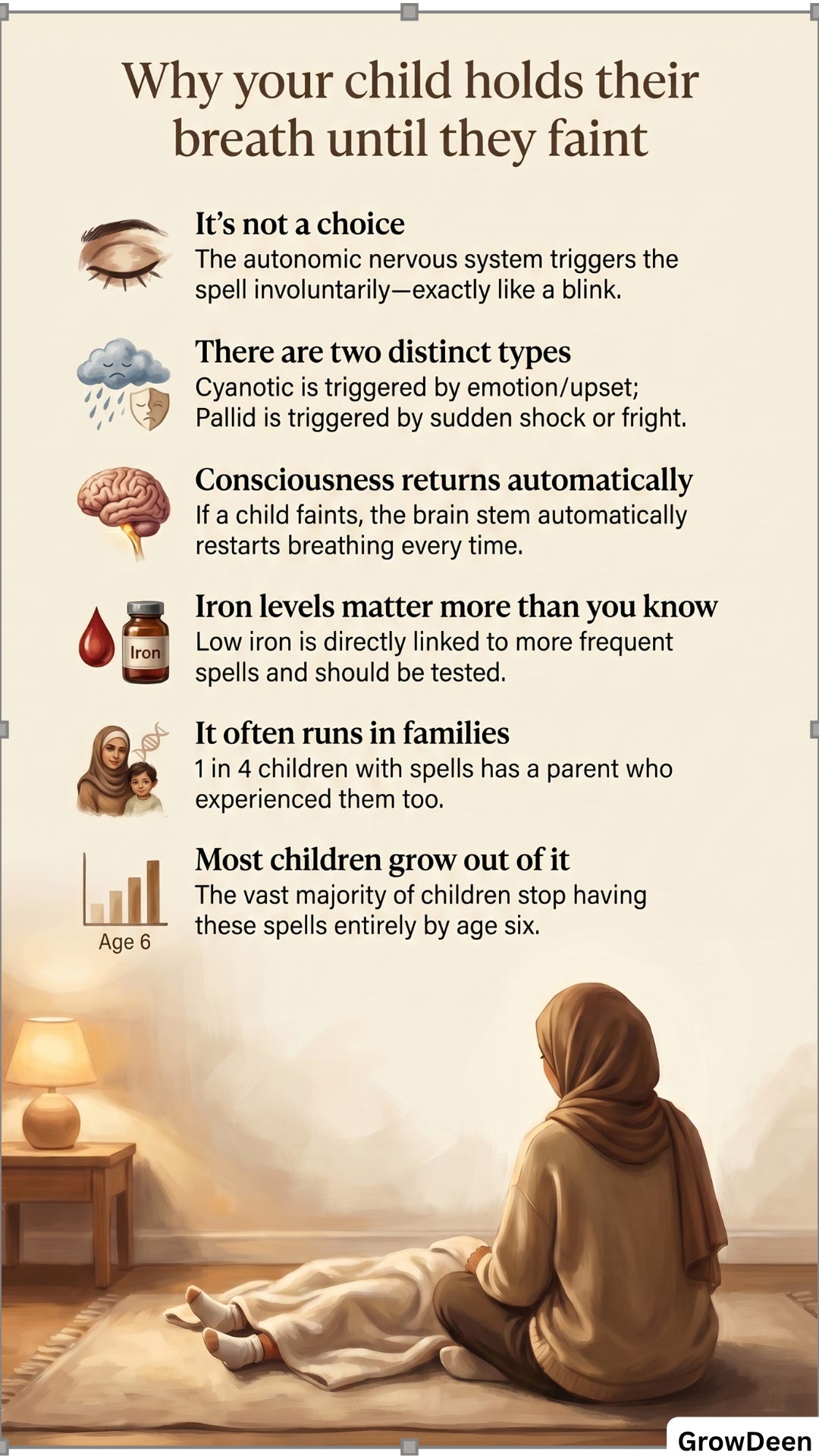
1. Stay calm. The spell will end. Your steadiness is the most useful thing in the room.
2. Lay your child on their side. This protects the airway and prevents injury if they fall.
3. Do not put anything in your child’s mouth. Not fingers, not a spoon, nothing. The airway doesn’t need to be cleared — leave it alone.
4. If your child has jerky movements, hold them gently. Support their head and limbs to prevent injury, or move hard objects away. This secondary movement is a reflex and will stop.
5. Don’t shake your child. It doesn’t end the spell. It can cause harm.
Stay close until it’s over. Once they come around, resist the urge to dramatise it. A quiet “You’re okay. Alhamdulillah” is enough.
What Would Make You Call a Doctor?
The first time your child has a breath-holding spell: see a doctor. Not because spells are dangerous — but because you want a professional to confirm that’s what it is, and rule out seizure disorders or cardiac arrhythmias that can look similar.
After that, return to a doctor if:
Your child is younger than 6 months
Spells are happening more than once a week (iron deficiency should be ruled out)
Your child is confused or difficult to wake after the spell
Stiffening or jerking lasts longer than one minute
Spells begin suddenly with no prior history
When in doubt, go. Seeking medical care is not overreacting — it’s part of fulfilling the responsibility you were given.
The Islamic Perspective: When 60 Seconds Feels Like an Eternity
When I think about what Allah says about children, one verse comes back to me again and again. In Surah Al-Kahf, He says: “Wealth and children are the adornment of this worldly life.” [Qur’an 18:46] [7]
Ibn Kathir explains this verse as speaking to how children are among the most precious of what we have been given — gifts that beautify this life, but gifts that come with an immense responsibility to protect and care for. They are not ours in any permanent sense. We are entrusted with them.
And then there are the moments when that trust feels overwhelming. The 45 seconds your child doesn’t breathe. The moment you can’t tell if they’re okay. You’re not in control — and for a parent, there is almost no feeling harder than that.
But here’s what the Qur’an places directly beside hardship, twice in two consecutive verses — as if to make absolutely sure we don’t miss it: “So surely with hardship comes ease. Surely with hardship comes ease.” [Qur’an 94:5-6] [8]
Scholars of tafsir note that hardship is mentioned once (a definite noun) while ease is mentioned twice (an indefinite noun) — meaning Arabic grammar gives us two eases for every one hardship. The Prophet ﷺ is reported to have said: ‘One hardship cannot overcome twofold ease.’” (Reported in Tafsir Maariful Quran via Hasan al-Basri)
The spell ends. It always ends.
The Prophet ﷺ told Ibn Abbas directly: “Know that victory comes with patience, relief comes with affliction, and with hardship comes ease.” [Musnad Ahmad 2803 — Sahih] [9] This wasn’t abstract advice. It was a teaching specifically about what a believer does in the moment of difficulty: they hold their ground, they act on what they know, and they trust the outcome to Allah.
There’s one more thing I want you to carry with you. The Prophet ﷺ said: “Nothing afflicts a Muslim of hardship, nor illness, nor anxiety, nor sorrow, nor harm, nor distress — not even the prick of a thorn — but that Allah will expiate his sins because of it.” [Sahih al-Bukhari 5641, Sahih Muslim 2573] [10]
Those frightening seconds you watch your child through a spell — they are not wasted. Not a single moment of distress you endure for the sake of your child passes unnoticed by Allah.
Getting This Information to the People Who Need It
If you’ve read this far, you’re clearly the kind of parent who takes their child’s safety seriously — not from anxiety, but from love. That tells me something.
The thing about breath-holding spells is that grandparents, aunts, nursery teachers, and childminders are often the ones present when they happen — and they’re usually the least prepared. A parent who panics in the moment is completely understandable. A caregiver who doesn’t know what they’re seeing is a different problem.
Inside the Breath-Holding Spell Parent Toolkit (one comprehensive PDF, 3 pages):
Page 1: What’s Happening & What To Do — Emergency Reference Card — A two-column reference card showing the type of spell, what you’re seeing, and exactly what to do and what NOT to do — designed as a laminated card you can keep in your first aid kit, diaper bag, or hand to your child’s childminder before their first day.
Page 2: Triggers, Patterns & Prevention Planner — A practical two-section sheet to help you identify your child’s personal triggers (overtiredness, hunger, transitions, sudden frights) and plan one meaningful change this week — with 5 short prompts to make it feel manageable rather than overwhelming.
Page 3: Du’as for Frightening Parenting Moments — Three authentic du’as from the Sunnah specifically connected to moments of parental fear, asking Allah’s protection over your child, and finding calm when your heart is racing. Includes Arabic text, transliteration, English meaning, and a brief note on when to use each.
This isn’t just a PDF to download and forget. It’s a tool designed to stay in your first aid drawer — where you’ll actually use it when you need it most.
This Toolkit is what every GrowDeen subscriber receives with each article. We cover the full journey of raising Muslim children — from newborns through adolescence — all backed by research and rooted in Qur’an and Sunnah.
If you want both evidence-based guidance AND Islamic perspective arriving in your inbox before you need it, subscribe free below.
Subscribe free for parenting resources backed by both science and Sunnah — guidance so unique, you literally can’t get it anywhere else. No spam, no clutter, just resources that matter.
One Thing To Do Before You Move On
Save this to your phone right now, in your contacts or notes: “Lay them down. Stay close. Don’t touch the mouth. Wait.”
That’s it. Four words. That’s what your brain will reach for when your hands are shaking.
Pass This On
Think of one person right now: the grandmother in your family who regularly looks after your toddler and has never heard the term “breath-holding spell,” your sister whose two-year-old just started having tantrums, a close friend who mentioned at the last family gathering that her child had a terrifying episode no one could explain.
This article could spare them the panic you felt reading those first few paragraphs. Share it — not as a lecture, but as an act of care. Sometimes the most loving thing we can do is pass on knowledge before it’s needed.
Frequently Asked Questions
Q: Are breath-holding spells dangerous for my child’s brain? A: No. Even spells that lead to brief unconsciousness do not cause brain damage — the body’s survival mechanisms restart breathing automatically. [1] What looks catastrophic takes less than 60 seconds and leaves no lasting harm. For more detail, see “What Is Actually Happening in the Body?” above.
Q: My child turned blue and passed out. Should I call an ambulance? A: If this is the first time it’s happened, yes — get it medically assessed so you have a confirmed diagnosis. If spells have already been diagnosed and this one followed the usual pattern, call your doctor for a follow-up but an ambulance isn’t necessary. Call emergency services if your child remains blue or unresponsive for longer than a minute, or if the episode looks different from previous ones.
Q: Can breath-holding spells be caused by iron deficiency? A: Yes, and this is one of the most actionable findings around this topic. Studies show that treating iron-deficiency anaemia can significantly reduce or even stop breath-holding spells entirely. [2][3] If spells are happening more than once a week, ask your doctor for a blood test before assuming it’s purely behavioural.
Q: My child seems to hold their breath on purpose during tantrums. Are they doing it intentionally? A: I completely understand why it looks that way. But no — children cannot voluntarily trigger a breath-holding spell. The reflex is involuntary, driven by the autonomic nervous system. [1] What they’re not controlling is the spell itself. What matters is that your response stays calm and consistent, because giving in after a spell can reinforce the tantrum behaviour that came before it.
Q: What’s the difference between a breath-holding spell and a seizure? A: They can look similar, which is exactly why medical assessment after the first episode matters. Key differences: breath-holding spells are triggered by a clear emotional or physical event, happen at the onset, and don’t involve a confused post-spell phase. Seizures often occur without a clear trigger and are followed by significant drowsiness or confusion. [1] Your doctor can help confirm the diagnosis.
Q: My child is 3 months old and had what looked like a breath-holding spell. Is that normal? A: Breath-holding spells before 6 months are unusual and need prompt medical review. [1] In very young infants, episodes of colour change or breath-holding require assessment to rule out other causes. Please don’t wait on this one.
Q: Will my child grow out of breath-holding spells? A: Almost certainly, yes. Research consistently shows the vast majority of children stop having spells by age 6, most without specific treatment. [1] If spells are frequent, addressing iron deficiency can help. But for most families, time and informed calm are the two main tools.
References
[1] Leung, A.K.C., Leung, A.A.M., Wong, A.H.C., & Hon, K.L. (2019). Breath-holding spells in pediatrics: A narrative review of the current evidence. Current Pediatric Reviews, 15(1), 22–29. https://doi.org/10.2174/1573396314666181113094047
[2] Mocan, H., Yildiran, A., Orhan, F., & Erduran, E. (1999). Breath holding spells in 91 children and response to treatment with iron. Archives of Disease in Childhood, 81(3), 261–262. https://doi.org/10.1136/adc.81.3.261
[3] Kolkiran, A., Tutar, E., Atalay, S., Deda, G., & Cin, S. (2005). Autonomic nervous system functions in children with breath-holding spells and effects of iron deficiency. Acta Paediatrica, 94(9), 1227–1231. https://doi.org/10.1111/j.1651-2227.2005.tb02080.x
[4] Wikipedia contributors. (2024). Breath-holding spell. Wikipedia. https://en.wikipedia.org/wiki/Breath-holding_spell
[5] Sunan Abi Dawud 3855 — Hasan. “Make use of medical treatment, for Allah has not made a disease without appointing a remedy for it.”
[6] Sunan Abi Dawud 4943 — Sahih (Al-Arna’ut). “Whoever does not show mercy to our young ones, or acknowledge the rights of our elders, he is not one of us.”
[7] Qur’an 18:46 — Surah Al-Kahf. Sahih International translation. “Wealth and children are [but] adornment of the worldly life. But the enduring good deeds are better to your Lord for reward and better for hope.”
[8] Qur’an 94:5-6 — Surah Ash-Sharh. Sahih International translation. “For indeed, with hardship will be ease. Indeed, with hardship will be ease.” Ibn Kathir notes the repetition emphasises certainty; ease is mentioned twice (indefinite) against one hardship (definite).
[9] Musnad Ahmad 2803 — Sahih (verified authentic). Narrated by Ibn Abbas: “Know that victory comes with patience, relief comes with affliction, and with hardship comes ease.”
[10] Sahih al-Bukhari 5641, Sahih Muslim 2573 — Muttafaqun Alayhi (agreed upon by Bukhari and Muslim). Narrated by Abu Huraira: “Nothing afflicts a Muslim of hardship, nor illness, nor anxiety, nor sorrow, nor harm, nor distress — not even the prick of a thorn — but that Allah will expiate his sins because of it.”