

A 2015 review in Appetite found published rates of fussy eating running from 5.6% of four-year-olds in one Dutch study to 50% of two-year-olds in one American study. [1] This guide shows you which two nutrients actually matter, the seven-word sentence that ends most food battles, and what to do tonight.
The plate came back full again.
Same meal your child ate happily on Monday. Same bowl, same spoon, same everything. Tonight it gets pushed away with a firmness that feels almost personal.
So you did what the advice says. You stayed calm. You did not force it. You offered a second option, kept your voice light, sat down and ate the same food yourself. And your child looked at you, and refused harder.
That is the part nobody warns you about. Doing everything right does not always make it stop.
Now look at what researchers found when they tried to pin down how common this is. A 2015 review in Appetite collected prevalence figures from studies across several countries and found them ranging from 5.6% of four-year-olds in a Dutch sample to 50% of two-year-olds in an American one. [1] Nearly a tenfold spread, for the same behaviour.
Sit with that number for a second, because it tells you something the parenting forums will not. Fussy eating is so common and so loosely defined that whether your child gets the label depends more on which questionnaire someone hands you than on your child.
There is a question buried under that full plate, and it is not really about food. We will get to it.
Why This Guide Is Different
Every claim carries its source. Peer-reviewed research from Appetite, the American Journal of Clinical Nutrition, and the Journal of Pediatric Psychology, dated and cited, so you can check any of it.
The Islamic layer is not decoration. Qur’an 11:6 with Ibn Kathir’s own commentary, and a narration in Sahih Muslim that describes exactly the table behaviour the feeding research recommends.
You get the Calm Table Companion Pack free. A printable three-page PDF built around the refusal curve, the words to swap at dinner, and a reminder card for the nights when you have run out of patience.
The Question Underneath the Plate
The plate is the visible problem. It is rarely the real one.
Ask a parent what they are actually afraid of and it comes out sideways. Is she getting enough iron? Is he behind? Is this something I did? Underneath the refusal sits a private verdict a parent has quietly delivered on themselves.
Researchers found this too. A 2020 systematic review in the International Journal of Behavioral Nutrition and Physical Activity pooled qualitative studies of families with fussy eaters. One pattern came up repeatedly. Parents experience the behaviour as personal failure, even though the same patterns show up in households with completely different feeding styles. [2]
So name the thing you are actually up against. It is not your child. It is the idea that a refused plate is a report card on your parenting, because that idea is what turns dinner into a contest you feel you have to win.
And a contest is the one thing a two-year-old will never let you win.
Refusal Is a Curve, Not a Verdict
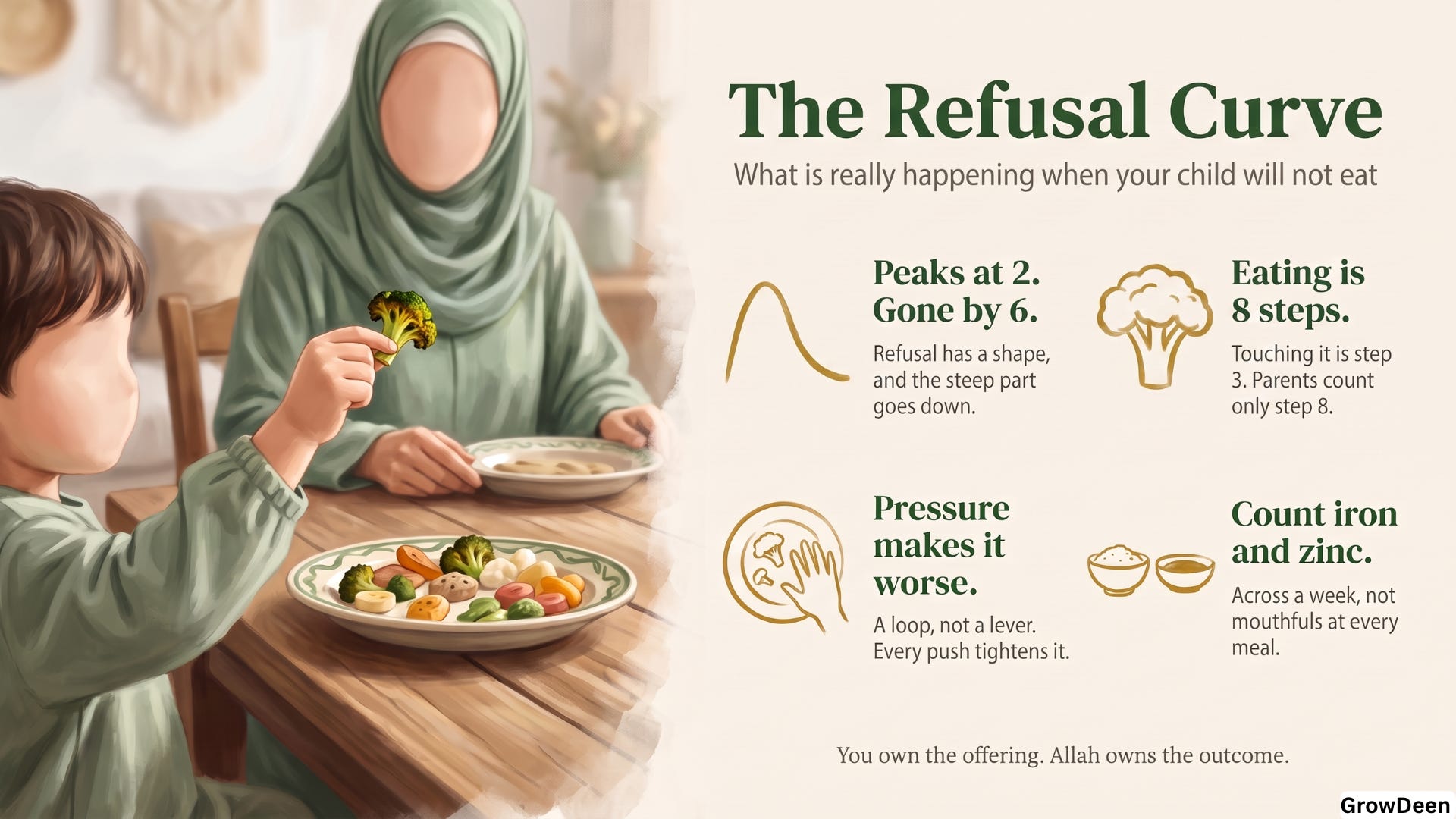
Food neophobia is the technical term for a child’s reluctance to eat unfamiliar food. A 2008 review in Appetite mapped it across the whole lifespan and found a clear shape: it rises quickly from birth, sits at its highest point between the ages of two and six, then falls away steeply. [3]
Read that again if you have a three-year-old.
You are standing at the top. Not on a slope that keeps climbing. The steep part is ahead of you, and it goes down.
There is a useful line at the bottom end too. Under twelve months, a child is still meeting textures and tastes for the first time and is generally considered too young to be experiencing neophobia at all. [11] A baby turning their head from a spoon is doing something different from a four-year-old refusing peas.
So why Monday and not Wednesday? Three things move independently in a small child. Appetite tracks growth spurts and activity, so intake swings hard between days. Bitterness lands harder on a young palate than an adult one, which is why brassicas take longest. And unfamiliar food registers as mildly risky by default, a caution that kept small humans alive long before supermarkets.
None of those three cares what your child ate on Monday.
Stop Counting Mouthfuls. Count Two Things.
Here’s why the nightly tally is the wrong measurement: it is not the one the research worries about.
When picky eaters at age three were compared with non-picky eaters, the meaningful differences turned up in carotene, iron, and zinc. Broader reviews land in the same place. Energy and protein often look lower, but the clearest consensus in the literature concerns low intakes of zinc and iron. [11]
That changes the question worth asking when the plates are cleared.
Not how much did she eat tonight. Instead: did iron and zinc get a route in this week? Red meat, chicken thigh, eggs, lentils, chickpeas, beans, fortified cereal, tahini, pumpkin seeds, yoghurt. Most of those cover both.
One free adjustment: serve an iron source alongside something with vitamin C in the same meal, because vitamin C improves how much iron the body absorbs. Lentils with tomato. Chicken with a few orange segments after.
If your child eats a narrow range, and that range includes an iron source, a protein, some dairy or its equivalent, and any fruit or vegetable at all, they are usually fine while the curve does its work.
If you suspect a real gap, ask a doctor rather than guessing. Nothing in an article replaces someone who has actually examined your child.
This is a lot to hold in your head at 6pm with a tired child and a cooling plate. That is exactly why we put together the free Calm Table Companion Pack: a printable three-page PDF with the refusal curve laid out by age, the exact words to swap at the table, and a reminder card for the nights it feels pointless. Keep reading and you can download it at the end.
Three Habits Quietly Making It Worse
Before adding anything, it is worth removing.
Pressure. A 2018 study in the Journal of Pediatric Psychology followed mothers and children over time and found the relationship runs in both directions. Fussier children draw more pressure from parents, and more pressure predicts more fussiness at the next measurement. [8] A loop, not a lever. Every “three more bites” tightens it.
The dessert bargain. Trading two spoons of broccoli for a biscuit teaches a lesson, just a precise and unhelpful one. Broccoli becomes the toll. The biscuit becomes the destination. You have now made the vegetable the price of something better.
The replacement plate. Cooking a second meal when the first is refused answers a question your child was asking, and the answer is: refusal works, and something better is always available.
There is a quieter cost running under all three. A child who is regularly pressured stops reading their own hunger and starts reading your face instead. Responsive feeding, where the caregiver provides and the child regulates the amount, is what nutrition position statements point to for exactly this reason. [10]
Which brings us to the division that actually works, and it fits in one line.
You decide what is served, when, and where. Your child decides whether and how much.
Handing over that second half feels like surrender. In practice it is the thing that ends the war.
But there is a deeper version of that division, and it is older than any feeding study.
Support Muslim Parenting Lab ❤️
Would you like a share in every good thing that comes from what you fund? Support it with the button below, at any level you choose.
The Prophet ﷺ said whoever sets a good precedent earns its reward and the reward of everyone who follows it. (Sahih Muslim 1017a)
Who Is Actually Feeding Your Child
That worry sitting under the refused dinner, the one about whether this child will get what they need, has an answer in the Qur’an that is more direct than most parents expect.
Allah says: “And there is no creature on earth but that upon Allah is its provision, and He knows its place of dwelling and place of storage. All is in a clear register.” [Qur’an 11:6] [14] According to Tafsir Ibn Kathir, Allah is informing us here that He has taken responsibility for the provisions of all creatures that dwell in the earth. Small or large, sea-dwelling or land-dwelling. [14]
Small or large. Your child sits inside that sentence.
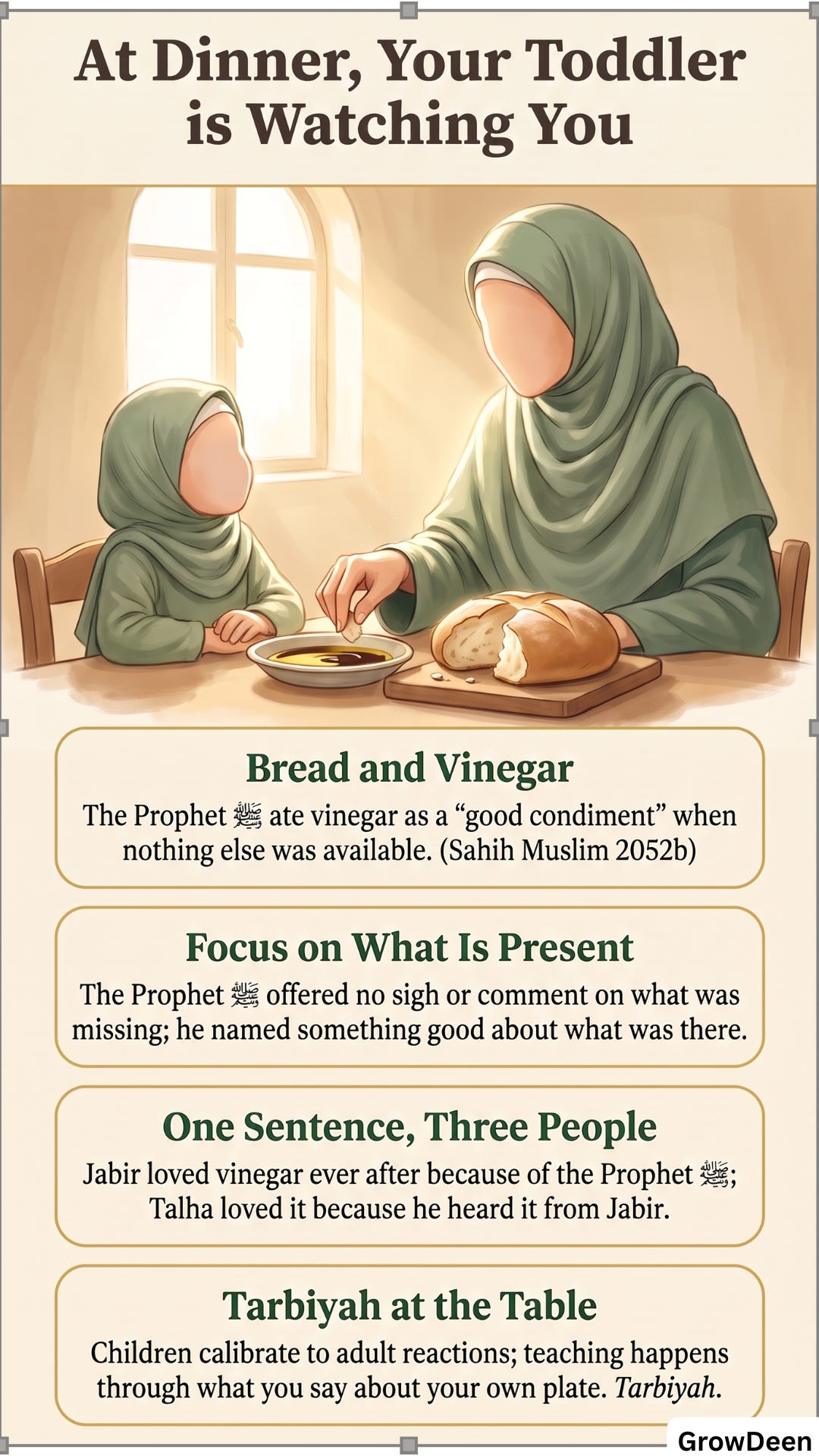
This is not a reason to put the plate away and wait. Jabir ibn Abdullah described the Prophet ﷺ taking him home for a meal of plain bread, asking whether there was a condiment, and being told there was nothing but vinegar. The Prophet ﷺ said vinegar is a good condiment, and ate. Jabir added that he loved vinegar ever after because of it, and Talha said he loved vinegar because of Jabir. [13] The Prophet ﷺ still asked, still sat, still ate. Taking the means is part of the design.
What the verse lifts is the weight you were never handed. You own the offering. Allah owns the outcome.
Look at what travelled in that narration, though. A liking passed from the Prophet ﷺ to Jabir, and from Jabir to Talha, carried by nothing but an attitude at a table. Your child is reading your face while you chew.
So What Does This Look Like at 6pm on a Tuesday?
Four things, and none of them require your child’s cooperation.
Offer it again. Then again. Most parents retire a food after two refusals. A randomised trial gave parents of children aged two to six one daily taste of a vegetable their child had already rejected, every day for fourteen days. Against families given nutritional information and families given nothing, the daily-taste group was the only one that improved on all three measures: liking, ranking, and how much was eaten. [4] A systematic review of repeated exposure in infants and toddlers reaches the same conclusion across a far wider evidence base. [5]
Fourteen days. One taste. Nothing said either way.
Put the target food beside something already liked. Keep the amount tiny, one floret, two beans, a quantity that cannot feel like a demand. Say nothing when it is refused. Count in weeks, not meals, because ten to fifteen offers before something shifts is ordinary.
Give a real choice, and keep it narrow. In a pre-registered study, 161 children aged four and five did a blind-choice task with three covered cups, each holding a vegetable. They could not see what they were choosing, so the result could not be dismissed as children picking a food they already liked. Choosing itself did the work. [6]
So: “Cucumber or carrot with your rice?” “Apple in slices or in pieces?” Two options. Three at the outside. An open fridge and an open question will flatten a four-year-old.
Let them touch it before they taste it. Research with three-year-olds found food rejection associated with tactile sensitivity and with how much a child enjoys touch. [7] A share of refusals are about texture, not flavour. The stages before eating are real stages: looking, touching, picking up, smelling, bringing it to the lips, licking, biting and spitting out, then chewing and swallowing. A child who turns a piece of broccoli over and puts it down has completed step three of eight. Say nothing. Offer it again in a few days.
Fix the twenty minutes, not the food. Family meals are associated with better dietary quality in young children, and the reason is unglamorous: children eat alongside people and copy what is near them. [9] So eat the same meal your child is eating rather than a separate adult version. Turn the screens off, because a child watching something is not tasting anything. Cap the meal at roughly twenty minutes, then clear the plate without comment and without a replacement. Serve small, since a full plate reads as a demand and a small one reads as an offer.
And keep your own dislikes to yourself at the table. A child who hears that you never liked aubergine has just been handed a position.
There is one more piece of this, and it happens before anyone sits down.

Put Their Hands in It First
Children who help prepare food get repeated contact with it under conditions where nobody expects them to eat any of it. Washing fruit, tearing salad leaves, stirring, counting out dates, watering a pot of mint on the windowsill, picking the leaves when they are ready.
That last one opens something worth doing on purpose.
Allah says in Surah al-An’am: “And [We produce] gardens of grapevines and olives and pomegranates, similar yet varied. Look at [each of] its fruit when it yields and [at] its ripening. Indeed in that are signs for a people who believe.” [Qur’an 6:99] [12] According to Tafsir Ibn Kathir, the instruction to look at the fruit as it bears and ripens is a call to contemplate the power of the One who brought these fruits into existence out of dry wood until they became grapes and dates. Ibn Kathir adds that the same applies to the different colours, shapes, tastes and scents of everything Allah created. [12]
Set that next to a plate and something rearranges. Colour. Shape. Taste. Scent. The four properties your fussy child is objecting to are the four the Qur’an points at as signs.
So cut a pomegranate open together and look at it before anyone eats. Hold a red pepper beside a green one. Smell mint, then coriander, and let your child tell you which is which. Say SubhanAllah over a piece of fruit where your child can hear you, and mean it.
None of that is a trick to get food swallowed. It teaches a child to look at food the way a believer is asked to look at it, and interest usually arrives before appetite does.
When to Speak to a Doctor
Most fussy eating needs patience rather than intervention. A child with energy to play and learn, growing along their own line, eating a reasonable spread across a week, is very likely fine.
Book an appointment with a doctor, paediatrician, or dietitian if your child eats only a very small number of foods or refuses whole food groups for longer than a few weeks. Also if weight is dropping or growth has visibly slowed, if eating causes pain, or if there is frequent gagging, choking, or vomiting.
Worth flagging separately: refusal that intensifies with age rather than easing. A 2023 study in Appetite found that picky eating persisting into the school years carries a distinct pattern of feeding difficulty and deserves proper assessment. [15]
And if you are simply worried, that is reason enough to ask. You do not need to justify the appointment.
Your Calm Table Companion Pack
If you have read this far, you are the kind of parent who wants to understand what is happening before deciding what to do about it. That says something about you.
Inside the Calm Table Companion Pack (one comprehensive PDF, 3 pages):
Page 1: The Refusal Curve, Age by Age. A visual chart running from age one to age eight showing where food refusal peaks and where it drops, with what counts as ordinary at each age and the specific signs that mean book an appointment. Designed as a fridge chart you can point to on the evenings when it feels like this will never end.
Page 2: The Table Script Card. Eight sentences parents say at dinner without thinking, each paired with the line to use instead, plus the iron and zinc food list on the reverse side. So you can change what happens at your table tonight without reading anything else.
Page 3: The Offering and the Outcome. A reminder card built on Qur’an 11:6 with Ibn Kathir’s commentary and the narration of the Prophet ﷺ at a meal of bread and vinegar (Sahih Muslim 2052b), setting out plainly what a parent is responsible for at the table and what belongs to Allah. For the nights when you have offered for the eleventh time and it went nowhere.
This is not a PDF to download and forget. It is built to live on your fridge door, at eye level, where dinner actually happens.
The Calm Table Companion Pack is what every subscriber receives with each article. At Muslim Parenting Lab we cover the whole span of raising Muslim children, from newborns through the early school years, all backed by scientific research and rooted in Islamic wisdom.
One Thing to Do at Dinner Tonight
Pick the one food your child has refused most often. Put a piece of it the size of your thumbnail on their plate, next to something they already like. Then say nothing about it. Not a word, not a look, not at the start of the meal and not when you clear the plate.
That is day one of fourteen. Start tonight.
May Allah place barakah in what you set on that table, ease in the offering, and reward in every attempt that seemed to go nowhere.
Think of One Person
Think of one person right now: the mother in your WhatsApp group who mentioned her four-year-old has been living on plain pasta for a month. Your sister who has quietly stopped putting vegetables out because she cannot face another argument. The friend who joked about it at the masjid in a voice that was not really joking.
Send this to her today. Not as advice, and not because you know better, but because the thing she needs most tonight is to hear that there is a curve and she is standing at the top of it.
Frequently Asked Questions
Q: At what age does fussy eating peak in children?
A: Between two and six years old. A 2008 review in Appetite mapped food neophobia across the lifespan and found it rises quickly from birth, peaks between those ages, then declines steeply. [3] If your child is three, you are at the top of the curve rather than the start of a slope.
Q: How many times should I offer a food before giving up?
A: Far more than most parents do. Ten to fifteen offers is ordinary, and a randomised trial found that a single daily taste over fourteen days improved liking, ranking, and intake of a previously rejected vegetable. [4] Two refusals is not a verdict, it is a Tuesday.
Q: Should I make my child a separate meal if they refuse dinner?
A: It is the most tempting option and the one that costs most later. A replacement plate teaches a child that refusal produces something better, and it removes the repeated exposure that actually builds acceptance. [5] Serve the family meal in a portion size your child can manage instead.
Q: Is it bad to bribe kids with dessert to eat vegetables?
A: It backfires. The trade turns the vegetable into a toll and the sweet into a prize, and pressure-based feeding practices predict more fussiness over time rather than less. [8] Serve dessert, when you serve it, without attaching conditions to it.
Q: What nutrients should I actually worry about with a picky eater?
A: Iron and zinc, more than total volume. When picky eaters at three were compared with non-picky eaters, the clearest gaps were in carotene, iron, and zinc. [11] Serve an iron source with something containing vitamin C in the same meal to improve absorption.
Q: When should I take my fussy eater to a doctor?
A: If your child eats only a very small number of foods or refuses entire food groups for more than a few weeks, if weight is dropping or growth has slowed, if eating is painful, or if there is frequent gagging or vomiting. Refusal that intensifies with age rather than easing also deserves assessment. [15] Being worried is itself a good enough reason to ask.
Q: What does Islam say about a child refusing food?
A: There is no ruling that requires a child to eat what is served, and the model the Prophet ﷺ gave at the table was gracious rather than forceful. Jabir ibn Abdullah described the Prophet ﷺ praising a plain meal of bread and vinegar rather than commenting on what was missing. [13] The parent’s part is the offering. The provision itself is with Allah. [14]
References
[1] Taylor, C.M., Wernimont, S.M., Northstone, K., & Emmett, P.M. (2015). Picky/fussy eating in children: Review of definitions, assessment, prevalence and dietary intakes. Appetite, 95, 349-359. https://doi.org/10.1016/j.appet.2015.07.026
[2] Wolstenholme, H., Kelly, C., Hennessy, M., & Heary, C. (2020). Childhood fussy/picky eating behaviours: A systematic review and synthesis of qualitative studies. International Journal of Behavioral Nutrition and Physical Activity, 17(1), Article 2. https://doi.org/10.1186/s12966-019-0899-x
[3] Dovey, T.M., Staples, P.A., Gibson, E.L., & Halford, J.C.G. (2008). Food neophobia and picky/fussy eating in children: A review. Appetite, 50(2-3), 181-193. https://doi.org/10.1016/j.appet.2007.09.009
[4] Wardle, J., Cooke, L.J., Gibson, E.L., Sapochnik, M., Sheiham, A., & Lawson, M. (2003). Increasing children’s acceptance of vegetables: A randomized trial of parent-led exposure. Appetite, 40(2), 155-162. https://doi.org/10.1016/S0195-6663(02)00135-6
[5] Spill, M.K., Johns, K., Callahan, E.H., Shapiro, M.J., Wong, Y.P., Benjamin-Neelon, S.E., Birch, L., Black, M.M., Cook, J.T., Faith, M.S., Mennella, J.A., & Casavale, K.O. (2019). Repeated exposure to food and food acceptability in infants and toddlers: A systematic review. The American Journal of Clinical Nutrition, 109, 978S-989S. https://doi.org/10.1093/ajcn/nqy308
[6] Mourmans, R., Fleischeuer, B., Dibbets, P., Houben, K., & Nederkoorn, C. (2023). Choice-induced tasting: Evaluating the effect of choice on children’s acceptance of an unfamiliar vegetable. Appetite, 191, Article 107049. https://doi.org/10.1016/j.appet.2023.107049
[7] van den Brand, A.J.P., Hendriks-Hartensveld, A.E.M., Havermans, R.C., Mourmans, R., Fleischeuer, B., Broers, N.J., & Nederkoorn, C. (2025). Food rejection is associated with tactile sensitivity and tactile appreciation in three-year-old children. Appetite, 204, Article 107769. https://doi.org/10.1016/j.appet.2024.107769
[8] Mallan, K.M., Jansen, E., Harris, H., Llewellyn, C., Fildes, A., & Daniels, L.A. (2018). Feeding a fussy eater: Examining longitudinal bidirectional relationships between child fussy eating and maternal feeding practices. Journal of Pediatric Psychology, 43(10), 1138-1146. https://doi.org/10.1093/jpepsy/jsy053
[9] Verhage, C.L., Gillebaart, M., van der Veek, S.M.C., & Vereijken, C.M.J.L. (2018). The relation between family meals and health of infants and toddlers: A review. Appetite, 127, 97-109. https://doi.org/10.1016/j.appet.2018.04.010
[10] Haines, J., Haycraft, E., Lytle, L., Nicklaus, S., Kok, F.J., Merdji, M., Fisberg, M., Moreno, L.A., Goulet, O., & Hughes, S.O. (2019). Nurturing children’s healthy eating: Position statement. Appetite, 137, 124-133. https://doi.org/10.1016/j.appet.2019.02.007
[11] Taylor, C.M., & Emmett, P.M. (2019). Picky eating in children: Causes and consequences. Proceedings of the Nutrition Society, 78(2), 161-169. https://doi.org/10.1017/S0029665118002586; and Taylor, C.M., Northstone, K., Wernimont, S.M., & Emmett, P.M. (2016). Macro- and micronutrient intakes in picky eaters: A cause for concern? The American Journal of Clinical Nutrition, 104(6), 1647-1656. https://doi.org/10.3945/ajcn.116.137356
[12] Qur’an, Surah al-An’am 6:99 — https://quran.com/6/99 — Tafsir Ibn Kathir: https://quran.com/en/6/99/tafsirs/en-tafisr-ibn-kathir
[13] Sahih Muslim 2052b, narrated by Jabir ibn Abdullah. The Book of Drinks, Book 36, Hadith 227. Graded: Sahih. https://sunnah.com/muslim:2052b
[14] Qur’an, Surah Hud 11:6 — https://quran.com/11/6 — Tafsir Ibn Kathir: https://quran.com/en/11/6/tafsirs/en-tafisr-ibn-kathir
[15] Diamantis, D.V., Emmett, P.M., & Taylor, C.M. (2023). Effect of being a persistent picky eater on feeding difficulties in school-aged children. Appetite, 183, Article 106483. https://doi.org/10.1016/j.appet.2023.106483
We combine scientific research with Qur’an and authentic Sunnah, and we cite our sources. Even so, this is general guidance and no substitute for a doctor who can examine your child.