

At one year, 28% still wake inside six hours. [1] Their development scores match the babies who sleep through. [1]
Printable. For 3am, and for planning the week.
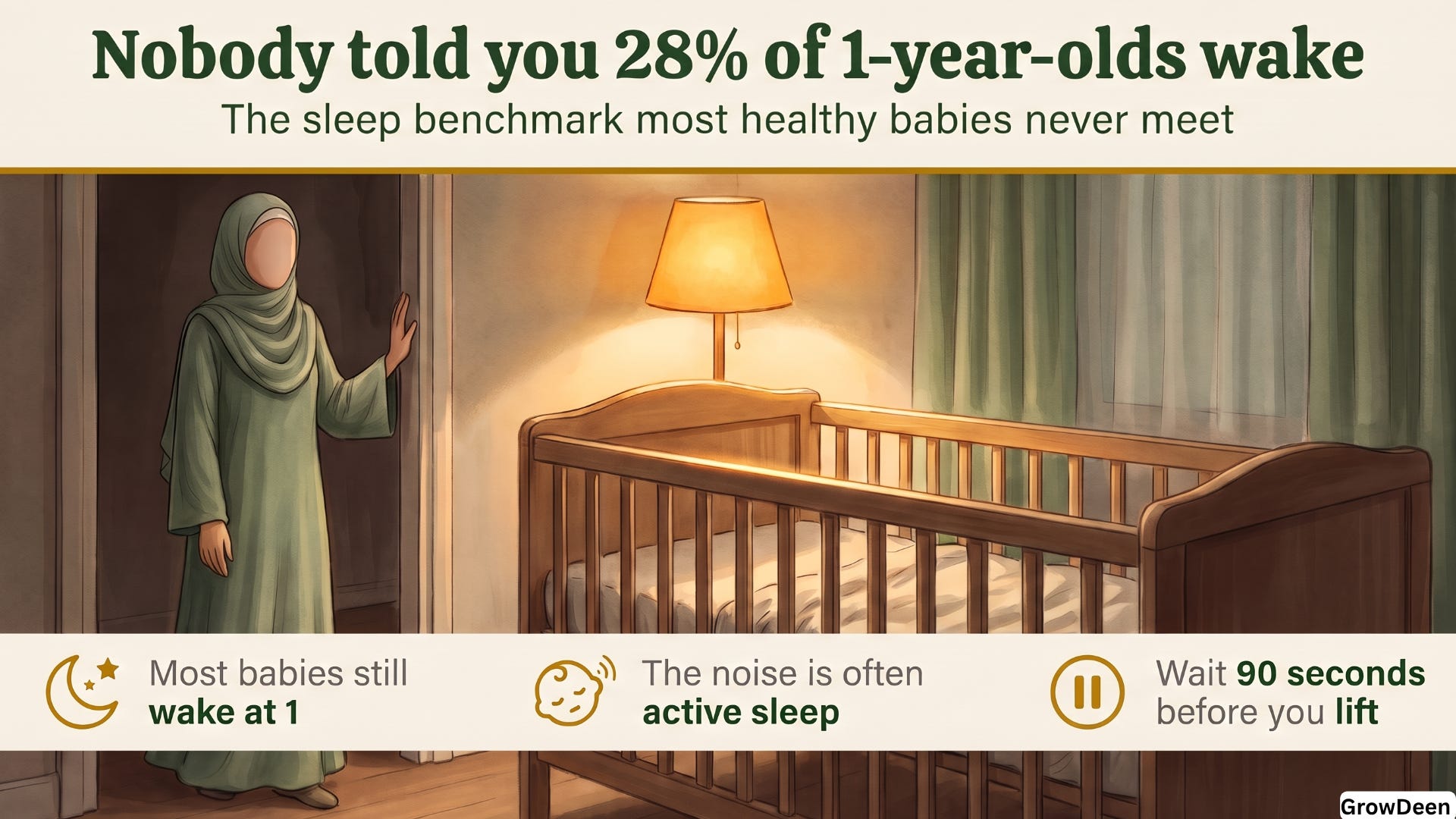
It is 3:14am and you are already standing up.
The noise from the cot is the small grunting, shifting, half-crying sound you have learned to move towards without deciding to. You lift. The body in your hands is heavy and loose, the eyes stay shut, and somewhere between the cot and your shoulder it occurs to you that this baby was not awake.
You did everything right and still ended the night more tired than you needed to be. That is not carelessness. It is what happens when nobody tells you what the end of a sleep cycle sounds like.
And it leads to the question most parents eventually ask out loud: why does the baby who slept five solid hours at four months wake four times at eight? That one has an answer, and it is not the one most people expect. Stay with it.
Why This Guide Is Different
Every number here comes from peer-reviewed paediatric research published between 2004 and 2022, including a Canadian study of close to 400 infants and an Australian randomised controlled trial [1,9].
The Islamic layer is not a quotation bolted to the end. The Qur’anic reference used here sits inside a passage about providing for a nursing child, and the bedtime practice described is the Prophet’s ﷺ own, step by step [14,16].
You already have the free Night Shift Pack from the top of this page, which turns the two hardest moments of the night into one printable decision card and one week-at-a-glance plan for the adults.
The Number Nobody Puts On A Pack Of Nappies
A research team in Canada followed close to 400 typically developing infants and asked a question the baby books tend to avoid: how many of them actually sleep through?
At six months, 38% were not sleeping six consecutive hours. 57% were not sleeping eight. At twelve months, 28% were still not sleeping six consecutive hours, and 43% were not sleeping eight [1].
Sit with the twelve month figures for a second. More than a quarter of healthy one-year-olds do not manage six unbroken hours, and well over a third do not manage eight. The benchmark your family keeps asking about is a minority achievement.
The same study went looking for the damage everyone assumes is there. It found none. Infants who were not sleeping in long unbroken blocks scored no differently on mental or psychomotor development at either age, and the mothers of babies who slept through did not report better mood than the mothers of babies who did not [1].
So the standard is not a health marker. It is a social expectation that got mistaken for one, and it is the thing quietly making you feel you have done something wrong at 3am.
What You Are Actually Hearing At The End Of A Cycle
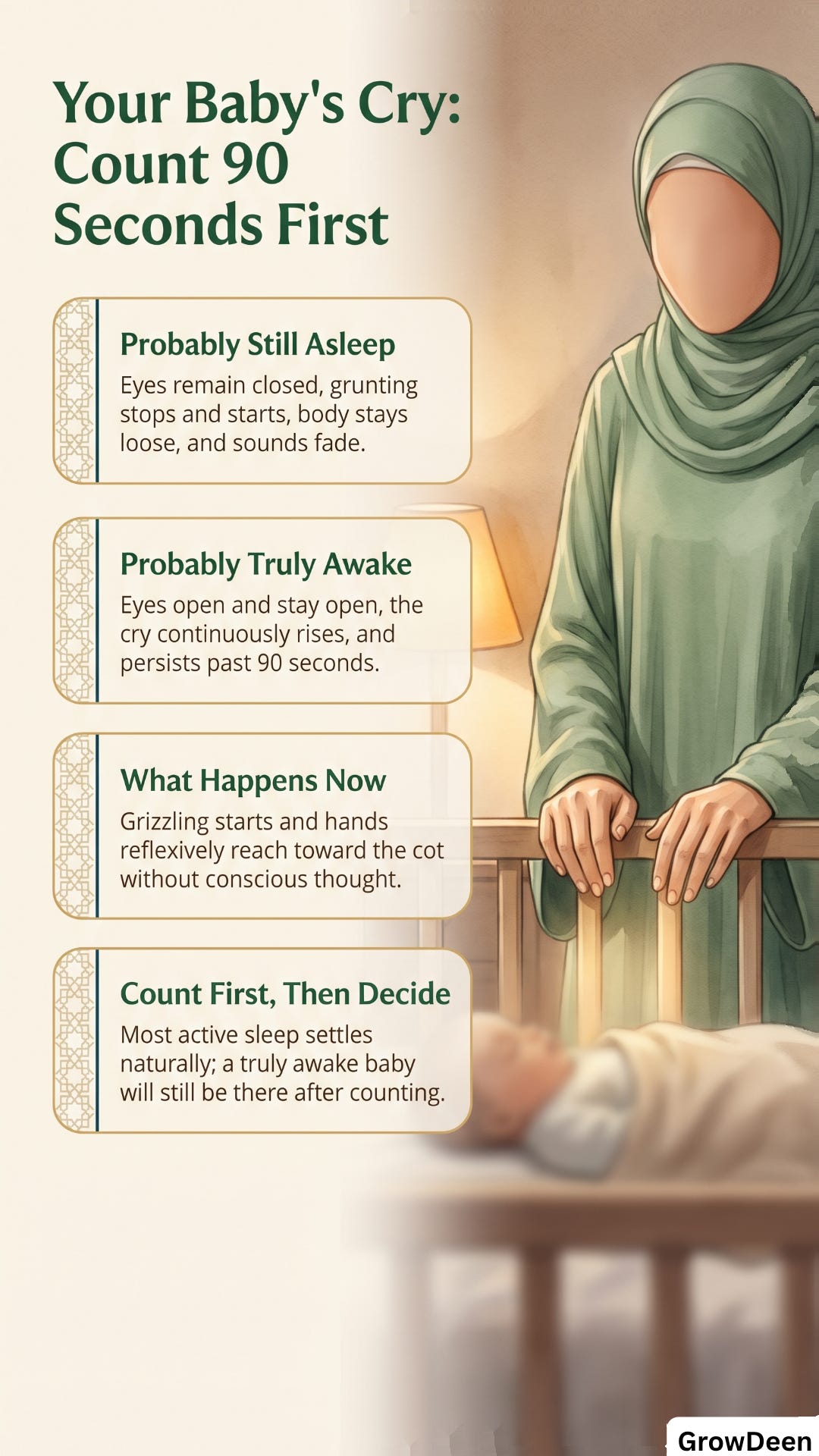
Your baby sleeps in cycles of roughly 50 to 60 minutes. Each one holds an active phase, where the baby twitches, grunts, flutters the eyelids and moves the arms, and a quiet phase, where breathing evens out and the body goes still [6].
Picture the moment again. The grunting, the shifting, the half-cry that stops and starts. That is frequently the active phase, or the brief surfacing at the boundary between one cycle and the next, which every human being does several times a night. Adults turn over and drop back without remembering it by morning. A baby has not learned that second half yet [6].
So the sound is real and the waking may not be.
Here is the only technique in this article that costs nothing and works tonight: wait. Ninety seconds, counted, before your hands go anywhere near the cot. A proportion of those night wakings resolve themselves while you stand there, and the ones that do not will still be there in ninety seconds.
Three things mature underneath all of this at once. The internal clock that separates night from day is still being set by light, feeding times and the rhythm of the house [7]. The cycles are lengthening, which spreads the surfacing points further apart [4]. And each cycle is reorganising towards the light, deep and dream sleep that older children have [6].
None of those three finishes on a set date, which is why the first year never settles into a straight line. And it is why the thing most parents dread happens exactly when it does.
Why It Gets Harder At Six Months, Not Easier
This is the answer to the question from the top of the page.
Around half a year your baby acquires a run of new abilities, and every one of them competes with sleep. They learn to hold themselves awake when something interesting is happening. They start crawling or pulling to stand, and they rehearse at night, sometimes ending up in a position they cannot reverse without help. They work out that things and people still exist when out of sight, so leaving the room now registers as you being somewhere else rather than nowhere at all. Separation anxiety arrives for many babies in this window, and temperament decides how readily a particular baby settles [4,6].
Nothing was lost. Something was gained, and the gain is loud.
The popular name for this is sleep regression. The word misdescribes what is happening, because nothing has gone backwards. These shifts track brain maturation in the same way that feeding and movement change across the first year, and they move a baby towards a more adult sleep pattern over the first five years [4].
Which gives you the line to hold on to when the fourth wake-up lands: waking is the design, not the fault.
That reframing does not make the nights shorter. It does change what you are measuring yourself against, and that turns out to matter more than most sleep advice.
What Normal Looks Like, By Age
Ranges describe most babies, not yours specifically. A baby who is wakeful and content is almost certainly getting the sleep they need. A baby who is wakeful and persistently grizzly may need more chances to sleep rather than a tighter schedule.
At 2 to 3 months, most babies sleep 14 to 17 hours in every 24, scattered across day and night [2,3]. Night and day are only just beginning to separate, and most parents notice it first as an evening stretch that is slightly longer than it used to be [4,7].
At around 3 months, total sleep holds at 14 to 17 hours [2]. Cycles lengthen, which means fewer surfacing points. Some babies start putting together four or five hours [4,5]. Others do not, and the range of normal here is wide.
At 3 to 6 months, most sleep 12 to 15 hours in every 24 [2], with the World Health Organization setting a slightly wider band of 12 to 16 hours for 4 to 11 months, naps included [3]. Two or three daytime sleeps of up to about two hours is a common shape, and by six months some babies manage a block of around six hours at night [4,5].
At 6 to 12 months, most sleep 11 to 14 hours in every 24, with the longest block at night [2,5]. Bedtime usually lands between 6pm and 10pm, and most fall asleep in under 40 minutes once settled. Many babies at this age still wake and call out three or four times a night and need an adult to settle them [5,13].
Keep that last line somewhere you can find it at 4am, because it is the one that gets left out of every conversation at the school gate.
A Tool For The Nights This Describes
Reading all of this at a reasonable hour is one thing. Remembering it while standing in the dark with a crying baby is another, and nobody retains a word of it at 3am.
That is what the Night Shift Pack is for. It takes the two decisions that actually happen at night, whether to lift and who is covering which stretch, and puts them on paper you can keep by the cot. The download button is at the top of this page, and there is a full description of what is inside it below.
Before any of the practical pieces, there is one line in the Qur’an that changes what the hard months mean, and it sits somewhere almost nobody goes looking for it.
The Burden Allah Measured To Your Strength
For a parent counting wake-ups at 4am, there is a verse that speaks to the exact shape of the problem, and it sits inside a passage about providing for a nursing child.
Allah says: “Allah does not charge a soul except [according to] what He has given it. Allah will bring about, after hardship, ease” [14].
According to Tafsir Ibn Kathir, the verse falls among the rulings on maintenance for a divorced mother and on the nursing of a child, and he reads the first clause as a measuring instruction. A father of means spends according to his means. A father with little spends from what Allah has given him, because Allah places on no one a burden beyond what He has granted them [15]. Ibn Kathir treats the closing promise as a certainty, since Allah does not break what He promises [15].
Read in its own context, the verse concerns the care of a baby and the capacity of the adults responsible for that baby. The obligation was never set above what Allah supplied. A mother at 4am is not falling short of a standard. She is spending what she was given, and the ease was promised to arrive after the hardship rather than instead of it.
So the broken months are a measured assignment with an expiry date attached by the One who set it. Waking is the design, not the fault, and the design came with a promise attached.
What you still get to decide is everything that happens around it.
Support Muslim Parenting Lab ❤️
Would you rather give a small amount that never stops than a large one you keep postponing? Set a monthly amount you are comfortable with, in a few seconds, using the button below.
The Prophet ﷺ said the deed most beloved to Allah is the most constant, even if little. (Sahih al-Bukhari 6464)
The Two Decisions That Are Actually Yours
Almost nothing about a baby’s sleep is under your control. Two things are.
Night feeds. Most babies under six months still need at least one overnight feed. From around six months, if your baby is growing and developing well, reducing night feeds becomes reasonable to consider, and it is not an obligation. Plenty of families carry on for months longer and do well [5]. Some parents use a rollover feed, sometimes called a dream feed, between roughly 10pm and midnight: rouse gently, feed, settle, then go to bed yourself. For some babies it buys a longer stretch towards morning. For others it changes nothing, and a week is enough to tell which.
One clarification matters here for Muslim families. Cutting night feeds changes the timing of feeds. It is not a decision to stop breastfeeding. The Qur’an sets the nursing term at two complete years, and that term, rather than six months or twelve, is the reference point for weaning decisions. Any decision to stop breastfeeding altogether is worth taking to a trusted scholar alongside your doctor or a lactation consultant.
Whether to use a settling approach. This argument runs on assertion far more than data, so here is the data. An Australian randomised controlled trial assigned 43 infants aged 6 to 16 months to graduated extinction, to bedtime fading, or to a sleep education control group. Graduated extinction shortened the time taken to fall asleep and produced large reductions in night wakings and in time awake after sleep onset. Bedtime fading shortened time to fall asleep without the same reduction in wakings [9].
The trial also measured the thing parents actually fear. Salivary cortisol fell slightly in both intervention groups compared with controls, which the authors read as an absence of a stress response, and at twelve months there was no difference between groups in secure versus insecure attachment on the strange situation assessment [9].
The honest reading is narrow. Small sample, one year of follow-up, and no trial can tell you whether a method suits your baby or your household. What the evidence does not support is the claim that a gradual, parent-present approach causes lasting harm. Most parents adapt whatever method they are handed rather than following it exactly, which is worth knowing before anyone feels they are failing a protocol [12]. Support offered early helps on a separate axis: a programme giving parents settling and crying guidance before problems set in reduced both infant sleep problems and parental depression symptoms [11].
Both decisions sit on top of something that is not a decision at all.
The Surface Everything Else Sits On
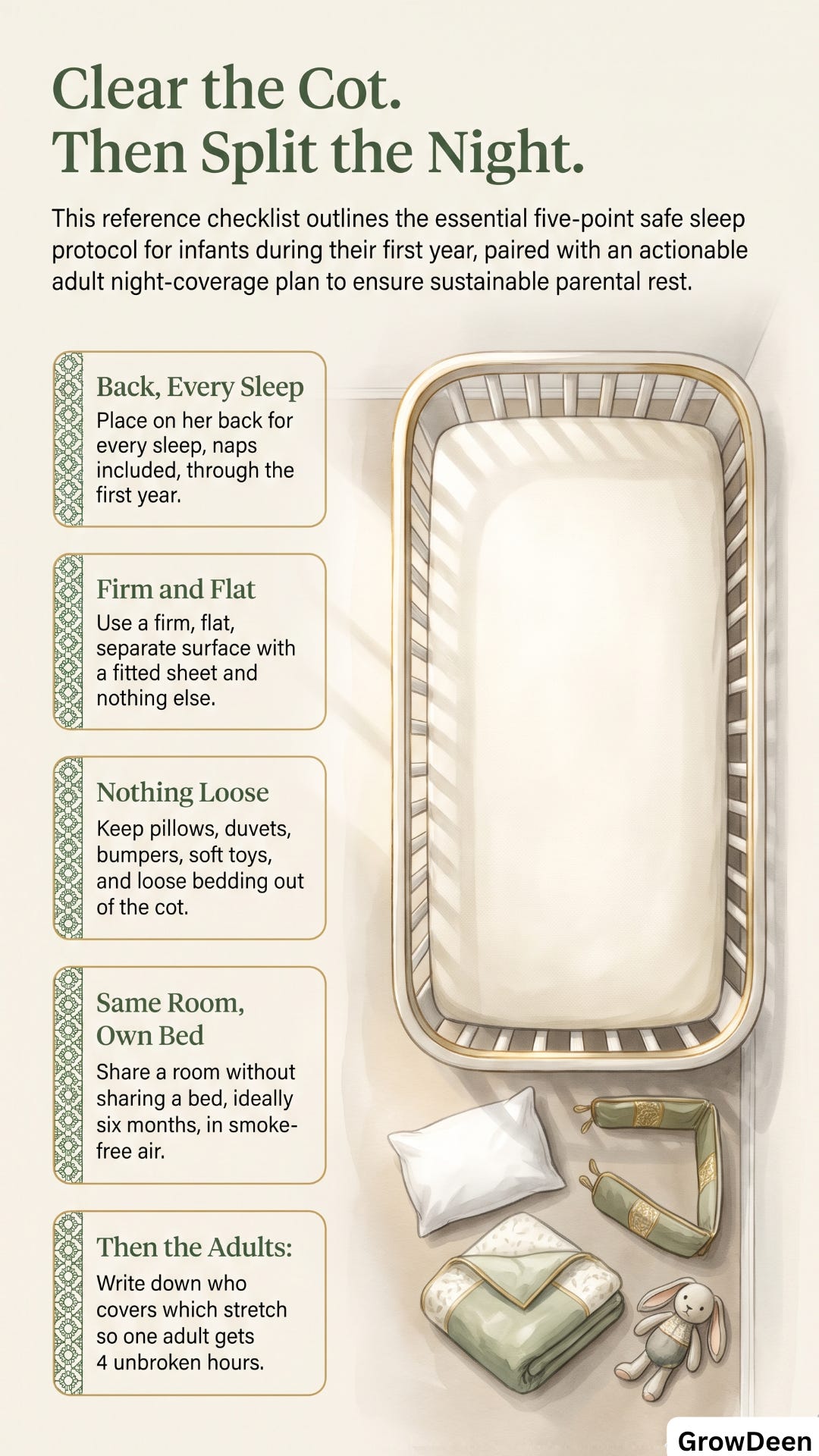
A routine sits on top of a safe sleep surface and never replaces one. Current paediatric guidance is specific [8]:
Place your baby on their back for every sleep, naps included, for the whole first year.
Use a firm, flat, separate sleep surface with a fitted sheet and nothing else on it.
Keep pillows, duvets, bumpers, soft toys and loose bedding out of the sleep space.
Share a room without sharing a bed, ideally for at least the first six months.
Keep your baby’s environment free of smoke.
Islam asks you to take the means seriously and then rely on Allah. Checking the cot is part of the amanah, and the du’a is what you say over a cot you have already made safe.
Which is exactly how the bedtime sequence of the Prophet ﷺ is built.
The Sequence Your Baby Can Read
Babies cannot read a clock. They read order. The same short set of actions in the same order, night after night, becomes the signal that sleep is next, and the Sunnah supplies that sequence with a shape worth copying.
Start the wind-down as the light goes. Bringing the household in at dusk, dimming lamps and closing down noisy play is long-established Islamic household practice, and it is also the exact pre-sleep slope sleep researchers describe.
Keep the sound of the room calm. Rather than music or recorded songs, recite gently or play Qur’an at low volume, or say adhkar quietly while you change and swaddle. Your own voice reciting is the most settling sound available to a baby who has been hearing it since before birth.
Check the bed before you lay your baby down. The Prophet ﷺ taught that when one of you goes to bed he should shake out his bedding, then say the supplication beginning “Bismika Rabbi wada’tu janbi” [16]. For an infant in a modern cot, that means running your hand across the whole mattress and clearing anything that does not belong there: a muslin, a toy, a loose sheet, a feeding pillow. The Sunnah and the safe sleep checklist turn out to be the same movement of the hand.
Then the protection the Prophet ﷺ used for children himself. He would seek refuge with Allah for Al-Hasan and Al-Husayn with the perfect words of Allah from every devil, every poisonous creature and every envious eye [18]. Recite Ayat al-Kursi, which he ﷺ confirmed keeps a guard with the reciter until morning [17]. Close with the words he said as he lay down: “Bismika Allahumma amutu wa ahya” [19].
Give the morning its own line too. The Prophet ﷺ woke saying, “Al-hamdu lil-lahil-ladhi ahyana ba’da ma amatana; wa ilaihi an-nushur” [19]. A baby who hears Alhamdulillah every morning for a whole year is absorbing shukr long before they can pronounce it, and that is tarbiyah at its earliest and cheapest.
Teach the sequence to everyone who puts your baby down, grandparents and older siblings included, so it survives a night you are not there. Which raises the question nobody asks you.
The Adult In The Room Needs A Plan Too
Nobody asks how you are sleeping. They ask how the baby is sleeping.
Most parents of babies under six months are up at night, and for many families that continues well past six months. Some handle broken nights reasonably well with support and a chance to recover sleep elsewhere. For others, months of interruption take a real toll on health, mood and family life. A randomised trial of early parental support found a strong link between infant sleep difficulties and symptoms of postnatal depression in birthing and non-birthing parents, with one finding that matters here: the link weakens substantially when the parents themselves are getting enough sleep [10].
So your rest is load-bearing, not optional. A parent running on three hours cannot supply the warm, patient daytime attention that in turn helps a baby sleep better at night.
Arrange it the way you would arrange anything else that matters. A relative who covers the first stretch. A spouse who owns the 2am wake-up on alternate nights. A friend who holds the baby while you sleep ninety minutes in the afternoon. Write it down where the other adults can see it, because a plan in your head is not a plan anyone else can follow.
And if low mood or anxiety settles in and stays, speak to your doctor or another qualified health professional. That is a medical matter and it responds to treatment. None of this article replaces medical advice, and your doctor’s guidance comes first.
The Night Shift Pack
If you have read this far, you are the kind of parent who wanted to understand the nights rather than just survive them. That tells me something about how you are doing this.
Inside the Night Shift Pack (one comprehensive PDF, 3 pages):
Page 1: The 3am Decision Card - a single side that tells you, in the dark, whether what you are hearing is active sleep or a true waking, with the ninety second wait rule, the four signs of each, and what to do next in either case - designed as a laminated card you can prop against the cot or keep on the nightstand.
Page 2: The Night Shift Planner - a fill-in week where the adults in the house divide the night between them, with slots for who covers which stretch, who gets the protected afternoon sleep, and one honest line per day for how it actually went - so you can set up a week of recoverable sleep in under ten minutes at the kitchen table.
Page 3: The Measured Burden Card - Qur’an 65:7 in English with its source reference, alongside Tafsir Ibn Kathir’s reading that Allah places on no one a burden beyond what He has granted them, written as three short lines a parent can read standing up at 4am.
This is not a PDF to download and forget. It is built to stay on the nightstand and on the fridge, where you will actually reach for it when you need it.
The Night Shift Pack is what every subscriber receives with each article. We cover the full stretch of raising Muslim children, all backed by scientific research and rooted in Islamic wisdom.
Do This Before You Close The Tab
Open your phone and set a timer for ninety seconds. Name it “wait”.
Tonight, when the noise starts, start the timer before you stand up. That is the whole exercise. One night of it will tell you more about your baby’s sleep than another hour of reading.
May Allah place barakah in your effort, accept your intention, and make the care you give more protective and more rewarded than it feels in the moment.
Share This With Someone Who Needs It
Think of one person right now: the friend who texted at midnight asking whether it is normal that her baby “was sleeping so well and now isn’t”, your sister who keeps apologising for how tired she sounds on the phone, the woman at the masjid who mentioned that bedtime has become a battle again out of nowhere.
Send this to her today. Not as advice, and not as correction, but because she is measuring herself against a benchmark that most healthy babies never meet, and nobody has told her.
Frequently Asked Questions
Q: Is it normal for a 9 month old to wake three times a night?
A: Yes. Many babies between six and twelve months wake and call out three or four times a night and need an adult to settle them, and at twelve months 28% of healthy babies are still not sleeping six unbroken hours [1,5]. Frequent waking on its own is not a medical sign. If it is leaving you depleted, that is a reason to get support for yourself, not evidence that something is wrong with your baby.
Q: Why has my baby’s sleep got worse at 6 months?
A: Almost always because of what they have just learned rather than what they have lost. Crawling, pulling to stand, object permanence and separation anxiety all land in this window and all compete with settling [4,6]. For the full picture, see “Why it gets harder at six months, not easier” above.
Q: Should I wake my baby for a dream feed?
A: You can, and you do not have to. A rollover feed between roughly 10pm and midnight helps some babies stretch further towards morning and does nothing measurable for others [5]. Try it for a week and judge by what happens in your own house.
Q: Is sleep training harmful to a baby?
A: The strongest evidence available does not support that claim. In a randomised controlled trial of infants aged 6 to 16 months, graduated extinction and bedtime fading both shortened the time taken to fall asleep, salivary cortisol fell slightly rather than rising, and there was no difference in attachment security at twelve months [9]. The sample was small, so it is evidence rather than proof, and whether an approach suits your household is a separate question.
Q: How many hours should a baby sleep at each age?
A: Roughly 14 to 17 hours in every 24 at 2 to 3 months, 12 to 15 hours at 3 to 6 months, and 11 to 14 hours by the end of the first year, naps included [2]. The World Health Organization gives 12 to 16 hours for 4 to 11 months [3]. Your baby’s mood across the day is a better guide than the range.
Q: What du’a should I say over my baby at bedtime?
A: The Prophet ﷺ sought refuge with Allah for Al-Hasan and Al-Husayn with the perfect words of Allah from every devil, every poisonous creature and every envious eye [18]. Ayat al-Kursi recited at bedtime keeps a guard with the reciter until morning [17], and the words said on lying down are “Bismika Allahumma amutu wa ahya” [19]. The full bedtime sequence is in “The sequence your baby can read” above.
References
[1] Pennestri, M.H., Laganiere, C., Bouvette-Turcot, A.A., Pokhvisneva, I., Steiner, M., Meaney, M.J., & Gaudreau, H. (2018). Uninterrupted infant sleep, development, and maternal mood. Pediatrics, 142(6), e20174330
[2] Hirshkowitz, M., Whiton, K., Albert, S.M., Alessi, C., Bruni, O., DonCarlos, L., et al. (2015). National Sleep Foundation’s sleep time duration recommendations: Methodology and results summary. Sleep Health, 1(1), 40-43
[3] World Health Organization. (2019). Guidelines on physical activity, sedentary behaviour and sleep for children under 5 years of age. Geneva: WHO
[4] Paavonen, E.J., Saarenpaa-Heikkila, O., Morales-Munoz, I., Virta, M., Hakala, N., Polkki, P., et al. (2020). Normal sleep development in infants: Findings from two large birth cohorts. Sleep Medicine, 69, 145-154
[5] Dias, C.C., Figueiredo, B., Rocha, M., & Field, T. (2018). Reference values and changes in infant sleep-wake behaviour during the first 12 months of life: A systematic review. Journal of Sleep Research, 27(5), 1-23
[6] Davis, K.F., Parker, K.P., & Montgomery, G.L. (2004). Sleep in infants and young children: Part One: Normal sleep. Journal of Pediatric Health Care, 18(2), 65-71
[7] Joseph, D., Chong, N.W., Shanks, M.E., Rosato, E., Taub, N.A., Petersen, S.A., et al. (2015). Getting rhythm: How do babies do it? Archives of Disease in Childhood. Fetal and Neonatal Edition, 100(1), F50-F54
[8] Moon, R.Y., Carlin, R.F., Hand, I., & AAP Task Force on Sudden Infant Death Syndrome and the Committee on Fetus and Newborn. (2022). Sleep-Related Infant Deaths: Updated 2022 Recommendations for Reducing Infant Deaths in the Sleep Environment. Pediatrics, 150(1), e2022057990
[9] Gradisar, M., Jackson, K., Spurrier, N.J., Gibson, J., Whitham, J., Sved Williams, A., Dolby, R., & Kennaway, D.J. (2016). Behavioral interventions for infant sleep problems: A randomized controlled trial. Pediatrics, 137(6), e20151486
[10] Hiscock, H., Cook, F., Bayer, J., Le, H.N., Mensah, F., Cann, W., Symon, B., & St James-Roberts, I. (2014). Preventing early infant sleep and crying problems and postnatal depression: A randomized trial. Pediatrics, 133(2), 346-354
[11] Cook, F., Bayer, J., Le, H.N., Mensah, F., Cann, W., & Hiscock, H. (2012). Baby business: A randomised controlled trial of a universal parenting program that aims to prevent early infant sleep and cry problems and associated parental depression. BMC Pediatrics, 12(1), 13
[12] Honaker, S.M., Schwichtenberg, A.J., Kreps, T.A., & Mindell, J.A. (2018). Real-world implementation of infant behavioural sleep interventions: Results of a parental survey. Journal of Pediatrics, 199, 106-111
[13] Zhang, Z., Sousa-Sa, E., Pereira, J., Chaput, J.P., Okely, A., Feng, X., & Santos, R. (2019). Correlates of nocturnal sleep duration, nocturnal sleep variability, and nocturnal sleep problems in toddlers: Results from the GET UP! Study. Sleep Medicine, 53, 124-132
[14] Qur’an, Surah At-Talaq 65:7 (Saheeh International)
[15] Ibn Kathir, I. Tafsir Ibn Kathir, commentary on Surah At-Talaq 65:6-7
[16] Sahih al-Bukhari 6320, Kitab ad-Da’awat, narrated by Abu Hurayrah. Graded: Sahih
[17] Sahih al-Bukhari 2311, Kitab al-Wakalah, narrated by Abu Hurayrah. Graded: Sahih
[18] Sahih al-Bukhari 3371, Kitab Ahadith al-Anbiya, narrated by Ibn Abbas. Graded: Sahih
[19] Sahih al-Bukhari 6324, Kitab ad-Da’awat, narrated by Hudhayfah. Graded: Sahih
We combine scientific research with Qur’an and authentic Sunnah, and we cite our sources. Even so, this is general guidance and no substitute for a doctor who can examine your child.