

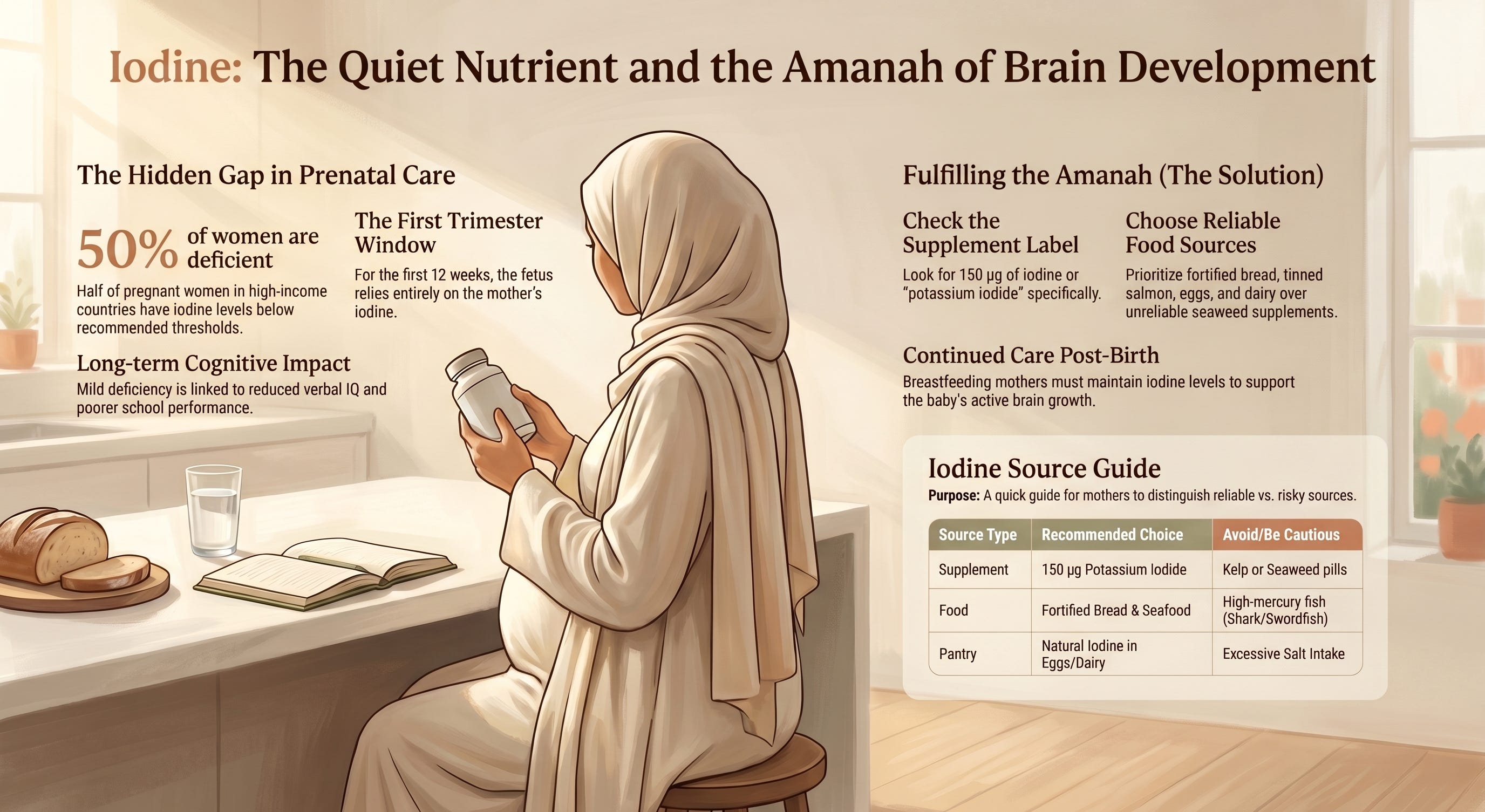
A Cochrane Review of 37 trials found that up to 50% of pregnant women in high-income countries have iodine levels below the recommended threshold and most of them have no idea. [1] This guide explains why that gap matters more than almost anything else in prenatal nutrition and the simple steps that close it.
Nobody told me iodine was on the list.
A mother once shared with me that she had been taking her pregnancy supplement faithfully every single day — iron, folic acid, vitamin D, calcium. She read the label properly for the first time around week 28. No iodine. Her midwife hadn’t mentioned it. The pharmacist hadn’t flagged it. It just wasn’t in anyone’s conversation.
I hear some version of this story more often than I’d expect.
Here’s why that matters: when I looked at the research on iodine and fetal development, one finding stopped me. The thyroid hormones that form the foundation of a baby’s brain — the ones that determine how neurons wire, how the nervous system organises itself, how cognitive potential develops — require iodine to exist. And the window when this happens is the first trimester. Before many women even know they’re pregnant.
That’s not something you can go back and fix.
Why This Guide Is Different From Generic Prenatal Nutrition Advice
Every recommendation is grounded in peer-reviewed research — including a 2013 Lancet study following children of iodine-deficient mothers for 9 years and tracking the actual cognitive outcomes. [2]
This isn’t just science — it’s amanah. Understanding what your child’s developing brain needs in the womb is one of the most direct ways we act on the trust Allah has placed in us. That perspective is woven throughout.
You’ll get a free Iodine & Pregnancy Companion Pack — a printable 3-page PDF with an iodine food source chart, a supplement checklist, and an authenticated Prophetic du’a for protection — designed to stay on your fridge where you’ll actually use it.
What’s Actually Happening in the First Trimester (And Why Iodine Is There)
The thyroid gland produces hormones that govern metabolism, growth, and development. In adults, a low-iodine diet causes the thyroid to work harder and eventually enlarge — a condition called goitre. In an unborn baby, the consequences run deeper.
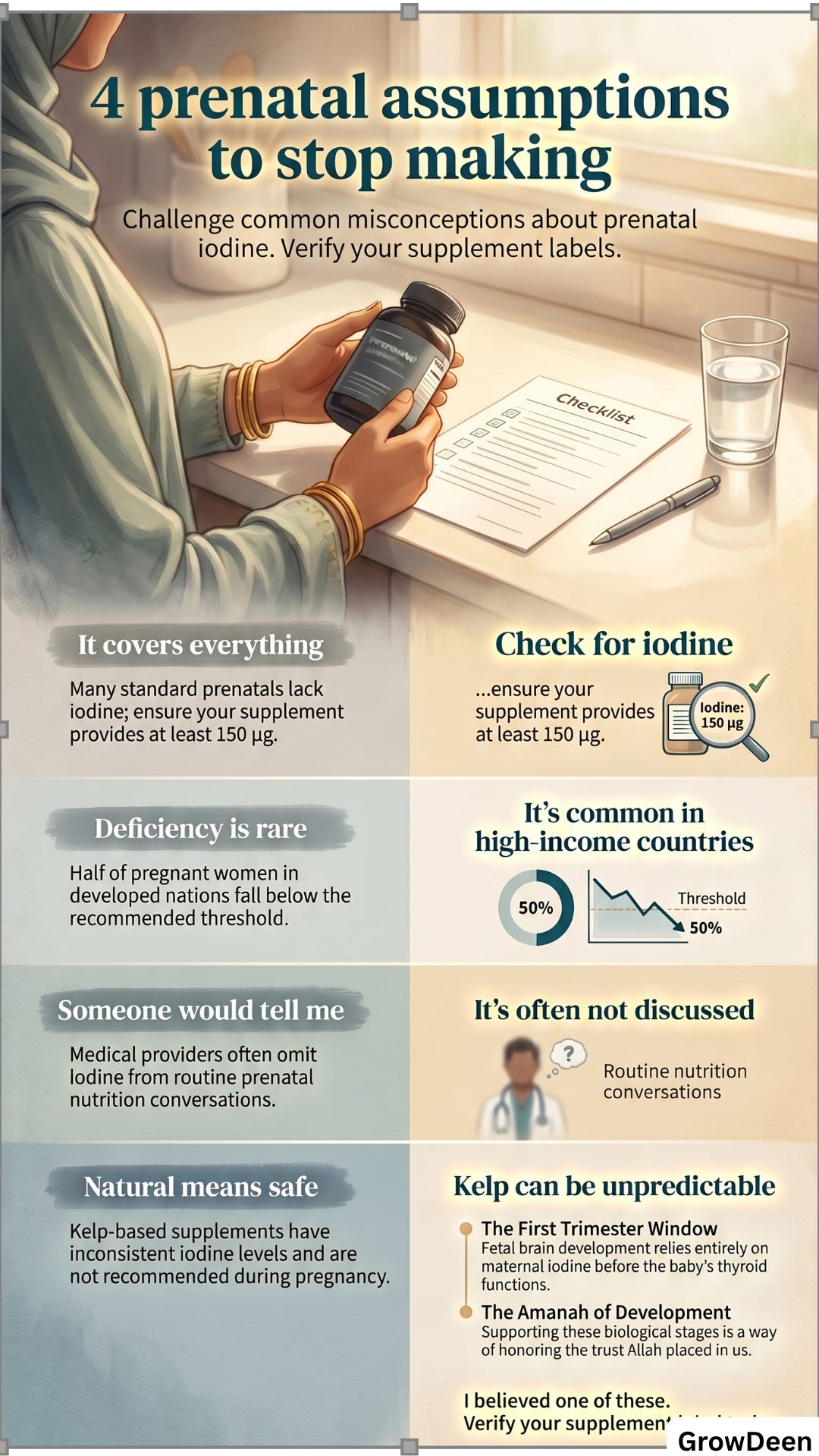
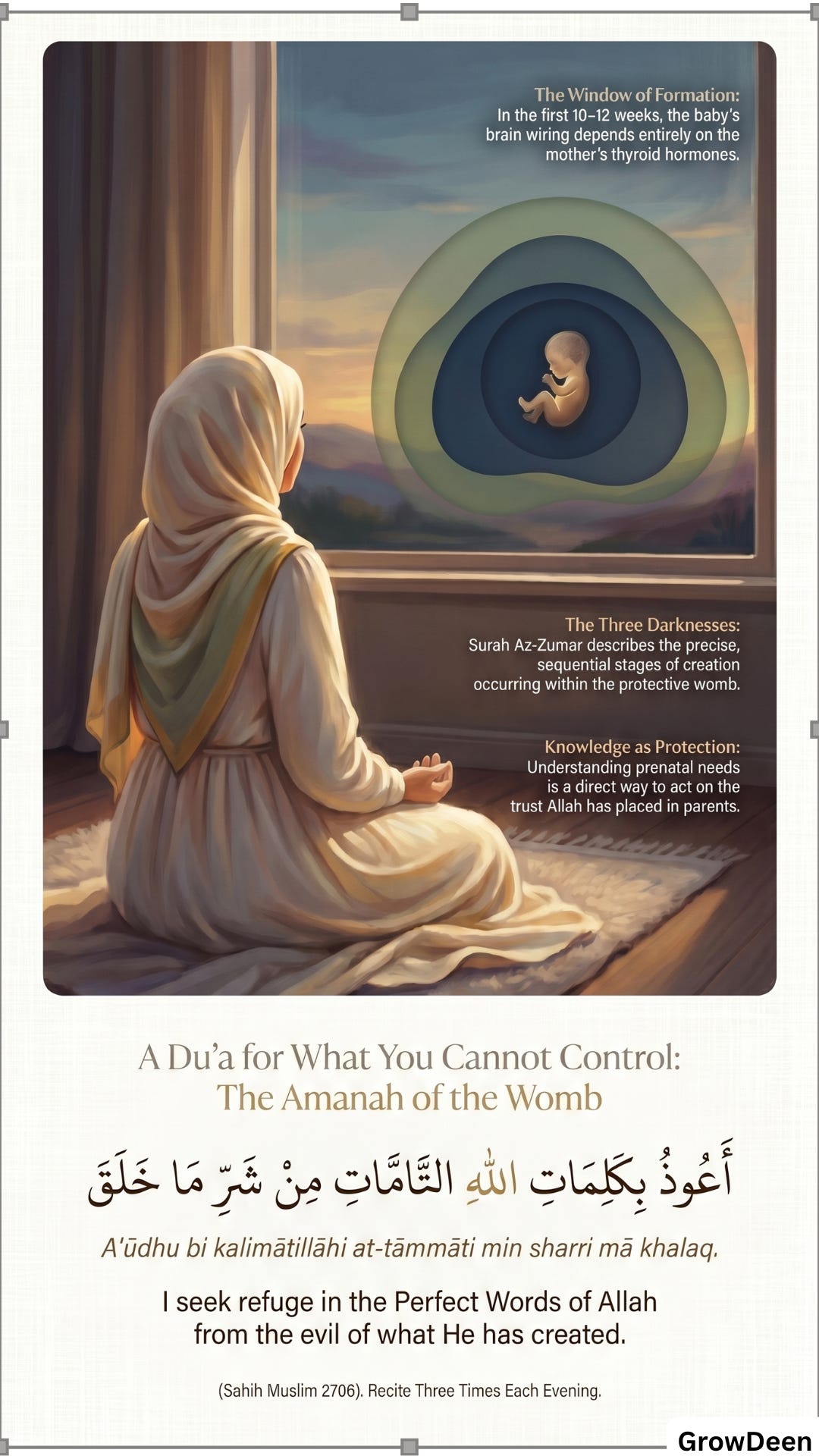
Here’s the thing: a fetus has no functioning thyroid of its own for the first 10–12 weeks. Everything it needs to develop its brain and nervous system during that window comes from the mother’s thyroid hormones — which require iodine. [3]
A 2013 study published in The Lancet followed children of mildly iodine-deficient mothers for nine years. The children showed measurably reduced verbal IQ, poorer working memory, and lower reading accuracy compared to children born to iodine-sufficient mothers — even with only mild, not severe, maternal deficiency. [2]
That’s not abstract. That’s school performance. Reading ability. The capacity to think.
Severe iodine deficiency goes further — it’s been linked to miscarriage, stillbirth, and profound intellectual disability. [4] But the mild-to-moderate range is where most families in high-income countries sit, quietly, without realising it.
After Birth, the Gap Continues
Breastfed babies draw their iodine entirely from their mother’s milk. [5] A breastfeeding mother who is deficient passes that deficiency directly to her infant — during one of the most active phases of the baby’s brain development outside the womb. This is why iodine needs don’t drop after birth. If anything, the stakes of sustained deficiency become more visible.
The recommended daily intake during pregnancy and breastfeeding is 150 micrograms (µg) of supplemental iodine, in addition to what comes from food. [1] Most standard pregnancy supplements contain iodine — but not all. Check the label specifically. If yours doesn’t list it, ask your doctor or midwife about adding a standalone supplement.
One important note: if you have a thyroid condition — either hypo- or hyperthyroidism — speak with your doctor before supplementing, as iodine interacts differently for people with existing thyroid issues. [6]
Where to Actually Find Iodine in Your Family’s Diet
I know you’re probably wondering: “What do I need to actually eat?” Here’s what the evidence points to:
Commercially fortified bread is the most reliable everyday source for most families. Iodised salt is used in standard packaged bread production. Organic, homemade, salt-free, and artisan loaves generally do not contain added iodine — so check labels before assuming. [7]
Seafood — especially tinned salmon and seaweed — ranks among the richest natural sources. Two to three servings of seafood per week is the general recommendation. [7]
Pregnant mothers: some fish carry higher mercury levels and should be limited. Shark, swordfish, and some preparations of tuna are the main ones to reduce. Your doctor or a dietitian can confirm what’s safe.
Eggs and dairy contribute variable but meaningful amounts depending on what the animals were fed. Fruit, vegetables, and meat provide smaller amounts. For vegan families, the picture shifts significantly — animal-based sources are where iodine concentrates, so fortified plant milks and supplementation become genuinely important. Speak with a dietitian about your specific needs. [7]
Iodised salt is rich in iodine, but the advice isn’t to eat more salt — it’s to ensure that if you’re eating bread, it’s from a fortified commercial source. Reducing salt is generally a good health move. Getting iodine from other sources is the smarter path.
I know keeping track of every nutrient during pregnancy feels like it never ends. That’s exactly why I made something practical to keep with you.
Coming up at the end of this article: your free Iodine & Pregnancy Companion Pack — a 3-page printable PDF with everything you need in one place. Keep reading.
What the Quran Tells Us About the Womb — and Why It Matters Here
The Sacred Trust of Prenatal Formation: What Allah Describes in Surah Az-Zumar
As Muslim parents, we understand that our children are not simply ours — they are an amanah, a trust placed in our care long before we hold them in our arms.
When I sit with the verse in Surah Az-Zumar where Allah says, “He creates you in the wombs of your mothers, creation after creation, within three darknesses” [Qur’an 39:6], what strikes me is the precision of it. Each stage sequential. Each stage dependent on what came before. According to Tafsir Ibn Kathir, drawing on the words of Ibn Abbas and the scholars of his generation, this verse describes how the human passes through distinct stages of formation — sperm-drop, then clot, then formed foetus — in the protective layers of the belly, womb, and placenta.
What this tells me as a parent is that what happens in those darknesses is not incidental. The environment the mother provides is the medium in which those stages unfold. The thyroid hormones that guide the formation of the baby’s brain in the first weeks of pregnancy require iodine to exist. Without it, the formation that Allah has designed to happen — stage after stage — is compromised before anyone knows it has begun.
This is not a reason for fear. It’s an invitation to awareness. To take the means that are available to us. To do what we can, with sincerity, and then place our trust in Allah — who knows what is in every womb.
May Allah grant our children sound beginnings, and make their formation a means of barakah for them and for us.
Your Free Iodine & Pregnancy Companion Pack
If you’ve read this far, you’re the kind of parent who takes prenatal care seriously — not as anxiety, but as attentive love. That tells me something genuinely beautiful about you.
Inside the Iodine & Pregnancy Companion Pack (one PDF, 3 pages):
Page 1: Iodine Food Source Chart — A clear, printable reference showing which everyday foods contain iodine, ranked by source strength (from tinned salmon and fortified bread down to fruit and vegetables), with notes for vegan families and a column for pregnancy-safe seafood choices — designed as a laminated card for your fridge or kitchen cupboard.
Page 2: Pregnancy Supplement Checklist — A quick-reference guide showing what to look for on your supplement label, the recommended iodine dose by life stage (pregnancy, breastfeeding, general adult), and a simple checklist of questions to raise with your doctor — so you can confirm your iodine intake is covered in under five minutes.
Page 3: A Du’a for Protection — The authentic du’a narrated in Sahih Muslim, which the Prophet ﷺ taught to seek refuge in the Perfect Words of Allah from harm: A’udhu bi kalimātillāhi at-tāmmāti min sharri mā khalaq — with full Arabic text, transliteration, and English meaning — a practice that connects the physical care you’re taking with the spiritual trust you’re placing in Allah. [Sahih Muslim 2708]
This isn’t a PDF to download and forget. It’s a reference designed to stay on your fridge — where you’ll see it when you’re planning meals, preparing supplements, and simply living the amanah of pregnancy and new motherhood.
This Iodine & Pregnancy Companion Pack is what every subscriber receives with each article. MPL covers the full journey of raising Muslim children — including nutrition, development, behaviour, spiritual formation, and the everyday decisions that shape a child’s life.
If you’re a Muslim parent who wants research-backed guidance rooted in Islamic wisdom, subscribe free so future resources arrive in your inbox before you need them.
Subscribe free for parenting resources backed by both science and Sunnah — guidance so unique, you literally can’t find it anywhere else. No spam, no clutter. Just resources that matter.
Your 2-Minute Action Right Now
Go find your pregnancy supplement — or the one you’re considering — and check the label for iodine. Look for “iodine” or “potassium iodide” in the ingredients or nutritional information. Check the dose. If it’s not there, or if the dose is below 150 µg, write it on a piece of paper and put it next to your phone so you remember to ask your doctor or midwife at your next appointment.
That’s it. Two minutes. It matters more than it looks.
Share This With Someone Who Needs It
Think of one person right now: a sister who’s just announced her pregnancy and is still in the first trimester. A friend whose second baby is due and who didn’t know about iodine with her first. A mother in your community who asks good questions at every antenatal appointment but has never heard this one mentioned.
This article could protect their child’s brain development. Share it with them today — not to be preachy, but because you care. Sometimes the most loving thing we can do is pass along knowledge that protects what matters most.
Frequently Asked Questions
Q: How do I know if my pregnancy supplement contains enough iodine?
A: Check the label for “iodine” in the ingredients or the nutritional panel. The recommended amount is 150 µg (micrograms) per day. [1] If it’s not listed or the dose is below that, speak with your doctor about whether a standalone iodine supplement is appropriate for you. For more detail, see “After Birth, the Gap Continues” above.
Q: Can I get enough iodine from food alone during pregnancy?
A: For some women, yes — but research shows that up to 50% of pregnant women in high-income countries still fall short. [1] Relying on food alone during pregnancy is risky because iodine content in food varies significantly with soil quality and food source. A supplement provides a reliable baseline that diet often can’t guarantee.
Q: Is iodised salt a good way to boost my iodine intake during pregnancy?
A: Iodised salt contains iodine, but it’s not the recommended route during pregnancy because increasing salt intake carries its own health risks. Fortified commercial bread, seafood, eggs, and dairy — along with a proper pregnancy supplement — are safer ways to meet your iodine needs. [7]
Q: Are kelp or seaweed iodine supplements safe to take during pregnancy?
A: No. Kelp and seaweed-based supplements are not recommended during pregnancy because their iodine content is highly inconsistent and unpredictable. [1] You could inadvertently get too little or far too much. Stick to a standard supplement with a stated dose and confirm with your doctor.
Q: What are the signs that a child might have been affected by low iodine during pregnancy?
A: Iodine deficiency in pregnancy typically doesn’t show visible signs in the newborn — which is what makes it so easy to miss. Longer-term, children affected by mild maternal deficiency may show subtle cognitive differences: lower verbal IQ, weaker reading skills, or difficulty with working memory. [2,6] These are gradual and often attributed to other causes. If you have concerns, speak with your paediatrician.
Q: I’m breastfeeding, not pregnant. Do I still need to take iodine?
A: Yes. Breastfed babies depend entirely on their mother’s milk for iodine. [5] The recommendation for supplementation (150 µg/day) applies throughout breastfeeding, not just pregnancy. If you stopped your pregnancy supplement when you gave birth, this is worth revisiting with your doctor.
References
[1] Harding, K.B., Peña-Rosas, J.P., Webster, A.C., Yap, C.M., Payne, B.A., Ota, E., & De-Regil, L.M. (2017). Iodine supplementation for women during the preconception, pregnancy and postpartum period. Cochrane Database of Systematic Reviews, 3, CD011761. https://doi.org/10.1002/14651858.CD011761.pub2
[2] Bath, S.C., Steer, C.D., Golding, J., Emmett, P., & Rayman, M.P. (2013). Effect of inadequate iodine status in UK pregnant women on cognitive outcomes in their children: Results from the Avon Longitudinal Study of Parents and Children (ALSPAC). The Lancet, 382(9889), 331–337. https://doi.org/10.1016/S0140-6736(13)60436-5
[3] World Health Organization. (2007). Assessment of iodine deficiency disorders and monitoring their elimination (3rd ed.). WHO Press. https://www.who.int/publications/i/item/9789241595827
[4] Pearce, E.N., Lazarus, J.H., Moreno-Reyes, R., & Zimmermann, M.B. (2016). Consequences of iodine deficiency and excess in pregnant women: An overview of current knowns and unknowns. American Journal of Clinical Nutrition, 104(Suppl. 3), 918S–923S. https://doi.org/10.3945/ajcn.115.110429
[5] National Health and Medical Research Council. (2013). Infant feeding guidelines: Information for health workers. Australian Government Department of Health. https://www.nhmrc.gov.au/about-us/publications/infant-feeding-guidelines-information-health-workers
[6] Hynes, K.L., Otahal, P., Hay, I., & Burgess, J.R. (2013). Mild iodine deficiency during pregnancy is associated with reduced educational outcomes in the offspring: 9-year follow-up of the gestational iodine cohort. Journal of Clinical Endocrinology & Metabolism, 98(5), 1954–1962. https://doi.org/10.1210/jc.2012-4249
[7] Food Standards Australia New Zealand. (2019). Iodine fortification. http://www.foodstandards.gov.au/consumer/nutrition/iodinefort/Pages/default.aspx
[8] Zimmermann, M.B., & Boelaert, K. (2015). Iodine deficiency and thyroid disorders. The Lancet Diabetes & Endocrinology, 3(4), 286–295. https://doi.org/10.1016/S2213-8587(14)70225-6
[9] Qur’an 39:6 (Surah Az-Zumar). Tafsir Ibn Kathir, as verified at sunnah.com/muslim:2708a and surahquran.com/tafsir-english-aya-6-sora-39.html
[10] Sahih Muslim 2708 (A’udhu bi kalimātillāhi at-tāmmāti min sharri mā khalaq). Verified at sunnah.com/muslim:2708a.