

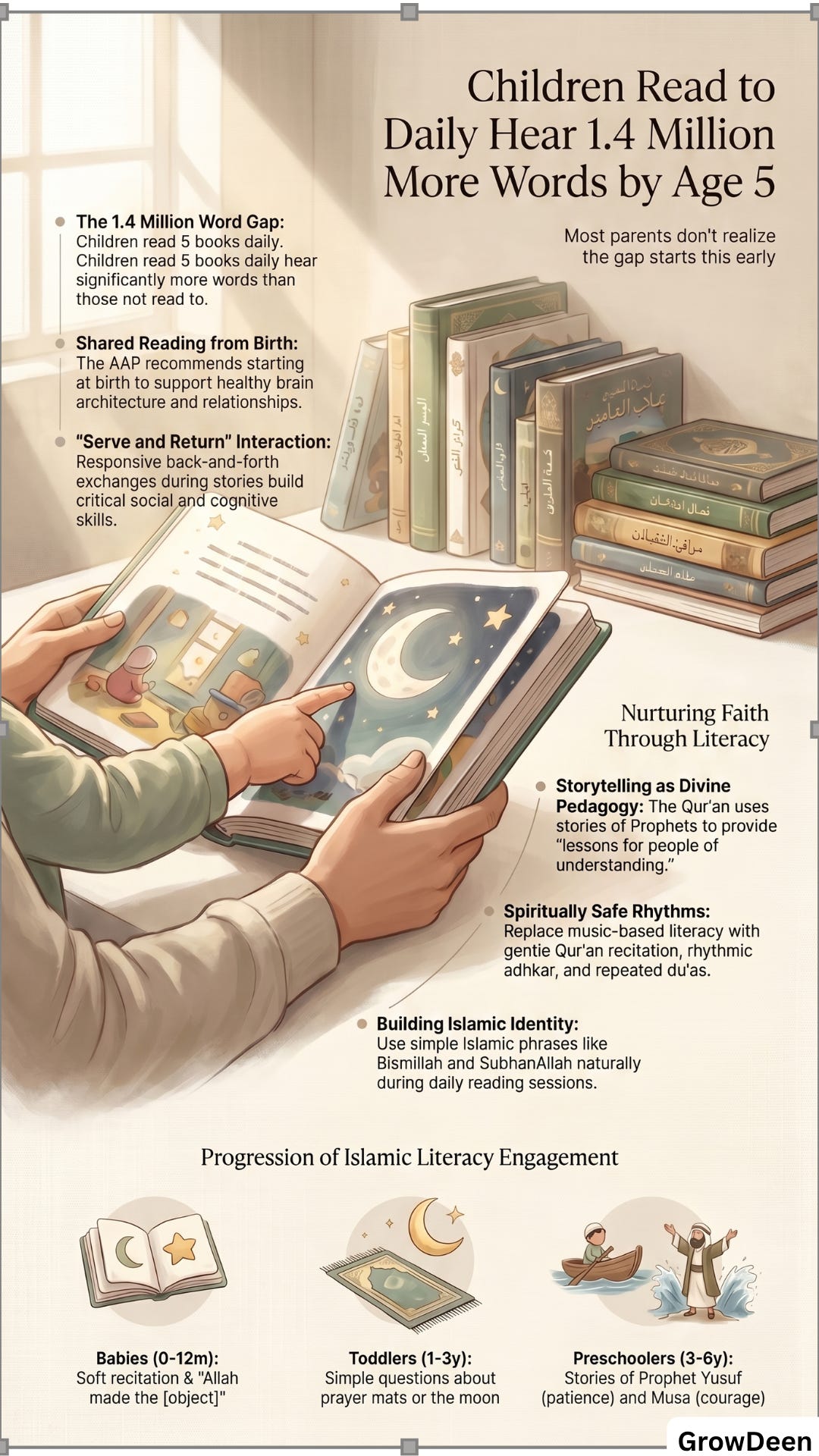
Research shows children who have five books read to them daily hear approximately 1.4 million more words by age five than children who are not regularly read to. [1] This guide shows you how to turn shared reading into a natural doorway to the Qur’an, Islamic stories, and love for Allah — starting from birth.
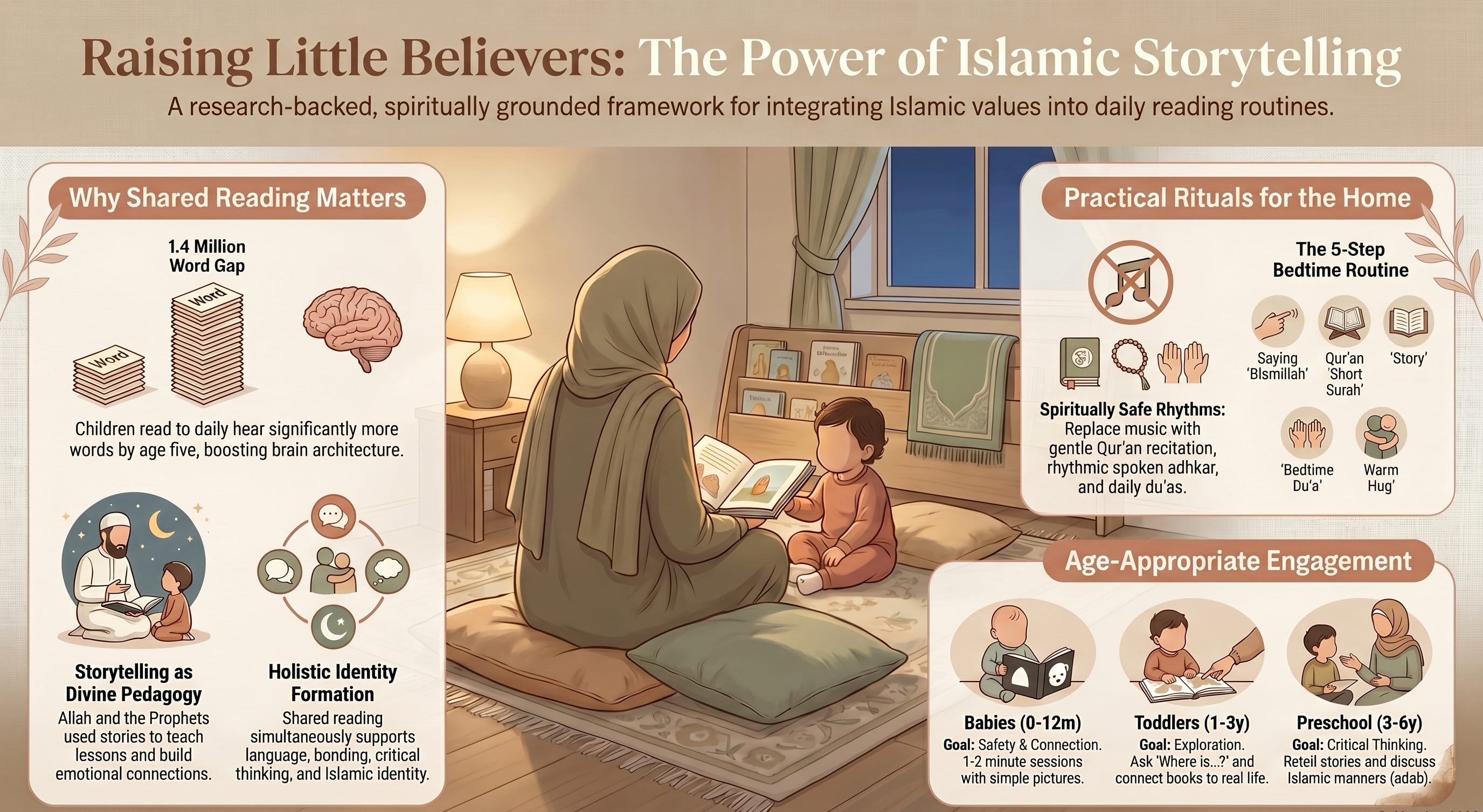
You turn off your phone. Dim the lights. Pull your baby close.
You open a board book with one simple picture — a crescent moon. You say softly, “SubhanAllah. Allah made the moon.”
Your baby may not understand the words yet. But they understand your voice. Your warmth. Your presence. Your love.
This is how it begins.
Not with elaborate lesson plans or expensive curricula. Just you, a book, and a child who feels safe in your arms.
The American Academy of Pediatrics recommends shared reading beginning at birth because reading aloud supports early relationships, language development, social-emotional growth, and healthy brain architecture [2]. And for Muslim families, shared reading becomes something even more profound: a gentle pathway to the Qur’an, the stories of the Prophets عليهم السلام, Islamic values, and love for Allah.
Why This Guide Is Different
Islamic foundation from day one. While most early literacy resources focus solely on phonics and vocabulary, this guide shows you how to weave Qur’an recitation, Islamic stories, du’as, and adhkar naturally into daily reading routines — replacing music-based methods with spiritually safe alternatives.
Research-backed and age-specific. Every recommendation is grounded in current research from Harvard’s Center on the Developing Child, the American Academy of Pediatrics, and peer-reviewed studies on bilingual language development [4] — adapted specifically for babies, toddlers, and preschoolers.
Practical tools you’ll actually use. Not theory. Not ideals. Real strategies for busy Muslim parents, from simple spoken rhythms to Qur’an story prompts to multilingual reading approaches — all designed to build both literacy and Islamic identity together.
Why Reading to Your Child Matters More Than You Think
When you read to your child, you’re offering far more than words on a page.
You’re giving them your lap. Your voice. Your attention. Your warmth.
Harvard’s Center on the Developing Child confirms that responsive, back-and-forth exchanges between loving caregivers and young children build healthy brain architecture and support language skills, social development, and cognitive abilities [4].
So when you pause mid-story and ask, “What do you think happened next?” or point to a picture and say, “SubhanAllah, look at the bird Allah created,” this isn’t trivial. It’s simultaneously language development, bonding, critical thinking, Islamic identity formation, and emotional security.
The Qur’an teaches us that storytelling is already a divine method of teaching. Allah says in Surah Yusuf: “Indeed, in their stories there is a lesson for people of understanding” [5].
Allah teaches through stories. The Prophet ﷺ taught through stories. Parents can teach through stories too.
What to Use Instead of Songs and Music
Many early learning resources recommend songs and rhythmic music for literacy development [1]. Muslim parents can preserve the developmental benefits of rhythm, repetition, and vocal interaction while using Islamically safer alternatives.
Use these instead:
Gentle Qur’an recitation. Short surahs like Al-Fatihah, Al-Ikhlas, Al-Falaq, and An-Nas can become part of calm daily routines.
Softly spoken adhkar. Say simple phrases with your child: SubhanAllah, Alhamdulillah, Allahu Akbar, La ilaha illa Allah, Astaghfirullah.
Repeated du’as. Use short du’as before eating, after eating, before sleeping, when leaving home, and when entering.
Spoken rhythm without music. Create rhythmic spoken phrases like: “Bismillah, we open the book. Alhamdulillah, we turn the page. SubhanAllah, what do we see?”
Qur’an listening time. Play calm recitation softly while your child rests or colors. The Qur’an reminds us: “Verily, in the remembrance of Allah do hearts find rest” [7].
Start Reading from Birth
You can begin reading aloud to your baby as early as you wish. The AAP encourages shared reading from birth because it strengthens parent-child relationships and supports early development [2].
For a newborn, reading can look like this: You hold your baby close. You recite softly from a board book. You point to one picture. You say gently, “Allah made the moon.” You repeat, “Alhamdulillah.” You close the book when baby looks away.
That’s enough. That moment counts.
Age-Specific Reading Ideas
Babies (0-12 months):
Choose board books with simple pictures of family, food, animals, and daily life
Use Islamic words naturally: “Bismillah, we start.” “SubhanAllah, look at the bird.”
Keep sessions very short — even 1-2 minutes is valuable [2]
Hold your baby while reading so they associate books with safety and love [1]
Toddlers (1-3 years):
Let them touch and explore sturdy board books
Ask simple questions: “Where is the moon?” “What color is the prayer mat?”
Connect books to real life: “We say Bismillah before eating, just like in the book.”
Keep Qur’an stories very simple: “Prophet Nuh عليه السلام listened to Allah.” “Prophet Muhammad ﷺ was very kind.”
Repeat favorite books often — repetition builds vocabulary and confidence [1]
Preschoolers (3-6 years):
Ask thinking questions: “What do you think will happen next?” “What would please Allah?”
Connect stories to Islamic manners: sharing, truthfulness, patience, gratitude
Introduce Qur’an stories like Prophet Yusuf عليه السلام (patience), Prophet Musa عليه السلام (courage), and Maryam عليها السلام (devotion)
Share seerah stories about the kindness, honesty, and mercy of Rasulullah ﷺ
Let your child retell stories to build memory, sequencing, and confidence [1]
A Simple Muslim Home Reading Routine
You don’t need a complicated system. Start with one small routine:
Morning: Read one short page after breakfast. Say: “Today we will learn one beautiful word.” Examples: Allah, Rahmah, Sabr, Shukr, Jannah.
Before nap: Read a calm picture book. End with: “Alhamdulillah for rest.”
After Asr or Maghrib: Family story time. Choose a Qur’an story, seerah story, or story about manners.
Bedtime: Turn off screens. Dim lights. Hold your child close. Read a short Islamic story. Recite a short surah. Say bedtime du’as together. End with a warm hug.
Shared reading can become a positive daily ritual that supports social-emotional development, language growth, and cognitive skills [2].
Support Muslim Parenting Lab ❤️
Would you like one parent, somewhere, to be guided because of you? Fund the articles that reach them, with the button below.
The Prophet ﷺ said one person guided through you is better for you than red camels, the greatest wealth of that time. (Sahih al-Bukhari 3701)
The Islamic Vision of Reading
In Islam, reading is connected to divine guidance, worship, reflection, and transformation.
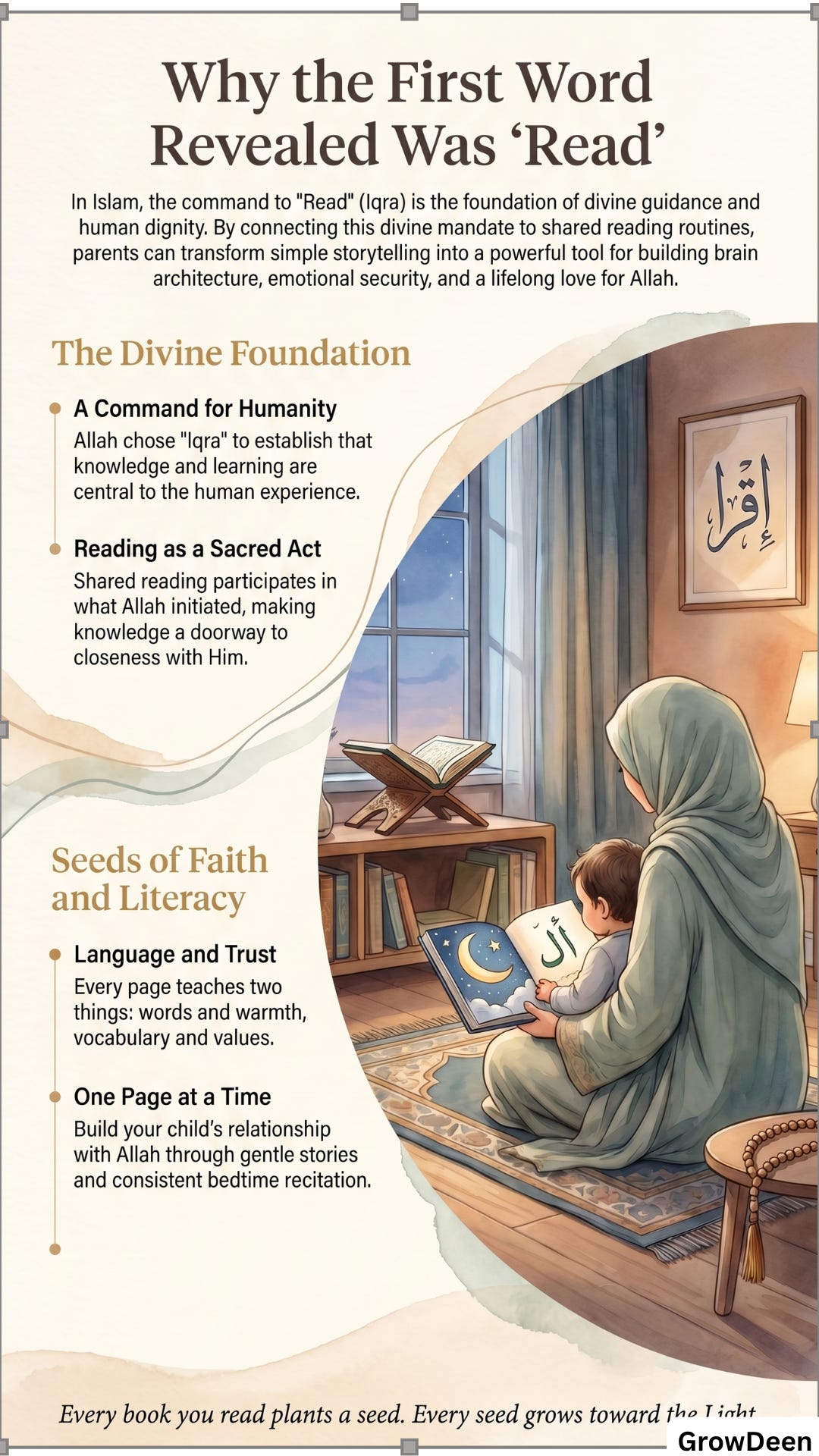
The very first words revealed in the Qur’an commanded “Read” (Iqra) in the name of your Lord [3]. According to Tafsir Ibn Kathir, these verses teach us that out of Allah’s generosity, He taught human beings what they did not know, thus exalting and honoring them through knowledge — the same dignity that distinguished Prophet Adam عليه السلام over the angels.
This divine instruction gives Muslim families a profound foundation for raising children who understand that reading, learning, and seeking knowledge are acts deeply connected to Allah.
The Prophet ﷺ said, “The best among you are those who learn the Qur’an and teach it” [9].
When we read with our children, we’re not just building vocabulary. We’re nurturing future believers who see the Qur’an as beautiful, relevant, and life-giving.
Choosing the Right Books
Good starting categories:
Simple board books about family, animals, food, and daily life
Islamic routine books about salah, wudu, Ramadan, Eid, and masjid
Qur’an story books written for children in simple language
Seerah books about the life and character of Rasulullah ﷺ
Books about Islamic manners (adab): sharing, patience, gratitude, truthfulness
Nature books that connect to Allah’s creation
Be mindful of:
Music-centered content
Magic themes that conflict with Islamic beliefs
Disrespectful behavior presented as funny
Values that normalize disobedience or arrogance
Frightening images for young children
The goal isn’t to make children afraid of books. The goal is to build a library that feels joyful, safe, meaningful, and aligned with Islamic values.
If you’ve read this far, you’re thinking: “This sounds beautiful, but where do I even start?” I created something to help you — a practical resource you can use today. Keep reading to the end for the Reading & Storytelling Companion Pack, including a visual reading routine tracker, age-specific Islamic book list, and authentic bedtime du’as with transliteration.
The Real Goal
The goal is not just to raise a child who can read early.
The goal is to raise a child who loves words of goodness. A child who loves stories of truth. A child who feels safe with books. A child who sees the Qur’an as beautiful. A child who connects learning with Allah.
A child who hears Islamic words in the warmest voice they know — the voice of their mother or father.
Research shows children read five books daily may hear approximately 1.4 million more words by age five than children not regularly read to [10].
But for Muslim parents, the opportunity is even greater.
Every page can build language.
Every story can build love.
Every du’a can build connection.
Every gentle recitation can build peace.
Every Islamic story can plant a seed.
And insha’Allah, those seeds may grow into a lifelong relationship with the Qur’an, beneficial knowledge, and love for Allah that will benefit your child in this life and the next.
The Reading & Storytelling Companion Pack
If you’ve read this far, you’re the kind of parent who wants to build both literacy and faith together — not as separate goals, but as one beautiful journey. That tells me something about you.
I created the Reading & Storytelling Companion Pack because knowing what to do and actually doing it consistently are two different things. This isn’t just theory — it’s a tool designed to stay with you where you need it most.
Inside this comprehensive 3-page PDF:
Page 1: Weekly Reading Routine Tracker — A simple visual schedule showing when to read (morning, nap, evening, bedtime) with checkboxes for each day of the week. Includes suggested Islamic book categories for each time slot and space to write your family’s favorite books. Designed to print and post on your fridge or keep in your baby’s room so you never wonder “when should we read today?”
Page 2: Age-Specific Islamic Book List — Curated recommendations for babies (0-12 months), toddlers (1-3 years), and preschoolers (3-6 years). Each category includes specific Islamic book titles about Qur’an stories, seerah, manners, Ramadan, and Eid — with notes on what makes each book valuable and where to find them. This eliminates hours of searching “best Islamic books for toddlers” and gives you a proven starting library.
Page 3: Bedtime Du’as & Islamic Reading Ritual — The authentic du’a the Prophet ﷺ taught for children before sleep, with Arabic text, transliteration, and English meaning. Plus a simple 5-step Islamic bedtime reading routine you can start tonight: Bismillah → short surah → story → du’a → Alhamdulillah. Includes reminders for parents on how to make it feel peaceful, not rushed.
This isn’t just a PDF to download and forget. It’s a tool you’ll reference when you’re too tired to remember what comes next. It’s a visual reminder when life gets chaotic. It’s the structure that makes consistent Islamic reading routines actually work.
This Reading & Storytelling Companion Pack is what every subscriber receives with each article I publish. We cover the full journey of raising Muslim children, all backed by research and rooted in Islamic wisdom.
You’ll only hear from us when there’s something valuable to share — no spam, no daily emails, just practical tools that matter.
One Small Action You Can Take Right Now
Before you close this tab, do this: Go find one book in your home — any book with pictures. Sit with your child (or plan to later today). Open it. Point to one picture. Say one Islamic word: Bismillah, Alhamdulillah, or SubhanAllah.
That’s it. That’s the beginning.
You don’t need a perfect library. You don’t need the “right” book. You just need to start.
May Allah place barakah in your effort, accept your intention, and make every story you read, every du’a you teach, and every moment you share a means of drawing your children closer to Him. May He grant your children love for the Qur’an, beneficial knowledge, and righteous character.
Share This with Someone Who Needs It
Think of one person right now: a new mother at the masjid who’s overwhelmed with “what to do” lists, a friend who confided she doesn’t know how to teach Islam to her toddler, a sister whose home is filled with children’s books but none are Islamic.
This article could give them a place to start. Share it with them today — not as advice-giving, but as support. Sometimes the most loving thing we can do is show others what made this journey easier for us.
Frequently Asked Questions
Q: When should I start reading to my baby?
A: You can start reading aloud from birth. The American Academy of Pediatrics recommends shared reading beginning in the newborn period because it strengthens parent-child bonds and supports early language development [2]. Even if your baby doesn’t seem to understand, they’re absorbing language patterns, vocal rhythms, and most importantly, feeling loved and safe in your arms.
Q: How long should reading sessions be with young children?
A: Keep it short and follow your child’s lead. For babies (0-12 months), even 1-2 minutes is valuable [2]. For toddlers (1-3 years), 5-10 minutes works well. For preschoolers (3-6 years), you can extend to 15-20 minutes. If your child walks away or loses interest, stop. Forcing reading creates negative associations. Quality matters more than duration.
Q: Can I read in multiple languages to my child?
A: Absolutely. Muslim families often live in multilingual homes, and this is a gift. Read and tell stories in whatever language you feel most comfortable using. Comfort enhances communication and emotional connection [1]. You can read in English then explain in Urdu, or read an Arabic word then translate it. Research on bilingual children shows that content-rich shared reading supports vocabulary, grammar, and language development across both languages [8].
Q: Should I use ebooks or paper books?
A: Paper books are strongly recommended for young children. The American Academy of Pediatrics emphasizes that print books support richer parent-child interaction than digital reading because screens can be distracting [2]. Young children benefit most when an adult reads with them actively, not when left alone with a device [1]. If you use ebooks, sit together and treat them like print books — no games or animations.
Q: What if my child only wants the same book over and over?
A: This is completely normal and actually beneficial. Repetition helps children internalize vocabulary, language patterns, story structures, and meaning [1]. Don’t worry about variety — embrace the repetition. Each time you reread a favorite book, your child is deepening their understanding and building confidence. Eventually, they’ll ask for something new.
Q: How do I teach my child to love the Qur’an through storytelling?
A: Start by making Qur’an recitation a calm, loving part of daily routines — not forced or stressful. Recite short surahs gently before bed or during quiet time. As they grow, share Qur’an stories in simple, age-appropriate language that emphasizes emotions and values (Prophet Yusuf عليه السلام showed sabr; Prophet Ibrahim عليه السلام loved Allah). Connect these stories to your child’s own life experiences. The Prophet ﷺ said, “The best among you are those who learn the Qur’an and teach it” [9]. When children associate the Qur’an with your warm voice, patient presence, and loving attention, they begin to see it as beautiful and relevant to their lives.
References
[1] Raising Children Network. Reading and storytelling with babies and children. Adapted from this source with Islamic enrichment and additional research.
[2] American Academy of Pediatrics. Early Literacy Resources and Policy Guidance. The AAP recommends shared book reading beginning at birth and continuing through kindergarten, highlighting benefits for relationships, language, social-emotional development, and brain development.
[3] Qur’an, Surah Al-Alaq (96:1-5). The first revealed verses begin with “Iqra” (Read). According to Tafsir Ibn Kathir, these verses teach that out of Allah’s generosity, He taught human beings what they did not know, exalting them through knowledge.
[4] Center on the Developing Child at Harvard University. Serve and Return. Responsive, back-and-forth interaction between caring adults and young children supports healthy brain architecture, early language, social skills, and cognitive abilities.
[5] Qur’an, Surah Yusuf (12:111). The Qur’an states that in the stories of the Prophets and previous nations, there is truly a lesson for people of understanding.
[6] Islamic storytelling has been a core method of teaching throughout Islamic history. The Qur’an uses narrative as divine pedagogy, and the Prophet Muhammad ﷺ taught companions through stories and examples.
[7] Qur’an, Surah Ar-Ra’d (13:28). “Verily, in the remembrance of Allah do hearts find rest.”
[8] Grøver, V., Rydland, V., Gustafsson, J. E., and Snow, C. E. (2020). Shared Book Reading in Preschool Supports Bilingual Children’s Second Language Learning. Child Development. This study found shared reading supported second language skills, vocabulary, grammar, and perspective-taking in bilingual children.
[9] Sahih al-Bukhari 5027. The Prophet Muhammad ﷺ said, “The best among you are those who learn the Qur’an and teach it.”
[10] Logan, J. A. R., Justice, L. M., Yumuş, M., and Chaparro-Moreno, L. J. (2019). When Children Are Not Read to at Home: The Million Word Gap. Journal of Developmental and Behavioral Pediatrics.
We combine scientific research with Qur’an and authentic Sunnah, and we cite our sources. Even so, this is general guidance and no substitute for a doctor who can examine your child.