


A Kochanska et al. study tracked self-regulation from infancy through age 4 and found it doesn’t fully form until well past the toddler years [1]. This guide shows you the one shift, called time-in, that actually helps a two- or three-year-old come back down from a meltdown, without a single minute of isolation.
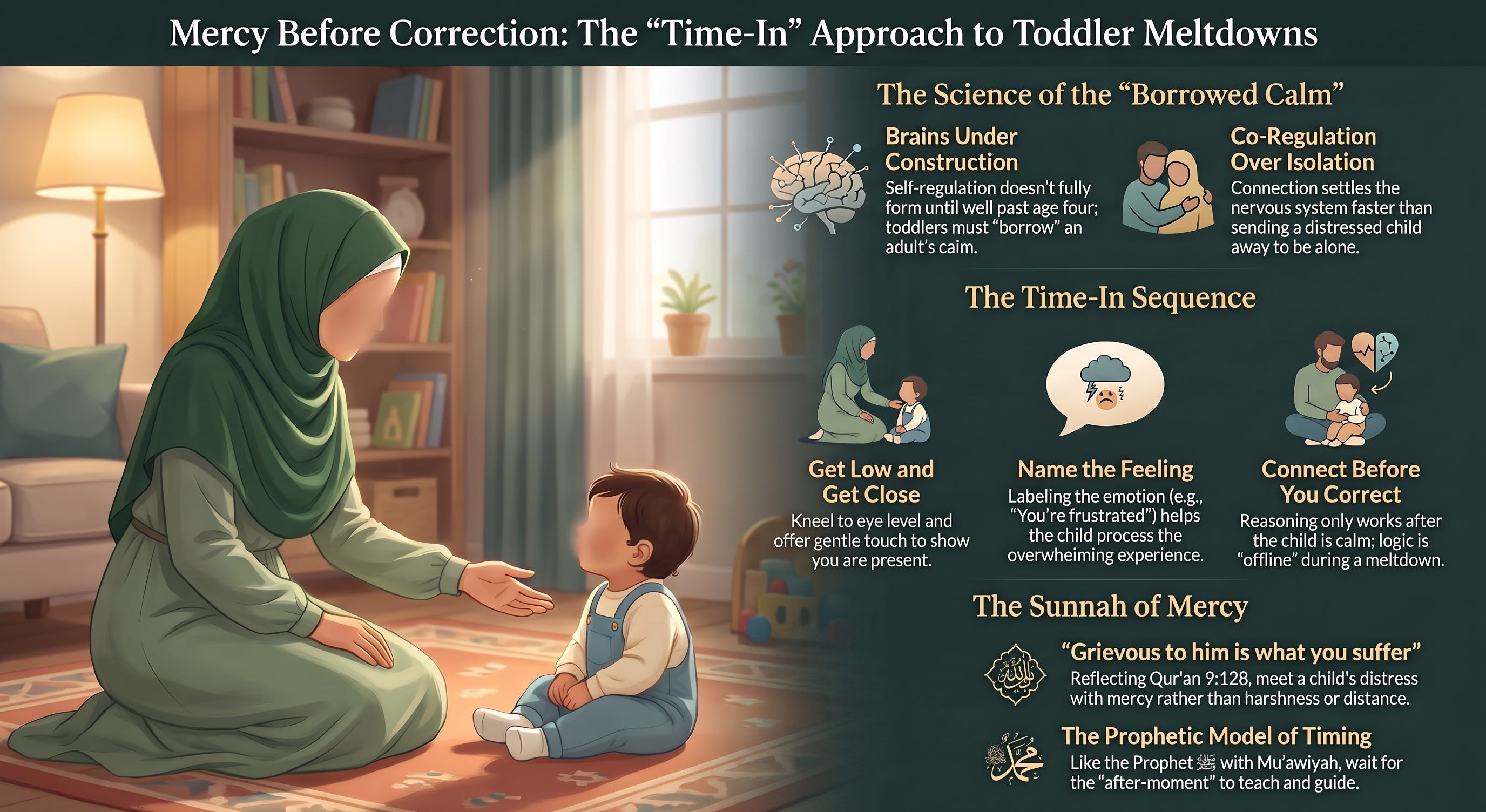
Your toddler is on the floor of the cereal aisle. Not really because you said no to the sugary cereal. More because you said no to it in the wrong tone, at the wrong moment, in a body that had already run out of patience an hour earlier.
You know this feeling. Every parent of a toddler knows this feeling.
Here’s what’s actually happening underneath it, and it isn’t defiance. A toddler’s brain is still under construction, building the exact wiring that lets a person notice a hard feeling, name it, and manage it without falling apart. That wiring, what researchers call self-regulation, doesn’t arrive all at once. It’s assembled slowly across early childhood, shaped almost entirely by how the adults around a child respond when things go sideways [1][2].
A three-year-old melting down in a shop isn’t broken. They’re mid-construction. And what you do in that exact moment either helps the building continue, or it doesn’t.
Why This Guide Is Different
It’s not another list of discipline techniques. This is about timing, specifically, the order in which comfort and correction happen, and why getting that order wrong undoes even good advice.
It draws a direct line to a 1,400-year-old hadith, not as decoration, but because the Prophet ﷺ modeled this exact sequence with a grown man centuries before developmental psychology gave it a name.
It tells you what to avoid, not just what to do. Most tantrum advice skips the part where well-meaning responses quietly make things worse.
Why Toddlers Fall Apart the Way They Do
Somewhere around age two, a wave of new emotions shows up that your child has never had to manage before. Frustration that goes beyond “annoyed.” Embarrassment. Jealousy sharp enough to make a toddler shove a sibling out of the way. These aren’t small feelings scaled down from adult ones. They’re enormous, unfamiliar, and they land in a body with almost no tools to process them [1].
Language usually lags behind the feeling by months, sometimes years. An adult who’s furious can say “I am furious,” and that act of naming already takes some heat out of it. A toddler doesn’t have that option yet. So instead of words, you get the whole-body version: screaming, dropping to the floor, hitting, going rigid. It looks like defiance. It’s closer to an alarm going off in a system that hasn’t learned how to switch itself off [3].
Here’s the part most parenting advice skips.
Developmental psychologists describe this as co-regulation before self-regulation. Before a child can calm themselves alone, they need to borrow calm from someone else, again and again, until the pattern gets built into their own nervous system [4]. That borrowing isn’t a crutch or a workaround. It’s the actual mechanism through which self-regulation develops.
Which means the way you respond during a meltdown isn’t just damage control. It’s the lesson.
Time-In, Not Time-Out
Time-in flips the usual instinct. Instead of sending a distressed child away to sit with a feeling too big for them, alone, you move toward them. You get down to their level. You stay. You let them know, through your body and your words, that you’ve seen what’s happening and you aren’t going anywhere.
This isn’t permissiveness. It’s timing.
A child in the middle of a flood of emotion cannot absorb a lesson, cannot reflect, cannot problem-solve. Trying to teach in that window is a bit like shouting instructions at someone who’s underwater. What has to happen first is that they resurface, and a calm, steady adult is usually what gets them there [4][5].
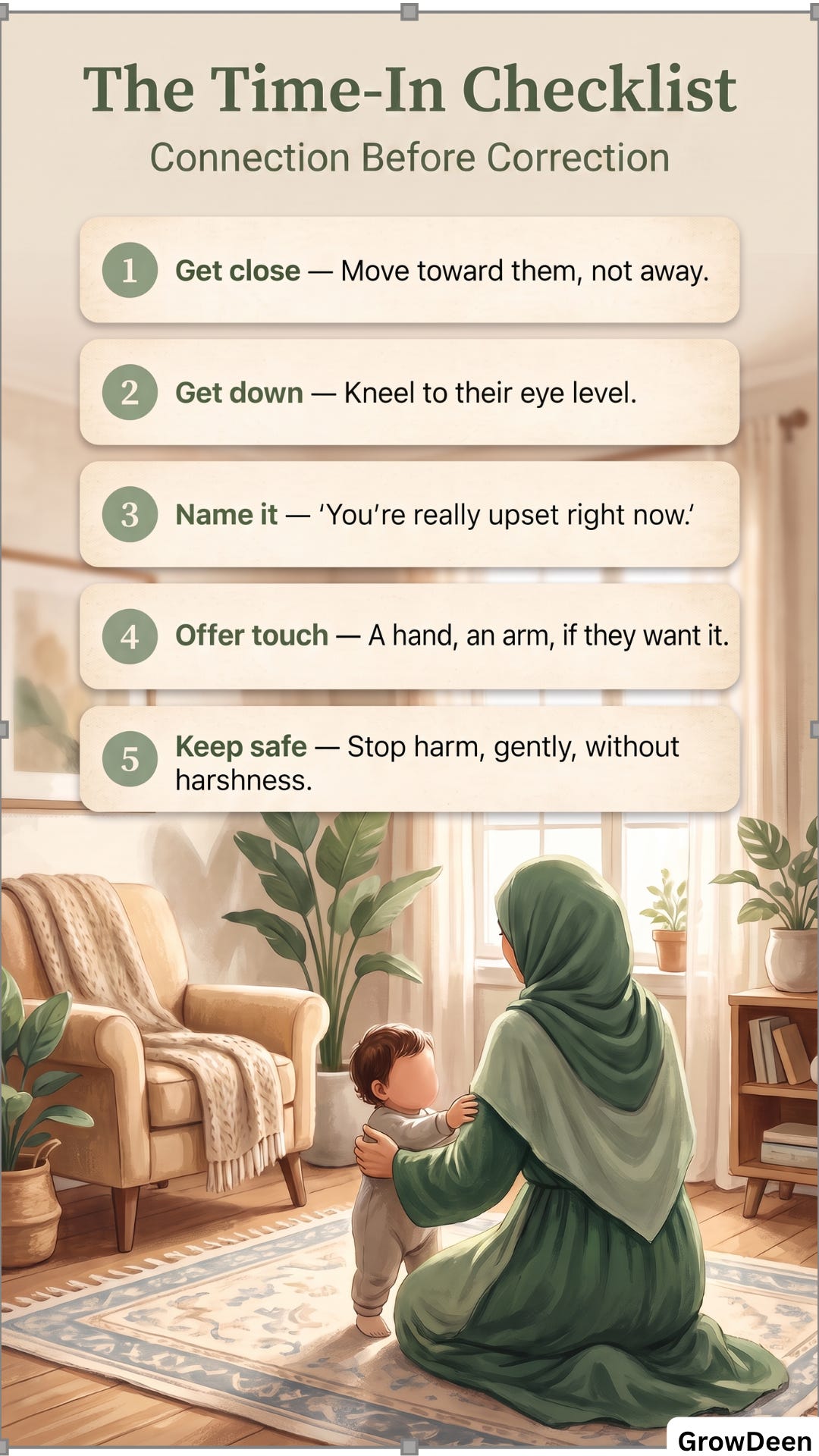
In practice, that looks like this:
Getting physically close. Kneel or crouch so you’re at eye level, not looming. A hand on the shoulder or an arm around them, if they want it.
Finding somewhere quieter, if you can. A corner of the room, a bench outside, a quieter hallway. Less noise and fewer eyes on them makes it easier for a flooded nervous system to settle.
Naming the feeling out loud. “You’re really angry we have to leave the park.” Naming doesn’t inflate the feeling. It tends to shrink it, because the child no longer feels alone with something that had no shape or word yet.
Offering touch, if they want it. Some toddlers want to be held through the whole thing. Others need a little space but want you within reach. Watch what they’re actually asking for.
Keeping everyone safe without adding harshness. If hitting or throwing is about to happen, stop it firmly and gently. Move the object, hold the hands. This is containment, not punishment.
I’ve created a full walk-through card for exactly this sequence, more on that in a moment.
The Conversation Comes After. Never During.
Once your child has actually calmed, and only then, there’s room to talk about what happened. “Did you throw the puzzle because it wasn’t going together the way you wanted? What’s something else you could try next time?”
Said before they’ve settled, the same words land as noise. Said after, they land as something closer to a lesson that sticks.
What the Prophet ﷺ Modeled With a Grown Man
As Muslim parents, it’s worth sitting with how closely this maps onto something Allah tells us directly about the character of His Messenger ﷺ. Allah says, “There has certainly come to you a Messenger from among yourselves. Grievous to him is what you suffer; he is concerned over you and to the believers is kind and merciful” [Qur’an 9:128]. According to Tafsir Ibn Kathir, this verse describes a Prophet who felt the hardship of his people as though it were his own, and who met that hardship consistently with mercy rather than harshness or distance.
I find real comfort in that description when I think about a toddler screaming on a kitchen floor. Their distress is real to them, even when the trigger looks small to us.
There’s an even more direct example. A companion named Mu’awiyah ibn al-Hakam, new to the community, spoke out loud in the middle of a congregational prayer after someone near him sneezed. He didn’t know the rule. The people around him glared. He grew flustered, even a little angry, by his own account. The Prophet ﷺ said nothing to correct him in that moment. He waited until the prayer ended, and only then, calmly, explained what had gone wrong. Mu’awiyah later described it this way: “He did not scold, beat, or revile me” [Sahih Muslim 537a].
That sequence, mercy first, correction only once the person can actually hear it, is the entire logic of time-in. Applied to an adult. Fourteen centuries before the term existed.
What’s striking is how naturally this lines up with what co-regulation research is finding: a calm, present adult is often the entire mechanism by which a small child learns to settle. Islam arrived at mercy-first as the default response to someone else’s overwhelm long before anyone ran a study on it.
Every time you get down on the floor instead of sending your child to it alone, you’re teaching them something that will outlast this particular tantrum: that big feelings are survivable, that they don’t have to face them by themselves, and that the people who love them stay close even when things fall apart.
What Helps
Move toward your child during a meltdown rather than sending them off alone
Put a word to the feeling, even if you’re guessing at it
Keep your own voice low and steady. Toddlers pick up the emotional temperature of the adult in front of them
Wait until they’re calm before you talk through what happened
Build in a small, repeatable calming ritual for the after-moment, a quiet phrase, a few slow breaths together, something your child comes to recognize as the sound of things being okay again

What Tends to Backfire
Sending a toddler to “calm down” by themselves. Most children this age genuinely cannot do that yet
Reasoning or lecturing mid-meltdown, when the part of the brain that processes logic has essentially gone offline
Raising your own voice to match theirs, which tends to add fuel rather than settle anything
Reading every meltdown as defiance instead of what it usually is: a nervous system that’s been overwhelmed and is asking, in the only language it has, for help
If you’ve read this far, you’re the kind of parent who wants to get the moment right, not just survive it. That’s exactly why I put together something to make this easier to reach for in the middle of a hard afternoon.
Your Time-In Companion Pack
If you’ve read this far, you’re the kind of parent who takes your child’s emotional world seriously, not as a problem to manage, but as something worth understanding. That tells me something beautiful about you.
Inside the Time-In Companion Pack (one comprehensive PDF, 3 pages):
Page 1: The 5-Step Time-In Card — A visual, step-by-step walkthrough of exactly what to do in the first sixty seconds of a meltdown (get close, get down, name it, offer touch, keep safe) — designed as a card you can keep on the fridge or tucked into a diaper bag for the moments you can’t think straight.
Page 2: Feeling Words for Little Ones — A simple, illustrated set of emotion words (frustrated, embarrassed, jealous, overwhelmed) with plain-language definitions, so you always have the right word ready when your toddler doesn’t — so you can build their emotional vocabulary a little more every week.
Page 3: Mercy First — A reflection card built around the Mu’awiyah ibn al-Hakam hadith and Qur’an 9:128, with a short prompt inviting you to consider how you can meet your child’s big feelings with the same mercy Allah describes in His Messenger ﷺ.
This isn’t just a PDF to download and forget. It’s a tool designed to stay in your kitchen or on your phone, where you’ll actually reach for it when you need it most.
This Time-In Companion Pack is what every subscriber receives with each article. We cover the full journey of raising Muslim children, all backed by scientific research and rooted in Islamic wisdom.
If you’re a Muslim parent who wants both evidence-based guidance AND Islamic perspective, subscribe for free so future resources arrive in your inbox before you need them.
Subscribe free for parenting resources backed by both science and Sunnah, guidance so specific you won’t find it anywhere else. No spam, no clutter, just resources that matter.
Before you keep scrolling: the next time your toddler falls apart, try getting down to their level before you say a single word. Just get close. That’s it. That’s the whole practice, for today.
May Allah place barakah in your effort, accept your intention, and make the mercy you show your child more protective, more far-reaching, and more rewarded than it feels in the moment.
One More Thing
Think of one person right now: the exhausted mother at the masjid who confided that bedtimes and tantrums are a daily battle, your sister whose toddler just had a meltdown in front of everyone at the family gathering, a friend whose WhatsApp messages this week sound exactly like what you were going through last year.
This article could ease their next hard afternoon. Share it with them today, not as advice-giving, but as support. Sometimes the most loving thing we can do is pass along what finally made sense to us.
Frequently Asked Questions
Q: What’s the difference between time-in and time-out?
A: Time-out sends a child away to manage a big feeling alone. Time-in keeps you close, offering comfort while the feeling passes, then teaching once they’ve calmed. For most toddlers, connection settles the nervous system faster than isolation does. See “Time-In, Not Time-Out” above for the full walkthrough.
Q: At what age can a toddler actually calm down on their own?
A: Genuinely independent self-regulation doesn’t fully develop until well past the toddler years, and continues maturing into adolescence [1]. A two- or three-year-old needing your help to settle isn’t behind. That’s exactly where they should be developmentally.
Q: Isn’t staying close during a tantrum just rewarding bad behavior?
A: No. A toddler mid-meltdown isn’t choosing to misbehave, their nervous system is overwhelmed and can’t process a lesson in that moment. Staying close teaches regulation. The correction, if one is needed, comes after they’ve calmed, not during.
Q: How long should I stay with my child during a meltdown?
A: As long as it takes for them to settle enough to hear you, which is usually a few minutes, sometimes longer. Rushing the process or trying to talk them out of the feeling early tends to extend it rather than shorten it.
Q: What if my toddler hits or throws things during a meltdown?
A: Stop the unsafe action firmly and calmly, moving objects out of reach or gently holding their hands, without adding harshness. This is containment, not punishment, and it can happen alongside comfort rather than instead of it.
Q: When should I be concerned about my toddler’s tantrums?
A: Speak with your child’s doctor if outbursts are extremely frequent, involve prolonged breath-holding or self-injury, or if your child seems unable to settle even with consistent, calm support over several weeks. A professional can help rule out other factors.
References
[1] Kochanska, G., Coy, K.C., & Murray, K.T. (2001). The development of self-regulation in the first four years of life. Child Development, 72, 1091-1111. https://doi.org/10.1111/1467-8624.00336
[2] Feng, X., Hooper, E.G., & Jia, R. (2017). From compliance to self-regulation: Development during early childhood. Social Development, 26, 981-995. https://doi.org/10.1111/sode.12245
[3] Montroy, J.J., Bowles, R.P., Skibbe, L.E., McClelland, M.M., & Morrison, F.J. (2016). The development of self-regulation across early childhood. Developmental Psychology, 52(11), 1744-1762. https://doi.org/10.1037/dev0000159
[4] Rothenberg, W.A., Weinstein, A., Dandes, E.A., & Jent, J.F. (2019). Improving child emotion regulation: Effects of parent-child interaction therapy and emotion socialization strategies. Journal of Child and Family Studies, 28(3), 720-731. https://doi.org/10.1007/s10826-018-1302-2
[5] Rademacher, A., & Koglin, U. (2019). The concept of self-regulation and preschoolers’ social-emotional development: A systematic review. Early Child Development and Care, 189(14), 2299-2317. https://doi.org/10.1080/03004430.2018.1450251
[6] Qur’an 9:128, with Tafsir Ibn Kathir on the Prophet’s ﷺ mercy toward the suffering of his community.
[7] Sahih Muslim 537a, narrated by Mu’awiyah ibn al-Hakam, graded Sahih.