

Harvard researchers studying brain development found that the connections formed in the first 5 years of life outnumber those formed in all the decades that follow. [1] This guide shows you exactly what’s happening in your baby’s brain right now and why the everyday moments between you matter more than any toy, app, or technique ever could.
Why This Guide Is Different From Generic Baby Milestone Lists
Every recommendation is grounded in current research from Harvard, the CDC, and peer-reviewed paediatric journals — not parenting folklore.
This isn’t just a developmental checklist. It connects what science confirms about your baby’s brain to what the Qur’an and Sunnah have always said about the human being’s innate capacity to connect, recognise, and seek meaning.
You’ll also get the free Your Baby’s 3–4 Month Development Pack — a 3-page printable designed to help you observe your baby’s growth, interact with more confidence, and carry an Islamic du’a into every ordinary moment.
The Moment Everything Shifts
3 AM. Your baby has been fed. Changed. Burped. And still — they are just looking at you.
Not crying. Not sleeping. Just looking.
And in that moment, something happens that no parenting book can fully prepare you for. Your baby smiles.
Not a reflex. Not gas. A real, social, I-see-you smile aimed directly at your face.
Here’s what that smile actually is: it’s the opening move in a conversation that will continue for the rest of their life. At 3–4 months, your baby is beginning to understand that you respond to them. That the world is not indifferent. That their signals have power.
When I studied the research from Harvard’s Center on the Developing Child, what stayed with me was this: the serve-and-return interactions happening right now — when your baby sends a signal and you respond — are described as the essential foundation for healthy brain development, influencing not just language but emotional regulation, stress response, and cognitive function across the entire lifespan. [1]
That is not a small thing. That is everything.
What Is Your Baby Actually Doing Right Now?
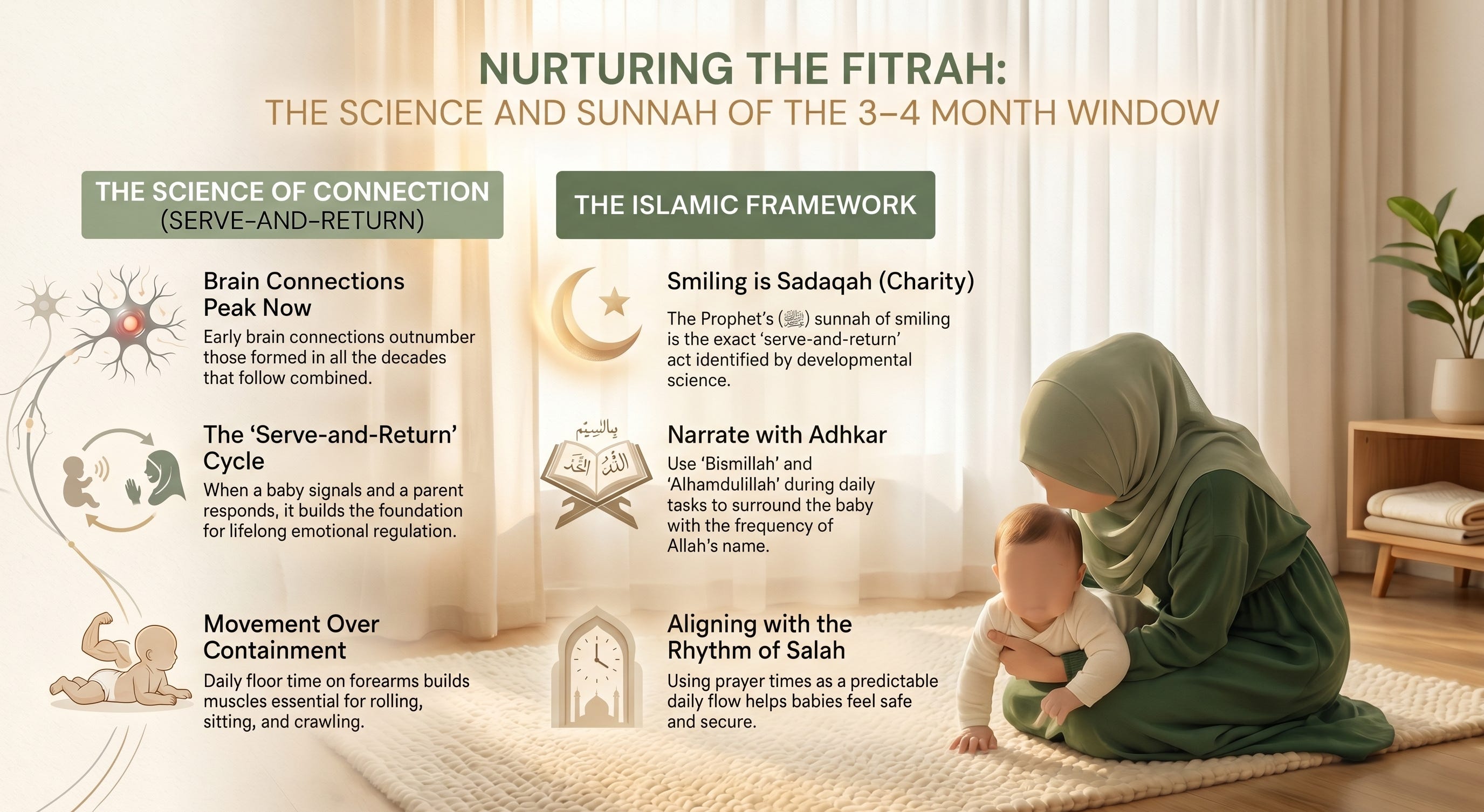
They’re learning to communicate. At 3–4 months, babies begin to link faces with emotion, track voices across a room, and practice their own sounds — coos, “ah-goo,” squeals — in a rhythm that mirrors conversation. [2] They listen. They wait. They respond. The CDC identifies social smiling, turning toward a voice, and making cooing sounds as key 4-month milestones. [3]
They may also: laugh out loud for the first time, babble to themselves when alone, reach for objects placed nearby, and stare at their own hands with complete fascination. That last one is not space-out time — it’s your baby discovering that they can move things on purpose.
The crying is changing too. The peak fussiness period that can make the early weeks feel relentless typically settles around 12–16 weeks. [4] If you’ve been in that intensity and you’re sensing a shift — you are not imagining it.
They’re getting stronger. When you hold your baby, you may notice their head is steadier than it was even a few weeks ago. During tummy time, they’re lifting higher — some babies onto their forearms, some already onto their hands. [5, 6] These muscles are the foundation for everything that comes next: rolling, sitting, crawling, walking.
Give your baby floor time every day. Limit time in bouncinettes and prams to what’s necessary. The muscles build through movement, not containment. [5]
The Aha Moment Nobody Tells You About
Here’s something I wish someone had told me earlier: the most developmentally powerful thing you can do for your 3–4 month old costs nothing, takes no preparation, and you can do it right now.
Smile at them. Genuinely. Hold their gaze and let your face show that you are glad they exist.
That’s it.
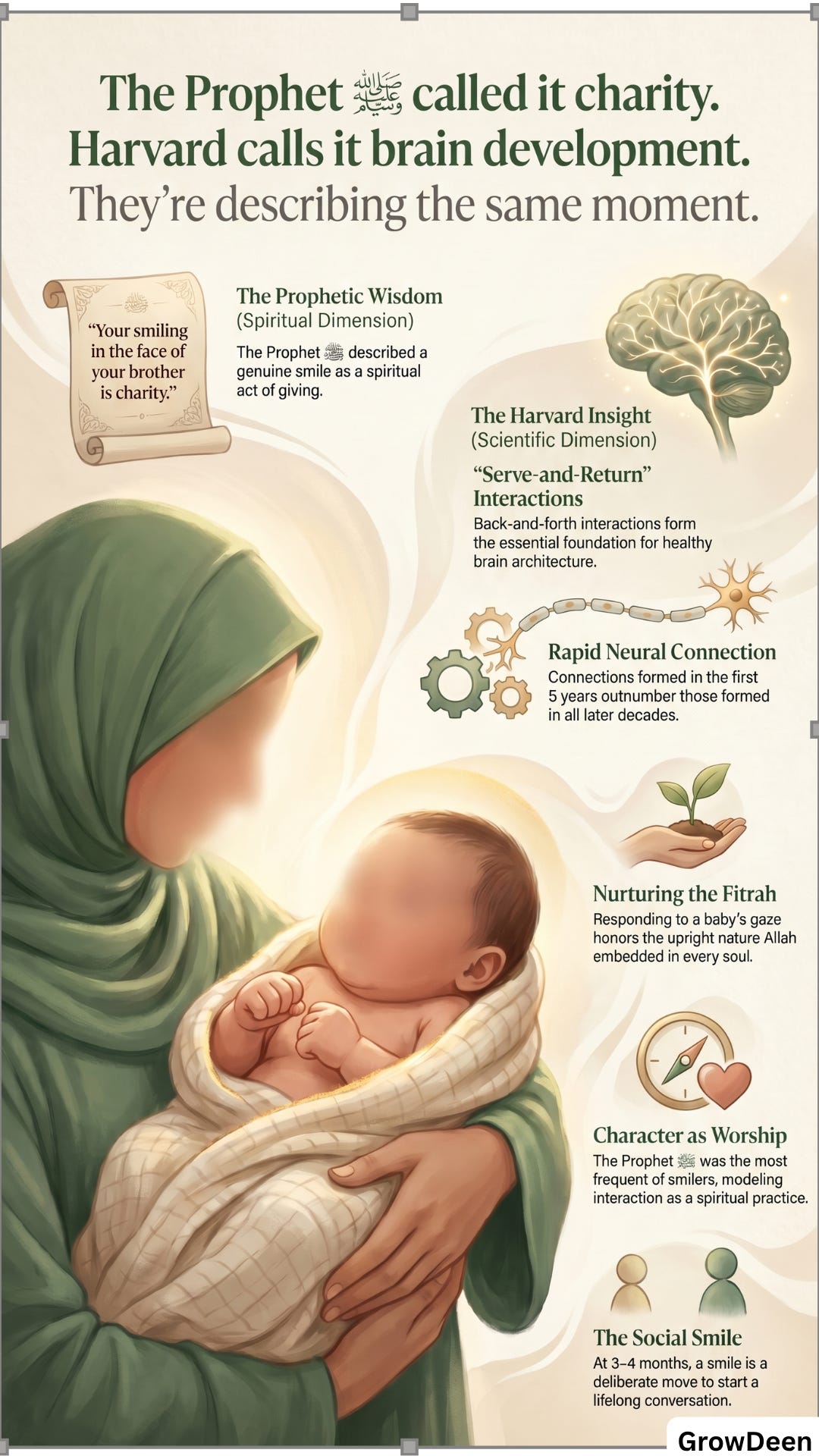
The Prophet ﷺ said: “Your smiling in the face of your brother is charity.” [Sunan al-Tirmidhi 1956 — Sahih] [9] He was described by his companions as the most frequent of smilers — not as performance, but as character. When you smile at your 3–4 month old, you are doing something the Prophet ﷺ described as an act of giving. Simultaneously, you are triggering the serve-and-return cycle that developmental scientists say builds the architecture of the brain. [1]
One act. Two dimensions. Both real.
How to Actually Use These Months
Talk constantly. Narrate your day. Respond to every coo. Describe what you’re doing as you do nappy changes, feeds, and settling. The content doesn’t matter — the rhythm does. Language is built through back-and-forth, not through passive exposure. [2]
In a Muslim home, that voice carries more. Soft Qur’an recitation during feeding. Adhkar spoken gently during nappy changes. “Bismillah” before you begin, “Alhamdulillah” when you’re done. Your baby cannot understand words yet — but they are learning the frequency of a home where Allah’s name is spoken often.
Replace music with: Qur’an recitation, gentle spoken adhkar, parent-led narration of the world as it passes. Your voice — warm, present, responding — is genuinely irreplaceable. [2]
Make eye contact a practice. Get to their level. Slow your face down. Give them time to respond. Then go again.
Let the rhythm of salah shape your day. A predictable flow — not a rigid schedule, but a recognisable pattern — helps babies feel safe. [2] Fajr marks the morning. Dhuhr midday. Asr afternoon. The adhan is already a cue in your home. Let your baby hear it.
A Word About the 3–4 Month Window and the Fitrah
When Allah says in the Qur’an, “[Adhere to] the fitrah of Allah upon which He has created [all] people” [Qur’an 30:30] [8], He is describing something that is visible in your baby right now. That searching gaze. That social smile. That reach toward your face. According to Tafsir Ibn Kathir, this fitrah is the sound, upright nature Allah created all of humanity with — a nature that recognises, seeks connection, and inclines toward truth. [8]
Your baby was born with it. The environment you create either nurtures it or neglects it. There is nothing elaborate required. You need only to be present — responding, warm, and consistent — and the fitrah does the rest.
I know this is a lot to hold in your head when you’re already running on broken sleep and instinct alone. That’s exactly why I put together the free Your Baby’s 3–4 Month Development Pack — three pages designed to stay on your fridge or beside your changing mat, so the most important things stay visible when you need them most. Keep reading — it’s at the end of this article.
When to Speak With a Paediatrician
Trust your instincts. You know your baby. Speak with a paediatrician if, at 4 months, your baby:
Does not make eye contact or show interest in faces
Makes no sounds — no coos, no vocalisations
Does not respond to noises
Has one eye that turns in or out consistently, or does not track moving objects
Is not lifting their head during tummy time
Does not appear to notice their hands or keeps them in a fist most of the time
Has lost skills they previously had
Also speak with a doctor if you are experiencing signs of postnatal anxiety or depression. Early support changes outcomes — for you and for your baby. [2]
The Islamic Framework: What Nurturing the Fitrah Actually Looks Like
As Muslim parents, we understand that our children arrive as an amanah — a trust from Allah. And there is something specific in these 3–4 months that sits right at the intersection of Islamic wisdom and developmental science.
When I reflect on the verse “[Adhere to] the fitrah of Allah upon which He has created [all] people” [Qur’an 30:30] [8], what moves me is how visible this fitrah is in a baby at this stage. The seeking. The smiling. The waiting for your response. According to Tafsir Ibn Kathir, this is the sound, upright nature Allah embedded into every human soul — not a blank slate, but a recognition-seeking design. [8] Every time you respond to your baby’s coo, you are tending to something Allah placed there before they were born.
And then there is the hadith of the Prophet ﷺ: “Your smiling in the face of your brother is charity.” [Sunan al-Tirmidhi 1956 — Sahih] [9] What strikes me about this is how it lands differently when you understand the serve-and-return research. The act the Prophet ﷺ described as sadaqah is the exact act that developmental science identifies as the foundational building block of the brain. A smile, returned genuinely, is not small. It is worship and science — indistinguishable, because both are gifts from the same Source.
If You’ve Read This Far
You’re the kind of parent who takes this seriously — not as anxiety, but as love. That tells me something beautiful about you. And that’s why we have designed the following gift pack for you!
Inside the Your Baby’s 3–4 Month Development Pack (one comprehensive PDF, 3 pages):
Page 1: “What to Notice Right Now” — Your 3–4 Month Observation Card — A domain-by-domain guide to what healthy development looks like at this exact window (communication, movement, hands, eyes) with simple “look for this / try this” prompts — designed as a printable card to keep beside your changing mat or on the fridge.
Page 2: “30 Days of Warm Conversations” — A Daily Interaction Prompt Card — 30 short, specific, age-appropriate things to say and do with your baby, organised by occasion: morning, nappy change, feeding, floor time, and settling. Not a rigid script — just a resource to draw from on the days when your own words run dry.
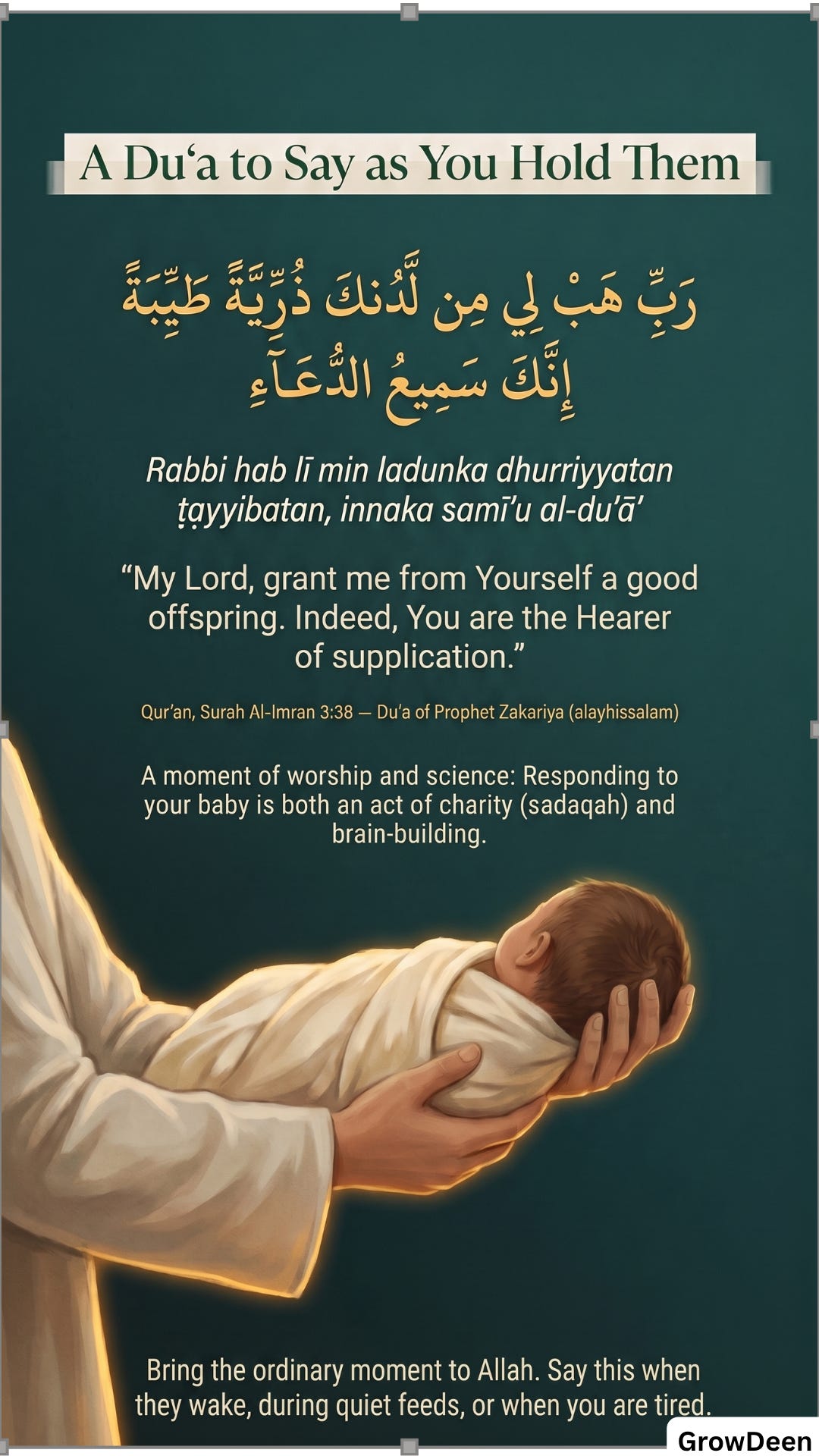
Page 3: A Du’a to Say as You Hold Them — The du’a of the Prophet Zakariya (alayhissalam), who asked Allah for a good child while witnessing Allah’s miraculous provision: Rabbi hab lī min ladunka dhurriyyatan ṭayyibatan — “My Lord, grant me from Yourself a good offspring.” [Qur’an 3:38] With Arabic text, transliteration, English translation, and a brief note on how to use it with your baby in your arms.
This isn’t a PDF you’ll download and forget. It’s designed to live in the spaces where parenting actually happens.
Every article at Muslim Parenting Lab by GrowDeen Education covers a different chapter of your child’s journey — from newborn to school-age — grounded in both current research and Islamic wisdom. Subscribe free so each new resource reaches your inbox before you need it.
Subscribe free for parenting resources backed by both science and Sunnah — guidance so unique, you literally can’t get it anywhere else — no spam, no clutter, just resources that matter.
Your Micro-Action
The next time you are with your baby — not in a planned “development session,” just in an ordinary moment — look at them and smile. A real smile. Hold it. Wait for their response.
That’s the practice. That’s the sadaqah. That’s the serve-and-return. All at once.
May Allah place barakah in every ordinary moment between you and your baby, and make the care you give more powerful than it feels in the hard moments. Ameen.
Share This With Someone Who Needs It
Think of one person right now: a new mother in your family or community whose baby is 2–4 months old, who is running on barely enough sleep, who is doing everything she can and still wondering if it’s enough.
This article could reach her at exactly the right time. Share it with her today — not as advice-giving, but as a hand extended. Sometimes the most loving thing we can do is pass along something that quietly says: you are doing it right, and it is working.
Frequently Asked Questions
Q: What are the most important developmental milestones at 4 months?
A: The CDC identifies four key areas: communication (social smiling, cooing, turning toward voices), movement (lifting head during tummy time, beginning head control when seated), hands and touch (noticing and playing with their own hands, reaching for objects), and vision (tracking moving objects with eyes). [3] For more detail, see “What Is Your Baby Actually Doing Right Now?” above.
Q: How can I help my baby’s brain development at 3–4 months?
A: The single most impactful thing you can do is respond consistently to your baby’s cues — the serve-and-return interaction that Harvard researchers describe as the essential foundation for brain development. [1] Talk to them constantly, make eye contact, smile genuinely, and give them plenty of floor time. You don’t need any special equipment.
Q: My baby isn’t smiling yet at 3 months — should I be worried?
A: Not necessarily. Social smiling typically emerges between 6–8 weeks and is reliably present by 2–3 months, but babies develop on a spectrum. If your baby is past 3 months with no social smile, no eye contact, and no vocalisations, it’s worth a conversation with your paediatrician — not to panic, but to get a proper look. Early support, when needed, makes a significant difference.
Q: Is it normal for my 3–4 month old to cross their eyes?
A: Yes, occasional eye crossing when focusing on something close is developmentally normal in the first few months as the visual system matures. [7] What’s worth noting is one eye that turns in or out consistently, or a baby who isn’t tracking moving objects. If you see either of those, speak with a paediatrician.
Q: How much tummy time does my 4-month-old need?
A: There’s no single fixed number, but the goal is to accumulate tummy time throughout the day in short sessions — starting from a few minutes at a time and building up as your baby’s tolerance grows. [5] The key is to do it daily, when your baby is awake and supervised, and to stop when they are clearly fatigued. Floor time generally and tummy time specifically build the muscles needed for all the movement milestones ahead.
Q: Can I spoil my baby by responding every time they cry at this age?
A: No. Responding consistently to your baby’s cries at 3–4 months builds the foundation of secure attachment and trust. [2] The research is clear: responsiveness at this age does not create demanding behaviour — it creates the felt sense of safety that allows babies to explore and settle more easily as they grow. You cannot over-respond to a baby this young.
References
[1] Center on the Developing Child at Harvard University. (2021). Three principles to improve outcomes for children and families, 2021 update. Retrieved from https://developingchild.harvard.edu/resources/report/three-principles-to-improve-outcomes-for-children-and-families/
[2] Centers for Disease Control and Prevention (CDC). (2024). Child development: Positive parenting tips: Infants (0–1 years). Retrieved from https://www.cdc.gov/child-development/positive-parenting-tips/infants.html
[3] Centers for Disease Control and Prevention (CDC). (2023). Important milestones: Your baby by four months. Retrieved from https://www.cdc.gov/ncbddd/actearly/milestones/milestones-4mo.html
[4] The Royal Children’s Hospital (RCH). (2018). Crying and unsettled babies – Colic. Retrieved from http://www.rch.org.au/kidsinfo/fact_sheets/Crying_and_unsettled_babies/
[5] Zubler, J.M., Wiggins, L.D., Macias, M.M., Whitaker, T.M., Shaw, J.S., Squires, J.K., et al. (2022). Evidence-informed milestones for developmental surveillance tools. Pediatrics, 149(3), Article e2021052138. https://doi.org/10.1542/peds.2021-052138
[6] Onigbanjo, M.T., & Feigelman, S. (2024). The first year. In R. Kliegman & J.W. St Geme III (Eds), Nelson textbook of pediatrics (22nd edn, pp. 151–156). Elsevier.
[7] Nye, C. (2014). A child’s vision. Pediatric Clinics of North America, 61(3), 495–503. https://doi.org/10.1016/j.pcl.2014.03.001
[8] Qur’an, Surah Ar-Rum 30:30 — https://quran.com/30/30 | Tafsir Ibn Kathir commentary verified via multiple scholarly sources including alim.org/quran/tafsir/ibn-kathir/surah/30/30
[9] Sunan al-Tirmidhi 1956 — Graded: Sahih (authenticated by Al-Tirmidhi and Al-Albani) — https://sunnah.com/tirmidhi:1956
[10] Sharma, A., Cockerill, H., & Sanctuary, L. (2022). Mary Sheridan’s from birth to five years: Children’s developmental progress (5th edn). Routledge.
[11] Kliegman, R.M., & Marcdante, K.J. (2019). Nelson essentials of pediatrics (8th edn). Elsevier.
[12] Qur’an, Surah Al-Imran 3:38 — https://quran.com/3/38