


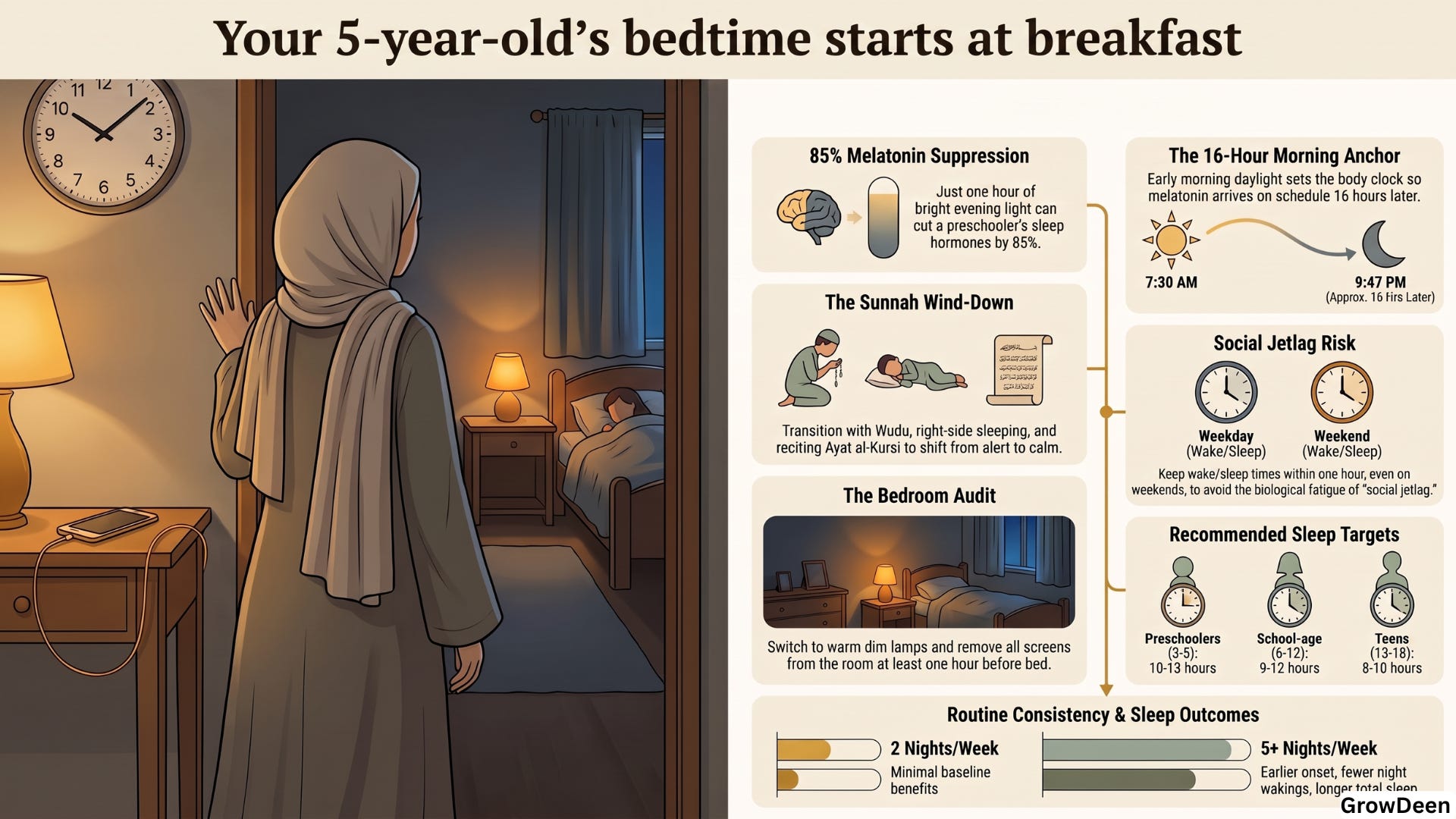
Researchers found that one hour of ordinary bright light before bed cut preschoolers’ melatonin by more than 85%, and it had still not recovered fifty minutes after the lights went off. [3] This guide walks you backwards through your child’s day, hour by hour, to find the one thing that is actually costing you the night.
It is 9:47pm.
Your eight-year-old has been in bed for over an hour. You have brought water twice. You have done the firm voice, then the gentle voice, then the voice that is mostly just tired. In the next room your fourteen-year-old’s phone is still glowing under the duvet, and tomorrow she will tell you she went to sleep at eleven.
You are not doing this wrong. You have read the articles, kept the routine, moved bedtime earlier twice. And still, most nights, the last hour of your day belongs to someone else.
Here is what almost nobody tells parents: bedtime is where the problem shows up, not where it lives. By 9:47pm, the outcome was mostly settled hours ago. That 85% melatonin drop from evening light [3] happened while you were washing up at seven. The nap that ran until half past four, the caffeine in the iced tea at five, the morning your child never saw daylight because you drove instead of walked. All of it arrived at bedtime before your child did.
So here is the question I want you to hold onto: if bedtime is only the symptom, where is the actual cause hiding in your child’s day?
We are going to find it by walking backwards.
Why This Guide Is Different From Generic Sleep Advice
It works backwards, not forwards. Instead of another list of bedtime tips, this walks from lights-out back to breakfast so you can find the one hour that is actually costing you the night.
The Sunnah is the method, not the decoration. The wind-down sequence the Prophet ﷺ taught sits inside the practical steps, and the Qur’anic framing of night and day is the reason the whole thing holds together.
You get the Night Audit Pack free. A printable diagnostic and seven-night log you can put on the fridge, so you stop guessing and start seeing the pattern.
Before We Start: Do You Actually Know How Much Your Child Sleeps?
Most parents guess, and most guesses are wrong by about an hour.
For seven nights, write down two numbers and nothing else. The time the light went off. The time your child woke up. That is the whole exercise.
The American Academy of Sleep Medicine reviewed more than 800 studies to set the targets, and the American Academy of Pediatrics endorsed them: children aged 3 to 5 need 10 to 13 hours including naps, 6 to 12 year olds need 9 to 12 hours, and teenagers aged 13 to 18 need 8 to 10 hours. [1] Sleeping inside those ranges is linked to better attention, behaviour, learning, memory and emotional regulation. Falling short is linked to more injuries, obesity and depression. [1]
Your log will also show you something the hours alone cannot: how much the timing wanders. A child who gets nine hours every single night does better than a child who gets six on school nights and twelve on Saturdays, even when the weekly totals match. Researchers call that weekend swing social jetlag, and it does to a child’s body roughly what a Friday flight to Karachi and a Sunday flight home would do to yours.
Now let’s walk backwards.
9:00pm: The Hour That Has No Shape
Think about what actually happens in your home between nine and ten. Not what you intend to happen. What happens.
For most families it is different every night, and that is the whole problem. Mindell and colleagues surveyed over 10,000 mothers across fourteen countries and found the benefit of a bedtime routine scales with how often you run it. Families who kept the routine on more nights of the week reported earlier sleep onset, less time settling, fewer night wakings and longer total sleep than families who kept it on fewer. [2]
Two nights a week does something. Five does considerably more. Elaborate is irrelevant; identical is the active ingredient.
Here is the sequence, and notice that it is already yours.
It starts at Isha. Pray it together where you can, and let it be the moment the house changes gear. Screens go off then. For most families that lands about an hour before anyone lies down, which is exactly where the research puts the cutoff anyway.
Then wudu. Al-Bara ibn Azib reported that the Prophet ﷺ told him: “When you go to bed, perform ablution as you do for prayer, then lie down on your right side.” [11] Sleep clinics arrive at the same place from the other direction. Warm water on the face and forearms is a dependable settling cue, and a warm wash at this point in the evening is standard behavioural advice.
Then the bed, and the right side. [11]
Then recitation, where a playlist would otherwise go. Ayat al-Kursi first. Abu Hurayrah’s narration records the Prophet’s ﷺ confirmation that Allah appoints a guardian over whoever recites it at bedtime, and that no devil comes near them before daybreak. [12] Then the three short surahs, Al-Ikhlas, Al-Falaq and An-Nas. Aisha described his nightly habit of cupping his hands, reciting into them, and passing them over his head, face and the front of his body, three times over. [13]
A fifteen-year-old will not do a six-step routine, and you should not ask her to. Hers compresses to three things: wudu, the recitations, and her phone plugged in downstairs. Drop the third and the other two stop mattering.
And if your child truly cannot fall asleep at the bedtime you have set? Stop fighting it in the dark for an hour. Move bedtime later, to roughly when they actually fall asleep now. Hold it a few nights until they drop off quickly. Then walk it back fifteen minutes every few nights. Sleep clinicians call this bedtime fading. It feels completely backwards and it works, because it stops the bed from being the place where your child lies awake feeling frustrated.
But the routine can be perfect and still fail, if the room is fighting you.
7:00pm: The Room You Have Never Actually Seen
Tonight, after the lights are off, go and stand in your child’s bedroom for one minute. Do not tidy. Just stand there and look.
You will see what they see, and it is almost never what you assumed.
Blue light from a television, monitor or tablet suppresses melatonin and delays sleepiness, and a bright overhead light in the last hour does much the same. [3] Brosnan and colleagues, writing in JAMA Pediatrics in 2024, found that young people who used screens in the hour before bed slept less and slept worse, with the strongest association for use after getting into bed. [5] Hale and Guan’s systematic review found the same pattern repeated across dozens of studies. [6]
A companion study run inside children’s own homes found the same evening exposure pushing their circadian timing later. [4]
Screens hurt in three separate ways, and it helps to know which one you are actually fighting. The light itself. The content, which is built to keep a brain alert. And plain displacement, where the hour spent scrolling is simply an hour not spent asleep.
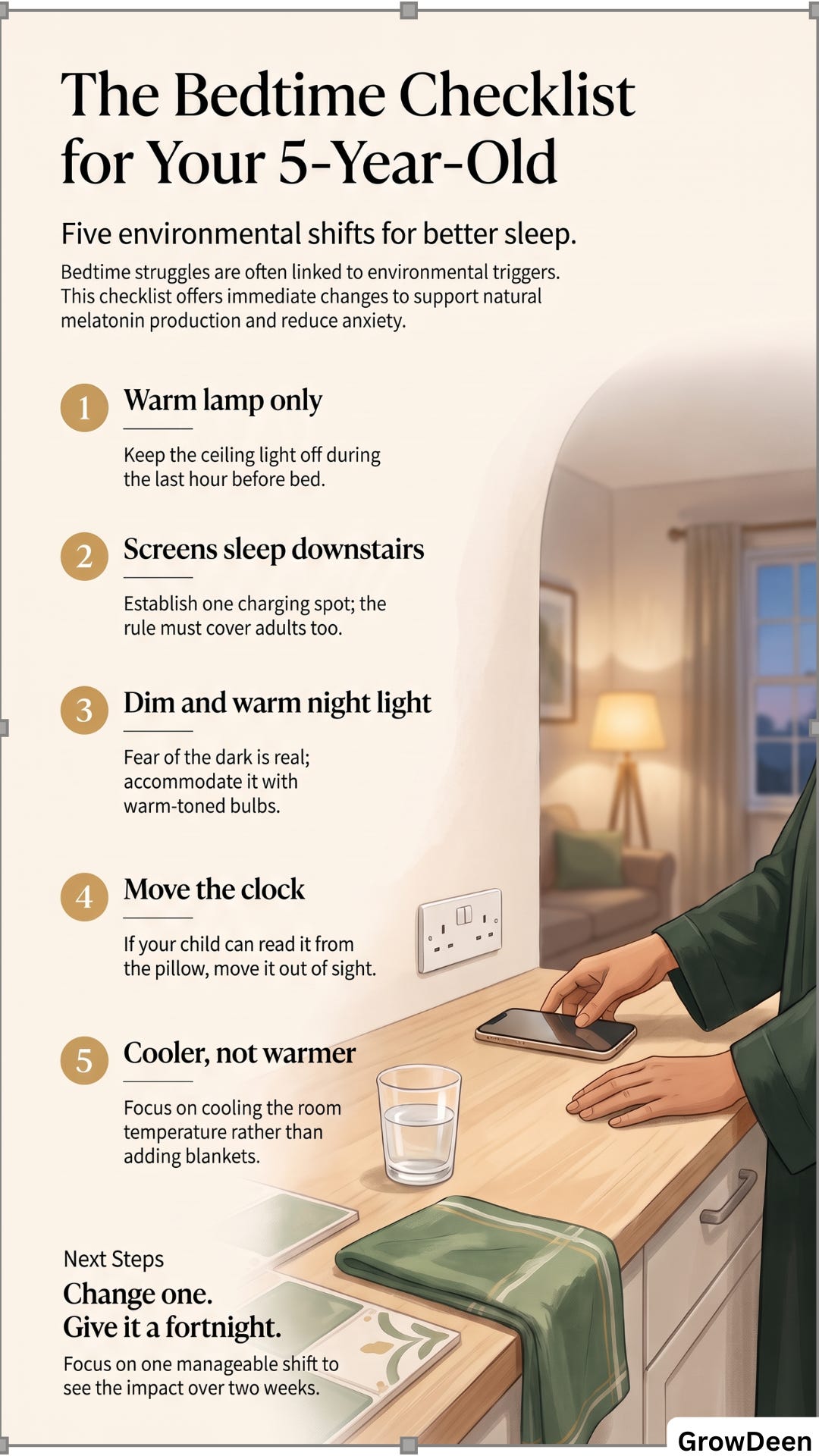
So, five changes, in order of how much they matter:
Switch to a warm, dim lamp for the final hour and leave the ceiling light off.
Everything with a screen sleeps outside the bedroom. One charging spot in the house, and the rule applies to adults too.
A night light is fine if the bulb is dim and warm in colour. Fear of the dark at these ages is real and better accommodated than argued with.
If there is a clock your child can read from the pillow while lying awake doing arithmetic on it, move the clock.
Cooler beats warmer.
There is also a question of who sleeps where. In a narration graded hasan, Abdullah ibn Amr reported the Prophet’s ﷺ instruction that children be told to pray from the age of seven, held to it from ten, and given separate sleeping places. [14] Scholarly commentary reads that last clause as a modesty provision coming into force as children near puberty. Practically, it means settling your room plan while the eldest is eight or nine, rather than scrambling at eleven.
A Quick Word Before We Go Further Back
You are five changes deep and we have not even reached the afternoon yet. I know that is a lot to hold in your head at 10pm on a Tuesday when you are already running on fumes.
That is why I put together the Night Audit Pack, free. It is a printable diagnostic that sorts your child’s specific symptoms to the specific hour of the day causing them, plus a seven-night log so you can actually see the pattern instead of guessing at it. Keep reading and you can download it at the end.
Two Signs, and Why Allah Made the Night Dark
You know that feeling of arguing with a nine-year-old about why the lights have to go off, and having no better answer than “because it’s bedtime”?
There is a better answer, and it changes the tone of the whole argument.
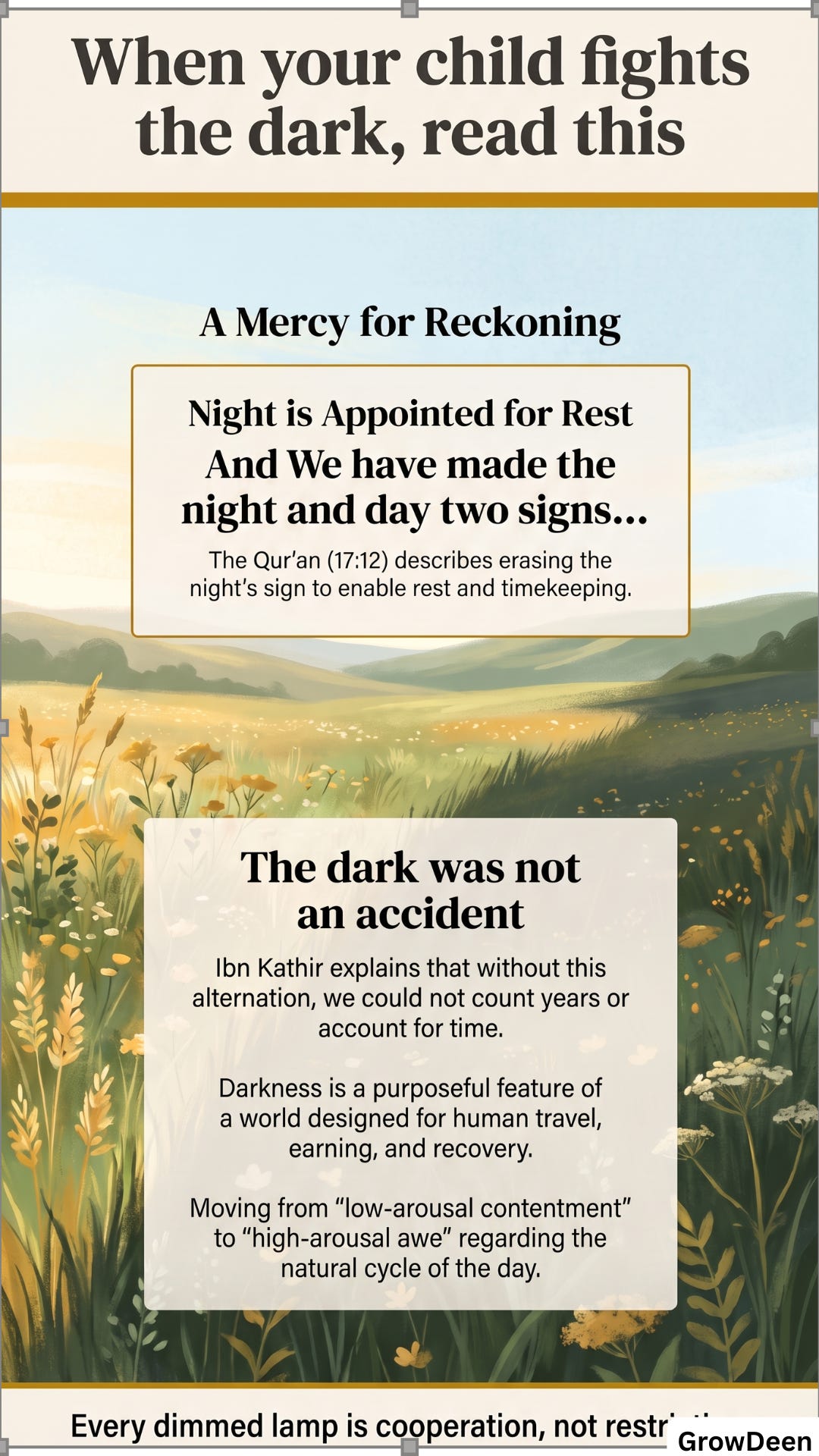
Allah says: “And We have made the night and day two signs, and We erased the sign of the night and made the sign of the day visible, that you may seek bounty from your Lord and may know the number of years and the account of time.” [10]
According to Tafsir Ibn Kathir, Allah is reminding us of the alternation of night and day, arranged so that people may rest at night and go out to earn a living, work and travel during the day, and so that they may count days, weeks, months and years. Ibn Kathir adds that if time never changed, we would know none of these things.
Sit with that for a moment. The darkness of the night is described as part of a design, a mercy with a purpose, rather than an inconvenience to be lit up. Every warm dim lamp, every phone left charging in the kitchen, is a small act of cooperating with something Allah built rather than overriding it.
And the Prophet ﷺ named the morning consequence with startling precision. He said that Satan ties three knots at the back of the head of a sleeping person, saying over each one, “The night is long, so stay asleep.” When the person wakes and remembers Allah, one knot comes undone. When he makes wudu, a second. When he prays, the third, and he rises energetic and good-hearted. Otherwise he rises sluggish and ill-tempered. [15]
Fourteen centuries before anyone measured a circadian rhythm, that hadith names the exact outcome you are chasing: a child who wakes up in a good mood.
4:00pm: The Afternoon That Quietly Steals the Night
Here is where most families lose the evening without noticing.
The nap. If your three or four-year-old still naps, keep it short and keep it before mid-afternoon. A ninety-minute sleep at four o’clock is borrowed directly from bedtime, at interest. Most children drop the nap somewhere between three and five, and the fortnight it happens is usually rough for everyone.
Caffeine, in places you would not check. Cola, obviously. But also iced tea, chocolate, the coffee-flavoured milk drinks teenagers like, and every energy drink on the shelf. Set a cutoff at Asr and hold it, including for whatever you are drinking yourself. And energy drinks in the evening are not a negotiation.
Dinner, and when it lands. Too early and they are hungry by nine. Too late or too heavy and they lie there uncomfortable. Aim for a satisfying meal at a sensible hour, eaten sitting down together where you can manage it. Opening with Bismillah and closing with Alhamdulillah turns it into the evening’s first quiet point instead of a refuelling stop.
Movement. Children who have moved during the day fall asleep faster. But vigorous running around in the last hour works against you, so push it earlier.
7:30am: The Half Nobody Does
This is the part almost every family skips, and it is half the correction.
Get your child into daylight early. Outdoors is best. A seat by a window is second best. Morning light is what anchors the body clock so that the evening rise in melatonin arrives on schedule. [7] A walk to school before eight does more for your child’s sleep than any amount of negotiating at nine at night.
Then hold the timing steady. Keep bedtime and wake time within about an hour across the whole week, weekends and school holidays included. This is the least popular sentence in this article and the one that changes the most.
For teenagers there is one more thing worth knowing, because it will change how you argue. Puberty pushes the adolescent body clock measurably later. When your fifteen-year-old says she is not sleepy at ten, she is usually telling the truth, not being difficult. Evening lighting and phone use then stretch that biological delay much further. [7] So negotiate instead of decreeing. Put daylight in her morning, keep the charger downstairs, hold the Asr caffeine cutoff, and have one frank conversation about what five hours a night is doing to her grades and her patience with her brother. A rule she helped write is a rule that survives.
Bedtime is the symptom. The day is the cause. Say it to yourself the next time you are standing outside a bedroom door at ten past nine.
When It Is Not the Schedule At All
Three more things, because you deserve the full picture.
Melatonin supplements. Roughly half of American parents have given melatonin to a child under thirteen, and it is now the second most popular product parents give their children after multivitamins. The American Academy of Sleep Medicine issued a health advisory about this, and the substance of it matters. [8] There is little evidence melatonin helps otherwise healthy children fall asleep faster. Because it is regulated as a dietary supplement rather than a medicine, actual content varies widely against the label, and the widest variation shows up in chewable tablets, which is exactly the form children take. Paediatric ingestions reported to US poison control rose from around 8,000 in 2012 to more than 52,000 in 2021, with about 15% of overdose cases hospitalised. [8] None of that makes melatonin forbidden. It has a real place in specific sleep-wake disorders, prescribed and timed by a clinician. It just does not substitute for the four hours of the day we have walked through.
Sometimes it is fear, not defiance. Some children are not stalling. They are frightened of the dark, or of being alone once the room goes quiet, and no schedule change will touch that. Keep the warm night light. Keep frightening content out of the evening entirely. Sit for a short fixed period rather than an open-ended one, and praise the specific thing (”you stayed in your bed the whole night”) rather than the general one. For worries, sort them into two piles: solvable now, and needs daylight. Answer the first straight away and briefly. For the second, name the feeling and set an appointment your child can hold you to, then close the subject. And please do not use jinn stories to keep a child in bed. It works for about a week and buys years of bedtime anxiety in exchange.
And sometimes it is medical. Obstructive sleep apnoea affects between 1% and 5% of children, peaking between ages two and eight when tonsils and adenoids are large relative to a small airway. [9] Enlarged tonsils and adenoids are the commonest cause in younger children; in teenagers, obesity takes over as the leading driver. [9] Untreated, it is associated with neurocognitive and behavioural problems, poor growth and raised blood pressure. The AAP guideline is blunt: every child should be asked about snoring at routine health visits. [9]
Speak to a doctor if you notice any of these:
Loud snoring on most nights, gasping, or pauses in breathing
Nodding off during lessons or on short car journeys
A sleep problem that has outlasted three or four weeks of a routine you actually kept
Sleep that is affecting mood, schoolwork or friendships
Leg discomfort at night, or bedwetting that returns after a dry spell
Iron deficiency is worth asking about too, since it is linked with restless legs and repeated waking. So is poorly controlled asthma, eczema or allergic rhinitis, all of which fragment sleep quietly.
None of this replaces medical advice. And pursuing a diagnosis sits comfortably inside tawakkul: you take the means, and you leave the outcome with Allah.
Your Free Night Audit Pack
If you have read this far, you are the kind of parent who is willing to look past the obvious answer to find the real one. That tells me something about you.
Inside the Night Audit Pack (one comprehensive PDF, 3 pages):
Page 1: The Four-Hour Sleep Diagnostic. A decision-tree that takes what you are actually seeing (takes over an hour to fall asleep, wakes exhausted, fine on holidays but terrible on school nights, cries at the door) and sorts it to the specific hour of the day causing it. Designed as a laminated card you can keep inside a kitchen cupboard door where you will actually look at it.
Page 2: The Seven-Night Sleep Log. A single fill-in grid for lights-out time, wake time and one behaviour note, with a built-in weekend-swing calculator and a red-flag column, so you can see the real pattern in under a week instead of arguing about it for a month.
Page 3: The Three Knots, A Morning Card. The hadith of the Prophet ﷺ on what determines whether a person wakes energetic or sluggish, laid out as the three-step morning sequence it describes, with the wording your child can learn. It is the one Islamic card in this series built for the morning rather than for bedtime.
This isn’t just a PDF to download and forget. It’s a tool designed to stay on the inside of your kitchen cupboard door, where you’ll actually use it when you need it most.
The Night Audit Pack is what every subscriber receives with each article. We cover the full journey of raising Muslim children, from newborns through the teenage years, all backed by peer-reviewed research and rooted in the Qur’an and Sunnah.
If you’re a Muslim parent who wants both evidence-based guidance AND Islamic perspective, subscribe for free so future resources arrive in your inbox before you need them.
Subscribe free for parenting resources backed by both science and Sunnah, guidance so specific you can’t get it anywhere else. No spam, no clutter, just resources that matter.
Do This One Thing Tonight
Go and find every device in your child’s bedroom. Phone, tablet, console, the old laptop on the desk. Carry them to one spot in the kitchen and plug them in there.
Not next week when you have had the conversation. Tonight. The conversation goes better once the chargers have already moved.
May Allah place barakah in your effort, accept your intention, and make the rest you are fighting for arrive easier than it has been.
Share This With Someone Who Needs It
Think of one person right now: the sister at the masjid who mentioned her son is up until midnight, the friend whose messages arrive at 1am because that is the only quiet she gets, your cousin who has tried three different bedtimes this month and is starting to think something is wrong with her child.
This article could give them back an hour of their evening. Send it to them today, not as advice, but as company. Sometimes the kindest thing we can do is tell someone the problem was never where they were looking.
Frequently Asked Questions
Q: How many hours should my child sleep? A: 10 to 13 hours including naps for ages 3 to 5, 9 to 12 hours for ages 6 to 12, and 8 to 10 hours for teenagers aged 13 to 18. [1] Those are the American Academy of Sleep Medicine’s consensus figures, endorsed by the AAP. See “Do You Actually Know How Much Your Child Sleeps?” above for how to check where your child actually sits.
Q: How long before bed should screens go off? A: An hour, and the single most important part is that they leave the bedroom overnight. Screen use after getting into bed is the pattern most strongly linked with shorter, poorer sleep. [5] Anchor the cutoff to Isha and you will not have to negotiate it every night.
Q: Is melatonin safe for children? A: Talk to your child’s doctor before giving it. There is little evidence it helps otherwise healthy children fall asleep faster, the actual dose in chewable tablets varies widely against the label, and paediatric poison control reports rose from around 8,000 in 2012 to over 52,000 in 2021. [8] It has a genuine place in some conditions, prescribed and timed by a clinician.
Q: Why does my teenager say they are not tired at 10pm? A: Because they usually are not. Puberty shifts the adolescent body clock later, and evening light and phone use stretch that delay further. [7] Morning daylight and a fixed charging spot outside the bedroom will do more than an earlier bedtime will.
Q: My child snores every night. Should I worry? A: Mention it to your doctor. Obstructive sleep apnoea affects between 1% and 5% of children, is most common between two and eight, and is routinely missed because the daytime signs look like inattention rather than tiredness. [9] The AAP recommends every child be asked about snoring at routine visits.
Q: What is the Sunnah bedtime routine for children? A: Wudu as you would for prayer, then lying on the right side [11], then Ayat al-Kursi [12] and the three surahs Al-Ikhlas, Al-Falaq and An-Nas blown into the hands and wiped over the head, face and body three times. [13] For a full walkthrough by age, see “The Hour That Has No Shape” above.
Q: Does it matter if my child sleeps in at the weekend? A: More than most parents expect. A child who gets nine hours every night does better than one who gets six on school nights and twelve on Saturdays, even when the weekly totals match. Keep bedtime and wake time within about an hour across the whole week.
References
[1] Paruthi, S., Brooks, L.J., D’Ambrosio, C., et al. (2016). Recommended amount of sleep for pediatric populations: A consensus statement of the American Academy of Sleep Medicine. Journal of Clinical Sleep Medicine, 12(6), 785-786. Endorsed by the American Academy of Pediatrics. https://doi.org/10.5664/jcsm.5866
[2] Mindell, J.A., Li, A.M., Sadeh, A., Kwon, R., & Goh, D.Y.T. (2015). Bedtime routines for young children: A dose-dependent association with sleep outcomes. Sleep, 38(5), 717-722. https://doi.org/10.5665/sleep.4662
[3] Hartstein, L.E., Behn, C.D., Akacem, L.D., Stack, N., Wright, K.P. Jr., & LeBourgeois, M.K. (2022). High sensitivity of melatonin suppression response to evening light in preschool-aged children. Journal of Pineal Research, 72(2), Article e12780. https://doi.org/10.1111/jpi.12780
[4] Akacem, L.D., Wright, K.P. Jr., & LeBourgeois, M.K. (2018). Sensitivity of the circadian system to evening bright light in preschool-age children. Physiological Reports, 6(5), Article e13617. https://doi.org/10.14814/phy2.13617
[5] Brosnan, B., Haszard, J.J., Meredith-Jones, K.A., Wickham, S., Galland, B.C., & Taylor, R.W. (2024). Screen use at bedtime and sleep duration and quality among youths. JAMA Pediatrics, 178(11), 1147-1154. https://doi.org/10.1001/jamapediatrics.2024.2914
[6] Hale, L., & Guan, S. (2015). Screen time and sleep among school-aged children and adolescents: A systematic literature review. Sleep Medicine Reviews, 21, 50-58. https://doi.org/10.1016/j.smrv.2014.07.007
[7] Ricketts, E.J., Joyce, D.S., Rissman, A.J., Burgess, H.J., Colwell, C.S., Lack, L.C., & Gradisar, M. (2022). Electric lighting, adolescent sleep and circadian outcomes, and recommendations for improving light health. Sleep Medicine Reviews, 64, Article 101667. https://doi.org/10.1016/j.smrv.2022.101667
[8] American Academy of Sleep Medicine. (2022). Health advisory: Melatonin use in children and adolescents. Journal of Clinical Sleep Medicine. https://aasm.org/advocacy/position-statements/melatonin-use-in-children-and-adolescents-health-advisory/
[9] Marcus, C.L., Brooks, L.J., Draper, K.A., et al. (2012). Diagnosis and management of childhood obstructive sleep apnea syndrome. Pediatrics, 130(3), 576-584. American Academy of Pediatrics clinical practice guideline. https://doi.org/10.1542/peds.2012-1671
[10] Qur’an, Surah Al-Isra 17:12 — https://quran.com/17/12. Tafsir Ibn Kathir — https://www.alim.org/quran/tafsir/ibn-kathir/surah/17/12/
[11] Sahih al-Bukhari 247, narrated by al-Bara ibn Azib — Graded: Sahih — https://sunnah.com/bukhari:247
[12] Sahih al-Bukhari 2311, narrated by Abu Hurayrah — Graded: Sahih — https://sunnah.com/bukhari:2311
[13] Sahih al-Bukhari 5017, narrated by Aisha — Graded: Sahih — https://sunnah.com/bukhari:5017
[14] Sunan Abi Dawud 495, narrated by Abdullah ibn Amr ibn al-As — Graded: Hasan — https://sunnah.com/abudawud:495
[15] Sahih al-Bukhari 1142, narrated by Abu Hurayrah — Graded: Sahih (agreed upon by al-Bukhari and Muslim) — https://sunnah.com/bukhari:1142