

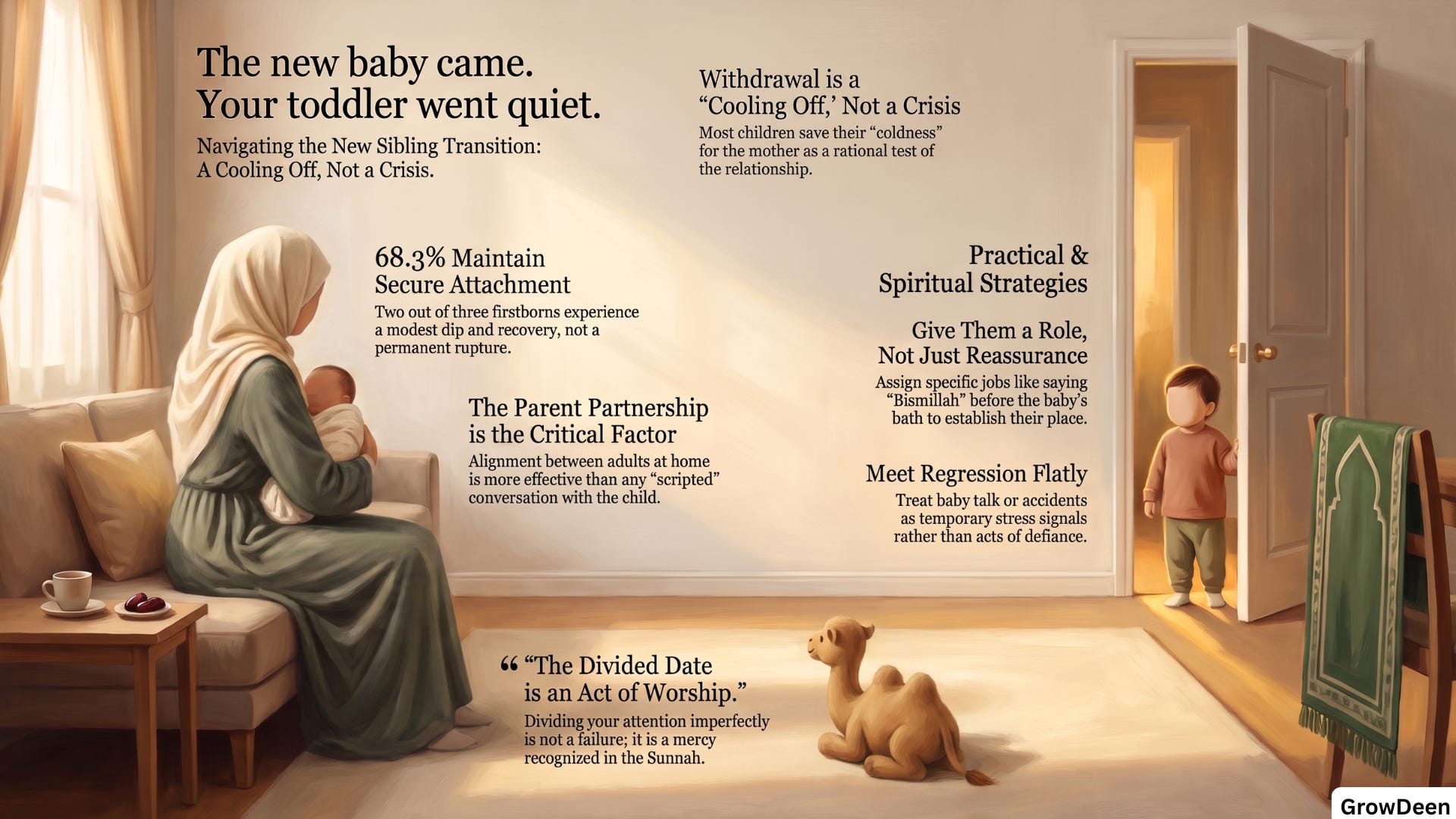
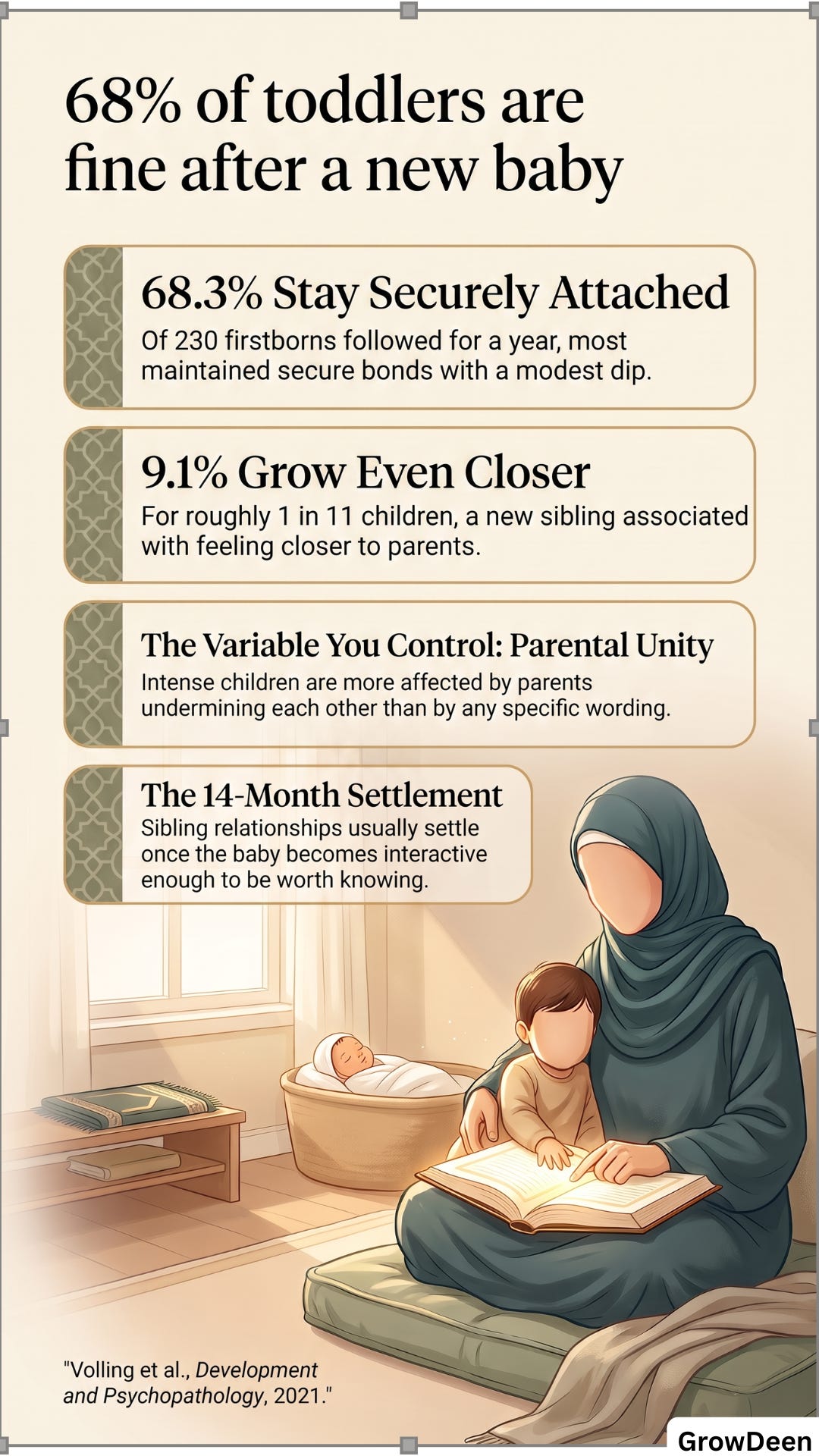
A 2021 study in Development and Psychopathology tracked 230 firstborns across the first year after a sibling was born and found 68.3% stayed securely attached to both parents, with only a modest dip. [2] Here is what actually changes in those months, what the research says you can control, and the one thing to hand your older child this week.
Your three-year-old says, “Put her down.”
You do the thing the books tell you to do. You crouch to her level. You explain that the baby is very small and needs a lot of help right now, and that you love them both exactly the same, and that nothing has changed.
She looks at you. Then she walks off and plays by herself, and does not come back.
Not a tantrum. Not a scene. Just a small door closing that you cannot quite name, and a knot in your stomach that stays there for the rest of the evening.
I want to be careful here, because I cannot tell you what is happening in your specific house. What I can tell you is what the research on this transition found, and it surprised me. In a review of thirty studies on what researchers call the transition to siblinghood, the evidence did not support a crisis model at all. Sleep problems, anxiety, aggression, regression: the findings came back mixed rather than uniform. The one thing that showed up fairly consistently was quieter and much easier to miss. Children became less affectionate and less responsive toward their mothers. [1]
Not louder. Cooler.
Which raises a question I want you to hold on to, because it is the strange part of all this: your older child is often perfectly gentle with the baby, and saves all of their coldness for you. Why?
Stay with me. I will get there.
Why This Guide Is Different
The research is specific and recent. Every claim here comes from peer-reviewed work, most of it from a longitudinal study that followed 241 families through the whole first year after a second child arrived. [3]
Islamic guidance sits at the centre, not the edges. The hardest part of this season is dividing yourself imperfectly between two children. There is a narration about exactly that, and it changes how the dividing feels.
You get a free tool, not just a read. The Big Sibling Settling Pack gives you a role handover card and a three-day attention audit you can start tonight.
The Number That Reframed This Whole Topic for Me
Here is where it gets genuinely reassuring.
Researchers followed 230 firstborns, average age just over thirty-one months, through the year after their sibling was born. They found four distinct patterns. In 68.3% of families, the child stayed securely attached to both parents with a modest dip across the year. In 12.6%, the child was more secure with the father than the mother and security fell steeply with both. In 10%, the child was insecure with both parents and did not change. And in 9.1%, security actually went up. [2]
Read that last one again.
For roughly one child in eleven, the arrival of a sibling was associated with feeling closer to their parents, not further away.
So the honest picture is this: for about two children out of three, what you are watching is a dip and a recovery, not a rupture. Emotional reactivity across the same period also follows several different paths rather than one universal one, which is exactly why two children in the same house respond in completely opposite ways. [5] Comparing them tells you nothing.
Researchers have also pointed out that this transition is badly understudied for something that happens to roughly 80% of children. [1][6] Part of why you feel blindsided is that nobody wrote enough about it.
But knowing the odds does not tell you what to do on a Tuesday evening. So let me show you the finding that does.
The Thing You Can Actually Change Isn’t Your Child
I expected the answer to be about phrasing. Something you say, some clever reframe.
It isn’t.
When researchers looked at the same 241 families, firstborns’ externalising behaviours did rise significantly from before the birth to after. Internalising problems, on average, did not. But children who were temperamentally intense, the ones researchers describe as high in negative reactivity, were far more sensitive to something else entirely: whether the two parents were pulling together or pulling against each other. When the parenting partnership was strained, those children showed more difficulty on both counts. [4]
Let me say that plainly, because most articles on this topic never get near it.
The single most changeable factor is not what you say to your older child. It is whether the adults in the house are on the same page.
A mother and father who agreed the plan before the birth, who back each other up in front of the children, who do not contradict one another about bedtime in the middle of the hardest fortnight of the year: that partnership is doing more for the firstborn than any amount of careful wording.
And yes, I know that is harder than a script. Scripts are easy. Alignment at 10pm when you are both running on four hours of sleep is not.
I know this is a lot to hold in your head while you are also feeding a newborn every three hours. That is exactly why I put together the free Big Sibling Settling Pack: a one-page role handover card and a three-day attention audit that shows you, in actual numbers, where your minutes went. Keep reading, it is at the end of this article.
Before the practical part, there is something I want to sit with you on. Because there is a knot underneath all of this that no research paper addresses.
What One Date Divided Between Two Daughters Says About Your Attention
Let’s be honest about the part nobody says out loud. This is not really about your child’s behaviour. It is about the feeling at 9pm that you have quietly broken your first child by giving them a sibling.
I do not think there is a parenting technique for that feeling. But there is something else.
Aisha (may Allah be pleased with her) said a woman came to her with two daughters, asking for charity. Aisha had one date in the house and gave it to her. The woman split that single date between her two girls and left. When Aisha told the Prophet ﷺ, he said: “Whoever is in charge of these daughters and treats them generously, then they will act as a shield for him from the Fire.” [12]
One date. Two children. No good options. She divided it, and that division was declared enough. Al-Bukhari placed this narration in his chapter on mercy toward children, not among the chapters on charity, which tells you how it was read.
And the arrangement itself, this older child and this new baby in this order, was not an accident of your planning. Allah says He gives to whom He wills daughters, and to whom He wills sons. [11] Ibn Kathir’s commentary on this passage is blunt: whatever Allah wills happens, and none can withhold what He gives.
So the imperfect division you are making every single day is not the thing standing between you and your worship.
It is the worship.
Support Muslim Parenting Lab ❤️
Would you like a share in every good thing that comes from what you fund? Support it with the button below, at any level you choose.
The Prophet ﷺ said whoever sets a good precedent earns its reward and the reward of everyone who follows it. (Sahih Muslim 1017a)
So What Does This Actually Look Like at 6pm on a Tuesday?
Here is the shift that matters, and it is the one sentence I would put on your fridge: give them a role, not a reassurance.
Reassurance answers a question your child did not ask. They are not asking whether you love them. They are asking whether they still have a place. A place is a job.
Hand over five specific things. They say Bismillah before the baby’s bath. They make du’a for the baby out loud once a day, both palms raised, in their own words. They hand over the sadaqah if your family gives charity to mark the birth, physically placing it in the box, told plainly that this is their charity for their sister. They give salaam to the baby every morning. They are the one who says Alhamdulillah when she finally settles. None of this is a distraction tactic. It is the first handover of an amanah they will carry for the rest of their lives.
Protect ten to fifteen minutes, at a fixed point. Not an afternoon. Phone down, baby with another adult or genuinely asleep, your older child picks the activity. Predictability beats length. Anchor it to something that already happens, like after Asr. [10]
Greet them first. Every morning, your older child gets the first salaam, before the baby is mentioned once.
Build a feed basket. Feeds are long and immobilising, which makes them the moment your child feels most locked out. A basket that only appears during feeds, restocked every couple of weeks. Or let them cuddle in while you read aloud or play a short Qur’an recitation and listen together. That turns exclusion into shared time, which is a completely different experience from their side.
Meet regression flatly. Toilet accidents, baby talk, asking to be spoon-fed: these are stress signals, not defiance. [7] A child asking to be fed like a baby has worked out that being a baby currently attracts more care and is testing whether that route is open. Feed them the few spoonfuls. Say nothing about it. Watch it fade faster than it would have under correction.
Do not stack transitions. Moving them out of their bed, starting nursery, beginning toilet training in the same weeks piles losses on top of each other. [8] Shift it two months either side.
And never leave a toddler unsupervised with a newborn. Not a gentle one, not for a minute.
Now, That Question From the Beginning
Why is your older child gentle with the baby and cold with you?
Because the baby did not do anything to them. You did. The baby is not who they are negotiating with. You are. The withdrawal is not rejection, it is a small, entirely rational test of whether the person who used to be reliably theirs still is. [1]
Which is why a role works and a speech does not. A role is a repeated, physical answer to the question, delivered daily, in a language a three-year-old actually reads.
Warm sibling relationships tend to settle in around the time the younger child reaches roughly fourteen months, largely because that is the point the baby becomes interesting rather than merely disruptive. [3][5] Birth spacing has some association with early outcomes, but the effects are modest and heavily shaped by what happens at home. [9] What you do in these months matters far more than how many months apart they happen to be.
That is a long stretch. Worth calling it what it is: sabr. A difficulty you have named is easier to carry than one that just feels like failure.
When to Speak to a Doctor
Most of this settles without any intervention. Speak with your child’s doctor or paediatrician if aggression toward the baby continues despite consistent supervision and one-on-one time, if lost skills persist for many months rather than weeks, if you see withdrawal or flatness or loss of interest in play and food, or if sleep disruption is severe enough to affect their daytime functioning. A worry that will not settle in you is reason enough on its own.
And if the one struggling is you rather than your child, that also deserves a conversation with a doctor. Low mood after a birth is common and treatable. Seeking treatment sits comfortably beside tawakkul. Taking the means and relying on Allah are two halves of the same practice, not alternatives.
There is one more thing I want to give you before you go.
The Big Sibling Settling Pack
If you have read this far, you are the kind of parent who noticed a small door closing and refused to ignore it. That tells me a lot about you.
Inside the Big Sibling Settling Pack (one comprehensive PDF, 3 pages):
Page 1: The Handover Card, Five Jobs That Belong to Your Big One — Five specific, named roles you formally give your older child, each written out word for word so you know exactly what to say when you hand it over, with a signature line your child can scribble on. Designed as a card to stick at their eye height on the fridge or their bedroom door, so the job is visible to them every day, not just the day you announced it.
Page 2: The Three Day Attention Audit — A simple grid covering six time windows across three days, where you mark who actually had you. Most parents are genuinely surprised by what they see, and it takes under a minute a day to fill in. So that within seventy-two hours you know exactly where the gap is, instead of guessing.
Page 3: Two Reflections For The Hard Weeks — Two reflection cards, one on Qur’an 42:49–50 and Ibn Kathir’s commentary on how family composition is decreed, and one carrying the full narration of the mother who divided a single date between her two daughters (Sahih al-Bukhari 5995). English translation and source only, formatted to read in thirty seconds on a bad night.
This isn’t just a PDF to download and forget. It is designed to stay on your fridge and in your feeding chair, where you will actually reach for it.
This pack is what every subscriber receives with each article. Muslim Parenting Lab covers the whole span of raising Muslim children from birth to age eight: sleep, speech, behaviour, feeding, safety, sibling life, and the Islamic framework underneath all of it, all backed by peer-reviewed research and authenticated sources.
Do This Before You Close This Tab
Pick one of the five jobs. Just one. Go tell your older child, out loud, right now, that from tomorrow morning saying Bismillah before the baby’s bath is their job and nobody else is allowed to do it.
Thirty seconds. That is the whole thing.
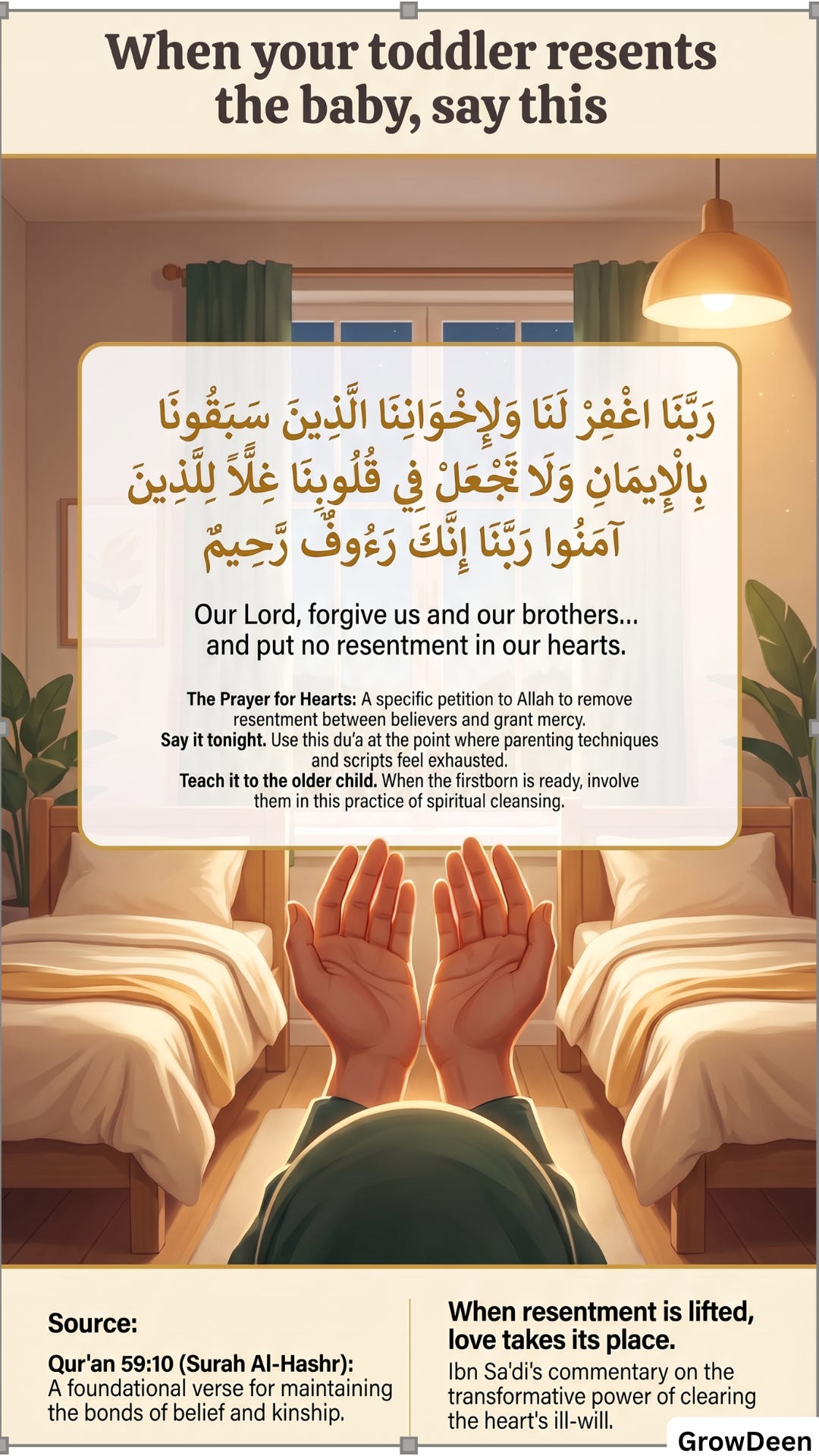
May Allah place love between your children, make the dividing lighter than it feels, and make each of them a coolness to your eyes.
Share This With Someone Who Needs It
Think of one person right now: your sister who is thirty-four weeks pregnant with her second and keeps saying she feels guilty about her toddler, or the friend at the masjid who mentioned that her four-year-old has started wetting the bed again since the baby came.
This could take a weight off them tonight. Send it to her, not as advice, but because you know what she is carrying. Sometimes the kindest thing is handing someone the sentence they have not been able to find.
Frequently Asked Questions
Q: How do I prepare my toddler for a new baby before the birth?
A: Talk about it in concrete terms rather than abstract ones, involve them in something physical like folding the baby’s clothes, and finish any major transition such as toilet training or a new bed at least two months before the due date. [8] Stacking changes is the single most common preparation mistake.
Q: Is it normal for my toddler to regress after a new baby?
A: Yes, and it is a stress signal rather than defiance. [7] Toilet accidents, baby talk, and asking to be carried are the most common. Meet them calmly and without correction and they usually fade faster. See “So What Does This Actually Look Like at 6pm on a Tuesday?” above.
Q: How long does it take for a toddler to adjust to a new sibling?
A: Warm sibling relationships tend to settle around the time the younger child reaches roughly fourteen months, when the baby becomes interactive enough to be interesting. [3][5] The first three months are usually the hardest.
Q: My toddler hits the new baby. What should I do?
A: Separate them immediately and calmly, name the feeling rather than prosecuting the act (”You are angry. You do not want her here right now. You may not hurt her.”), then honestly check whether that child has had any real attention that day. Never leave them unsupervised together, even briefly.
Q: Should I let my toddler breastfeed if they ask when they see the new baby?
A: There is no single correct answer. Some mothers offer, some offer a taste from a cup, and some prefer not to. If you would rather not, explain simply that breastmilk is made specially for very small babies, offer something the baby is not allowed to have, and move on. Keep your tone flat. It is a question, not a crisis.
Q: Does the age gap between my children affect how well they adjust?
A: Birth spacing shows some association with early developmental outcomes, but the effects are modest and heavily shaped by the home environment. [9] What happens in the house across these months matters considerably more than the gap itself.
References
[1] Volling, B.L. (2012). Family transitions following the birth of a sibling: An empirical review of changes in the firstborn’s adjustment. Psychological Bulletin, 138(3), 497–528. https://doi.org/10.1037/a0026921
[2] Volling, B.L., Oh, W., Gonzalez, R., Bader, L.R., Tan, L., & Rosenberg, L. (2021). Changes in children’s attachment security to mother and father after the birth of a sibling: Risk and resilience in the family. Development and Psychopathology, 35(3), 1404–1420. https://doi.org/10.1017/S0954579421001310
[3] Volling, B.L., Gonzalez, R., Oh, W., Song, J-H., Yu, T., Rosenberg, L., Kuo, P.X., Thomason, E., Beyers-Carlson, E., Safyer, P., & Stevenson, M.M. (2017). Developmental trajectories of children’s adjustment across the transition to siblinghood: Pre-birth predictors and sibling outcomes at one year. Monographs of the Society for Research in Child Development, 82(3), Serial No. 326. https://doi.org/10.1111/mono.12307
[4] Kolak, A.M., & Volling, B.L. (2013). Coparenting moderates the association between firstborn children’s temperament and problem behavior across the transition to siblinghood. Journal of Family Psychology, 27(3), 355–364. https://doi.org/10.1037/a0032864
[5] Kuo, P.X., Volling, B.L., Gonzalez, R., Oh, W., & Yu, T. (2017). Developmental trajectories of children’s emotional reactivity after the birth of a sibling. Monographs of the Society for Research in Child Development, 82(3), 93–105. https://doi.org/10.1111/mono.12313
[6] Ward, K.P. (2022). The transition to siblinghood: An understudied yet influential process pertinent to social work research. Social Work, 67(2), 175–183. https://doi.org/10.1093/sw/swac009
[7] Dagcioglu, B.F. (2018). The effects of the new baby on the older sibling. Ankara Medical Journal, 18(3), 286–299. https://doi.org/10.17098/amj.461653
[8] American Academy of Pediatrics (2019). Caring for your baby and young child: Birth to age 5 (Eds S.P. Shelov & T.R. Altmann, 7th edn). Bantam Books.
[9] Dhamrait, G., O’Donnell, M., Christian, H., & Pereira, G. (2022). Is early childhood development impeded by the birth timing of the younger sibling? PLoS One, 17(5), Article e0268325. https://doi.org/10.1371/journal.pone.0268325
[10] Stankovic-Ramirez, Z. (2023). 7 tips on helping your only child welcome a new baby to the family. Dimensions of Early Childhood, 51(1).
[11] Qur’an, Surah Ash-Shura 42:49–50 — https://quran.com/42/49 — with Tafsir Ibn Kathir — https://quran.com/en/42:49/tafsirs/en-tafisr-ibn-kathir
[12] Sahih al-Bukhari 5995, Book of Good Manners (Al-Adab), Book 78, Hadith 26, chapter “To be merciful to children and embrace them.” Narrated by Aisha (may Allah be pleased with her). Graded: Sahih — https://sunnah.com/bukhari:5995
We combine scientific research with Qur’an and authentic Sunnah, and we cite our sources. Even so, this is general guidance and no substitute for a doctor who can examine your child.