


A 2024 systematic review found babies typically adjust to a new sleep habit within 3 to 21 nights [5]. This guide walks you through gently phasing out a dummy, a night feed, or rocking to sleep; one habit at a time, on your own timeline.
It’s 1am. You rock your baby back to sleep. By 3am, you’re doing it again. By 5am, your arms are done, and so are you.
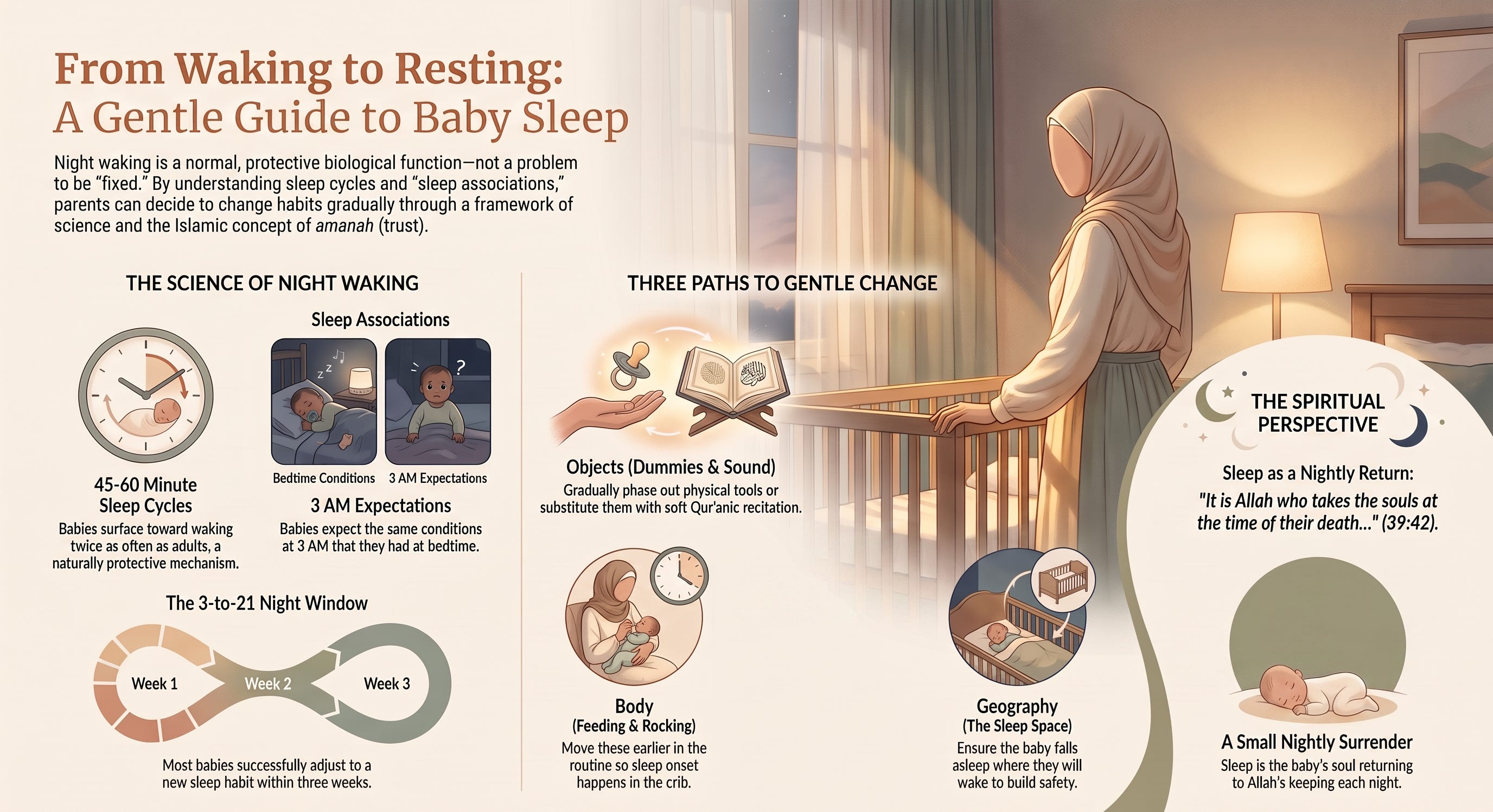
Here’s the part almost nobody tells new parents: your baby isn’t waking up more than usual. They’re waking the normal amount for their age — every couple of hours, like every human does [8][12]. What’s different is that each time they surface, they expect the exact same thing that got them to sleep the first time.
You haven’t done anything wrong. You’ve built what researchers call a sleep association, and once you understand how it works, you can decide, calmly and gradually, whether to change it.
Why This Guide Is Different
Backed by current sleep research. Every recommendation here draws on peer-reviewed studies through 2024, not generic tips [1][3][5][11].
Built on an Islamic framework, not just science. This isn’t only about technique — it’s about honoring the amanah of your child’s rest and your own, with Qur’anic grounding woven through.
Comes with a free Gentle Habit Change Companion Pack — a printable worksheet and routine card you’ll actually use at 2am, not just read once and forget.
What’s Actually Happening at Bedtime
Babies aren’t born knowing how to fall asleep alone. That skill develops gradually, and in the meantime, most lean on something external: a dummy, motion, a feed, sound, or your presence [1][13].
Here’s something worth understanding first: your baby’s sleep cycle is much shorter than yours. Adults cycle through sleep roughly every 90 minutes; babies cycle roughly every 45 to 60 minutes [17]. At the end of each cycle, your baby briefly surfaces toward waking, whether or not they fully wake up. Some researchers believe this frequent surfacing is actually protective, a built-in arousal mechanism thought to lower the risk of SIDS [17]. So the waking itself isn’t the problem. What determines whether your baby resettles alone or calls for you is simply what they’ve learned to expect at that surfacing point.
Rock your baby to sleep at 7pm, and their brain may quietly expect rocking again at every one of those surfacing points through the night, not because they’re needy, but because that’s the pattern they’ve learned.
None of this needs fixing by default. If your current setup is working, there’s no research finding and no Islamic principle saying you have to change it [3][11]. This guide is for the families where it’s stopped working.
What Actually Happens When You Change It
Expect protest, at least for a few nights. A baby isn’t testing you when something reliable suddenly disappears. They’re reacting to a change they didn’t choose [4][10].
Give it real time. The adjustment window is genuinely three days to three weeks, depending on temperament and method [5][11]. Past that, most households see a real, lasting shift [3][6].
There’s something worth sitting with here. Every night, your baby’s awareness leaves them completely, no negotiating, until morning. The Qur’an names this directly, and I’ll come back to that below.
Three Kinds of Habits, Three Different Fixes
Most guides list sleep habits one after another, as if a dummy and a night feed need the same approach. They don’t. What actually determines how you phase something out isn’t what the habit looks like, it’s what kind of thing it is.
Habits that are objects. A dummy, a sound machine, a mobile spinning overhead. These are things you physically hold and can remove or substitute. A dummy gets lost mid-sleep and sends your baby into a search-and-rescue mission for something they can’t retrieve themselves; most families manage weaning it gradually over one to two weeks, or teach the baby to relocate it themselves [3][10]. Worth knowing here: pediatric guidance links pacifier use past infancy to a higher risk of ear infections and, with prolonged use, changes to the bite, which is part of why several professional bodies suggest starting to wean in the second half of the first year, once the SIDS-protective window of early pacifier use has passed [15b]. A sound machine or mobile works the same way logistically: turn it off before sleep fully arrives instead of letting it run underneath your baby’s unconsciousness, and offer something with the same calming rhythm in its place, like soft Qur’an recitation or quiet adhkar, which does the identical soothing work without a device attached to it.
Habits that live in your body. A feed, being held, being rocked. These aren’t things you can simply remove, because you can’t unplug your own presence. This category needs a timing shift, not a removal. If your baby routinely falls asleep at the breast or bottle, the feed has likely become tied to sleep onset itself, not strictly to hunger [2][7], so moving the last feed earlier in the routine, so it’s no longer the final act before sleep, tends to loosen that link. It’s medically reasonable to phase out night feeds for formula-fed babies from around 6 months and breastfed babies from around 12 months, once growth is on track [2][14], though nothing forces your hand sooner. Rocking and holding follow a similar logic in reverse: instead of removing the closeness, shift when it happens, offering it earlier in the wind-down and setting your baby down drowsy but still awake, so falling fully asleep becomes something they finish on their own.
A habit that’s actually a place. Falling asleep in the family room, in motion in the car, anywhere other than the baby’s own sleep space. This one is neither an object nor a feeling; it’s geography. Babies who fall asleep somewhere different from where they wake up often struggle precisely because the room itself was part of what told them it was safe to sleep [1][8]. The fix here is the slowest of the three: move the starting point of sleep to the baby’s own space, drowsy but awake, so their brain gradually reattaches the feeling of safety to that specific room instead of to a location they’ll leave in an hour [10][12].
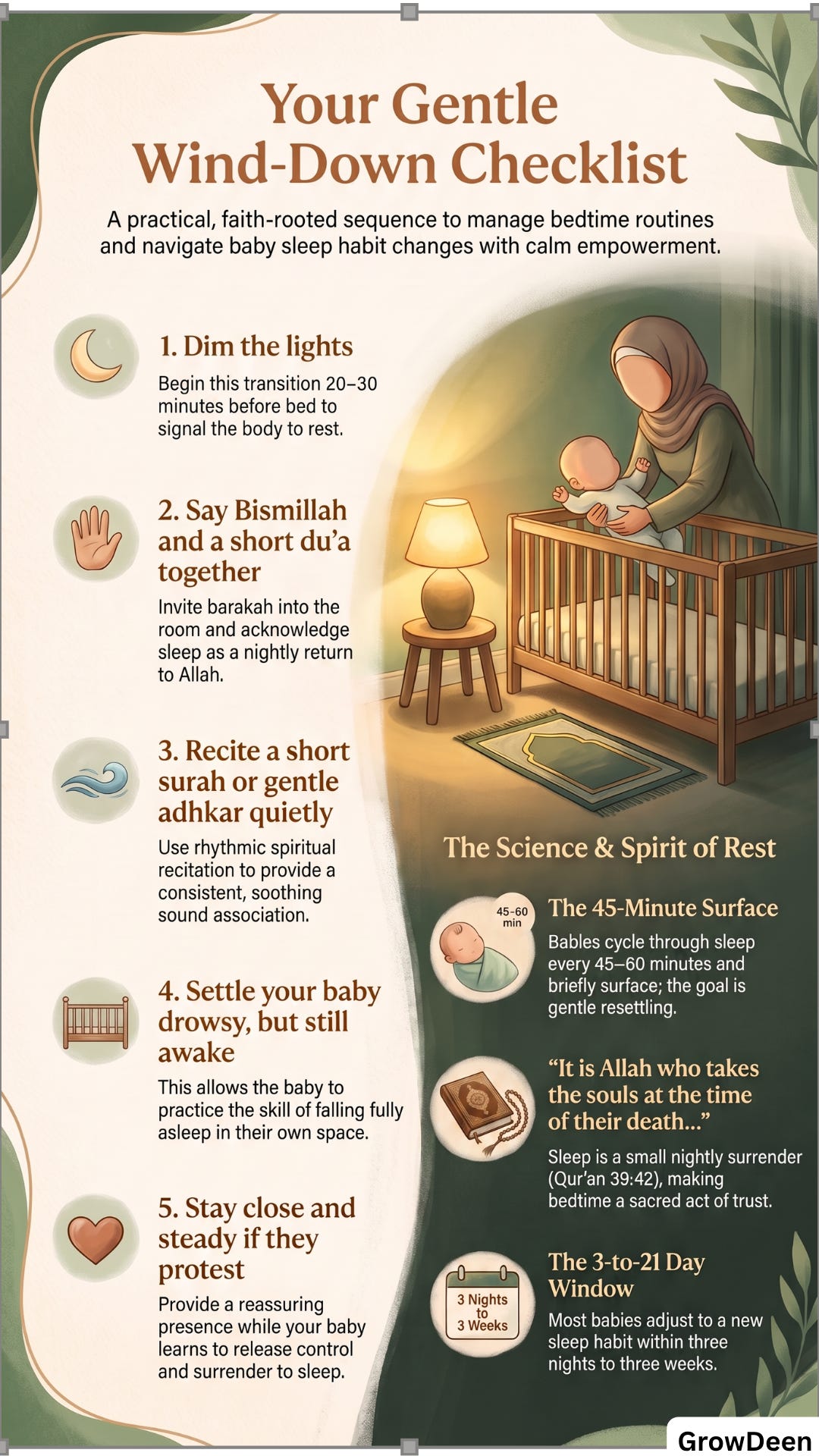
Across all three categories, keep the physical sleep environment itself constant and safe: back sleeping, a firm flat surface, nothing loose nearby, room on the cooler side, no smoke exposure. This measurably lowers SIDS risk on its own, independent of anything else in this guide [1][3].
Here’s something worth naming honestly: information helps in daylight, but at 2am your brain isn’t reading paragraphs. That’s the actual reason the Gentle Habit Change Companion Pack exists, not as a bonus tacked onto the end of an article, but as the version of this guide built for the moment you’ll actually need it. Keep reading, it’s waiting for you at the end.
Sleep as a Nightly Return
When your baby fights the change, it isn’t defiance, it’s a very small person practicing something enormous.
Every night, without exception, your baby’s awareness leaves them entirely and returns by morning. The Qur’an describes this directly: “It is Allah who takes the souls at the time of their death, and those who have not died [He takes] during their sleep. Then He keeps those for which He has decreed death and releases the others for a specified term” (Qur’an 39:42) [16]. Sleep, understood this way, is a small nightly surrender, your baby’s soul returned into Allah’s keeping and handed back each morning.
I find real comfort in that. A baby resisting a habit change isn’t being difficult. They’re learning, night after night, to release control to something they can’t see, and your steadiness while they learn is part of what makes that safe to do.
Your Gentle Habit Change Companion Pack
Here’s something worth naming: knowing what to do and remembering it at 2am, half-asleep, with a crying baby in your arms, are two completely different skills. The article gives you the first. This companion pack is built for the second.
Inside the Gentle Habit Change Companion Pack (one comprehensive PDF, 3 pages):
Page 1: Name Your Baby’s Sleep Habit — a simple worksheet to pin down exactly what your baby relies on and when, so you know precisely what you’re changing before you start.
Page 2: Your Gentle Wind-Down Routine — a five-step printable timeline card, designed to tape near the crib so the whole household follows the same routine, even on the hard nights.
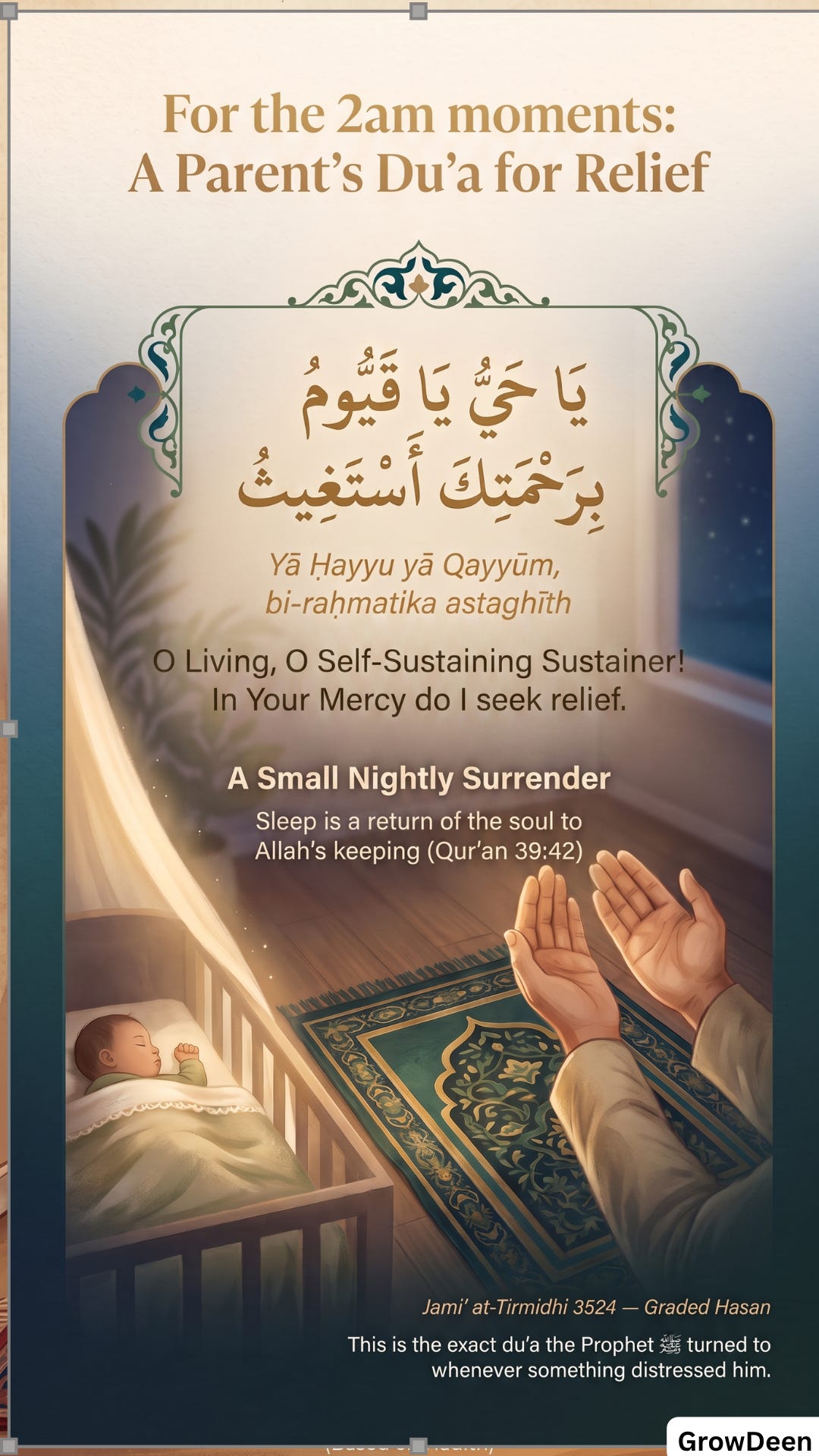
Page 3: For the Harder Nights — a reflection card for you, the parent, grounded in Qur’an 39:42, for the 2am moments when you need the reminder more than your baby does.
This isn’t a PDF to download once and forget. It’s designed to live on your fridge or nightstand, right where you’ll need it at 1am.
This companion pack is what every Muslim Parenting Lab subscriber receives with each article, we cover the full journey of raising Muslim children, all backed by research and rooted in Islamic wisdom. If you want both evidence-based guidance and Islamic perspective, subscribe free so future resources reach you before you need them.
You’ll only hear from us when there’s something worth sharing, no spam, no daily inbox clutter, just resources that matter.
Before you keep scrolling: pick ONE habit from this article, just one, and write it on a sticky note tonight. Don’t plan the whole overhaul. Start there.
May Allah place barakah in your effort tonight, and make this small act of letting go easier than it feels right now.
Think of one person right now: the friend at the masjid who mentioned bedtime feels like a battle, the sister in your WhatsApp group who hasn’t slept properly in months, the new mother who keeps apologizing for how tired she looks. This article could ease one of their hardest hours. Share it with them today, not as advice, but as company through something hard.
Frequently Asked Questions
Q: How long does it take to change a baby’s sleep habit?
A: Most babies adjust within three days to three weeks, depending on temperament and the method used [5][11]. After that window, most families see a real, lasting improvement.
Q: Is it bad for my baby to fall asleep with a dummy or while feeding?
A: No, it’s completely normal and not a sign of anything gone wrong [1][8]. It only becomes worth changing if the current pattern has stopped working for your family.
Q: Why does my baby wake up so often at night?
A: Babies cycle through sleep roughly every 45 to 60 minutes, compared to about 90 minutes for adults, and briefly surface at the end of each cycle [17]. That frequent surfacing is normal, and some researchers believe it’s actually protective against SIDS.
Q: When should I stop night feeds?
A: It’s medically reasonable to begin phasing out night feeds for formula-fed babies from around 6 months and breastfed babies from around 12 months, once growth is on track [2][14]. There’s no deadline forcing you to stop sooner.
Q: When should I wean my baby off a dummy?
A: Pediatric guidance links extended pacifier use to a higher risk of ear infections and dental changes, so several professional bodies recommend starting to wean during the second half of the first year, once the SIDS-protective window has passed [15b].
Q: Can I change more than one sleep habit at a time?
A: It’s best not to. Changing one habit at a time gives your baby a single, clear adjustment to make, rather than several confusing changes at once.
References
[1] Barry, E.S. (2020). What is ‘normal’ infant sleep? Why we still do not know. Psychological Reports, 124(2), 651–692. https://doi.org/10.1177/0033294120909447
[2] Davis, K.F., Parker, K.P., & Montgomery, G.L. (2004). Sleep in infants and young children: Part two: Common sleep problems. Journal of Pediatric Health Care, 18(3), 130–137. https://doi.org/10.1016/s0891-5245(03)00150-0
[3] Drozd, F., Leksbø, T.S., Størksen, H.T., Wilhelmsen, C.E.W., & Slinning, K. (2022). An overview of reviews for preventing and treating sleep problems in infants. Acta Paediatrica, 111(11), 2071–2076. https://doi.org/10.1111/apa.16475
[4] France, K.G., & Blampied, N.M. (2005). Modifications of systematic ignoring in the management of infant sleep disturbance. Child & Family Behavior Therapy, 27, 1–16. https://doi.org/10.1300/J019v27n01_01
[5] Lecuelle, F., Leslie, W., Gustin, M.P., Franco, P., & Putois, B. (2024). Treatment for behavioral insomnia in young children with neurotypical development under 6 years of age: A systematic review. Sleep Medicine Reviews, 74, Article 101909. https://doi.org/10.1016/j.smrv.2024.101909
[6] Hiscock, H. (2019). An educational intervention for improving infant sleep duration. JAMA Network Open, 2(12), Article e1918061.https://doi.org/10.1001/jamanetworkopen.2019.18061
[7] Hiscock, H., & Fisher, J. (2014). Sleeping like a baby? Infant sleep: Impact on caregivers and current controversies. Journal of Paediatrics and Child Health, 51, 361–364. https://doi.org/10.1111/jpc.12752
[8] Honaker, S.M., & Meltzer, L.J. (2014). Bedtime problems and night wakings in young children: An update of the evidence. Paediatric Respiratory Reviews, 15(4), 333–339. https://doi.org/10.1016/j.prrv.2014.04.011
[9] Martini, J., et al. (2017). Infant, maternal, and familial predictors and correlates of regulatory problems in early infancy. Early Human Development, 115, 23–31. https://doi.org/10.1016/j.earlhumdev.2017.08.005
[10] Middlemiss, W., et al. (2017). Response-based sleep intervention: Helping infants sleep without making them cry. Early Human Development, 108, 49–57. https://doi.org/10.1016/j.earlhumdev.2017.03.008
[11] Reuter, A., et al. (2020). A systematic review of prevention and treatment of infant behavioural sleep problems. Acta Paediatrica, 109(9), 1717–1732. https://doi.org/10.1111/apa.15182
[12] Sadeh, A. (2005). Cognitive-behavioral treatment for childhood sleep disorders. Clinical Psychology Review, 25(5), 612–628. https://doi.org/10.1016/j.cpr.2005.04.006
[13] Tikotzky, L. (2017). Parenting and sleep in early childhood. Current Opinion in Psychology, 15, 118–124. https://doi.org/10.1016/j.copsyc.2017.02.016
[14] Vieira, A.R., dos Santos, J., & Santos, P. (2020). Parental education and better sleep in infants. Pediatria i Medycyna Rodzinna, 16(2), 190–197. https://doi.org/10.15557/PiMR.2020.0036
[15b] Callaghan, A., et al. (2005). Association between pacifier use and breast-feeding, SIDS, infection and dental malocclusion; supporting clinical summary: Psaila, K., et al. (2009), Risks and Benefits of Pacifiers, American Family Physician, 79(8), 681–685.
[16] Qur’an, Surah Az-Zumar 39:42. Tafsir Ibn Kathir.
[17] Wandsworth Community and Neighbourhood Health Care Trust (NHS). Your Baby’s Sleep at 3–6 Months: safer sleep guidance on infant sleep cycles and SIDS-protective arousal. https://www.wchc.nhs.uk/