


The Harvard Center on the Developing Child found that brain connections form faster in the first 5 years than at any other period of life — with the most critical window starting now. [1] This guide shows you the 7 key milestones to watch for at 4–5 months, the Islamic framework behind it all, and the simple daily habits that shape your baby’s brain for life.
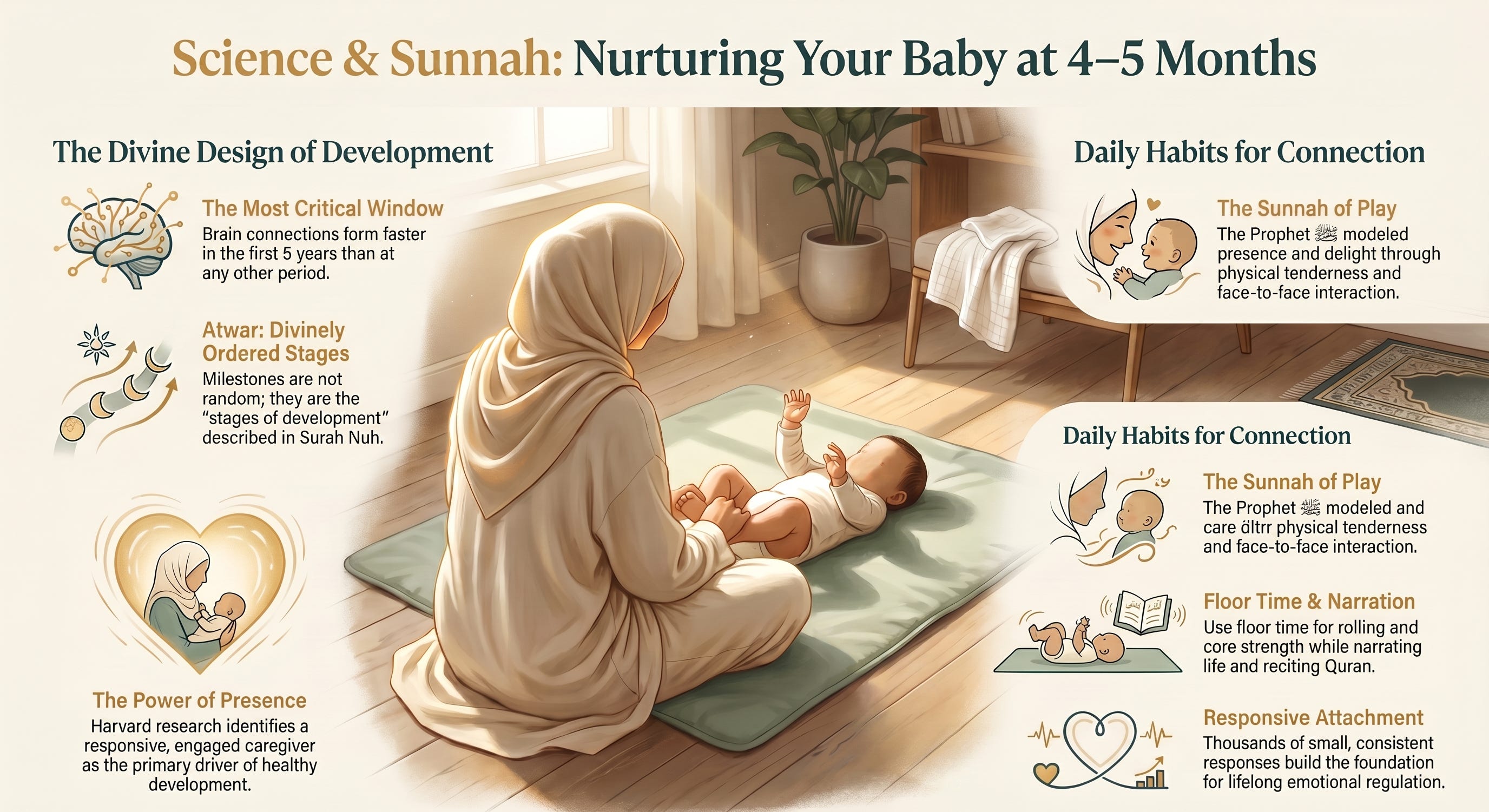
Your baby is on the floor. Rolling — or getting close. Reaching for things. Making sounds that feel like they mean something. And somewhere in the back of your mind, you’re wondering: Am I doing this right? Is this enough?
Here’s something that helped me when I was stuck in that same loop of second-guessing:
The research is remarkably clear about what matters most at this age. Not the toys. Not the apps. Not the flashcards. What matters — what the Harvard Center on the Developing Child calls the single most important driver of healthy brain development — is a responsive, engaged caregiver. [1]
That’s you. Right now. Reading this article.
But here’s the thing most parenting content misses: there’s a whole layer of meaning underneath the neuroscience. Because when the Prophet ﷺ spread his arms wide and chased a small child down a road just to make him laugh and hold him — he wasn’t doing something separate from deen. That was the deen. And understanding that changes how you see the next hour of your day.
Why This Guide Is Different From Generic Baby Development Advice
It’s backed by current research. Every milestone and recommendation here draws from peer-reviewed developmental science — including CDC guidelines, the Zubler et al. 2022 landmark milestone study, and Harvard’s ongoing research on early brain development. [1,4]
It integrates authentic Islamic guidance. Not as a quote dropped in at the end, but woven through from the start — using only verified Qur’anic verses and graded-Hasan hadith, checked against classical tafsir.
You’ll walk away with a free printable resource. The 4–5 Month Milestone & Play Pack gives you a pocket reference card, a weekly activity planner, and an Islamic du’a card — everything in one place so you don’t have to hold it all in your head.
What Your Baby Is Actually Doing Right Now
Let’s get specific — because “they’re developing a lot!” doesn’t help you at 7pm when you’re not sure if what you’re seeing is normal.
The CDC’s developmental surveillance criteria and the Zubler et al. 2022 study on evidence-informed milestones give us a clear picture of what to expect between months four and five. [4]
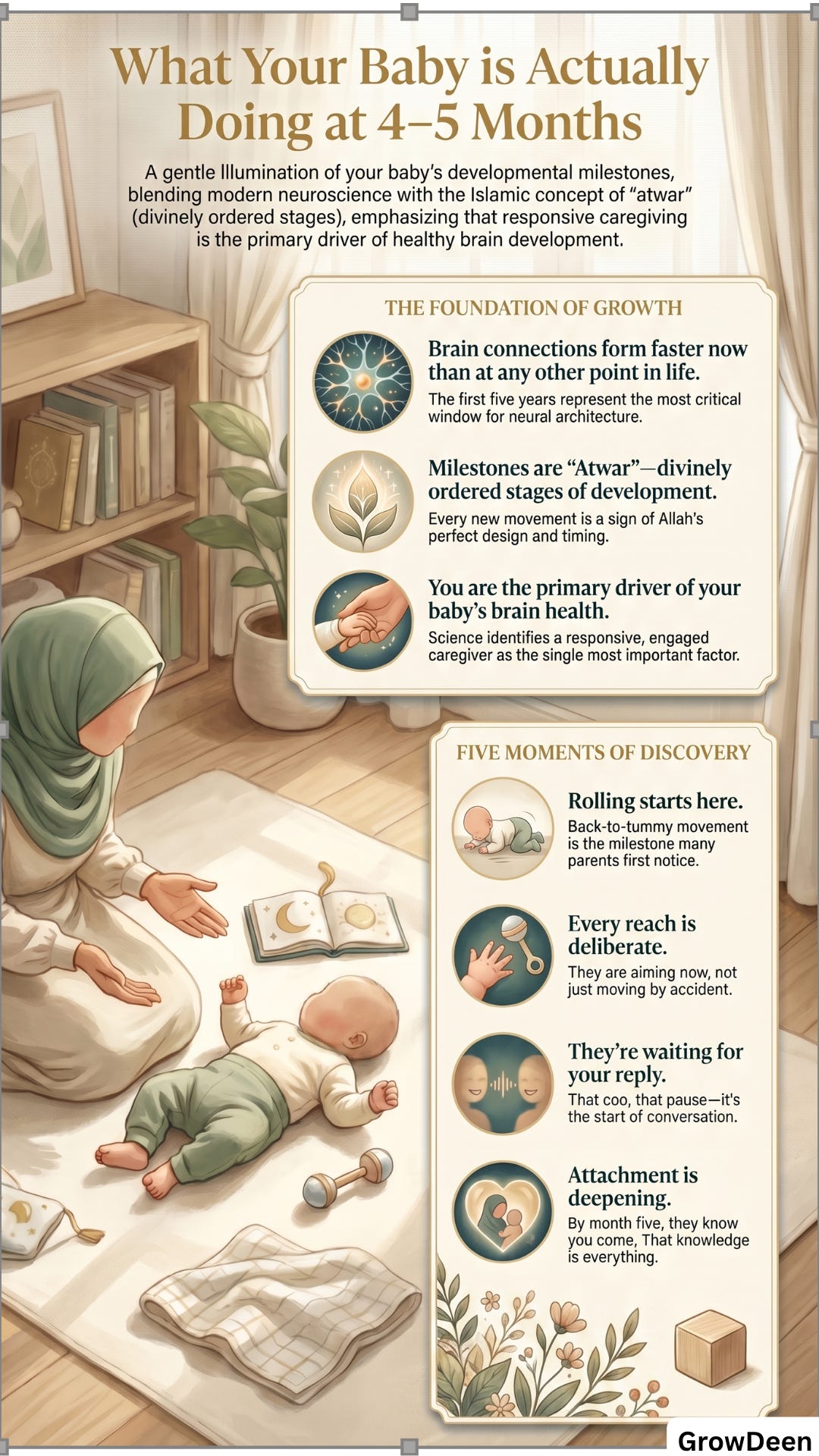
Rolling. This is often when it starts. Many babies begin rolling from back to tummy and tummy to back around 4–5 months. [5] Once it starts, no more unattended moments on any raised surface. Full stop.
Reaching and grabbing. Your baby can now reach deliberately for objects — your face, a rattle, your hair — and grip with their palm and fingers. Everything goes in the mouth. That’s not a problem. That’s how they’re learning about the world. [6]
Vocal turn-taking. Back-and-forth sounds, raspberries, “ah-goo” — your baby makes a sound, watches your face, waits for you to respond. The Newman et al. 2016 study found that the quality and quantity of early language input at this age predicts vocabulary outcomes at toddler age. [3] Every response you give matters.
Emotional range. Irritation. Frustration. Delight. These are new. Your baby isn’t just crying anymore — they’re communicating in layers. Respond to the emotional cues the same way you respond to physical ones.
Attachment deepening. By five months, your baby doesn’t just recognise you. They’re attached to you. They know you come when they call. That security — built through thousands of small, consistent responses — is what the Harvard research identifies as the foundation for lifelong emotional regulation. [1]
Keep reading — the 4–5 Month Milestone & Play Pack has all of this in a single printable page, so you can reference it without scrolling back.
(The full companion pack is waiting for you at the end of this article.)
What the Prophet ﷺ Showed Us About Playing With Your Baby
I find myself returning to one narration more than almost any other in this season of early parenting.
Ya’la ibn Murra described a moment from the Prophet’s life: travelling with companions, invited to eat, when they spotted Husayn — a young child — playing alone in the road. The Prophet ﷺ raced ahead of the others and spread his arms wide. The boy darted this way and that. The Prophet laughed, chased him, made him laugh, caught him, held his face in both hands, and embraced him. [14]
And then he said: “Husayn is from me and I am from Husayn.”
When I read the research on play at this age — how joyful, face-to-face, physically responsive interaction literally builds neural architecture in a baby’s brain [1] — I think about that narration. The Prophet ﷺ wasn’t indulging a moment of sentimentality. He was modelling something Islam teaches about the earliest years: presence, delight, and physical tenderness with a young child are not extras. They are the practice.
Get on the floor with your baby this week. Not because a parenting article told you to. Because the man we love as our Prophet ﷺ ran down a road for a child who needed to be caught and held.
There’s also something in Surah Nuh that changes how I see these milestones. Allah addresses a people who refused to believe, reminding them:
“when He truly created you in stages of development” — Qur’an 71:14 [13]
Ibn Kathir’s commentary explains the word atwar — stages — as the procession from a drop of sperm, to a clot, to flesh, and then further, through each phase of human life. [13] Your baby’s first roll. First grab. First social laugh. These are not random events. They are atwar — divinely ordered stages, designed and timed by the One who made this child before you ever held them.
Which means every milestone is not just a developmental checkpoint. It’s a sign. A reason to say Alhamdulillah.
What You Can Do This Month: 5 Simple Habits That Actually Matter
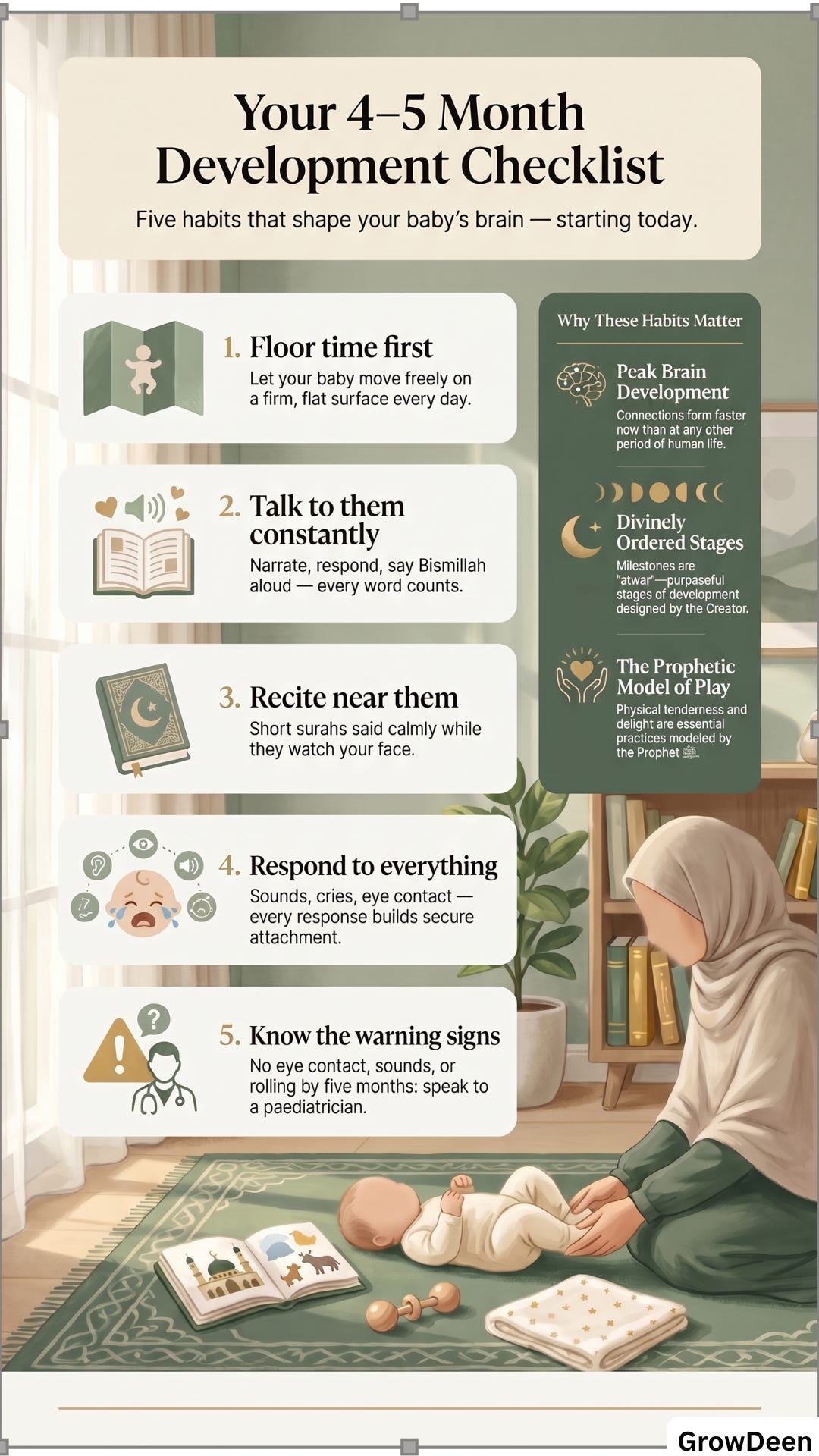
Floor time first. Give your baby as much time as possible on a clean, firm surface — not in a bouncer, not propped in a chair. Floor time is where rolling, reaching, and core strength develop. [7]
Talk constantly. Narrate everything. Describe what you’re doing during every feed, every nappy change, every walk. Say Bismillah aloud. Say Assalamu alaykum when you greet them. Let Arabic be part of what they hear from the beginning. [3]
Recite near them. Not as background noise. As an offering. Short surahs said in a calm voice while your baby watches your face. Ayat al-Kursi at bedtime. The mu’awwidhatayn when you lay them down. These are Sunnah-rooted protections the Prophet ﷺ would recite over children — and they are entirely appropriate from birth.
Respond to everything. Their sounds, their emotional signals, their cries, their eyes looking for yours. Every response builds the secure attachment that will support their emotional development for life. [1]
Watch for warning signs. By five months, speak with a paediatrician if your baby isn’t making eye contact, isn’t responding to sounds, isn’t smiling, or isn’t lifting their head during tummy time. [4] Early identification makes a significant difference. Seeking help is using the asbab — the means — Allah has provided.
Your Free Printable: The 4–5 Month Milestone & Play Pack
If you’ve read this far, you’re the kind of parent who takes this seriously — not out of anxiety, but out of love. That tells me something about you.
I created the 4–5 Month Milestone & Play Pack so you don’t have to hold all of this in your head.
Inside this one PDF (3 pages):
Page 1: 5 Months, 5 Milestones: Your At-a-Glance Development Spotter — A pocket-sized visual reference card organised by the five key developmental domains (movement, communication, social, sensory, and cognition), with the specific things to look for at 4–5 months and a brief note on what each means. Designed for the nursery wall or your phone camera roll — quick to scan at any moment.
Page 2: Floor Time, Talk Time, Recite Time: A Weekly Play Planner — A simple 7-day rhythm card with age-appropriate activity prompts for the 4–5 month window, organised around the article’s five daily habit categories. Not a rigid schedule — a gentle weekly rhythm you can return to and adapt. Designed to stay on the fridge.
Page 3: The Sunnah Home: 5 Daily Adab to Begin Now — A beautifully designed reference card presenting five Sunnah-rooted adab that parents can begin modelling in front of their 4–5 month old today: Bismillah before every act, Alhamdulillah after every blessing, Assalamu alaykum as a daily greeting, the right hand in everything you offer, and a gentle, present face when you respond. Each adab sits in its own colour-tinted card with a short, practical explanation.
This isn’t a PDF to download and forget. It’s designed to stay in your nursery or on your phone — where you’ll reach for it when you need it.
The 4–5 Month Milestone & Play Pack is what every subscriber receives with each article at Muslim Parenting Lab by GrowDeen Education. We cover the full journey of raising Muslim children — from the earliest weeks through the school years — all backed by current research and rooted in authentic Islamic guidance.
If you’re a Muslim parent who wants both evidence-based parenting and Islamic perspective, subscribe free so future resources arrive before you need them.
Subscribe free for parenting resources backed by both science and Sunnah — guidance so unique, you literally can’t get it anywhere else. No spam, no clutter, just resources that matter.
Your 5-Minute Action Right Now
Put your phone down after you finish this sentence and spend five minutes on the floor with your baby — face to face, no distractions, talking to them about whatever is in front of you. That’s it. That’s the practice. The research and the Sunnah agree: five present minutes beats fifty distracted ones.
Share This With Someone Who Needs It
Think of one person right now: your sister who just had a baby and is quietly unsure whether she’s doing enough, the friend in your WhatsApp group who mentioned her four-month-old isn’t rolling yet and was told not to worry but still worries, the new mother at the masjid who looks a little lost in the chaos of the first year.
This article could settle something for them. Share it today — not as advice-giving, but as companionship. Sometimes the most loving thing we can do is pass along something that made us feel less alone.
Frequently Asked Questions
Q: When exactly do babies start rolling — and what if my 4-month-old hasn’t yet?
A: Rolling typically begins somewhere between 4 and 6 months, with most babies rolling from tummy to back first. [5] A 4-month-old who hasn’t rolled yet is not behind — but if there’s no rolling at all by 6 months, it’s worth mentioning to your paediatrician. For more on what to look for, see “What Your Baby Is Actually Doing Right Now” above.
Q: Is it normal for my baby to put everything in their mouth at this age?
A: Yes, completely normal. Mouthing is how babies at 4–5 months explore texture, temperature, and shape. [6] It’s a form of learning, not a hygiene problem. Just make sure there are no choking hazards in reach — nothing smaller than a 50-pence coin, no loose parts, no strings.
Q: How much tummy time should a 4–5 month old get each day?
A: The goal is to work up to about 30 minutes of tummy time spread across the day, in short sessions while your baby is awake and you’re watching. [7] If your baby hates it, start with just 2–3 minutes after a nappy change and build gradually. The key is consistency, not duration.
Q: What does secure attachment actually mean — and how do I know if I’m building it?
A: Secure attachment forms when a baby learns, through hundreds of repeated experiences, that their caregiver responds when they need something. [1] You don’t need to be perfect — you need to be consistent. If you pick them up when they cry, respond to their sounds, make eye contact, and come back when you’ve had to step away, you’re building it. Every time.
Q: My 5-month-old isn’t making eye contact much. Should I be worried?
A: Reduced eye contact at 5 months is worth discussing with a paediatrician — it can be an early sign of developmental differences that benefit from early support. [4] It doesn’t mean something is wrong, but early assessment always produces better outcomes than waiting. Trust your instinct if something feels off.
Q: What Quranic recitation is best to play near my baby?
A: There’s no single prescribed answer, but many families find shorter surahs work well — Al-Fatiha, Al-Ikhlas, Al-Falaq, An-Nas, and Ayat al-Kursi. Recited in a calm, natural voice by the parent (rather than played through a speaker) tends to be more effective for bonding and soothing, since babies are especially attuned to their caregiver’s voice at this age.
References
[1] Center on the Developing Child at Harvard University. (2021). Three Principles to Improve Outcomes for Children and Families. https://developingchild.harvard.edu/resources/report/three-principles-to-improve-outcomes-for-children-and-families/
[2] Onigbanjo, M. T., & Feigelman, S. (2024). The first year. In R. Kliegman & J. W. St Geme III (Eds), Nelson Textbook of Pediatrics (22nd edn, pp. 151–156). Elsevier.
[3] Newman, R. S., Rowe, M. L., & Ratner, N. B. (2016). Input and uptake at 7 months predicts toddler vocabulary. Journal of Child Language, 43(5), 1158–1173. https://doi.org/10.1017/S0305000915000446
[4] Zubler, J. M., Wiggins, L. D., Macias, M. M., Whitaker, T. M., Shaw, J. S., Squires, J. K., Pajek, J. A., Wolf, R. B., Slaughter, K. S., Broughton, A. S., Gerndt, K. L., Mlodoch, B. J., & Lipkin, P. H. (2022). Evidence-informed milestones for developmental surveillance tools. Pediatrics, 149(3), Article e2021052138. https://doi.org/10.1542/peds.2021-052138
[5] Sharma, A., Cockerill, H., & Sanctuary, L. (2022). Mary Sheridan’s From Birth to Five Years: Children’s Developmental Progress (5th edn). Routledge.
[6] Sharma, A., & Cockerill, H. (2022). From Birth to Five Years: Practical Developmental Examination (2nd edn). Routledge.
[7] Centers for Disease Control and Prevention. (2024). Child development: Positive parenting tips: Infants (0–1 years). https://www.cdc.gov/child-development/positive-parenting-tips/infants.html
[8] Centers for Disease Control and Prevention. (2023). Important milestones: Your baby by six months. https://www.cdc.gov/ncbddd/actearly/milestones/milestones-6mo.html
[9] Berk, L. E. (2013). Child Development (9th edn). Pearson.
[10] Wilks, T., Gerber, R. J., & Erdie-Lalena, C. (2010). Developmental milestones: Cognitive development. Pediatrics in Review, 31(9), 364–367. https://doi.org/10.1542/pir.31-9-364
[11] World Health Organization. (2023). Complementary feeding. https://www.who.int/health-topics/complementary-feeding
[12] Kliegman, R. M., & Marcdante, K. J. (2019). Nelson Essentials of Pediatrics (8th edn). Elsevier.
[13] Qur’an 71:14. Translation: Saheeh International. Tafsir Ibn Kathir (covering 71:5–20) confirms atwar as the stages of human creation from earliest development through all phases of life. https://quran.com/71/14
[14] Al-Adab Al-Mufrad 364 (Al-Imam al-Bukhari). Graded: Hasan (al-Albani, Silsilah al-Sahihah, no. 1227). https://sunnah.com/adab:364