


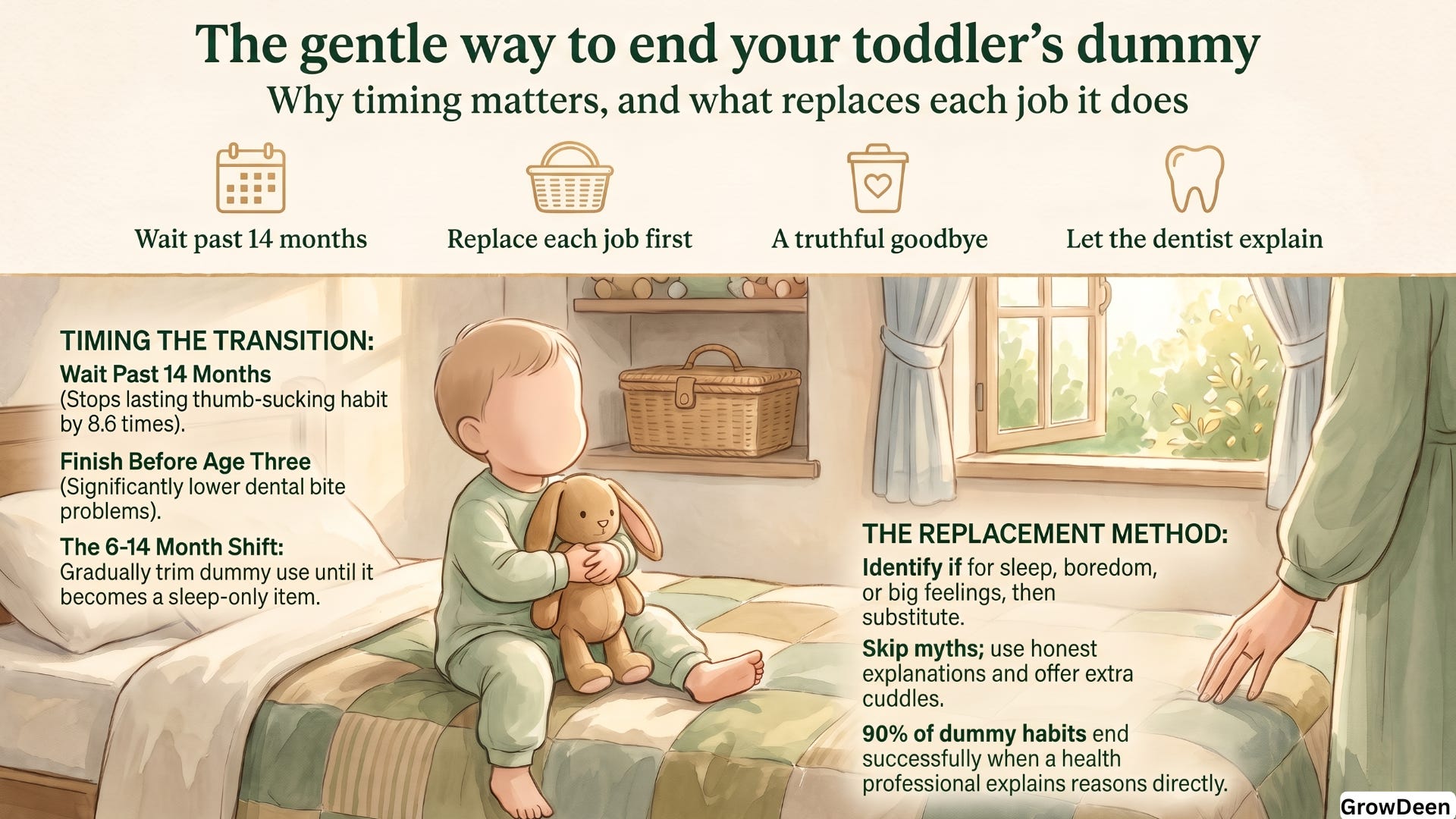
Children whose dummy use ended before 14 months had about 8.6 times the odds of a lasting finger-sucking habit. [1] Use beyond 18 months changes the developing mouth and jaw. [2]
Printable. For the night the box is asked for.
Every dummy went in the bin on a Sunday night.
The baby was eleven months old. There were three rough nights, tears on both sides of the cot, and then a quiet house. The family felt they had done the hard thing early and got it over with.
Six weeks later, a small thumb had found its way into the same mouth. Nobody can put a thumb in the bin.
If you have been told to get rid of the dummy as soon as you possibly can, the urge to act comes from love. You have heard about teeth and ears, and maybe a relative has already said something at a family gathering. What rarely gets mentioned is that timing cuts both ways, and the quickest goodbye is often the one that lasts least.
Dummies are part of ordinary family life. About half of babies still use one at 12 months, and around 1 in 100 children are still using one at five years. [4] There is also one method, reported in a survey of 502 families, that worked 90% of the time, and it was the method parents used least. [5] It comes near the end of this guide, after the plan it belongs to.
Why this guide is different
The advice rests on current evidence, including the American Academy of Pediatric Dentistry’s 2024 policy and studies of more than 1,000 children in Japan and Brazil. [1][2][5]
The Qur’an and Sunnah shape the plan itself, down to an example from the Prophet ﷺ of replacing something familiar with something better.
You already have the free Dummy Job Swap Pack from the top of this page — it turns the plan into pages for the fridge and the bedside.
What is a dummy actually doing for your child?
Think back over the last week. The dummy probably went in during the supermarket queue, again at nap time, again at 2 a.m. when your child stirred, and maybe once more after an injection at the clinic. It looks like one habit. In practice it is doing different jobs at different moments, and each job needs its own answer when the dummy goes.
The first job answers a pull that was there before any dummy arrived. When Pharaoh asked Musa (peace be upon him) who his Lord was, the answer came: “Our Lord is He Who gave to each thing its form and nature, then guided it aright.” [6] According to Tafsir Ibn Kathir, Sa’id ibn Jubayr explained this as Allah giving each of His creatures what is suitable for its creation. [6]
Ibn Kathir also records scholars of tafsir who read the verse alongside “And Who has measured; and then guided,” meaning that Allah measured out what His creatures need, including their sustenance and actions, and then guided them to it. [6] A newborn who can already suck, without a single lesson, fits that description closely. Doctors describe the same thing in their own words: sucking without feeding is a natural reflex in unborn babies and newborns, usually seen as sucking on the hands and fingers. [7] Comfort sucking belongs to how your child was made, so a baby who took to a dummy gives no one a reason for shame.
The second job is switching sleep on. The third is settling big feelings, whether from a bumped head or a room full of loud cousins. In the early months these jobs bring real benefits: a dummy offered at the start of sleep lowers the risk of sudden infant death syndrome (SIDS), mostly during the first six months, and sucking eases the pain of injections and blood tests and can help sore ears on a flight. [4]
Two cautions hold at every age. Never dip a dummy in sugar, which feeds tooth decay, or in honey, which also carries a risk of botulism for babies. And if you are breastfeeding a newborn, wait until feeding is well established before offering one. [4]
Before changing anything, watch for a day or two and notice which job the dummy does most in your home. That tells you where the plan needs to start.
When does a dummy start causing problems?
Maybe it was a comment in the dentist’s chair, or an aunt glancing at your toddler after Jumu’ah. Underneath the practical question sits a quieter one that plenty of parents carry around for months, the private worry that this has already gone on too long. That worry deserves a real answer, and the real answer is that most of the risk comes from long, heavy use.
Many Muslim parents think of a child’s body as an amanah, a trust from Allah that they look after until the child can look after it. The ears that will learn the words of the adhan and the tongue that will one day recite Surah Al-Fatihah in salah fall inside that trust.
The ears are where costs show first. The American Academy of Pediatric Dentistry notes that dummy use after 12 months can raise the risk of acute middle ear infections, and that use beyond 18 months can start to shape how the mouth and jaw develop. [2]
Teeth take longer, but they carry the most consistent evidence. A 2025 scoping review of 35 studies found dummy use repeatedly linked with open bite, where the front teeth don’t meet, and with crossbite and overjet, and the risk climbed with how long, how often and how intensely the dummy was used. [3] Use beyond three years markedly raised the chance of changes that need treatment, while children who stopped before three had substantially lower rates and some early changes may correct themselves once the habit ends. [3] Visible dental effects can appear after two years of age but mostly show after four. [7]
Speech is less settled. Some studies linked heavy use with smaller vocabularies at one and two years, and more frequent daytime use with lower cognitive scores, while another study found most speech measures unaffected. [8] Researchers are now asking whether hours with a dummy in the mouth restrict the lip and tongue movements babies seem to use while learning to hear and make speech sounds. [8]
The pattern worth changing, then, is the all-day dummy that carries on for years. A two-year-old who still has one at bedtime is not heading for trouble.
So why not simply take it away at 12 months and be done?
Can you stop the dummy too early?
Go back to the family who binned every dummy on a Sunday night. They did what felt responsible, and for three nights it looked like it had worked.
In that Japanese study of 555 three-year-olds, stopping the dummy before 14 months went with about 8.6 times the odds of persistent finger-sucking at age three. [1] The American Academy of Pediatric Dentistry now notes that forced early cessation has been associated with prolonged finger sucking, and that letting the dummy continue past 14 months may help prevent a lasting finger habit. [2] A thumb is always within reach, and much harder to put away.
Guidance therefore pulls in two directions. The American Academy of Pediatrics suggests weaning off the dummy in the second half of the first year to lower the risk of ear infections, and no one has pinned down a single ideal age. [4] Put the two findings side by side and a workable middle path appears.
Replace the job before you remove the dummy. That line explains why the Sunday-night goodbye went wrong: the urge to suck was still there, and nothing new had been given to it.
Under six months, keep offering the dummy at sleep if it helps your baby settle, because this is when the SIDS protection is strongest. [4]
Between six months and about 14 months, trim it back gently until it becomes a sleep-only item, especially cutting it from waking hours, without forcing a complete stop. [2][4]
From about 14 months to three years is the best window to finish. Stopping before three is linked with fewer lasting bite changes [3], and by the second half of this window most toddlers can follow a simple plan with plenty of help.
After three, bring your child’s dentist into it. The American Dental Association and the American Academy of Pediatric Dentistry have long recommended discouraging dummy use after four years of age. [7]
Does breastfeeding affect how long a dummy habit lasts?
Some parents reading this are nursing a younger baby while trying to wean an older one off the dummy, and wondering whether the two are connected. The research suggests they are.
The Qur’an gives nursing a full term: “The mothers should suckle their children for two whole years, for those who desire to complete the term of suckling.” [9] According to Tafsir Ibn Kathir, the same verse permits a mother and father to wean before the two years are complete when they both agree to it after consulting each other, for a benefit they have discussed together. [9]
The research on sucking habits sits comfortably beside that term. In the survey of 502 families in Brazil, the more a child had been breastfed, the less that child used a dummy. [5] The Japanese study found that children weaned from the breast before 12 months were also more likely to still be sucking their fingers at three. [1] And among dummy users, exclusive breastfeeding until three to six months went with a 41% lower risk of malocclusion compared with no breastfeeding, rising to 72% lower when exclusive breastfeeding lasted beyond six months. [4]
A family that completes the two years is keeping to a term Allah Himself named. The verse also makes room for parents who agree to wean earlier, so none of this is blame, and every part of the plan below works for bottle-fed children too. Agreeing together, and then speaking to your child with one voice, matters just as much when the dummy is the thing being weaned.
Knowing all of this is one thing. Remembering it at 2 a.m. is another.
Plans like this make perfect sense over a morning cup of tea and slip away in the dark, when a small voice is asking for the one thing in the box. The Dummy Job Swap Pack puts the whole plan onto three printable pages, starting with a job-by-job planner and a 21-day sticker tracker for the fridge. The download button is at the top of this page, and there’s a full description of what’s inside it below.
The evidence explains what happens when a dummy goes. It says much less about why the urge to hurry is so hard to resist.
What do the Qur’an and Sunnah teach about haste and replacing what is familiar?
A relative asks, again, why your two-year-old still has a dummy, and suddenly you want every one of them gone by Saturday. Allah names that pull exactly: “Man is created of haste.” [10] According to Tafsir Ibn Kathir, the verse is like the one describing man as ever hasty, and that haste appears in all matters. [10] It lives in you when the comment stings, and in your toddler, who wants comfort this instant.
Seeing haste as part of human nature turns a slower pace into a deliberate choice. The Prophet ﷺ also showed what to do with something familiar. When he ﷺ arrived in Madinah, the people kept two days of games from before Islam. He ﷺ asked about them, then said: “Allah has substituted for them something better than them, the day of sacrifice and the day of the breaking of the fast.” [11]
The scholars at IslamQA explain that celebrating festivals is an instinctive part of human nature [12], so the need itself was met with something better. Using a dummy was never a sin, and the comparison is only about method. When a comfort leaves a small child’s life, say plainly what better thing is taking its place.
Doctors arrive somewhere similar from their own direction, recommending praise and positive reinforcement when weaning a child off the dummy. [4]
How do you replace each job the dummy does?
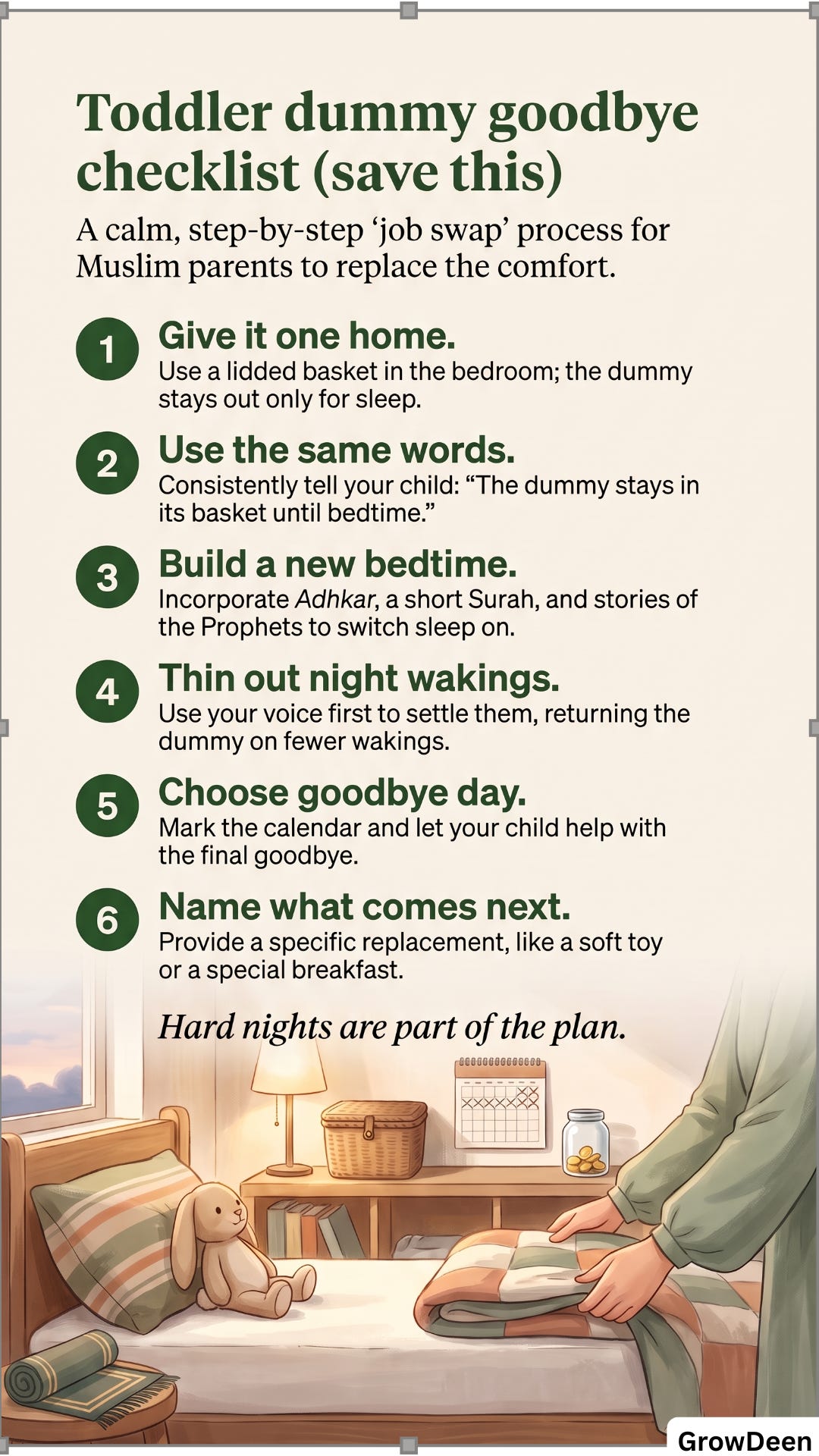
Picture the 5 p.m. slump. Dinner is half made, a tired toddler is pulling at your leg, and a small hand keeps pointing toward the bedroom where the box lives. Each job the dummy does needs its own replacement, and it helps to hand them over one at a time.
The daytime comforter
Give the dummy one fixed home, such as a lidded box or pouch that stays in the bedroom, and let it come out only for naps and night sleep. When your child asks during the day, use one short answer every single time: “Dummy stays in its box until sleep time.” Then move straight on to something else, like a cup of water with Bismillah said together, a snack, a few minutes outside or a book on your lap.
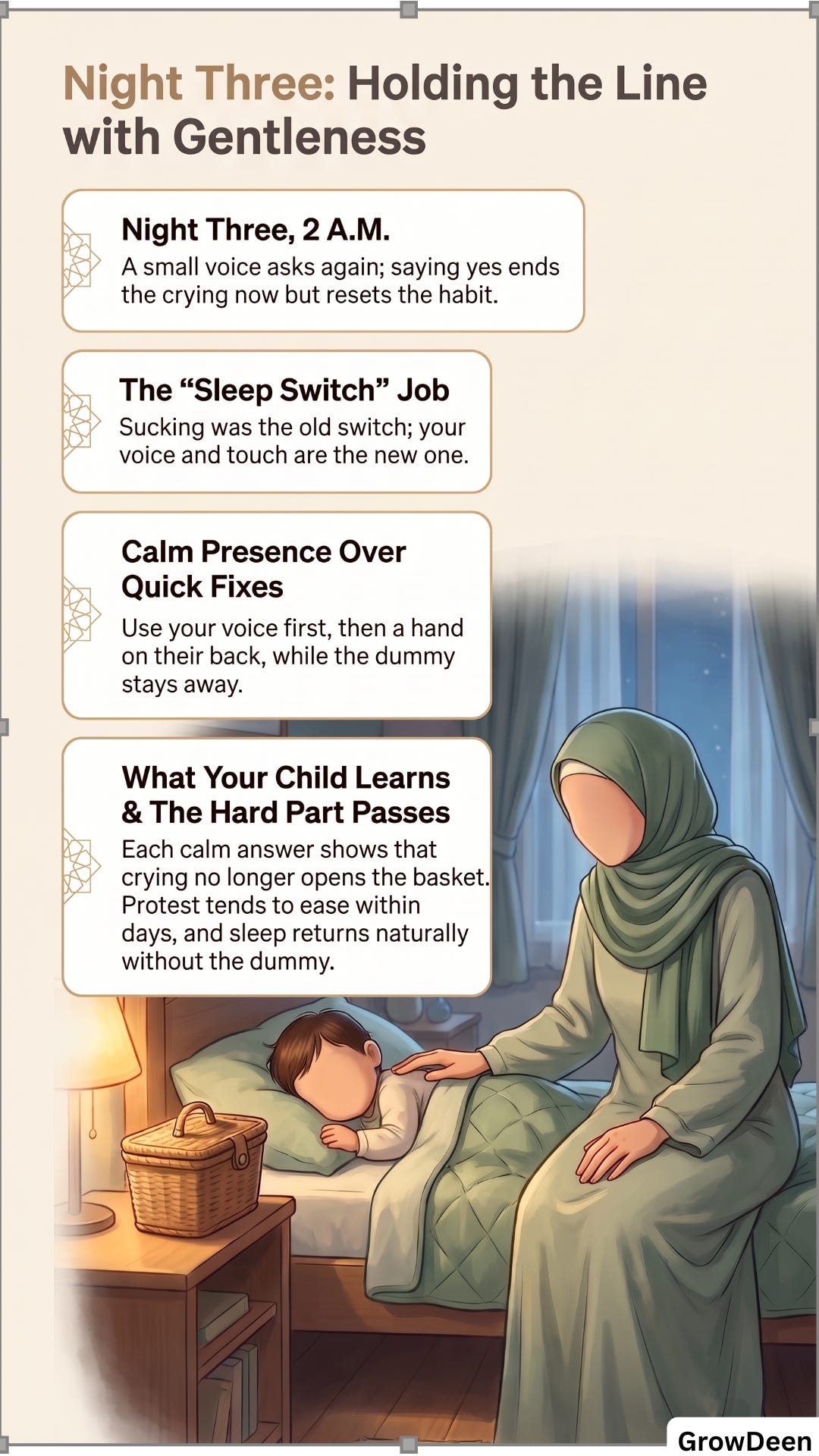
Small children work out quickly which responses pay off. A dummy handed over whenever crying starts teaches that crying fetches the dummy. A calm, repeated answer slowly teaches the opposite.
The sleep switch
Once the daytime asking has faded, build a bedtime that switches sleep on without the dummy’s help: washing up, pyjamas, the adhkar your family already says before sleep, a short surah recited quietly, and a story about one of the Prophets told in your own words. The dummy comes at the very end, and you ease it out as your child dozes off.
Night wakings come next. Settle first with your voice and a hand resting on your child’s back, then give the dummy back only on some wakings, perhaps every other one at first and later every third, stretching the gap across a week or so.
Tired parents manage this better with a rota, one covering the hours before midnight and the other the stretch before Fajr. The quiet beside a child’s bed is a good place for du’a, so ask Allah in your own words for patience and for a settled child.
The big-feelings soother
This job passes to you: your lap, your voice, and simple words for what your child feels, like “You’re cross, and you miss it.” When most nights pass without the dummy, choose a goodbye day and tell your child it is coming.
On the day, round up every dummy in the house, including the spare in the changing bag and the one that rolled under the car seat, and let your child help drop them in the bin. Some families say fairies or birds collect dummies for other babies. Children eventually work out that stories like these weren’t real, and the goodbye loses its meaning once they do, so a truthful version works better: “You’re growing, so the dummies are finished today. Tonight you’ll get an extra story and a long cuddle.”
Name the replacement out loud and keep your word about it. A soft toy that belongs to bedtime, or a special breakfast after the first dummy-free night with everyone saying Alhamdulillah, can mark the change, and some parents let their child drop a coin into the sadaqah jar so the day ends with giving.
Praise the effort in specific words the next morning. Expect protest for a few nights, however well you prepared, and stay calm and affectionate. Handing a dummy back after a rough night teaches that enough crying reverses the decision.
Who should explain to your child why the dummy is going?
Parents often find that careful explanations bounce straight off a determined three-year-old. That brings back the method from the start of this guide.
The Brazilian survey asked 502 families how they had ended the dummy habit and whether it worked. A health professional explaining the reasons to the child succeeded in 90% of cases. A bad-tasting substance on the dummy worked in 80%, stopping abruptly in 64%, and parents explaining the reasons themselves in only 38%, and the most effective method was the one families used least. [5]
So book the dental check, and ask the dentist to talk to your child directly about why the dummy is going. Keep the rest of the plan warm and encouraging, since doctors recommend positive reinforcement [4], and check with your doctor or dentist before putting any coating on a dummy.
What makes stopping the dummy harder?
Starting in a month already crowded with change, such as a new baby, a house move, travel, illness or a first term at nursery
Mocking or comparing, like “only babies have dummies,” or pointing to a cousin who has stopped
Forcing a complete stop during the first year, when an abrupt early end is linked with lasting finger-sucking [1][2]
Sweetening a dummy, and above all dipping it in honey [4]
Telling stories about fairies or birds that you would later need to take back
Hiding a spare “just in case,” because small children are very good at finding things
Giving a dummy back after goodbye day because one night was hard
When should you see a doctor or dentist about a dummy habit?
This guide does not replace medical advice. See your doctor, dentist or a speech and language therapist if:
your child is three or older and still uses a dummy for long stretches during the day [3]
the front teeth don’t close together, or the upper teeth jut forward [3]
ear infections or earaches keep coming back [2]
family members find your child’s speech hard to understand, or words seem slow to come
a thumb or fingers have taken over from the dummy and the habit is sticking [1]
sleep is still badly broken two weeks or more after goodbye day, or your child’s distress worries you
The goodbye that lasts
The right measure for this is your own child and the weeks your family can actually manage. A dummy that carried your baby through colic and the first long nights has earned a little gratitude, so say Alhamdulillah for what it gave.
Replace the job before you remove the dummy. Then let the goodbye come once something better is ready and waiting.
Your free Dummy Job Swap Pack
Hard nights go better when the plan is written down somewhere you can see it, and the words are ready before the crying starts. The Dummy Job Swap Pack was put together for exactly those moments.
Inside The Dummy Job Swap Pack (one comprehensive PDF, 3 pages):
Page 1: The Dummy Job Swap Planner. A job-by-job planner that shows what replaces the dummy as a daytime comforter, a sleep switch and a big-feelings soother, with tick boxes for each step and a 21-day sticker tracker, designed as a fridge planner you can keep on the kitchen door.
Page 2: What to Say When They Ask for the Dummy. Calm, ready-made words for the eight moments children ask most, including the car seat and 2 a.m., so you can answer the same way every time in under ten seconds.
Page 3: Three Reminders for the Letting-Go Weeks. Reflection cards on Qur’an 20:50, Qur’an 21:37 and the Prophet’s ﷺ words about replacing the old days with something better, plus space to write your own du’a, for the parent on the nights that feel slow.
It is made to stay on your fridge, where it will actually get used on the hard nights.
The Dummy Job Swap Pack is what every subscriber receives with each article. Muslim Parenting Lab covers the full road of raising Muslim children, from newborn sleep to school-age character, all backed by research and rooted in the Qur’an and Sunnah. If you want both in one place, subscribe for free so the next resource reaches your inbox before you need it.
Subscribe free for parenting resources grounded in both science and Sunnah, with no spam and no clutter, only resources that matter.
One thing to do in the next five minutes
Go and find every dummy in the house, including the car and the changing bag. Keep only the ones used at sleep time, put them together in one box in the bedroom, and throw the rest away.
May Allah make these weeks easy on your child and gentle on you, and place barakah in every patient night.
Share this with someone who needs it
Think of one person right now: the cousin who admitted at Eid that her toddler still can’t sleep without a dummy, and looked embarrassed saying it. Or the friend whose WhatsApp message last week said she was about to bin the lot this weekend.
This guide could spare them a harder road. Send it to them today as quiet support.
Frequently asked questions
Q: When should a child stop using a dummy?
A: For most children, the best window to finish is between about 14 months and three years. Stopping before 14 months is linked with lasting finger-sucking [1], and stopping before three is linked with fewer bite problems. [3] For the full age-by-age path, see “Can you stop the dummy too early?” above.
Q: Is it better to stop the dummy cold turkey?
A: Stopping abruptly worked for 64% of families in one survey, while a health professional explaining the reasons worked for 90%. [5] A forced early stop in the first year is also linked with finger-sucking [1], so a gradual plan with praise suits most children better. [4]
Q: Does a dummy damage a child’s teeth?
A: Long, frequent use is linked with open bite, crossbite and overjet, and the risk grows with how long it continues. [3] Visible effects mostly show after four [7], and some early changes may correct themselves if the habit ends before three. [3]
Q: Can a dummy delay a toddler’s speech?
A: The evidence is mixed. Heavy daytime use has been linked with smaller vocabularies at one and two years, but another study found most speech measures unaffected. [8] If your child’s speech worries you, speak to a speech and language therapist.
Q: What if a toddler starts sucking a thumb after the dummy stops?
A: This is more likely when the dummy stops before about 14 months. [1] Keep offering comfort without shaming, give the hands something to hold at sleep time, and mention the habit at your child’s next dental check. See “When should you see a doctor or dentist about a dummy habit?” above.
Q: Is using a dummy allowed in Islam?
A: Nothing in the Qur’an or authentic hadith addresses dummies directly, and comfort sucking is part of how babies are made. [6] If you have a specific question of ruling for your family, ask a trusted scholar.
References
[1] Fukumoto, E., Fukumoto, S., Kawasaki, K., Furugen, R., Kitamura, M., Kawashita, Y., Hayashida, H., Fukuda, H., Iijima, Y., & Saito, T. (2013). Cessation age of breast-feeding and pacifier use is associated with persistent finger-sucking. Pediatric Dentistry, 35(7), 506-509. https://pubmed.ncbi.nlm.nih.gov/24553272/
[2] American Academy of Pediatric Dentistry. (2024). Policy on pacifiers. The Reference Manual of Pediatric Dentistry. https://www.aapd.org/globalassets/media/policies_guidelines/p_pacifiers.pdf
[3] Hung, M., Marx, J., Ward, C., & Schwartz, C. (2025). Pacifier use and its influence on pediatric malocclusion: A scoping review of emerging evidence and developmental impacts. Dentistry Journal, 13(7), 319. https://doi.org/10.3390/dj13070319
[4] Garcia, D.S., & Garcia, K.W. (2025). Pacifiers: Common questions and answers. American Family Physician, 111(3), 230-235. https://www.aafp.org/afp/2025/0300/pacifiers
[5] Degan, V.V., & Puppin-Rontani, R.M. (2004). Prevalence of pacifier-sucking habits and successful methods to eliminate them: A preliminary study. Journal of Dentistry for Children, 71(2), 148-151. https://pubmed.ncbi.nlm.nih.gov/15587099/
[6] Quran, Surah Ta-Ha 20:50: https://quran.com/20/50. Ibn Kathir, Tafsir Ibn Kathir, Surah Ta-Ha 20:49-52 commentary: https://quran.com/en/taha/50/tafsirs
[7] Sexton, S., & Natale, R. (2009). Risks and benefits of pacifiers. American Family Physician, 79(8), 681-685. https://www.aafp.org/afp/2009/0415/p681
[8] Kanellopoulos, A.K., & Costello, S.E. (2024). The effects of prolonged pacifier use on language development in infants and toddlers. Frontiers in Psychology, 15, 1349323. https://doi.org/10.3389/fpsyg.2024.1349323
[9] Quran, Surah Al-Baqarah 2:233: https://quran.com/2/233. Ibn Kathir, Tafsir Ibn Kathir, Surah Al-Baqarah 2:233 commentary: https://quran.com/al-baqarah/233/tafsirs
[10] Quran, Surah Al-Anbiya 21:37: https://quran.com/21/37. Ibn Kathir, Tafsir Ibn Kathir, Surah Al-Anbiya 21:36-37 commentary: https://quran.com/en/al-anbya/37/tafsirs
[11] Sunan Abi Dawud 1134, narrated by Anas ibn Malik. Graded: Sahih (Al-Albani): https://sunnah.com/abudawud:1134
[12] IslamQA. (2018). Etiquette and rulings of Eid. https://islamqa.info/en/articles/72