

The CDC’s 2025 guidelines emphasize that approximately 70% of breastfeeding mothers express milk at some point.[1] This guide shows you how to safely express, store, and prepare your milk while fulfilling the amanah Allah has placed in your hands—with step-by-step instructions backed by both medical research and Islamic wisdom.
I want you to know something that might ease your worry: expressing breastmilk isn’t about replacing the beautiful connection of nursing. It’s about extending that nourishment when life requires you to be apart from your baby.
When I studied the research on breastmilk expression and storage, what struck me wasn’t just the medical guidelines. It was how this practice allows mothers to fulfill Allah’s design for infant nutrition even during necessary separations. The Quran speaks beautifully about a mother’s right to nurse for two complete years,[2] and expressing milk becomes one way to honor that guidance when circumstances require it.
Whether you’re returning to work, managing a medical situation, or simply building a supply for those moments when you need support, proper expressing and storage techniques protect both the safety and nutritional integrity of your milk.
Let me walk you through exactly how to do this.
Why This Guide Is Different
It combines current medical research with Islamic wisdom — You’ll learn both the CDC’s 2025 storage guidelines AND what the Quran teaches about nourishing children.
It speaks to your actual concerns — Written in the voice of a knowledgeable elder sister who understands both the science and the sacred trust you’re carrying.
It gives you confidence, not just instructions — You’ll understand not just the “how” but the “why” behind each practice, so you can make informed decisions for your family.
When and Why You Might Express
Breastmilk expression removes milk from your breast either by hand or with a pump.[3,4] The World Health Organization and American Academy of Pediatrics both recognize breastfeeding as optimal nutrition from birth through two years and beyond.[5,6]
Here’s what matters for your situation right now: expressing milk allows you to sustain this blessed nourishment even when direct nursing isn’t possible.
You might need to express when:
Your baby is hospitalized or in the NICU and can’t nurse directly yet. You’re returning to work or school. Your breasts feel uncomfortably full and need relief. You want to build a freezer supply. You’re managing a blocked duct or early mastitis. You’re temporarily unable to nurse due to illness.
Here’s something most parents don’t realize: the amount you can express varies dramatically between individuals and even between sessions.[7,8] Some mothers express large volumes easily. Others work harder for smaller amounts. If you’re in the second group, you’re not failing. You may just need some technique adjustments or professional support.
If you’re unable to express much milk or having difficulties, consult with your midwife, healthcare provider, or a lactation consultant.[9,10]
Preparing to Express: The Foundation
Before you even touch a pump or position your hands, proper preparation makes everything easier.[11,12]
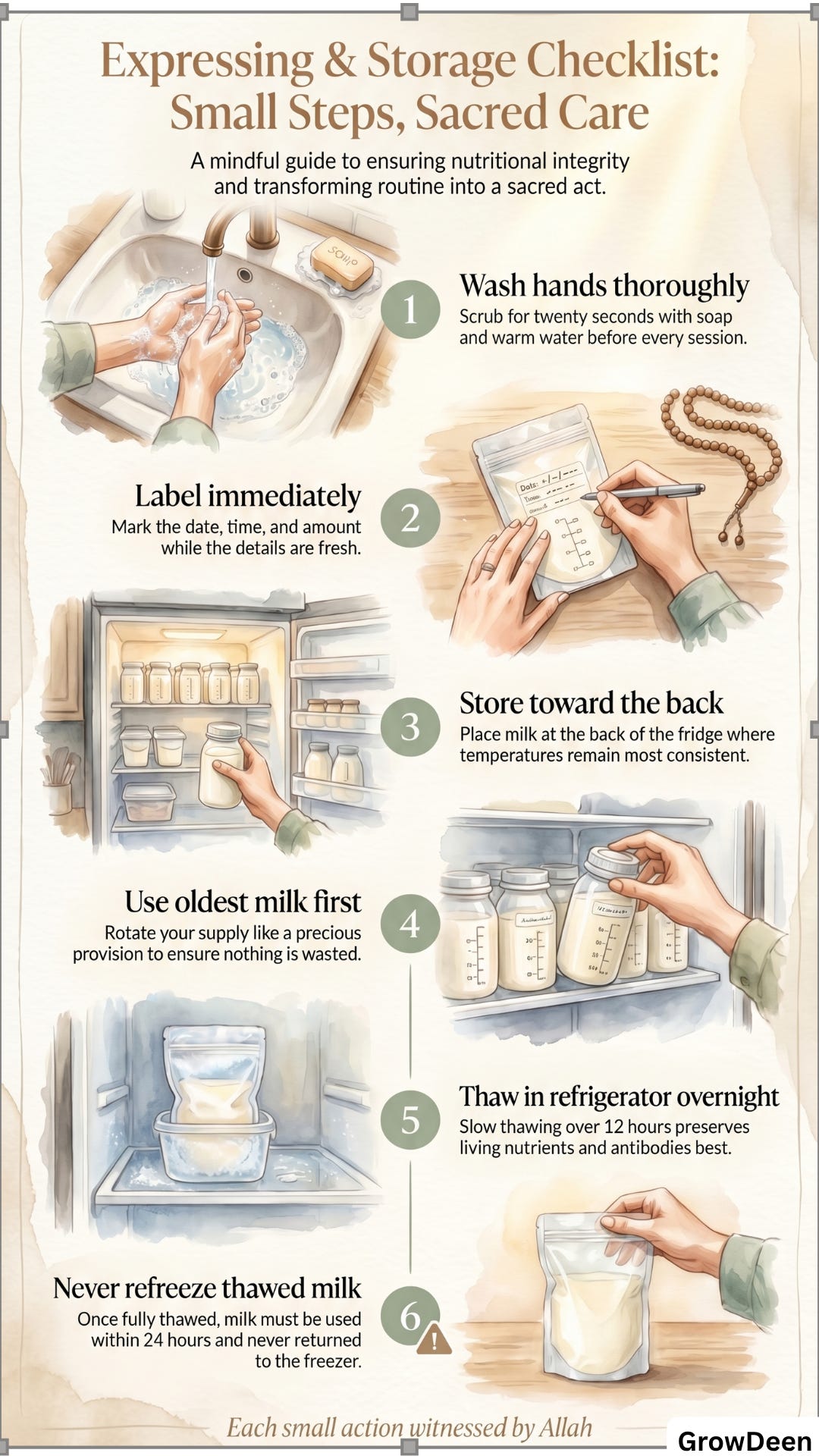
Wash your hands thoroughly. This is the single most critical step. Twenty seconds with soap and warm water, then dry with a clean towel.[13,14] Hand hygiene prevents contamination more than any other single practice.
Create your environment. Find somewhere private and comfortable where you can relax completely.[15,16] Stress and tension suppress the let-down reflex that triggers milk flow.
I know you’re busy. I know privacy feels like a luxury. But those few minutes of calm make a measurable difference in how much milk flows.
Stimulate your let-down reflex by gently massaging your breast, applying a warm washcloth, looking at your baby’s photo, or taking several deep breaths.[16,17]
When I reflect on the verse where Allah says, “Mothers may breastfeed their children two complete years for whoever wishes to complete the nursing period,”[2] I’m struck by how He recognizes both the mother’s role and the child’s need. According to Tafsir Ibn Kathir, this verse emphasizes the mother’s sacred duty to attend to her infant’s nutritional needs during this tender time.[18]
That sacred duty doesn’t end when you’re physically separated. Expressing milk becomes one way to fulfill it.
Three Ways to Express: Hand, Manual Pump, or Electric
The CDC recommends that every lactating mother learn hand expression.[19,20] Here’s why: it works when pumps fail, when power is out, when you’re somewhere without your equipment.
Hand expression (the Marmet Technique):
Sit comfortably. Form a “C” shape with your thumb and fingers positioned about 1-2 inches behind your nipple.[19,20,21] Gently press back toward your chest wall, then bring fingers toward each other in a rhythmic rolling motion. Never slide your fingers across your skin—that causes friction and soreness.[20,21]
At first, you’ll see only drops. Then you should see streams of milk. If it hurts, stop and adjust. Hand expression shouldn’t cause pain.[19,20]
Hand expression typically takes 15-30 minutes per session.[21] With practice, many mothers become faster.
Manual pumps work well for occasional expressing—they’re portable, quiet, and don’t require electricity.[22,23]
Electric pumps are more efficient for frequent, regular expressing and help maintain milk supply better when you’re pumping long-term.[23,24]
The most important thing about any pump: ensuring the breast shield (flange) fits properly.[22,25] Your nipple and a small portion of areola should move comfortably without friction or pinching.
Here’s something that surprised me when I researched this: you should never share personal-use breast pumps between different people, even if you change all the parts.[26,27] The pump motor itself can harbor bacteria. Only hospital-grade pumps designed for rental can be safely shared.[27]
Storage: Protecting Liquid Gold
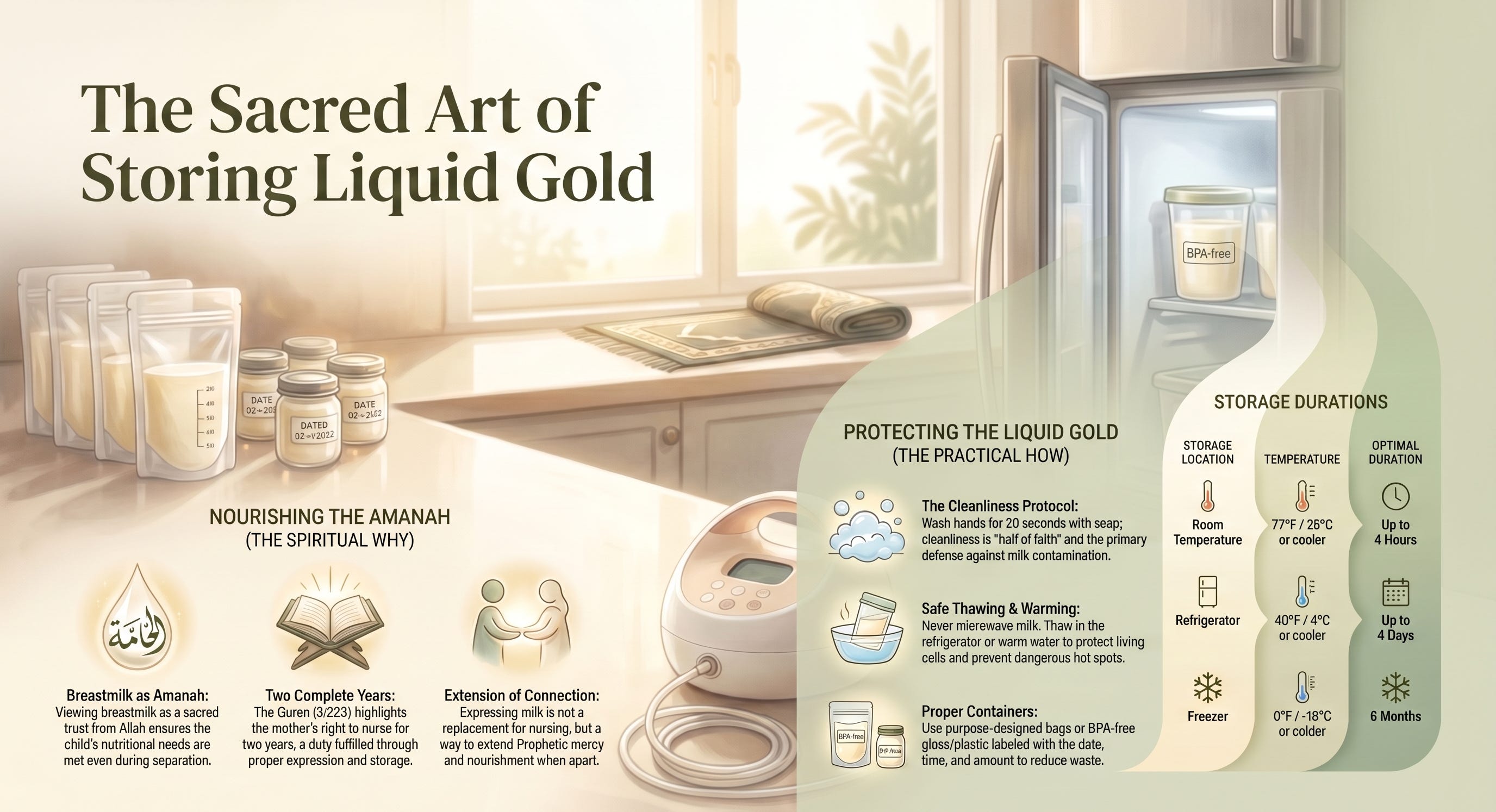
When Allah designed breastmilk, He created something extraordinary—living cells, antibodies, growth factors, beneficial bacteria. Proper storage protects all of that.[28,29,30]
Use these containers:[28,29,30]
Purpose-designed breastmilk storage bags for freezing
Clean, food-grade glass or BPA-free plastic containers with tight-fitting lids
Never regular plastic bags or containers not intended for food storage
Always label with: Date and time of expression, amount of milk, any medications you’re taking.[28,29,30]
Storage duration (CDC 2025 guidelines):[29,30,31]
Room temperature (77°F/25°C or cooler): Up to 4 hours is optimal. Up to 6-8 hours acceptable in very clean, cool environments.
Refrigerator (40°F/4°C or cooler): Up to 4 days is optimal. Store toward the back where temperature stays most consistent. Never store in the door where temperature fluctuates.
Freezer with separate door (-18°C/0°F or lower): 6 months is optimal for best quality. Up to 12 months is acceptable.
Previously frozen milk (thawed in refrigerator):[29,30,31] Use within 24 hours after completely thawed. Never refreeze.
Here’s why: Store milk in portions your baby typically consumes (2-4 ounces/60-120 ml).[29,30] This reduces waste and makes thawing more efficient. Use the oldest dated milk first.
Thawing and Warming: Preserving the Living Nutrition
Never—and I mean never—microwave breastmilk [29,30,31,32]. Microwaving destroys valuable nutrients and antibodies, creates dangerous hot spots that can burn your baby’s mouth, and heats milk unevenly.[32]
Safe thawing:[29,30,31,32]
Best method: Place frozen milk in the refrigerator overnight (takes about 12 hours).[32] Once fully thawed, use within 24 hours.[29,30,31]
Faster method: Hold the sealed container under warm (not hot) running water or place in a bowl of warm water.[29,30,32] This takes about 20 minutes.
Warming milk: Breastmilk doesn’t require warming—many babies accept it cold.[29,30,31] If you do warm it, place the sealed container in warm water or use a bottle warmer. Test the temperature on your inner wrist—it should feel comfortably warm, not hot.[29,30]
After warming: Use within 2 hours. Never reheat milk that’s already been warmed once.[30,32]
Fat separation is completely normal. Stored breastmilk separates into layers with cream rising to the top.[28,30,32] Gently swirl the container to remix—avoid vigorous shaking, which can damage beneficial proteins.[32]
Support Muslim Parenting Lab ❤️
Would you like the most rewarded kind of charity there is? Use the button below now, while you are well, rather than later.
Asked which charity is best, the Prophet ﷺ said the one given while you are healthy, not deferred until death is near. (Sahih al-Bukhari 1419)
Hygiene: The Sacred Responsibility of Cleanliness
The Prophet ﷺ taught, “Cleanliness is half of faith.”[33] This principle applies directly here.
The CDC’s 2025 guidelines emphasize that germs can grow rapidly in breastmilk residue.[34,35] For healthy, full-term babies over 3 months, thorough washing after each use is usually sufficient. For babies under 3 months, premature babies, or those with weakened immune systems, sanitize pump parts at least once daily.[34,35,36]
After each pumping session:[34,35,36]
Wash your hands (20 seconds with soap). Disassemble all pump parts that contacted milk. Rinse everything under cold running water. Wash in hot soapy water using a basin designated only for baby items and a brush used only for infant feeding equipment.[34,35] Never wash pump parts directly in the kitchen sink.
Rinse thoroughly at least twice under hot running water. Air dry completely on a clean paper towel. Never use a dish towel, which can transfer germs.[34,35]
Store completely dry parts in a sealed container in a clean area.
If your tubing has mold, discard it immediately. Moldy tubing cannot be cleaned adequately.[34,35]
If you’ve read this far, you’re the kind of parent who takes your baby’s nutrition seriously—not just as a task to complete, but as a sacred trust to honor. That tells me something beautiful about you.
I’ve created something that might help: the Expressing & Storing Breastmilk Companion Pack—a comprehensive 3-page PDF with quick-reference cards you can keep on your fridge, a storage duration chart, hygiene checklists, and authentic du’a for mothers who are expressing milk.
More on that in a moment. First, let me show you the Islamic framework that makes all of this deeply meaningful.
The Islamic Perspective: This Is Amanah
Allah سُبْحَانَهُ وَتَعَالَىٰ addresses breastfeeding with remarkable specificity: “Mothers may breastfeed their children two complete years for whoever wishes to complete the nursing period. Upon the father is the mothers’ provision and their clothing according to what is acceptable...”[2]
Imam Ibn Kathir explains that this verse provides “guidance from Allah to mothers so that they breastfeed their children with complete breastfeeding, that is for two years.”[18] This divine recommendation, revealed over fourteen centuries ago, aligns perfectly with modern research on optimal breastfeeding duration.[37]
But here’s what speaks to me personally: the Quran’s permission to use wet nurses when circumstances require it.[2] In earlier Islamic times, wet nurses allowed mothers to sustain their children’s nutrition during necessary separations. Expressing milk serves the same function in our modern context.
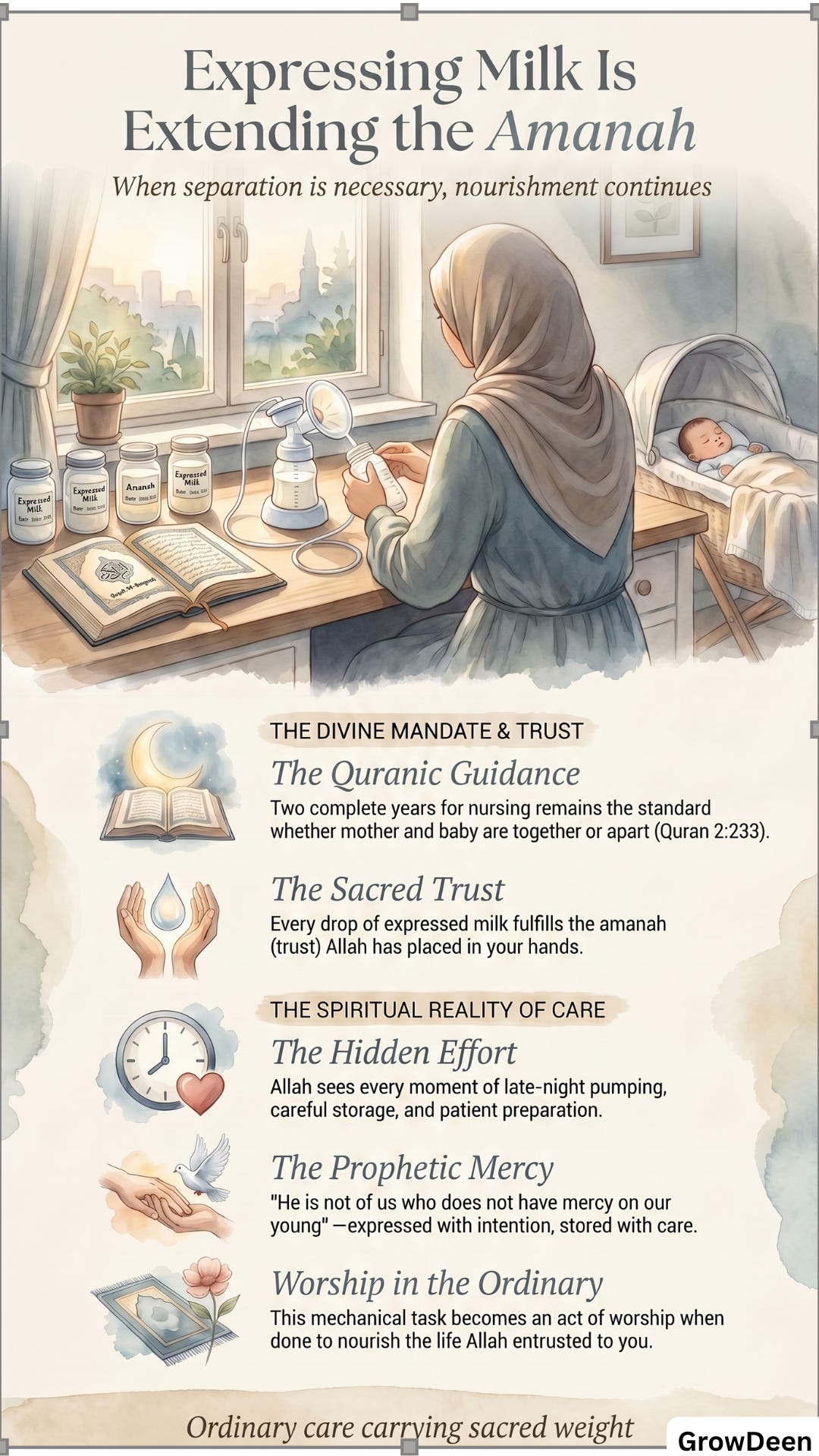
Your expressed milk carries the same nutritional benefits, immune protection, and divine blessing as milk provided through direct nursing. The effort you invest in expressing, the care you take in storage, the dedication you show in maintaining supply—all of this reflects your commitment to providing the best nutrition Allah designed for your child.
The Prophet ﷺ emphasized: “He is not of us who does not have mercy on our young children.”[38] When we take the time to properly express, store, and prepare breastmilk—ensuring hygiene, appropriate temperature, and safe handling—we manifest this Prophetic mercy in tangible form.
Every drop of milk you express for your child is witnessed by Allah, who knows your intentions, your efforts, and your love for your infant.
Your Companion Pack for This Journey
Inside the Expressing & Storing Breastmilk Companion Pack (one comprehensive PDF, 3 pages):
Page 1: Quick-Reference Storage Chart — A visual guide showing exactly how long breastmilk lasts at room temperature, in the refrigerator, and in the freezer, with color-coded zones and clear “use by” guidance—designed as a laminated card you can stick on your fridge or inside your pump bag so you never have to Google “how long can breastmilk sit out” at 2 AM.
Page 2: Pump Hygiene Checklist — A step-by-step cleaning protocol showing what to wash, what to sanitize, and when, with checkboxes for morning and evening routines—so you can maintain CDC 2025 standards without having to remember every detail when you’re exhausted.
Page 3: Du’as for the Nursing Mother — The authentic du’a for seeking barakah (blessing) in your milk supply, with transliteration and English meaning, plus a simple supplication to say before each pumping session—something you can make part of your expressing routine as an act of worship and a source of spiritual comfort.
This isn’t just a PDF to download and forget. It’s a tool designed to stay in your kitchen or pump bag—where you’ll actually use it when you need it most.
This Expressing & Storing Breastmilk Companion Pack is what every subscriber receives with each article. We cover the full journey of raising Muslim children—from pregnancy through adolescence—all backed by research and rooted in wisdom.
You’ll only hear from us when there’s something valuable to share—no spam, no daily emails, just resources that matter.
One Small Action You Can Take Right Now
Before you keep reading, do this: go to your kitchen and find one clean container or storage bag. Write today’s date on it in permanent marker. Right now. I’ll wait.
There. You’ve just prepared your first properly labeled storage container. That’s how building good habits starts—one small, specific action at a time.
When You Need Support
If you’re struggling with expression technique, experiencing low supply, or uncertain about any aspect of this process, seeking guidance aligns with Islamic values. Allah says, “So ask the people of knowledge if you do not know.”[39]
Consult with your healthcare provider, midwife, obstetrician, hospital lactation consultants, or International Board Certified Lactation Consultants (IBCLCs).[40,41] Many communities offer free or low-cost lactation support.
May Allah grant ease to all mothers seeking to nourish their children, provide abundant supply to those expressing milk, and bless our children with health, growth, and righteousness. Ameen.
Think of one person right now: a sister who’s about to return to work and anxious about maintaining her milk supply, a friend in your WhatsApp group who just got a breast pump and doesn’t know where to start, a new mother at the masjid who’s struggling with expressing and feels alone in this challenge.
This article could give her the confidence she needs. Share it with her today—not because you’re being preachy, but because you care. Sometimes the most loving thing we can do is pass along knowledge that makes someone else’s parenting journey a little easier.
Frequently Asked Questions
Q: How long can I store breastmilk in the refrigerator? A: Freshly expressed breastmilk can stay in the refrigerator (40°F/4°C or cooler) for up to 4 days optimally, according to CDC 2025 guidelines.[29,30] Store it toward the back of the fridge where temperature stays most consistent, never in the door. For the complete storage chart covering all scenarios, see the “Storage: Protecting Liquid Gold” section above.
Q: Can I combine breastmilk from different pumping sessions? A: Yes, you can combine milk from different sessions in the same container.[28,29,30] Cool freshly expressed milk in the refrigerator first before adding it to previously chilled milk, and label the container with the date of the oldest milk.
Q: Is it safe to refreeze breastmilk that has been thawed? A: No, never refreeze breastmilk once it has been thawed.[29,30,31] Once frozen milk is fully thawed in the refrigerator, use it within 24 hours. If thawed in warm water, use it within 4 hours.[30,31] Refreezing can compromise milk quality and safety.
Q: How do I know if my breast pump parts are clean enough? A: For healthy, full-term babies over 3 months, thorough washing with hot soapy water after each use is usually sufficient.[34,35,36] For babies under 3 months, premature babies, or those with weakened immune systems, sanitize pump parts (by boiling, steam, or dishwasher sanitizing cycle) at least once daily.[34,35,36] For the complete cleaning protocol, see the “Hygiene: The Sacred Responsibility of Cleanliness” section above.
Q: Can I warm breastmilk in the microwave if I’m in a hurry? A: Never microwave breastmilk, even if you’re pressed for time.[29,30,31,32] Microwaving destroys valuable nutrients and antibodies, creates dangerous hot spots that can burn your baby’s mouth, and heats milk unevenly.[32] Instead, use the warm water method (about 20 minutes) or a bottle warmer.
Q: What should I do if I’m not expressing enough milk? A: Express frequently (every 2-3 hours), express for longer sessions even after milk flow slows, ensure adequate hydration and nutrition, use breast massage and warm compresses, practice relaxation techniques, and consider combining pumping with hand expression.[16,17,42] Most importantly, consult a lactation consultant for personalized strategies—low output is often a technique issue, not a supply issue.[9,10,40]
References
[1] Centers for Disease Control and Prevention. (2025). Breast milk expression and storage statistics. Retrieved from https://www.cdc.gov/breastfeeding/
[2] The Noble Quran, Surah Al-Baqarah (2:233).
[3] Raising Children Network. (n.d.). Expressing and storing breastmilk. Retrieved from
https://raisingchildren.net.au/
[4] Australian Breastfeeding Association. (n.d.). Expressing and storing breastmilk. Retrieved from
https://www.breastfeeding.asn.au/
[5] World Health Organization. (2017). Guideline: Protecting, promoting and supporting breastfeeding in facilities providing maternity and newborn services. Geneva: WHO.
[6] American Academy of Pediatrics. (2022). Breastfeeding and the use of human milk. Pediatrics, 150(1), e2022057988.
[7] Kent, J. C., Mitoulas, L., Cox, D. B., Owens, R. A., & Hartmann, P. E. (1999). Breast volume and milk production during extended lactation in women. Experimental Physiology, 84(2), 435-447.
[8] Australian Breastfeeding Association. (n.d.). Expressing and storing breastmilk.
[9] Centers for Disease Control and Prevention. (2024). Breastfeeding frequently asked questions (FAQ).
[10] Centers for Disease Control and Prevention. (2023). Hand expression.
[11] Raising Children Network. (n.d.). Expressing and storing breastmilk.
[12] Centers for Disease Control and Prevention. (2023). Hand expression.
[13] Centers for Disease Control and Prevention. (2026). Breast milk storage and preparation.
[14] Centers for Disease Control and Prevention. (2026). Proper storage and preparation of breast milk.
[15] Mom Loves Best. (2025). How to hand express breast milk: Step-by-step guide.
[16] Centers for Disease Control and Prevention. (2024). Hand expression of breast milk.
[17] Australian Breastfeeding Association. (n.d.). Expressing and storing breastmilk.
[18] Tafsir Ibn Kathir, commentary on Surah Al-Baqarah, verse 233.
[19] Wikipedia contributors. (2024). Hand expression of breast milk. In Wikipedia, The Free Encyclopedia.
[20] La Leche League International. (2025). Hand expressing.
[21] Cleveland Clinic. (2024). A how-to guide on hand-expressing breast milk.
[22] U.S. Food and Drug Administration. (2018). Breast pumps.
[23] Australian Breastfeeding Association. (n.d.). Expressing and storing breastmilk.
[24] Meier, P. P., Engstrom, J. L., Janes, J. E., Jegier, B. J., & Loera, F. (2012). Breast pump suction patterns that mimic the human infant during breastfeeding. Journal of Perinatology, 32(2), 103-110.
[25] Wilson-Clay, B., & Hoover, K. (2017). The Breastfeeding Atlas (6th ed.). LactNews Press.
[26] U.S. Food and Drug Administration. (2014). FDA advises against sharing breast pumps.
[27] Breast Pumps Direct. (n.d.). Keeping your breast pump clean.
[28] Wikipedia contributors. (2024). Breastmilk storage and handling. In Wikipedia, The Free Encyclopedia.
[29] Centers for Disease Control and Prevention. (2023). Breast milk storage questions and answers.
[30] American Academy of Pediatrics. (2025). Tips for freezing and refrigerating breast milk. HealthyChildren.org.
[31] Centers for Disease Control and Prevention. (2026). Transporting breast milk.
[32] Neb Medical. (2025). How to safely warm and thaw breast milk.
[33] Sahih Muslim, Hadith 223.
[34] Centers for Disease Control and Prevention. (2025). How to clean and sanitize breast pumps.
[35] U.S. Food and Drug Administration. (n.d.). Cleaning a breast pump.
[36] La Leche League International. (2023). Cleaning and sanitizing pumping accessories.
[37] IslamWeb. (2022). Wisdom behind two years of breastfeeding - A scientific perspective.
[38] Al-Adab Al-Mufrad, Hadith 363. Graded Sahih by Al-Albani.
[39] The Noble Quran, Surah An-Nahl (16:43).
[40] Centers for Disease Control and Prevention. (2024). Breastfeeding frequently asked questions (FAQ).
[41] Centers for Disease Control and Prevention. (2023). Hand expression.
[42] Morton, J., Hall, J. Y., Wong, R. J., Thairu, L., Benitz, W. E., & Rhine, W. D. (2009). Combining hand techniques with electric pumping increases milk production in mothers of preterm infants. Journal of Perinatology, 29(11), 757-764.
We combine scientific research with Qur’an and authentic Sunnah, and we cite our sources. Even so, this is general guidance and no substitute for a doctor who can examine your child.