


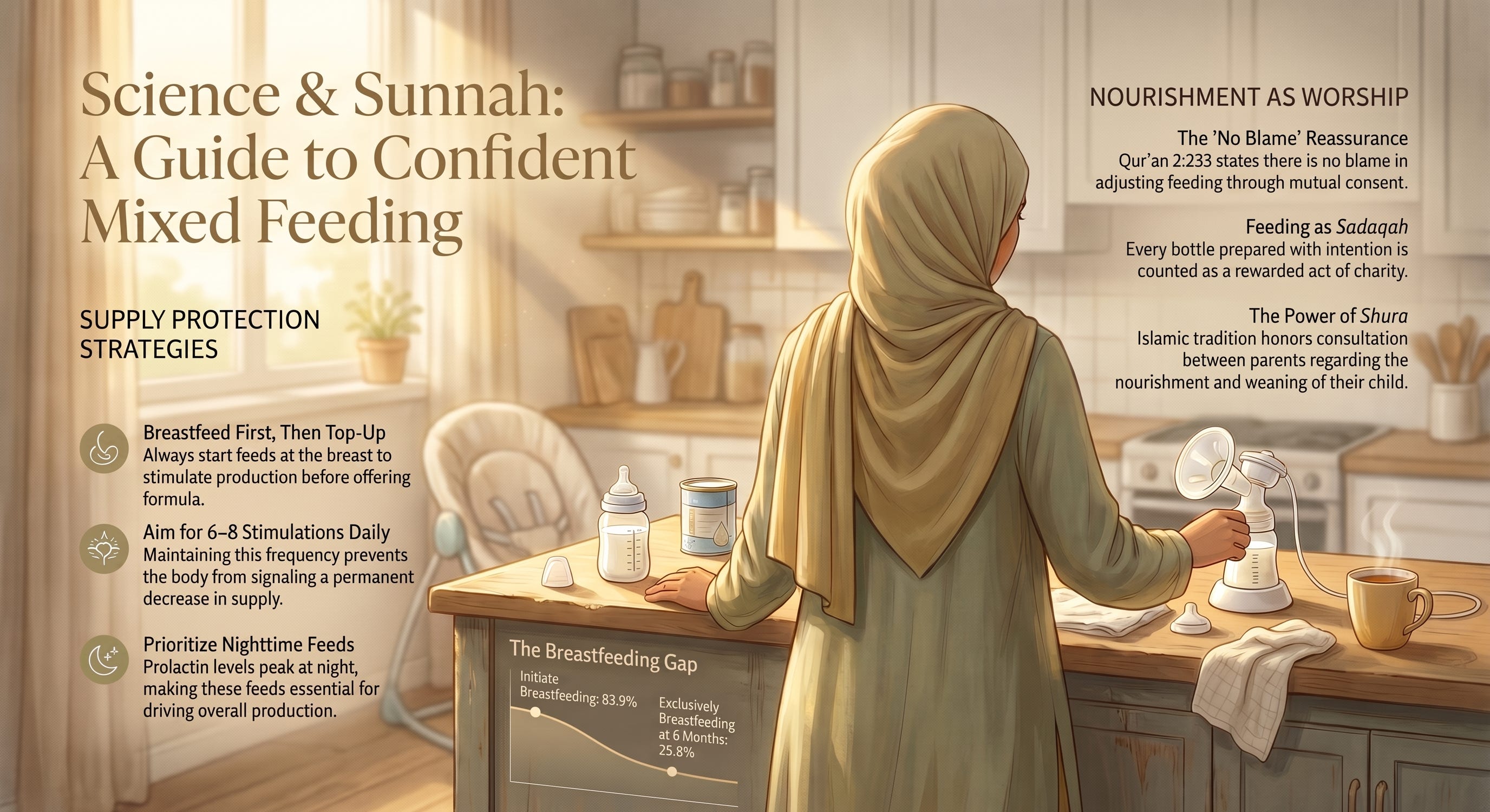
The AAP’s 2022 data shows that only 25.8% of mothers are still exclusively breastfeeding at 6 months — even though over 83% start. [1] If you’re combining breastmilk with formula, this guide shows you how to do it without accidentally losing your supply.
She didn’t plan to stop breastfeeding. She just started giving one bottle of formula at night so her husband could take a feed. Then two. Then the baby started fussing at the breast, and within three weeks, she was barely producing anything.
“I didn’t know it would happen that fast,” she told me.
And that’s the thing most guides don’t say clearly enough: mixed feeding itself isn’t the problem. It’s how you do it that determines whether your supply survives.
When I looked at the AAP’s 2022 breastfeeding data, the drop-off was striking — 83.9% of mothers begin breastfeeding, but by six months only 25.8% are still doing it exclusively. [1] Globally, fewer than half of infants under six months are exclusively breastfed. [2] Somewhere in that gap, millions of families are navigating exactly what you might be considering.
This guide is about doing it well.
Why This Guide Is Different From Generic Feeding Advice
Evidence-based and current. Every recommendation comes from the AAP 2022 guidelines, WHO 2023 data, and peer-reviewed lactation research — not outdated advice or opinion. [1][2][3]
Rooted in Islamic wisdom. This isn’t just practical guidance — it’s grounded in the Qur’anic framework for infant nourishment, including the divine reassurance that adjusting your feeding approach carries no blame. [8]
A free companion resource you’ll actually use. You’ll get the Mixed Feeding Confidence Pack — a printable 3-page PDF with a daily feed planner and supply protection strategies designed to sit on your fridge, not in a forgotten folder.
What Is Mixed Feeding — and Why Do Families Start?
Mixed feeding means your baby gets both breastmilk and infant formula. The breastmilk can come directly from the breast or expressed into a bottle. The formula fills whatever gap exists.
Some families start because a doctor recommends supplementing — premature birth, slow weight gain, a medical condition. Others start because the mother is returning to work, struggling with supply, or managing pain that needs time to heal.
Here’s what matters: the reason is less important than the approach. Whether you’re supplementing temporarily or long-term, how you structure your feeds will determine what happens to your milk supply in the weeks ahead.
But first — talk to a professional before you begin.
Why You Should Talk to a Lactation Consultant Before Introducing Formula
Many mothers assume low supply when what’s actually happening is normal. Cluster feeding, fussy evenings, growth spurts — they all feel like “not enough milk.” They’re usually not.
An IBCLC-certified lactation consultant or your baby’s doctor can assess whether supplementation is genuinely needed, and if so, how much and how often. This single conversation could save you from introducing formula you don’t need — or from waiting too long when you do.
Ask about: how to accurately assess your supply; how much formula to offer; how to structure feeds to protect production; and whether your goal is temporary supplementation or long-term mixed feeding.
The One Thing Most Parents Don’t Realise About Milk Supply
Here it is: breastmilk works on supply and demand. Every time your baby feeds at the breast, your body receives a signal to produce more. Every time that feed is replaced with a bottle, the signal weakens.
This is why the way you introduce formula matters so much. Replace feeds carelessly, and your supply drops faster than you expect. But structure it thoughtfully, and many mothers maintain strong production for months alongside formula.
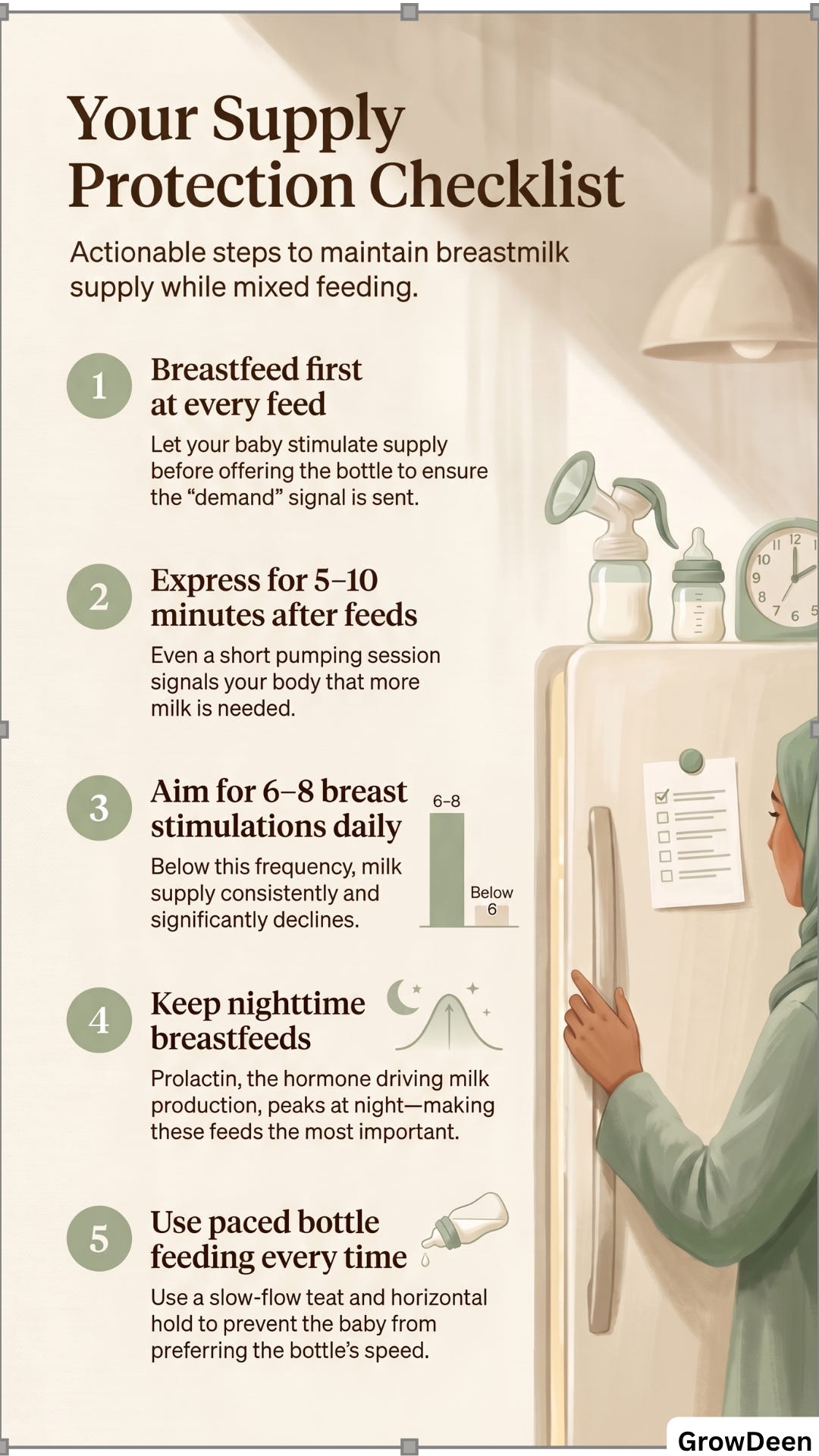
Here’s what works:
Breastfeed first, then offer formula. Starting each feed at the breast keeps your supply stimulated. The formula becomes a top-up, not a replacement.
Express after breastfeeding. Even five to ten minutes of pumping sends a signal that more milk is needed. Over days, this accumulates. [3]
Keep at least 6 to 8 breast stimulations per day. Below this, supply consistently declines. [3]
Don’t drop nighttime breastfeeds early. Prolactin — the hormone driving milk production — peaks at night. Nighttime feeds are disproportionately important. [4] This is the one most parents get wrong.
Use paced bottle feeding. A slow-flow teat, horizontal hold, and frequent pauses prevent your baby from preferring the faster bottle flow and refusing the breast. [5]
I know this feels like a lot to hold in your head, especially at 2 AM when you’re half-asleep and just trying to feed your baby. That’s exactly why I created the Mixed Feeding Confidence Pack — a printable 3-page guide with a daily feed planner and supply protection checklist you can stick on your fridge. Keep reading to download it at the end of this article — it’s designed to stay where you’ll actually use it.
What Changes to Expect When You Start Mixed Feeding
Your baby might refuse the bottle at first. Having someone else offer it while you’re out of the room helps. Your baby’s stools will change — firmer, darker, stronger-smelling. That’s normal with formula.
Watch for engorgement if you drop breastfeeds quickly. Express just enough to relieve discomfort — not a full session — or you’ll maintain the production level you’re trying to reduce. [3]
And if your baby starts preferring the bottle? Paced feeding is your best defence. Every time.
Can You Go Back to Mostly Breastfeeding After Mixed Feeding?
Yes. It takes patience, but your body responds.
Add one extra breastfeed or pumping session per day. After a few days, add another. Slowly reduce the formula volume — by 15 to 30 ml at a time. Cut one formula feed every few days. Work with a lactation consultant to pace it. Progress won’t be linear, and that’s fine.
What the Qur’an Says About Feeding Decisions — and Why It Should Ease Your Heart
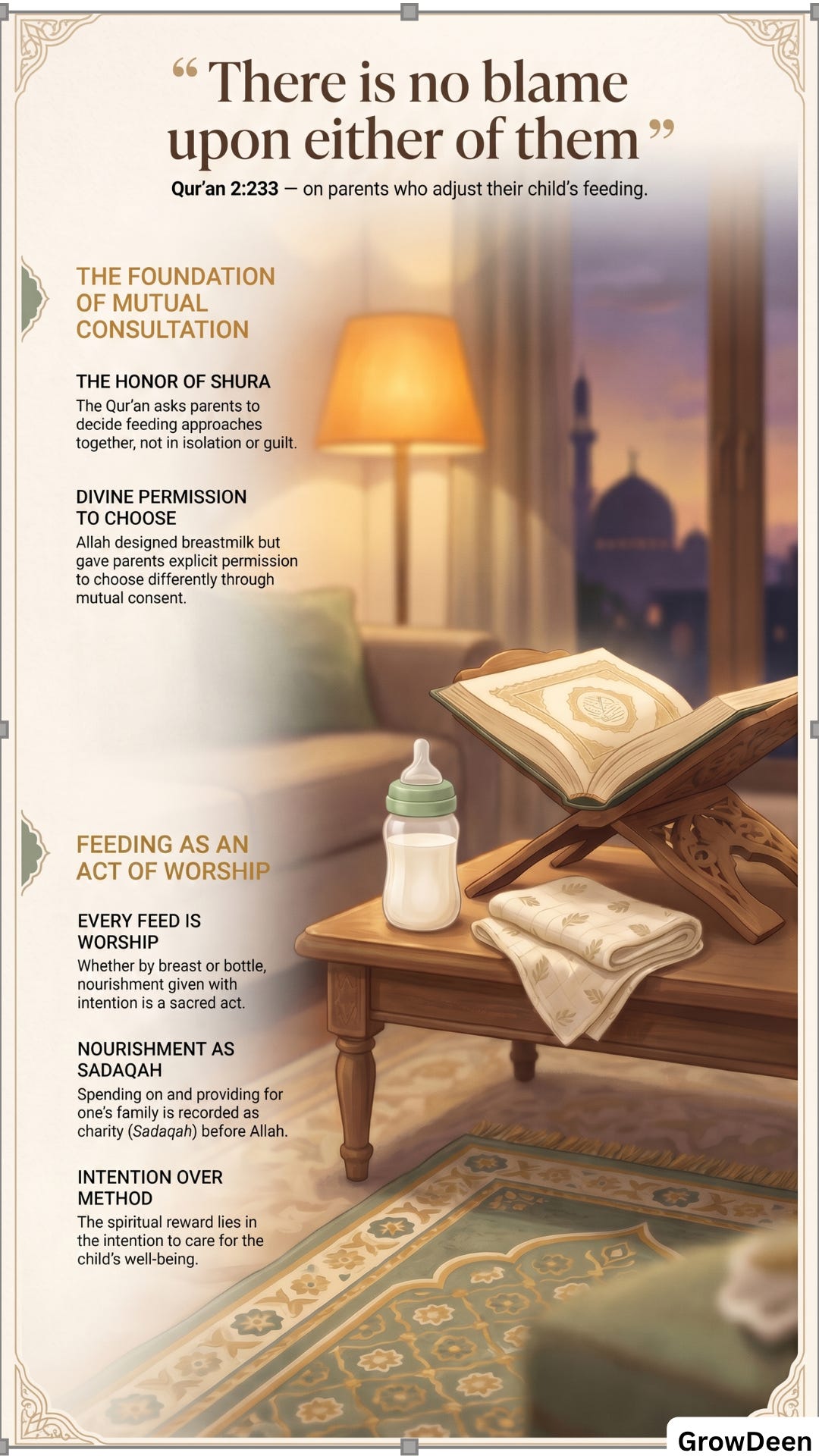
There is a verse I keep returning to. Allah ﷻ says: “And if they both desire weaning through mutual consent from both of them and consultation, there is no blame upon either of them.” [Qur’an 2:233] [8]
There is no blame. Allah — who designed breastmilk and knows every benefit it carries — says that when parents make a thoughtful, mutual decision about feeding, they carry no sin. According to Tafsir Ibn Kathir, this verse establishes that shura (consultation) between parents about their child’s nourishment is not only permitted but honoured. [9]
And the Prophet ﷺ said: “When a Muslim spends on his family seeking reward from Allah, it is counted as sadaqah.” [Sahih al-Bukhari 5351] [10]
Every bottle you prepare with intention is worship. Not second-best worship. Real, recorded, honoured worship.
Your Mixed Feeding Confidence Pack
If you’ve read this far, you’re the kind of parent who doesn’t just want to feed their baby — you want to feed them well, with knowledge and intention. That already says so much.
Inside the Mixed Feeding Confidence Pack (one comprehensive PDF, 3 pages):
Page 1: Daily Mixed Feeding Planner — A visual 24-hour feed planner showing you exactly where to place breastfeeds vs formula feeds to protect your supply — designed as a fillable chart you can stick on your fridge and update each week as your routine changes.
Page 2: Supply Protection Quick-Reference Card — The 5 non-negotiable strategies for maintaining your breastmilk supply while supplementing, with a simple traffic-light system (green = supply-safe, amber = watch closely, red = supply risk) — so you can make confident decisions even when exhausted.
Page 3: Feeding as Worship — Islamic Affirmations for Mixed Feeding Mothers — The Qur’anic “no blame” reassurance (2:233) paired with the Prophet’s ﷺ hadith on family provision as sadaqah (Bukhari 5351), with transliteration and English meaning — a beautiful reminder to keep beside your feeding chair that every feed, breast or bottle, carries divine reward.
This isn’t just a PDF to download and forget. It’s a tool designed to stay on your fridge and beside your feeding chair — where you’ll actually use it when you need it most.
This Mixed Feeding Confidence Pack is what every subscriber receives with each article. We cover the full journey of raising Muslim children, all backed by scientific research and rooted in Islamic wisdom.
If you’re a Muslim parent who wants both evidence-based guidance AND Islamic perspective, subscribe for free so future resources arrive in your inbox before you need them.
Subscribe free for parenting resources backed by both science and Sunnah — guidance so unique, you literally can’t get it anywhere else — no spam, no clutter, just resources that matter.
One Small Action You Can Take Today
If you’re currently mixed feeding — or about to start — do this one thing today: book a 15-minute phone call with a lactation consultant or mention it at your baby’s next doctor visit. One conversation with someone who can assess your situation is worth more than a hundred articles. You don’t need more information. You need the right guidance for your family.
May Allah place barakah in your milk, in your effort, and in every feed you give your child — breast or bottle.
Share This With Someone Who Needs It
Think of one person right now: a friend who mentioned she’s thinking about adding formula but sounded guilty about it, a sister who just went back to work and is struggling with pumping, a mother in your family group chat who keeps asking whether combination feeding is “okay.”
This article could ease her burden. Share it with her today — not as advice-giving, but as reassurance. Sometimes the most loving thing we can do is show someone that they’re not failing.
Frequently Asked Questions
Q: Will mixed feeding make my baby reject the breast? A: It can happen, but it’s preventable. The main cause is flow preference — bottles deliver milk faster, so babies get impatient at the breast. Using paced bottle feeding with a slow-flow teat dramatically reduces this risk. [5] For more, see the paced feeding section above.
Q: How much formula should I give alongside breastmilk? A: This depends entirely on why you’re supplementing. A lactation consultant can assess your supply and recommend the right amount. As a general starting point, many professionals suggest topping up with 30–60 ml after breastfeeds and adjusting based on weight gain. [1]
Q: Will my milk supply definitely drop if I give formula? A: If you replace breastfeeds without compensating, yes. But if you breastfeed first and express after feeds, many mothers maintain strong supply for months alongside formula. [3] The key is keeping breast stimulation at 6–8 times per day.
Q: Is it safe to switch between breast and bottle in the same day? A: Absolutely. Millions of families do this daily. The main things to watch are your baby’s comfort transitioning between the two, and your breast comfort if feeds are dropped. [5]
Q: Does Islam say I must breastfeed for two full years? A: The Qur’an says two years is “for whoever wishes to complete the term” (2:233) — it’s recommended, not obligatory. The same verse permits parents to adjust feeding arrangements by mutual agreement, and explicitly states “there is no blame” for doing so. [8][9]
Q: When should I introduce formula in a cup instead of a bottle? A: Around 6 months, you can start offering small sips from an open cup alongside bottle feeds. The AAP recommends weaning off bottles by 12 months to protect dental health. [1] It’s a gradual transition — start with water or formula at mealtimes and reduce bottles slowly.
References
[1] Meek, J.Y. & Noble, L. (2022). Policy Statement: Breastfeeding and the Use of Human Milk. Pediatrics, 150(1), e2022057988. American Academy of Pediatrics. https://doi.org/10.1542/peds.2022-057988
[2] UNICEF & WHO. (2023). Global Breastfeeding Scorecard 2023. UNICEF. https://www.unicef.org/documents/global-breastfeeding-scorecard-2023
[3] Australian Breastfeeding Association. (2023). Increasing Your Supply. ABA. https://www.breastfeeding.asn.au/resources/increasing-supply
[4] National Health and Medical Research Council. (2012). Infant Feeding Guidelines: Information for Health Workers. NHMRC. https://www.nhmrc.gov.au/about-us/publications/infant-feeding-guidelines-information-health-workers
[5] Australian Breastfeeding Association. (2022). Mixed Feeding. ABA. https://www.breastfeeding.asn.au/resources/mixed-feeding
[6] Michalopoulou, S., Garcia, A.L., Wolfson, L., & Wright, C.M. (2023). Does planning to mixed feed undermine breastfeeding? Maternal & Child Nutrition, 20(1), e13610. https://doi.org/10.1111/mcn.13610
[7] World Health Organization. (2009). Acceptable Medical Reasons for Use of Breast-Milk Substitutes. WHO. https://www.who.int/publications/i/item/WHO_FCH_CAH_09.01
[8] Qur’an, Surah Al-Baqarah 2:233.
[9] Tafsir Ibn Kathir, commentary on Surah Al-Baqarah, verse 233.
[10] Abu Mas’ud Al-Ansari reported: The Prophet ﷺ said, “When a Muslim spends something on his family intending to receive Allah’s reward, it is regarded as sadaqah for him.” Sahih al-Bukhari 5351.