

A 2007 study in the Journal of Applied Behavior Analysis found that when parents combined clear instructions with hands-on modelling, their teaching accuracy climbed above 90%. [1] This guide walks you through the exact method — the same one the Prophet ﷺ used with his own companions, fourteen centuries before anyone published a study about it.
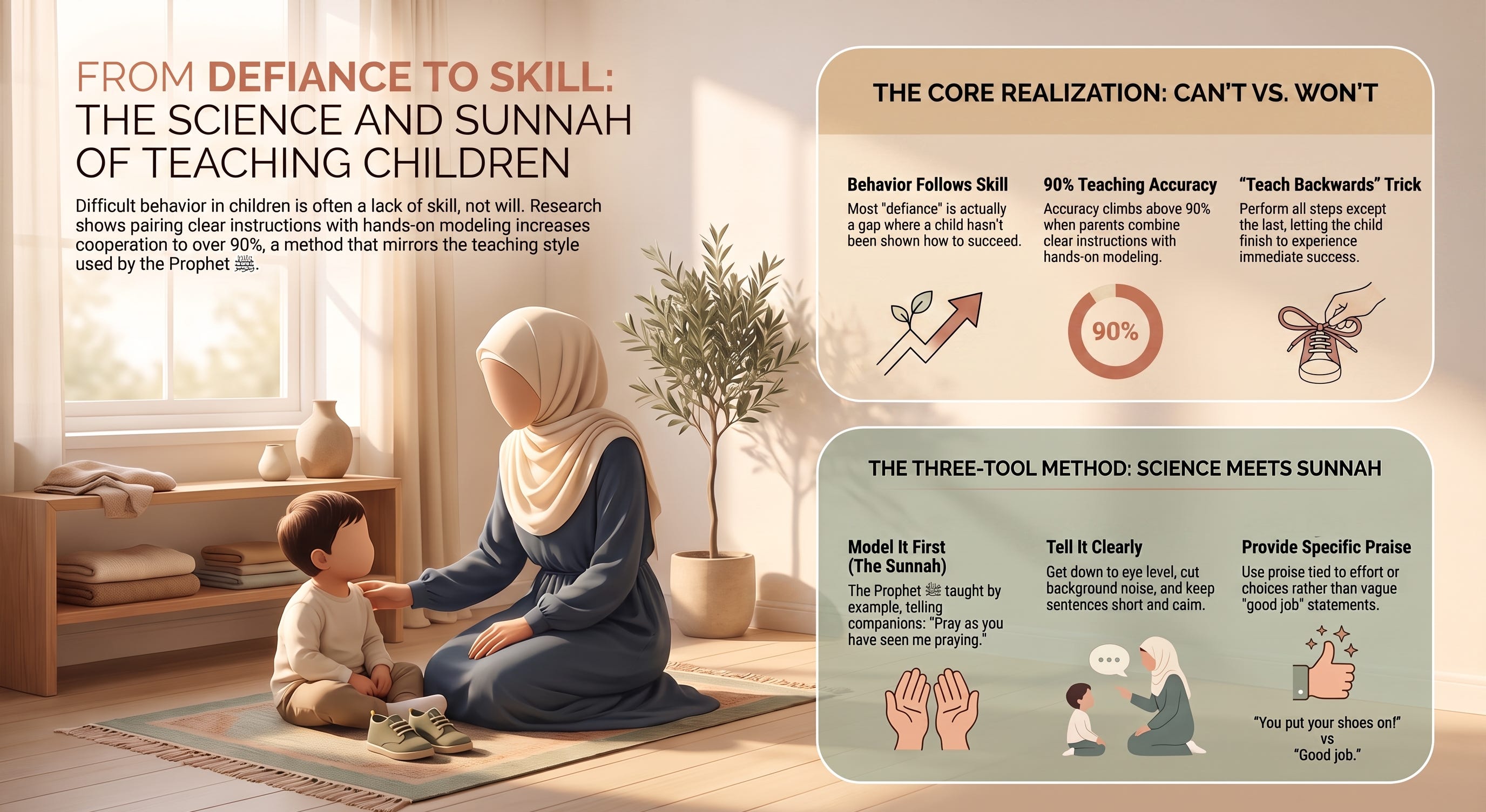
Picture a four-year-old told to set the table. He doesn’t move. He picks at his sleeve, wanders toward the window, maybe knocks a fork off the counter on his way past.
You’d be forgiven for calling that defiance. It usually isn’t.
Nobody has ever shown him which side the fork goes on.
That gap — can’t versus won’t — sits underneath more “difficult behaviour” than most parenting advice admits. Researchers who study how caregivers teach children found something worth sitting with: pairing clear instructions with hands-on modelling raised parents’ own teaching accuracy above 90%, and children’s cooperation climbed right alongside it. [1] Not a discipline overhaul. Not a personality fix. Teaching, done properly.
Why This Guide Is Different
Built on caregiver-training research, not opinion. Every strategy here comes from studies on how skills actually transfer from adult to child — including the 2007 caregiver-training study behind the 90% figure above. [1][7]
Rooted in how the Prophet ﷺ actually taught. This isn’t a psychology framework with a Quran verse bolted on. The Prophet ﷺ sent people home to teach their families by demonstration — the same method researchers rediscovered fourteen centuries later.
Comes with a free step-by-step worksheet. You’ll get the Show, Tell, Break It Down Companion Pack — a printable tool for turning any skill into something your child can actually learn, not just a list of tips you’ll forget by Thursday.
Behaviour Follows Skill, Not the Other Way Around
Children cooperate more easily when they’re actually capable of what’s being asked of them. [2][4] When they aren’t, frustration builds. And frustration in a four-year-old rarely shows up as a calm request for help.
It shows up as a meltdown. A flat no. A fork across the room.
Here’s what changed how I think about this: instead of asking “how do I get my child to behave,” try asking “does my child actually know how to do this yet.” Fix the skill gap, and a surprising share of the behaviour problem goes with it.
Three Tools That Actually Teach a Skill
Developmental researchers point to three methods that do most of the work in building a new skill. All three, it turns out, show up in exactly how the Prophet ﷺ taught the people around him.
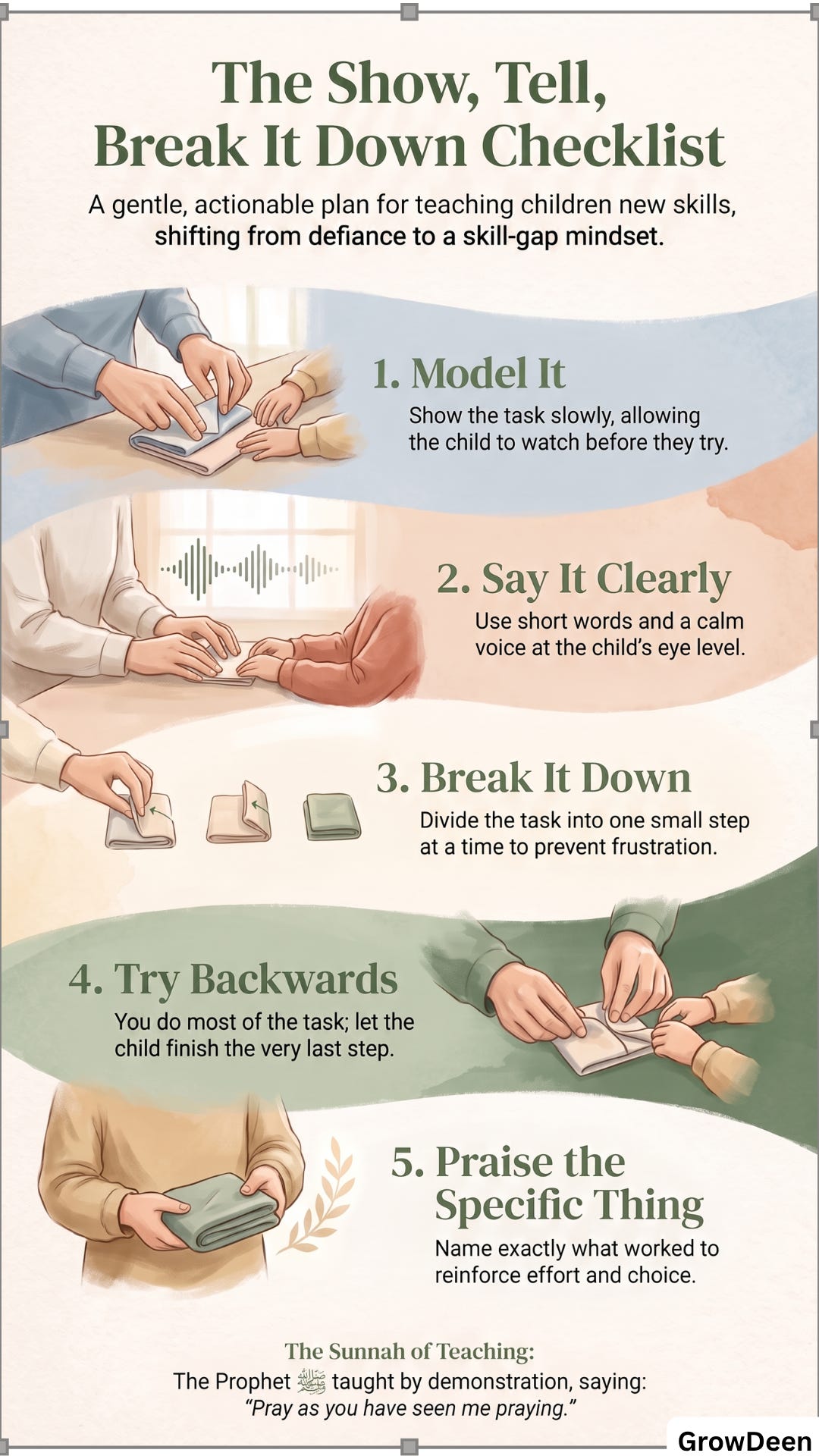
Modelling. Albert Bandura’s social learning theory — still one of the most replicated frameworks in developmental psychology — showed that children can pick up a new behaviour purely by watching, no reward and no instruction required. [3] A child learns to sweep a floor or throw a ball far faster by watching it happen than by being told the mechanics.
Here’s what surprised me researching this: the Prophet’s ﷺ own teaching method matches this almost exactly. A group of young companions once stayed with him for twenty days. When it came time to send them home, he didn’t hand them a rulebook. He told them to teach their families — and to “pray as you have seen me praying” [Bukhari 631]. Watching came before doing. Every time.
Clear instructions. Some skills need to be explained, not just shown. Get down to your child’s eye level. Cut the noise — a blaring television undoes half the work before you’ve started. Keep sentences short. A calm voice carries further than a loud one.
Step-by-step guidance. Getting dressed isn’t one skill. It’s six stacked together — clothes out, underwear, socks, shirt, pants, jumper. Teach one link, let it hold, then add the next. [4][5]
One trick most parents never try: teach backwards. Handle every step except the last one yourself, and let your child finish it — pulling the jumper down, say. Once that’s solid, hand over the second-to-last step too. Children find this far less frustrating, because the fiddly early steps stay with you while they get the payoff of finishing the task themselves. [4]
Why Repetition and Specific Praise Matter
None of this sticks after one demonstration.
The caregiver-training research mentioned earlier didn’t stop at modelling and instructions. It found that combining instruction, modelling, guided rehearsal, and feedback produced lasting gains — not just in how well caregivers taught, but in how consistently children followed through afterward. [1][7]
Praise plays a role too, but the type matters more than most parents realize. A major review of the research on praise and children’s motivation found that vague praise (”good job”) does far less than praise tied to something the child actually controlled — an effort, a choice, a specific attempt. [6] “You remembered to look both ways before you crossed” tells a child exactly what worked. “Good job” tells them nothing they can repeat on purpose.
Before you keep reading, do this: think of one skill your child is currently “refusing” to do. Now ask yourself — have I actually shown them how, or have I only told them?
I know this is starting to feel like a lot to track — which skill, which step, which type of praise, all while managing the rest of a household. That’s exactly why I put together the free Show, Tell, Break It Down Companion Pack — a printable worksheet that turns any skill into a step-by-step plan you can actually follow. Keep reading to grab it at the end.
The Islamic Framework for Teaching a Child: Show Before You Tell
As Muslim parents, we carry an amanah — a trust from Allah — every time we’re handed the task of raising a child. Part of honouring that trust is remembering that a child who hasn’t been taught something cannot fairly be expected to already know it.
There’s a narration I keep coming back to. A group of young companions stayed with the Prophet ﷺ for twenty days. When it was time to send them home, he didn’t recite a list of rules. He told them to teach their own families, and — in his exact words — “pray as you have seen me praying” [Bukhari 631]. Teaching, for him, wasn’t separate from demonstration. Watching came first. Doing came second, imperfectly, and that was allowed.
The Qur’an describes this quality in the Prophet ﷺ directly: “There has certainly been for you in the Messenger of Allah an excellent pattern” [Quran, Al-Ahzab 33:21]. According to Tafsir Ibn Kathir, this verse establishes the principle of following the Prophet ﷺ in word and in deed — not admiring him from a distance, but actually copying what he did.
What strikes me is how directly the research and the Sunnah line up. Modern behavioural science measured, decades later, what the Prophet ﷺ was already doing: instruction paired with demonstration teaches better than instruction alone. When you show your child wudu instead of only describing it, you’re not borrowing a technique from a psychology journal. You’re following a Sunnah that predates the journal by fourteen centuries.
What Gets in the Way
A few habits quietly undermine skill-teaching, even with good intentions behind them:
Skipping the demonstration and going straight to instructions.
Teaching when a child is overtired or overstimulated — skills are absorbed far better when a child is alert.
Piling correction onto a genuine attempt instead of naming one thing to adjust.
Expecting mastery after a single lesson. Behaviour sometimes gets messier before a new skill settles in.
If a child consistently struggles with basic self-care or social skills despite patient, repeated teaching, it’s worth raising with a doctor or a qualified child development specialist. Early input tends to make the biggest difference, and asking for it isn’t a failure. [8]
Your Show, Tell, Break It Down Companion Pack
If you’ve read this far, you’re the kind of parent who wants to actually fix the underlying problem, not just survive today’s meltdown. That tells me something good about you.
Inside the Show, Tell, Break It Down Companion Pack (one comprehensive PDF, 3 pages):
Page 1: The Quick Reference Card — the three teaching tools laid out at a glance, with a one-line reminder from the Sunnah of the Prophet ﷺ — designed as a fridge card you can glance at mid-task, no searching required.
Page 2: The Step-by-Step Task Breakdown Worksheet — a worked example (getting dressed, broken into six steps) plus a blank template with a weekly practice tracker, so you can turn any skill into a plan in about 15 minutes.
Page 3: An Excellent Example — a short reflection built around Qur’an 33:21 and the Prophet’s ﷺ teaching method, connecting your daily effort at home to the highest example in Islam.
This isn’t just a PDF to download and forget. It’s a tool designed to live on your fridge or in your child’s room — where you’ll actually reach for it mid-task.
This companion pack is what every subscriber receives with each article. We cover the full journey of raising Muslim children, all backed by scientific research and rooted in Islamic wisdom.
If you’re a Muslim parent who wants both evidence-based guidance and Islamic perspective, subscribe for free so future resources land in your inbox before you need them.
Subscribe free for parenting resources backed by both science and Sunnah — guidance so specific, you won’t find it packaged this way anywhere else. No spam, no clutter, just what actually helps.
Tonight, pick just one skill your child has been “refusing.” Show it to them once, slowly, before you say a single instruction. That’s it. That’s the whole practice.
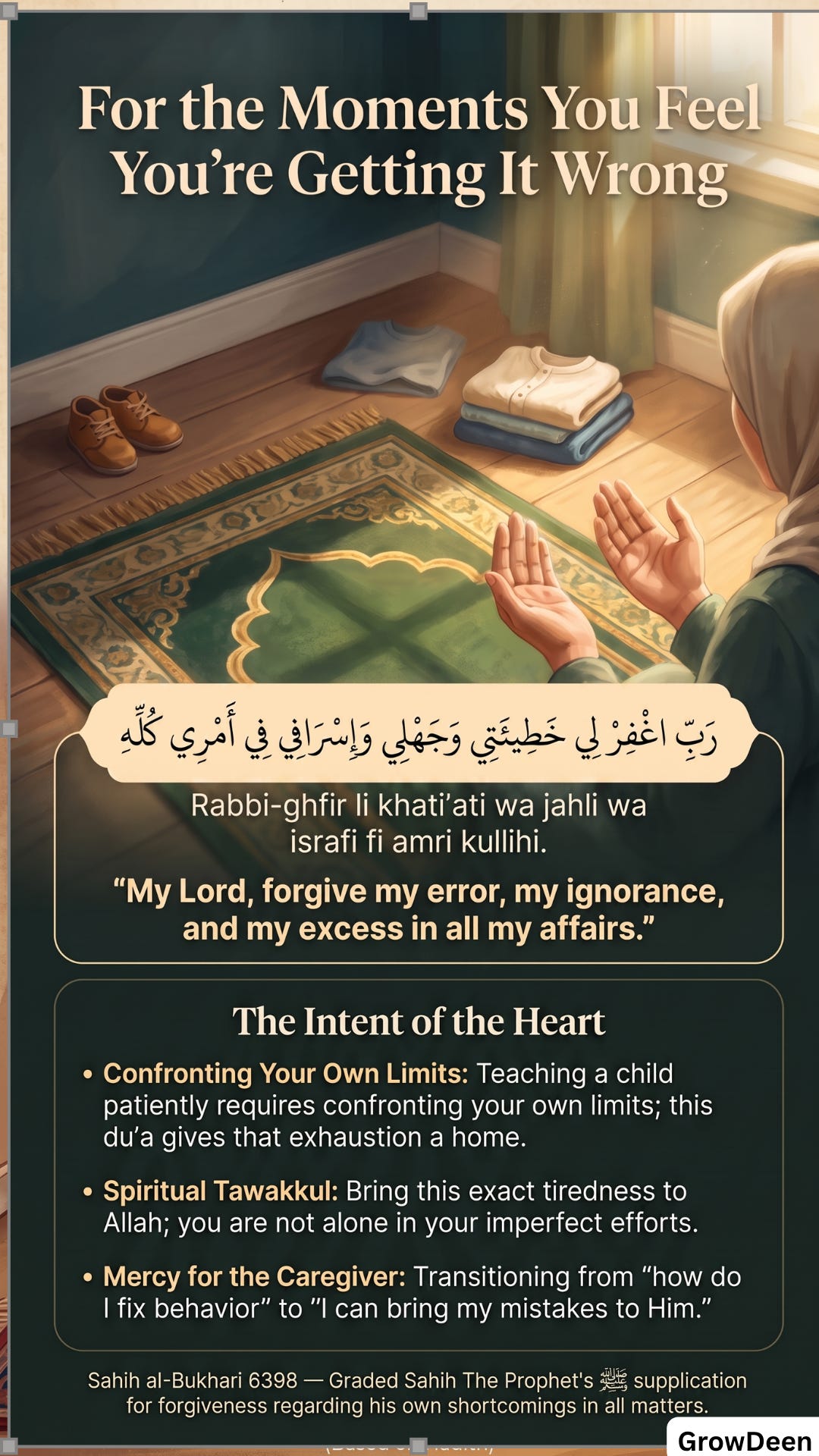
May Allah place barakah in your effort, accept your intention, and make the patience you’re building more rewarded than it feels in this moment.
Share This With Someone Who Needs It
Think of one person right now: the friend who texted you last week saying her son “just won’t listen no matter what she tries,” the sister at the masjid whose toddler melts down every time she’s asked to get dressed, the parent in your group chat who keeps asking what’s “wrong” with their kid’s behaviour.
This article could change how they see the whole problem. Share it with them today — not as advice-giving, but as something that helped you see it differently.
Frequently Asked Questions
Q: Why won’t my child do something I’ve already explained to them multiple times?
A: Explaining isn’t the same as showing. Most skills — especially physical or multi-step ones — need to be modelled, not just described. [3] Try demonstrating the task once, slowly, before giving any more instructions.
Q: At what age should I start teaching my child new skills this way?
A: This approach works from toddlerhood through the early school years. Younger children need more modelling and fewer words; older children can handle more verbal instruction alongside the demonstration. [4][5]
Q: What’s “teaching backwards” and does it actually work?
A: It means handling every step of a task except the last one, then letting your child complete just that final step before gradually handing over more. Children tend to find it less frustrating because the hardest parts stay with the adult while they get the satisfaction of finishing. [4] For the full example, see “Three Tools That Actually Teach a Skill” above.
Q: Is “good job” bad praise?
A: It’s not harmful, but it’s weak. Research on praise and children’s motivation found that specific praise tied to something the child actually controlled works far better than generic praise. [6] Try naming exactly what they did.
Q: How long does it take for a new skill to stick?
A: There’s no fixed timeline — it depends on the skill’s complexity and how consistently it’s practised. What the research does show is that repeated demonstration paired with real practice opportunities produces lasting gains, while a single lesson usually doesn’t. [1][7]
Q: What if my child seems to be behind on basic skills compared to other kids their age?
A: Some unevenness in skill development is completely normal. If it’s consistent and doesn’t budge despite patient, repeated teaching, it’s worth mentioning to a doctor or child development specialist. [8] Early input tends to help the most.
References
[1] Tarbox, R. S. F., Wallace, M. D., Penrod, B., & Tarbox, J. (2007). Effects of three-step prompting on compliance with caregiver requests. Journal of Applied Behavior Analysis, 40(4), 703–706.
[2] Ahn, J.N., Hu, D., & Vega, M. (2020). ‘Do as I do, not as I say’: Using social learning theory to unpack the impact of role models on students’ outcomes in education. Social and Personality Psychology Compass, 14(2), e12517.
[3] Bandura, A. (1977). Social learning theory. Prentice-Hall.
[4] Baker, B.L., Brightman, A.J., Blacher, J.B., Heifetz, L.J., Hinshaw, S.R., & Murphy, D.M. (2004). Steps to independence: Teaching everyday skills to children with special needs. Brookes Publishing Company.
[5] Ledford, J., Lane, J.D., & Barton, E.E. (2019). Methods for teaching in early education (1st ed.). Routledge.
[6] Henderlong, J., & Lepper, M. R. (2002). The effects of praise on children’s intrinsic motivation: A review and synthesis. Psychological Bulletin, 128(5), 774–795.
[7] Miles, N. I., & Wilder, D. A. (2009). The effects of behavioral skills training on caregiver implementation of guided compliance. Journal of Applied Behavior Analysis, 42(2), 405–410.
[8] Sege, R.D., Siegel, B.S.; Council on Child Abuse and Neglect; Committee on Psychosocial Aspects of Child and Family Health. (2018). Effective discipline to raise healthy children. Pediatrics, 142(6), e20183112.
[9] Quran, Surah Al-Ahzab 33:21 — https://quran.com/33/21
[10] Sahih al-Bukhari 631 — Graded: Sahih — https://sunnah.com/bukhari:631