


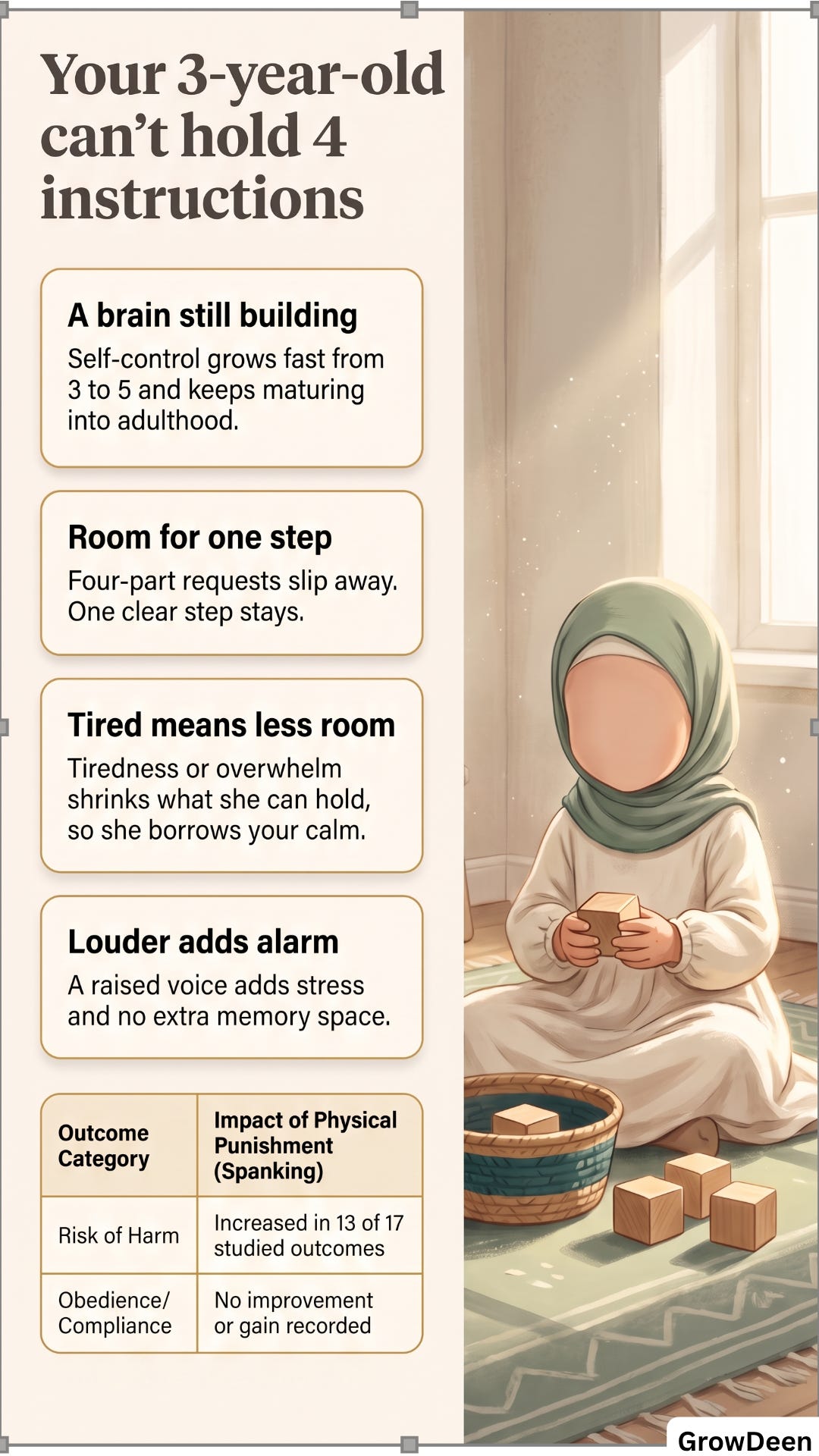
Spanking was linked to higher risk of harm in 13 of 17 outcomes across 160,927 children, with no gain in obedience. [1]
Printable. For the fourth time you ask.
You’ve asked three times now.
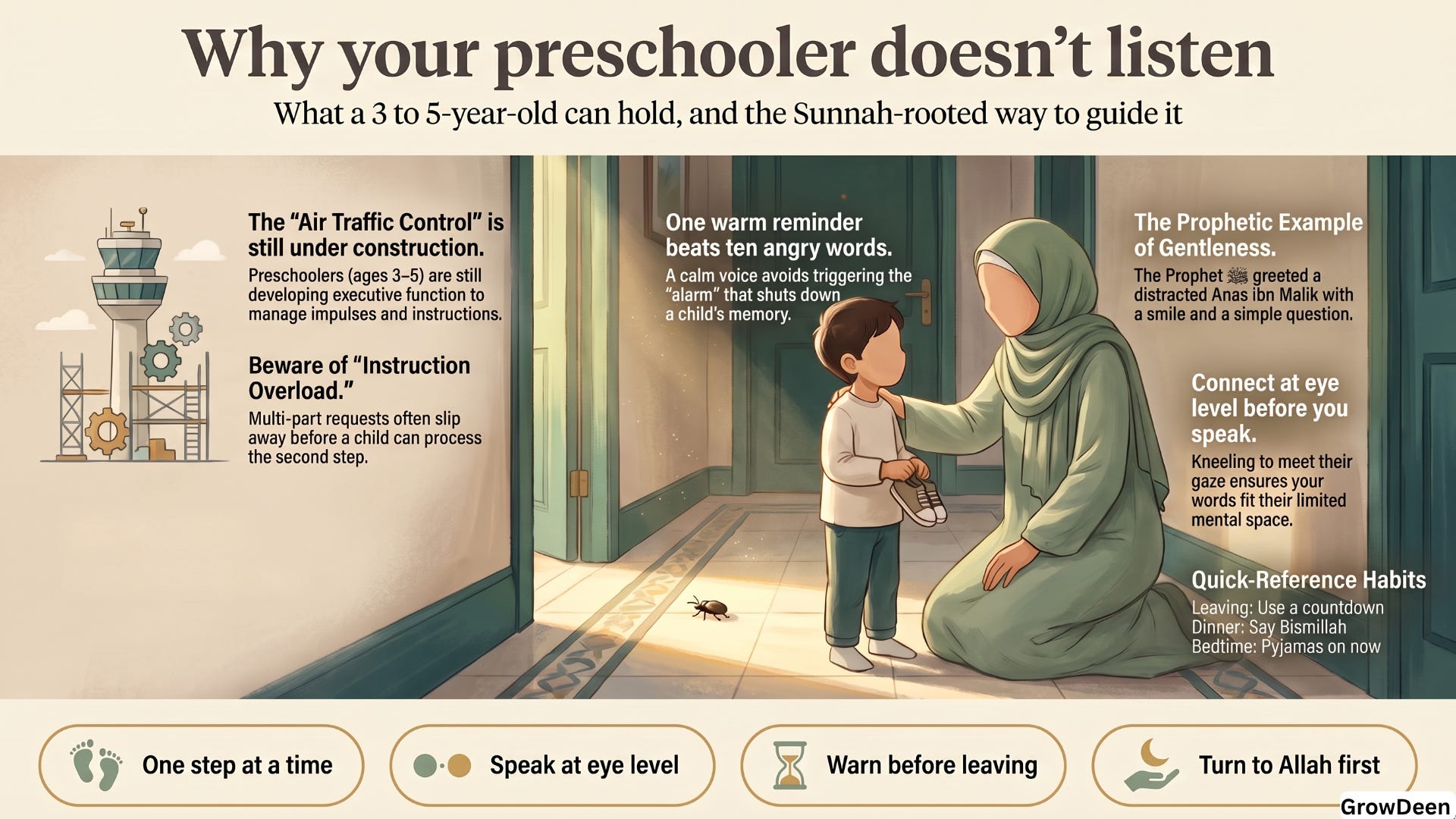
“Shoes on, please.” Then, a little firmer: “Shoes. On. Now.” By the fourth time your voice has climbed, the car keys are digging into your palm, and your four-year-old is still crouched in the hallway watching a beetle cross the tiles. The louder you got, the further away he seemed.
Most parents standing in that hallway land on the same explanation: he’s ignoring me. It feels like defiance. It rarely is, and that one belief, that a preschooler who doesn’t respond has decided not to, sits behind a great deal of the shouting that happens between Asr and bedtime in homes everywhere, and the guilt that arrives once the children are asleep.
If that guilt sounds familiar, you’re in good company, and it doesn’t mean you’re failing your child. What happens when correction gets harsher is sobering, though. The same 2016 analysis of 160,927 children found spanking, the sharpest end of harsh correction, tied to worse outcomes in 13 of 17 areas while doing nothing for obedience. [1]
So why does one quiet sentence, said at your child’s eye level, so often get a four-year-old moving when five loud ones didn’t? The answer involves a part of the brain that’s still being assembled, and a boy in Madinah who wandered into a street game fourteen centuries ago.
Why this guide is different from generic behaviour advice
Every strategy here rests on published research, including the American Academy of Pediatrics’ discipline guidance and Harvard’s work on how young children build self-control. [2,3]
The Prophet’s ﷺ own way with a distracted child sits at the centre of the approach, taken from a narration in Sahih Muslim and checked against its source.
You already have the free One Warm Reminder Pack from the top of this page — printables made for your fridge and your child’s bedroom wall.
What a four-year-old actually hears when you give an instruction
Picture that hallway again, from knee height. Your son is busy with a thought about the beetle (where it’s going, whether it bites) at the moment your words arrive. To drop that thought and pick up yours, he needs what scientists call executive function, the brain’s toolkit for holding an instruction in mind and putting the brakes on an impulse. [3]
Those skills grow quickly between 3 and 5, then keep maturing through adolescence and into early adulthood. [3] Preschoolers who are further behind in them tend to show more challenging behaviour. [4] That’s a large part of why the child who copes beautifully on a calm Saturday morning can come apart at a crowded family dinner.
Now add a four-part request: “Get your shoes, put your coat on, grab your water bottle and meet me at the door.” Attention develops at different speeds in different children, and instructions with several parts are especially hard to hold at this age. [5,3] By the time he has processed “shoes”, the rest has slipped away. A louder voice adds alarm and no extra room in his memory.
When your child is tired or overwhelmed, she has even less to work with, and she needs to lean on your calm because she can’t yet produce enough of her own. Keep one line somewhere you’ll see it: one warm reminder beats ten angry words.
Once you know what a preschool brain can hold, the next question is where a particular behaviour is coming from.
The four places preschool behaviour comes from
Most of the moments that test you between 3 and 5 grow from one of four roots. Spotting the root first saves you from reaching for the wrong response.
A brain still building its brakes
The waiting room is warm and the appointment is running forty minutes late. Your three-year-old has climbed two chairs and asked to go home nine times. Sitting still for a long stretch is plain hard at this age, and most preschoolers carry more energy than the day seems to need. [5]
So plan around it. Before a doctor’s appointment or a long family dinner, give your child a chance to run around outside first. Masjid visits go better with a plan as well: sit near the back so a restless child can step out without disturbing anyone, and bring a small, silent activity for the longer stretches.
Focus works the same way. Give one step, then wait. “Socks on.” Pause until the socks are on. “Now shoes.” During longer or harder activities, build in short breaks. [5,3]
Tantrums grow from the same root. Your child is still learning to put big feelings into words, so tuning in to what she feels helps, and so does noticing her usual triggers and planning around them. [6] For most children, tantrums become less frequent after age 4. [5] While the storm lasts, keep your voice low and wait it out without adding to it. If your own temper starts to rise, step back and turn to Allah in your heart before you respond.
If your child’s energy seems unusual for their age, or makes it hard to join in learning or play, talk to a doctor.
Feelings bigger than their words
“There’s something in the cupboard.” It’s the third time tonight, and the cupboard is full of towels. Fear of the dark or of being apart from you is very common between 3 and 5. An anxious child may cling or keep asking for reassurance, and some begin avoiding places that feel frightening. [5]
Name the fear without brushing it aside: “The dark feels scary to you right now.” Then encourage small, manageable steps, and praise each one. [6] Bedtime is also a natural moment to bring Allah into the conversation. Make du’a for your child’s protection out loud, in simple words she can follow, so she hears that her fears are something the two of you take to Allah together. If fears begin to shrink your child’s everyday life, speak with a doctor.
Shyness lives here too. Picture your daughter pressed against your abaya while an aunty bends down to say salam. Many preschoolers take a while to warm up, so stay close for the first few visits to a new place. Praise brave social moments, like returning a salam or answering a question from a new adult, and practise greetings at home through play. [6] A quiet child doesn’t need to become a loud one. The aim is a child who feels safe enough to greet people and join in when she’s ready.
Being picked on at preschool belongs in this group as well, since it can knock a child’s confidence. Give your child extra warmth at home and speak with the staff about the support they can put in place. It also helps your child to hear you say plainly that you’re going to act so it doesn’t keep happening. [6] At home, you can explain that mocking and name-calling are wrong whoever does them, and that telling a trusted grown-up is the right thing to do.
A mind racing ahead of itself
A walk to the postbox takes twenty minutes because every snail needs inspecting. Why does the moon follow the car? Do fish sleep? A child between 3 and 5 can ask dozens of questions like these before lunch, and curiosity at this age is how children build their picture of the world. [5]
Muslim families have a lovely precedent for treating questions as a teaching tool. One day fresh dates were brought to the Prophet ﷺ, and he told the Companions around him that among the trees there is one that resembles a Muslim. Abdullah ibn Umar, the youngest person present, thought of the date palm at once but kept quiet because he was the youngest of them all. The Prophet ﷺ then gave the answer himself: the date palm. [7]
A question went out to a room of grown men and one boy, and the boy was thinking right alongside them. Your child’s questions deserve that same room. When you don’t know the answer, say so and look it up together. When the question is about the natural world, turn it gently toward its Creator: “Allah made fish. Shall we find out how they rest?”
The same fast-growing mind produces the first fibs. Many children tell their first lies at about age 3, and early lying goes hand in hand with new thinking skills, such as working out that other people don’t know everything you know. [8] Stay calm when it happens, and keep the focus on how much honesty matters in your family. Children learn a lot about truthfulness from watching their parents, so if you promise to play after Dhuhr, play after Dhuhr.
This mind also wants to do everything alone. Children build confidence through warm attention and plenty of chances to have a go. [5,6] Let your daughter carry her plate to the table after saying Bismillah, even if a few peas land on the floor, and let your son unroll his little prayer mat beside yours, even when it faces slightly the wrong way.
Habits such as thumb-sucking and nail-biting can worry parents, but they’re rarely a problem. They often soothe children, and most fade on their own. [5] If one does concern you, ask your doctor.
Life alongside other children
Two cousins, one toy truck, and a wail from the living room. Squabbles between children are ordinary, and how often they happen depends on temperament, surroundings, age and social skill. [9,6] Fairness heads off a good share of them. Share treats evenly and keep turns in a predictable order, and give your child the exact words to use: “Can I have a go when you’ve finished?”
There’s encouraging news in the longer view. For most children, hitting and grabbing peak in the toddler years and then decline through early childhood, while helping and sharing climb. [9] Preschool, playgroups and long afternoons with cousins give children steady practice at sharing and waiting their turn, and a tussle over one truck can become a small lesson in working things out. Children also get used to following rules set by adults who aren’t their parents, which prepares them for the classroom. [6]
Some children need weeks to settle into a new group, and some dread starting. It’s usually worth persisting, and if settling in drags on, talk to the teacher. You might make du’a with your child on the walk there, so the morning starts with something steady.
Home offers practice as well. A little sadaqah jar by the front door gives a preschooler something concrete to do with the idea of giving, so let her drop the coin in herself and talk together about who it might help. The masjid adds another layer, because a weekend Qur’an class for little ones means sitting in a circle and waiting for your turn to recite.
That’s a lot to carry in your head at 5:40pm with dinner on the stove. The free One Warm Reminder Pack puts the most useful pieces on paper, including a countdown strip your child can hold during transitions and a routine board built around the five daily prayers. The download button is at the top of this page, and there’s a full description of what’s inside it below.
There’s a narration that shows almost all of this happening in real time, centuries before anyone had a word for executive function.
The errand that became a street game: how the Prophet ﷺ handled a distracted boy
You’ve sent your child to fetch something, and ten minutes later you find him doing anything but. Your first instinct might be a sharp “What did I just tell you?” Sahih Muslim records a moment that went very differently. [10]
Anas ibn Malik, who served the Prophet ﷺ as a boy, was sent on an errand one day. His first words were “By Allah, I will not go,” although in his heart he meant to go. On his way out he came across children playing in the street, and the errand slipped his mind. Then the Prophet ﷺ came up behind him and took hold of the back of his neck. When Anas turned around, the Prophet ﷺ was smiling. “Unays, did you go where I told you to go?” Anas answered that he was on his way. [10]
The narration records no rebuke, neither for the refusal nor for the game. What Anas received was a gentle, shortened form of his own name, a hand on his neck and a single question that pointed him back to the job.
Put that beside the research above and the two meet in the same place. A preschool brain holds one short, warm reminder far better than a lecture. [3,6] The Prophet ﷺ gave a distracted boy exactly that. May Allah help you find the smile before you find the words.
What gentle guidance looks like on an ordinary evening
This part is about your child’s behaviour, and it’s about the tight feeling in your chest after you’ve shouted, and the replay that runs through your head at night. Warm, responsive parenting, paired with positive attention for the behaviour you want more of, works better than harsh methods, so every step below is built on warmth. [2,11]
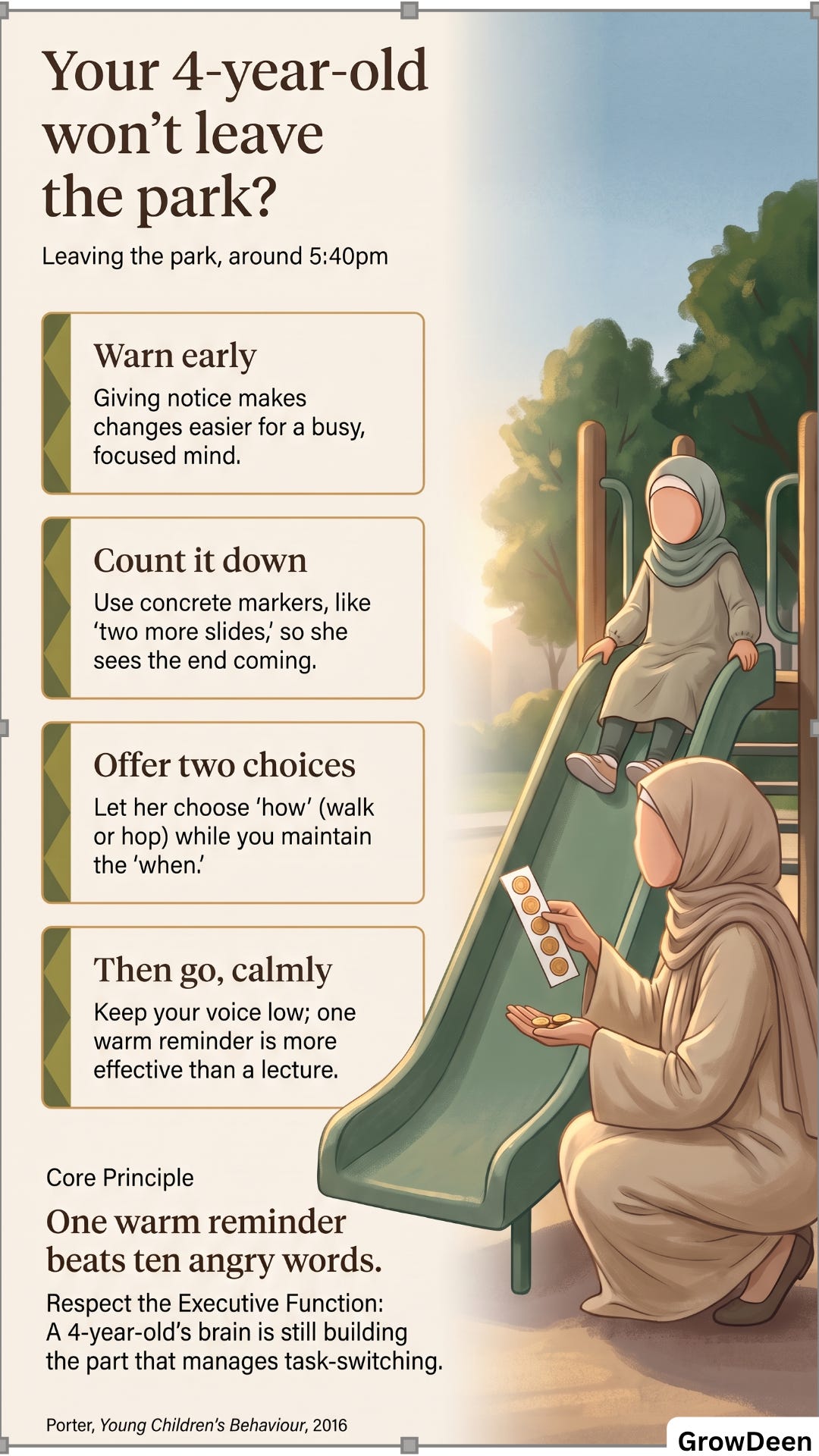
5:40pm, park time is ending. Children who get absorbed do better when a change doesn’t come out of nowhere. “We’re leaving the park soon.” A little later: “Two more slides and then it’s time to go.” [6] Then offer two choices you’re happy with, which gives your child some control while you keep the decision that matters: “Do you want to walk to the car or march like a soldier?” [6]
6:15pm, dinner. A handful of family rules, said the positive way, tells a four-year-old what to do rather than what to stop. “We say Bismillah before we eat.” “We use gentle hands with the baby.” [6] When your son hands his sister the last date, name it: “You gave your sister the last date. That was generous, masha’Allah.” Praise that names the exact action tells a child what to do again. [11] A plain “good boy” feels nice but carries far less information.
7:00pm, after Maghrib. Routines let children know what comes next and whose job each task is. [6,11] Prayer times hand a Muslim home a rhythm for free: “After Maghrib we tidy up. After Isha we brush our teeth, make du’a and go to bed.” A child who already knows what’s coming has less to fight about. Wudu can slot in long before your child prays, too. Let her stand at the sink beside you and wash her hands and face while you make yours, and the habit forms quietly, with no lesson attached.
7:20pm, a block flies across the room. If the baby keeps crawling through the tower, move the building project to a table, since small changes to the surroundings head off a surprising number of battles. [6] When a rule is broken anyway, a mild consequence clearly linked to what happened can help the message stick: the blocks go away for now. Consequences work best in a relationship where warm attention is the everyday norm. [6,2]
Leave smacking out entirely. Across 160,927 children, spanking was linked with a higher risk of harm in 13 of 17 outcomes and with no better compliance. [1] The American Academy of Pediatrics advises parents against it, [2] and a child who is frightened of a parent also finds that parent’s guidance harder to take in. [6]
7:45pm, bedtime. Get down to your child’s eye level, say her name, and give one clear step: “Pyjamas on now.” A four-year-old can act on one step far more easily than on a string of three. [6] The same goes for screens earlier in the evening: when they’re on, choose Islamically suitable, music-free, parent-approved content.
The part of this that’s about you
Some evenings your preschooler’s behaviour will leave you drained, and that’s normal. Saying calmly how you feel, starting with “I,” can help: “I’m getting frustrated because it’s so noisy and I can’t hear your uncle on the phone.” It gives your child a chance to change something for your sake, and it teaches words for feelings. [6]
Calm comes far more easily when your own needs aren’t running on empty. Eat properly, get outside and move, sleep when you can, and speak to yourself as kindly as you’re trying to speak to your child. When both parents back each other up as a team, children tend to manage their emotions better and show more helping behaviour. [12]
Talk about how you’re feeling with someone you trust, whether that’s your spouse or a close friend, and a qualified counsellor can help as well. Keep making du’a for your children and for yourself, in your own words, as often as your heart asks.
When to call the doctor
Speak with a doctor if:
worries or fears are stopping your child from joining in normal daily life
energy or attention difficulties are making it very hard for your child to learn or play with others
tantrums are becoming more frequent after age 4 instead of settling down
you feel angry or stressed about your child’s behaviour most of the time, or you don’t know what to try next
This article does not replace medical advice. Follow your doctor’s guidance for your own child.
Back to the hallway
So why does one quiet sentence work when five loud ones didn’t? Because it fits inside the small amount of space a four-year-old brain has for instructions, and because a calm voice doesn’t set off the alarm that makes that space even smaller. [3] The boy in the hallway was never really choosing the beetle over you. His brain simply hadn’t finished building the part that lets him choose.
Anas got a smile and one question. Your son can get the same. One warm reminder beats ten angry words.
May Allah place barakah in your patience and make your home a place where your children learn gentleness by living inside it.
Your One Warm Reminder Pack
If you’ve read this far, you’re a parent who wants to guide your child without the shouting that leaves everyone worn out, and that says a lot about the home you’re building.
Inside the One Warm Reminder Pack (one comprehensive PDF, 3 pages):
Page 1: The Leaving-Time Countdown Strip. A printable strip of five tokens your child removes one at a time as a transition gets closer, with picture cues for the park, the masjid, screen time and bedtime. It’s designed as a cut-and-keep card you can tuck in your bag or stick by the front door.
Page 2: My Salah-Time Day Board. A picture routine board built around Fajr, Dhuhr, Asr, Maghrib and Isha, with blank slots for your family’s own tasks, so you can set up a predictable day your preschooler can follow in under fifteen minutes.
Page 3: Two Moments from the Sunnah. Two illustrated reflection cards: the story of Anas and the errand that became a street game, and the story of young Abdullah ibn Umar and the date palm question. Each card includes a short line on how to use it at home, one for the moments your child drifts off task and one for the moments your child is too shy to speak.
This PDF is made to stay on your fridge and your child’s bedroom wall, right where the hard moments happen.
This pack is what every subscriber receives with each article. Muslim Parenting Lab covers the early years, pregnancy through school age, with articles on sleep, feeding, behaviour, language and Islamic habits, all backed by research and rooted in the Qur’an and Sunnah.
If you want evidence-based guidance with Islamic grounding, subscribe for free so future resources reach your inbox before you need them.
Subscribe free for parenting resources backed by both science and Sunnah, with no spam and no clutter, just resources that matter.
Try this in the next five minutes
Pick the one instruction you repeat most often in your home, the one that usually ends with a raised voice. Rewrite it now in five words or fewer, and next time, say it once, at your child’s eye level, with her name first.
Share this with one parent tonight
Think of one person right now: the cousin who told you at the last family dinner that her four-year-old “never listens,” or the mother at the masjid whose son was running laps around the prayer hall while she apologised to everyone.
This article could ease her evening. Send it to her tonight as support, from one tired parent to another.
Frequently asked questions
Q: Why doesn’t my 4-year-old listen until I shout?
A: Usually the reason is development. The brain skills that let a preschooler hold your instruction and switch away from what they’re doing are still developing, so short, one-step requests at eye level work far better than louder ones. [3] For more detail, see “What a four-year-old actually hears when you give an instruction” above.
Q: Is it normal for a 3-year-old to lie?
A: Yes. Many children tell their first lies around age 3, and early lying is linked to new thinking skills, such as understanding that other people know different things. [8] Stay calm, focus on honesty, and keep your own promises to your child.
Q: Is smacking ever okay for preschoolers?
A: The evidence says no. A meta-analysis of 160,927 children linked spanking to worse outcomes in 13 of 17 areas with no improvement in compliance, and the American Academy of Pediatrics advises against it. [1,2]
Q: At what age do tantrums get better?
A: For most children, tantrums become less frequent after age 4. [5] If they’re getting more frequent after that, speak with a doctor.
Q: What does Islam teach about correcting young children?
A: The Sunnah gives a clear picture of gentleness with a distracted child. When young Anas wandered off from an errand, the Prophet ﷺ came to him smiling and asked one short question. [10] For specific rulings on discipline, ask a trusted scholar.
Q: When should I worry about my preschooler’s behaviour?
A: Speak with a doctor if fears or attention difficulties are getting in the way of your child’s daily life, or if you feel angry or stressed about your child’s behaviour most of the time. For the full list, see “When to call the doctor” above.
References
[1] Gershoff, E. T., & Grogan-Kaylor, A. (2016). Spanking and child outcomes: Old controversies and new meta-analyses. Journal of Family Psychology, 30(4), 453-469.
[2] Sege, R. D., & Siegel, B. S. (2018). Effective discipline to raise healthy children. Pediatrics, 142(6), e20183112. American Academy of Pediatrics.
[3] Center on the Developing Child at Harvard University. (2011). Building the brain’s “air traffic control” system: How early experiences shape the development of executive function (Working Paper No. 11).
[4] Kuhn, M., Boise, C., Marvin, C. A., & Knoche, L. L. (2021). Challenging behaviors and executive function in preschool-aged children: Relationships and implications for practice. Infants and Young Children, 34(1), 46-65.
[5] Sharma, A., Cockerill, H., & Sanctuary, L. (2021). Mary Sheridan’s from birth to five years: Children’s developmental progress (5th ed.). Routledge.
[6] Porter, L. (2016). Young children’s behaviour: Guidance approaches for early childhood educators (4th ed.). Allen & Unwin.
[7] Sahih al-Bukhari 72, Book of Knowledge, narrated by Abdullah ibn Umar. Graded: Sahih.
[8] Talwar, V., & Lee, K. (2008). Social and cognitive correlates of children’s lying behavior. Child Development, 79(4), 866-881.
[9] Jambon, M., Madigan, S., Plamondon, A., & Jenkins, J. M. (2019). Developmental trajectories of physical aggression and prosocial behavior in early childhood: Family antecedents and psychological correlates. Developmental Psychology, 55(6), 1211-1225.
[10] Sahih Muslim 2310a, The Book of Virtues, narrated by Anas ibn Malik. Graded: Sahih.
[11] Centers for Disease Control and Prevention. Positive parenting tips: Preschoolers (3-5 years).
[12] Pan, B., Wang, Y., Zhang, J., Wang, J., Xiao, B., & Li, Y. (2025). Parental co-parenting quality, children’s emotion regulation abilities, and prosocial behavior. BMC Psychology, 13(1), Article 635.