

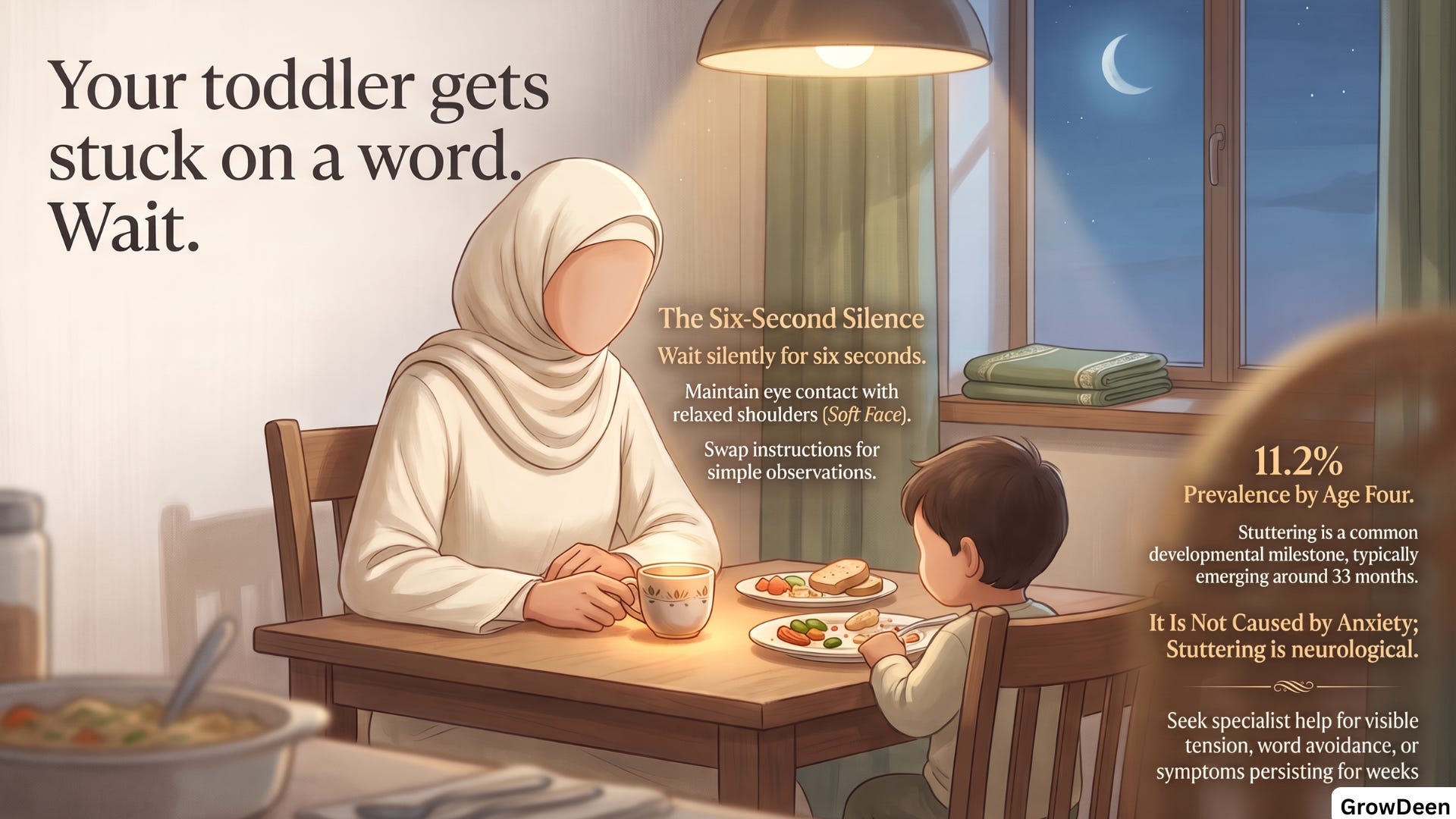
In the largest prospective study of its kind, published in Pediatrics in 2013, 11.2% of children had begun stuttering by the age of four. [1] This guide shows you what to do in the seconds a word gets stuck, and the one appointment most parents postpone too long.
He was going to tell you about the bird.
He had been building up to it since the plates went down. Now he finally has the room, his mouth is open and shaped and ready, and nothing is arriving. “Th, th, th, there was a bird.”
So you do what any loving parent does. You lean in, you smile encouragingly, you say the gentle thing: slow down, sweetheart, take your time.
And his eyes drop.
That is the part nobody warns you about. The kindest instinct you have, the one that comes straight from love, is the one that lands on a four-year-old as a correction. Not because you did anything wrong. Because he cannot deliver what you just asked for, and now he knows you noticed.
Here is the number that reframed this whole topic for me. When researchers in Melbourne enrolled more than 1,600 children at eight months old and then followed them prospectively, they found that 11.2% had begun stuttering by their fourth year. [1] More than double what earlier research had suggested. Which means that if this is happening in your kitchen, you are not in rare territory. You are in ordinary territory nobody talks about at the school gate.
But here is the thing I want you to carry through the rest of this article, because it is the question everything else answers:
Why is it that the very moment you try hardest to help, your child’s speech usually gets worse?
Hold onto that. I will come back to it, and the answer changes what you do tonight.
Why This Guide Is Different From Generic Speech Advice
Built on the strongest available evidence. Every claim here comes from prospective community cohorts, a Cochrane review, a randomised trial, and peer-reviewed fluency research from 2013 to 2025, not from parenting forums.
The Islamic dimension is not decoration. The Qur’an contains a scene in which a man is publicly mocked for a speech difficulty, and the tafsir addresses that mockery directly. That scene sets the standard for what happens in your home, and it is the spine of this article rather than a quote at the end.
You leave with tools, not information. You will get the free Six Seconds Pack to print, including a fourteen-day log built specifically to get your child taken seriously at the appointment.
The Six Seconds That Actually Belong To You
You cannot decide whether your child’s brain rewires this timing on its own. You cannot speed it up by wanting it enough.
What you own completely is the six seconds between the moment the word jams and the moment the conversation moves on.
In those six seconds your child is doing two things at once. He is fighting his own mouth. And he is reading your face, because children read faces years before they read words, and they read their parents’ faces best of all.
So the first question is not what do I say. It is what is my face doing.
Keep it soft. Keep your eyes on his, not on his mouth. Let your shoulders stay down. Do not lean in with that encouraging tilt, because the tilt reads as pressure. And whatever else you do, do not supply the word, even the obvious one, even when the wait feels endless and the dinner is going cold.
Filling in the word says something you would never say out loud: your speech was too slow to be worth my time.
Wait instead. Six seconds is nothing. It will feel like a minute.
The Three Sentences That Feel Kind And Land As Criticism
Let me be honest about the ones almost every parent reaches for, because I have never met a family where at least one of these was not in circulation.
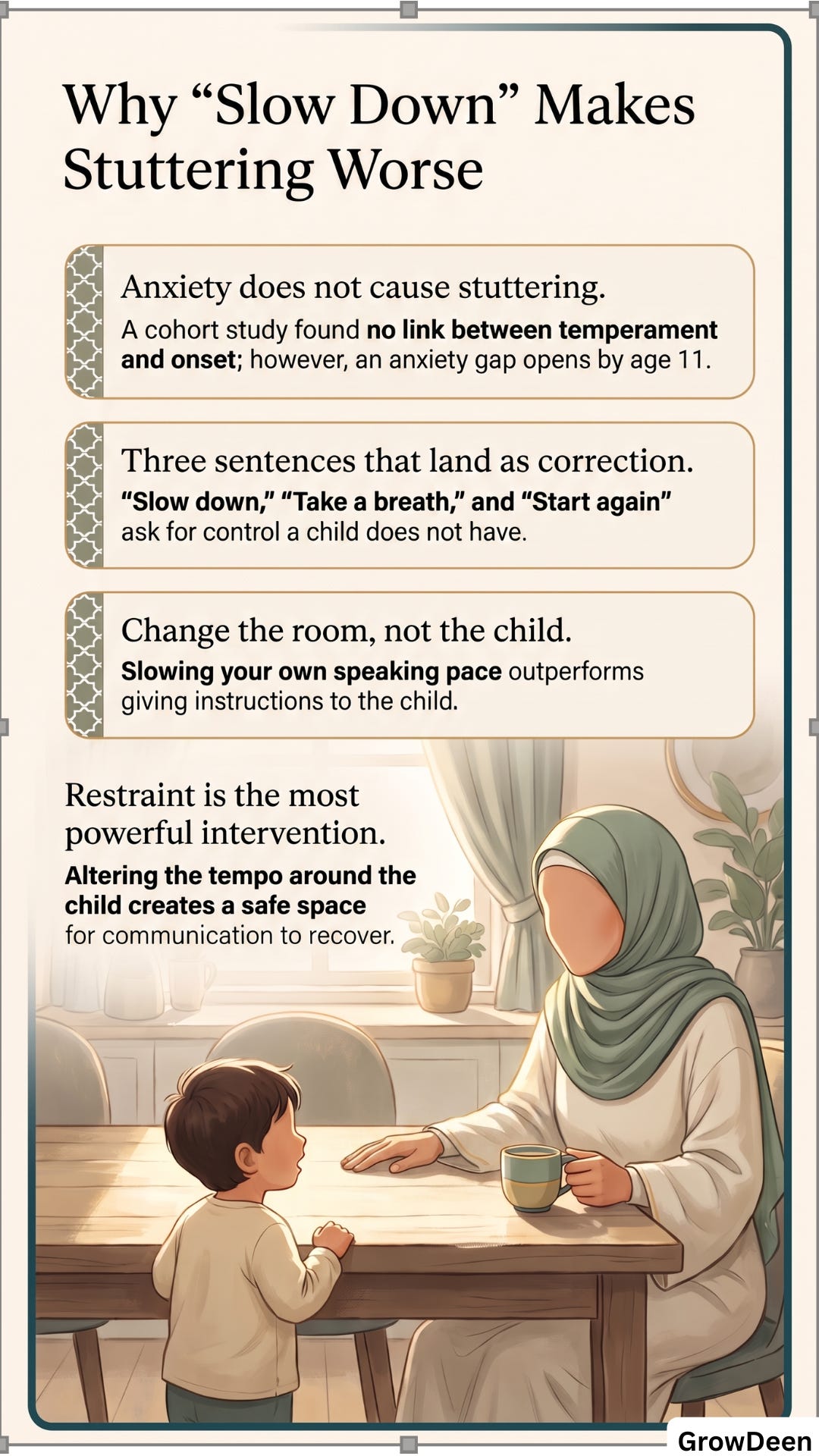
“Slow down.” He cannot. Rate is not the mechanism.
“Take a breath.” He is already taking one. The breath is not stuck, the sound is.
“Start again.” Now the sentence has failed twice.
Each of these asks for a control your child does not have. Said once, they are nothing. Said forty times across a month, they teach a small child that the way he talks is a problem his parents are managing.
Swap the instruction for a comment. Questions demand immediate performance on a clock. Comments do not. “You found a snail” gives your child something to answer if he wants and nothing to fail if he does not.
And here is a shift that does more than any of it: slow your own speech down before you ask him to slow his. Change the pace of the room instead of instructing the child. Unhurried speech is better adab in its own right, and children copy rhythm long before they copy content.
Now, about that question I left you with.
Why He Cannot Just Try Harder
The honest answer first: nobody has the full mechanism yet. Anyone who tells you otherwise is selling something.
What we do know is that stuttering travels with measurable differences in the brain regions that handle spoken language, essentially in how the instruction gets from the brain to the mouth. [2] One influential model describes it as a shortfall in the internal timing cues that pace each syllable. Hold that thought, because it turns out to have a beautiful practical use later.
It also runs in families. Identical twins show higher concordance than non-identical twins, and variants in a handful of specific genes are estimated to account for somewhere between 12% and 20% of persistent cases. [3]
Onset clusters between two and four, at exactly the point when sentences lengthen and grammar arrives. That timing is not a coincidence, and it should reassure you: his ambition has outrun his equipment, temporarily. The Melbourne researchers found early onset was not linked to language delay, shyness, or social disadvantage. If anything it travelled alongside rapid growth in language. [4] Average age of onset sits around 33 months. [3]
Now the list you actually need at two in the morning.
It is not caused by anxiety. This one runs backwards in popular belief, and correcting it matters. A community cohort followed from ages two to four found no evidence that temperament or anxiety came before onset. [5] What the research shows is the reverse arrow: by age eleven, children who stutter carry measurably higher anxiety than children who do not. [6] The stuttering came first.
It is not your parenting. Not the new baby, not the move, not the evening you shouted.
It is not catching. He did not pick it up from his cousin.
So the answer to my earlier question is this: your help feels like pressure, and pressure is one of the few things that reliably makes a stuck word worse. Not because you are doing it wrong. Because the only lever you were reaching for was never the right lever.
Your face is the room your child speaks in.
I know this is a lot to hold in your head at 6pm with three other children in the house. That is why I have put together the free Six Seconds Pack, and I want to be specific about what is in it, because one page of it exists for a reason you will understand in about two minutes. Keep reading and you can download it at the end.
What Fir’awn’s Sneer Teaches Muslim Parents
There is a moment in the Qur’an I keep returning to whenever this topic comes up.
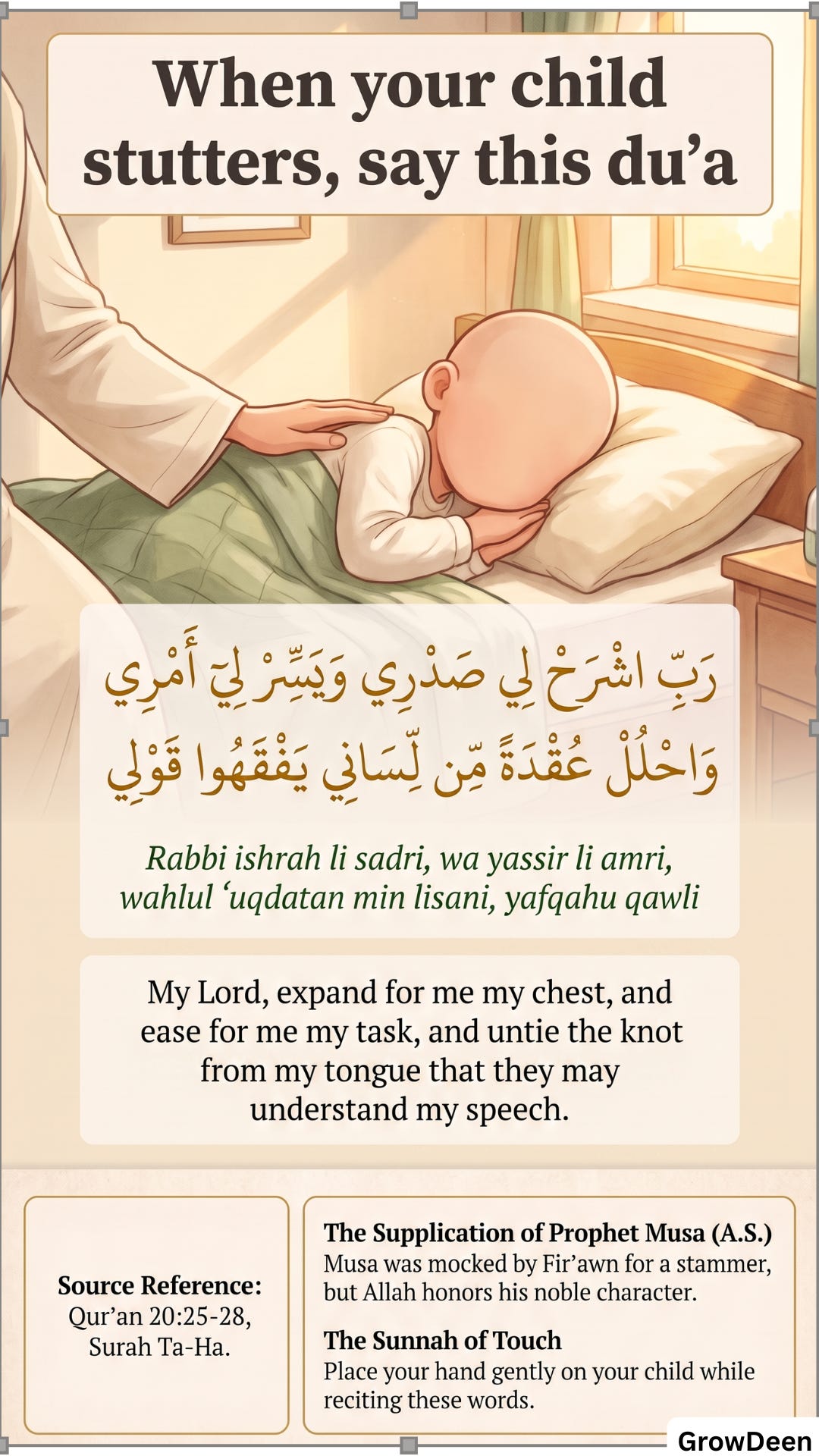
Fir’awn stands before his court, gestures at Musa, and sneers: “Am I not better than this one who is despicable and can scarcely express himself clearly?” [12]
According to Tafsir Ibn Kathir, that second phrase means Musa could not speak clearly, that he stammered. But Ibn Kathir does not stop there, and this is the part that steadied me. He calls both halves of the taunt a lie. Fir’awn was the despicable one; Musa was noble, truthful, righteous and upright. Ibn Kathir records that Musa had asked Allah to loosen the knot from his tongue and that the request was granted, and reports that Al-Hasan al-Basri suggested some difficulty may have remained, since Musa had asked only to be relieved of what stood between him and delivering the message. Then Ibn Kathir writes the line I would put on a wall: a person cannot be blamed for physical matters over which he has no control. Fir’awn understood that perfectly well. He mocked anyway, to mislead people who did not know better. [12]
Allah forbids this outright too: “let not a group scoff at another group, it may be that the latter are better than the former,” and “nor insult one another by nicknames.” [13] Ibn Kathir explains that scoffing is forbidden precisely because it humiliates, and that the one being mocked may be dearer to Allah than the one mocking.
Islam did not treat the difficulty as the disgrace. It treated the mockery as the disgrace.
Support Muslim Parenting Lab ❤️
Worried that giving will leave you with less? Give an amount you will not feel, with the button below.
The Prophet ﷺ said charity does not decrease wealth. (Sahih Muslim 2588)
The Sibling Problem Nobody Wants To Name
Here is where that verse stops being beautiful and starts being useful.
The Prophet ﷺ said that a Muslim is one from whose tongue and hands other Muslims are safe. [14]
Sit with the double meaning for a second. Your child’s tongue is the part that is struggling. And the standard set for the home he lives in is that every tongue inside it has to be a place of safety.
Which means the nine-year-old doing an impression at the table is not ordinary sibling teasing to be shrugged off. Measured against that hadith, it fails the definition of the thing itself.
So make the rule explicit, and give your other children the reason rather than only the instruction. In this house: nobody finishes anyone’s sentence, nobody imitates how somebody talks, nobody laughs at a stuck word. Not once, not as a joke, not when they think he cannot hear.
This matters more with every year that passes. Preschoolers often have no idea they are stuttering, and their willingness to talk usually looks no different from other children their age. [1] By primary school that changes. Children start swapping the word they wanted for an easier one mid-sentence, so smoothly that nobody notices they have quietly shrunk their own vocabulary to stay safe. And children who stutter at that age are less likely to be seen as leaders by their peers and more likely to be bullied.
Which brings me to the appointment.
The Referral They Might Not Give You
Book the speech pathology assessment. Not in three months. Now.
Yes, most children recover. Around two thirds recover during childhood, naturally or with treatment or both. [3] But recovery within the first twelve months after onset is uncommon, in the range of 6% to 9%, [3] and there is no reliable way to know in advance which children will be in the lucky group. A 2023 systematic review of the evidence put it plainly: wait-and-see is no longer the appropriate approach, and young children should be referred to a stuttering specialist to maximise the chance of recovery. [7] Speech researchers have also warned that the longer a child stutters, the more entrenched the patterns can become and the less amenable to treatment. [11]
Now, the part that will change how you prepare.
Researchers surveyed pediatricians nationally using case vignettes of a four-year-old boy with a family history whose mother reported signs of stuttering. Referral turned out to be driven largely by whether the child actually stuttered during the visit. Pediatricians were significantly less likely to refer children showing fewer overt stuttering behaviours. [9]
And where does stuttering reliably vanish? A quiet room, an unfamiliar adult, short answers.
So do not walk in empty-handed. Take fourteen days of written notes: heavy days, light days, which situations made it worse, whether there was visible physical struggle, whether he avoided words or went quiet. Take a short video recorded at home, not one where he is performing for the camera. Then say the sentence plainly: I would like a referral to a speech pathologist for an assessment. And ask what the plan is if the stutter is still there in three months.
That is exactly why Page 1 of the pack is a fourteen-day log rather than another milestone chart.
What Actually Helps, Including One Thing You Already Do
Treatment runs on two tracks.
Speech restructuring targets the stuttering directly, and the best known programme is unusual in that you deliver most of it yourself, at home, in ordinary situations, with a clinic visit once a week where the pathologist trains you and adjusts as you go. It suits children under six best. [8] Let me be straight about the evidence rather than overselling it: a randomised trial comparing this direct approach against an indirect one found 76.5% of children in the direct group and 71.4% in the indirect group no longer stuttering at eighteen months, a difference that did not reach statistical significance, though the direct group improved faster early on. [10] A Cochrane review reached similarly cautious conclusions about the strength of the evidence base. [8] What is clear is that treated children in these trials did well.
Psychosocial support works on the emotional side rather than on fluency, and if your child has started avoiding speaking, ask for it by name rather than waiting to be offered it.
And now the finding I most wanted to get in front of Muslim parents.
Speaking in unison with another person, which researchers call choral speech, is one of the most reliable fluency-inducing conditions known. Reading chorally reduces stuttering frequency and duration by somewhere between 90% and 100% compared with speaking alone. It works immediately, without training. [8] A comparison of adults who stutter across monologue, solo reading and choral reading found stuttering markedly lower in the choral condition, which the researchers explained as the second voice supplying the external timing cues that the internal ones are not reliably providing. [15]
Two honest caveats. The effect is temporary, and stuttering typically returns as soon as the other voice stops. And this is not treatment. It does not replace a speech pathologist.
But think about what it means for a Muslim household anyway. Reciting short surahs together. Saying the morning and evening adhkar side by side. Your child getting daily, repeated experience of his own voice moving smoothly, with no audience, no clock, and nothing riding on it.
Do it as tarbiyah, not as an exercise. Do not measure it. Do not comment afterwards on how it went. Just recite together, and let him hear what his own voice sounds like when the words come easily.
Move Faster If Any Of These Apply
It has been present more than a few weeks
There is visible struggle: tension, hard blinking, pushing to force sounds out
He has started avoiding words, avoiding speaking, or showing distress about his own speech
Onset happened after age three
Stuttering runs in the family
He is approaching school age
Speak with your doctor or paediatrician if you are unsure where to start, or if you have any concern about his hearing alongside the stutter. This article is general information and does not replace individual assessment by a qualified professional.
The Six Seconds Pack
If you have read this far, you are the kind of parent who takes this seriously without letting it tip into panic. That tells me something about you, and it tells me your child is in good hands even on the evenings it does not feel that way.
Inside the Six Seconds Pack (one comprehensive PDF, 3 pages):
Page 1: The Fourteen-Day Speech Log — A two-week tick-box grid covering seven daily observations plus a prompts box for situations, patterns and family history, designed as a fridge sheet you fill in ninety seconds a day so you walk into the appointment with evidence instead of memory.
Page 2: The Three Conversations Script — Word-for-word scripts for the three conversations that decide how this goes: what to say at the doctor’s appointment to secure a referral, the exact email to send your child’s teacher, and how to explain the household rule to siblings in one minute so it actually sticks.
Page 3: Two Reflections and the Household Covenant — The Qur’anic scene of Fir’awn’s mockery with Ibn Kathir’s commentary, the Prophetic standard for a household from Sahih al-Bukhari, and a signable family covenant your other children can put their names to and stick on the wall.
This isn’t just a PDF to download and forget. It’s a tool designed to stay on your fridge and in your bag, where you’ll actually use it when you need it most.
The Six Seconds Pack is what every subscriber receives with each article. Muslim Parenting Lab covers the full journey of raising Muslim children from birth to age eight, from sleep and feeding to speech, behaviour, sibling conflict and emotional regulation, all backed by peer-reviewed research and rooted in verified Islamic sources.
Do This Tonight
Tonight, when the word jams, say nothing.
Not “slow down.” Not the word he is reaching for. Nothing at all. Keep your face soft and your eyes on his and wait six seconds.
That is the whole practice. You will find it is much harder than it sounds, and much more powerful than it looks.
May Allah untie every knot in your child’s path, place barakah in your patience, and make the waiting you do for him count for more than it feels like in the moment.
Share This With Someone Who Needs It
Think of one person right now: the mother in your circle who mentioned, half-laughing, that her three-year-old has started “getting stuck,” and then changed the subject. The relative whose son goes quiet at family gatherings and gets called shy. The friend whose doctor told her to wait and see six months ago.
This article could change what the next two years cost their child. Send it to them today, not as advice-giving, but as care. Sometimes the most loving thing we can do is hand someone the sentence they needed to say at an appointment.
Frequently Asked Questions
Q: At what age does stuttering usually start in children?
A: Most commonly between two and four, with an average onset around 33 months, right as sentences lengthen and grammar arrives. [3] It can start suddenly, over a day or two, or creep in gradually. Both patterns are normal. See “Why He Cannot Just Try Harder” above.
Q: Will my child grow out of stuttering?
A: Around two thirds of children who stutter recover during childhood, naturally or with treatment or both. [3] But recovery in the first twelve months after onset is only 6% to 9%, and there is no reliable way to identify in advance which children will recover on their own. [3] That’s exactly why waiting is a gamble rather than a neutral choice.
Q: Did I cause my child’s stutter?
A: No. Stuttering is associated with differences in how the brain sequences speech, and it runs in families. [2,3] It is not caused by parenting, by a new sibling, by a house move, or by anything you said on a hard day.
Q: Is stuttering caused by anxiety?
A: This one runs backwards in popular belief. A community cohort followed from ages two to four found no evidence that anxiety or temperament preceded onset, [5] while by age eleven children who stutter show measurably higher anxiety than children who do not. [6] The stuttering comes first, and the anxiety grows out of how the world responds to it.
Q: What should I say when my child gets stuck on a word?
A: Nothing, for about six seconds. Keep your face relaxed, hold eye contact, and let the sentence finish itself. Avoid “slow down,” “take a breath,” and “start again,” because they ask for control your child doesn’t have. For the full approach, see “The Six Seconds That Actually Belong To You” above.
Q: When should I take my child to a speech pathologist for stuttering?
A: As soon as you notice it, and urgently if there’s visible struggle, avoidance of speaking, onset after age three, or a family history. [7,11] Take two weeks of written notes with you, because pediatricians are significantly less likely to refer a child who happens to be fluent during the visit. [9]
References
[1] Reilly, S., Onslow, M., Packman, A., Cini, E., Conway, L., Ukoumunne, O.C., Bavin, E.L., Prior, M., Eadie, P., Block, S., & Wake, M. (2013). Natural history of stuttering to 4 years of age: A prospective community-based study. Pediatrics, 132(3), 460–467. https://doi.org/10.1542/peds.2012-3067
[2] Etchell, A.C., Civier, O., Ballard, K.J., & Sowman, P.F. (2018). A systematic literature review of neuroimaging research on developmental stuttering between 1995 and 2016. Journal of Fluency Disorders, 55, 6–45. https://doi.org/10.1016/j.jfludis.2017.03.007
[3] Onslow, M., & O’Brian, S. (2022). Stuttering, family history and counselling: A contemporary database. Journal of Fluency Disorders, 73, 105924. https://doi.org/10.1016/j.jfludis.2022.105924
[4] Reilly, S., Onslow, M., Packman, A., Wake, M., Bavin, E.L., Prior, M., Eadie, P., Cini, E., Bolzonello, C., & Ukoumunne, O.C. (2009). Predicting stuttering onset by the age of 3 years: A prospective, community cohort study. Pediatrics, 123(1), 270–277. https://doi.org/10.1542/peds.2007-3219
[5] Kefalianos, E., Onslow, M., Ukoumunne, O.C., Block, S., & Reilly, S. (2014). Stuttering, temperament, and anxiety: Data from a community cohort ages 2–4 years. Journal of Speech, Language, and Hearing Research, 57(4), 1314–1322. https://doi.org/10.1044/2014_JSLHR-S-13-0069
[6] Smith, K.A., Iverach, L., O’Brian, S., Mensah, F., Kefalianos, E., Hearne, A., & Reilly, S. (2017). Anxiety in 11-year-old children who stutter: Findings from a prospective longitudinal community sample. Journal of Speech, Language, and Hearing Research, 60(5), 1211–1222. https://doi.org/10.1044/2016_JSLHR-S-16-0035
[7] Bosmans, L., Aernouts, L., & Piedfort, D. (2023). Why early intervention is essential in preschool age children who stutter: A systematic review. Medical Research Archives, 11(7). https://doi.org/10.18103/mra.v11i7.3676
[8] Sjostrand, A., Kefalianos, E., Hofslundsengen, H., Guttormsen, L.S., Kirmess, M., Lervag, A., Hulme, C., & Bottegaard Naess, K-A. (2021). Non-pharmacological interventions for stuttering in children six years and younger. Cochrane Database of Systematic Reviews, 9, CD013489. https://doi.org/10.1002/14651858.cd013489.pub2
[9] Winters, K.L., & Byrd, C.T. (2020). Pediatrician referral practices for children who stutter. American Journal of Speech-Language Pathology, 29(3), 1404–1422. https://doi.org/10.1044/2020_AJSLP-19-00058
[10] de Sonneville-Koedoot, C., Stolk, E., Rietveld, T., & Franken, M.C. (2015). Direct versus indirect treatment for preschool children who stutter: The RESTART randomized trial. PLOS ONE, 10(7), e0133758. https://doi.org/10.1371/journal.pone.0133758
[11] Walsh, B., & Brown, B. (2013). Wait-and-see for preschoolers who stutter is not the best approach. Purdue Stuttering Project, Purdue University. https://www.purdue.edu/newsroom/archive/releases/2013/Q3/wait-and-see-for-preschoolers-who-stutter-not-best-approach.html
[12] Qur’an, Surah Az-Zukhruf 43:52 — https://quran.com/43/52 — Tafsir Ibn Kathir: https://quran.com/en/43:52/tafsirs/en-tafisr-ibn-kathir (readings of mahin attributed by Ibn Kathir to Sufyan, Qatadah, As-Suddi and Ibn Jarir; the view that residual difficulty may have remained is attributed by Ibn Kathir to Al-Hasan al-Basri, not to himself)
[13] Qur’an, Surah Al-Hujurat 49:11 — https://quran.com/49/11 — Tafsir Ibn Kathir: https://quran.com/en/49:11/tafsirs/en-tafisr-ibn-kathir
[14] Sahih al-Bukhari 10, narrated ‘Abdullah bin ‘Amr — Graded: Sahih — https://sunnah.com/bukhari:10
[15] Ritto, A.P., Costa, J.B., Juste, F.S., & de Andrade, C.R.F. (2016). Comparison of different speech tasks among adults who stutter and adults who do not stutter. Clinics, 71(3), 152–155. https://doi.org/10.6061/clinics/2016(03)06
We combine scientific research with Qur’an and authentic Sunnah, and we cite our sources. Even so, this is general guidance and no substitute for a doctor who can examine your child.