

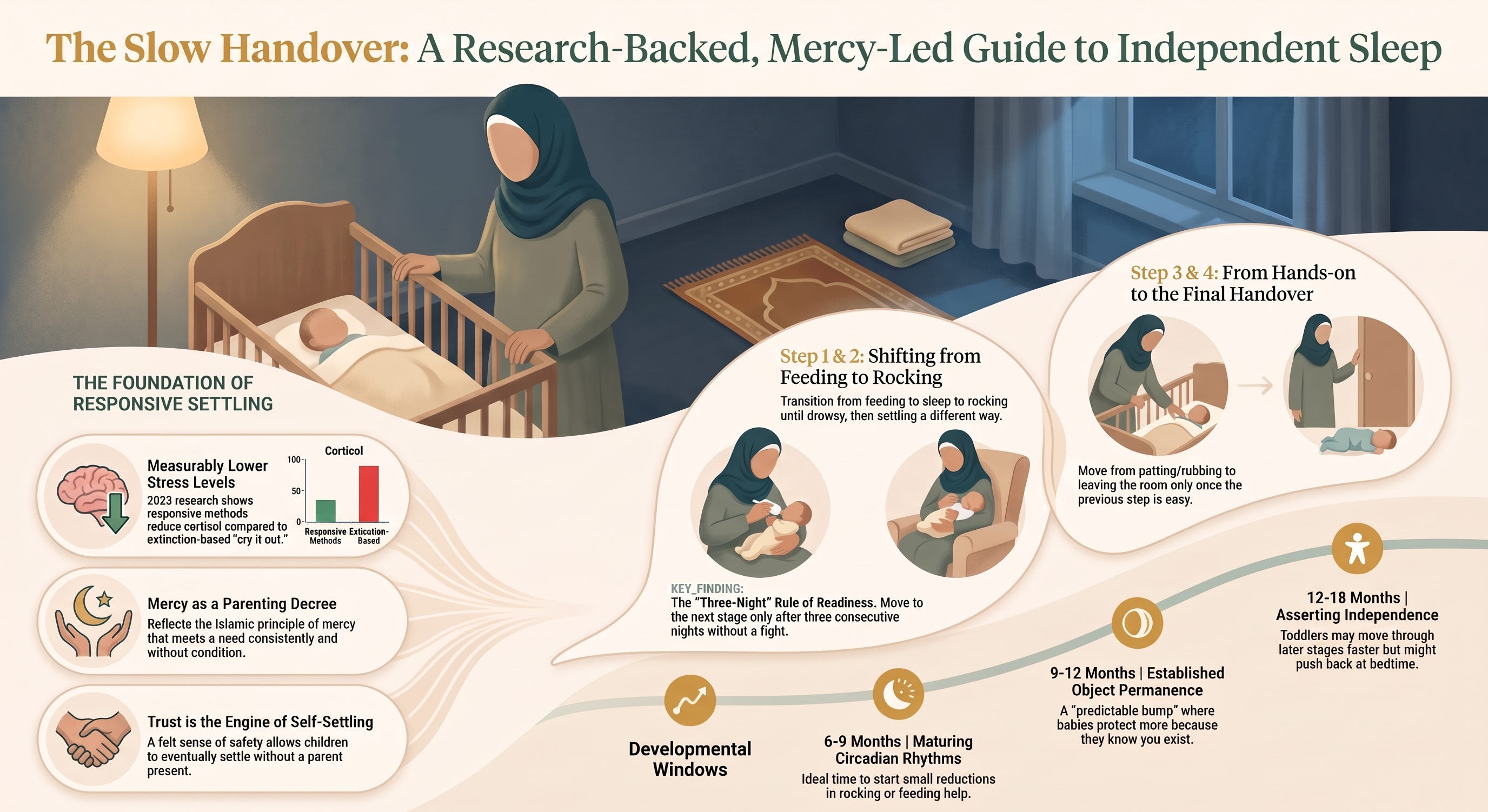
A 2022 pilot study followed 31 mother-infant pairs and found that responsive, gradually-reduced settling methods came with lower measured stress than extinction-based approaches like “cry it out” [2]. Here’s the exact four-stage sequence that makes the gradual version actually work.
It’s 11 p.m. You’re standing beside the cot, one hand still moving in that slow, automatic rocking rhythm, even though your arm gave up feeling normal about twenty minutes ago. Somewhere in the back of your mind, a question keeps surfacing: is it time to need me a little less at bedtime?
You’re not imagining the tiredness. And you’re not imagining that this question keeps circling back, month after month, without a clean answer.
Here’s what changed things for a lot of families in the same spot: a 2022 pilot study comparing responsive settling to extinction-based methods found measurably lower stress in mother-infant pairs using the responsive approach [2]. Not a faster fix. Not a magic trick. Just a calmer, steadier path that happens to work.
Two Words That Aren’t Actually Fighting Each Other
Parents often hear “responsive” and “independent sleep” as if they’re opposites. They’re not. Responsive settling means answering your baby’s need for comfort at the exact same moment you’re helping them fall asleep, day or night [1] [12]. Nobody is telling you to ignore a baby into self-sufficiency.
Here’s the thing: the method that actually works asks for something close to the opposite. Stay present. Let the shape of your presence change slowly. It’s also worth knowing this four-stage approach is one of several responsive models researchers describe, not the only one, and they increasingly frame these as a spectrum parents can draw from rather than a single fixed method [6].
The “gradual reduction” part is where the real work lives, and it is harder than it sounds. Once your baby can fall asleep easily at one level of help, you ease back to something slightly lighter. Not overnight. Not because a book claims six weeks is standard. Step by step, timed to what this particular baby can tolerate.
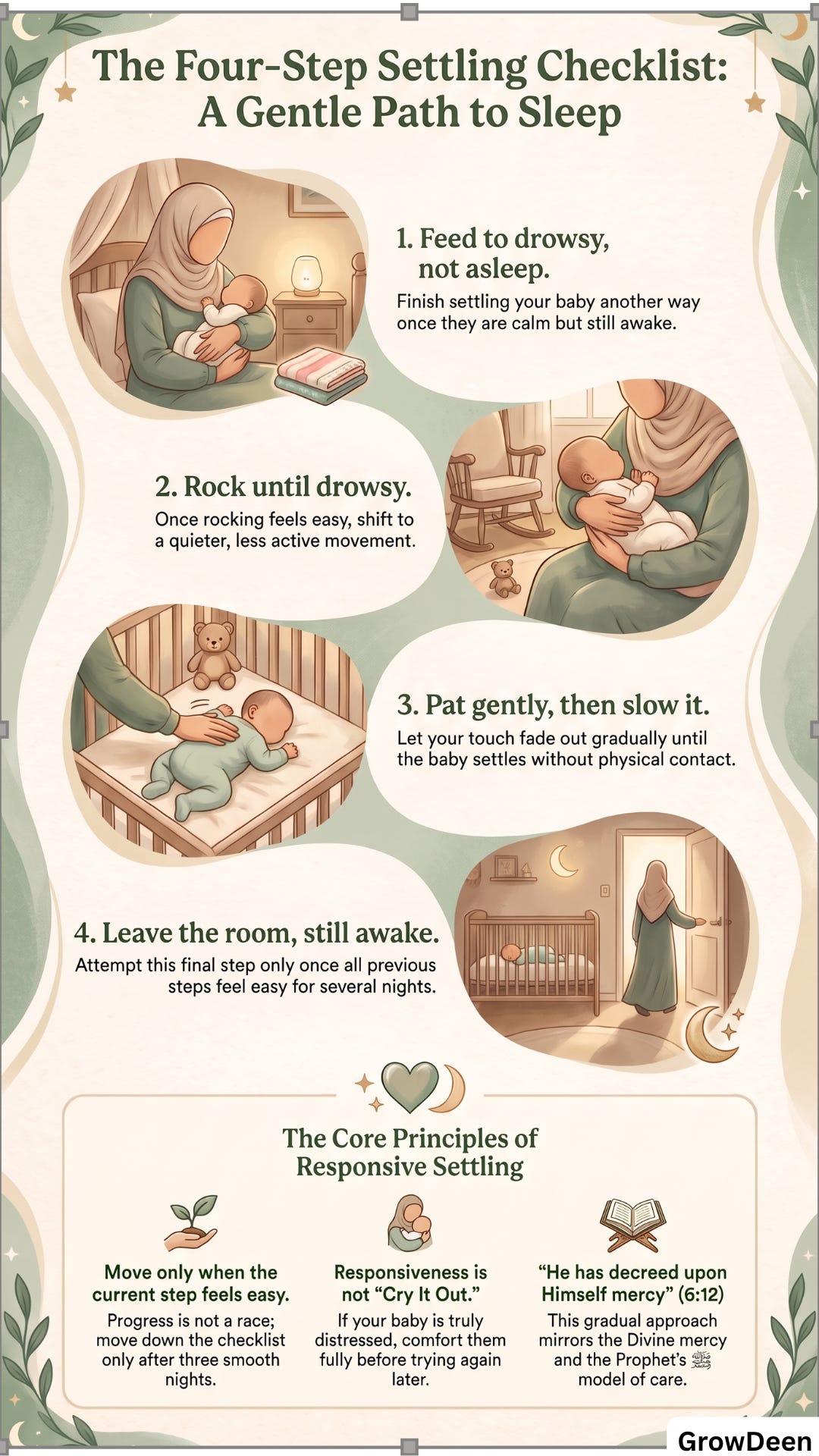
A sequence that works for a lot of families:
Feeding to sleep. Feed until drowsy, not fully asleep, then finish settling a different way.
Rocking in arms. Hold and rock until drowsy, then shift to something less active.
Hands-on settling. Pat or rub gently until drowsy, then slow the touch until it stops.
Leaving the room while your baby is still awake. The last rung, tried only once everything before it feels easy.
You move to the next stage only once the current one is already working without a fight. Current research on pediatric sleep interventions increasingly backs this individualized read: no single behavioral method fits every child or family equally well [7].
Why This Guide Is Different
Backed by current sleep research, not opinion. Every recommendation here draws on peer-reviewed studies from 2010-2022, not a single trending method.
Built on an Islamic understanding of mercy and gradual change. This isn’t just a sleep technique. It’s grounded in how Allah describes His own mercy, and how the Prophet ﷺ modeled gradual, sustained presence.
Comes with a printable Settling Reduction Toolkit. You’ll get a tracker for exactly which stage you’re on tonight, not just information you’ll forget by tomorrow.
Why Slow Beats Sudden
This isn’t training a baby out of needing you. If anything, it’s closer to the reverse.
A baby who learns comfort reliably shows up when they’re distressed builds what researchers call a felt sense of safety [3] [4]. That sense of safety, oddly enough, is exactly what eventually lets a child settle without you in the room. They aren’t settling from fear or confusion. They’re settling from trust, earned night after night.
Families using gradual, comfort-led reduction tend to report two things. Babies often fall asleep faster, since there’s less back-and-forth when nothing feels abruptly yanked away [1]. And babies frequently self-settle more easily after waking overnight, because a child who has practiced quieting themselves with a parent nearby is more likely to manage the same thing alone at 2 a.m., without waking the whole household [1].
Parent-reported outcomes from programs built around this kind of gradual, non-distressing settling echo the same pattern: less parental anxiety, and change that tends to stick [5].
What You Can Actually Do Tonight
Watch for the “this is easy now” signal before moving on. Three smooth nights of rocking in a row is your cue. Not a countdown timer. Not what worked for a friend’s baby.
Pick one method and hold that line for a stretch. Swapping techniques every few frustrated nights tends to reset the whole process rather than speed it up.
Say the exact same short phrase every time. Something like “I’m here, time to sleep,” repeated at the same point regardless of which physical method you’re using, gives your baby a verbal anchor that stays constant while everything else changes underneath it.
Let someone else take a turn. If you’ve been the only one settling your baby, they’ve learned your specific rhythm and your particular hold. Bringing in a partner or another trusted caregiver, even occasionally, widens what “safe” means for your child instead of narrowing it to one person.
Expect a little grizzling. Full distress is different. A bit of fuss when you pull back help is ordinary. Real crying means you comfort fully, then try the lighter version again another night.
Give yourself permission to freeze the whole process. Illness, travel, a new sibling, teething. Any of these is reason enough to hold at the current stage, or step back one, for as long as you need. That isn’t failure. That’s correctly reading what your family can handle right now.
What Actually Sets This Back
Skipping stages to speed things up almost always backfires, producing more distress, not less. So does letting your own frustration turn a gentle pat into something harder and faster. If you feel that happening, put your baby down somewhere safe like their cot and step away to calm yourself first [1].
Comparing timelines against another family doesn’t help either. A baby who needs four months to move through these stages isn’t behind one who did it in six weeks. And a single hard night doesn’t mean the whole approach has failed. Sleep at this age simply isn’t linear.
Don’t ignore genuine crying in the name of sticking to a plan. Responsive settling means responding. If your baby is truly upset, comfort them completely, then pick the reduction back up another night.
Support Muslim Parenting Lab ❤️
Would you like the reward of every parent who acts on what they read here? Fund it with the button below and it is yours.
The Prophet ﷺ said whoever guides to good has a reward like the one who does it. (Sahih Muslim 1893a)
What Changes by Age
6-9 months. Many families first attempt gently reducing settling help here, since a lot of babies are developmentally capable of longer independent stretches of sleep by now, as circadian rhythms and broader sleep regulation continue maturing across the first year [1] [8]. Start small: trim a little time off the rocking, or shift from feeding-to-sleep straight into feeding-then-rocking.
9-12 months. Object permanence is well established by this point, which sometimes makes leaving the room harder before it gets easier. Your baby now knows, in a way they didn’t a few months back, that you continue to exist somewhere they can’t see. That new awareness can bring a fresh wave of protest. It tracks with what’s known about how attention and environmental awareness develop rapidly during this window, shaped jointly by a maturing brain and ongoing caregiver experience [9]. None of this means the plan has failed. It’s a predictable bump, not a wrong turn.
12-18 months. Toddlers at this stage often move through the later stages, including brief time away from the room, faster than younger babies, especially if earlier stages were handled consistently. Some toddlers are simultaneously asserting independence during the day and push back harder at bedtime because of it. Both patterns are entirely normal.
I know this feels like a lot to hold in your head, especially at 11 p.m. when your brain has nothing left to give. That’s exactly why I built the Settling Reduction Toolkit — a printable tracker that tells you, at a glance, which stage you’re on tonight and what “ready to move on” actually looks like. Keep reading, you’ll be able to download it at the end.
The Islamic Framework: A Mercy That Meets You Where You Are
As Muslim parents, we already understand that raising a child, including the exhausting parts, is part of the amanah Allah has placed in our hands. There’s something worth sitting with in the fact that gradual, responsive reduction genuinely works better than sudden withdrawal, because it echoes something the Qur’an tells us plainly about how Allah relates to His creation.
Allah says, “Say, ‘To whom belongs whatever is in the heavens and earth?’ Say, ‘To Allah.’ He has decreed upon Himself mercy” [13]. This is one of only two places in the entire Qur’an where Allah describes an obligation He has placed upon Himself, and both times, the obligation is mercy. Not something that has to be earned first. A mercy written into how Allah has chosen to deal with everyone He has made, before anything at all is asked of them.

When you answer your baby’s cry at two in the morning for what feels like the hundredth night, you are practicing a small, tired version of that same principle. Responsive settling asks you to be the kind of presence Allah describes Himself as being: mercy that meets a real need consistently, without waiting for anything to be proven first.
The method itself has its own echo in the Sunnah. There’s a well-known narration describing how the Prophet ﷺ led the prayer while carrying his granddaughter Umama bint Zaynab on his shoulder: “He prostrated, he put her down, and when he stood up, he carried her again” [14]. Sit with that rhythm. Down, up. Down, up. Held, released, held again, without ever fully letting go until the prayer was finished. It isn’t a stretch to see in that same rhythm something close to what responsive settling actually is: presence that loosens by degrees, at whatever pace the child in front of you can bear.
This is, more broadly, how Islam approaches change. Nothing in the deen expects a person to leap from one state into a completely different one overnight. Applying that same wisdom to your baby’s sleep isn’t stretching the religion to fit modern parenting advice. It’s the same old principle, showing up again in a dim nursery at nine at night.
The Settling Reduction Toolkit
If you’ve read this far, you’re the kind of parent who takes your baby’s sleep seriously, not as a problem to fix, but as a stage to move through with care. That tells me something beautiful about you.
Inside The Slow Handover: Settling Reduction Toolkit (one comprehensive PDF, 3 pages):
Page 1: The Four-Step Ladder — A visual staircase showing all four settling stages, with a simple checkbox for “we’re here now” and “ready to move on,” designed as a laminated reference you can keep by the cot.
Page 2: Tonight’s Routine Card — A fill-in-the-blank card where you write your current stage, your chosen anchor phrase, and a short list distinguishing real distress from normal grizzling, built for a 2 a.m. glance when your brain has nothing left to spare.
Page 3: The Down, Up, Down, Up Reflection Card — The Bukhari 516 narration and the Qur’an 6:12 verse on decreed mercy, paired with a short reflection connecting the Prophet’s ﷺ rhythm of holding and releasing to your own nightly rhythm at the cot.
This isn’t just a PDF to download and forget. It’s a tool designed to stay by your cot, where you’ll actually reach for it at 2 a.m.
This Toolkit is what every subscriber receives with each article. We cover the full journey of raising Muslim children, from newborns to school age, all backed by research and rooted in wisdom.
You’ll only hear from us when there’s something worth sharing. No spam, no daily emails, just resources that matter.
Before you keep reading anything else tonight, do this: figure out which of the four stages you’re actually on right now, and say it out loud. Not where you think you should be. Where you actually are. That one honest answer tells you exactly what to try tonight.
May Allah place barakah in your effort, accept your intention, and make the care you give more protective, more merciful, and more rewarded than it feels in this exact tired moment.
Share This With Someone Who Needs It
Think of one person right now: the friend from your parenting group who admitted, half-laughing and half-exhausted, that she’s still rocking her one-year-old for forty minutes every single night and feels quietly guilty about it.
This article could ease her load. Share it with her today, not as advice-giving, but as support. Sometimes the most loving thing we can do is pass along what actually worked for someone else.
Frequently Asked Questions
Q: Is responsive settling the same thing as “cry it out”? A: No, and this is the most common mix-up. Cry it out involves withdrawing support all at once and letting a baby cry without intervention. Responsive settling keeps you fully involved throughout, gradually reducing the intensity of help while still comforting real distress immediately [1] [2].
Q: How long does gradual reduction usually take? A: There’s no fixed timeline, and research supports individualizing the pace rather than following a set schedule [7]. Some families move through all four stages in a matter of weeks. Others take several months, especially with illness, travel, or teething interrupting the process along the way.
Q: What if my baby cries when I reduce settling help? A: A little grizzling is normal and expected. Real, sustained crying means you comfort fully before trying the lighter stage again another night. Reducing help was never meant to mean withholding comfort.
Q: Can I skip a stage to speed things up? A: It’s tempting, but skipping stages tends to backfire, producing more distress rather than less. Move to the next stage only once the current one feels genuinely easy for a few nights running.
Q: Is it normal for a 9-12 month old to suddenly protest more at bedtime? A: Yes. Object permanence develops around this window, meaning your baby now understands you exist even when out of sight, which can bring a fresh wave of protest right when things were starting to feel easier [9]. It’s a developmental bump, not a sign the plan has failed.
Q: When should I talk to a doctor about my baby’s sleep? A: If your baby is regularly waking more than three or four times a night past 12 months with no clear cause, if settling problems are affecting daytime mood, feeding, or growth, or if you notice snoring, gasping, or breathing pauses during sleep, speak with your child’s doctor [10] [11]. These signs need medical attention rather than a settling technique.
References
[1] Raising Children Network. (2018). Responsive settling: 6-18 months. Australian Government-funded parenting resource. https://raisingchildren.net.au/babies/sleep/settling-routines/responsive-settling-at-6-18-months-reducing-settling-help
[2] Blunden, S., Osborne, J., & King, Y. (2022). Do responsive methods of improving sleep reduce stress in mother/infant dyads compared to extinction interventions? A pilot study. Archives of Women’s Mental Health, 25, 621-631.
[3] Sadeh, A., Tikotzky, L., & Scher, A. (2010). Parenting and infant sleep. Sleep Medicine Reviews, 14(2), 89-96.
[4] Kenner, C., & McGrath, J.M. (Eds). (2022). Developmental care of newborns & infants (3rd edn). Lippincott Williams & Wilkins.
[5] Ball, H.L., Douglas, P.S., Kulasinghe, K., Whittingham, K., & Hill, P. (2018). The Possums Infant Sleep Program: Parents’ perspectives on a novel parent-infant sleep intervention in Australia. Sleep Health, 4(6), 519-526.
[6] Blunden, S., & Dawson, D. (2020). Behavioural sleep interventions in infants: Plan B - combining models of responsiveness to increase parental choice. Journal of Paediatrics and Child Health, 56(5), 675-679.
[7] Kahn, M., Juda-Hanael, M., Livne-Karp, E., Tikotzky, L., Anders, T.F., & Sadeh, A. (2019). Behavioral interventions for pediatric insomnia: One treatment may not fit all. Sleep, 43(4), Article zsz268.
[8] Bathory, E., & Tomopoulos, S. (2017). Sleep regulation, physiology and development, sleep duration and patterns, and sleep hygiene in infants, toddlers, and preschool-age children. Current Problems in Pediatric and Adolescent Health Care, 47(2), 29-42.
[9] Swingler, M.M., Perry, N.B., & Calkins, S.D. (2015). Neural plasticity and the development of attention: Intrinsic and extrinsic influences. Development and Psychopathology, 27(2), 443-457.
[10] Honaker, S.M., & Meltzer, L.J. (2016). Sleep in pediatric primary care: A review of the literature. Sleep Medicine Reviews, 25, 31-39.
[11] Meltzer, L.J. (2010). Clinical management of behavioral insomnia of childhood: Treatment of bedtime problems and night wakings in young children. Behavioral Sleep Medicine, 8(3), 172-189.
[12] Middlemiss, W., Stevens, H., Ridgway, L., McDonald, S., & Koussa, M. (2017). Response-based sleep intervention: Helping infants sleep without making them cry. Early Human Development, 108, 49-57.
[13] Qur’an, Surah Al-An’am 6:12 — https://quran.com/6/12. Tafsir Ibn Kathir and classical commentary confirm this is one of only two verses in the Qur’an (the other being 6:54) where Allah describes mercy as an obligation He has decreed upon Himself.
[14] Sahih al-Bukhari 516 — Graded: Sahih — https://sunnah.com/bukhari:516
We combine scientific research with Qur’an and authentic Sunnah, and we cite our sources. Even so, this is general guidance and no substitute for a doctor who can examine your child.