

Your three year old asks about 76 questions an hour. Roughly three in ten never get an answer. [1]
Print it before tonight’s bedtime.
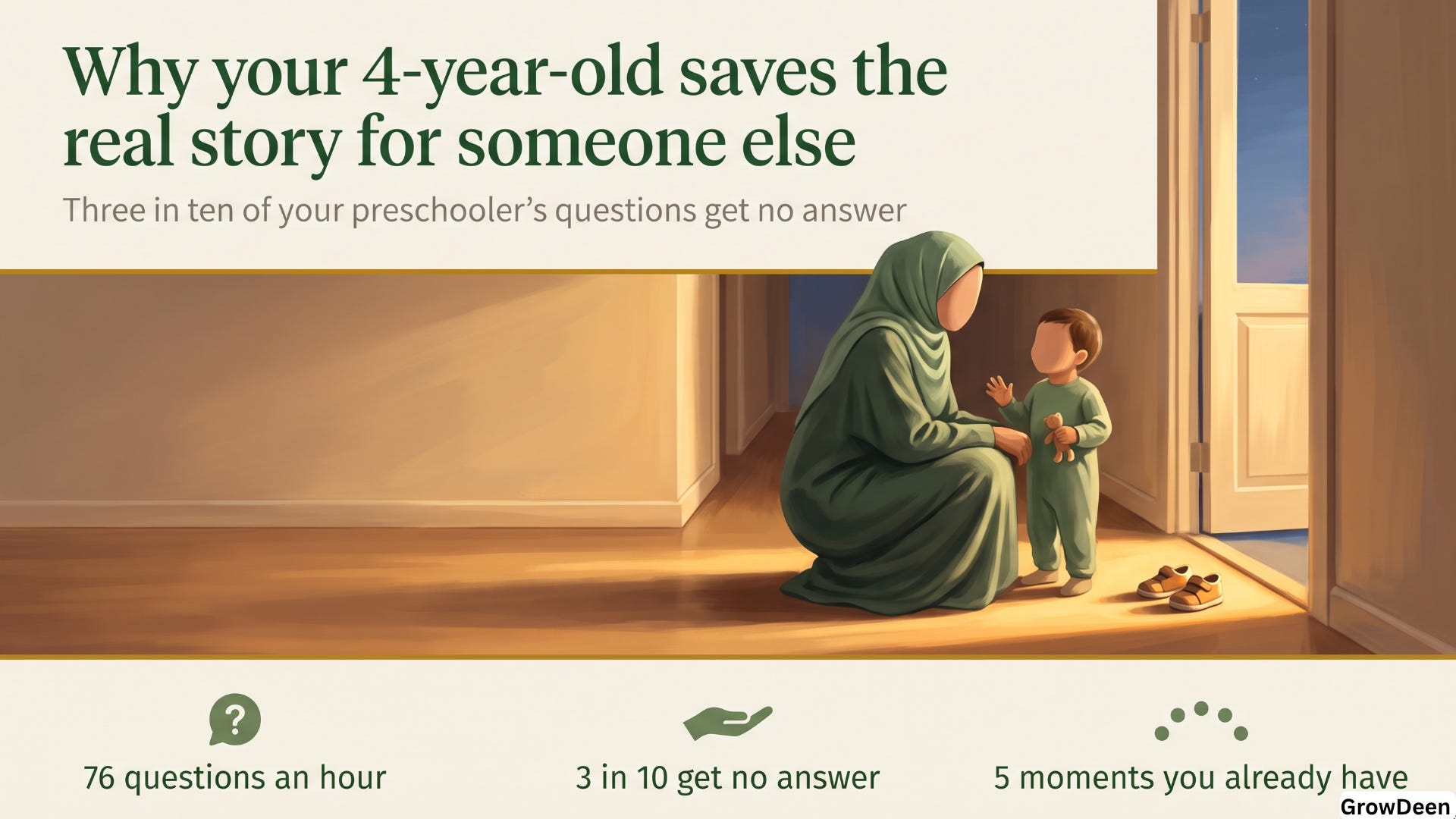
She had the whole story ready.
Your four year old came out of nursery holding something she wanted to tell you. On the walk home you asked how her day was, properly, phone away, the way you have read that you should. She said “fine.” Then she told the entire thing to your neighbour on the doorstep, in detail, including the part about the worm.
You did it right and it still went somewhere else. That stings in a particular way, and most parents carry it quietly rather than say it out loud.
So why does she save the real story for someone else? Hold that question. The answer is not about how much time you spend together, and it changes what you do tonight.
What Makes This Guide Different From Generic Parenting Advice
Every claim here is tied to a named source and year, including a 2021 American Academy of Pediatrics policy statement and a 2007 study that recorded how many questions preschoolers actually ask [1,2].
The Islamic material is load-bearing rather than decorative. The Qur’an preserves a father asking his young son’s view before the hardest decision of his life, and that scene sets the standard this whole article works toward.
You already have the free Open Door Pack from the top of this page, so the practical part lives on paper in your kitchen instead of in a browser tab you will never find again.
What Actually Changes In Your Child Between Three and Five
A three year old is still hunting for words to describe what is happening inside them. By five, the same child can tell you that nobody let them join the game at the park, and can look at your face and ask why you seem tired.
Two things shift, and they shift together.
The first is language. Longer sentences become longer conversations, which means your child can finally report on their inner life instead of acting it out on the kitchen floor. The second is perspective. Somewhere in here your child works out that other people have insides too, which is why a four year old pats your arm when you sigh, or hands over the bigger half of the orange without being asked. Researchers who recorded ordinary family talk found that the children whose households discussed feelings during everyday exchanges, rather than only during a crisis, became clearer at naming those feelings themselves [10].
The research on this age holds a surprise. The strongest predictor of how a preschooler develops is not what you teach them. In 2021 the American Academy of Pediatrics asked paediatrics to reorganise itself around what it calls relational health, on the grounds that safe, stable and nurturing relationships are a biological necessity: they absorb hardship when it lands, and they build the capacity a child needs for hardship that has not arrived yet [2]. A study that followed families through the pandemic found that warm, nurturing care predicted stronger development mostly through the quality of the parent and child relationship itself, rather than through anything the parents set out to pass on [3].
Temperament decides the shape of the rest. A cautious child connects over something quiet at the table. A child built like a motor connects while running. Neither one is better, and the version of closeness that works is the one that fits the child in front of you.
Which brings us to what your preschooler is quietly checking.
The First Thing Your Preschooler Is Testing: Does My Word Count Here?
Think about the last time your child asked for five more minutes and you said yes, then called them in after two.
They noticed. They always notice, and they file it.
Children between three and five run a constant, wordless audit on whether what they say changes anything. “In a minute” is a contract to a four year old. So is “we’ll do it after dinner” and “next time, I promise.” When those hold, your child learns that speaking up moves the world slightly. When they do not hold, your child learns that talking to you is a pleasant ritual with no consequences attached, which is a very easy thing to stop bothering with.
Islam treats this with a seriousness that surprises people. The honesty of what a parent says to a small child is not a minor domestic courtesy in the Sunnah; it sits inside the general obligation of truthfulness, and a promise made to a child is a promise.
Here is what to do with that tonight.
Stop making promises you will not check. Swap “in a minute” for the actual number: “two more turns, then shoes.” Say “I don’t know yet” out loud when you do not know, because a child can work with that and cannot work with a yes that evaporates. And when you break one, which you will, name it: “I said after dinner and I didn’t do it. That was mine. We’ll do it now.”
One line covers the whole of it. Ask them. Then keep what they say.
The Second Thing: Is It Safe To Bring You Anything?
Now the number from the top of this page.
In 2007 a research team recorded preschoolers at home and counted the questions. Children at this age ask an average of 76 information-seeking questions per hour, and they receive an actual answer about 71% of the time [1]. Nearly three in ten questions land on nothing. Not refused. Just absorbed into the noise of a Tuesday.
I know how that reads when you are making dinner with one hand. The point is not that you must answer 76 questions an hour. The point is what a child concludes from the misses.
Children at this age test the door with small things first. The worm. The sticker that fell behind the sofa. Whether cats go to Jannah. If the small things get a real answer, the big things come later, because a child has no way to know in advance which category a thing belongs to. They only know whether you tend to pick up.
What a real answer looks like at this age is simpler than most parents assume. It means stopping what you are holding, turning your body, and saying “and then what happened” instead of filling the silence yourself. When you do not know, say so, then find out together from a book or someone trustworthy. Expect the same question many times, because repetition is how small children build understanding, and your patience on the fifth asking is the whole proof that you can be asked anything.
When your child is upset, name the feeling before you fix anything. “You’re frustrated with that puzzle. Shall I hold the corner?” Research on how mothers respond to toddler distress found that naming and supporting the emotion, rather than steering the child off it, predicted better self regulation later [4]. Work on mindful parenting with preschoolers, where parents attend without reacting straight away, found lower rates of anxious and withdrawn behaviour over time [5]. And naming a feeling is not agreeing to the behaviour. You can say “you’re furious that we’re leaving” and still leave.
The hard questions arrive at this age too, usually at bedtime. Death, and why grandmother is not coming back. Tell the truth in short words: “Grandmother has died. We won’t see her again in this world. I feel very sad, and that’s alright.” Then say what Muslims say at a loss, inna lillahi wa inna ilayhi raji’un, and let your child hear it from you. The softening lie seems kind and costs you later. A child told that grandmother is sleeping will start worrying about sleep.
I know that is a lot to hold in your head at 6pm with the dinner going cold. That is exactly why I made the free Open Door Pack, a three page printable that puts the question map and the five daily moments on paper where you can see them. The download button is at the top of this page, and there’s a full description of what’s inside it below.
What the Qur’an Shows About Asking a Child What They Think
Most of us reach for Islamic guidance on what our children should say to us. There is something older and more useful in the other direction.
Sit with Qur’an 37:102 for a moment. Ibrahim (peace be upon him) has been shown in a dream that he must sacrifice his son. The boy is old enough to walk and work beside his father. And Ibrahim does not announce it. He turns to the child and says, “O my son, indeed I have seen in a dream that I must sacrifice you, so see what you think.” [6]
According to Tafsir Ibn Kathir, Ibrahim told his son about the dream in order to make it easier for him, and also to test his patience and resolve at a young age in obeying Allah and obeying his father [6]. Hold that next to the hardest thing a parent could ever say. Even there, the Qur’an preserves a father turning toward his child and asking for his view, and preserves the answer the boy gave.
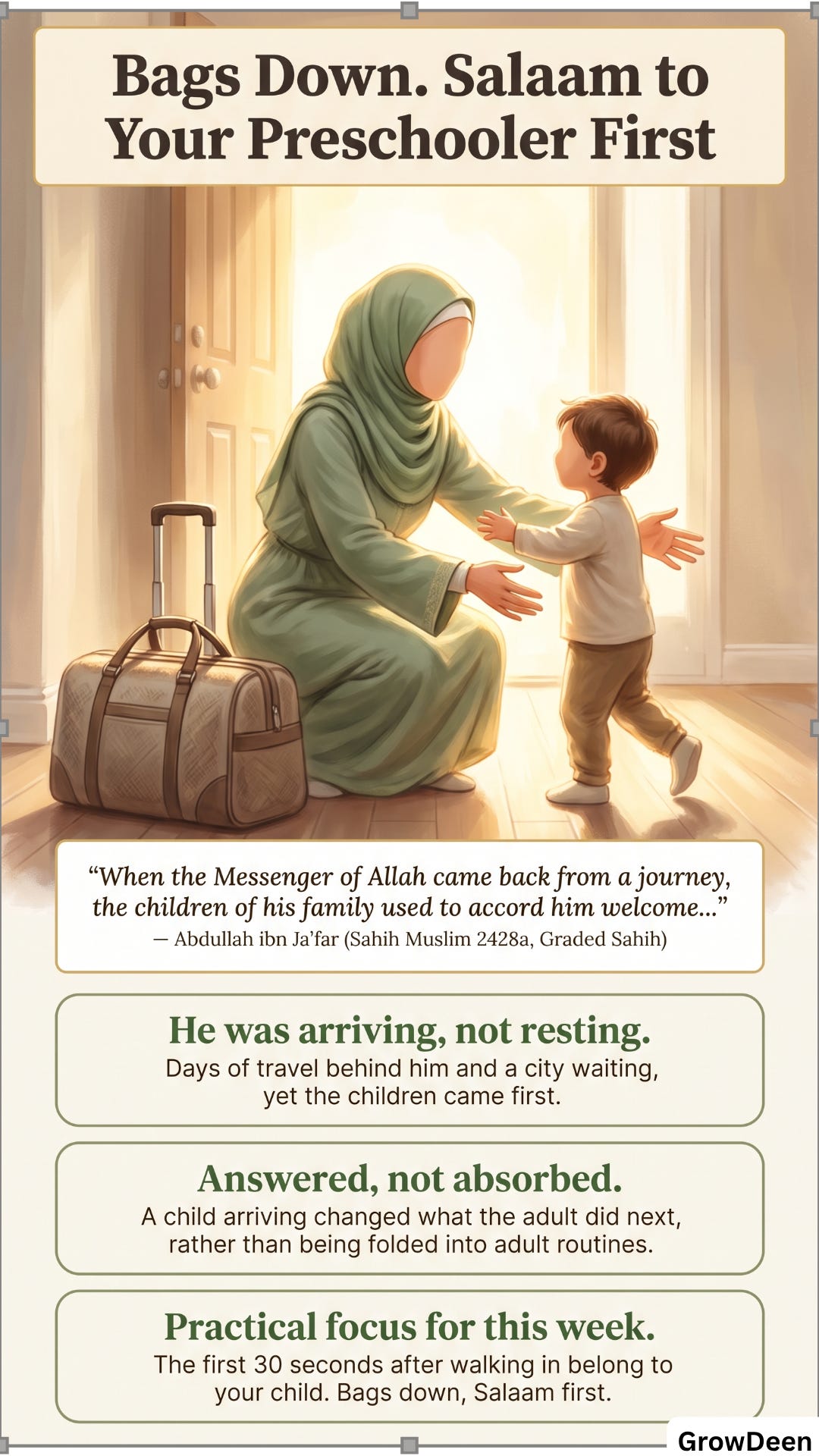
The same warmth runs through the Sunnah. Abdullah ibn Ja’far described how the children of the Prophet’s ﷺ household were brought out to welcome him whenever he came back from travelling. One time Abdullah reached him first, and the Prophet ﷺ seated him on the mount in front of him. Then one of Fatimah’s sons arrived, and he seated that child behind him. The three of them rode into Madinah together [7].
Both scenes do the same thing. A child is approached rather than instructed, and a child’s arrival is answered rather than absorbed into whatever the adult was already doing.
Support Muslim Parenting Lab ❤️
Would you like a deed that keeps earning for you after you die? Start one in a few seconds with the button below.
The Prophet ﷺ named ongoing charity and beneficial knowledge among the three things that keep counting after death. (Sahih Muslim 1631)
The Third Thing: Will You Come Back After You Lose Your Temper?
You will lose it. Tuesday evening, three children, no dinner, and someone has poured the water again.
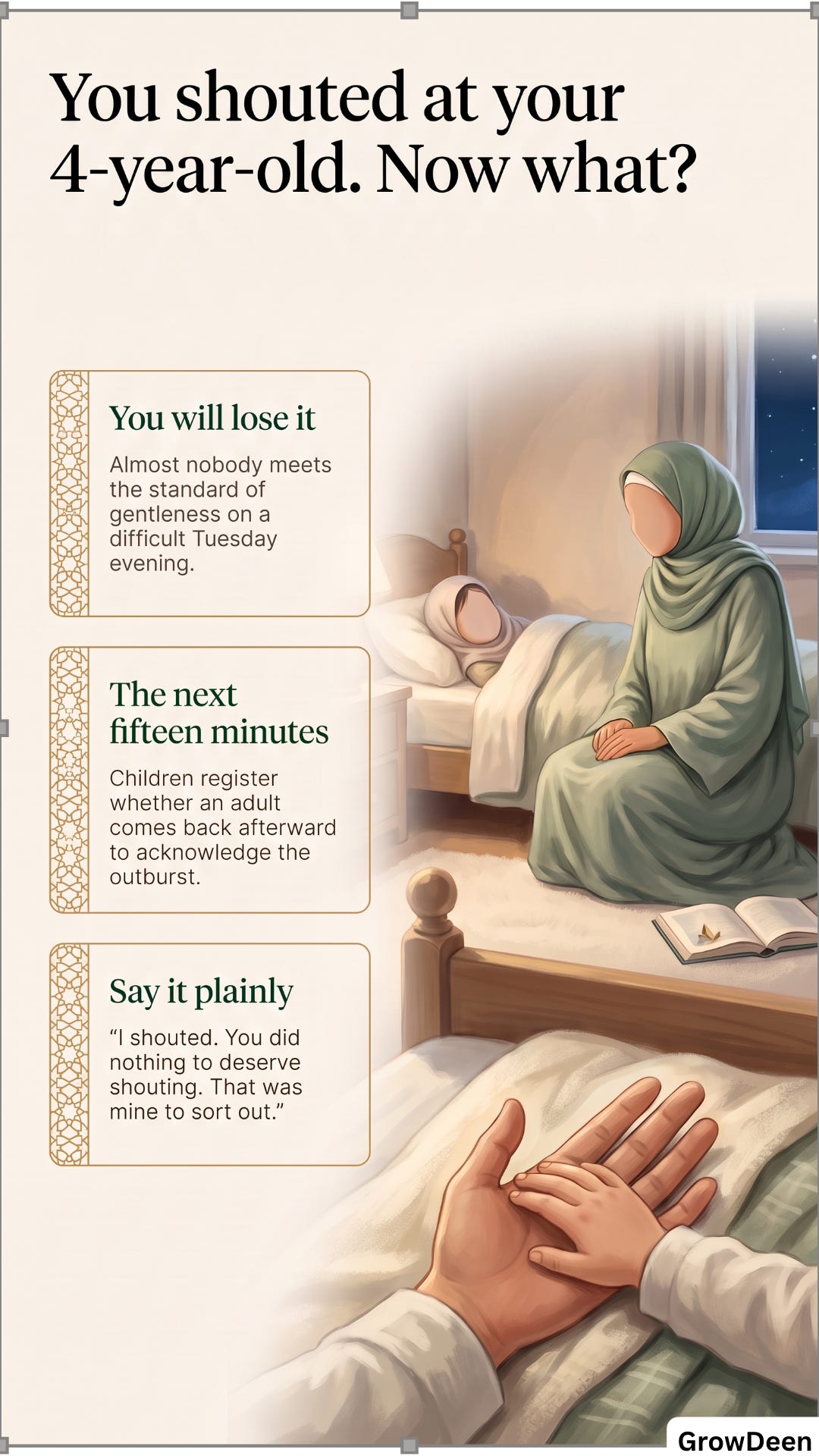
The Islamic standard here is gentleness, and almost nobody meets it on a Tuesday. What matters more than whether you snapped is what you do in the eleven minutes afterwards.
Go back and repair properly. Sit down at their height, say you were angry and that you spoke harshly, and apologise. A child who watches an adult own a mistake learns something no lecture transmits: that mistakes are survivable, and that the relationship holds even when someone has behaved badly in it. That is the single most useful thing a four year old can know about you.
Two things help in the moment itself. Guard your tongue while you are still hot, because words said against your own child in temper are exactly the words you would least want answered. And lower the bar for the rest of the evening. Feed them, keep them safe, read one book, start again tomorrow.
Fairness between siblings belongs here too, because most lost tempers at this age start with a blue cup. Justice between children is not a soft recommendation in Islam, and preschoolers keep an exact mental tally of lap time and whose turn it was. Your sense of what is fair matters a good deal less here than theirs does. Where you cannot give the same, say so plainly and explain why, since an explained difference lands very differently from an unexplained one.
Why Your Child Saves the Real Story for Someone Else
Back to the doorstep, and the worm.
Your neighbour got the story because your neighbour asked about the worm specifically, had nothing else running, and had no history of absorbing the answer. Your child was choosing the listener who, at that exact moment, had the lowest cost of entry. Withholding had nothing to do with it.
That is good news, because cost of entry is something you control. Harvard’s Center on the Developing Child calls the basic unit of this serve and return: the child reaches out, the adult answers, and the answering is what builds the circuitry [11]. It drops every time a small promise holds, every time a small question gets a real answer, and every time you come back after a bad evening. It is not built in a dedicated hour of quality time. It is built in roughly eight ordinary exchanges a day that you are already having.
Ask them. Then keep what they say.
When to Speak to a Doctor About Your Three to Five Year Old
Talk to your doctor or child health nurse if your child is not combining words into short sentences by around three, if their speech is getting harder rather than easier to understand, if they show little interest in other children by four or five, if they lose skills they clearly had before, or if aggression or withdrawal is severe enough to disrupt daily life [8].
Raise it sooner rather than later when something feels wrong to you. Parents are usually right about their own children, and early support works better than late support. If stress or conflict at home is making warmth hard to sustain, a doctor or qualified counsellor can help, and asking is part of taking the means while relying on Allah.
This article does not replace medical advice. Follow your doctor’s guidance for your own child.
Your Free Open Door Pack
If you have read this far, you are the kind of parent who takes your child’s inner life seriously rather than treating it as noise to manage. That tells me something about you.
Inside the Open Door Pack (one comprehensive PDF, 3 pages):
Page 1: The Question Map. A single-page map of the four kinds of question a three to five year old asks, what each one is actually reaching for underneath, and one worked answer for each that keeps the door open instead of closing it. Designed as a reference sheet you can tape inside a kitchen cupboard door and glance at mid-cooking.
Page 2: The Five Doorways. The five fixed points in an ordinary day where a preschooler is most likely to hand you something real (the pickup, the table, the bath, the book, the dark), each with one opening line and what to do with the silence that follows, so you can cover the whole day in under five minutes of actual effort.
Page 3: Two Things the Sunnah Did With Children. The narration of Abdullah ibn Ja’far on how the Prophet ﷺ met the children of his household when he returned from travelling, and the scene in Qur’an 37:102 where Ibrahim (peace be upon him) asks his son’s view before the hardest decision of his life, each paired with one concrete practice for your own door and your own hard conversation.
This isn’t just a PDF to download and forget. It’s a tool designed to stay inside your kitchen cupboard door, where you’ll actually see it when you need it most.
This Open Door Pack is what every subscriber receives with each article. We cover raising Muslim children from newborns to school age, all backed by research and rooted in Islamic guidance.
Do This Before Bedtime Tonight
Pick one thing your child mentioned today that you did not follow up on. The worm, or the friend with the red shoes. Go and ask about that specific thing by name, then stop talking and wait. That’s it. That’s the whole practice.
May Allah place barakah in your effort, accept your intention, and make the care you give more protective and more rewarded than it feels in the moment.
Share This With Someone Who Needs It
Think of one person right now: the sister who told you her four year old “never tells her anything,” or the mother at the masjid whose child talks non-stop to everyone except her.
This article could change what happens at her door this week. Send it to her today, not as advice-giving, but as companionship. Sometimes the most loving thing we can do is hand over the thing that finally made sense to us.
Frequently Asked Questions
Q: How do I connect with my 3 to 5 year old when I have no time?
A: You do not need extra time, you need the time you already have to be answered. The eight or so moments you already share each day (the pickup, the table, the bath, the book, the dark) do more than a scheduled hour does, because connection at this age is built from whether their word counts, not from duration.
Q: Why does my preschooler ask so many questions?
A: Because that is what a brain does at this age. Researchers recording preschoolers at home counted an average of 76 information-seeking questions per hour, with an actual answer coming back about 71% of the time [1]. The questions are the learning, so the answering is the teaching.
Q: My child talks to everyone except me. Is that normal?
A: Usually, yes, and it is rarely about love. Children choose whichever listener costs them the least effort in that moment. For more on why this happens and how to lower that cost, see “Why Your Child Saves the Real Story for Someone Else” above.
Q: How do I talk to my 4 year old about death in Islam?
A: In short, true sentences, without the softening lie. Say that the person has died and you will not see them again in this world, say that you feel sad, and say inna lillahi wa inna ilayhi raji’un so your child hears the words from you first.
Q: Should I apologise to my child when I lose my temper?
A: Yes, and specifically rather than generally. “I shouted and that was mine” teaches your child that mistakes are survivable and that relationships hold through them, which is more useful to a four year old than a parent who never slips.
Q: Is play with my preschooler actually important or just nice?
A: It is doing real work. A large study of family leisure found that physical activities done together as a family predicted stronger social competence in children, with the parent and child relationship carrying much of that effect [9].
Q: When should I worry about my 3 to 5 year old’s development?
A: Speak to your doctor if your child is not combining words into short sentences by around three, if speech is getting less clear, if they show little interest in other children, or if they lose skills they clearly had [8]. Trust the feeling that something is off, because early support works better than late support.
References
[1] Chouinard, M.M., Harris, P.L., & Maratsos, M.P. (2007). Children’s questions: a mechanism for cognitive development. Monographs of the Society for Research in Child Development, 72(1), 1 to 129.
[2] Garner, A., & Yogman, M.; Committee on Psychosocial Aspects of Child and Family Health, Section on Developmental and Behavioral Pediatrics, Council on Early Childhood. (2021). Preventing childhood toxic stress: partnering with families and communities to promote relational health. Pediatrics, 148(2), e2021052582. American Academy of Pediatrics.
[3] Zhang, X., Zhou, Q., & Cao, J.L. (2024). Mediating effect of the parent and child relationship on the association between maternal nurturance and early child development: a longitudinal study during the COVID-19 pandemic. Psychology Research and Behavior Management, 17, 3241 to 3253.
[4] Senehi, N., & Brophy-Herb, H.E. (2020). Role of maternal affect and regulatory strategies in toddlers’ emotion and behavior regulation. Infant Behavior and Development, 60, 101472.
[5] Huang, J., Chen, X., Liao, X., Peng, Y., Xie, S., & Chi, X. (2025). Mindful parenting, parent and child relationship and preschoolers’ internalizing behaviors: a cross lagged panel analysis. Journal of Experimental Child Psychology, 258, 106295.
[6] Qur’an, Surah As-Saffat 37:102, with Tafsir Ibn Kathir.
[7] Sahih Muslim 2428a, narrated by Abdullah ibn Ja’far. Graded: Sahih.
[8] Centers for Disease Control and Prevention. Positive parenting tips and developmental milestones: preschoolers, 3 to 5 years.
[9] Yan, Z., Xu, J., & Yuan, H. (2024). The relationship of family leisure physical activities and children’s social competence: the mediating role of parent and child relationships and the moderating role of parenting styles. Early Child Development and Care, 194(15 to 16), 1555 to 1572.
[10] Fields-Olivieri, M.A., Cole, P.M., & Roben, C.K.P. (2020). Toddler emotion expressions and emotional traits: associations with parent and toddler verbal conversation. Infant Behavior and Development, 61, 101474.
[11] Center on the Developing Child, Harvard University. Serve and return interaction shapes brain circuitry.