

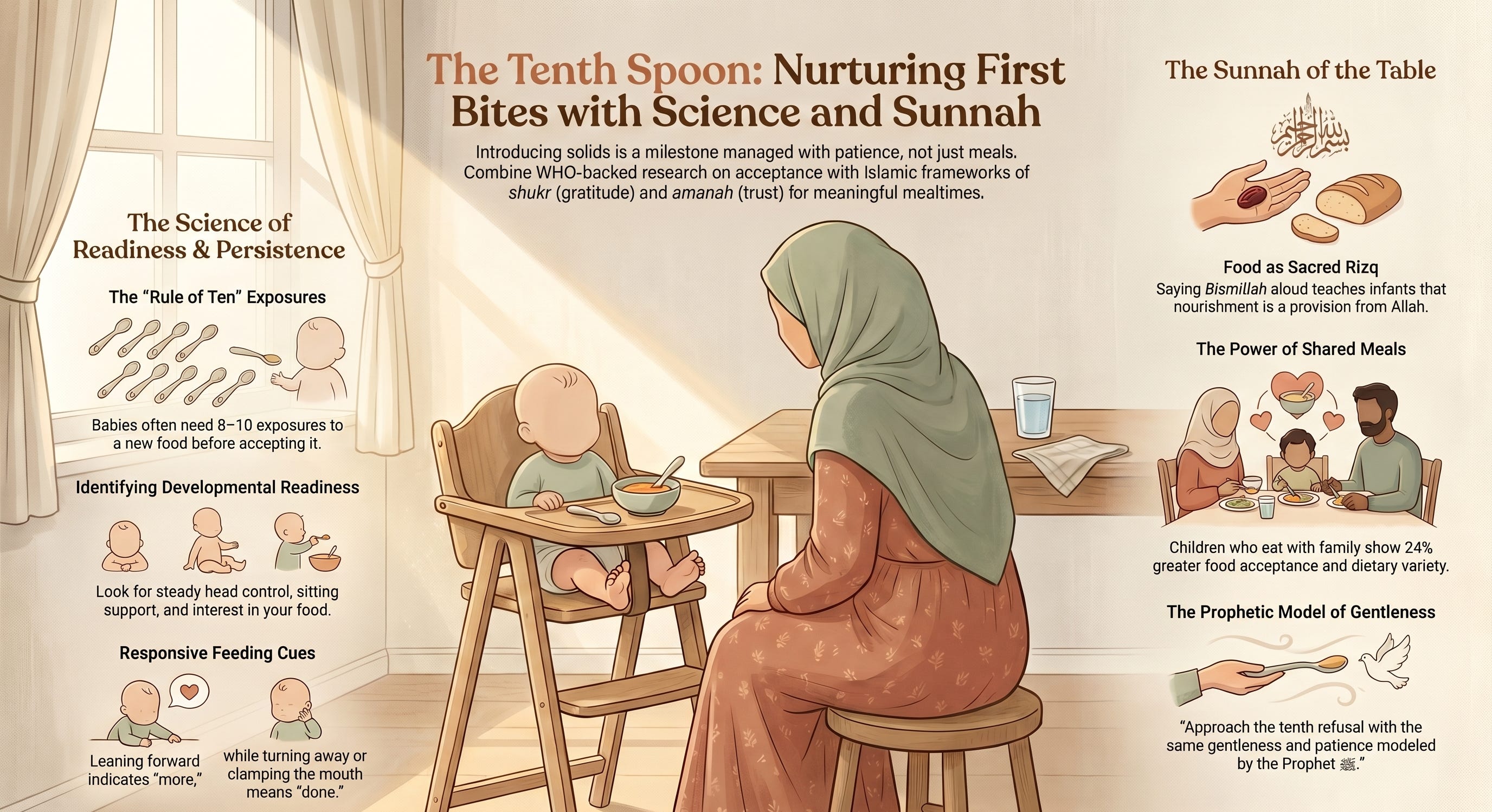
The WHO recommends introducing solid foods from around 6 months, but research shows babies need an average of 8–10 exposures to a new food before they accept it. [1][3] This guide shows you exactly how to start and how to keep going through the refusals, the mess, and the days when it all falls apart.
Picture this: you’ve prepared a smooth little bowl of pureed sweet potato. Your baby is in the highchair. You’re holding the spoon. You offer it. They open their mouth — and then push it back out with their tongue, stare at you, and proceed to bat the spoon away entirely.
You think: Am I doing this wrong? Is something wrong with them?
Here’s what I want you to know before anything else: nothing went wrong. That moment is the beginning of learning, not the sign of a problem.
Starting solid foods is one of the most confusing milestones of the first year — and often, the hardest part isn’t knowing what to serve. It’s managing your own expectations about how it should go. This guide will help you with the science, the practical steps, and the Islamic framework that makes even the messy, slow days feel meaningful.
Why This Guide Is Different From Generic Feeding Advice
Research-backed, not blog-based. Every recommendation draws from WHO 2023 guidelines, AAP 2022 policy, and peer-reviewed research on food acceptance in infants — not articles that recycle the same general tips without citations. [1][2][3]
Islamic framework woven in — not bolted on. This guide treats your baby’s mealtime as what it actually is: an act of amanah, of shukr, and of tarbiyah — grounded in Qur’anic guidance and the Prophetic model of eating together.
A free practical tool included. Keep reading to download the Baby’s First Bites Companion Pack — a spoon-feeding readiness checklist, a mealtime problem-solver, and a family table barakah card — tools you’ll actually pin to your fridge.
How Do You Know Your Baby Is Ready for Solids?
The short answer: watch them, not the calendar.
The WHO recommends exclusive breastfeeding for the first six months of life, then gradual introduction of solid foods alongside continued breastfeeding. [1] The AAP aligns with this — and both are clear that introduction should not happen before four months, when your baby’s digestive system simply isn’t ready. [2]
Signs of readiness include:
Sitting with minimal support and holding their head steady
Reaching toward food or opening their mouth when you eat nearby
Loss of the tongue-thrust reflex — they’re no longer automatically pushing things out of their mouth
But — and this matters — readiness doesn’t arrive at exactly 183 days. Some babies show these signs at five and a half months. Others aren’t there until closer to seven. Trust what you observe. If your baby is approaching eight months without showing interest, speak with your paediatrician.
Every child is given their own timeline. Patience here is its own kind of wisdom.
Setting Up for Success: The First Few Sessions
Before the first spoonful, a few things make a real difference.
Choose a calm moment. Not when your baby is exhausted. Not when they’re already frantic with hunger. Early in the day, after a breastfeed or formula feed, when both of you are rested and unhurried. [4]
Position safely. Upright, head steady — in a highchair or on your lap with support. Never reclined.
Give your baby their own spoon. While you feed with one, let them hold the other. This isn’t mess for the sake of mess. Research confirms that babies who explore food with their hands alongside spoon-feeding develop a more positive relationship with eating over time. [5]
And before you begin — say Bismillah out loud. Every time. Your baby cannot yet understand the words, but they hear your voice, they feel your intention, and they are already learning that food is not just fuel. It is rizq. It is provision from Allah. These are seeds planted long before they can speak.
Here’s the spoon-feeding method that works. Place a small amount on the tip of a soft, flat spoon. Bring it to your baby’s lips and wait — let them lean forward and open. Gently rest the spoon without pushing far in. Give them time to move the food. Then watch: leaning in means more, turning away means done.
That’s it. That’s the whole technique.
What Happens When Your Baby Says No
This is the part that trips most parents up.
Food refusal is normal. It is not failure.
Your baby might refuse because they’ve had enough. Signs: head turned away, mouth clamped shut, spoon pushed aside, sudden interest in everything except the bowl. All of those are communication, not defiance. [4]
They might refuse because they’re tired. If sleepy cues show up, stop. Get them down. Try again another day.
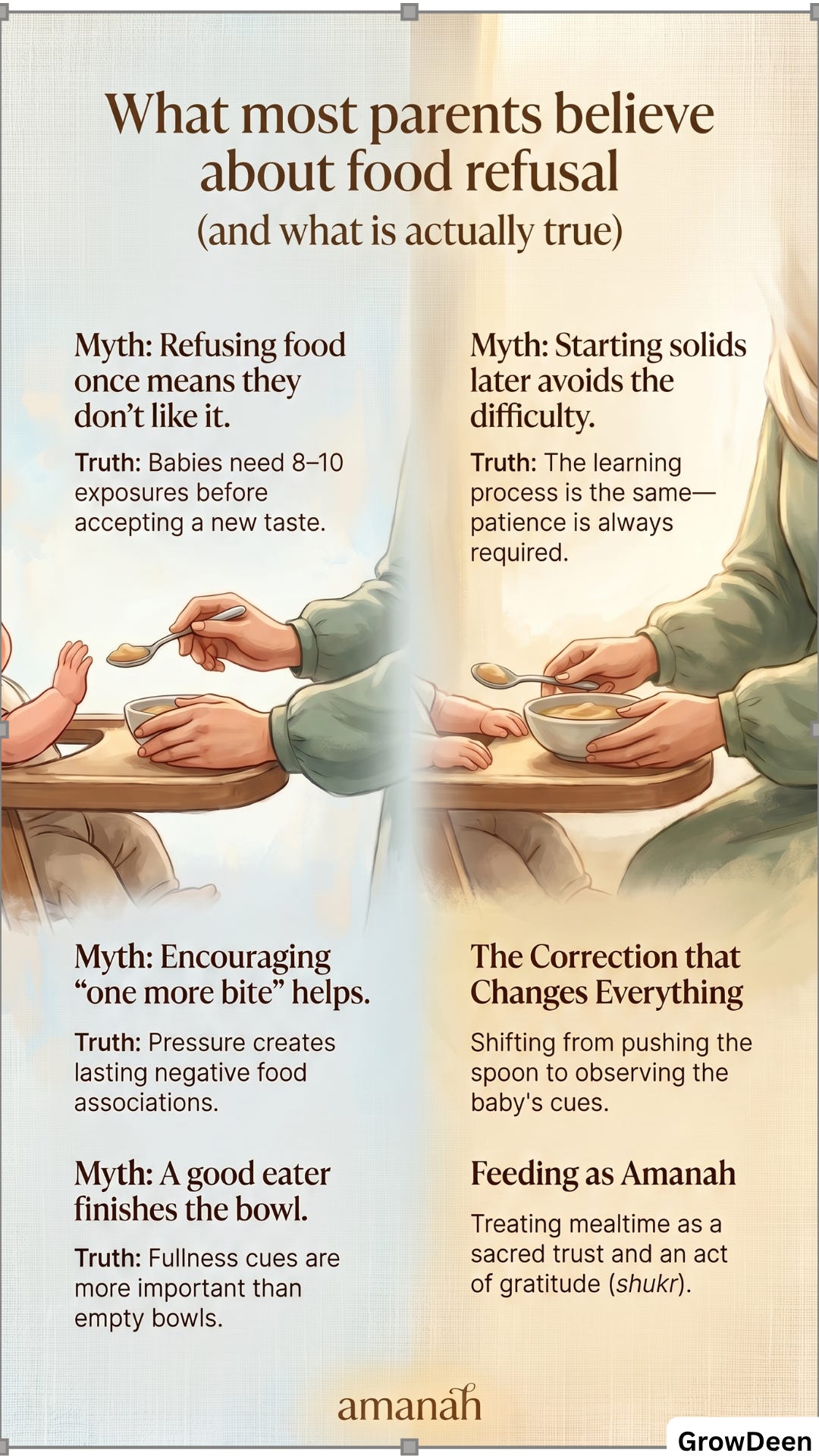
Or — and this is the big one — they might refuse because the food is new. And here’s what most parents don’t know: the research shows babies need 8–10 exposures to a new food, sometimes more, before they accept it. [3] That’s not eight meals. That’s potentially eight or ten separate offerings, across days or weeks.
Don’t give up after the third no. Don’t assume they hate it. Offer again next week alongside something familiar. Stay calm about it. Pressure at mealtimes — even gentle, well-meaning pressure — creates negative associations with food that can persist for years. [5]
The Prophet ﷺ was the most gentle of people. As Muslim parents, we’re called to bring that same gentleness to the tenth time we offer the rejected puree.
I Know This Is a Lot to Hold in Your Head
That’s exactly why I created the free Baby’s First Bites Companion Pack — a printable designed to sit on your fridge or in your kitchen where you’ll actually see it when you need it. Keep reading to download it at the end — it’s three pages and takes two minutes to print.
What the Qur’an Teaches About Feeding: Gratitude as a Daily Practice
Feeding your baby is one of the most ordinary things you’ll do today.
It is also one of the most sacred.
When I sit with the verse where Allah says, “O you who believe! Eat of the good things that We have provided for you, and be grateful to Allah, if it is indeed He Whom you worship” [Quran 2:172], I notice something. The command to eat and the command to be grateful arrive together in the same breath. According to Tafsir Ibn Kathir, this verse commands the believers to eat from the pure provisions Allah has created for them and to give Him thanks for it — because He is Tayyib, and He accepts only what is Tayyib. [6]
When we offer our babies food — any food, even a rejected spoonful of sweet potato — we are introducing them to rizq. To the idea that what nourishes us comes from somewhere beyond us.
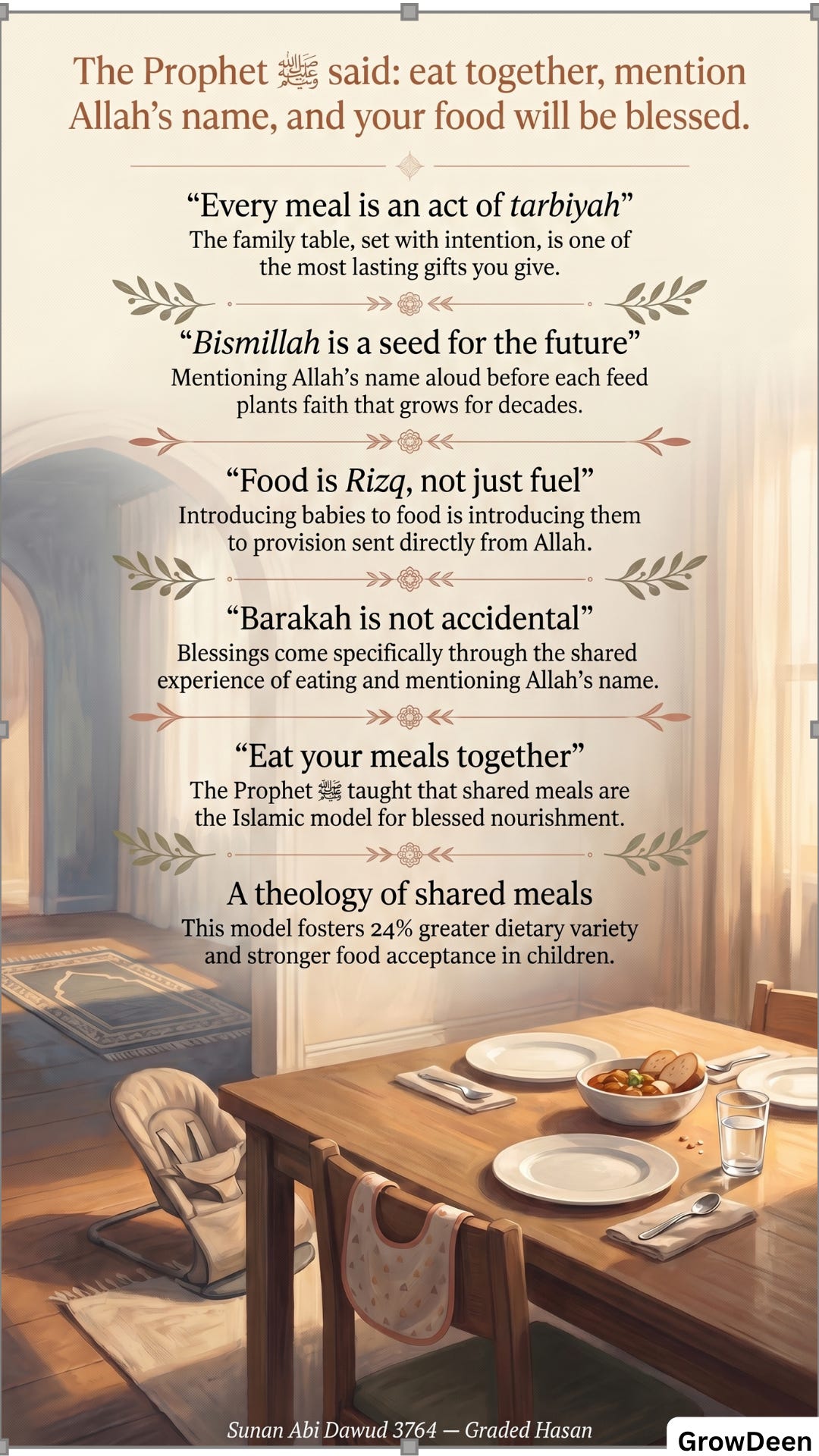
And the Prophet ﷺ said: “Eat your meals together and mention the name of Allah over it, for you will be blessed in it.” [Sunan Abi Dawud 3764 — graded Hasan] [7]
This isn’t a table manner. It is a theology of shared meals.
When your baby joins your family table — even before they can eat much — you’re not just including them in a meal. You’re welcoming them into a practice. A practice of gratitude and remembrance that, if you tend it carefully, will stretch across their entire life.
What strikes me is how the Islamic emphasis on eating together with dhikr, and what developmental research shows about shared family mealtimes, point in exactly the same direction: children who eat with their families regularly show 24% greater dietary variety and stronger food acceptance patterns over time. [5] The Sunnah and the science are saying the same thing, in different languages.
May Allah place barakah in your family’s meals, and make them a space of warmth, shukr, and tarbiyah.
Your Baby’s First Bites Companion Pack
If you’ve read this far, you’re not looking for a quick answer. You want to get this right — with intention and with peace.
That tells me something beautiful about you.
Inside the Baby’s First Bites Companion Pack (one comprehensive PDF, 3 pages):
Page 1: Spoon-Feeding Readiness Checklist — A clear, visual checklist covering the 5 signs of readiness, a step-by-step spoon-feeding guide, and a “signs of fullness” reference — designed as a fridge card you can check at any feed, especially in the early weeks when you’re still learning your baby’s cues.
Page 2: Mealtime Problem-Solver — A simple flowchart walking you through the four most common scenarios: baby refuses food, baby gags, baby only wants milk, baby loses interest quickly — with specific, calm next steps for each. So that when you’re standing at the highchair wondering what to do, you have a clear path forward.
Page 3: Family Table Barakah Card — The Islamic mealtime practice, built around the Prophet’s ﷺ guidance to eat together with the name of Allah. Includes the du’a before eating solid food (Allāhumma bārik lanā fīhi wa aṭ’imnā khayran minhu — Tirmidhi 3455, graded Hasan), and a three-step mealtime ritual for saying Bismillah, eating together, and saying Alhamdulillah — that you can begin with your baby from their very first meal.
This isn’t just a PDF to download and forget. It’s a tool designed to stay in your kitchen — where the real learning happens.
This Baby’s First Bites Companion Pack is what every subscriber receives with each article. At Muslim Parenting Lab, we cover the full journey of raising Muslim children — all backed by scientific research and rooted in Islamic wisdom.
If you’re a Muslim parent who wants evidence-based guidance with an Islamic perspective, subscribe for free so future resources arrive in your inbox before you need them.
Subscribe free for parenting resources backed by both science and Sunnah — guidance so unique, you literally can’t get it anywhere else — no spam, no clutter, just resources that matter.
One Small Action
At your next feed — whether milk or solids — say Bismillah out loud. Just once, clearly, before you begin. Your baby is listening. And that is how the habit starts.
Someone Else Needs This Today
Think of one person: a friend whose baby is approaching six months and has no idea where to start. A sister who mentioned the highchair is just sitting unused. A mother at the masjid who asked you last week whether her baby was “supposed to” be eating by now.
This guide could land in her inbox at exactly the right moment.
Frequently Asked Questions
Q: When should I start solid foods? A: Around six months, once your baby shows signs of readiness — head control, interest in food, and a reduced tongue-thrust reflex. [1] The WHO and AAP are both clear that before four months is too early, regardless of readiness signs. For more, see “How Do You Know Your Baby Is Ready” above.
Q: My baby keeps refusing food. Is something wrong? A: Almost certainly not. Research shows that 8–10 exposures to a new food is normal before acceptance — so repeated refusal is part of the process, not a sign that something is wrong. [3] If your baby is seven months or older with consistent refusal across many foods, mention it to your paediatrician.
Q: Can I start solids before six months if my baby seems ready? A: Not before four months — the gut and immune system aren’t ready regardless of developmental signs. Between four and six months, some babies show early readiness cues, but the medical consensus is to wait until around six months where possible. [1][2] If you’re unsure, speak with your paediatrician.
Q: What is the right amount of food at first? A: Very small. Start with a teaspoon or two once a day. Your baby may swallow almost nothing at first — this is expected. The early stage is about learning to eat, not filling the tummy. Amounts increase gradually over weeks as your baby’s interest and skill develop. [4]
Q: My baby gags when I offer lumpy food. Is that choking? A: Gagging and choking are different. Gagging is a normal, protective reflex that moves unfamiliar textures to the front of the mouth — it looks alarming but is part of learning. Choking is silent, involves inability to breathe or cry, and requires immediate first aid. If your baby is gagging regularly on age-appropriate textures, stay calm and keep offering — it typically reduces with practice. If you’re concerned, speak with your paediatrician.
Q: Is it okay for my baby to make a mess? A: Yes — and more than okay. Letting your baby explore food with their hands develops fine motor skills and builds a positive relationship with food. [5] Try to wait until the end of the meal to wipe their face. Most babies strongly dislike mid-meal wiping, and it disrupts their focus.
References
[1] World Health Organization. (2023). Infant and young child feeding: Key facts. WHO. https://www.who.int/news-room/fact-sheets/detail/infant-and-young-child-feeding
[2] American Academy of Pediatrics. (2022). Breastfeeding and the use of human milk: Policy statement. Pediatrics, 150(1), e2022057988. https://doi.org/10.1542/peds.2022-057988
[3] Nicklaus, S. (2011). Children’s acceptance of new foods at weaning: Role of practices of weaning and of food sensory properties. Appetite, 57(3), 812–815. https://doi.org/10.1016/j.appet.2011.05.321
[4] National Health and Medical Research Council (NHMRC). (2012, updated 2015). Infant feeding guidelines: Information for health workers. NHMRC. https://www.nhmrc.gov.au/about-us/publications/infant-feeding-guidelines-information-health-workers
[5] Savage, J.S., Fisher, J.O., & Birch, L.L. (2016). Parental influence on eating behavior: Conception to adolescence. Journal of Law, Medicine & Ethics, 35(1), 22–34. https://doi.org/10.1111/j.1748-720X.2007.00111.x
[6] Quran, Surah Al-Baqarah 2:172. Tafsir Ibn Kathir: Allah commands believers to eat from the pure provisions He has created for them and to give thanks to Him for it, for He is Tayyib and accepts only what is Tayyib. Referenced from Alim.org classical Ibn Kathir commentary.
[7] Sunan Abi Dawud 3764. Narrated by Wahshi ibn Harb, Kitab al-At’imah. Graded Hasan li-ghayrihi by Shu’ayb al-Arnaut in Takhrij Sunan Abi Dawud. The Prophet ﷺ said: “Eat your meals together and mention the name of Allah over it, for you will be blessed in it.”