

More than one baby in ten is born preterm, around 13.4 million in 2020. [1] Most of them go on to develop like babies born at term. [2]
Print it before the next milestone chart.
Your baby is six months old and not sitting up.
Someone at a family gathering notices. They mean well. They mention a cousin who sat at five months, and the sentence lands somewhere in your chest and stays there for a week.
Here is what nobody said in that room. Your baby was ten weeks early, which makes them closer to three and a half months old in the only sense that matters for sitting up. They are not behind. Everyone in the room was reading the wrong number.
You have been doing the same thing, quietly, every time you open a milestone chart at eleven at night.
Count from the due date. That one habit dissolves most of the fear parents of preterm babies carry through the first two years. There is also a group of babies for whom it dissolves far less, and that is the part of this piece that matters most.
Why this guide is different from a standard preterm checklist
Current research, named and dated. Every claim here traces to a specific source, including a 2024 Cochrane review covering 44 trials and 5,051 preterm infants, and WHO’s 2022 recommendations for preterm care.
Islamic framing that goes past reassurance. The question of whose measure your child is being held to is a theological one before it is a developmental one, and the Qur’an answers it directly.
A tool you already have. You already have the free Preemie Pace Kit from the top of this page, a three page printable that does the arithmetic for you and tells you what to say at the next appointment.
The number almost every parent of a preterm baby is using wrong
There are two ages in your baby’s file and only one of them belongs on a milestone chart.
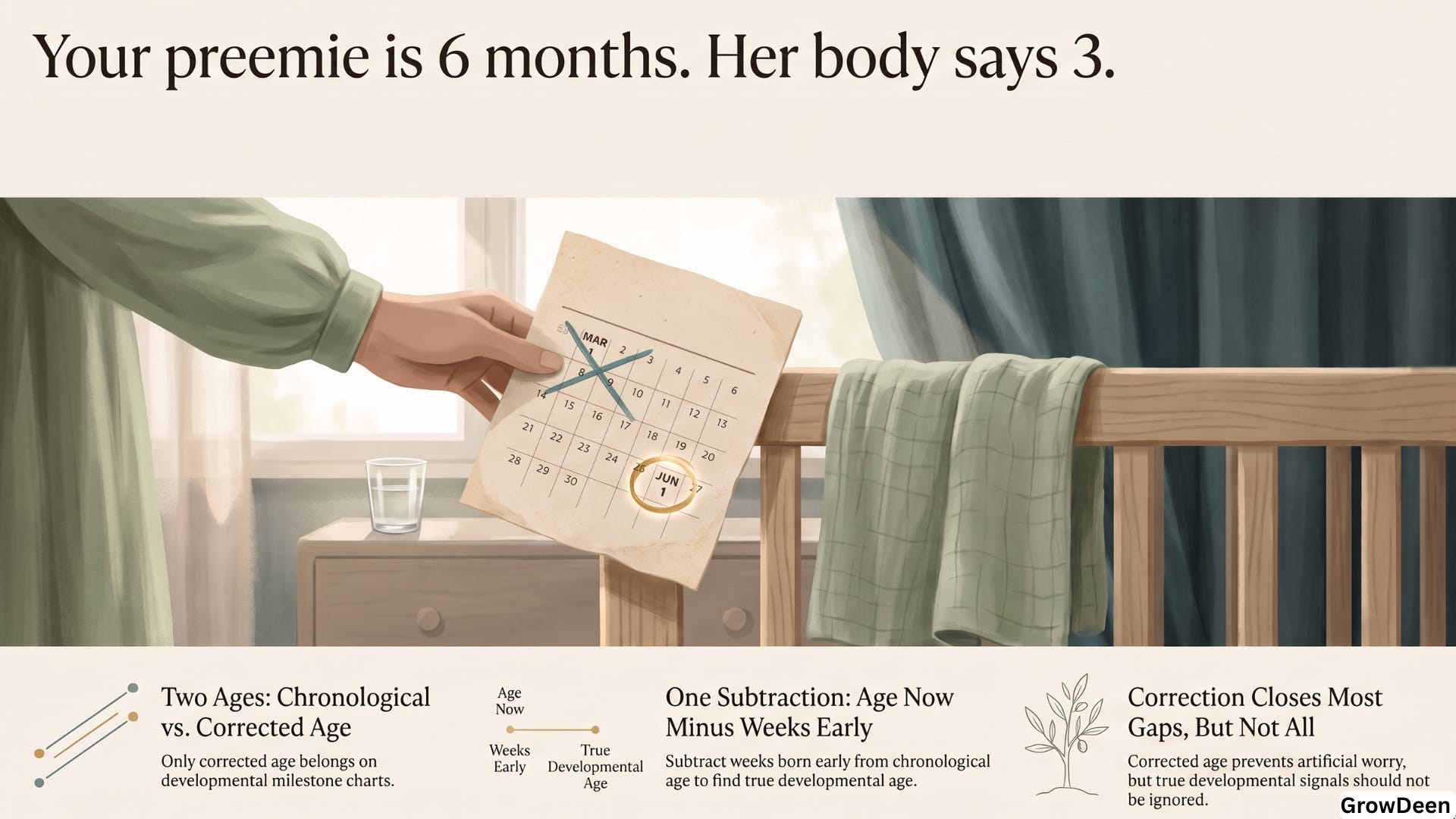
Chronological age is time since birth. It goes on forms, on cards, on the cake. Corrected age is time since the due date, and it is the one developmental comparison runs on.
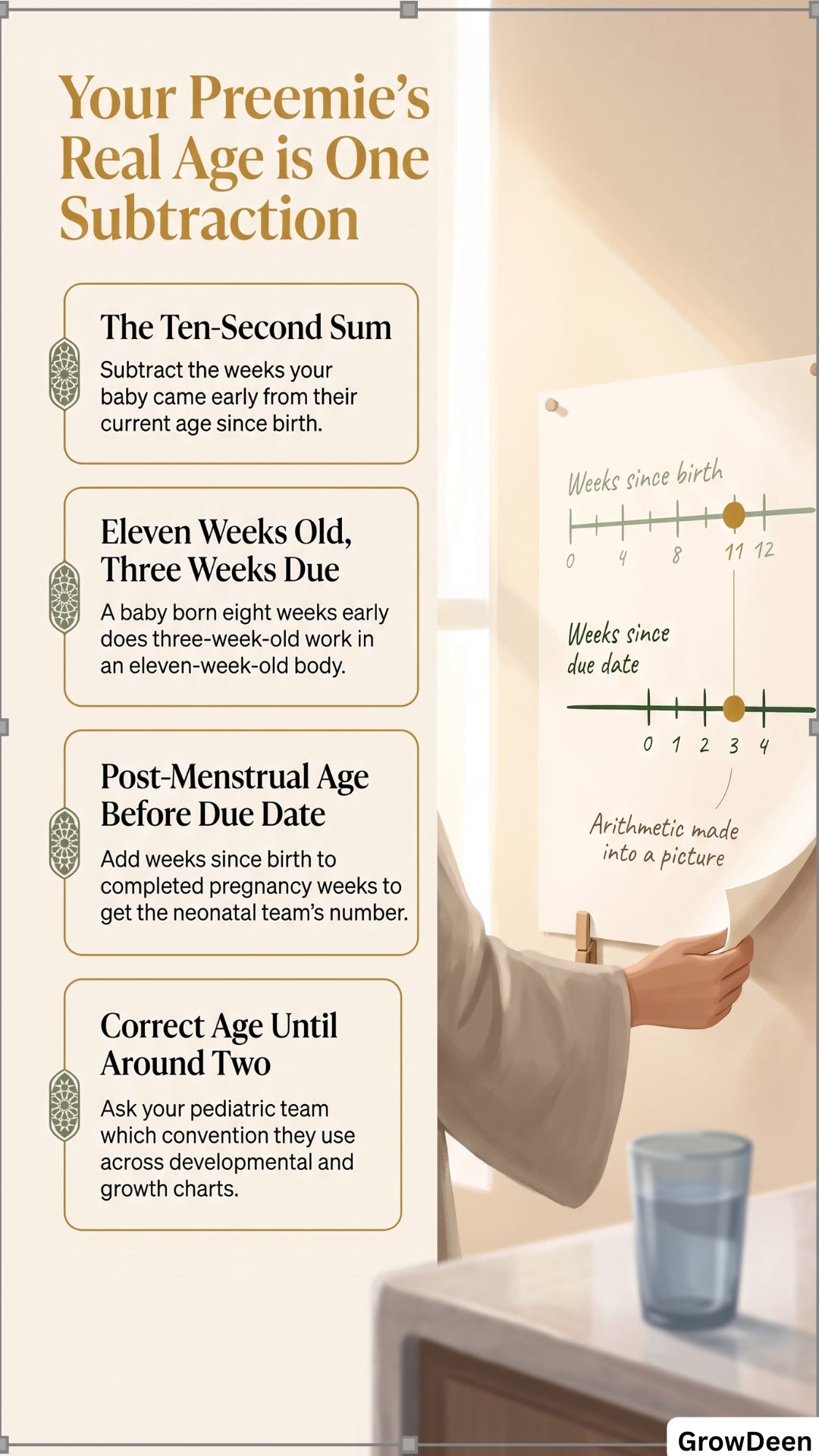
The sum takes ten seconds. Take your baby’s age now, subtract the weeks they arrived early, and use what is left.
Eleven weeks old, born eight weeks early. Corrected age, three weeks. That baby is doing three-week-old work in a body that has been outside for eleven weeks, and every chart written for term babies will call that a delay.
Before the due date passes, the arithmetic runs the other way. Add the weeks since birth to the weeks of pregnancy completed at delivery, and you get post-menstrual age, which is the figure the neonatal team quotes on a ward round and the reason their numbers never match the ones on your phone.
Keep correcting until your paediatric team says to stop, usually around the second birthday. Some teams correct growth for longer than development, and some extend correction to three years for babies born before 32 weeks. Ask yours which convention they use, because it changes how every chart in the file should be read.
Where correction stops working, and why that matters more than the reassurance
Correction has limits, and a guide that hides them is no use to you.
For babies born moderately or late preterm, correcting for prematurity closes most of the apparent gap. For the very and extremely preterm it does not close all of it [3]. A corrected age score that still looks behind is a signal, not an invitation to subtract for another six months.
This is the line that matters. Corrected age exists to stop you panicking about a gap that is not there. It was never meant to help you ignore one that is.
The thing you have not said out loud
The chart is only part of what this is costing you.
Somewhere in the first week, a thought arrived and never fully left. That you did something, or failed to do something, and that this is the result. Mothers carry it more often, and carry it silently, because saying it aloud invites reassurance that feels hollow. Some nights it arrives as a specific memory. Some nights it is just a weight with no sentence attached to it.
Preterm labour has many causes and most of them sit outside anyone’s control. Allah does not hold a soul accountable for what it never chose, and a cause nobody could have seen coming carries no blame.
The second half of that weight is different and more useful. It is the fear that you are missing something, that a real signal is going past you while you reassure yourself. That fear is the correct instinct pointed at the wrong target, and the rest of this article is about where to point it.
What the earliest weeks actually predict
Gestational age at birth tells you more about likely support needs than birth weight, feeding history or anything visible from your sofa [3].
34 to 36 weeks, late preterm. Where most premature babies sit. Organs nearly finished, brain still building. Risk of a lasting concern only slightly above a term baby’s. A short hospital stay is common, usually to gain weight and to master the coordination of sucking, breathing and swallowing, which is harder neurological work than it sounds.
32 to 34 weeks and 28 to 32 weeks, moderately and very preterm. Likelihood of difficulty rises. Most of these children still do well [4].
Before 28 weeks, or under 1 kg. Highest likelihood of development concerns, higher again where intensive care brought complications [3]. Cohort studies following the smallest babies show survival and outcomes improving decade on decade [5].
A band describes a population. It has never met your child, seen your home, or watched what the next three years hold.
The growth chart, and why it keeps frightening you
Growth after an early birth rarely runs in a straight line. The first year often holds a stretch of rapid catch-up followed by a plateau that looks alarming on paper and is unremarkable in a baby who is feeding, alert and interested in faces.
Plot growth against corrected age, which is the single most common charting error families run into. Weight, length and head circumference all belong on the sheet, and head circumference carries the most weight in the early months because it tracks the growth of the brain itself. A head measurement crossing centile lines in either direction is worth raising promptly rather than at the next scheduled visit.
Feeding is the other half of that picture. WHO recommends mother’s own milk for preterm and low birth weight babies, with donor human milk as the next option, and advises that skin to skin contact begins immediately after birth rather than after a stabilising period in an incubator, because starting at once improves survival, lowers infection and hypothermia, and helps feeding [17]. Fathers and other family members can provide skin to skin when the mother cannot.
What you can actually watch for at home
Clinic appointments are twenty minutes. You have the other ten thousand.
How they move. Roughly four in ten very preterm children show mild motor difficulty [6,7]: an awkward pencil grip later on, hesitation about getting around an obstacle, a full cup that does not survive the room. A smaller group has cerebral palsy, concentrated among the most premature and most medically fragile [8], and both the rate and the severity have fallen across recent decades [9]. What to notice now is asymmetry. One side used far more than the other, or limbs that feel stiff or unusually floppy, belongs in a conversation this month.
How they hear. Hearing loss is more common after preterm birth, though severe loss in both ears stays rare [3]. The newborn screen catches most of it. Some surfaces later, which is why a baby who has stopped turning toward sound deserves action rather than another month of watching.
How they see. Low vision and milder problems, short sightedness, squint, poor depth judgement, are all more common after early birth [3]. Serious eye disease is usually caught in hospital, where the most premature babies have scheduled examinations throughout their stay.
How they sound. Language usually unfolds normally, though some preterm children start later or find understanding harder [4]. Delayed speech can be the first visible sign of a hearing or learning difficulty underneath it, so raise it at six months of concern rather than twelve.
How they settle. Some preterm children stay unusually sensitive to light, noise or fabric. Some resist anything entering the mouth, a pattern called oral aversion that turns feeding into slow and anxious work. Pain responses can run stronger too. None of this is a behaviour problem. It is a nervous system finishing work the womb would otherwise have completed [7].
And when was the last time you wrote any of this down before an appointment?
Support Muslim Parenting Lab ❤️
Would you like the most rewarded kind of charity there is? Use the button below now, while you are well, rather than later.
Asked which charity is best, the Prophet ﷺ said the one given while you are healthy, not deferred until death is near. (Sahih al-Bukhari 1419)
What happens at follow up, and how to stop wasting it
Parents arrive at preterm follow up expecting a verdict and leave unsure what was decided.
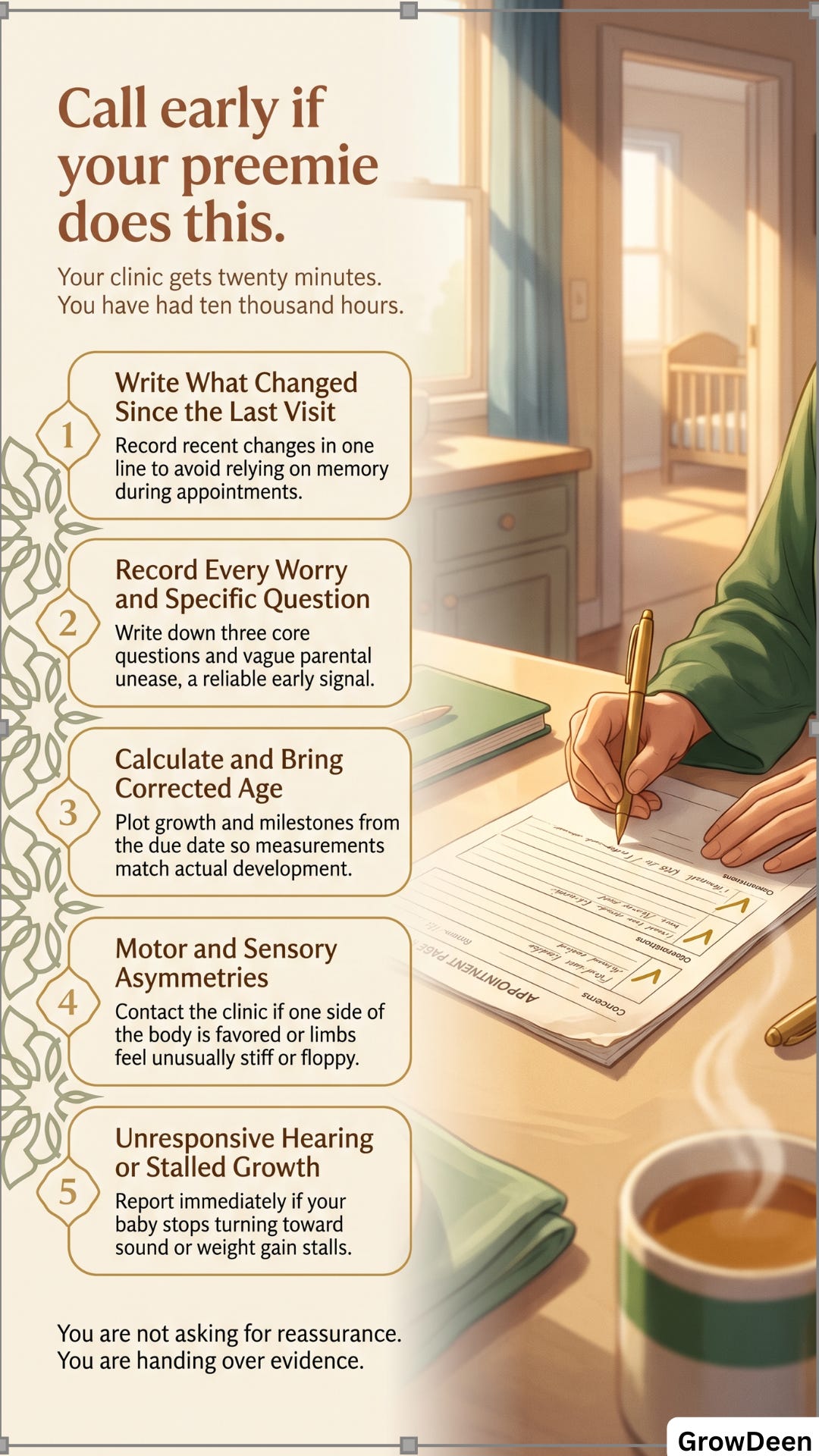
The appointment is surveillance, not diagnosis. A clinician plots growth against corrected age, watches how your baby moves and holds themselves, looks at hands and eyes working together, listens to the sounds being made, and asks you a structured set of questions about home.
Your answers carry real weight there. You have watched hundreds of hours of this baby. The clinic has watched twenty minutes.
So bring a written list. What has changed since last time, what is worrying you, and the things that feel too small to mention. That vague unease a parent struggles to put into words is one of the more reliable early signals in developmental medicine, and it vanishes entirely if nobody says it out loud in the room.
That is a lot to hold in your head at nine at night with a baby on your chest, which is exactly why the free Preemie Pace Kit exists: the corrected age sum worked out for you, a milestone sheet that reads from the due date, and an appointment page you fill in beforehand so nothing gets lost. The download button is at the top of this page, and there is a full description of what is inside it below.
The part of the research nobody puts on a leaflet
Children born prematurely do best in homes that are warm, stable, predictable and safe, where close relationships form easily. A good early environment reduces the severity of some development concerns and helps children with early delay catch up through later childhood [10]. Among low birth weight children, the quality of parenting measurably altered how executive function developed [11].
Structured programmes add to that. The 2024 Cochrane review of early developmental intervention after discharge pooled 44 trials covering 5,051 preterm infants and found cognitive outcomes improved in infancy and clearly improved by preschool age, with a standardised mean difference of 0.39 across nine studies and 1,524 children aged three to five [12]. Motor gains were smaller. Benefits at school age were not established.
Read that again with your own week in mind. The intervention with the best evidence behind it is the one you are already running, in a kitchen, at two in the morning, without calling it anything.
Now consider what a Muslim household supplies before anyone designs a programme. Five prayers marking out the day. Bismillah before food. The same adhkar at the same hinges of morning and evening. A parent’s body as the default place of comfort. That is the warm, repeatable, low-chaos environment the research keeps pointing toward, arriving as ordinary practice rather than as a plan.
Whose measure is your child being held to
The comparison that started this article was never a medical question first.
Allah describes Himself as the One “Who created and proportioned / And who destined and [then] guided” [13]. Tafsir Ibn Kathir reads it plainly: Allah created what exists and shaped every creation in its best form, then set a fixed measure for each thing and guided it toward that measure. Ibn Kathir cites a narration in Sahih Muslim that the measures of all creation were ordained fifty thousand years before the heavens and the earth [13].
So the pace your child moves at was proportioned for that child. The guidance toward it is Allah’s work, not yours and not the chart’s. Holding your baby against the cousin who sat at five months asks a question that was answered long before either of them existed.
Which leaves the part that is actually yours, which is what you expect. The Prophet ﷺ reported that Allah is as His servant expects Him to be, and that He is with him whenever he remembers Him [14]. A parent reading risk percentages at midnight is forming an expectation about a child’s future, and this narration treats that expectation as something consequential rather than as private weather.
Expect well of Allah. Then phone the clinic in the morning. Both of those are acts of trust.
Everything in the Preemie Pace Kit
If you have read this far, you are the kind of parent who would rather hold two uncomfortable facts at once than take the comfortable half. That says something about how this child is being raised.
Inside the Preemie Pace Kit (one comprehensive PDF, 3 pages):
Page 1: The Corrected Age Worksheet. The sum laid out as a fill-in line with two worked examples, plus a twelve-row milestone sheet that reads from the due date. Designed as a fridge sheet you write on once a month, so the arithmetic stops living in your head.
Page 2: The Appointment Page. A fill-in sheet for what changed, what is worrying you and what you want answered, with the red flag list printed alongside it. You walk into a twenty-minute appointment with your ten thousand hours already written down.
Page 3: Allah Proportioned the Pace. A reflection card carrying the verse on creation and measure with Ibn Kathir’s explanation, alongside the narration on expecting well of Allah. Set out for the nights when the chart wins and you need the other argument in front of you.
This is not a PDF to download and forget. It is built to live on a fridge door and in a hospital bag, where you will actually reach for it.
The Preemie Pace Kit is what every subscriber receives with each article. Muslim Parenting Lab covers the full arc of raising Muslim children, from the newborn weeks through the school years, with every piece grounded in current research and rooted in Islamic guidance.
Do this in the next five minutes
Find your due date. Write it on the inside cover of the red book, the baby book, whichever one you actually open, in a pen that will survive two years.
Count from the due date. Every milestone question between now and the second birthday starts at that line, and the calendar on the wall has been quietly lying to you since the day you came home.
May Allah grant your child complete shifa, lighten these years beyond what they look like from here, and place barakah in the acts of care that nobody else ever sees.
Share this with someone who needs it
Think of one person right now: the sister whose baby came at 31 weeks and who has stopped posting photos, the cousin still in the unit doing the drive twice a day, the friend who said something cheerful about milestones last week and then went quiet.
Send it to her today, as company rather than as advice. One of the kindest things a Muslim can do is hand someone the number that ends a month of unnecessary fear.
Frequently asked questions
Q: How do you calculate corrected age for a premature baby?
A: Take your baby’s current age and subtract the number of weeks they were born early. A baby who is 11 weeks old and arrived 8 weeks early has a corrected age of 3 weeks. Use that number for every milestone comparison, not the birth date.
Q: Until what age should I use corrected age?
A: Commonly until around the second birthday, though practice varies. Some teams correct growth measurements for longer than developmental ones, and some extend correction to three years for babies born before 32 weeks. Ask your paediatric team which convention they follow.
Q: Will my premature baby catch up?
A: Most babies born early go on to develop much like babies born at term [2]. The earlier the birth, the higher the chance of some difficulty, and babies born before 28 weeks carry the highest likelihood [3]. Catch-up is the norm rather than the exception, and a good early environment makes it more likely [10].
Q: Are premature babies more likely to have autism or ADHD?
A: Rates of attention deficit hyperactivity disorder, autism, anxiety and depression run slightly above the term population in children born very preterm [15]. All of them remain uncommon. A raised rate across a population is not a prediction about one child.
Q: When should I worry about my premature baby’s development?
A: Speak to your doctor if your baby stops responding to sound or stops babbling, uses one side of the body far more than the other, has limbs that feel stiff or floppy, does not track your face, is distressed by feeding or has stalled in weight gain, or if something feels wrong that you cannot name. See “What you can actually watch for at home” above for what each of those looks like.
Q: Do twins and triplets born early face higher risks than single babies?
A: Multiple pregnancies deliver early far more often, but health and development outcomes for premature multiples look broadly similar to those for premature singletons [16]. The worry scales with the number of cots. The risk per baby holds steady.
Q: Does my premature baby need therapy, or should I wait and see?
A: Early assessment is almost always better than waiting. Occupational therapy and physiotherapy work well on mild motor difficulty and work best when started early [6], and structured early intervention after discharge improves cognitive outcomes through preschool age [12]. A referral buys you an assessment, which is information rather than a diagnosis.
References
[1] World Health Organization. (2023). Preterm birth. WHO Fact Sheet.
[2] Ohuma, E.O., Moller, A.B., Bradley, E., Chakwera, S., Hussain-Alkhateeb, L., Lewin, A., Okwaraji, Y.B., Mahanani, W.R., Johansson, E.W., Lavin, T., Fernandez, D.E., Domínguez, G.G., de Costa, A., Cresswell, J.A., Krasevec, J., Lawn, J.E., Blencowe, H., Requejo, J., & Moran, A.C. (2023). National, regional, and global estimates of preterm birth in 2020, with trends from 2010: A systematic analysis00878-4). The Lancet, 402(10409), 1261-1271.
[3] Crilly, C.J., Haneuse, S., & Litt, J.S. (2021). Predicting the outcomes of preterm neonates beyond the neonatal intensive care unit: What are we missing? Pediatric Research, 89, 426-445.
[4] Wolke, D., Johnson, S., & Mendonca, M. (2019). The life course consequences of very preterm birth. Annual Review of Developmental Psychology, 1, 69-92.
[5] Doyle, L.W., Roberts, G., & Anderson, P.J. (2011). Changing long-term outcomes for infants 500-999 g birth weight in Victoria, 1979-2005. Archives of Disease in Childhood: Fetal and Neonatal Edition, 96(6), F443-F447.
[6] Marlow, N., Hennessy, E.M., Bracewell, M.A., & Wolke, D. (2007). Motor and executive function at 6 years of age after extremely preterm birth. Pediatrics, 120(4), 793-804.
[7] Allievi, A.G., Arichi, T., Tusor, N., Kimpton, J., Arulkumaran, S., Counsell, S.J., Edwards, D., & Burdet, E. (2016). Maturation of sensori-motor functional responses in the preterm brain. Cerebral Cortex, 26(1), 402-413.
[8] Himpens, E., Van den Broeck, C., Oostra, A., Calders, P., & Vanhaesebrouck, P. (2008). Prevalence, type, distribution, and severity of cerebral palsy in relation to gestational age: A meta-analytic review. Developmental Medicine & Child Neurology, 50(5), 334-340.
[9] van Haastert, I.C., Groenendaal, F., Uiterwaal, C.S., Termote, J.U.M., van der Heide-Jalving, M., Eijsermans, M.J.C., Gorter, J.W., Helders, P.J.M., Jongmans, M.J., & de Vries, L.S. (2011). Decreasing incidence and severity of cerebral palsy in prematurely born children. Journal of Pediatrics, 159(1), 86-91.
[10] Cheong, J.L.Y., Burnett, A.C., Treyvaud, K., & Spittle, A.J. (2020). Early environment and long-term outcomes of preterm infants. Journal of Neural Transmission, 127, 1-8.
[11] Camerota, M., Willoughby, M.T., Cox, M., Greenberg, M.T., & the Family Life Project Investigators. (2015). Executive function in low birth weight preschoolers: The moderating effect of parenting. Journal of Abnormal Child Psychology, 43, 1551-1562.
[12] Orton, J., Doyle, L.W., Tripathi, T., Boyd, R., Anderson, P.J., & Spittle, A. (2024). Early developmental intervention programmes provided post hospital discharge to prevent motor and cognitive impairment in preterm infants. Cochrane Database of Systematic Reviews, 2024(2), CD005495.
[13] Qur’an, Surah Al-A’la 87:2-3 (Saheeh International), with Tafsir Ibn Kathir.
[14] Sahih al-Bukhari 7405. Graded: Sahih.
[15] Johnson, S., Hollis, C., Kochhar, P., Hennessy, E., Wolke, D., & Marlow, N. (2010). Psychiatric disorders in extremely preterm children: Longitudinal finding at age 11 years in the EPICure study. Journal of the American Academy of Child & Adolescent Psychiatry, 49(5), 453-463.
[16] Yeo, K.T., Lee, Q.Y., Quek, W.S., Wang, Y.A., Bolisetty, S., & Lui, K. (2015). Trends in morbidity and mortality in extremely preterm multiple gestation newborns. Pediatrics, 136(2), 263-271.
[17] World Health Organization. (2022). WHO recommendations for care of the preterm or low-birth-weight infant. Geneva: World Health Organization.
We combine scientific research with Qur’an and authentic Sunnah, and we cite our sources. Even so, this is general guidance and no substitute for a doctor who can examine your child.