

One daily book adds about 290,000 words by kindergarten. [1] Five a day adds roughly 1.4 million.
Three pages for the next bedtime story.
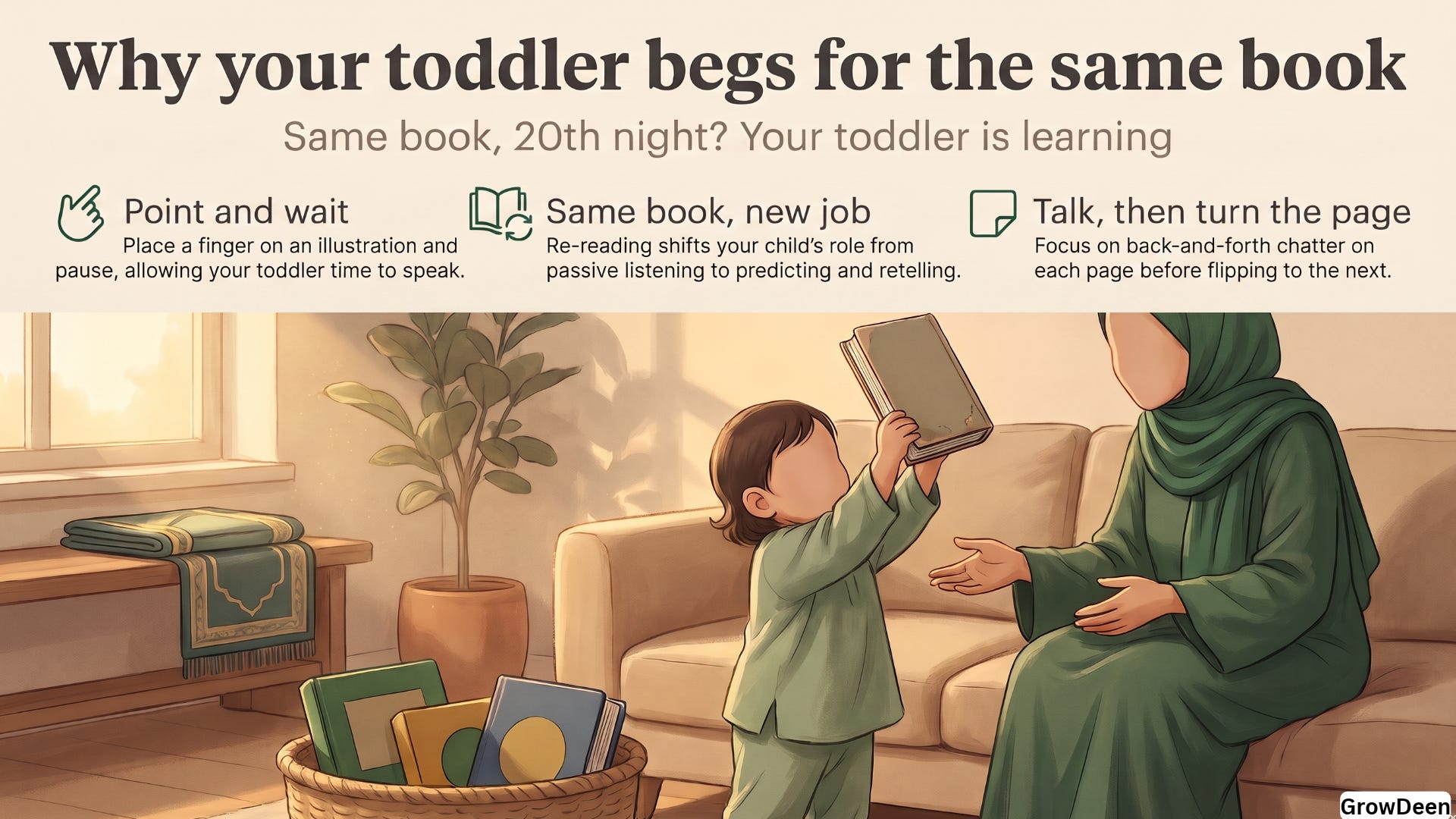
You read every single word.
You did the voices. You turned the pages at a sensible pace and you didn’t skip the boring bit about the tractor. And somewhere around page three, your toddler slid off your lap, walked to the other side of the room and started driving a plastic truck into the sofa.
Now picture a different evening. You only got through two pages, because she kept jabbing a finger at the duck and you kept answering. “Duck! Yes. Where’s the duck going?” The book never got finished. That second evening, with its stops and starts and the story barely moving, was the better reading session by a long way.
If story time in your house rarely looks like the calm photos on parenting accounts, there’s a reason. The thing working against you is an idea most parents absorbed without noticing: that reading to a toddler means getting from the first page to the last. It doesn’t. A toddler learns language in the gaps between the words, when you stop reading and start talking.
There’s a second puzzle worth holding onto as you read. Why does the twentieth reading of the same tired farm book teach your child more than a shiny new one would? It sounds backwards, and the answer is coming.
What Makes This Approach Different
Every recommendation rests on published research, including a 2019 estimate of the word gap [1] and a 2019 laboratory study of print versus tablet books. [2]
The Qur’an and the practice of remembering Allah are woven into the reading itself, so story time becomes part of your child’s tarbiyah instead of a separate lesson.
You already have the free Story Pause Pack from the top of this page: a fridge card of pause moves, a guide to re-reading, and a page that links the animals in your child’s books to the Qur’an.
What Actually Happens In The Pauses When You Read To A Toddler?
Most parents have a private worry about story time, and it’s rarely said out loud. You’re tired by 7:40pm. The book is the same one as yesterday. Your toddler won’t sit still, the cousin the same age seems to know more words, and you’ve skipped three nights this week. It’s easy to conclude that you’re doing it wrong, or not doing enough.
Look closer at what your toddler is doing when the reading “goes off track.” She points. She wants to turn the page herself, even if it’s two pages at once. Those interruptions are the activity. The chatter that grows up around a book, the naming and the back-and-forth, is where much of a young child’s language learning takes place. [3,4]
Researchers have tested this directly. Reviews of shared reading programmes for infants and toddlers find that when parents learn to read in a back-and-forth way, pausing to ask and then following the child’s interest, toddlers’ language grows. [5,6] The pauses carry the weight.
The pause is where the learning lives.
So what does a pause sound like at 7:40 on a Tuesday? A few moves cover almost everything:
Point and wait. Put your finger on one picture and say nothing for a moment. Let your toddler fill the silence.
Finish the line. In a book you’ve read often, stop before the last word: “And the cow says...?”
Ask where. “Where’s the moon?” Wait for a finger.
Ask what. “What’s the cat doing?” If nothing comes, answer cheerfully yourself, “Sleeping!”, and move on.
Do it together. “Can you stretch like the cat?”
Bring it home. “They’re eating dates. You like dates too. What do we say before we eat?” That gives you a natural moment for Bismillah.
Let them turn. Hand over the page and wait for small fingers to flip it.
None of these is a test. If your toddler doesn’t answer, the game still worked, because your toddler heard the word in a moment of shared attention. Which brings us back to that puzzle about the same book read twenty times.
Why Does My Toddler Want The Same Book Every Single Night?
You know the book. Its corners are soft from chewing and you could recite it in your sleep. Some nights you’d give anything for a different one. Your toddler, meanwhile, greets it like an old friend.
The Qur’an names repetition as part of how understanding reaches people. Allah describes it as “the best statement: a consistent Book wherein is reiteration”. [7] Among the explanations Ibn Kathir records for that word, reiteration (mathani), Ad-Dahhak said the Qur’an is oft-repeated so that people will understand what their Lord tells them. [8] A board book is nothing like the Qur’an, and the verse isn’t about children’s stories. It does, though, put words to something parents see every evening: hearing the same words again and again is one of the ways meaning settles.
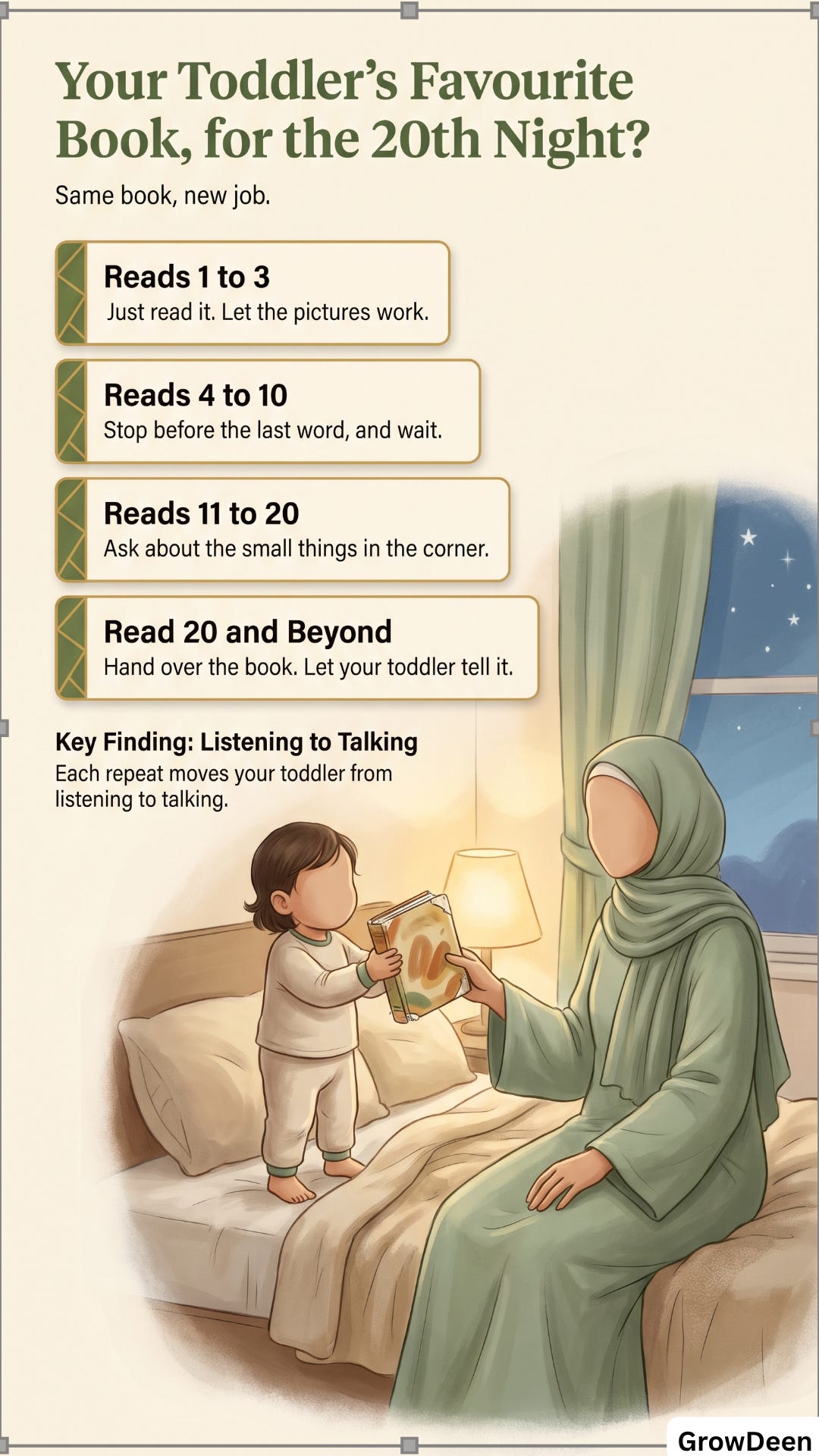
For a toddler, each repeat changes the job. The first few times, the story is new and they just listen. By the fifth or tenth reading, they know what’s coming, so they can predict and finish your lines. Later still, they start “reading” it back to you from memory. That’s why the same book keeps earning its place.
A simple way to use this:
Reads one to three: just read, slowly, and enjoy it.
Reads four to ten: start leaving gaps for your toddler to fill.
Reads eleven to twenty: ask about the pictures, the small details, the dog hiding in the corner.
Beyond twenty: hand your toddler the book and let them tell it to you, however wildly.
What Does Reading Look Like At 18 Months, And At Age Three?
Toddlers read with their whole bodies, and each stage looks different. Knowing what’s normal takes a lot of the frustration out of it.
Between one and two, many toddlers:
hold, pat and chew their favourite books (this is what board books are for)
make sounds for what they see, a “beep beep” for a car or a “baa” for a sheep
bring you the same book over and over
Between two and three, many toddlers:
point at familiar things and name them, sometimes twice: “Ball! Ball!”
answer simple questions like “Where’s the moon?” (pointing to things in a book when asked is a typical milestone by age two, according to the CDC [9])
turn pages and “read” aloud using words remembered from earlier readings
join in with spoken rhymes, short surahs and repeated lines
The naming stage hands you lovely openings to talk about Allah without any lecture. Picture a bird flapping across the page. Your toddler yells “Bird!” and looks at you. You say, “Yes, a bird! Who holds the bird up in the sky? Allah does.” The Qur’an asks, “Do they not see the birds above them with wings outspread and [sometimes] folded in?” and says that none holds them aloft except the Most Merciful. [10] Ibn Kathir explains that Allah holds them up by subjecting the air to them out of His mercy and His gentleness. [11] A two-year-old won’t grasp the tafsir, but the sentence “Allah holds the bird up” is something a toddler can carry.
Do A Few Minutes Of Reading Really Add Up?
It’s a fair question at the end of a long day, when ten minutes with a book feels like one more thing. The numbers say those minutes are among the best spent of the whole day.
Researchers who estimated the words children hear from books found that a child read one book a day hears about 290,000 more words by kindergarten than a child who is never read to, and a child read five a day hears around 1.4 million more. [1] Picture books also carry words that rarely come up in ordinary talk at home, “burrow” and “enormous” and “tumble”, so the gain is in range as well as volume.
The effect lasts. How much parents read with their children in the toddler years predicts language and literacy outcomes years later, and the link holds even after researchers account for how much parents talk with their children in other ways. [12] A large Australian study linked more frequent parent-child reading in early childhood with stronger vocabulary in the first years of school. [13] A study that used natural differences in reading time within the same families found that more time reading with a mother improved children’s reading skills. [14]
Reading also reaches the heart. Children who started reading for pleasure early had better cognitive scores and fewer mental health difficulties in early adolescence, along with differences in brain structure. [15] The American Academy of Pediatrics recommends reading aloud from infancy and describes it as something that strengthens the bond between parent and child, [16] and reviews of the evidence link reading for pleasure with children’s wellbeing as well as their learning. [17]
For Muslim parents there’s a further reason to keep going. Stories carry weight in the Qur’an itself. Allah tells the Prophet ﷺ, “And each [story] We relate to you from the news of the messengers is that by which We make firm your heart”. [18] Ibn Kathir explains that the stories were told to strengthen the Prophet ﷺ, and that the surah contains a reminder that causes the believers to reflect. [19] The stories of the Prophets you’ll one day read to your child belong to that same tradition.
All of this can feel like a lot to hold in your head on a tired evening. That’s why the free Story Pause Pack exists: a fridge card with the pause moves, a page on how to use the same book at each stage, and a page linking the animals in picture books to the Qur’an. The download button is at the top of this page, and there’s a full description of what’s inside it below.
What The Qur’an’s Own Pace Shows About Reading To A Little One
Think about how you read when you’re rushed. The words come out fast and the whole thing is over before it has really started. Now sit with the verse where Allah says, “And [it is] a Qur’an which We have separated [by intervals] that you might recite it to the people over a prolonged period”. [20] According to Tafsir Ibn Kathir, “at intervals” means slowly, and the end of the verse means the Qur’an was sent down little by little. [21] The verse concerns Allah’s Book, and no picture book compares with it. Still, any parent can take a lesson from it: what is meant to be understood arrives in small portions, at an unhurried pace.
Allah also describes the listener who benefits: “Indeed in that is a reminder for whoever has a heart or who listens while he is present [in mind]”. [22] Ibn Kathir records Mujahid describing that listener as one who listens with an attentive heart, and Ad-Dahhak describing a person whose heart is present, not absent. [23] A toddler can’t listen like that over a television, and a parent can’t read like that with one eye on a phone.
A slow book, read a little each day by a parent who is fully in the room, matches closely what the research calls good shared reading. May Allah put barakah in those few quiet minutes.
How Do You Keep The Rhythm Of Nursery Rhymes Without The Music?
Toddler culture runs on songs. Many board books are printed lyrics, and playgroups often finish with a sing-along. Muslim families can keep every bit of the rhythm and leave the music out.
Short surahs are the obvious place to begin. The verses of surahs such as Al-Ikhlas and An-Nas end on a repeated sound, [24] exactly the pattern small ears catch. A toddler who hears Al-Ikhlas each evening will often start supplying the last word of each verse long before they can manage the whole surah.
Spoken rhymes work too. Read rhyming picture books aloud in a bouncy speaking voice instead of singing them. Bounce your toddler on your knee, or pat their back in time with the line. Play clapping and counting games with words, or invent little chants of your own: “Bismillah, here’s my spoon. Alhamdulillah, all done soon.” Gentle adhkar said slowly at bedtime give the same calm, repeated pattern that helps a toddler wind down.
How Do You Set Up Ten Minutes Of Reading That Actually Work?
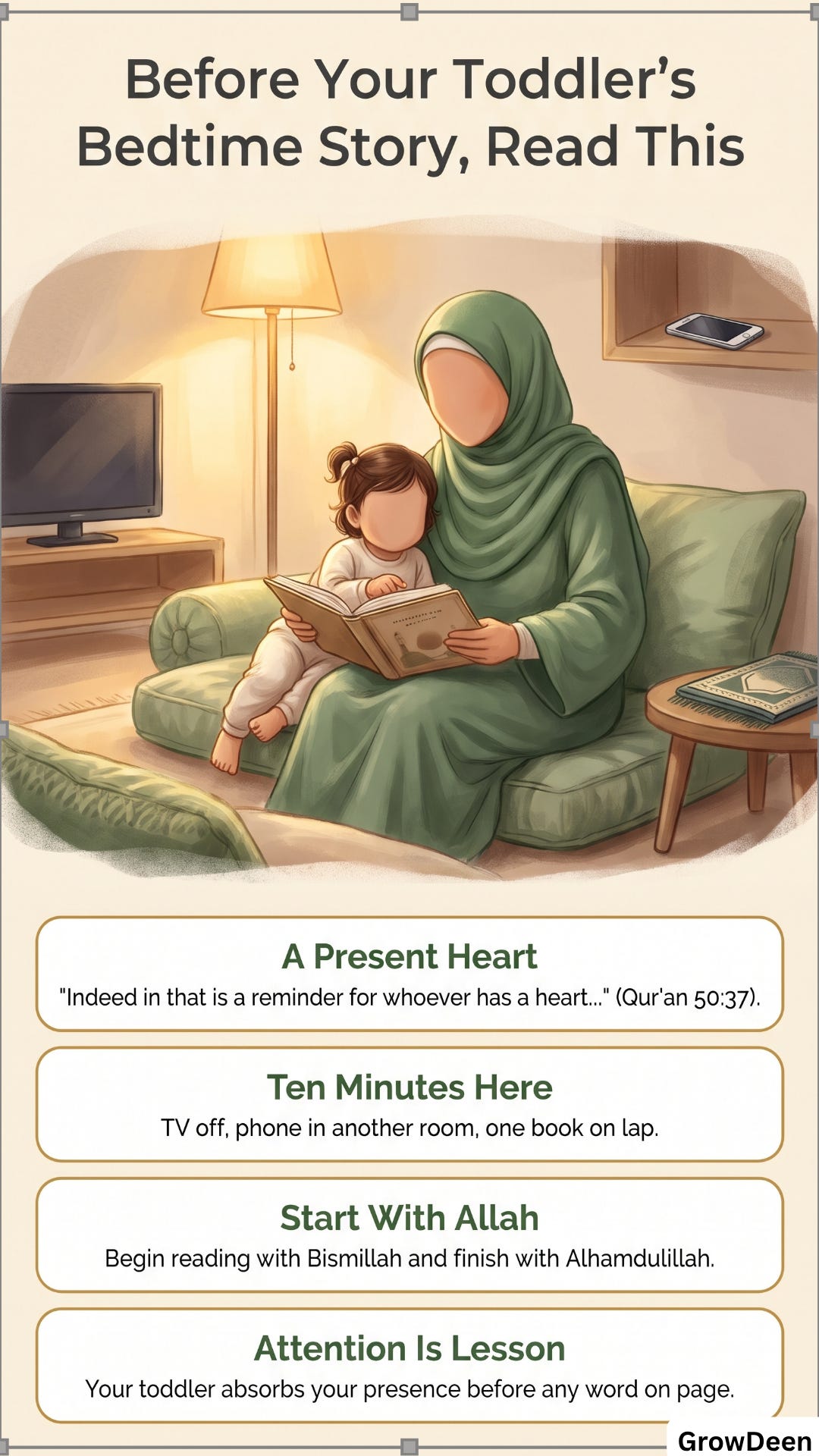
Most reading routines fall apart for one reason: they’re too ambitious. An hour on Saturday is lovely and rarely happens twice. One small book every day, after Fajr or before bed, survives busy weeks and visiting relatives.
A few things make those ten minutes easier:
Pick a fixed point in the day. After the afternoon nap, after Maghrib, or tucked into the bedtime routine beside the bedtime adhkar.
Make a corner. A low shelf or basket with covers facing out, two soft cushions, and the family prayer mat close by if that’s where everyone gathers.
Turn the background off. In a study of 329 children aged 2 to 48 months, each hour of audible television was linked to hundreds fewer words from nearby adults and fewer back-and-forth exchanges between child and adult. [25] Put phones out of reach too.
Sit close. On your lap or tucked beside you, your toddler can see your face and the page at once.
Open with Bismillah and close with Alhamdulillah. Two seconds, and story time is framed as something done in Allah’s name.
Keep books short. One that takes four or five minutes is plenty for most toddlers.
Follow your toddler’s lead. Some nights the book lasts two pages before your child wanders off. That still counts.
What about tablet books with sound effects? They look like a modern upgrade, but they change the conversation. In a laboratory study of 37 parent-toddler pairs, parents and toddlers talked less and collaborated less with electronic books than with print books. [2] The researchers suggested print may be the better choice for toddlers. A narrated video is a step further away again: it can’t stop when your child points at the dog and wants to tell you about the dog next door.
Support Muslim Parenting Lab ❤️
Would you like the reward of every parent who acts on what they read here? Fund it with the button below and it is yours.
The Prophet ﷺ said whoever guides to good has a reward like the one who does it. (Sahih Muslim 1893a)
Which Books Earn A Place On A Toddler’s Shelf?
Toddlers learn best from books about things they already care about. [3,4] Look for:
stories you can read in four to five minutes
simple plots with a beginning, a middle and an end
sturdy board pages, plus fabric, collage or touch-and-feel textures
pictures of simple, familiar things like cups, shoes, cats and the moon
favourite topics such as trucks, trains, animals, stars, the ocean and other children
lift-the-flap, pop-up and moveable formats
stories from different cultures, with some characters who look like your family and some who don’t [26]
Animal books open an easy door to the Qur’an, because several surahs carry animal names: Al-Baqarah (The Cow), An-Nahl (The Bee), An-Naml (The Ant), Al-’Ankabut (The Spider) and Al-Fil (The Elephant). [27] When a bee buzzes across a page, you can say, “Allah has a whole surah called The Bee.” Toddler-friendly retellings of the stories of the Prophets belong here too, the same stories Allah describes as making hearts firm. [18]
Read every book yourself before your toddler sees it. Some much-loved picture books are adaptations of songs, and some carry images or themes that clash with your family’s values and modesty. Quietly swap those out.
Many classics have the rhyme, rhythm and repetition toddlers love, and these are widely available:
Dear Zoo by Rod Campbell, for lift-the-flap animals
Where Is the Green Sheep? by Mem Fox, for repetition and opposites
the Spot books by Eric Hill, for flaps and everyday adventures
Each Peach Pear Plum and Peepo! by Janet and Allan Ahlberg, for spotting games and family routines
Hairy Maclary from Donaldson’s Dairy by Lynley Dodd, for rhyme and rhythm
The Gruffalo by Julia Donaldson, for rhyme and a little suspense with older toddlers
Ten Little Fingers and Ten Little Toes by Mem Fox, for babies from around the world
Freight Train by Donald Crews, for colours and vehicles
I Went Walking by Sue Williams, for farm animals and a repeated question
Whose Baby? and Whose Nose? by Jeanette Rowe, for animal flaps
Dig Dig Digging and Choo Choo Clickety-Clack! by Margaret Mayo, for vehicles and sound words
Alongside these, look for board books from Islamic publishers on Bismillah and Alhamdulillah, Allah’s creation, the five pillars and the stories of the Prophets. Your masjid library or a local Islamic bookshop can point you to toddler titles.
Read in whichever language your warmth comes out in. Shared reading in a family’s heritage language supports early literacy, [28] and shared reading in preschool has helped bilingual children learn their second language. [29] Arabic, Urdu, Somali, Bengali, Malay or English are all good choices.
A library card costs nothing and lets you rotate books every week. Many libraries run free toddler story times; ask first whether a session includes singing, or start a small story circle with other families at home or at the masjid. Plenty of masjids keep a children’s shelf, and giving a few board books to it is an easy sadaqah.
When Is A Quiet Toddler A Reason To Call The Doctor?
Story time is one of the best windows you have onto how your toddler’s language is coming along. Talk with your doctor if your child:
is not trying to say at least three words besides “mama” or “dada” by 18 months [30]
is not pointing to things in a book when asked, or not putting two words together, by two years [9]
loses words or skills they once had [31]
If you ever wonder whether your toddler hears you clearly, ask about a hearing check. The American Academy of Pediatrics recommends general developmental screening at 9, 18 and 30 months, and autism screening at 18 and 24 months, or whenever a parent has a concern. [31] Asking early is part of caring for the amanah Allah has placed in your hands, alongside your du’a and your trust in Him. This article does not replace medical advice, so follow your doctor’s guidance for your own child.
Back To The Book On The Floor
Remember that evening when your toddler slid off your lap at page three? Nothing went wrong. A toddler who wanders off has had enough for tonight, and tomorrow you start again, a page or two at a time.
And the puzzle about the twentieth reading? A new book asks your toddler to listen. A familiar book lets them predict, finish your lines, spot the dog in the corner and, one day, tell the story back to you. The repeats are what turn listening into talking.
So next time the farm book comes back, read slower than feels natural and leave space. The pause is where the learning lives.
Your Free Story Pause Pack
If you’ve read this far, you’re the kind of parent who keeps showing up for the small, repeated moments, even on the nights you’re running on empty. That says a great deal about the home you’re building.
Inside the Story Pause Pack (one comprehensive PDF, 3 pages):
Page 1: The Story Pause Card. Seven pause moves, each with the exact words to say and what to wait for, designed as a fridge or bookshelf card you can glance at mid-story.
Page 2: Same Book, New Job. Four stages of re-reading, from the first few times through to the day your toddler tells the story to you, with a short box on when to speak with a doctor, so you can tell in under five minutes which stage your child is at and what to try next.
Page 3: Allah’s Creatures in Your Child’s Books. Six animal tiles that link the cow, bee, ant, spider, elephant and bird in picture books to the Qur’an, each with a one-line sentence to say to your toddler, plus a parent reminder from Surah Qaf about listening with a present heart.
This isn’t a PDF to download and forget. It’s built to live on the fridge or beside the bookshelf, where you’ll reach for it in the middle of a story.
The Story Pause Pack is what every subscriber receives with each article. Muslim Parenting Lab covers raising Muslim children from the newborn weeks through the early school years, all backed by research and rooted in Islamic guidance.
One Thing To Do In The Next Five Minutes
Choose tonight’s book now, and put it on your pillow so it’s waiting. Then pick the one page where you’ll stop reading and ask, “What’s that?” That’s the whole practice for tonight.
May Allah put barakah in your evenings, and make every small story you share a means of drawing your child closer to Him.
Share This With Someone Who Needs It
Think of one person right now: the cousin who told you at the last family dinner that her son “just won’t sit for a book”, or the friend from the masjid who keeps apologising that she’s too tired to read every night.
This article could take a weight off their shoulders. Send it to them today, as encouragement, so they know that two pages and a lot of pointing is real reading.
Frequently Asked Questions
Q: How long should I read to my toddler each day? A: Short and daily works best. A book that takes four or five minutes is plenty for most toddlers, and even one book a day adds up to about 290,000 extra words by kindergarten. [1] For the routine itself, see “How do you set up ten minutes of reading that actually work?” above.
Q: Is it okay to read the same book over and over? A: Yes, and it’s one of the most useful things you can do. Each repeat lets your toddler predict and finish lines, which is how listening turns into talking. The re-reading stages are in “Why does my toddler want the same book every single night?” above.
Q: What if my toddler won’t sit still for a story? A: That’s normal for this age. Pointing and wandering off are part of how toddlers read, and the back-and-forth around the book is where much of the learning happens. [3] Read two pages, follow their interest, and try again tomorrow.
Q: Are e-books or tablet stories okay for toddlers? A: Print books are the better choice for this age. In one study, parents and toddlers talked less and collaborated less when they read electronic books than when they read print books. [2] If you do use a tablet book, read it the way you would a paper one and ignore the sound effects.
Q: When should I start reading to my child? A: As early as you like. The American Academy of Pediatrics recommends reading aloud from infancy, [16] and a toddler who hasn’t been read to yet can start tonight.
Q: Should I read in English or in our home language? A: Read in the language you speak most warmly. Shared reading in a family’s heritage language supports early literacy, [28] and bilingual children still go on to learn a second language through shared reading. [29]
Q: When should I worry about my toddler’s speech? A: Speak with your doctor if your toddler isn’t trying to say at least three words besides “mama” or “dada” by 18 months, [30] isn’t pointing to things in a book or putting two words together by two, [9] or loses words they once had. [31] See “When is a quiet toddler a reason to call the doctor?” above.
References
[1] Logan, J.A.R., Justice, L.M., Yumuş, M., & Chaparro-Moreno, L.J. (2019). When children are not read to at home: The million word gap. Journal of Developmental and Behavioral Pediatrics, 40(5), 383-386.
[2] Munzer, T.G., Miller, A.L., Weeks, H.M., Kaciroti, N., & Radesky, J. (2019). Differences in parent-toddler interactions with electronic versus print books. Pediatrics, 143(4), e20182012.
[3] Zero to Three. (2003). What we know about early literacy and language development.
[4] Torr, J. (2023). Reading picture books with infants and toddlers: Learning through language. Routledge.
[5] Lorio, C.M., Delehanty, A.D., & Romano, M.K. (2022). A systematic review of parent-child shared book reading interventions for infants and toddlers. Topics in Early Childhood Special Education, 42(3), 222-233.
[6] Salley, B., Daniels, D., Walker, C., & Fleming, K. (2022). Shared book reading intervention for parents of infants and toddlers. Journal of Early Childhood Research, 20(3), 341-358.
[7] Quran, Surah Az-Zumar 39:23 (Saheeh International)
[9] Centers for Disease Control and Prevention. Important milestones: Your child by two years. Learn the Signs. Act Early.
[10] Quran, Surah Al-Mulk 67:19 (Saheeh International)
[11] Ibn Kathir. Tafsir Ibn Kathir, Surah Al-Mulk 67:19 commentary
[12] Demir-Lira, O.E., Applebaum, L.R., Goldin-Meadow, S., & Levine, S.C. (2019). Parents’ early book reading to children: Relation to children’s later language and literacy outcomes controlling for other parent language input. Developmental Science, 22(3), e12764.
[13] Farrant, B.M., & Zubrick, S.R. (2013). Parent-child book reading across early childhood and child vocabulary in the early school years: Findings from the Longitudinal Study of Australian Children. First Language, 33(3), 280-293.
[14] Price, J., & Kalil, A. (2019). The effect of mother-child reading time on children’s reading skills: Evidence from natural within-family variation. Child Development, 90(6), e688-e702.
[15] Sun, Y-J., Sahakian, B.J., Langley, C., Yang, A., Jiang, Y., Kang, J., Zhao, X., Li, C., Cheng, W., & Feng, J. (2023). Early-initiated childhood reading for pleasure: Associations with better cognitive performance, mental well-being and brain structure in young adolescence. Psychological Medicine, 54(2), 359-373.
[16] Council on Early Childhood. (2014). Literacy promotion: An essential component of primary care pediatric practice. Pediatrics, 134(2), 404-409.
[17] Cremin, T., & Scholes, L. (2024). Reading for pleasure: Scrutinising the evidence base. Benefits, tensions and recommendations. Language and Education, 38(4), 537-559.
[18] Quran, Surah Hud 11:120 (Saheeh International)
[19] Ibn Kathir. Tafsir Ibn Kathir, Surah Hud 11:120 commentary
[20] Quran, Surah Al-Isra 17:106 (Saheeh International)
[21] Ibn Kathir. Tafsir Ibn Kathir, Surah Al-Isra 17:106 commentary
[22] Quran, Surah Qaf 50:37 (Saheeh International)
[24] Quran, Surah Al-Ikhlas 112 and Surah An-Nas 114
[25] Christakis, D.A., Gilkerson, J., Richards, J.A., Zimmerman, F.J., Garrison, M.M., Xu, D., Gray, S., & Yapanel, U. (2009). Audible television and decreased adult words, infant vocalizations, and conversational turns: A population-based study. Archives of Pediatrics & Adolescent Medicine, 163(6), 554-558.
[26] Adam, H., Barblett, L., Kirk, G., & Boutte, G.S. (2023). (Re)considering equity, inclusion and belonging in the updating of the Early Years Learning Framework for Australia: The potential and pitfalls of book sharing. Contemporary Issues in Early Childhood, 24(3), 263-277.
[27] Quran, surah titles: Al-Baqarah 2; An-Nahl 16; An-Naml 27; Al-’Ankabut 29; Al-Fil 105
[28] Shen, Y., & Del Tufo, S.N. (2022). Parent-child shared book reading mediates the impact of socioeconomic status on heritage language learners’ emergent literacy. Early Childhood Research Quarterly, 59, 254-264.
[29] Grøver, V., Rydland, V., Gustafsson, J.E., & Snow, C.E. (2020). Shared book reading in preschool supports bilingual children’s second-language learning: A cluster-randomized trial. Child Development, 91(6), 2192-2210.
[30] Centers for Disease Control and Prevention. Important milestones: Your child by eighteen months. Learn the Signs. Act Early.
[31] Centers for Disease Control and Prevention. CDC’s developmental milestones. Learn the Signs. Act Early.
We combine scientific research with Qur’an and authentic Sunnah, and we cite our sources. Even so, this is general guidance and no substitute for a doctor who can examine your child.