


Spanking does not work. Pooled across 75 studies and 160,927 children, it was linked to harm on 13 of 17 measured outcomes and to no improvement in behaviour at all. [3]
Three pages. Print before the next hard evening.
You said it three times.
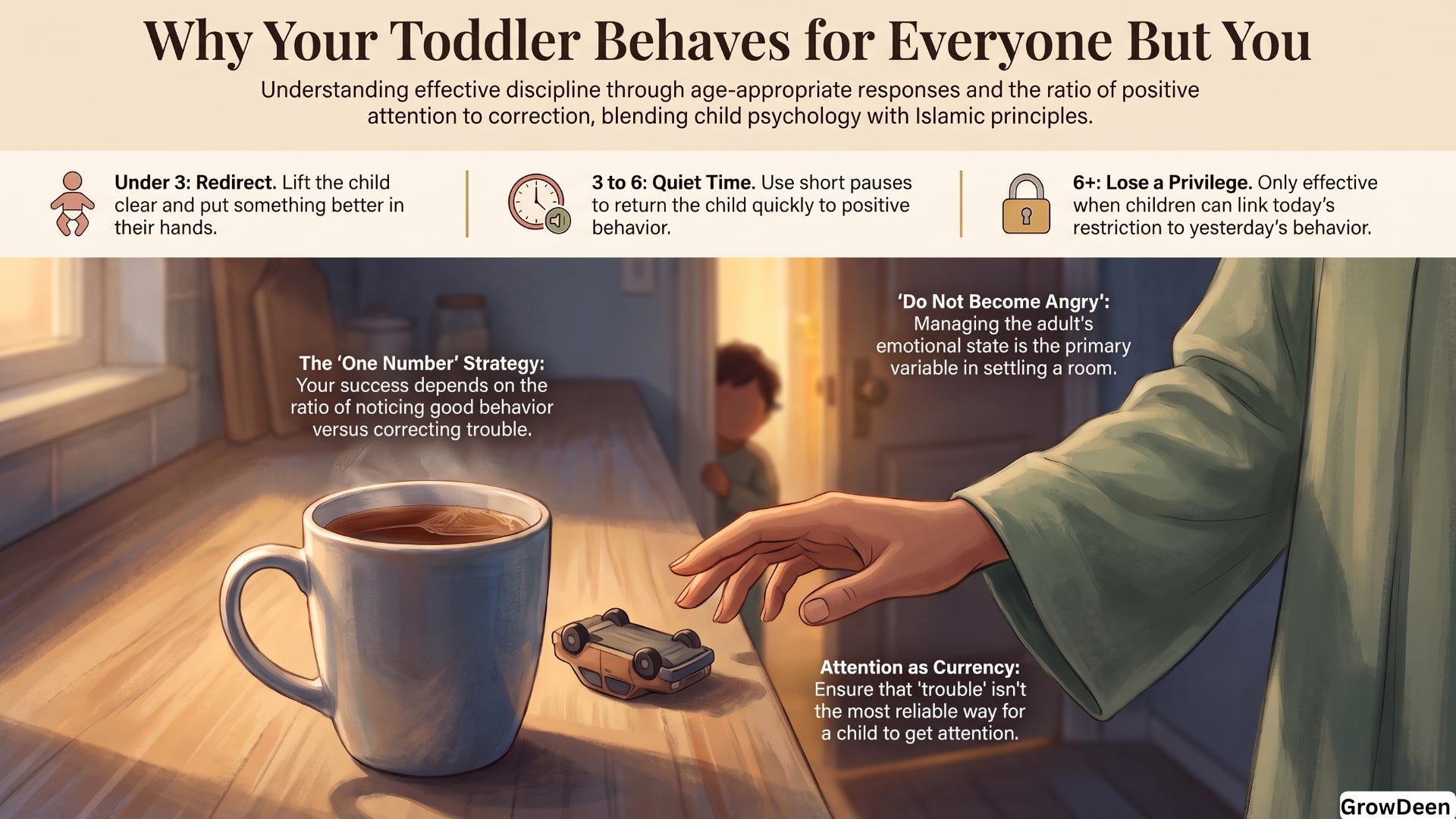
The third time, your voice went somewhere you did not plan. Your four-year-old is now crying about the wrong thing entirely, the toy car is still on the floor, and the tea you made twenty minutes ago has gone cold on the counter.
And you did everything the parenting posts said. You stayed calm, gave the warning, followed through. It escalated anyway.
You are not doing it wrong. You are almost certainly doing it in the wrong order.
There is one number that decides whether any consequence you use will teach your child anything. It has nothing to do with the length of the time-out or the firmness of your voice. Keep reading and it will make sense before the end.
What Makes This Approach Different
The evidence is current and named. Every claim here traces to the American Academy of Pediatrics’ 2018 discipline policy, the CDC’s parenting programme, or peer-reviewed meta-analyses covering tens of thousands of children [1][2][3][5].
The Islamic framing carries the argument. Qur’an 99:7-8 and three authenticated narrations sit at the centre of how this article explains discipline, because Allah’s own system of consequence is the clearest model a parent will ever be given.
You already have the free Consequence Card from the top of this page. Three pages, printable, built for the four seconds before you respond rather than for the calm afternoon afterwards.
The Four Seconds Before You Say Anything
Start with the adult, because the adult is the variable.
A small child in distress has no working brake of his own yet. He borrows one. Whatever state you are in, he moves toward it, which means a raised voice tends to double the disorder in the room rather than settle it.
A man once came to the Prophet ﷺ and asked for advice. The answer was two words: “Do not become angry.” He asked again. He kept asking, and each time the Prophet ﷺ gave him exactly the same two words [13]. Classical commentators note that the Prophet ﷺ was prescribing to the particular man standing in front of him, the way a doctor prescribes to the illness he has actually diagnosed.
Any parent who has lost their temper over spilt milk and then spent the whole evening making it up to a four-year-old knows why that diagnosis keeps getting made.
The research is blunt about where the other road leads. The AAP concluded in 2018 that corporal punishment and yelling at or shaming children are minimally effective in the short term and ineffective in the long term, and that hitting, shouting at or humiliating a child raises stress hormones and is associated with more aggression, not less [1].
So if you are too angry to respond well, say so out loud and postpone it. “I am too upset to talk about this now. We will sort it out in five minutes.” Your children are watching what a Muslim does with anger. That sentence teaches more than the consequence would have.
And when you are steady, there is still one group of children this whole approach does not work on.
Why Your Two-Year-Old Is Not Ignoring You
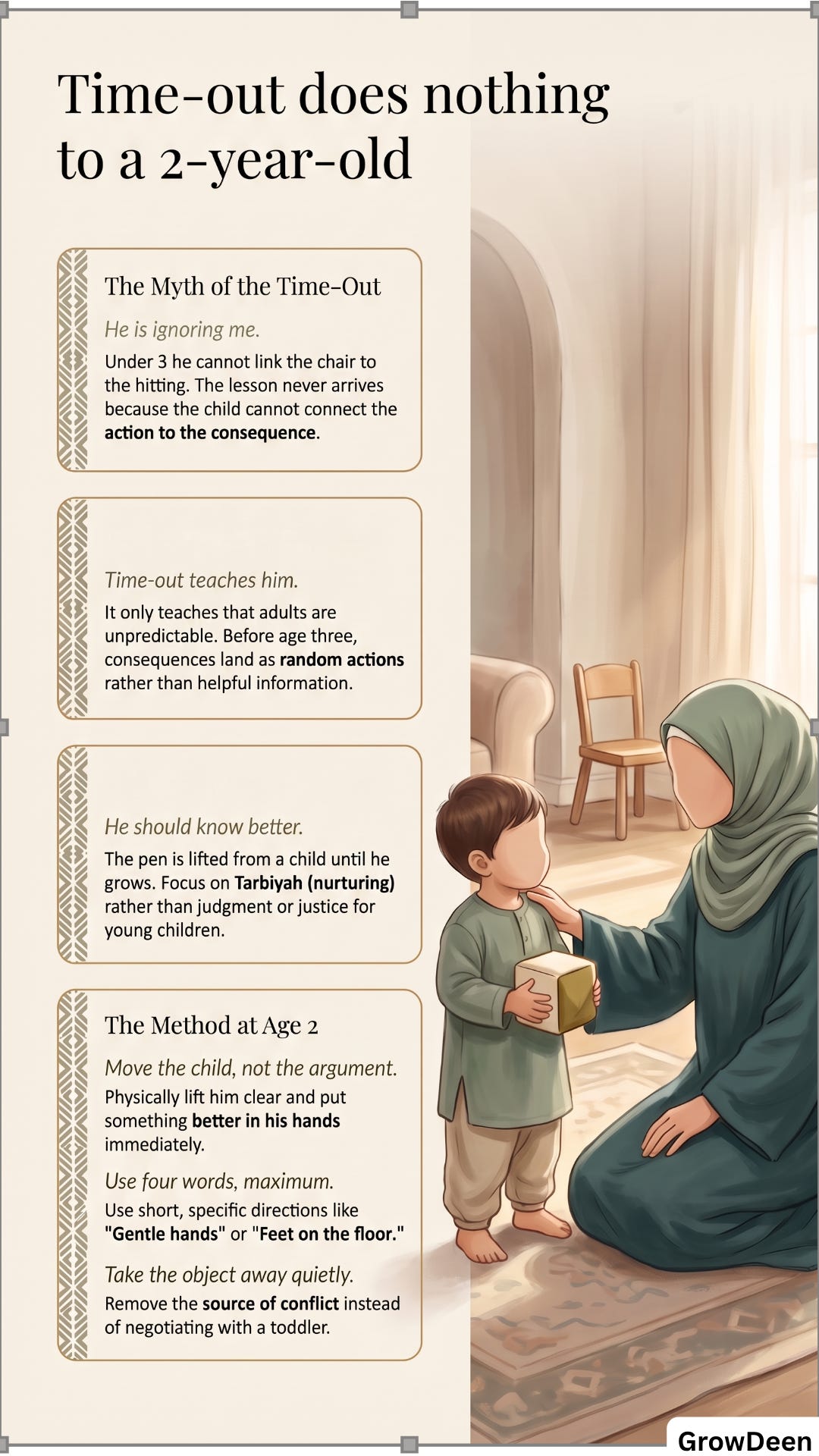
Here is why the same approach that works on your five-year-old fails completely on your two-year-old.
Before roughly three, children cannot reliably link their own action to an outcome that shows up afterwards [2][6]. The consequence lands as something random that an adult did to them, rather than as information, and the only lesson available is that adults are unpredictable.
Islam settled this question long before developmental psychology existed. The Prophet ﷺ said that the pen has been lifted from three: the sleeper until he wakes, the child until he reaches puberty, and the one who has lost his reason until he recovers [12]. Scholars across the schools of law take this as the basis for the position that a child before puberty is simply not held to account the way an adult is.
Sit with that for a second. Your toddler is not committing sins. He is under construction, and your job in these years is tarbiyah rather than justice.
What that looks like at 6pm on a Tuesday:
Move the child, not the argument. Lift him clear and put something better in his hands.
Four words, maximum. “Gentle hands.” “Feet on the floor.” “We share the car.”
Take the object away quietly instead of negotiating with someone who has no negotiating equipment yet.
Say the good thing out loud while it is happening. “You are waiting so nicely. Alhamdulillah.”
Feed and rest them before the hard part of the day. An enormous share of toddler behaviour is hunger and tiredness in a costume.
Quiet time and time-out start working somewhere around three [2]. Loss of privilege, the kind where the bike disappears for an afternoon, needs about six, because that is when a child can hold yesterday’s behaviour and today’s restriction in mind at once.
I know this is a lot to hold in your head at 6pm with one child crying and dinner half made. That is exactly why the free Consequence Card exists: a three-page printable that lays out what works at each age and what to say in the moment. The download button is at the top of this page, and there is a full description of what is inside it below.
But here is what most parents have never been shown: the model for all of this is already in the Qur’an, and it is not the part you would expect.
The Recompense for Every Small Deed
Before the practical part, one thing worth slowing down for.
Allah says, “So whoever does an atom’s weight of good will see it, and whoever does an atom’s weight of evil will see it” [Qur’an 99:7-8]. According to Tafsir Ibn Kathir, the Prophet ﷺ described this as the single comprehensive verse, and Ibn Kathir then gathers narration after narration pressing it in both directions: never belittle a small good, not even meeting someone with a cheerful face, and never wave away a small wrong, because small wrongs gather until they overwhelm a person [9].
Teaching a three-year-old that actions carry outcomes is that verse, scaled down to a toy car and a shared turn.
What is harder to sit with is how much mercy Allah builds into His own reckoning. A good deed intended and not carried out is still written as a full good deed. Carried out, it multiplies from ten to seven hundred. A bad deed intended and then abandoned is recorded as a good deed [10]. And written above the Throne is that His mercy overcomes His anger [11].
Read as a system of consequences, that is wildly lopsided toward encouragement. Which brings us to the number.
The Ledger Most Homes Run Backwards
The number is the ratio of noticing to correcting.
Watch an ordinary Tuesday. The child who plays quietly for twenty minutes gets silence. The child who tips over a cup gets ninety seconds of undivided adult attention, a raised voice, and a parent suddenly two feet away.
Attention is the only currency a small child deals in. A parent who pays out exclusively during trouble has, without meaning to, made trouble the better deal.
This is why the AAP’s guidance starts where it does: begin from the premise of rewarding positive behaviour, set expectations in advance, and follow through consistently [1]. When researchers pulled apart dozens of parent-training programmes to find which components actually shifted children’s behaviour, the same unglamorous ingredients kept surfacing: positive time together, consistent responding, and parents practising the new skill with the child rather than being lectured about it [5][7].
So make the praise specific. “Good boy” tells a child almost nothing. “You put both shoes away without being asked” tells him exactly which behaviour bought your warmth, which is the only part he can repeat tomorrow.
And notice him when nothing is going wrong. Sit down for the quiet ten minutes he spends with his blocks. It is the cheapest investment available, and it lowers the amount of trouble he has to manufacture to be seen.
So what does all of this actually look like at 8pm on a Tuesday, when the ledger is already in deficit?
What To Actually Do When It Happens
Consequences still matter. They just work inside a relationship rather than instead of one [1][8].
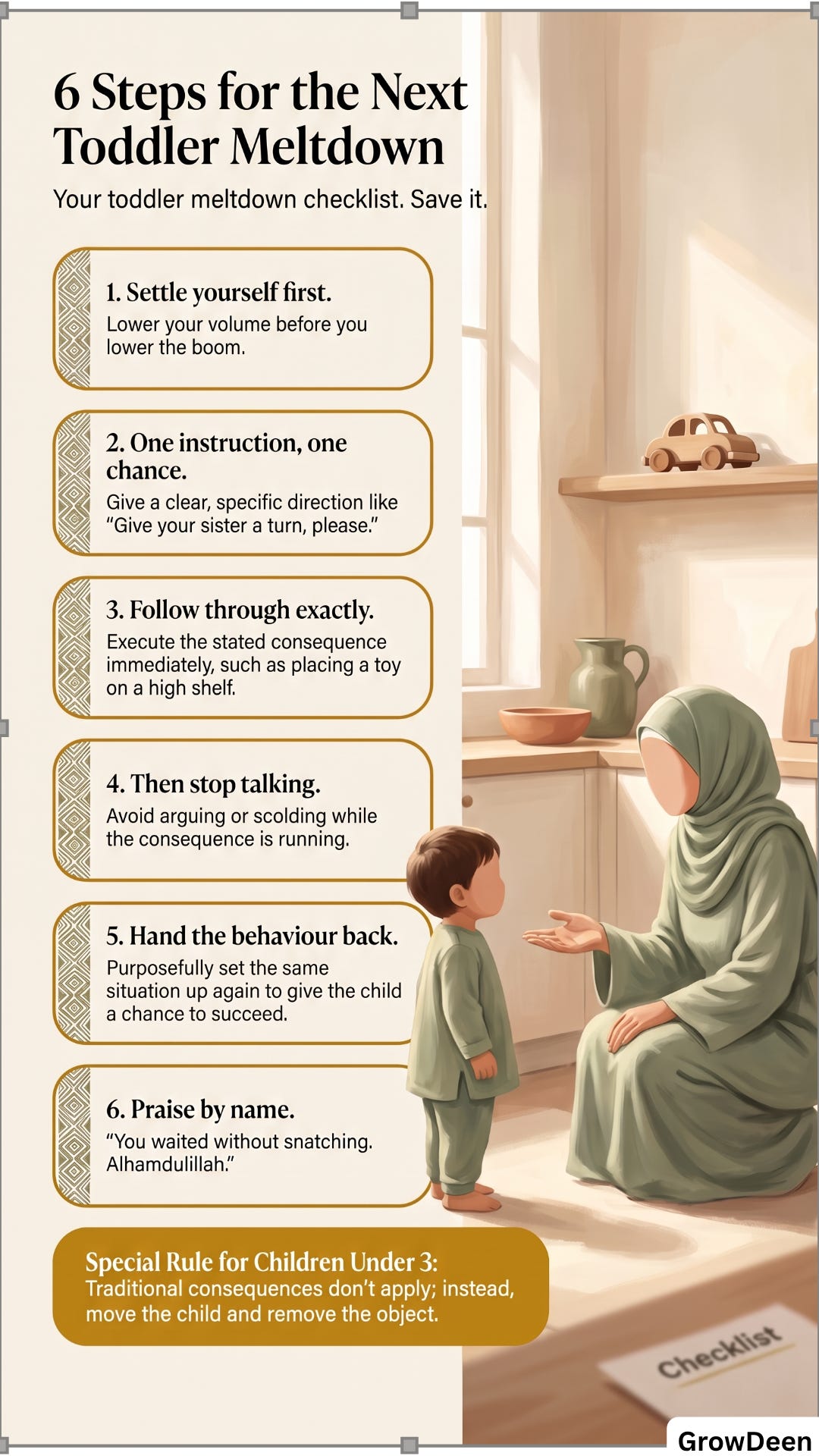
Six steps, in this order:
Settle yourself first. Lower your volume before you lower the boom.
One clear instruction, one chance. “Yusuf, give Maryam a turn please.” Short, positive, specific directions produce far more cooperation than questions or explanations [6]. The exception is a rule the family has already agreed is absolute, like hitting, where the consequence follows immediately.
Follow through exactly as you said. “Because the turn was not given, the car rests on the shelf for ten minutes.”
Then stop talking. Lecturing during the consequence turns a short pause into a negotiation.
Hand the behaviour back. Recreate the same situation on purpose so he gets a chance to succeed at it.
Praise the success by name. “You waited for your sister without snatching. Alhamdulillah, that is beautiful adab.”
Step six is the one everybody skips, and it does most of the teaching.
Two rules about the consequence itself. Keep it connected: the child who spilled it wipes it up, the toy they fought over rests on the shelf for ten minutes. Research with children and parents found that consequences which connect logically to the behaviour, delivered with the child’s dignity intact, produce less anger and more empathy than punishment that arrives out of nowhere [4]. And keep it short: ten minutes returns your child quickly to the same situation, where he can get it right and collect your praise, which is where the learning actually happens.
If you use time-out, pick the spot on a calm day rather than mid-meltdown, warn once, state the reason in a single sentence, hold it to roughly one minute per year of age, and praise the very next good thing he does [2]. Keep the prayer mat, the Qur’an and the masjid entirely out of it. A child sent to pray as a punishment learns that salah is what happens when he is in disgrace, and that takes years to undo.
None of which survives contact with a second child unless one more thing holds.
The Sibling Audit Nobody Escapes
Children audit fairness with something close to forensic accuracy. If one child sits out for hitting and the other does not, the rule is dead, and both of them work that out before you do.
Islam puts a weight on this that most parents never stop to consider. The Prophet ﷺ said that those who act justly will be with Allah on pulpits of light at the right hand of the Most Merciful: those who are just in their judgements, with their families, and in whatever has been placed under their charge [14].
Sorting out a dispute over a toy car at eight in the morning is the small daily version of something Allah rewards at that level.
Justice here means consistency, not sameness. A six-year-old and a two-year-old cannot carry identical expectations. What has to hold steady is that the same rule produces the same response whichever child breaks it, with a reason each of them can follow.
Five Things That Reliably Backfire
Hitting, smacking, shaking. Against the weight of the evidence [1][3], and outside the Prophet’s ﷺ practice in his own household.
Shouting and name-calling. Same documented harms as physical punishment [1].
Threats you will not carry out. “We are leaving right now,” said for the fifth time, teaches a child that your words are decorative.
Long consequences. A whole day without the bicycle is forgotten by lunch and teaches nothing [2].
Correcting the child instead of the behaviour. “In our family we share” addresses an action. “You are so selfish” hands a child an identity.
Expect things to get briefly worse the first week you stop giving in. A child tests whether a new rule is real before accepting that it is [2]. That week is the price, and it is short.
The Consequence Card
If you have read this far, you are the kind of parent who treats correction as teaching rather than as winning. That tells me something about you.
Inside the Consequence Card (one comprehensive PDF, 3 pages):
Page 1: The Four Seconds Card — the six-step sequence with the exact sentences to say at each step, plus a one-line age rule for under-3s, 3 to 6s and 6-plus, so you are not deciding what a fair consequence looks like while a child is screaming — designed as a laminated quick-reference card you can keep on the fridge door or inside a kitchen cupboard.
Page 2: The Noticing Tracker — a seven-day grid with two columns, one tally for every time you noticed something good out loud and one for every correction, so you can see your actual ratio on paper by Wednesday instead of guessing at it.
Page 3: The Atom’s Weight Reflection — Qur’an 99:7-8 in English translation with its source line, alongside the narration on how Allah records an intended good deed, a performed one and an abandoned bad one, with three short lines on what that lopsided ledger asks of a parent standing in a kitchen at 6pm.
This isn’t just a PDF to download and forget. It’s a tool designed to stay on your fridge door — where you’ll actually use it when you need it most.
This Consequence Card is what every subscriber receives with each article. We cover the full journey of raising Muslim children, from the newborn weeks through the school years, all backed by peer-reviewed research and rooted in the Qur’an and Sunnah.
If you’re a Muslim parent who wants both evidence-based guidance and Islamic perspective, subscribe for free so future resources arrive in your inbox before you need them.
Subscribe free for parenting resources backed by both science and Sunnah, guidance you genuinely can’t get anywhere else. No spam, no clutter, just resources that matter.
Before You Close This Tab
One thing, and it takes ninety seconds.
Go and pick the time-out spot now, while the house is calm. A specific chair, a specific step, a specific corner. Choosing it tonight means you are not inventing it in the middle of a meltdown tomorrow, which is when every parent picks the bedroom by accident and then spends six months fixing bedtime.
If your children are under three, do the toddler version instead: move one thing that causes the same fight every single day. The bowl, the remote, the sibling’s puzzle. Just move it.
Share This With Someone Who Needs It
Think of one person right now: the sister at the masjid who told you bedtime has become a nightly fight, the friend whose voice messages sound exactly like yours did last year, the cousin who confessed she shouted at her three-year-old and has not stopped feeling sick about it.
This article could take some weight off them today. Send it to her, not as advice-giving but as companionship. Sometimes the kindest thing we can do is hand someone the thing that finally made sense to us.
Frequently Asked Questions
Q: At what age can you start using consequences with a child?
A: Around three. Before that, children cannot reliably connect their own action to an outcome that arrives afterwards, so the consequence registers as random rather than as a lesson [2][6]. For under-threes, redirection, removing the object and changing the environment do the work instead. See “Why Your Two-Year-Old Is Not Ignoring You” above.
Q: How long should a time-out be?
A: Roughly one minute per year of age, so three minutes for a three-year-old [2]. Warn once, give the reason in a single sentence, then stop talking. Short is the whole point: it returns your child quickly to the same situation so they can get it right and earn your praise.
Q: Does smacking ever work?
A: No. Pooled across 75 studies and 160,927 children, spanking was linked to harm on 13 of 17 outcomes and showed no association with improved behaviour or compliance [3]. The AAP reached the same conclusion in 2018 about hitting, yelling and shaming [1].
Q: What does Islam say about disciplining young children?
A: The Prophet ﷺ taught that the pen is lifted from a child until puberty, meaning a young child is not held to account the way an adult is [12]. His standing advice on anger was two words, repeated: “Do not become angry” [13]. Correction in these years is tarbiyah, teaching, not punishment.
Q: My child behaves for everyone except me. Why?
A: Usually because home is where the attention ledger is most lopsided. Children get noticed at school for effort and noticed at home mainly when something goes wrong, which quietly makes trouble the more reliable way to be seen. Start tallying how often you say something good out loud versus how often you correct.
Q: Is it wrong to use the prayer mat or Qur’an as a consequence?
A: Keep worship out of the discipline system entirely. A child sent to pray as a punishment learns that salah is what happens when he is in disgrace, and that association is expensive to undo later. Use a neutral spot instead.
Q: My toddler’s behaviour got worse when I started being consistent. Should I stop?
A: No, that is the expected pattern. A child tests whether a new rule is real before accepting it, so the first week is usually the worst one [2]. If severe aggression or distress continues for weeks despite consistent handling, speak with your doctor or a qualified child health professional [8].
References
[1] Sege, R.D., & Siegel, B.S. (2018). Effective Discipline to Raise Healthy Children. American Academy of Pediatrics Policy Statement. Pediatrics, 142(6), e20183112.
[2] Centers for Disease Control and Prevention. Essentials for Parenting Toddlers and Preschoolers: Using Discipline and Consequences; Using Time-Out; Steps for Effective Time-Outs.
[3] Gershoff, E.T., & Grogan-Kaylor, A. (2016). Spanking and child outcomes: Old controversies and new meta-analyses. Journal of Family Psychology, 30(4), 453-469.
[4] Robichaud, J-M., Lessard, J., Labelle, L., & Mageau, G.A. (2020). The role of logical consequences and autonomy support in children’s anticipated reactions of anger and empathy. Journal of Child and Family Studies, 29(6), 1511-1524.
[5] Leijten, P., Gardner, F., Melendez-Torres, G.J., van Aar, J., Hutchings, J., Schulz, S., Knerr, W., & Overbeek, G. (2019). Meta-analyses: Key parenting program components for disruptive child behavior. Journal of the American Academy of Child & Adolescent Psychiatry, 58(2), 180-190.
[6] Morris, C., Conway, A.A., & Goetz, D.B. (2021). A review of effective strategies for parent-delivered instruction. Behavior Analysis in Practice, 14(2), 513-522.
[7] Kaminski, J.W., Valle, L.A., Filene, J.H., & Boyle, C.L. (2008). A meta-analytic review of components associated with parent training program effectiveness. Journal of Abnormal Child Psychology, 36(4), 567-589.
[8] Jarman, R. (2015). Finetuning behaviour management in young children. Australian Family Physician, 44(12), 896-899.
[9] Qur’an, Surah az-Zalzalah 99:7-8, with Tafsir Ibn Kathir.
[10] Sahih al-Bukhari 6491; Sahih Muslim 131.
[11] Sahih al-Bukhari 3194; Sahih Muslim 2751.
[12] Sunan Abi Dawud 4403; Jami’ at-Tirmidhi 1423; Sunan Ibn Majah 2041; Musnad Ahmad 940.
[13] Sahih al-Bukhari 6116; Forty Hadith of an-Nawawi 16.
[14] Sahih Muslim 1827; Sunan an-Nasa’i 5379.