

Children may need ten to fifteen separate encounters with a new food before they willingly eat it. [1]
Print it before tonight’s dinner.
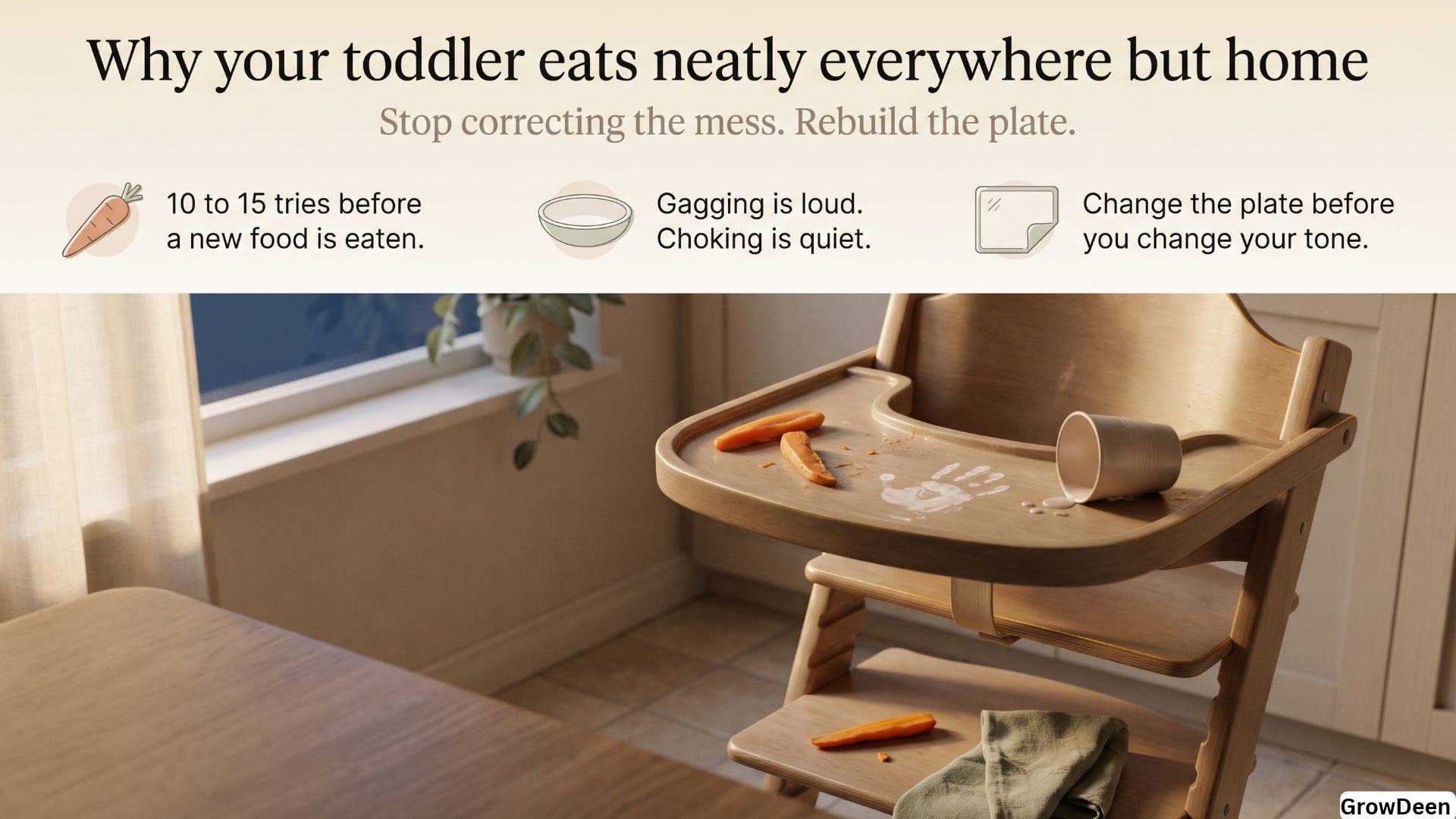
The rice went on the floor again.
You had already wiped the chair twice. You cut everything small, you sat down with her, you said Bismillah out loud the way you always do, and she looked straight at you, opened her hand over the side of the tray, and let the whole fistful drop. Then she waited to see your face.
Most parenting advice would tell you to stay calm and be patient, and you have been. That is the part nobody warns you about. You can do everything the gentle-parenting posts recommend and still be on your knees under the table at seven in the evening, wondering why your child is the only one who eats like this.
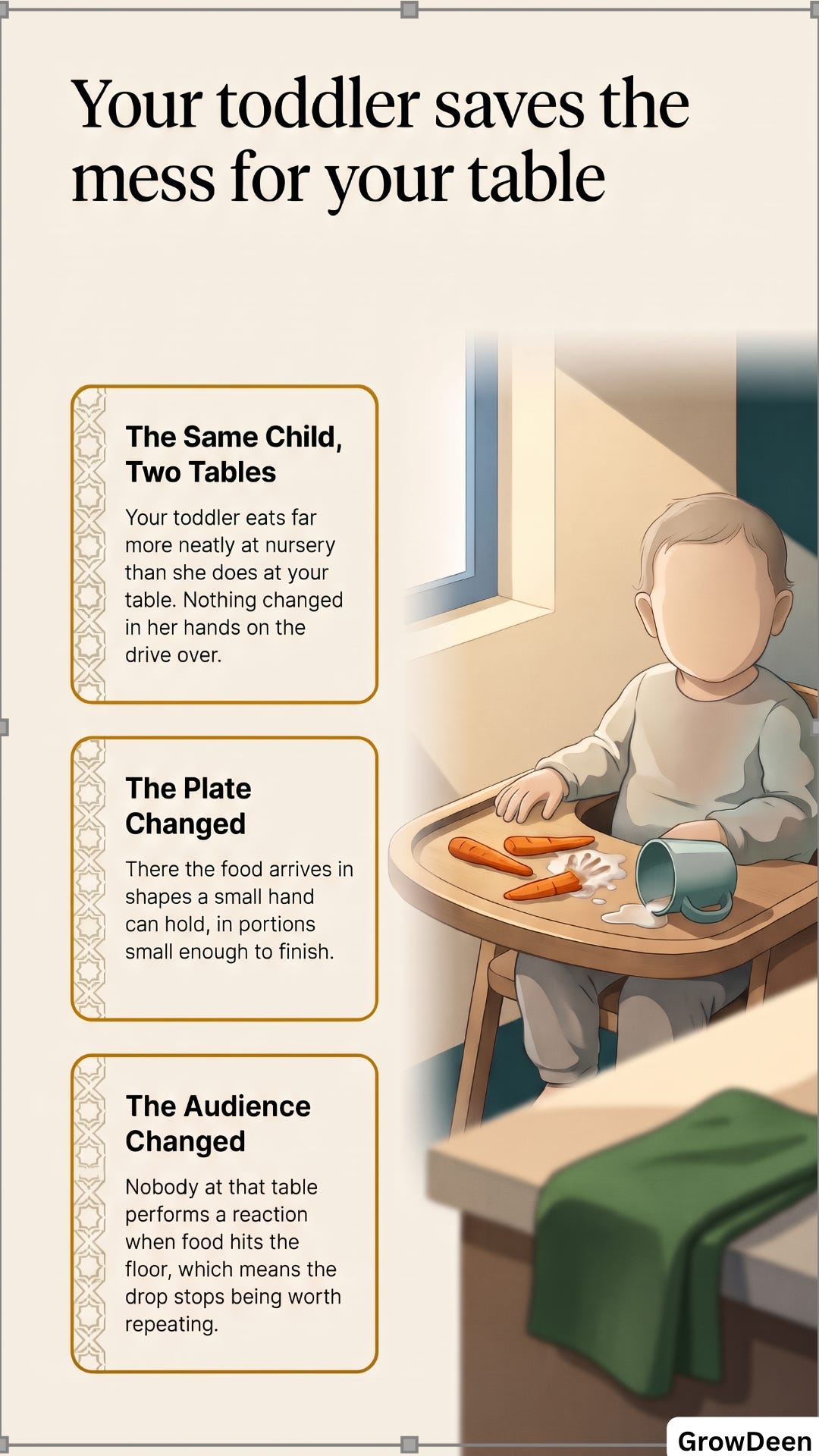
Here is the question worth carrying through the rest of this: why does the same child who paints the table with yoghurt at home manage to eat so much more neatly at nursery or at her grandmother’s house?
The answer is coming. It has almost nothing to do with your child.
Why This Guide Is Different From The Usual List Of Mealtime Tips
Every claim here is traced to paediatric and child-development research, named in the text and listed at the end, including a randomised controlled trial on self-feeding and choking that most mealtime advice never mentions.
The Islamic frame is not decoration at the end. Qur’an 4:28 and Tafsir Ibn Kathir sit at the centre of this piece, because the question of what Allah asks of a creature with small capacity is exactly the question a parent is standing in at dinner.
You already have the free Messy Hands Pack from the top of this page, built so the two pages you actually need are on the fridge before the next meal rather than saved in a tab you never reopen.
What Your Child’s Hands Are Actually Doing
Picture the moment before the drop. She lifts a piece of pasta, loses it, finds it again, flattens it against the tray with her palm, licks her hand, and only then opens her fingers over the edge. Nothing about that sequence is aimless.
Feeding yourself is one of the harder physical skills of early childhood, and it arrives in stages. Food comes first on a spoon held by an adult. Then fingers and fistfuls. Then a spoon your child loads and lifts and tips at the last second. The American Academy of Pediatrics describes the ordinary shape of it: around fifteen months, many children can fill a spoon and land it reasonably often, and by eighteen months they can manage a spoon, fork and unbreakable cup when they feel like doing so, which is not every meal. Some children settle out of chaotic eating near their second birthday, and others stay thoroughly messy well into their third year. [2]
Both of those children are normal. One of them simply has a parent who has stopped sleeping over it.
Then there is the part that surprises most parents, because it has nothing to do with muscles at all. Touching food lowers a child’s suspicion of it. Research with preschool children has linked sensory play with food to a greater willingness to taste fruit and vegetables [3], and children who enjoy messy tactile play tend to show lower food neophobia, the wariness of anything unfamiliar landing on the plate [4]. A longitudinal study following young children across repeated introductions of new foods found that the early poking and squashing was part of how acceptance built over time. [5]
Which means the broccoli your child destroyed tonight still counted. It was one of the ten to fifteen encounters. [1]
And that is before the thing most parents have never been told about gagging.
Gagging Is Not Choking, And The Difference Changes Everything
The first time a child gags on a lump of food, most parents decide on the spot that finger foods are too dangerous and go back to purée. The evidence points somewhere more reassuring.
A randomised controlled trial in New Zealand compared infants who fed themselves from the start of solids with infants who were spoon fed in the usual way. Choking rates showed no significant difference between the groups at any point measured. The same trial found that 35 percent of all the infants choked at least once between six and eight months, across both groups, which tells you how common a frightening moment is whatever method a family uses. The self-feeding infants gagged more often at six months, then gagged less often than the comparison group by eight months. [6]
Gagging is a protective reflex pushing food forward, and it is loud. Choking is quiet. Learning to tell those two apart is worth more than any amount of mess prevention, and an infant first aid course is the most useful evening a parent of this age group can spend.
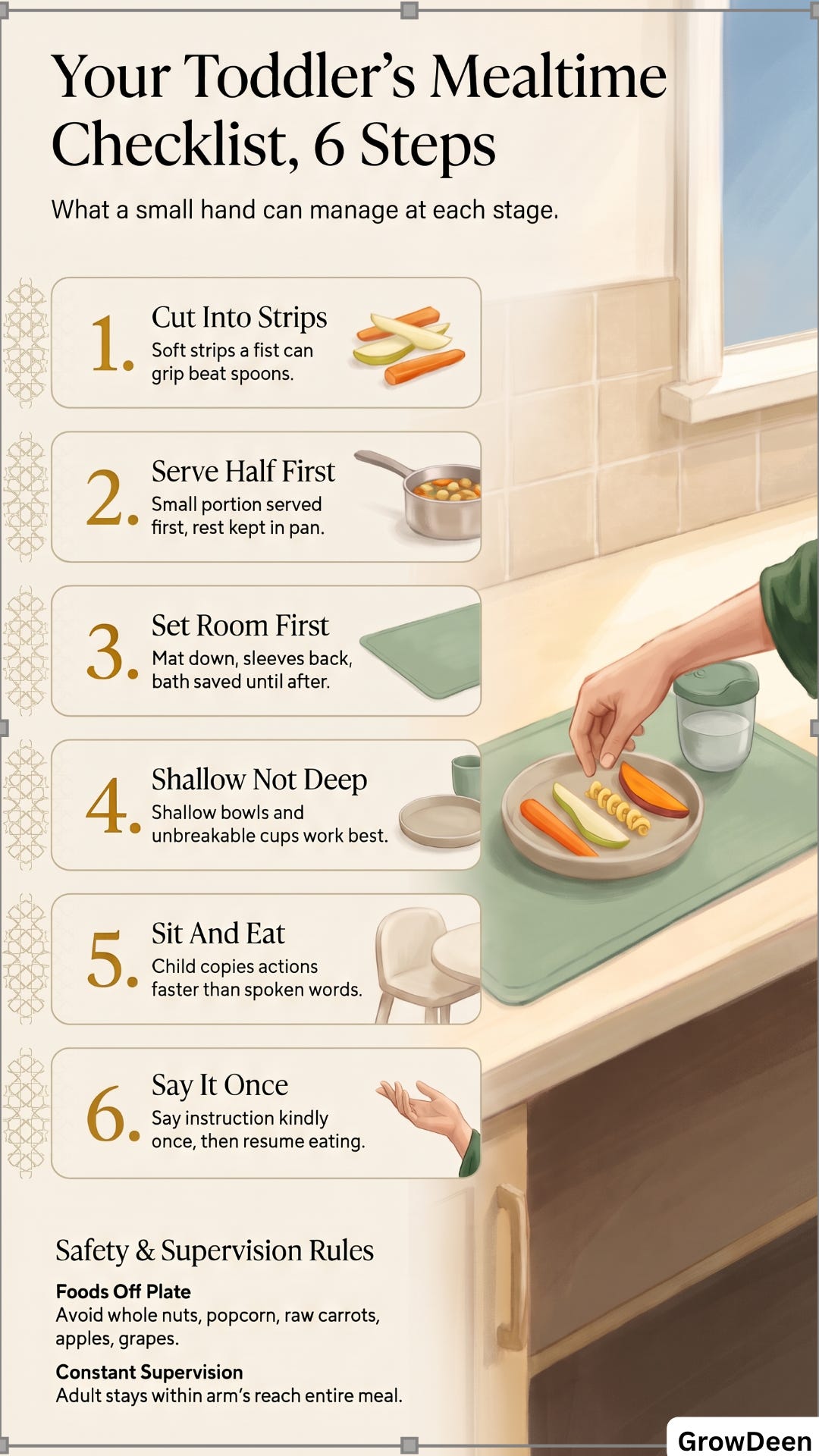
None of which cancels the real rules. Whole nuts, popcorn, hard raw carrot, apple chunks and whole grapes stay off a learner’s plate, and an adult stays within arm’s reach for the whole meal. [7][8]
By now you have a fair amount to hold in your head at once: what to put on the plate, what to do with your face when it lands on the floor, and which of those two matters more. That is a lot to remember at six in the evening with a hungry child in front of you. The free Messy Hands Pack exists for exactly that reason. The download button is at the top of this page, and there is a full description of what is inside it below.
What The Qur’an Teaches About Weakness, And Why It Belongs At Your Table
There is a feeling that arrives somewhere around the third wipe-down, and most parents will not say it out loud. It is the quiet suspicion that a better parent would have this child eating properly by now.
Allah says: “And it is Allah’s Will to lighten your burdens, for humankind was created weak.” [10]
Tafsir Ibn Kathir reads the verse as Allah easing what He has legislated for people, and states the reason plainly: because the human being was created weak, it is fitting that what is asked of him be made lighter. The weakness comes first, and the lightening follows from it. [10]
Read that order again with a small child in front of you. A fourteen month old cannot yet grip, aim, balance and swallow in sequence without losing half of it. That is weakness in the plain sense the verse names, rather than defiance. The commentary speaks about the burdens Allah places on adults rather than about toddlers at a table, so the application here belongs to the reader rather than to the tafsir. The principle itself is hard to miss. Where capacity is small, what is asked is made lighter to match.
So a parent carrying that verse stops asking why this child cannot eat properly yet, and starts asking what this child can manage tonight. Change the plate before you change your tone.
Support Muslim Parenting Lab ❤️
Would you like a small amount of yours grown into something enormous? Give what you can spare with the button below.
The Prophet ﷺ said Allah grows a charity the size of a date until it is like a mountain. (Sahih al-Bukhari 1410)
Change The Plate Before You Change Your Tone
Here is the answer to the question planted at the top. At nursery, the food arrives in shapes a small hand can hold, in portions small enough to be finished, at a table where nobody performs a reaction when something lands on the floor. Your child has not become a different person on the drive over. The plate and the audience changed.
So rebuild the plate first.
Cut food into strips and fingers. Soft pieces a small hand can grip and mash are far easier than anything that needs a loaded spoon, which is why finger foods are recommended as children begin feeding themselves. [7][8] Less frustration tends to mean less throwing.
Serve small and keep more within reach. A modest portion topped up on request puts far less food on the floor than a full plate does, and it keeps you clear of waste. Avoiding israf at a toddler’s table is mostly a question of what goes onto the plate in the first place rather than of getting a child to clear it.
Set the room before the food arrives. A wipeable mat or old towels under the chair, a smock or wide bib, sleeves pushed back, bath saved until after the meal. When the clearing up is quick, your patience lasts longer, and your patience is the thing being tested here.
Eat together whenever the day allows it. Children copy what they see far more reliably than they follow what they are told, and shared meals give them a live model of how a family sits, starts and finishes. [8][9] Saying Bismillah out loud before you eat, and Alhamdulillah when you finish, teaches more across a year of ordinary dinners than any amount of instruction aimed at a child who is not yet listening.
Give an older toddler a job. Carrying unbreakable cups to the table, laying mats, handing round spoons. A child who helped build the meal treats it a little differently.
Say the instruction once, kindly, then go back to your own food. Repeating it six times at rising volume turns dinner into theatre, and theatre is extremely interesting to a two year old.
What Quietly Makes It Worse
Reacting to the drop. A bowl pushed over the edge is often an experiment about what happens to you next, and a large reaction is a reward in itself. Removing the bowl quietly for a few minutes says more than a lecture does.
Pressure. Pushing a child to eat more, bargaining over spoonfuls, or holding dessert hostage is linked with worse eating over time. The position guidance on nurturing children’s eating draws the line plainly: adults decide what food is offered and when, and the child decides how much of it to eat. [9]
Commentary on the food, including the food your child has just rejected. A household where nobody announces that the lentils are disgusting raises children who are slower to announce it themselves. Finding fault with food sits badly with Muslim table adab, and children pick that restraint up by watching adults rather than by being told.
Treating a fallen piece of food as a crime. Honouring food is real adab, and a child absorbs it from watching an adult pick something up calmly. The lesson here is that food is handled with care, and that a dropped carrot stick can simply be picked up.
Taking over. Feeding a child who is trying to feed themselves is faster tonight, and it is the one reliable way to slow the skill down.
When To Ask For Help
Speak to a doctor, a child health nurse or a dietitian if messy eating continues through the preschool years, if your child cannot manage textures that children of a similar age handle easily, if meals involve frequent gagging or any choking, if whole categories of texture are refused, or if you have concerns about weight, growth or energy. Ask early. A short conversation often settles what months of private worry could not. This article is education rather than medical advice, so follow the guidance of the professional who can actually see your child.
The Messy Hands Pack
If you have read this far, you are the kind of parent who wanted to understand what was happening before deciding what to do about it. That says something about you.
Inside the Messy Hands Pack (one comprehensive PDF, 3 pages):
Page 1: The Plate Rebuild Card. A visual guide showing the shape, size and portion of food a child can actually manage at each stage from six months to three years, with the never-serve list printed alongside it, designed as a card for the inside of the cupboard door where you make the plate up.
Page 2: The Four-Second Card. What to do in the four seconds after food hits the floor, set out as a simple sequence, with the five sentences parents say at the table and the line to use instead of each one, so you can change what happens at dinner tonight without reading anything else.
Page 3: Where Capacity Is Small. A reflection card built on Qur’an 4:28 with Tafsir Ibn Kathir’s explanation, in English with the source reference, for the evenings when you have cleared the floor twice and your patience has run out.
This is not a PDF to download and forget. It is built to live on your fridge door and the inside of your cupboard, where the plate actually gets made up.
The Messy Hands Pack is what every subscriber receives with each article. At Muslim Parenting Lab we cover the whole span of raising Muslim children, from newborns through the early school years, all backed by scientific research and rooted in Islamic wisdom.
Your Micro-Action
Before the next meal, do one thing: cut whatever you are serving into strips your child can hold in a fist, and put half as much on the plate as you normally would. Keep the rest in the pan. That is the whole practice tonight. Change the plate before you change your tone.
May Allah place barakah in the food you serve, sabr in the clearing up, and ease in every meal you share with your children.
Share This With Someone Who Needs It
Think of one person right now: the sister who apologised last week for the state of her kitchen floor, the friend whose toddler has just started refusing the spoon, the new mother at the masjid who said quietly that mealtimes have become the worst part of her day.
This article could take a weight off her evening. Send it to her today, not as advice-giving, but as company. Sometimes the kindest thing we can do is tell another mother that what is happening on her floor is the skill arriving, right on time.
Frequently Asked Questions
Q: At what age do children stop being messy eaters?
A: Many children become noticeably tidier somewhere around their second birthday, while others carry on smearing happily well into their third year, and both are inside the normal range. [2] By the preschool years the open mess usually settles, though spills continue for all of us.
Q: Is it normal for a toddler to throw food on the floor on purpose?
A: Yes, and it is usually an experiment rather than defiance. Your child is testing what happens next, which includes what your face does. A calm, boring response removes the interesting part. For more on this, see “What quietly makes it worse” above.
Q: Should I let my baby feed themselves if they gag?
A: Gagging is a protective reflex and it is noisy; choking is quiet and needs immediate action. In a randomised trial, infants who fed themselves from the start were no more likely to choke than spoon-fed infants, and by eight months they gagged less often than the comparison group. [6] Keep hard, round foods off the plate and stay within arm’s reach. [7][8]
Q: How do I stop my toddler making such a mess at mealtimes?
A: Change the food and the setup before you change your tone. Strips a small hand can grip, half the portion with more kept ready, a wipeable mat underneath and the bath after the meal will cut the mess faster than correction will.
Q: Does playing with food help a child eat more vegetables?
A: Research with preschoolers has linked sensory play with food to a greater willingness to taste fruit and vegetables, and children comfortable with messy tactile play tend to show lower food neophobia. [3][4] Handling an unfamiliar food is often one of the encounters that leads to eating it.
Q: Is it wrong in Islam to let a child waste food while learning to eat?
A: Avoiding israf is a real obligation, and at a toddler’s table it is handled mostly through portion size. Serve a small amount and keep more within reach, so that what reaches the floor stays small while your child learns. Food that falls is picked up and handled with care rather than treated as a crime.
Q: When should I worry about my child’s messy eating?
A: Speak to a doctor, child health nurse or dietitian if the mess continues through the preschool years, if your child cannot manage textures that similar-aged children handle, if there is frequent gagging or any choking, if whole textures are refused, or if weight, growth or energy concern you.
References
[1] Practice does make perfect: A longitudinal look at repeated taste exposure. (2008). Appetite, 51(3), 739-742. https://doi.org/10.1016/j.appet.2008.05.063
[2] American Academy of Pediatrics. Self-Feeding. HealthyChildren.org, adapted from Caring for Your Baby and Young Child: Birth to Age 5. https://www.healthychildren.org/English/ages-stages/toddler/nutrition/Pages/Self-Feeding.aspx
[3] Coulthard, H., & Sealy, A. (2017). Play with your food! Sensory play is associated with tasting of fruits and vegetables in preschool children. Appetite, 113, 84-90. https://doi.org/10.1016/j.appet.2017.02.003
[4] Coulthard, H., & Thakker, D. (2015). Enjoyment of tactile play is associated with lower food neophobia in preschool children. Journal of the Academy of Nutrition and Dietetics, 115(7), 1134-1140. https://doi.org/10.1016/j.jand.2015.02.020
[5] Moding, K.J., Bellows, L.L., Grimm, K.J., & Johnson, S.L. (2020). A longitudinal examination of the role of sensory exploratory behaviors in young children’s acceptance of new foods. Physiology & Behavior, 218, Article 112821. https://doi.org/10.1016/j.physbeh.2020.112821
[6] Fangupo, L.J., Heath, A.M., Williams, S.M., et al. (2016). A baby-led approach to eating solids and risk of choking. Pediatrics, 138(4), e20160772. https://doi.org/10.1542/peds.2016-0772
[7] Fewtrell, M., Bronsky, J., Campoy, C., Domellof, M., Embleton, N., Fidler Mis, N., Hojsak, I., Hulst, J., Indrio, F., Lapillonne, A., & Molgaard, C. (2017). Complementary feeding: A position paper by the ESPGHAN Committee on Nutrition. Journal of Pediatric Gastroenterology and Nutrition, 64(1), 119-132. https://doi.org/10.1097/mpg.0000000000001454
[8] National Health and Medical Research Council (2012). Infant feeding guidelines: Information for health workers. NHMRC. https://www.nhmrc.gov.au/about-us/publications/infant-feeding-guidelines-information-health-workers
[9] Haines, J., Haycraft, E., Lytle, L., Nicklaus, S., Kok, F.J., Merdji, M., Fisberg, M., Moreno, L.A., Goulet, O., & Hughes, S. (2019). Nurturing children’s healthy eating: Position statement. Appetite, 137, 124-133. https://doi.org/10.1016/j.appet.2019.02.007
[10] Qur’an, Surah An-Nisa 4:28, with Tafsir Ibn Kathir. Translation: Dr. Mustafa Khattab, The Clear Quran, as published on Quran.com. https://quran.com/4/28 and https://quran.com/en/4:28/tafsirs/en-tafisr-ibn-kathir
We combine scientific research with Qur’an and authentic Sunnah, and we cite our sources. Even so, this is general guidance and no substitute for a doctor who can examine your child.