


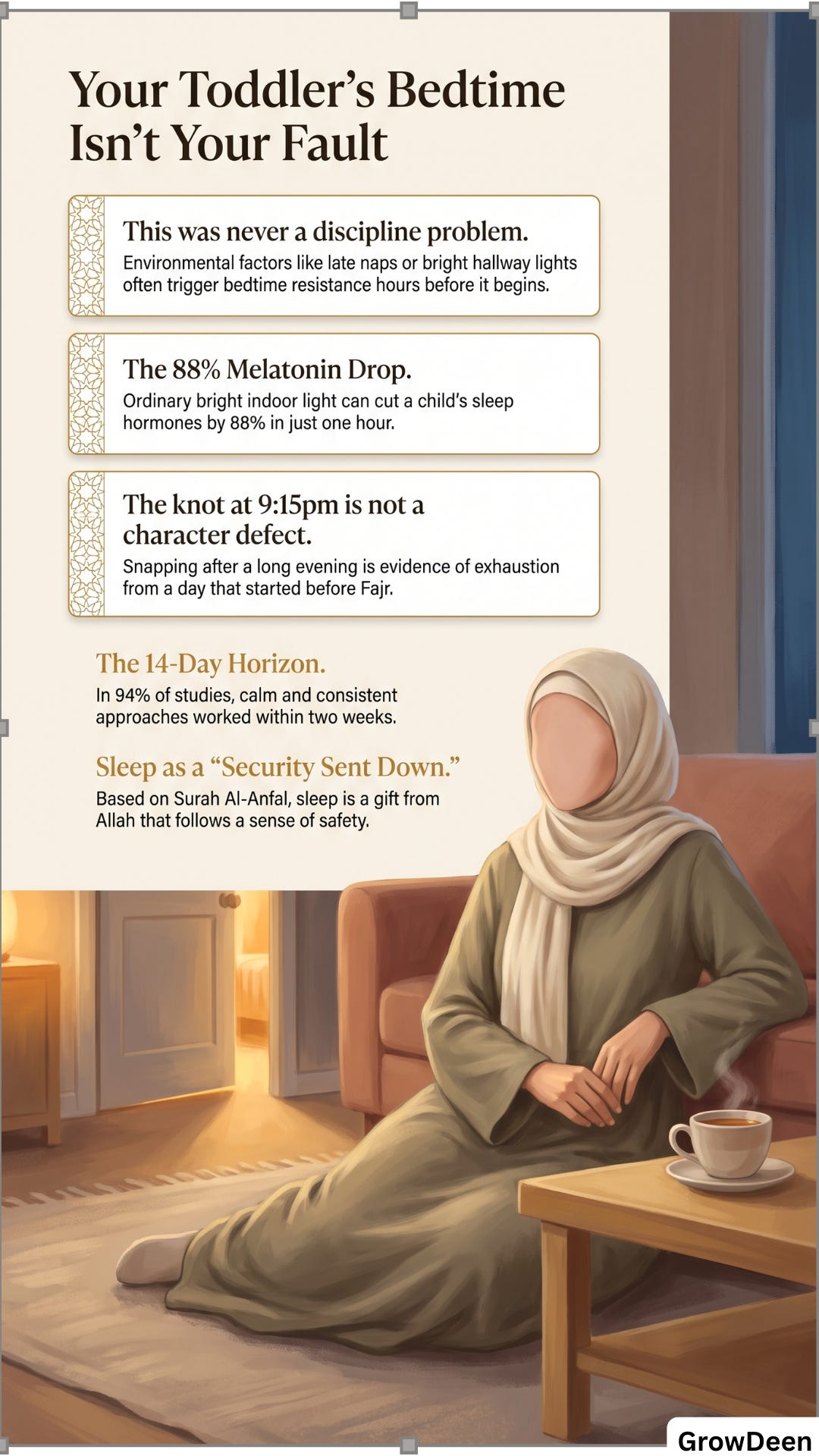
Researchers at the University of Colorado measured what one hour of ordinary bright light does to a small child before bed. Melatonin fell by 88%, and in 7 of the 10 children it had not recovered even halfway 50 minutes later. [1] This guide shows you the four things you can actually change tonight, and why the first one takes 30 seconds.
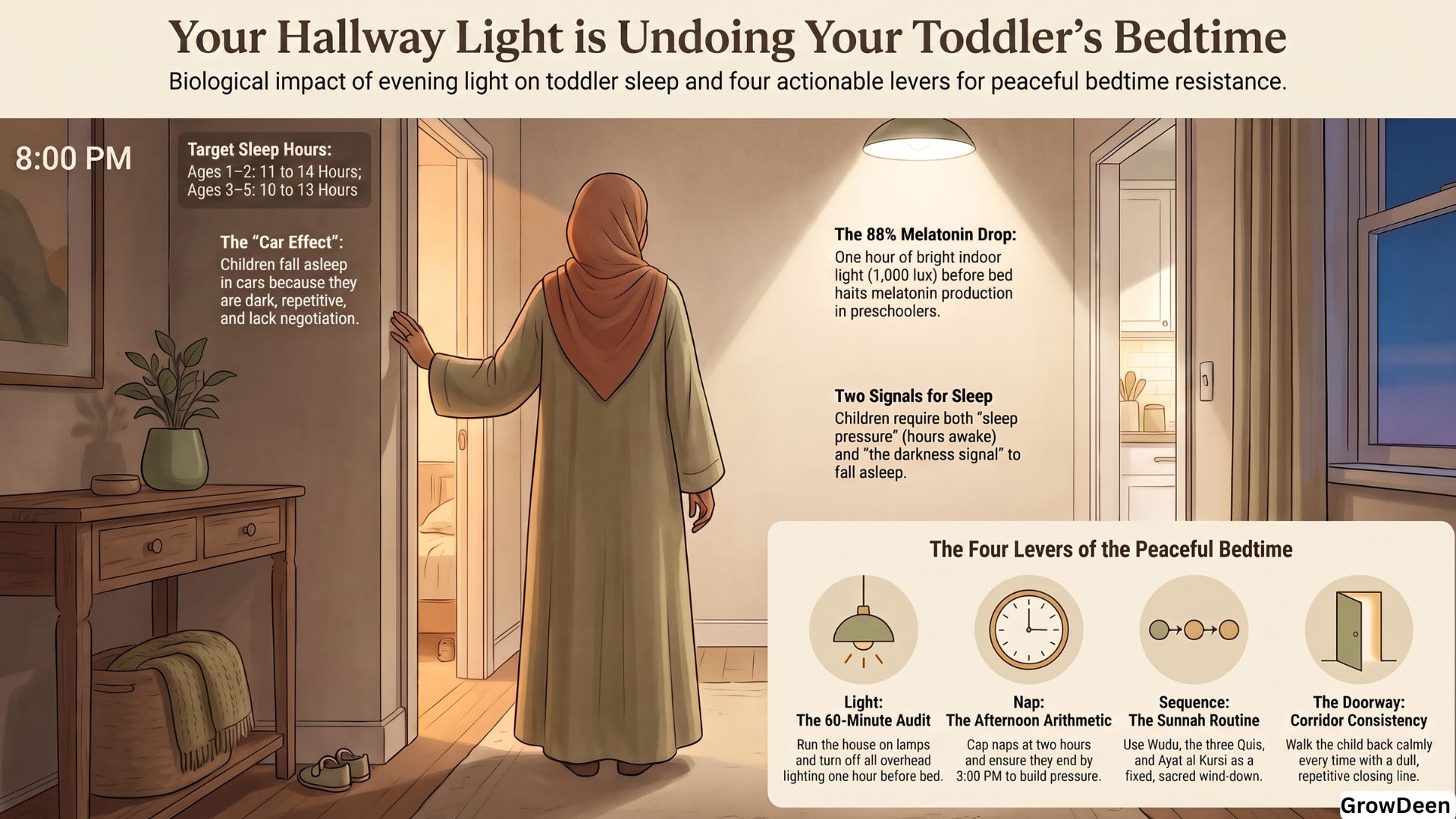
It was 8:12pm.
The pyjamas were on. Teeth brushed. Du’a said. And then the hallway light went on again, small feet, a request for water, then for a different cup, then for the door to be open exactly as wide as it already was.
You did everything the guides told you to do. You kept the routine. You stayed calm the first three times. And your toddler is still standing in the doorway, more awake than she was an hour ago.
You are not failing at this. Something in that last hour is working against you, and it is almost certainly not your child’s willpower.
When researchers at the University of Colorado exposed preschool-aged children to one hour of bright indoor light before their usual bedtime, the children’s melatonin dropped by roughly 88%. Not a screen. Not a tablet. Ordinary indoor lighting, the kind in most kitchens and hallways. And 50 minutes after the light went off, 7 of the 10 children still had not recovered even half of it. [1]
Read that with your own hallway in mind.
Why this guide is different from generic toddler sleep advice
Every number here comes from peer-reviewed research or a named clinical body, including the American Academy of Sleep Medicine, the American Academy of Pediatric Dentistry, and studies published in Sleep, JAMA Pediatrics and Physiological Reports between 2006 and 2026.
The Islamic material is verified rather than decorative. One Qur’anic verse, checked in full through Tafsir Ibn Kathir, and three Sunnah bedtime practices traced to Sahih al-Bukhari with their hadith numbers and gradings printed.
You get a free three-page printable, The Last Hour Pack, built around the light audit and the nap arithmetic that most sleep advice skips entirely.
The question I want you to carry through this article
Here is what I would like you to hold on to while you read.
Why does the same child who falls asleep in the car in four minutes need ninety minutes and three glasses of water at home?
Same child. Same tiredness. Wildly different outcome. The answer is not that she prefers the car, and it is not that she is being difficult at home. Once you see what is actually different about those two environments, most of the rest of this article becomes obvious. Hold the question. I will come back to it.
What your toddler’s body is actually waiting for
Before the routine, before the negotiation, there is biology.
Two separate signals have to line up before a small child can fall asleep. The first is sleep pressure, which is simply how long she has been awake. The second is the darkness signal, which tells her brain to release melatonin. If either one is missing, no amount of consistency at the door will help.
The American Academy of Sleep Medicine, whose figures the American Academy of Pediatrics endorses, sets the target at 11 to 14 hours of sleep per 24 hours for children aged one to two, naps included, and 10 to 13 hours for ages three to five. [2] An independent panel convened by the National Sleep Foundation landed on a similar band. [3] Most toddlers get there with 10 to 12 hours overnight and one nap.
Those hours are doing real work. Sleep at this age supports growth, immune function, memory, and the capacity to handle frustration without dissolving into the floor. Researchers who tracked young children day by day found the traffic runs both ways: poor sleep worsened the next day’s mood, and a rough evening mood predicted a worse night after it. [4]
That second finding is the one nobody tells parents. The hour before bed is not a waiting room for sleep. It is already part of the night.
Roughly a third of parents of children under three report a sleep problem, and those problems are usually behavioural rather than medical. [20] And if you have ever wondered whether your child is simply an unusual sleeper, there is some comfort in the footage. Researchers who filmed toddlers sleeping at home found real nights are far messier than the tidy averages suggest, with more brief wakings than parents ever notice. [5] Not matching a chart is not the same as having a problem.
So if the biology is normal, why is bedtime so hard? Here is where the research gets uncomfortable.
The 88% problem hiding in your ceiling
You already dim the bedroom. Most parents do.
But think about where your toddler actually spends the last hour. The kitchen while you clear up. The bathroom under a bright mirror light. The hallway. The living room with the main light on because someone needs to find a shoe.
That Colorado study is worth sitting with. One hour at roughly 1,000 lux, which is normal bright indoor lighting rather than anything unusual, cut the children’s melatonin by about 88%. Levels stayed flat for the full 50 minutes the researchers kept measuring afterwards. [1]
So the routine can be flawless and the light can still have switched the whole thing off before it started.
Here is what to do about it, and it costs nothing. For the last hour, run the house on lamps. Overhead lights off in the kitchen, the hallway and the living room. Bathroom light low if you can do that safely. Screens off well before the routine begins, and if your household uses any screen content with young children, keep it Islamically suitable, music-free and parent-approved, and keep it out of the evening altogether.
One dim house beats three perfect bedtime steps under a bright ceiling.
That is one signal handled. The other one gets decided much earlier in the day.
The nap that quietly steals the night
Most bedtime battles are timing problems wearing a costume.
A meta-analysis of napping in children under 12 confirmed that daytime sleep is normal right through the toddler years, with most children settling into a single nap around age two. [6] The complication is that naps and nights draw on the same account.
An experimental study in Japan showed that longer and later naps push bedtime back and shorten overnight sleep. [7] A separate study found that skipping the nap altogether does not simply buy you a longer night, it changes the physiology of the sleep that follows. [8]
So here is the arithmetic. Cap the nap at about two hours and finish it by mid-afternoon. A nap ending at 3pm leaves enough waking hours to build real sleep pressure by 7:30pm. A nap ending at 4:30pm does not, and no routine on earth will fix that.
If your toddler really is not tired at bedtime, pushing bedtime later usually backfires. An overtired child settles worse and still wakes at the same time, so you lose at both ends. Bedtime fading works better. Start the routine at the time she currently falls asleep, then shift the whole sequence 15 minutes earlier every three or four nights.
And watch her, not the clock. Eye rubbing, ear pulling, a glazed stare, sudden clinginess, a burst of frantic running. Starting at the first of those is far easier than starting twenty minutes after.
Safety comes first. Sleep comes after. That sentence is going to keep coming back.
A small confession about the next part
I know this is already a lot to hold in your head at 8pm on a Tuesday, especially when you are also doing dinner, wudu, and somebody’s missing sock.
That is exactly why there is a free printable at the end of this called The Last Hour Pack. It turns the light audit and the nap arithmetic into two pages you can stick inside a kitchen cupboard, plus a third page for the nights that go badly anyway. Keep reading and you can download it at the bottom.
There is one more thing I want to share before the practical steps, and it is the part that changed how I would frame this whole article.
Sleep as a security sent down: what the Qur’an shows about settling
When your toddler cannot settle, your first instinct is to make her stop getting up. But what if settling was never something a child does by trying harder?
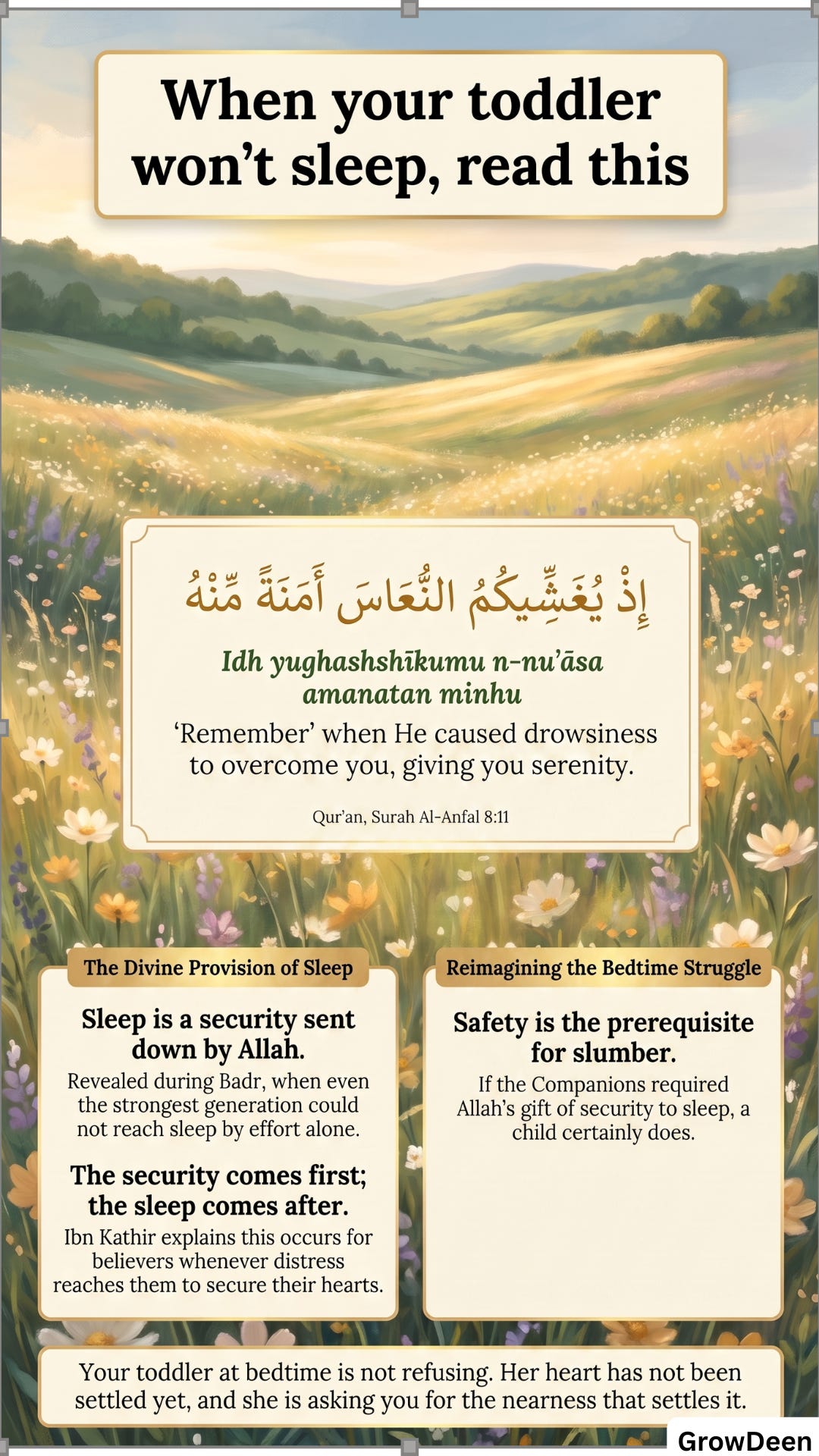
There is a moment in the Qur’an where Allah reminds the believers of something He gave them on the night before Badr, and it is not a weapon. “˹Remember˺ when He caused drowsiness to overcome you, giving you serenity.” [Qur’an, Surah Al-Anfal 8:11] [21]
According to Tafsir Ibn Kathir, this is Allah reminding them of the slumber He sent down as security from the fear they were suffering, because of how many their enemy was and how few they were. Ibn Kathir then widens it beyond that one night: this appears to happen for the believers whenever they are in distress, so that their hearts feel safe and sure of Allah’s aid and mercy. [21]
Notice the order in that sentence. The security comes first. The sleep arrives after it.
Those Companions were not lying awake because they lacked discipline. They were the strongest generation this ummah has produced, and sleep still would not come to them by effort. It came as a gift, once their hearts were quietened.
So when a two-year-old stands in your doorway at 8:12pm, she is almost never being defiant. She is a small person whose heart has not settled yet, asking for the nearness that will settle it. Every practical thing in this article, the dim house, the fixed order, the calm voice in the corridor, is aimed at exactly what the verse points to.
Safety comes first. Sleep comes after.
The sequence that does the rest
Now for what actually happens in those thirty minutes.
Bedtime routines are among the best-evidenced tools in child sleep, and the evidence has a dose-response shape. Across a large international sample, the more nights per week a family kept the routine, the better the child slept, and the benefit climbed step by step. [9] A separate trial found that introducing a nightly routine improved both sleep onset and night waking within two weeks, and lifted mothers’ mood along with it. [10]
Consistency beats content. Night-to-night variation in the routine predicted worse toddler sleep on its own, [11] and families with steady everyday routines had children who slept longer over time. [12]
Keep it short enough to repeat on a terrible night. Twenty to thirty minutes. Same order, weekends included.
A Sunnah-shaped version has one advantage no invented routine has. It is already fixed, already sacred, and already something the whole household does.
Start with wudu, then pyjamas. The Prophet ﷺ told al-Bara’ ibn ‘Azib that when he came to his bed he should perform wudu as he would for prayer, then lie down on his right side and entrust himself to Allah in du’a. [22] For a two-year-old, wudu is water play with a purpose, and it doubles as an unmistakable signal that the day has closed.
Then the three short surahs. Aisha reported that every night before sleeping, the Prophet ﷺ would cup his hands, recite Surah al-Ikhlas, Surah al-Falaq and Surah an-Nas into them, blow into his palms, and pass them over his head, face and body, three times. [23] Done over a toddler in a dim room this is slow, quiet, repetitive and physical, which is close to a textbook description of an effective wind-down. The surahs are short enough that a three-year-old joins in within weeks.
Then Ayat al-Kursi. Abu Hurayrah was taught that whoever recites it on going to bed has a guard from Allah with him until morning, and the Prophet ﷺ confirmed the words were true even though the one who said them was a liar. [24] For most families this becomes the fixed point, the part that never moves even when the rest of the evening has fallen apart.
Then right side, lights out, and the hadith of al-Bara’ completes itself. [22]
Which brings us to the part of the night that most guides skip entirely.
The ninety seconds in the corridor
The bedroom is not where bedtime is won or lost. The corridor is.
And this is the part with the strongest evidence behind it. A task force appointed by the American Academy of Sleep Medicine reviewed 52 treatment studies of behavioural approaches to bedtime problems and night waking in young children. Ninety-four per cent of the studies found the approaches worked, more than 80% of the children showed clinically meaningful improvement, and the gains were still there at three to six months. [13]
That is an unusually strong result for anything in parenting. Hold on to it on night four, when it feels like nothing is shifting.
What to do when she appears:
Walk her back calmly, every time, with as few words as possible. Dull is the objective.
Check the real things first: nappy, temperature, thirst, teeth.
Use the same closing line every night. The repetition does the work here, not the persuasion.
Praise staying in bed the next morning, when she can actually absorb it. A simple sticker chart works from around two and a half.
If she shares a room, hold the older sibling’s bedtime back half an hour until she is asleep.
What to avoid:
Long negotiations at the door. Every extra sentence is a reason to come out again.
Starting an approach and dropping it after two nights. Inconsistency is the single behaviour most clearly tied to worse toddler sleep. [11]
Rough or exciting play after maghrib.
Sleep medicines. They are not the answer to behavioural sleep problems in young children, and any use is a doctor’s decision, not a parent’s experiment.
Shame. A child told she is being naughty at 9pm learns that night-time is when she disappoints the people she loves most.
That last one deserves a sentence of its own, because it is the one that costs parents the most. The knot in your stomach after you have snapped at 9:15pm is not evidence that you are a bad mother. It is evidence that you have been awake since Fajr.
When it isn’t the routine at all
Some nights have nothing to do with light or timing. Here is what those look like.
Ordinary night waking. Everybody surfaces between sleep cycles. A toddler who can drop back off unaided seems not to wake at all. A toddler who has only ever fallen asleep while being fed or carried will call for that exact condition at 2am, because that is the condition she associates with sleep. Self-settling is taught at the start of the night, not in the middle of it. [14]
Night terrors. This one surprises almost everyone. A Quebec cohort followed nearly two thousand children and found sleep terrors peak at 34.4% at 18 months, falling steadily to 5.3% by age 13. [16] So if your toddler sits up in the first few hours, screams, looks terrified and cannot be consoled, she is in the largest single group of children her age. Stay calm, keep her physically safe, and do not try to wake her. She will not remember it. Speak to your doctor if the episodes are frequent or she is at risk of hurting herself.
Rocking or head banging as she falls asleep. Common between roughly six months and five years, and usually a self-soothing habit children grow out of. Check the bed is safe and mention it to your doctor if it worries you. [15]
Waking up foul after a nap. That fog has a name. Sleep inertia is the transitional grogginess after waking, worst out of deep sleep, and it passes on its own. [17] If it lasts a long time or happens daily, she is probably short on sleep overall.
Teeth grinding. Common in toddlers, usually harmless, and not a reason to wake or treat her. Raise it at a dental appointment if it continues.
The bottle in bed. Worth retiring. Frequent night-time bottle feeding with milk or juice is a recognised risk factor for early childhood caries, and dental guidance is explicit that a child should not go to bed with a bottle of milk, formula or juice. [18] Finish the milk half an hour before bed, then brush. A bottle requested at 2am is almost always working as a sleep cue rather than as food.
The dummy. Evidence on pacifier use points to effects on the developing bite and jaw when the habit runs into the preschool years. [19] If it is helping and causing no problems yet, most families can leave it and plan an exit. If teeth or speech are affected, move the plan forward.
The move to a big bed. Most children make it between two and three, and there is no prize for being early. The usual triggers are climbing out of the cot or a new baby needing it. Keep the room dim, keep the routine identical, and expect a fortnight of testing.
When to speak to a doctor
Book an appointment if you notice snoring most nights, habitual mouth breathing, or pauses in her breathing during sleep. Also if she is heavily sleepy in the daytime despite getting the hours, or if night waking is getting worse over months rather than better.
Sleep problems alongside developmental concerns deserve tailored support rather than general advice, so mention both together.
And one more, which parents almost never raise. If your own exhaustion has reached the point where it is affecting your health or your ability to function in the day, that is a medical reason to ask for help. Not a character flaw.
None of this replaces medical advice. Where your doctor’s guidance differs from what you have read here, follow your doctor.
So, the car
Remember the question from the start. Why four minutes in the car and ninety at home?
The car is dark. The car is rhythmic and repetitive. Nothing in the car is being negotiated, and there is no door she can appear in. She is not choosing to sleep there, and she is not choosing to resist at home. The car accidentally supplies both signals her body is waiting for, and it removes the one thing that keeps her heart unsettled: the sense that something is still up for discussion.
You cannot drive her around every night. You can build a bedroom that does the same job on purpose.
The Last Hour Pack
If you have read this far, you are the kind of parent who treats bedtime as something to understand rather than something to win. That says a great deal about you.
Inside The Last Hour Pack (one comprehensive PDF, 3 pages):
Page 1: The Evening Light Audit. A room-by-room walkthrough of your home for the hour before bed, with a tick-box for each light source and a plain-language guide to which ones matter most, designed as a laminated card you can keep inside a kitchen cupboard door where the overhead switch lives.
Page 2: The Nap Clock. A fill-in timing worksheet that takes your child’s wake-up time and your target bedtime and shows you exactly when the nap needs to start and end, so you can stop guessing whether today’s nap is about to cost you tonight.
Page 3: When the Night Goes Badly Anyway. An Islamic reflection card built on Qur’an 8:11 and Ibn Kathir’s commentary on it, with the verse in Arabic, transliteration and English, and three short reminders for the moments when you have done everything right and she is still awake.
This isn’t just a PDF to download and forget. It’s a tool designed to stay inside your kitchen cupboard, where you’ll actually use it when you need it most.
The Last Hour Pack is what every subscriber receives with each article. Muslim Parenting Lab covers raising Muslim children from the newborn weeks to the early school years, across sleep, feeding, behaviour, speech and health, all backed by peer-reviewed research and rooted in Qur’an and authentic Sunnah.
If you want both evidence-based guidance and Islamic perspective in the same place, subscribe for free so future resources arrive in your inbox before you need them.
Subscribe free for parenting resources backed by both science and Sunnah, guidance so specific you literally can’t get it anywhere else. No spam, no clutter, just resources that matter.
Do this one thing tonight
Do not try all four levers this evening. Pick the light.
Tonight, before the routine starts, walk through your house and switch off every overhead light. Lamps only. That is it. It takes 30 seconds and it is the single change with the largest measured effect in this entire article. [1]
May Allah place barakah in your effort, accept your intention, and make the care you give more protective, more merciful, and more rewarded than it feels at 8:12pm.
Share this with someone who needs it
Think of one person right now. The sister at the masjid who mentioned, half-laughing, that she hasn’t finished a hot drink since 2023. Your cousin whose two-year-old has been in her bed every night for four months. The friend whose late-night voice notes sound exactly like the ones you were sending last year.
This article could give them back an hour of their evening. Share it with them today, not as advice-giving, but as care. Sometimes the kindest thing we can pass along is the reason something wasn’t working.
Frequently asked questions
Q: How much sleep does a toddler actually need? A: 11 to 14 hours per 24 hours for ages one to two, and 10 to 13 hours for ages three to five, naps included. [2] For most toddlers that works out as 10 to 12 hours overnight plus one nap. For the full picture see “What your toddler’s body is actually waiting for” above.
Q: Why won’t my toddler stay in bed? A: Usually one of three things: the nap ran too late, the last hour was too bright, or the corridor routine changes from night to night. Inconsistency is the factor most clearly linked to worse toddler sleep. [11] Walk her back calmly and identically every time, and give it a full two weeks before you judge it.
Q: Is it bad to let my toddler fall asleep with the light on? A: It works against you more than most parents realise. One hour of bright indoor light before bed cut preschoolers’ melatonin by about 88%, and levels stayed low for at least 50 minutes afterwards. [1] Dim lamps or near-darkness are far better, and a very dim night light is fine if she needs one.
Q: What time should a 2-year-old go to bed? A: Somewhere between 6:30pm and 7:30pm suits most two-year-olds who wake around 6:30am to 7am. If she isn’t tired at that time, the fix is usually an earlier end to the nap rather than a later bedtime, and moving the whole routine 15 minutes earlier every few nights.
Q: Are night terrors in toddlers dangerous? A: No, and they are far more common than parents expect. Sleep terrors peak at 34.4% at 18 months and drop steadily with age. [16] Keep her physically safe, stay calm, and don’t try to wake her. She won’t remember it in the morning. See your doctor if they’re frequent.
Q: When should a toddler stop napping? A: Most consolidate to one nap around age two, and a good number have dropped it by three. [6] When she does drop it, she’ll usually need an earlier bedtime for a while, and it’s worth keeping quiet time in the bedroom at the old nap slot even when sleep no longer happens.
References
[1] Akacem, L.D., Wright, K.P. Jr, & LeBourgeois, M.K. (2018). Sensitivity of the circadian system to evening bright light in preschool-age children. Physiological Reports, 6(5), e13617. https://doi.org/10.14814/phy2.13617
[2] Paruthi, S., Brooks, L.J., D’Ambrosio, C., et al. (2016). Recommended amount of sleep for pediatric populations: a consensus statement of the American Academy of Sleep Medicine. Journal of Clinical Sleep Medicine, 12(6), 785–786. https://doi.org/10.5664/jcsm.5866
[3] Hirshkowitz, M., Whiton, K., Albert, S.M., et al. (2015). National Sleep Foundation’s sleep time duration recommendations: methodology and results summary. Sleep Health, 1(1), 40–43. https://doi.org/10.1016/j.sleh.2014.12.010
[4] Hoyniak, C.P., Vogel, A.C., Puricelli, A., Luby, J.L., & Whalen, D.J. (2024). Day-to-day bidirectional associations between sleep and emotion states in early childhood. Sleep Health, 10(3), 264–271. https://doi.org/10.1016/j.sleh.2023.12.007
[5] Abel, E.A., Ozonoff, S., Anders, T.F., & Schwichtenberg, A.J. (2026). Capturing typical toddler sleep in context: a videosomnography study. Sleep Health, 12(1), 137–146. https://doi.org/10.1016/j.sleh.2025.09.010
[6] Staton, S., Rankin, P.S., Harding, M., et al. (2020). Many naps, one nap, none: a systematic review and meta-analysis of napping patterns in children 0–12 years. Sleep Medicine Reviews, 50, 101247. https://doi.org/10.1016/j.smrv.2019.101247
[7] Nakagawa, M., Ohta, H., Nagaoki, Y., et al. (2016). Daytime nap controls toddlers’ nighttime sleep. Scientific Reports, 6, 27246. https://doi.org/10.1038/srep27246
[8] Lassonde, J.M., Rusterholz, T., Kurth, S., et al. (2016). Sleep physiology in toddlers: effects of missing a nap on subsequent night sleep. Neurobiology of Sleep and Circadian Rhythms, 1(1), 19–26. https://doi.org/10.1016/j.nbscr.2016.08.001
[9] Mindell, J.A., Li, A.M., Sadeh, A., Kwon, R., & Goh, D.Y.T. (2015). Bedtime routines for young children: a dose-dependent association with sleep outcomes. Sleep, 38(5), 717–722. https://doi.org/10.5665/sleep.4662
[10] Mindell, J.A., Telofski, L.S., Wiegand, B., & Kurtz, E.S. (2009). A nightly bedtime routine: impact on sleep in young children and maternal mood. Sleep, 32(5), 599–606. https://doi.org/10.1093/sleep/32.5.599
[11] Prokasky, A., Fritz, M., Molfese, V.J., & Bates, J.E. (2019). Night-to-night variability in the bedtime routine predicts sleep in toddlers. Early Childhood Research Quarterly, 49, 18–27. https://doi.org/10.1016/j.ecresq.2019.05.004
[12] Koulouglioti, C., Cole, R., Moskow, M., McQuillan, B., Carno, M.A., & Grape, A. (2014). The longitudinal association of young children’s everyday routines to sleep duration. Journal of Pediatric Health Care, 28(1), 80–87. https://doi.org/10.1016/j.pedhc.2012.12.006
[13] Mindell, J.A., Kuhn, B., Lewin, D.S., Meltzer, L.J., & Sadeh, A. (2006). Behavioral treatment of bedtime problems and night wakings in infants and young children: an American Academy of Sleep Medicine review. Sleep, 29(10), 1263–1276. https://doi.org/10.1093/sleep/29.10.1263
[14] Galland, B.C., & Mitchell, E.A. (2010). Helping children sleep. Archives of Disease in Childhood, 95(10), 850–853. https://doi.org/10.1136/adc.2009.162974
[15] Hiscock, H., & Davey, M.J. (2018). Sleep disorders in infants and children. Journal of Paediatrics and Child Health, 54(9), 941–944. https://doi.org/10.1111/jpc.12033
[16] Petit, D., Pennestri, M.H., Paquet, J., et al. (2015). Childhood sleepwalking and sleep terrors: a longitudinal study of prevalence and familial aggregation. JAMA Pediatrics, 169(7), 653–658. https://doi.org/10.1001/jamapediatrics.2015.127
[17] Tassi, P., & Muzet, A. (2000). Sleep inertia. Sleep Medicine Reviews, 4(4), 341–353. https://doi.org/10.1053/smrv.2000.0098
[18] American Academy of Pediatric Dentistry. (2020). Policy on early childhood caries (ECC): classifications, consequences, and preventive strategies. The Reference Manual of Pediatric Dentistry, 79–81. https://www.aapd.org/media/policies_guidelines/p_eccclassifications.pdf
[19] Hung, M., Marx, J., Ward, C., & Schwartz, C. (2025). Pacifier use and its influence on pediatric malocclusion: a scoping review. Dentistry Journal, 13. https://doi.org/10.3390/dj13070319
[20] Byars, K.C., Yolton, K., Rausch, J., Lanphear, B., & Beebe, D.W. (2012). Prevalence, patterns, and persistence of sleep problems in the first 3 years of life. Pediatrics, 129(2), e276–e284. https://doi.org/10.1542/peds.2011-0372
[21] Qur’an, Surah Al-Anfal 8:11 — https://quran.com/8/11. Tafsir Ibn Kathir — https://quran.com/en/8:11/tafsirs/en-tafisr-ibn-kathir
[22] Sahih al-Bukhari 247, narrated by al-Bara’ ibn ‘Azib — Graded: Sahih — https://sunnah.com/bukhari:247
[23] Sahih al-Bukhari 5017, narrated by Aisha — Graded: Sahih — https://sunnah.com/bukhari:5017
[24] Sahih al-Bukhari 2311, narrated by Abu Hurayrah — Graded: Sahih — https://sunnah.com/bukhari:2311