

Research published in The Journal of Pediatrics (2019) tracked physical aggression from 6 to 24 months and found it peaks at around 17–24 months before declining naturally as language develops. [1] This guide explains the real reason your baby or toddler bites, pinches, or pulls hair and the response that actually works, rooted in both developmental science and Islamic guidance.
Your toddler sinks their teeth into your arm. Hard.
You’ve told them no. Multiple times. You’ve read the parenting forums. You’ve tried distraction. You’ve tried the stern voice. And they did it again today — at a playdate, in front of everyone.
Here’s what I want you to hear before anything else: this is not a character flaw. It is not bad parenting. And it is not going to last forever.
When I studied the research on toddler aggression, the finding that stopped me was this — biting, hitting, and pinching peak at around 17 to 24 months in almost every child, across almost every culture, before dropping off as language improves. [1] The body fills in for words that haven’t arrived yet. That’s it. That’s most of the explanation.
But here’s the thing: understanding why it happens is only half the picture. How you respond in that moment is where the real work happens.
Why This Guide Is Different
Science-backed, not guesswork: Everything here draws from peer-reviewed developmental research, including findings on how language ability directly predicts a reduction in aggressive behaviour by preschool age. [3]
Islamic grounding that’s genuine, not decorative: The Quranic and Prophetic wisdom in this article isn’t bolted on — it directly addresses the parenting experience of managing your own anger while guiding a child through theirs.
A free companion resource: Subscribers receive the When Your Toddler Bites Parent Response Guide — a 3-page PDF built for the moments you’re too exhausted to remember what you’re supposed to do.
What’s Actually Going On in That Little Body
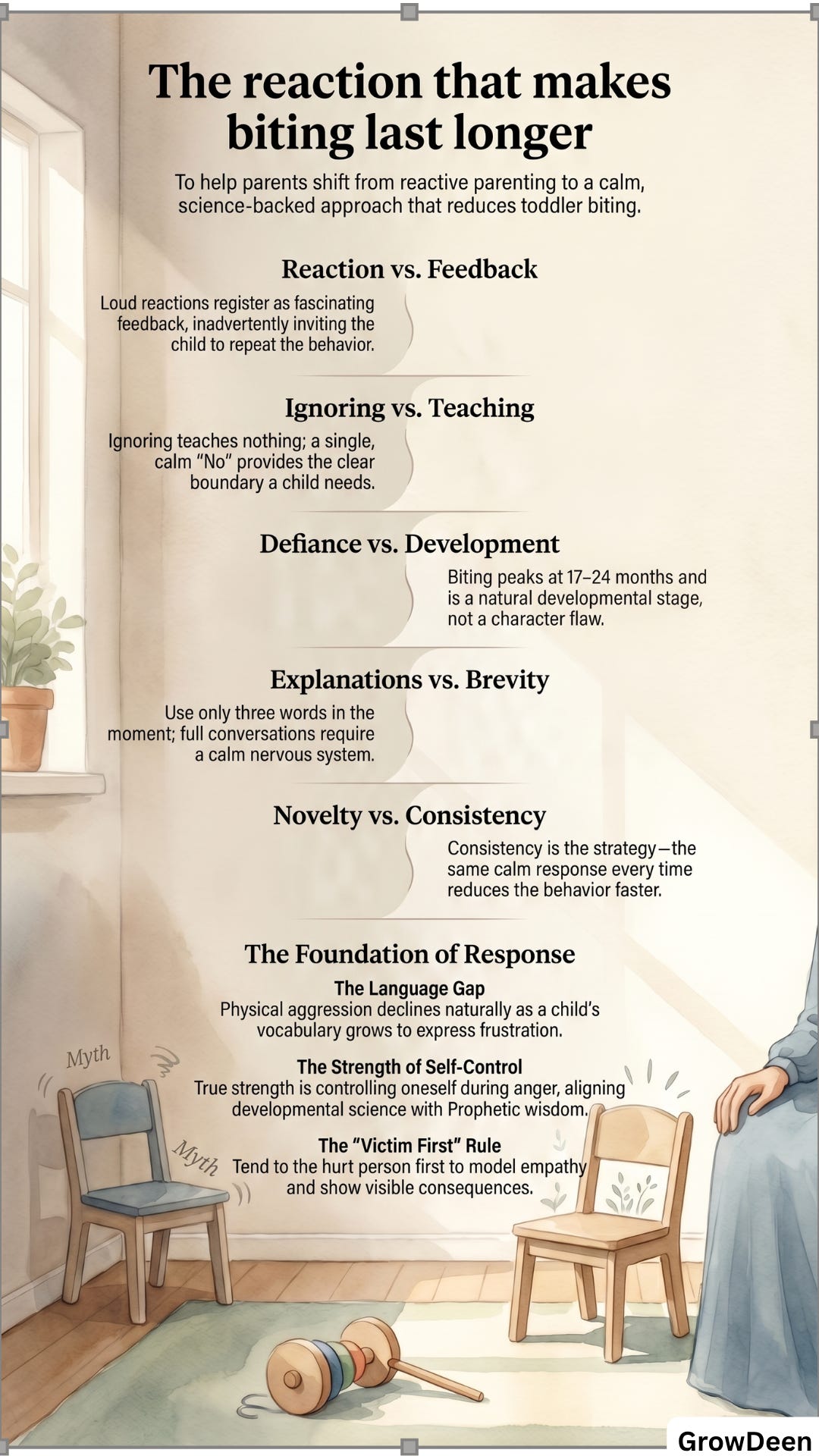
Babies from around 6–12 months bite and pinch to run experiments. They watch your face. They observe the reaction. They file it away. If the reaction is dramatic or interesting, they try again — not out of malice, but out of genuine scientific curiosity. [1]
Teething makes it worse. Soreness in the gums creates an almost uncontrollable urge to press down on something, and your shoulder is convenient.
For toddlers, it changes. A Penn State longitudinal study found that toddlers with stronger early language skills showed significantly less anger-driven physical behaviour when they reached preschool. [3] Read that again: the less equipped a child is to say “I’m furious” or “I don’t want to,” the more likely they are to demonstrate it physically. The biting is often the feeling.
Other triggers worth knowing:
Over-tiredness. Hunger. Sensory overload. Too much stimulation and not enough down-regulation. A fierce need for control in a world where very little belongs to them. And sometimes — plain imitation. They saw another child do it. They tried it out.
What to Do When a Baby Bites or Pinches
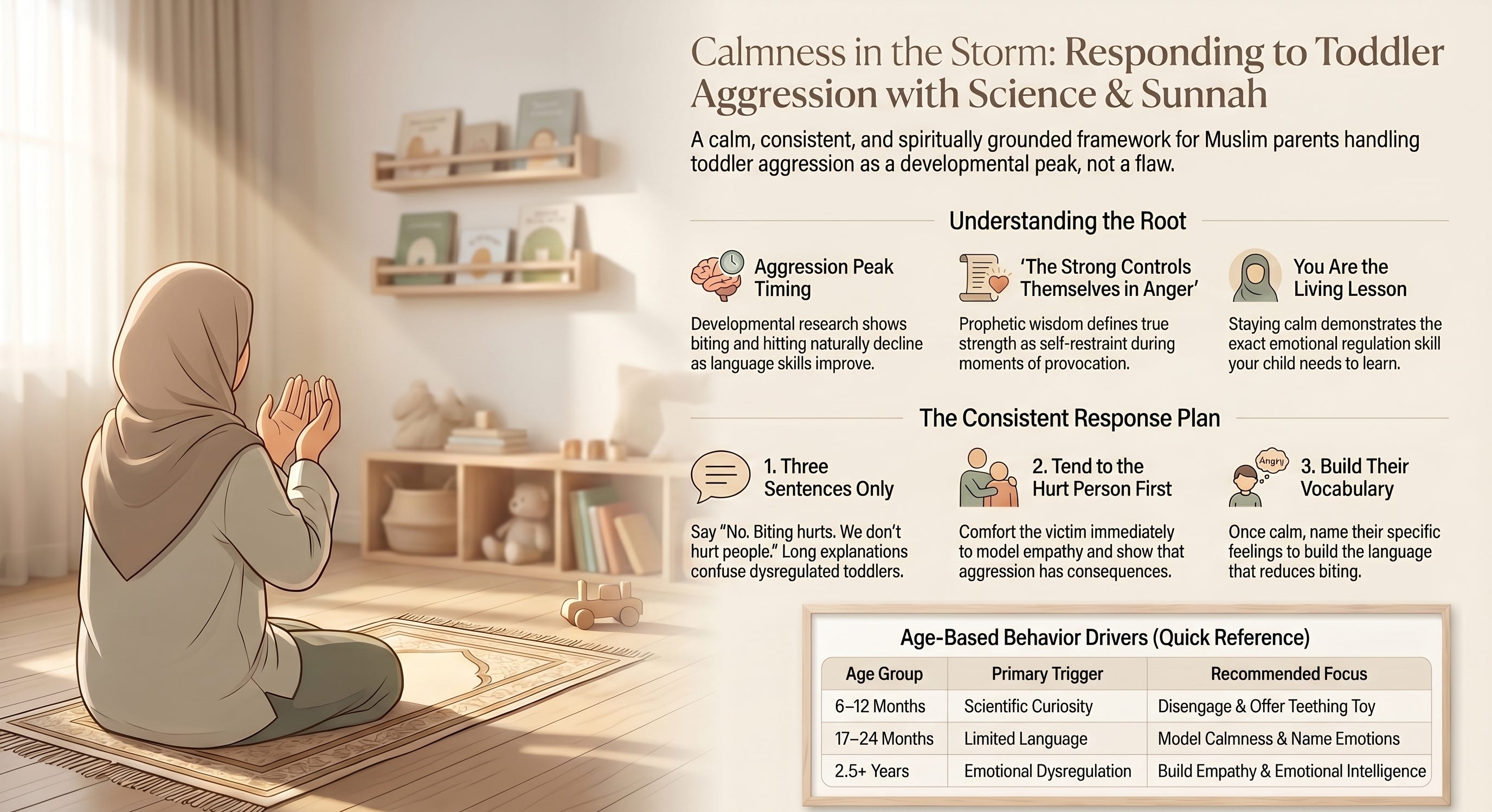
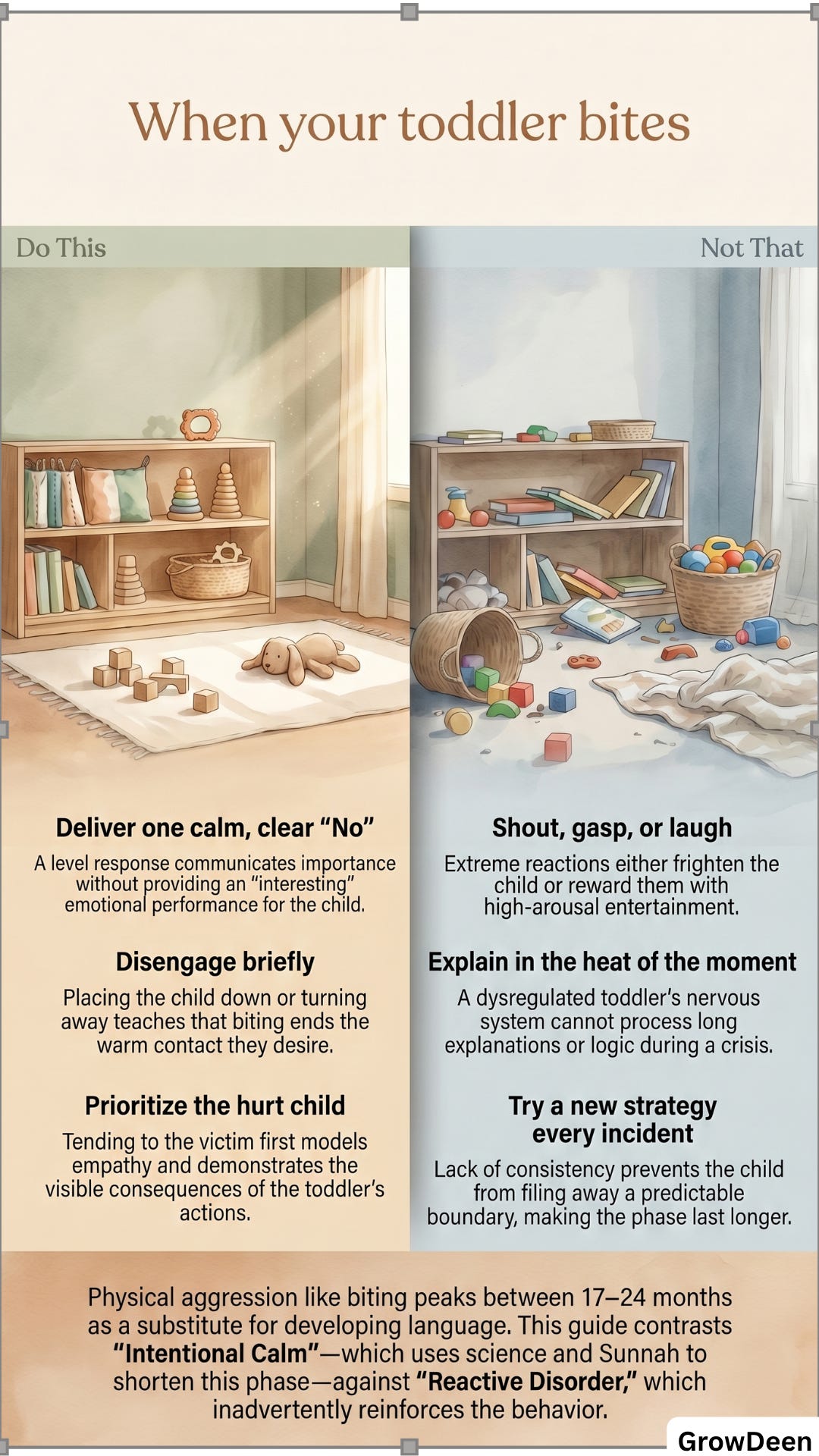
Say it once. One calm, clear “No.” Not shouted. Not laughed at. Both extremes feed the behaviour — one frightens, one rewards. A level, serious response communicates: this matters, and I’m not performing for you.
Then disengage. Put them down. Turn away for a moment. The message: biting ends the warm contact they want. It’s not punishment. It’s information.
Offer an alternative. Teething ring. Cold damp cloth. A snack if hunger is the driver. These are not concessions — they’re solving the actual problem underneath the behaviour.
Reward gentleness immediately. The moment your baby uses a soft touch, respond with your whole face. Say “MashaAllah, gentle” and mean it. Babies learn through what earns them the response they’re seeking. Consistency here matters as much as consistency with the “no.” [2]
What to Do When a Toddler Bites or Pinches
This is where most parents get it slightly wrong. Not because they don’t know what to say — but because they underestimate how much they are the lesson.
Your toddler is watching you regulate emotion in real time. When you stay calm after they’ve just hurt you, you are demonstrating the exact skill you’re trying to build in them.
Take one breath first.
Then: “No. Biting hurts. We don’t hurt people.” Three sentences. That’s enough. Long explanations are lost on a toddler mid-dysregulation — their nervous system isn’t ready to receive them.
After calm returns, sit with them and name it: “You were really angry when he took your toy.” This isn’t excusing the behaviour. It’s building the vocabulary that research shows reduces the behaviour. [3]
And when the same thing happens tomorrow — respond exactly the same way. Consistency is the strategy. Not a new technique every week. The same calm response, reliably, over time. [2]
When Your Child Hurts Another Child
Go to the child who was hurt first. I know this feels strange — your instinct is to grab your own child — but tending to the hurt child first teaches your toddler that hurting someone has visible consequences for that person. It plants the seed of empathy.
Then, to your toddler, quietly: “We don’t bite. That hurt Omar. That’s not kind.”
Remove them from the situation — not as punishment, but as a reset. Sit somewhere quieter. You might make a short du’a together, something to mark the pause: Allahumma inni as’aluka al-’afiyah — asking Allah for ease.
Later, when both of you are fully calm, revisit it gently. “Do you remember what happened earlier? How do you think Omar felt?” For children from about 2.5 years, these conversations build the emotional intelligence that protects against the behaviour recurring. [3]
The Islamic Framework for This: What the Quran Teaches About Strength
When I reflect on this topic through an Islamic lens, the verse that keeps returning to me isn’t about children at all — it’s about us.
Allah describes the people of Jannah: “Those who spend in the cause of Allah during ease and hardship, and who restrain anger, and who pardon the people — and Allah loves the doers of good.” [Quran 3:134] [4]
According to Tafsir Ibn Kathir on this verse: “For when they are angry, they control their anger and do not act upon it. Rather, they even forgive those who hurt them.” [4]
And the Prophet ﷺ said: “The strong is not the one who overcomes the people by his strength, but the strong is the one who controls himself while in anger.” [Sahih al-Bukhari 6114 — Muttafaqun Alayhi] [5]
What strikes me is this: the response Islam commends — restraint, steadiness, forgiveness — is exactly the response developmental science also says works best. They’re not in tension. They’re saying the same thing from different directions.
Every time you breathe before responding to a bite, you are practicing what Allah loves. That’s not a small thing.
Before You Keep Reading — Do This Now
Think of one thing that triggered your toddler’s last biting or pinching episode. Over-tiredness? Hunger? Sensory overload at a busy gathering? Write it down or make a mental note.
Now: protect that one trigger this week. If it’s over-tiredness, guard the nap like it’s a medical appointment. That single adjustment may reduce the frequency more than any technique.
One change. This week. That’s the practice.
The Companion Pack Built for This
If you’ve made it here, you’re the parent who actually wants to understand — not just survive. That tells me something.
I put together the When Your Toddler Bites: Parent Response Guide (one PDF, 3 pages) so you have something to reach for in the moments when you can’t remember what you’re supposed to do.
Page 1: The “Why Is My Toddler Doing This?” Age-by-Age Behaviour Decoder — a quick-reference chart covering babies (6–12 months) through toddlers (3 years), listing the most common trigger for each age and the most effective response — designed as a laminated card you can keep in your changing bag or on the fridge, not buried in a browser tab.
Page 2: The 5-Step Calm Response Flowchart — a visual decision tree for the exact moment it happens: Child bites → Check trigger → Apply response → Child bites again → Do this next. No guesswork when you’re already flustered. Moves you from reaction to response in under 60 seconds.
Page 3: Islamic Parenting Anchors for Hard Moments — two verified Prophetic supplications for parents managing anger and overwhelm, with Arabic, transliteration, translation, and a note on when to use each one. These are from Sahih sources. Not generic “du’as for patience” — specific words for the specific feeling of losing it with a child you love.
This isn’t a PDF to download and forget. It’s a tool for the moment you need it.
This resource is what every MPL subscriber receives with each article. We cover the full arc of raising Muslim children — all grounded in research and rooted in the Qur’an and Sunnah.
If you want evidence-based parenting guidance that doesn’t ask you to leave your Islam at the door, subscribe free and the next resource arrives before you need it.
Subscribe free for parenting resources backed by both science and Sunnah — guidance so specific to Muslim families, you literally can’t find it anywhere else. No spam. No clutter. Just what matters.
A Closing Thought
May Allah place barakah in the moments you held it together when it was hard. And in the ones where you didn’t — may He give you the strength to try again.
One More Thing
Think of one person right now: the mother at the school gate who mentioned her toddler’s biting with that look — half laughing, half ashamed. The friend whose WhatsApp message yesterday said “I don’t know what to do, he bit his little sister again.” The sister at the masjid who looked exhausted and said nothing.
This article could give them something solid to hold onto. Share it today — not as advice, but as company. Sometimes the most loving thing we can do is say: you’re not alone in this, and here’s what helped.
Frequently Asked Questions
Q: Is it normal for a 2-year-old to bite? Yes — completely. Research tracking over 2,000 children found that physical aggression (including biting) peaks between 17 and 24 months and then naturally declines as language develops. [1] If it’s happening, your child is developmentally on track. What matters most now is how you respond consistently, not how often it’s happening.
Q: Why does my toddler bite me specifically — and not other people? Because you are safe. You are the person they trust most, which means you’re the one they try things out on. It’s counterintuitive and genuinely frustrating — but a toddler who bites only their primary caregiver is often demonstrating secure attachment, not targeted aggression. Respond the same way regardless: calm, clear, consistent.
Q: Should I bite my child back so they understand how it feels? No. The evidence is clear: physical retaliation does not reduce aggressive behaviour in toddlers and can increase it. [2] It also models the exact behaviour you’re trying to stop. Your child learns what you do far more than what you say.
Q: My toddler bites when they’re excited, not when they’re angry. Is that different? Yes — excitement-related biting is common in younger toddlers (under 18 months) who don’t yet have the capacity to regulate high-arousal emotions. The response is the same: calm verbal “no,” brief disengagement. But you can also reduce the trigger by keeping high-stimulation activities shorter or followed by quiet decompression time.
Q: When should I be concerned about biting? Speak to your paediatrician if the biting continues past age 4 without reduction, causes serious injuries, escalates rather than decreasing over time, or is part of a broader pattern of aggressive behaviour that’s also affecting friendships, nursery, or family life. A paediatrician can assess whether sensory, developmental, or emotional factors are worth exploring further.
Q: How long does the biting phase actually last? For most children, physical aggression including biting peaks in the second year and reduces significantly by age 3 as language matures. [1] The timeline varies, but consistent parental response — same calm reply, every single time — is the factor most associated with faster reduction. [2] If you keep the response steady, you are shortening the phase, even when it doesn’t feel like it.
References
[1] Lorber, M.F., Del Vecchio, T., Slep, A.M.S., & Scholer, S.J. (2019). Normative trends in physically aggressive behavior: Age-aggression curves from 6 to 24 months. The Journal of Pediatrics, 206, 197–203. https://doi.org/10.1016/j.jpeds.2018.10.025
[2] Dunlap, G., Strain, P.S., Fox, L., Carta, J.L., Conroy, M., Smith, B.J., Kern, L., Hemmeter, M.L., Timm, M.A., McCart, A., Sailor, W., Markey, U., Markey, D.J., Lardieri, S., & Sowell, C. (2006). Prevention and intervention with young children’s challenging behavior. Behavioral Disorders, 32(1), 29–45. https://doi.org/10.1177/019874290603200103
[3] Cole, P.M., et al. (2012). Study links toddlers’ language skills to anger responses in preschool. Child Development. Penn State University. https://news.psu.edu/story/143642/2012/12/20/research/study-links-toddlers-language-skills-anger-responses-preschool
[4] Qur’an, Surah Āl ‘Imrān (3:134). Sahih International translation. Tafsir Ibn Kathir confirmed — “they control their anger and do not act upon it.”
[5] Sahih al-Bukhari 6114 (Book 78, Hadith 141); Sahih Muslim 2609. Narrated Abu Hurayrah. Grading: Muttafaqun Alayhi (agreed upon). https://sunnah.com/bukhari:6114