

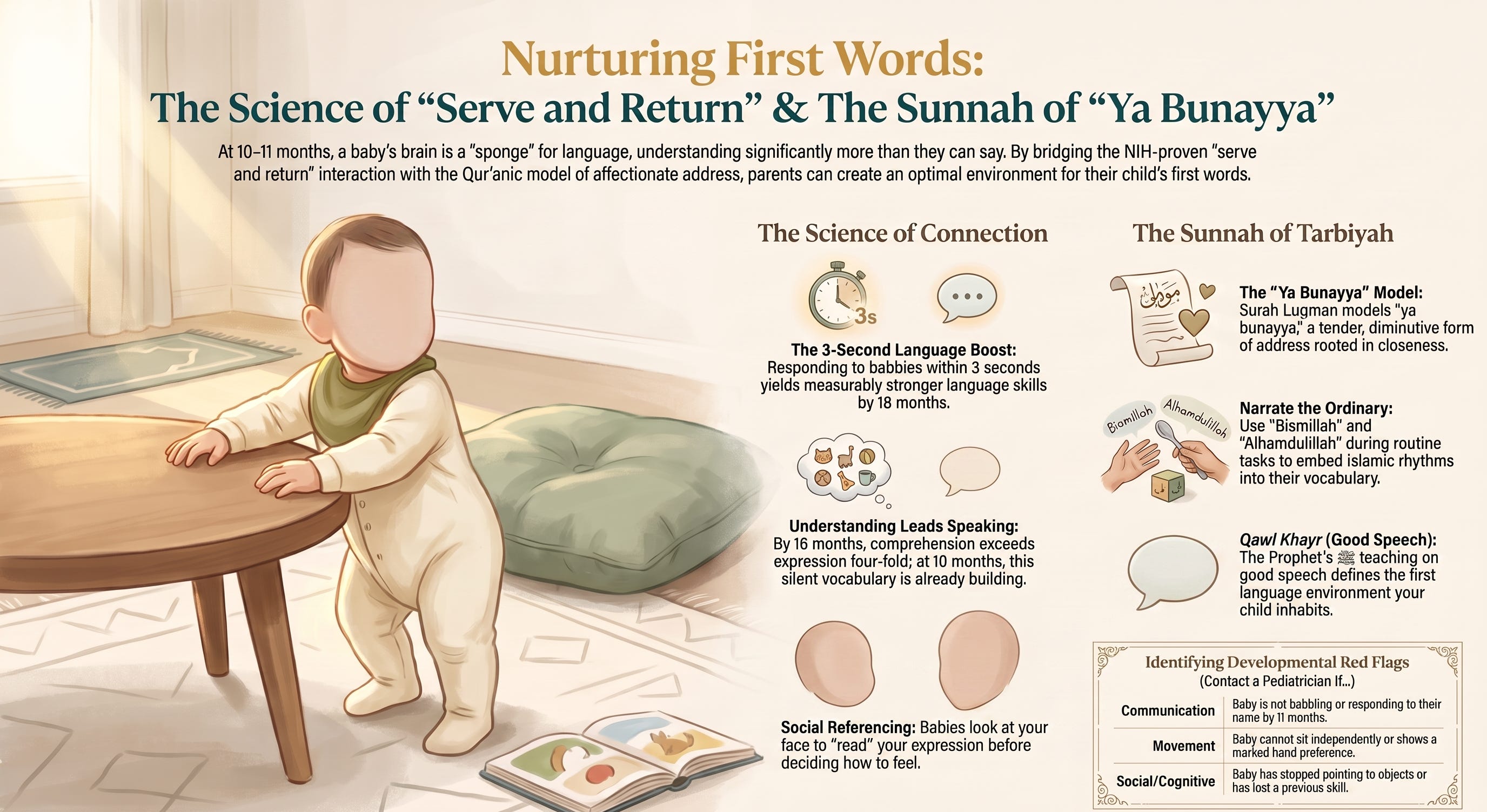
A 2024 NIH-funded study found that 85% of mothers and 78% of fathers who responded to their baby’s babble within 3 seconds — mirroring what their baby was looking at and labelling it with words — had babies with measurably stronger language skills at 18 months. [1] Your response to that babble right now is not small. It is the whole thing.
Ten months in. Your baby is pulling to stand on the sofa, babbling at you with unmistakable intention, looking back at your face before deciding how to feel about anything new.
Something is about to happen. You can feel it.
Here’s what stopped me when I read the research: your baby already understands far more than they can say. By 10 months, babies recognise dozens of spoken words — food names, body parts, familiar names — even though they can barely say one. [2] Receptive language (understanding) leads expressive language (speaking) by weeks, often months. Your baby is not silent because they have nothing to receive. They are absorbing everything, building a vocabulary they will begin to release across the coming months.
And the mechanism that most accelerates that release? You. A 2024 study published in the NIH database found that parents who consistently returned their baby’s “serves” — babbles, gestures, looks — with meaningful, relevant words had babies with significantly stronger language outcomes by 18 months. [1] Not classes. Not apps. Responsive presence.
Why This Guide Approaches Development Differently
Every milestone and recommendation is grounded in peer-reviewed research from sources including the 2024 NIH serve-and-return study, the CDC’s 2022 updated milestone framework, Harvard’s Center on the Developing Child, and the Nelson Textbook of Pediatrics — so what you’re reading reflects the current, verified science, not outdated guidance.
This guide is among the very few that weaves Islamic tarbiyah into the science of language development — exploring how the Qur’anic model of parental speech (Luqman’s ya bunayya) and the Prophetic teaching on good words align with what developmental research has discovered about how babies learn to talk.
You’ll receive a free “Your Baby at 10–11 Months: The Muslim Parent’s Development Companion” — a printable 3-page PDF with a milestone tracker, six talk-along activity scripts for everyday moments, and an Islamic reflection card on the tarbiyah of your voice.
What Is Your Baby Doing Right Now?
The Language Your Baby Already Carries
Most babies say their first recognisable word between 9 and 14 months. [3] It might not sound like the word you expect — “baba” for bottle, “uh” for up, a specific sound only you would decode. What makes it a word is not how it sounds. It’s the consistency: the same sound, the same meaning, used on purpose.
But the real story at 10–11 months is not the word that’s coming. It’s everything your baby already understands. Research shows babies at this age can identify familiar objects by name, respond to their own name reliably, and pause when they hear “no” — long before they can say any of these words themselves. [2] The gap between what babies understand and what they produce is so large that at 16 months, comprehension exceeds expression by at least four-fold. [5] At 10 months, that gap is already building.
Babbling has matured too. It now has rhythm and intonation — the rise and fall of conversation. Your baby babbles at you, with eye contact, with pauses, waiting for your turn. This is called canonical babbling, and researchers take it seriously as a direct precursor to words. [3]
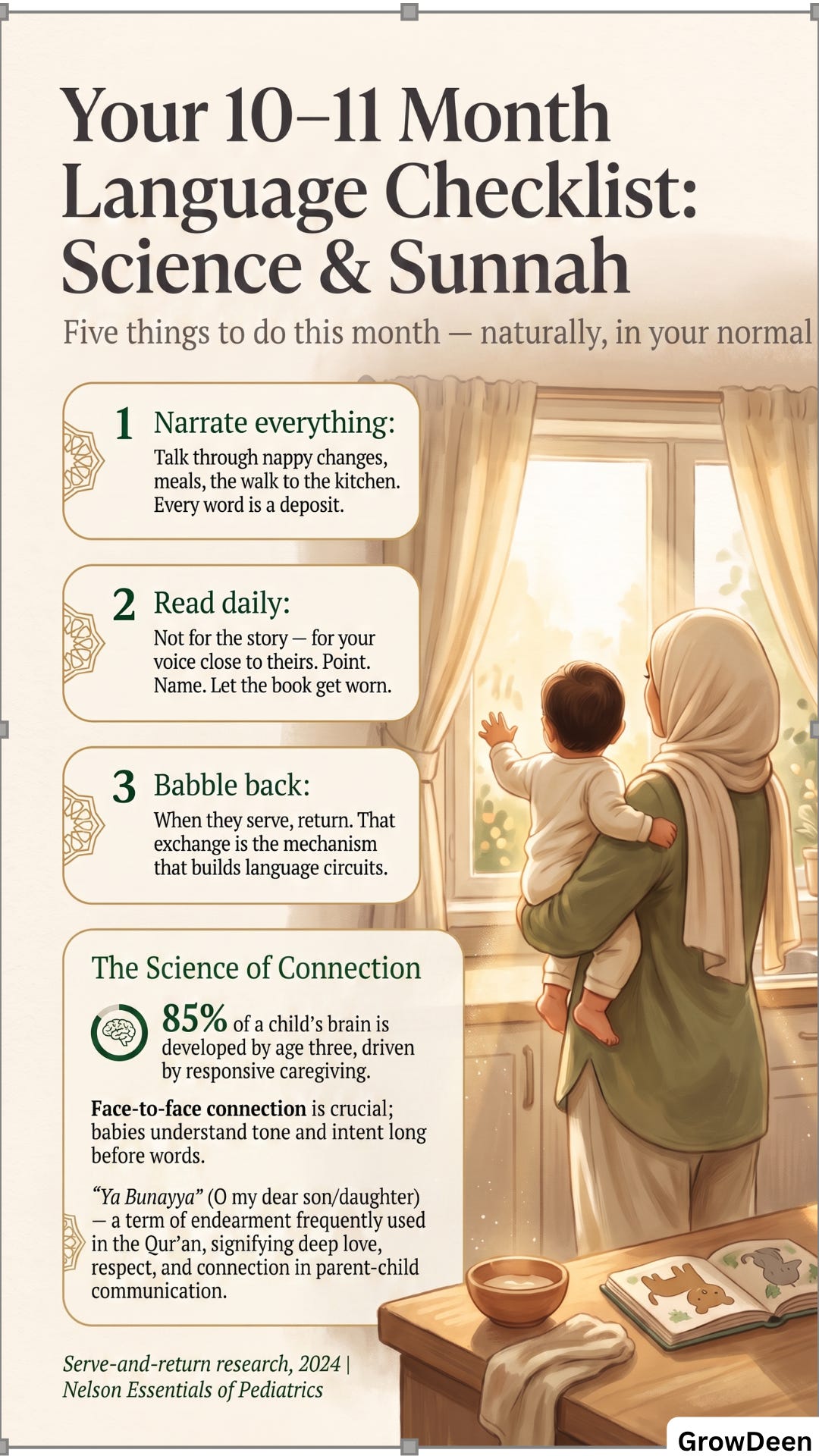
When your baby babbles, babble back. That exchange is the mechanism.
What Their Brain Is Building
Object permanence — knowing things exist even when out of sight — is firmly established by now. [6] This is why leaving the room feels different from a few months ago. Your baby doesn’t just feel startled. They know what they’re missing.
Cause and effect has clicked too. Dropping the spoon produces a sound and a response. Pressing a button makes something happen. Repeating the same action eleven times is not stubbornness. It is scientific method. [6] And cognition is deepening: your baby now imitates actions intentionally. Waving, clapping, putting a phone to their ear. These are high-level social cognition acts. [4]
Movement: The Floor Is the Curriculum
Most babies at 10–11 months are pulling to stand on furniture, then cruising sideways along it, shifting their weight and testing balance. Some will take first unassisted steps in this window — but typical independent walking spans 10 to 18 months, and there is no developmental prize for earlier. [4] What matters is that your baby has safe space to practise: sturdy furniture to pull up on, floor time without confinement, and you nearby enough that exploring feels safe.
The pincer grip — picking up a single pea with thumb and index finger — is now reliable. [4] It’s a remarkable neurological achievement, and it opens up finger feeding in earnest. It also builds proprioception, spatial reasoning, and patience, all from the dining table.
Their Emotional World
Your baby’s emotional life is rich and complex right now. They feel delight, frustration, determination, and wariness within the space of a single hour, and they are still learning to regulate all of it — mostly through you. [7]
Social referencing is at its peak: your baby looks at your face before deciding how to feel about something unfamiliar. A new person, a new sound, an unexpected object. They read your expression first. This is not a small social skill — it is the prototype of how human beings will consult trusted others for emotional guidance for the rest of their lives. [7]
What it requires from you is not performance. It is genuine, available attention. Your baby knows the difference.
I Know That’s a Lot to Hold — That’s Why This Pack Exists
Tracking milestones, narrating the nappy change, naming the tree, reading aloud, offering finger foods, staying regulated when your baby isn’t — while also looking after yourself and everyone else. That’s a lot to carry in your head every day.
That’s exactly why I created the free Your Baby at 10–11 Months: The Muslim Parent’s Development Companion — a 3-page printable PDF with a milestone checklist, six ready-to-use talk-along scripts for everyday moments, and an Islamic reflection card on the tarbiyah of your voice. Keep reading to download it at the end of this article.
What the Qur’an Models About Talking to Your Child
When I reflect on Surah Luqman, there’s one detail that stays with me. Allah didn’t record Luqman delivering a lecture. He recorded him bending toward his child and saying: “O my dear son — ya bunayya.” [8]
According to Tafsir Ibn Kathir, ya bunayya is an affectionate diminutive — the tender, small form of the word for son. [8] A form that, in its structure alone, carries love. The Qur’anic model of tarbiyah begins not with content but with closeness. A parent, face turned to their child, speaking warmth into the very grammar of their address.
Read that alongside the 2024 research showing that parents who responded meaningfully to their baby’s babbles — labelling what the baby was looking at, following their gaze — produced babies with measurably stronger language at 18 months. [1] What research describes as “meaningful return” is, in essence, what the Qur’an modelled as ya bunayya: you turn toward your child, you engage, and you speak with love.
The Prophet ﷺ left us a teaching with a dimension that applies directly here: “Whoever believes in Allah and the Last Day should speak what is good or keep silent.” [Sahih al-Bukhari 6136] [9]
This hadith is about all our speech — but its weight is particular for parents of babies on the threshold of language. Your baby absorbs your words. Not just what you say to them, but what they hear around them. The tone of your home, the presence of bismillah and alhamdulillah and the warmth in your voice — this is the first language environment your child will ever inhabit. Your commitment to qawl khayr — to speaking what is good — is not separate from their development. It is the beginning of it.
5 Practical Things to Do This Month
Talk through everything. Narrate the nappy change. Name the tree. Say alhamdulillah after the meal. You don’t need a programme — you need words, consistently, with warmth. Respond to every babble like it’s the beginning of a conversation, because it is. [1]
Read together daily. Not for stories yet — for closeness, vocabulary, and the rhythm of your voice over a picture page. Point at images, name them, let the book get worn. Include Islamic picture books — simple images of the natural world, scenes from Muslim family life. [10]
Let them move. Clear the floor, pad the corners, and step back. Your baby needs to practise pulling up and cruising without intervention. Falling and recovering is the work, not a problem to solve. [4]
Offer finger foods intentionally. The pincer grip is ready. Soft cooked vegetables, ripe fruit, small pasta pieces. Say bismillah first, every time — your baby will hear this word thousands of times before they can say it, and early exposure is exactly how language learning happens. [4]
Name the feelings. When your baby is frustrated, say it calmly: “You’re frustrated. This is hard.” Research shows children whose parents name emotions consistently develop stronger emotional regulation and greater empathy over time. [7]
When to Contact a Pediatrician
Trust what you see. By eleven months, speak with a doctor if your baby:
Is not babbling, or has stopped after a period of doing so. Does not respond to their name. Does not follow any instruction, even with a gesture. Has not pointed to share interest or communicate a want. Is not able to sit independently. Shows a marked, consistent preference for one hand. Has lost any skill previously present. [2][4]
Early support works. If something feels off, say so. You know your baby.
One Thing to Do Right Now
The next time you’re doing something routine — changing a nappy, making tea, loading the dishwasher — talk through it aloud. Not a lesson. Just words.
“Here’s the warm water. All clean now. Alhamdulillah.”
That exchange — your words meeting your baby’s world — is the mechanism that builds language.
If You’ve Made It This Far
You’re the kind of parent who wants to understand, not just survive. That tells me something.
Think about one person right now: a new mother in your life whose baby is a few months younger. A sister who asked you recently what she should be doing at this stage. A friend whose baby is quiet and not yet speaking, and she’s holding that worry quietly.
This article could ease something she’s carrying. Share it — not as advice, but as company.
Download Your Free Companion Pack
Inside the Your Baby at 10–11 Months: The Muslim Parent’s Development Companion (one PDF, 3 pages):
Page 1: 10–11 Month Milestone Tracker — A clean, domain-by-domain checklist covering communication, movement, cognition, and emotional development at this age — designed to stick on your fridge or go in the nappy bag, so you can observe with confidence and catch any concerns early.
Page 2: “Say More, Build More” Talk-Along Cards — Six practical talk-along scripts for everyday moments (nappy time, mealtimes, play, books, outdoor walks, and Qur’an time) — so that building your baby’s language becomes part of your day, not something extra to fit in.
Page 3: The Ya Bunayya Parent Reflection Card — An Islamic tarbiyah card anchored in Qur’an 31:13 and Sahih al-Bukhari 6136, with Arabic text, transliteration, and a brief reflection on how the Qur’anic model of Luqman and the Prophetic teaching on good speech speak directly to how you talk with your baby every day — something to read during the quiet moments when the weight of this year settles in.
This isn’t a PDF to download and forget. It’s designed to live on your fridge, wall, or phone — in the spaces where tarbiyah actually happens.
Every subscriber receives a companion pack with each article. Muslim Parenting Lab covers the full arc of raising Muslim children — from newborns through school age — all rooted in current evidence and Islamic wisdom. Subscribe free so future resources arrive before you need them.
Subscribe free for parenting resources backed by both science and Sunnah — guidance so unique you literally can’t get it anywhere else. No spam, no clutter, just what matters.
Frequently Asked Questions
Q: When should my baby say their first word?
A: Most babies produce their first recognisable word between 9 and 14 months, with 10–12 months being the most common window. [3] If your baby is babbling, responding to their name, and following gestures by 11 months, their language development is on track even without a clear first word yet.
Q: My 10-month-old isn’t walking yet. Should I be worried?
A: Almost certainly not. The typical range for independent walking is 10 to 18 months, and a baby who is not yet walking at 10 or even 12 months is well within normal. [4] What matters at this stage is that your baby is pulling to stand and motivated to move. If they’re not pulling to stand at all by 12 months, mention it to your paediatrician.
Q: How much should I be talking to my baby?
A: More than feels necessary. The 2024 NIH-funded serve-and-return study found that parents who responded to their baby’s babbles with relevant, labelling language — within 3 seconds — produced babies with measurably better expressive language at 18 months. [1] There is no ceiling. Every meaningful exchange counts.
Q: My baby drops things over and over deliberately. Is this a problem?
A: No — it’s research. Dropping and repeating is how babies this age study cause-and-effect. [6] It’s not about the reaction (though that’s a bonus); it’s scientific method. Your job is patience; their job is repetition.
Q: What finger foods are safe at 10–11 months?
A: Soft, small pieces work best: cooked carrot or sweet potato, ripe banana or pear, well-cooked pasta, soft scrambled egg, small pieces of soft cheese. [11] Always stay close during meals, cut pieces small to avoid any choking risk, and introduce new foods one at a time to watch for reactions.
Q: Is it too early to start Islamic routines with my baby?
A: It is never too early for your baby to hear the names of Allah, the sound of Qur’an, or bismillah before a meal. They won’t understand yet — but that’s not the point. The point is immersion. Research on language acquisition shows that words and sounds heard hundreds of times before a child can speak become deeply embedded, and the Islamic rhythms established now become the foundation of everything that follows. [2]
References
[1] Chen, M., et al. (2024). Mother-child and father-child “serve and return” interactions at 9 months: Associations with children’s language skills at 18 and 24 months. Early Childhood Research Quarterly (PMC10873112). https://pmc.ncbi.nlm.nih.gov/articles/PMC10873112/
[2] Zubler, J.M., Wiggins, L.D., Macias, M.M., et al. (2022). Evidence-informed milestones for developmental surveillance tools. Pediatrics, 149(3), Article e2021052138. https://doi.org/10.1542/peds.2021-052138
[3] Onigbanjo, M.T., & Feigelman, S. (2020). The first year. In R. Kliegman & J.W. St Geme III (Eds), Nelson Textbook of Pediatrics (22nd edn, pp. 151–156). Elsevier.
[4] Kliegman, R.M., & Marcdante, K.J. (2019). Nelson Essentials of Pediatrics (8th edn). Elsevier.
[5] Bates, E., Marchman, V., Thal, D., et al. (1994). Developmental and stylistic variation in the composition of early vocabulary. Journal of Child Language, 21(1), 85–123. https://doi.org/10.1017/S0305000900008680 (Foundational receptive/expressive vocabulary gap research; the 4-fold gap figure at 16 months is established across subsequent replications.)
[6] Wilks, T., Gerber, R.J., & Erdie-Lalena, C. (2010). Developmental milestones: Cognitive development. Pediatrics in Review, 31(9), 364–367. https://doi.org/10.1542/pir.31-9-364
[7] Berk, L.E. (2013). Child Development (9th edn). Pearson.
[8] Qur’an 31:13 (Surah Luqman) — https://quran.com/31/13 | Tafsir Ibn Kathir: confirms ya bunayya as an affectionate diminutive — the tender form of address used when speaking with love to a child.
[9] Sahih al-Bukhari 6136 — Graded: Sahih (Muttafaqun Alayhi) — https://sunnah.com/bukhari:6136
[10] Yogman, M., Garner, A., Hutchinson, J., Hirsh-Pasek, K., et al. (2018). The power of play: A pediatric role in enhancing development in young children. Pediatrics, 142(3), Article e20182058. https://doi.org/10.1542/peds.2018-2058
[11] National Health and Medical Research Council (NHMRC). (2012, updated 2015). Infant feeding guidelines: Information for health workers. NHMRC. https://www.nhmrc.gov.au/about-us/publications/infant-feeding-guidelines-information-health-workers