

Play lowers a preschooler’s stress fast. Children anxious about starting preschool were twice as relieved after fifteen minutes of play as after a story. [1]
Three printable pages for the next hard evening.
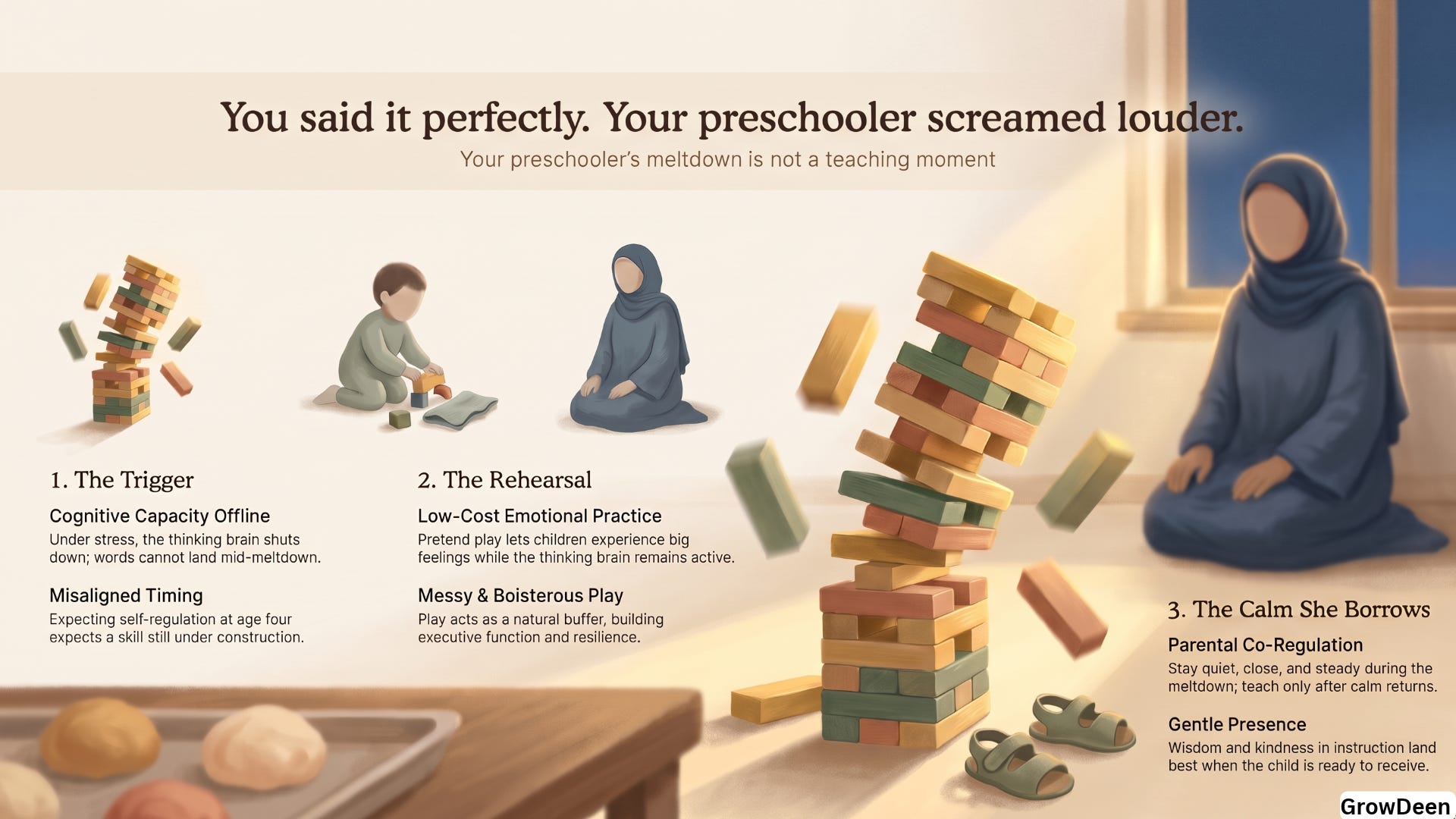
It is 6:40pm and the tower just fell.
What follows is loud enough to bring someone through from another room, and nothing in your voice makes any difference for about ninety seconds. You crouch down. You say the thing the book said to say, the calm naming of the feeling, the low voice, the hand on the back. Your child screams louder and pushes your hand away.
That part is not in the book. The gap between what you were told to do and what actually happened in your kitchen is where most parents quietly decide they are getting this wrong.
You are not getting it wrong. You are trying to teach in the one moment when teaching cannot land, which is a different problem and a much more fixable one.
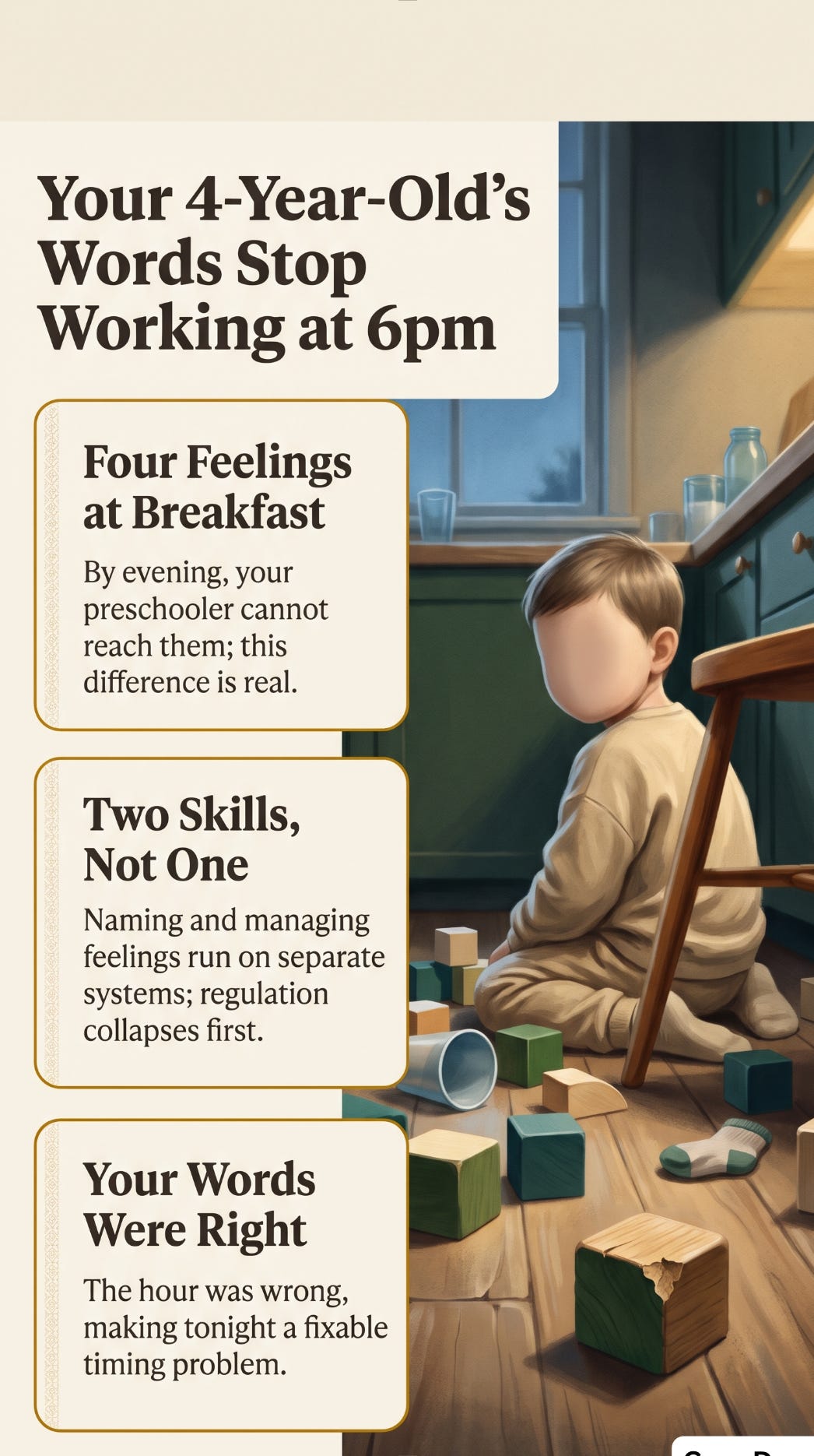
Here is the question worth carrying through the rest of this: why can your child name four feelings at breakfast and have none of those words available by six in the evening? The answer is further down, and it changes what you do tonight.
Why This Guide Is Different
Research first. Every claim here is tied to a named source with a year, including the ones that complicate the story rather than support it.
Islam woven through, not bolted on. The verse and the narration used here were checked against Tafsir Ibn Kathir and sunnah.com this week, and the article says plainly where an application is an application rather than a ruling.
A tool, not just a read. You already have the free Big Feelings Pack from the button at the top of this page, which turns all of this into three printable pages you can keep where the hard evenings happen.
The Worst Possible Moment To Teach Anything
Think about what is physically happening to a four-year-old mid-meltdown. The part of the brain that holds a goal, waits, switches tactics and ignores distraction is the part that goes offline first under stress. Feeling and thinking develop in step in a young child [7], which is why a flooded child also stops being able to follow a one-step instruction. Not refuses. Cannot.
So when you crouch and explain, you are speaking to a system that is not currently receiving. Your words are correct and the timing is wrong, and the result feels exactly like failure.
This is the villain of the whole topic: the belief that the meltdown is the teaching moment. It is a reasonable belief. It is also the reason so many calm, well-read, well-intentioned parents end up feeling like frauds by bath time.
What works instead has two halves. During the storm, you are not teaching, you are being the calm your child borrows. Afterwards, and more importantly beforehand, you are rehearsing. Play is where the rehearsal happens.
But that only makes sense if you know what a three, four or five year old is actually capable of yet.
What Your Child Can Actually Do Yet
Developmental milestones describe what roughly three quarters of children do by a given age [2]. They start a conversation with your doctor. Nobody passes or fails them.
At three to four, most children are putting names to the plain feelings. Sad, happy, angry, excited. Most settle within about ten minutes of a nursery drop-off, and most will notice other children and go over to join them [3]. Affection turns deliberate. A drawing gets made for a friend without anyone suggesting it, and handed over with enormous seriousness.
At four to five, the vocabulary widens to the awkward feelings. Frustration. Embarrassment. Most four-year-olds pretend to be something else during play, a teacher or a doctor or a dog, and most will go and comfort another child who is hurt or upset [3]. This is also the age of the first flat denial, usually attached to guilt or fear of your reaction, and a child insisting she did not do the thing you watched her do has just worked out that you cannot see inside her head.
By five, most children can take turns and hold to the rules of a game played with other children [3]. Disappointment, guilt and jealousy get names. Waiting gets slightly less unbearable.
Now read that list again and notice what is missing from all of it. Not one of those milestones says a child of this age can regulate a strong emotion while it is happening. That skill is still being built, and it will keep being built well past five. Expecting it at four is like expecting a child who has just learned to name letters to read you a paragraph.
Which brings us back to the question from the top, and the answer is simpler than it looks. Naming a feeling and managing a feeling are two different skills running on two different systems, and the second one collapses under load long before the first one does. Your child has the words. At 6:40pm she does not have access to them.
So where does the practice happen? Not where most parents think.
Where The Rehearsal Actually Happens
Play lets a child run an emotion at low cost. The teddy is not really ill. The shop is not really closing. A child who loses a pretend race finds out what losing feels like without the rest of the evening collapsing around it, and crucially, she finds out while her thinking brain is still online.
The American Academy of Pediatrics put the case in its clinical report on play, which states that play is not frivolous, that it builds executive function, and that it works as a buffer against the effects of stress [1]. That same report carries the finding in the opening line of this article: fifteen minutes of play with a teacher or another child left preschool-anxious children twice as relieved as children who sat and listened to a story [1].
A systematic review of free play and emotional development reports the same direction across many studies, with children who get room to play freely handling their feelings better than children whose hours are entirely adult-directed [4]. Work on preschool socialisation describes play as where a child practises reading other people, taking turns and patching up a fallout afterwards [5]. Self-regulation grows in the same ground [8].
Fathers deserve a line of their own. A systematic review of father-child play found the physical, boisterous style many fathers fall into without planning it is associated with better emotional regulation, most likely because it takes a child right to the edge of overexcitement and then brings them back down [6]. The wrestling on the rug after Maghrib is doing something real. It is a rehearsal of losing control inside a situation where losing control is safe.
And here is the part most parenting articles leave out, which is worth knowing before you build your evening around any of this.
The Honest Caveat
Pretend play gets credited with a great deal. A major review in Psychological Bulletin went through the evidence domain by domain and found the strongest claims unsupported. For language, narrative and emotion regulation the evidence could not separate competing explanations. For executive function and social skills it weighed against pretend play being the decisive cause. For problem solving there was no compelling evidence of even a correlation [10]. The authors concluded that other things about the child, the adults and the environment may be doing the work pretend play has been credited with.
Worth sitting with for a second, because it changes the sales pitch and not the practice. Play is still where a preschooler spends most of their waking attention, and the adult in the room is still the strongest single influence on what gets learned there. Nobody has to believe play is magic in order to sit on the floor for ten minutes.
That is the bar, and it is a low one. Here is what to do once you are down there.
Five Rehearsals That Build Feeling Skills
None of these need new toys, a timetable, or a parent who is good at pretending.
Messy play, for naming in the moment. Sand, water, dough, soapy bubbles in a tray, mud if the weather is on your side. Say what you see without correcting it: “You are squealing and your hands are going fast. That looks like excitement.” Your child is learning that an internal state has a word attached to it, at the exact moment the state is happening. Water play also runs straight into wonder about Allah’s creation, where rain comes from and who sends it.
Dress-up and pretend, for trying on a feeling that is not yours. A box of old clothes, a bag, a toy stethoscope. A preschooler can practise being gentle and concerned as a doctor, or practise greeting a guest with Salaam and carrying in the tray, which is adab learned through the hands instead of through a lecture.
Puppets, for the feelings too big to own yet. A sock puppet can be furious in a way your child cannot yet manage in person. Let the puppet rage. Then ask the puppet what would help, and watch your child answer with advice she would reject if you offered it to her directly.
The body map, for locating a feeling before it arrives. Draw a rough person on paper. Take turns colouring where each of you feels things. Nerves in the tummy, anger in the hands, sadness behind the eyes. A child who knows where her worry lives has a half-second of warning before it takes the room.
Child-led play, for the thing none of the others give. Choice and control inside play are where independence and confidence come from [9]. Ten minutes without redirecting or improving the game is harder than it sounds and worth more than an hour of the supervised kind.
Pick one. Not five. The parent who does one of these three times a week is doing better than the parent who plans all five and manages none.
There is one more thing your child is learning in all of this, and it is not on the list above.
Support Muslim Parenting Lab ❤️
Worried that giving will leave you with less? Give an amount you will not feel, with the button below.
The Prophet ﷺ said charity does not decrease wealth. (Sahih Muslim 2588)
What Your Calm Is Actually Teaching
Parents socialise emotion in three broad ways: by modelling it, by responding to it, and by talking about it directly. A meta-analysis of 24 studies on preschool-aged children found each of these positively associated with children’s emotion skills, with small effect sizes and mostly cross-sectional designs, which the authors were careful to flag themselves [11]. Small and real is still worth having, and it costs nothing.
Naming is the cheapest. A child who hears the label often enough starts reaching for it herself, and a child who can say “I feel jealous” is holding the raw material of tarbiyah in her hands. Sabr and shukr both begin with being able to tell one internal state from another. You cannot be patient with a storm that has no name.
Modelling is the one most parents skip, because it means narrating your own state out loud in front of a small and very attentive audience. Say it anyway. “I am feeling frustrated, so I am going to sit down and take three slow breaths.” Then sit down and do it, with a quiet dhikr underneath if that helps you settle. Your child is copying a sequence, and sequences are what get copied. Instructions are not.
Responding is the part that happens at 6:40pm. Stay near. Stay steady. Every feeling your child has is permitted. What she does with it is where the teaching sits, and that teaching lands far better once the crying has stopped than during it.
Which is also, almost word for word, what Islam asks of the one doing the teaching.
I know this is a lot to hold on a Tuesday evening, especially when the tower has already fallen twice. That is why the free Big Feelings Pack exists: five rehearsals on one printable page, a body map your child fills in herself, and a short reflection card for you. The download button is at the top of this page, and there is a full description of what is inside it below.
What Wisdom And Good Instruction Ask Of A Tired Parent
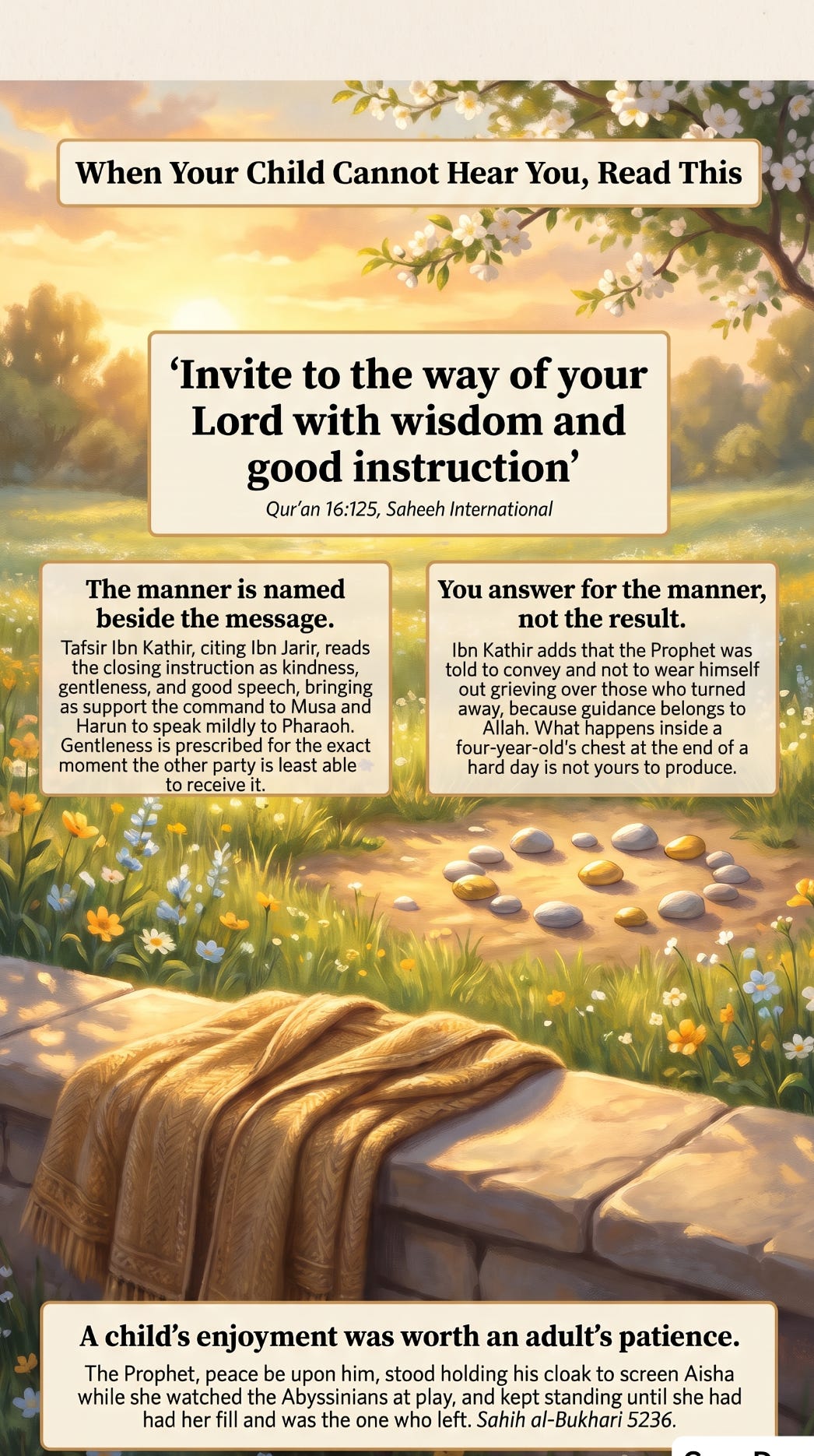
Allah tells His Messenger ﷺ: “Invite to the way of your Lord with wisdom and good instruction” [13]. Tafsir Ibn Kathir explains hikmah here, citing Ibn Jarir, as what was revealed in the Book and the Sunnah, and reads good admonition as fair exhortation. On the final clause he states that where there is argument, the response is to be carried out with kindness, gentleness and good speech, and he brings as support the instruction given to Musa and Harun to speak mildly to Pharaoh [14].
The verse addresses conveying the message to adults who can argue back, and what follows here is an application of its principle. What carries across is the order of priority. The manner of the teaching is named alongside its content, and gentleness is prescribed for exactly the moment when the other party is least able to receive it.
Ibn Kathir adds something a tired parent may need more than the instruction itself. The Prophet ﷺ was told to convey and not to wear himself out grieving over those who turned away, because guidance belongs to Allah [14]. You are answerable for the manner and the patience. What happens inside a four-year-old’s chest at 6:40pm is not yours to manufacture.
There is a narration that shows the same thing in a moment of ordinary life. Aisha, may Allah be pleased with her, watched the Abyssinians at play in the mosque courtyard while the Prophet ﷺ stood and screened her with his cloak. She kept watching. He kept standing, until she had had her fill and was the one who left [15]. The teaching was the standing.
What To Skip
Arguing a feeling away. “There is nothing to be sad about” teaches a child that reporting feelings is pointless, which is nobody’s intention.
Shame, and comparison with a sibling who happens to be coping better today.
Rushing into every pretend-play dispute. Hover, and step in only once it has stopped being play.
Reaching for a screen as the standard calm-down tool. The AAP states plainly that real play and real social interaction beat digital media for this kind of learning [1], and the World Health Organization recommends no more than one hour of sedentary screen time a day for children aged three and four, with less being better [12]. Where screens are used, keep them Islamically suitable, music-free and parent-approved.
Using salah, du’a or Allah’s anger as a threat to end a tantrum. Worship attached to fear of a parent’s temper does not grow into love of Allah.
Asking a child to perform calm for visitors. A child who is overwhelmed in a loud room needs a quiet corner.
When To Speak To A Doctor
Speak to your doctor or child health nurse if your child shows no interest in other children by three, does not pretend during play by three, or shows no empathy by four [3]. The same applies if skills your child had seem to go backwards, or if anything else about her development is worrying you. Early conversations are easier than late ones, and none of this replaces advice from a professional who can actually see your child.
The Big Feelings Pack
If you have read this far, you are the kind of parent who takes a four-year-old’s inner life seriously, at the end of a day when taking anything seriously is expensive. That says something about you that the 6:40pm version of the evening does not.
Inside the Big Feelings Pack (one comprehensive PDF, 3 pages):
Page 1: The Five Rehearsals Card. Each of the five play rehearsals from this article set out in a row of its own, with the feeling it practises and the one sentence to say while it is happening, designed as a fridge card you can read in four seconds while holding something else.
Page 2: Where My Feelings Live. A printable body outline your child colours in herself, with a six-word feelings key and a short parent guide on the reverse, so you can do the whole activity in under fifteen minutes without preparing anything.
Page 3: The Standing Still Card. A reflection card carrying the Qur’anic instruction on teaching with wisdom and good instruction, the narration of the Prophet ﷺ standing while Aisha watched the play in the courtyard, and three short lines on what both ask of a parent at the end of a hard day.
This is not a PDF to download and forget. It is built to stay on the fridge or in the drawer by the playmat, where you will actually reach for it when the evening goes sideways.
The Big Feelings Pack is what every subscriber receives with each article. Muslim Parenting Lab covers the whole arc of raising Muslim children, from newborn sleep and feeding through behaviour, learning and the early years of deen, all of it backed by current research and rooted in Qur’an and Sunnah.
Before You Close This
One thing, tonight, inside five minutes. Find a scrap of paper and draw a rough outline of a person on it. Leave it on the table with a few crayons. Say nothing about feelings. Tomorrow, when your child is calm and curious, sit down and colour in where your own worry lives, and wait.
May Allah make this stage easy on you, place barakah in your patience, and let the gentleness your child learns at your feet stay with her long after the games are forgotten.
Share This With Someone Who Needs It
Think of one person right now. The friend whose four-year-old melts down at every pickup and who laughed about it in a way that did not sound like laughing. Your sister, who told you last month that she loses her temper by bath time and then lies awake about it. The cousin who has read every book and still feels like she is failing at 6:40pm.
This article could take one weight off her evening. Send it to her today, not as advice and not as a correction, but because you know exactly what that hour feels like and she does not know that you do.
Frequently Asked Questions
Q: At what age should a child be able to calm themselves down?
A: Not reliably at three, four or five. Milestones at this age cover naming feelings, pretending, comforting a friend and following game rules [3], and self-regulation under real stress keeps developing well past five. Expect progress, not competence.
Q: How do I teach my preschooler to name their feelings?
A: Name them out loud during ordinary play, when the feeling is mild and your child’s thinking brain is still working. See the five rehearsals above for exactly how, starting with messy play.
Q: Is it normal for a 4-year-old to have meltdowns every day?
A: Daily meltdowns at four are common, and they usually thin out between four and five as language and waiting improve [3]. What matters more than the count is whether they are getting shorter over months, and whether your child recovers with you nearby.
Q: Should I talk to my child during a tantrum or wait?
A: Wait, mostly. Under stress a child loses the capacity to follow even a one-step instruction, because feeling and thinking develop in step at this age [7]. Stay close, stay quiet, and do the teaching once it has passed.
Q: Does play really help with emotions, or is that just something people say?
A: Both, in a way. Play reduced measured stress in preschool-anxious children in fifteen minutes [1], and free play is linked with better emotional handling across many studies [4]. A major review also found the strongest claims about pretend play unsupported [10], which is why this article treats play as the setting rather than the cure.
Q: What does Islam say about playing with your child?
A: Play is not treated as beneath a serious life. The Prophet ﷺ stood and screened Aisha with his cloak while she watched play in the mosque courtyard, until she had had her fill and was the one who left [15]. Attention given on a child’s clock has precedent.
References
[1] Yogman, M., Garner, A., Hutchinson, J., Hirsh-Pasek, K., & Golinkoff, R.M. (2018). The Power of Play: A Pediatric Role in Enhancing Development in Young Children. Pediatrics, 142(3), e20182058
[2] Zubler, J.M., Wiggins, L.D., Macias, M.M., et al. (2022). Evidence-Informed Milestones for Developmental Surveillance Tools. Pediatrics, 149(3), e2021052138
[3] Centers for Disease Control and Prevention. Learn the Signs. Act Early. Developmental milestone checklists, 3, 4 and 5 years
[4] Ahmed, S., Khan, D.S., & Mehmood, A.S. (2023). Let them play: A systematic review investigating the benefits of free play in emotional development of children. Academy of Education and Social Sciences Review, 3(4), 509-520
[5] Alwaely, S.A., Yousif, N.B.A., & Mikhaylov, A. (2020). Emotional development in preschoolers and socialization. Early Child Development and Care, 191(16), 2484-2493
[6] Amodia-Bidakowska, A., Laverty, C., & Ramchandani, P.G. (2020). Father-child play: A systematic review of its frequency, characteristics and potential impact on children’s development. Developmental Review, 57, Article 100924
[7] Bell, M.A. (2024). Child development at the intersection of emotion and cognition (2nd edn). American Psychological Association
[8] Whitebread, D., Grau, V., Kumpulainen, K., McClelland, M.M., Perry, N.E., & Pino-Pasternak, D. (2019). The SAGE handbook of developmental psychology and early childhood education. SAGE Publications
[9] Fleer, M. (2025). Play in the early years (4th edn). Cambridge University Press
[10] Lillard, A.S., Lerner, M.D., Hopkins, E.J., Dore, R.A., Smith, E.D., & Palmquist, C.M. (2013). The impact of pretend play on children’s development: A review of the evidence. Psychological Bulletin, 139(1), 1-34
[11] Zinsser, K.M., Gordon, R.A., & Jiang, X. (2021). Parents’ socialization of preschool-aged children’s emotion skills: A meta-analysis using an emotion-focused parenting practices framework. Early Childhood Research Quarterly, 55, 377-390
[12] World Health Organization. (2019). Guidelines on physical activity, sedentary behaviour and sleep for children under 5 years of age. Geneva: WHO
[13] Qur’an, Surah An-Nahl 16:125 (Saheeh International)
[14] Ibn Kathir. Tafsir Ibn Kathir, Surah An-Nahl 16:125 commentary
[15] Sahih al-Bukhari 5236. Narrated Aisha. Book 67, Hadith 169. Graded: Sahih
We combine scientific research with Qur’an and authentic Sunnah, and we cite our sources. Even so, this is general guidance and no substitute for a doctor who can examine your child.