

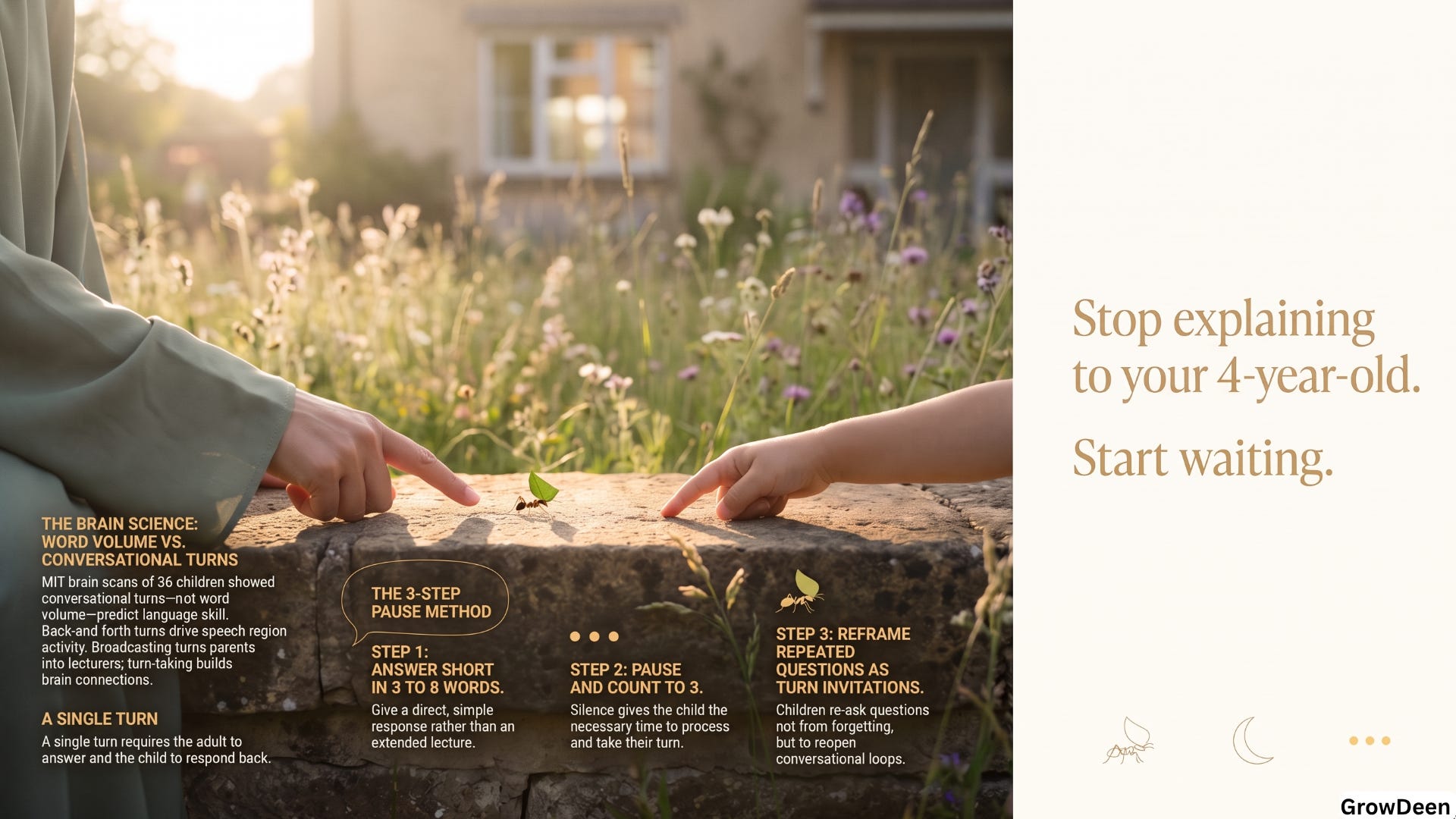
MIT scanned 36 four to six year olds. The ones with more back-and-forth conversation at home had stronger activity in the brain's speech region, whatever their family earned. [1]
Three pages. Printable. Nothing to sign up for.
It is 7:40 in the morning. Your three year old has already asked why the tap makes that noise, where the moon goes in the daytime, and whether the neighbour's cat is Muslim. You answered all three properly. Twenty minutes later he asks about the moon again.
You gave a good answer. He asked anyway. And something in your chest tightened, because it felt like the answer did not land, and you have eleven hours of this ahead of you.
Here is the question I want you to carry through this article: why does a four year old ask the same thing a fourth time, even when your answer was correct? The reason has nothing to do with forgetting, and nothing to do with how you explained it. I will come back to it, because once you see it, the whole day gets lighter.
What makes this guide different
Every claim here is tied to a named source with a year, including the CDC milestone data, the WHO movement and screen guidance, and the MIT conversation study that changed what we thought mattered most. [1][2][3][9]
This is not a developmental checklist with a verse bolted on the end. The Qur'an has something specific to say about where a questioning mind should be pointed, and it turns out to line up with what the research found.
You already have the free Next Question Pack from the top of this page, so the practical part lives on paper in your kitchen rather than in your memory at 6pm.
The advice that quietly made parenting harder
For about thirty years, the headline advice to parents of young children was volume. Talk more. Narrate your day. Fill the air with words, because the children who hear more words do better later.
That advice came from a real finding, and it created a real problem. It turned parents into broadcasters, when what the Harvard Center on the Developing Child identifies as the actual driver of early brain building is a child acting and an adult responding back. [5]
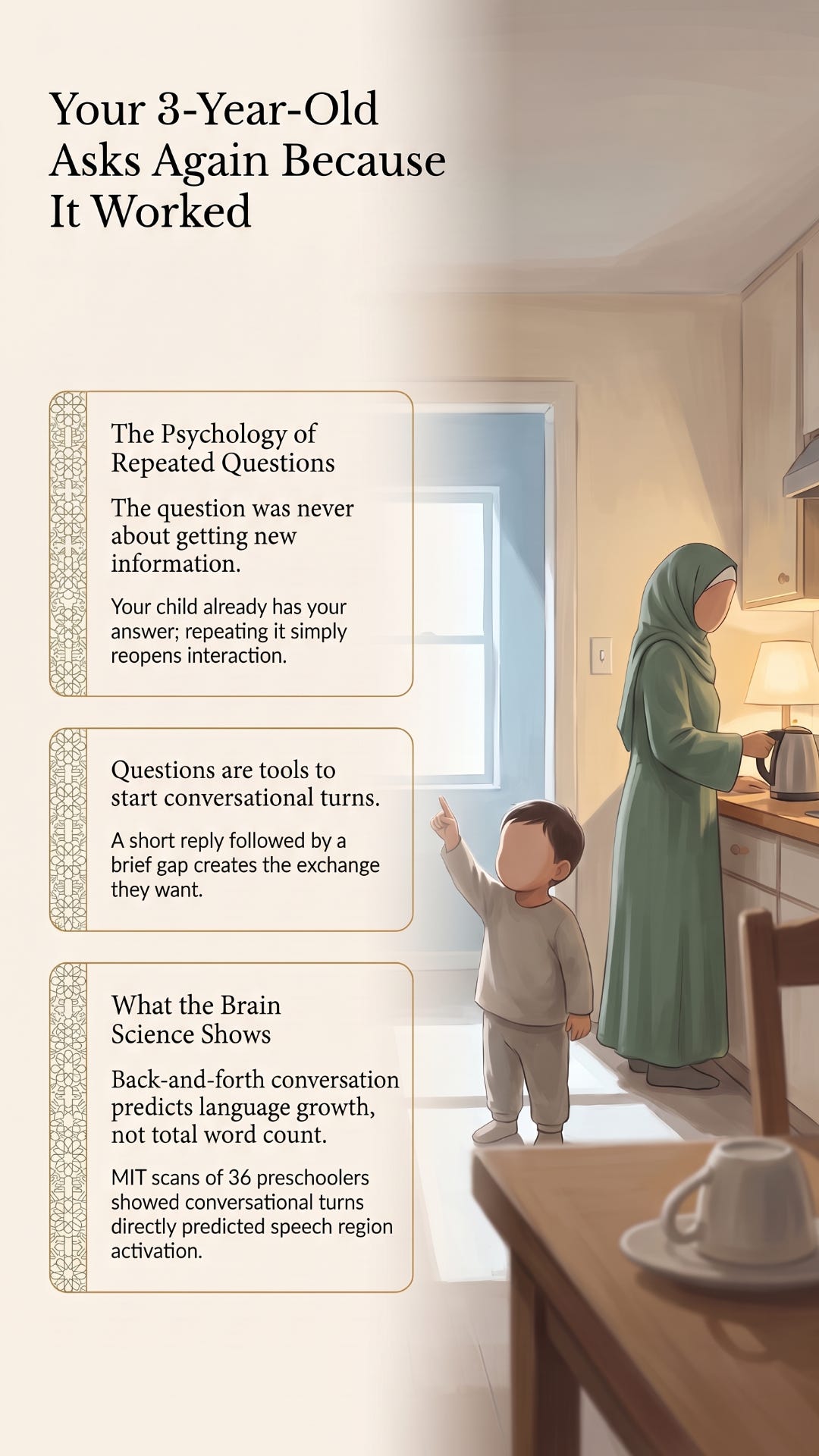
Here is what changed it. Researchers at MIT recorded the home language of 36 children aged four to six from a range of family backgrounds, then scanned their brains while they listened to stories. The children who had more conversational turns with an adult showed stronger activation in the left inferior frontal region, the part used for speech, and that activation explained much of the link between their language exposure and their verbal skill. The number of adult words on its own did not do it. Neither did family income: children from lower income homes who had plenty of back and forth looked like children from higher income homes. [1]
A turn is almost nothing. Your child says something. You answer the thing he actually said. He answers back. That is one turn.
And a turn is the one thing a monologue cannot produce, no matter how many words are in it.
Why the same question comes back
So, the question I planted at the top. Your four year old asks where the moon goes. You tell him. Twenty minutes later he asks again.
He is not checking your answer. He is opening another turn.
At this age your child knows his own age, names shapes and colours, understands opposites like big and small, follows ideas like on, in and under, and has started pointing out letters and numbers. [2][3][8] Every one of those came from a loop, not a lecture. The question is the only tool he has for starting one, so he reuses the question that worked.
Which means the length of your answer is almost irrelevant, and the fact that you answered at all is the entire point.
That reframe is worth sitting with for a second, because it changes what a tired parent is actually required to produce at 6pm. Not a better explanation. Just a reply, and then a gap.
The three seconds that do the work
So what does this look like at twenty past six on a Tuesday, when dinner is half made?
Answer short. Three to eight words is plenty. "The moon is still there, just hidden by the sun."
Then stop talking and count to three in your head.
That pause is where he puts his turn. Most of us fill it, because silence from a four year old feels like we lost him. We add a second sentence, then a third, and by the time we finish he has wandered off, and we conclude he was not interested. He was waiting.
Two more things that make turns easier to get:
Answer the question he asked, not the one you wish he had asked. A child who asks where the moon goes does not want astronomy. He wants you to look at the sky with him and say something true.
When you have nothing, say so. "I do not know. Let us find out." A child who learns that knowledge has edges, and that edges are not embarrassing, has learned something most adults are still working on.
And the turn is not only verbal. By four, pretend play has taken off, and the research links it to developing thinking, mental flexibility and an understanding of what is going on in someone else's head. [7] Paediatric guidance treats play as the main engine of learning at this age. [4] When you sit down inside the pretend clinic and let him take your pulse, you are taking a turn. A parent who supervises play is doing less than a parent who joins it.
Answer short, then wait for the next question.
I know that is a lot to hold in your head at the end of a long day, especially when you are also managing dinner, wudu, and someone who has strong views about socks. That is why the free Next Question Pack exists. The download button is at the top of this page, and there is a full description of what is inside it below. It puts the hard part on paper so you are not relying on memory at the exact moment you have none left.
But there is something underneath all of this that the research does not reach.
The Qur'anic invitation to look
Three to four is the age a child first asks who made the world. When that question lands, most of us reach for a bigger answer. The Qur'an does the opposite. It sends the questioner outside.
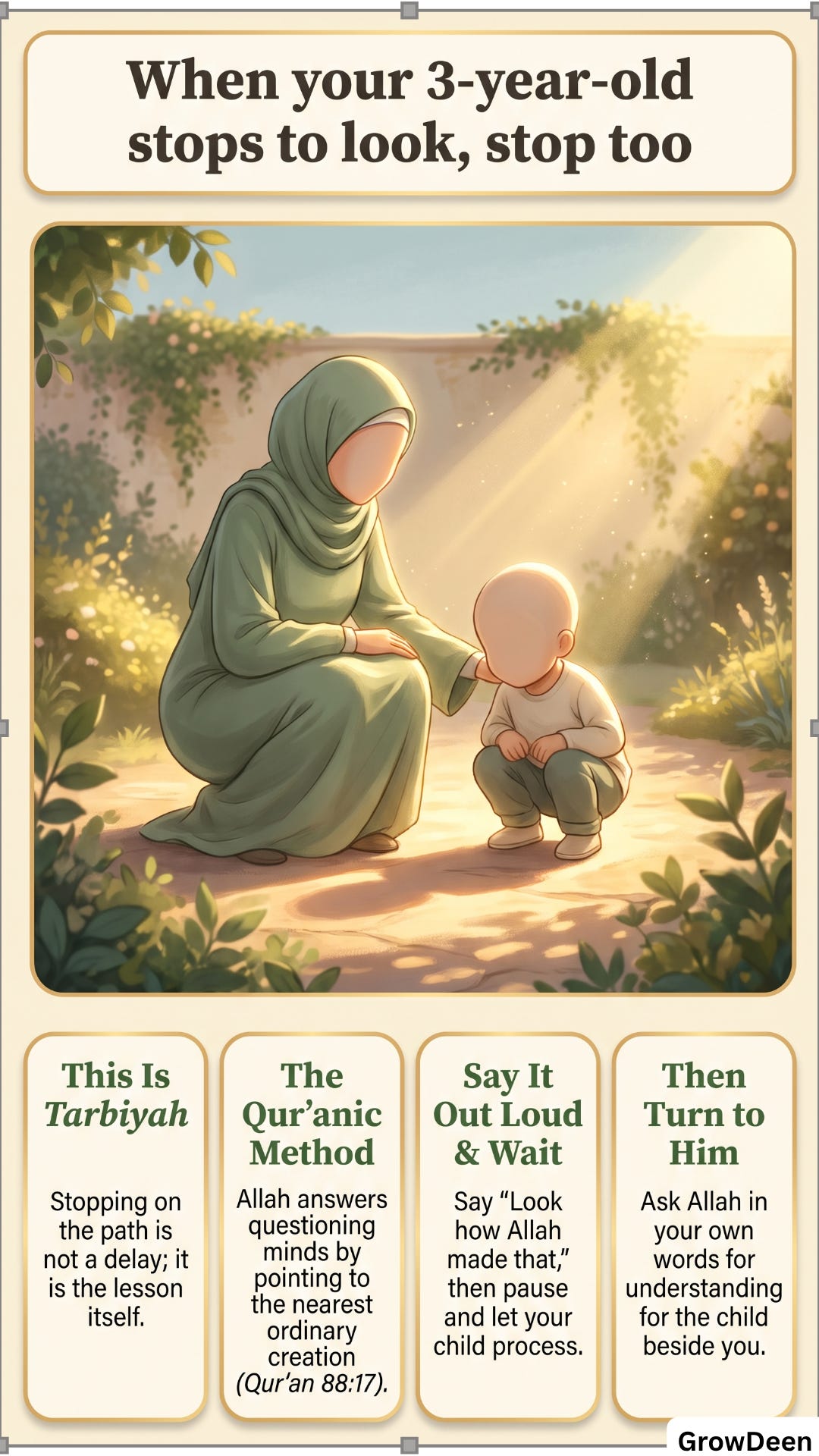
Allah says: "Then do they not look at the camels - how they are created?" [10] The verses that follow move on to the sky, the mountains and the earth.
According to Tafsir Ibn Kathir, these verses are a command from Allah to His servants to look at His creation as proof of His power and greatness, and the camel is named first because it was the animal the Arabs lived alongside every day. [11] The example chosen is the near one, already standing in the yard. Ibn Kathir also records that Shurayh al-Qadi used to say to his companions, come out with us so that we may look at the camels and how they were created, and at the sky and how it has been raised. [11] A judge, taking grown men outside to look again at what they had seen a thousand times.
Your three year old lives there permanently. He has not yet learned to stop noticing. When he stops you on the path because an ant is carrying something four times its size, he is doing what that verse asks of adults who have forgotten how.
So the instruction for this year is a walk, and a sentence: look how Allah made that. Then the pause. Then his next question.
The two things that decide how the asking goes
Here is what surprised me when I went through the guidance side by side: the biggest influence on how a day of questions feels is not your patience. It is your child's sleep.
The American Academy of Sleep Medicine convened a panel of thirteen sleep specialists who reviewed the evidence and recommended 10 to 13 hours of sleep per 24 hours, including naps, for children aged three to five. The panel found that regularly sleeping less is associated with problems in attention, behaviour and learning. [12] A four year old who falls apart at five in the afternoon is very often a four year old who went to bed at ten.
Movement is the second one. The World Health Organization recommends at least 180 minutes of physical activity a day for three and four year olds, with at least 60 of those minutes moderate to vigorous, spread through the day. [9] A child who has run is a child who can sit.
Screens sit against both. The WHO advises no more than one hour of sedentary screen time a day at this age, and says less is better. [9] The American Academy of Pediatrics recommends limiting children aged two to five to about an hour a day of high quality programming, watched alongside a parent who talks about what is on it. [13] Choose Islamically suitable, music-free, parent-approved content, and then ask the more useful question: what is the hour replacing? A screen will never take a turn with your child. That is the whole case against it.
The everyday things that are quietly building him
Mealtimes carry adab more easily than any lesson, because they arrive three times a day whether or not you planned one. Bismillah before, Alhamdulillah after, the right hand, eating from what is in front of you. By four, most children can feed themselves, dress and undress, manage shoes without laces and use the toilet largely alone. Many still wet the bed, which is normal. Teeth still need you. [2][3]
Prayer is not obligatory on him yet, and nothing in this year is. Put a small mat beside yours and let him copy the standing and the sujud. Do wudu alongside him with his sleeves rolled, slowly. Let him learn a short surah a line at a time in the car rather than drilled at a table. A four year old who loves the prayer mat is further ahead than one who has been made to stand on it.
Questions about bodies belong in this list too, because they arrive in this year and they catch parents off guard. Paediatric sources treat plain curiosity as common at this stage, and advise speaking to a doctor if a child's behaviour in this area concerns you. [2][3] Islam builds privacy by habit long before it explains it. Teach knocking. Close doors. Name body parts in ordinary words with no shame attached and no giggling encouraged. Teach that some parts are private and not shown to or touched by others, with the clear exception of a parent or doctor helping where needed. Haya grows in a house where nobody is embarrassed and nobody is harsh. It does not grow where a child learns that a question about his own body makes an adult go quiet.
When to speak to a doctor
Development follows a similar order in most children while the timing varies a great deal, so early advice beats waiting and hoping. See a doctor if you notice any of these, and go promptly if your child loses a skill he previously had. [2][3][6]
At three, if he is not using three-word sentences, cannot follow a two-part instruction such as getting his shoes and putting them in the box, is often hard for family to understand, shows no interest in other children, does not pretend during play, or struggles badly with a crayon.
At four, if he is not using sentences of four or more words, does not talk about his day, does not know any colours, has tantrums over very small things, shows no empathy when someone is hurt, seems frightened or sad much of the time, or cannot draw a circle or a square.
This article is general guidance and does not replace medical advice. Follow your doctor's guidance, and ask for a referral if your concerns are not addressed.
The Next Question Pack
If you have read this far, you are the kind of parent who takes a four year old's questions seriously rather than treating them as noise to be managed. That tells me something about the home he is growing up in.
Inside the Next Question Pack (one comprehensive PDF, 3 pages):
Page 1: The Answer-and-Wait Card. Eight real questions three and four year olds actually ask, each with a short answer you can say out loud, the three-second pause marked on the card, and the follow-up question to hand back. It is designed as a laminated card you can keep on the fridge or inside a kitchen cupboard door.
Page 2: The Ten-Minute Noticing Walk. Ten outdoor prompts built on the logic of looking at the near, ordinary thing, plus a one-glance anchor strip showing the sleep and movement numbers for this age, so you can turn a walk to the shops into the best ten minutes of your child's day without planning anything.
Page 3: The Invitation to Look Card. A reflection card built on Surah al-Ghashiyah 88:17 and what Ibn Kathir says about why Allah named the most ordinary creature first, in English with the source given, plus three sentences you can say to a child standing in front of something small and strange.
It is built to stay on your fridge, at eye level, where you will actually reach for it.
This pack is what every subscriber receives with each article. Muslim Parenting Lab covers the full span of raising Muslim children, from newborn sleep to the questions a nine year old starts asking, all backed by research and rooted in Qur'an and Sunnah.
If you want both evidence-based guidance and Islamic perspective in the same place, subscribe free so the next resource arrives before you need it.
Subscribe free for parenting resources backed by both science and Sunnah, guidance you cannot get anywhere else, with no spam and no clutter.
Do this one thing tonight
The next time your child asks you something, answer in under eight words and then count to three in your head before you say anything else. Once. Tonight. Watch what he does with that gap.
May Allah place barakah in your effort, accept your intention, and make the care you give more merciful and more rewarded than it feels at twenty past six on a Tuesday.
Share this with someone who needs it
Think of one person right now: the sister at the masjid who said her four year old never stops asking and she has run out of answers, or the friend whose voice notes sound exactly like yours did last winter, or the mother in your family who has started answering her child without looking up.
This could change one evening in their house. Send it to her today, not as advice, but because you remember what that tiredness feels like.
Questions parents ask
Why does my 3 year old ask the same question over and over?
Because the question is how he starts a conversation, not how he gets information. He already has your answer. What he wants is another turn with you. Answer short, then pause and let him take it.
How many words should a 4 year old be saying?
By four, most children are using sentences of five or six words and beyond, following two and three step instructions about familiar things, and are understood by most adults. [2][3] If your four year old is not using sentences of four or more words, speak to a doctor rather than waiting.
How much sleep does a 3 to 4 year old need?
Between 10 and 13 hours per 24 hours, including naps, according to the American Academy of Sleep Medicine panel. [12] Regularly getting less is linked to problems with attention, behaviour and learning, which is why bedtime often fixes things that look like behaviour problems.
Is screen time bad for a 3 year old?
The World Health Organization advises no more than one hour of sedentary screen time a day at this age, and less is better. [9] The more useful question is what the hour replaces. A screen cannot take a conversational turn, which is the thing driving language development at this age. [1]
What should I say when my child asks who made Allah?
Keep it short and calm, and turn his attention outward rather than inward: Allah made everything, and nobody made Allah. Then take him outside and show him something small. That is the pattern Surah al-Ghashiyah uses, pointing the questioner at the nearest ordinary thing in front of him. [10][11]
When should I start teaching my 3 year old to pray?
Prayer is not obligatory at this age. Put a small mat beside yours and let him copy you. Children of three and four learn by imitation far more than by instruction, and a child who associates the prayer mat with being near you will carry that for years.
My 4 year old is suddenly curious about bodies. Is that normal?
Paediatric sources treat plain curiosity at this age as common, and advise speaking to a doctor if a child's behaviour in this area concerns you. [2][3] Respond calmly, teach knocking and closed doors, and use ordinary words. A child who learns that the question itself is shameful simply stops asking you and asks someone else.
References
[1] Romeo, R.R., Leonard, J.A., Robinson, S.T., West, M.R., Mackey, A.P., Rowe, M.L., & Gabrieli, J.D.E. (2018). Beyond the 30-Million-Word Gap: Children's Conversational Exposure Is Associated With Language-Related Brain Function. Psychological Science, 29(5), 700-710.
[2] Centers for Disease Control and Prevention. Important Milestones: Your Child by Three Years.
[3] Centers for Disease Control and Prevention. Important Milestones: Your Child by Four Years.
[4] Yogman, M., Garner, A., Hutchinson, J., Hirsh-Pasek, K., Michnick Golinkoff, R., Committee on Psychosocial Aspects of Child and Family Health, & Council on Communications and Media (2018). The Power of Play: A Pediatric Role in Enhancing Development in Young Children. Pediatrics, 142(3), e20182058.
[5] Center on the Developing Child at Harvard University. Three Principles to Improve Outcomes for Children and Families.
[6] Zubler, J.M., Wiggins, L.D., Macias, M.M., Whitaker, T.M., Shaw, J.S., Squires, J.K., Pajek, J.A., Wolf, R.B., Slaughter, K.S., Broughton, A.S., Gerndt, K.L., Mlodoch, B.J., & Lipkin, P.H. (2022). Evidence-Informed Milestones for Developmental Surveillance Tools. Pediatrics, 149(3), e2021052138.
[7] Weisberg, D.S. (2015). Pretend play. WIREs Cognitive Science, 6(3), 249-261.
[8] Wilks, T., Gerber, R.J., & Erdie-Lalena, C. (2010). Developmental Milestones: Cognitive Development. Pediatrics in Review, 31(9), 364-367.
[9] World Health Organization (2019). Guidelines on Physical Activity, Sedentary Behaviour and Sleep for Children Under 5 Years of Age.
[10] Qur'an, Surah al-Ghashiyah 88:17, with 88:18-20 (Saheeh International translation).
[12] Paruthi, S., Brooks, L.J., D'Ambrosio, C., Hall, W.A., Kotagal, S., Lloyd, R.M., Malow, B.A., Maski, K., Nichols, C., Quan, S.F., Rosen, C.L., Troester, M.M., & Wise, M.S. (2016). Recommended Amount of Sleep for Pediatric Populations: A Consensus Statement of the American Academy of Sleep Medicine. Journal of Clinical Sleep Medicine, 12(6), 785-786.
[13] Council on Communications and Media, American Academy of Pediatrics (2016). Media and Young Minds. Pediatrics, 138(5), e20162591.