

Turns matter more than words. Conversational turns between 18 and 24 months explained 14 to 27 percent of children’s IQ and vocabulary ten years later. [1]
Three pages. Print it for the kitchen wall.
It is 6:40 and you have talked all day.
You narrated the supermarket. You explained why the lights go red. You answered a question about where the moon goes while carrying two bags and a scooter. Then the nursery form asked how many back and forth exchanges your four year old holds, and you sat there with no idea what to write.
The distance between how much you talk and how little comes back is not a sign that you are failing your child. It is a sign that the advice you were handed counted the wrong thing.
One question sits under the rest of this guide: why do some children who hear thousands of words a day end up with thinner language than children who hear far fewer? The answer is in this piece, and it is not about how much you say.
Why This Guide Is Different
Every claim here is tied to named research with a year attached, including the 2018 Pediatrics cohort that followed children for a decade and the MIT imaging study that scanned their brains while they listened.
The Islamic layer is not decoration on top of the science. Listening is treated in the Qur’an as attention carried through to understanding, and the Prophet ﷺ taught through question and answer, which is the same mechanism the research describes.
You already have the free Turn Taking Pack from the top of this page, so the ten prompts and the stall card are printable rather than something to remember.
The Gap Is Where The Language Goes In
Picture the last time your child told you something and you said “mmhmm” without looking up. Most parents do this twenty times a day, usually with something boiling behind them.
But that moment is exactly where the machinery either engages or does not.
A conversational turn is one thing said by your child and one thing said back by you that answers it. Not a comment over the top. Not a correction. A reply that treats the last thing your child said as the thing worth replying to.
Researchers at MIT and Harvard recorded two full days of home audio for children aged four to six and counted three separate quantities: words the child said, words the child heard, and turns between the child and an adult. Turns tracked with the children’s language scores. Turns also tracked with activity in Broca’s area while they listened to stories in a scanner, and that link was far stronger than anything the raw word counts explained. [2]
The pattern held regardless of parental income or education. [2]
A second study followed 146 children from infancy and tested them again between nine and fourteen years old. Turns recorded in a narrow window, between 18 and 24 months, accounted for 14 to 27 percent of the later variation in IQ, verbal comprehension and vocabulary, even after the researchers controlled for family socioeconomic status. The adult word counts in that same window mostly lost their power once that control went in. [1]
So here is the answer to the question planted earlier. A child can be soaked in words and still be short of language, because words poured over a child are not the same thing as words handed back and forth with one. Researchers who study input quality describe it along several dimensions at once, including how interactive the exchange is, which is a far more reachable target at 7pm than a word quota. [3]
Their words grow in the silence you leave.
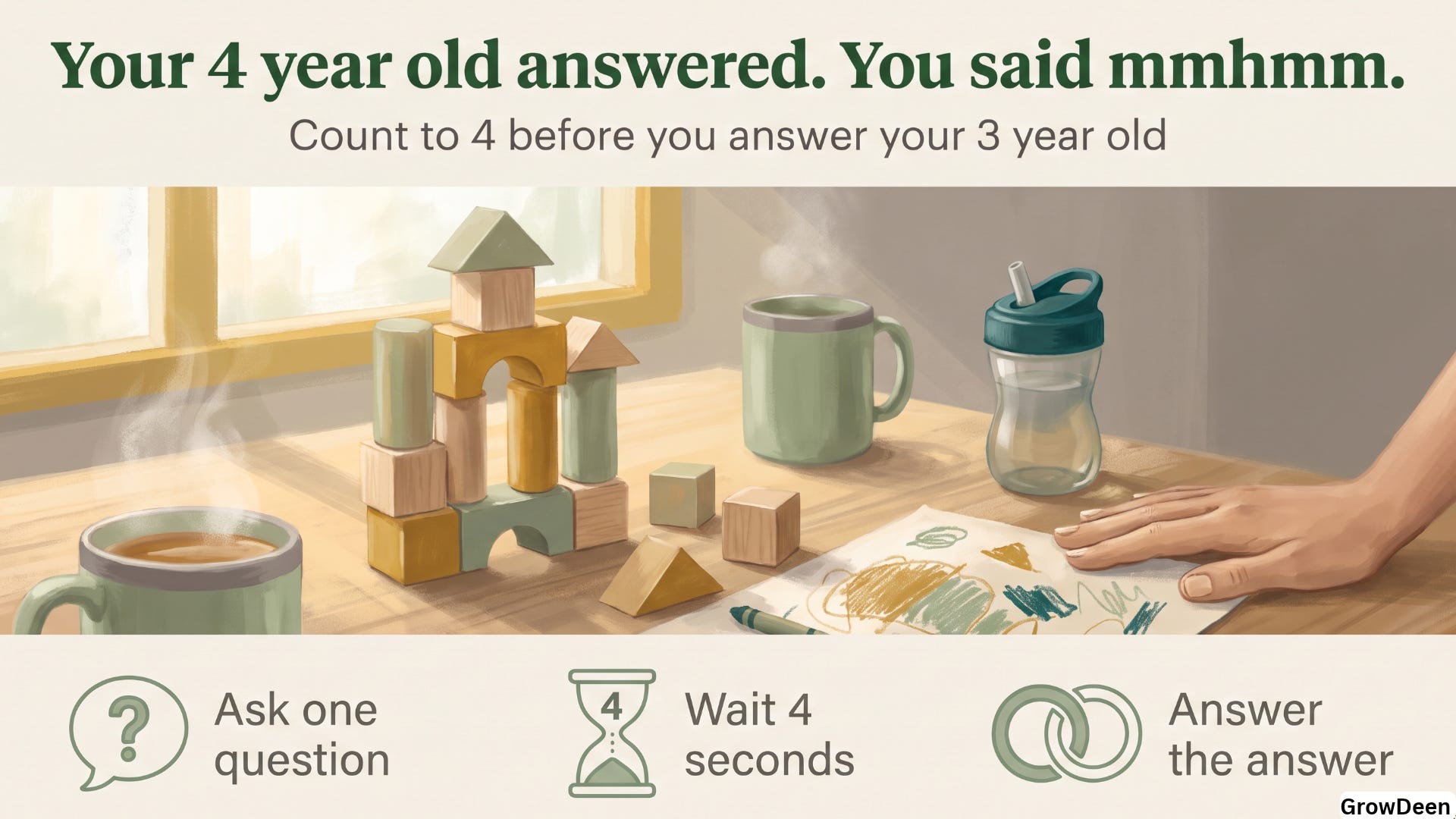
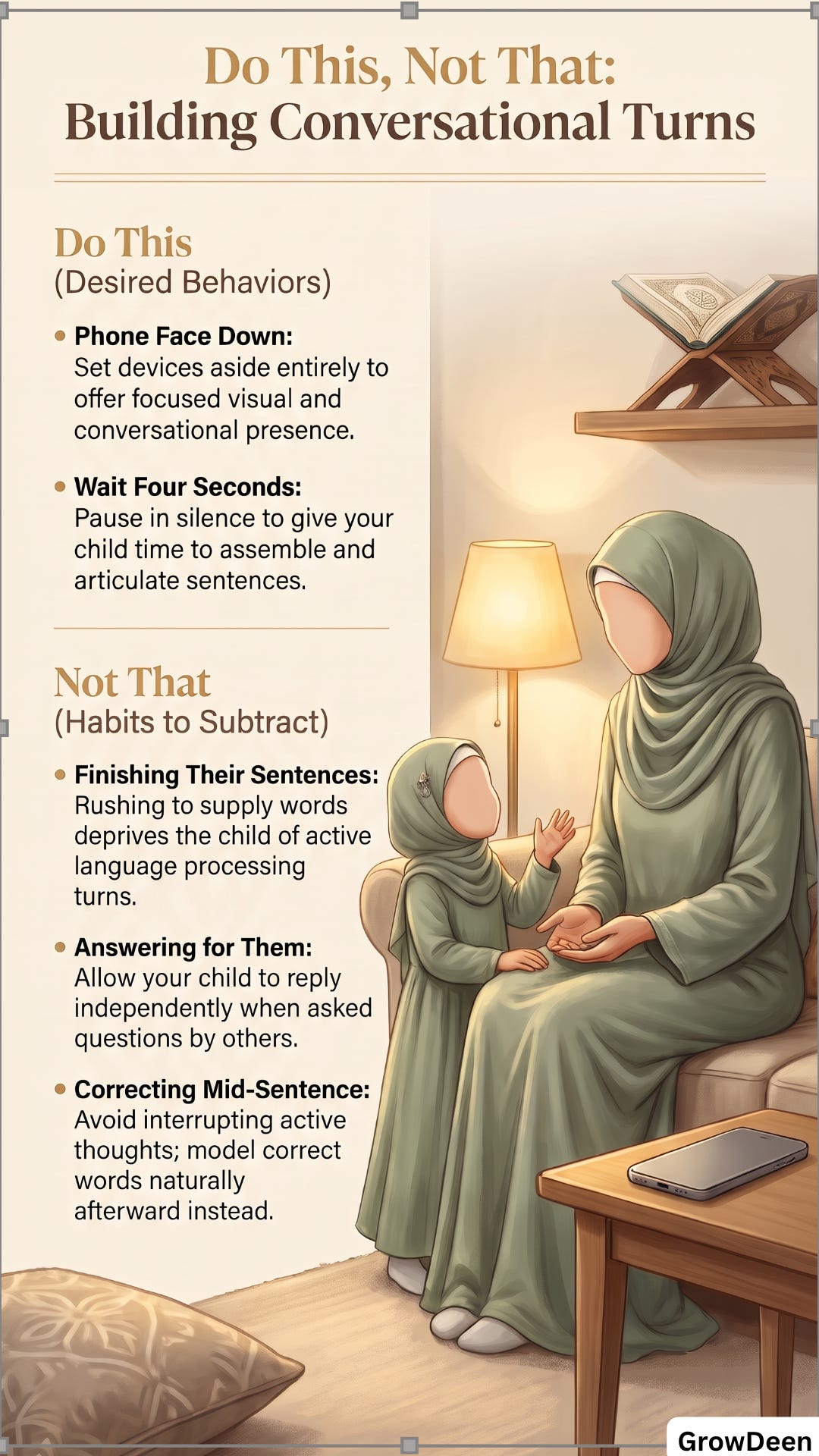
The practical version is four seconds. Ask, then count to four in your head before you add anything. Most adults wait under one second, and a three year old needs roughly three to assemble a sentence.
Five Moments Where The Turns Actually Happen
Nobody has a spare hour. These five moments already exist in your day, and each one is worth two to four turns.
Getting dressed. Ask something with more than one possible answer. “What are you hoping happens at nursery today?” beats “Did you sleep well?”, which a four year old can close with one syllable.
One meal. Bismillah at the start, Alhamdulillah at the end, and one turn each around the table in between. Teaching a preschooler to wait while someone else speaks is harder than teaching them to speak, and the table is where it is learned.
The car or the bus. Name two things you pass, then ask a question your child can answer more than one way. Car time also suits talk about things that are not present: what happened yesterday, what you will take to the masjid tomorrow, why the dough rises while it sits. Children whose parents use this kind of talk build vocabulary faster. [4]
One book. Read it, then argue about it. Ask what the character should have done. Let your child interrupt you. Book sharing supports early communication, and the research points at how the adult reads, with talk around the pictures counting alongside how often the books come out. [5] Stories told without a book work too. Stories of the Prophets and moments from the seerah carry new words attached to something your child wants to follow.
Bedtime. The bedtime du’a, then two minutes in which you say almost nothing. Last thing at night is when children offer the thing they have been holding all day, and they only offer it into silence.
Add those up and it is roughly ten minutes.
A Quick Note On The Pack
Ten minutes sounds easy until you are standing in the kitchen at 6pm with nothing to ask. That is why the free Turn Taking Pack exists: ten printed prompts a three to five year old can answer without a shrug, plus a card for the evenings when the conversation stalls on the first move. The download button is at the top of this page, and there is a full description of what is inside it below.
What Your Child Can Already Do At Three, Four And Five
Milestones describe what 75 percent or more of children manage by a given age. They are a map, not a deadline. [6]
A three year old holds a conversation across at least two back and forth exchanges, asks who, what, where and why, can say what is happening in a picture, and is understood by people outside the family most of the time. [6]
A four year old puts four or more words into a sentence and can tell you one thing that happened in the day, usually out of order. [6]
A five year old keeps a conversation going across more than three exchanges, retells a story with at least two events, answers questions about a story they just heard, and spots rhyming pairs such as bat and cat. [6]
Some of the bumps that worry parents most are ordinary. Between two and six, while language is being assembled at speed, plenty of children repeat sounds, stretch words or stick on a first syllable. Around 5 to 10 percent of children stutter for a period lasting weeks or years, and about 75 percent of them come through it. [7] Slow your own speech, hold eye contact, and let your child finish. Telling a child to slow down or start again makes it worse.
What Allah Praises In A Listener
You already know the difference between someone hearing you and someone listening to you. Your child knows it faster than you do.
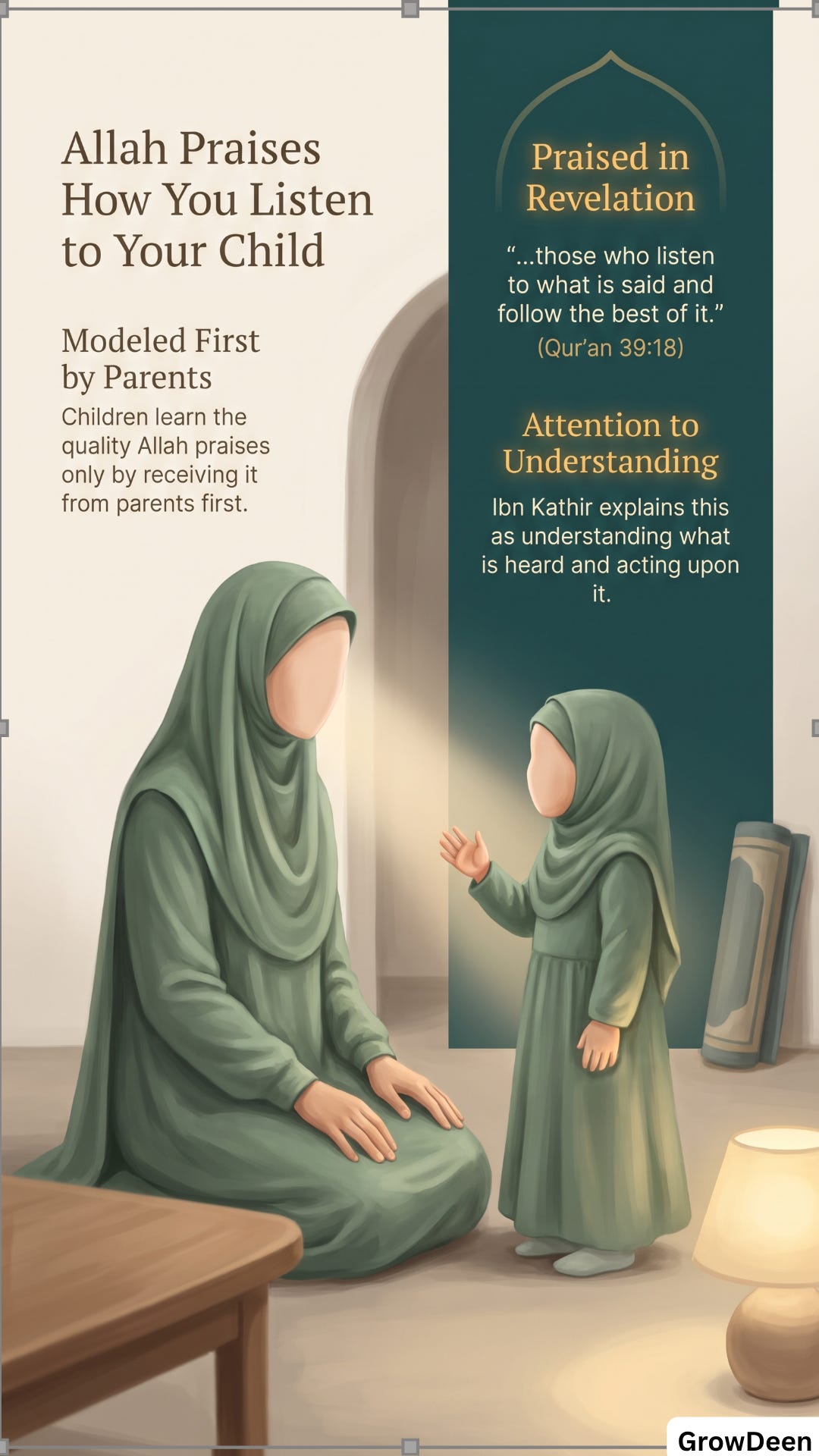
Allah gives good news in Surah Az-Zumar to “those who listen to what is said and follow the best of it.” [8] Ibn Kathir explains the phrase as describing people who understand what they hear and then act on it, and he reads the closing description of them as praise for sound reasoning rather than for hearing alone. [9]
Listening, in that reading, is not the pause before your turn to speak. It is attention carried far enough to produce understanding.
The Prophet ﷺ taught that way. Mu’adh ibn Jabal was riding behind him when the Prophet ﷺ put a question to him about what Allah is owed by His servants. Mu’adh answered that Allah and His Messenger knew best. Only then came the explanation, and when Mu’adh asked a question of his own, that question was answered too. [10]
Read it as a conversation and the shape is familiar: a question, a pause, an answer, an explanation, a question back. Four turns, with a teacher who waited.
So when you hear out a long story, or ask something and sit through the silence while your four year old hunts for the word, you are building the language your child will think in and handing them the quality the verse praises, in the only way a small child receives it, by being on the receiving end first.
Support Muslim Parenting Lab ❤️
Would you like a deed that keeps earning for you after you die? Start one in a few seconds with the button below.
The Prophet ﷺ named ongoing charity and beneficial knowledge among the three things that keep counting after death. (Sahih Muslim 1631)
What Quietly Eats The Turns
Screens take the turn and never give it back. A review of research on screen exposure and language development reports associations between heavier use and weaker language outcomes, while noting the studies vary in design and quality. [11] The World Health Organization advises no more than one hour of sedentary screen time a day for three and four year olds, with less being better. [12] The American Academy of Pediatrics suggests around an hour of high quality programming for two to five year olds, watched with an adult who talks about it. [13] That last clause carries the weight. A screen watched with a parent who asks questions becomes a prompt. A screen watched alone replaces the parent. Where screens are used, keep the content Islamically suitable, music free and parent approved.
Finishing their sentences takes a turn away too. So does answering for them when another adult asks your child a question.
Correcting pronunciation mid sentence ends the exchange faster than almost anything else. If your child wants pasghetti, tell them the spaghetti smells good and let the correct form go in without a lesson attached to it.
Then there are the small broken promises. “Tell me in the car” is a promise to a four year old. Lowering your voice instead of raising it, and keeping the small promises you make about talking later, are both ordinary points of Islamic manners, and both keep your child bringing you things to talk about.
Two Languages In One Home
Plenty of Muslim families run on more than one language, and parents often wonder whether this is holding their child back. It is not. Speaking your own languages with your child does not confuse them, does not cause or worsen a speech or language problem, and does not slow their learning, and a child who mixes words or grammar from two languages inside one sentence is doing something normal. [14]
Speak the language you are most comfortable in, because that is the one you will use richly. A parent who switches into a second language they half command hands their child thinner input, not better input. [14]
Qur’anic Arabic sits alongside the home language rather than competing with it.
When To Ask For Help
Speak to your child’s doctor, a paediatrician or a qualified speech and language therapist if people outside the family cannot understand your four year old, if your child rarely starts a conversation, if they are not asking questions, if words they used to have have gone, or if something simply feels wrong to you. [6] A hearing check is usually the sensible first step, since a child cannot reproduce what they do not clearly hear. For stuttering, an evaluation is recommended once it has run three to six months, if your child visibly struggles or tenses to get words out, or if stuttering runs in the family. [7]
Early help tends to be shorter and simpler than late help. Early language development has also been linked with cognitive ability decades later in a Danish cohort followed into middle age, which is reason to act now rather than wait another year. [15] None of this replaces an assessment by someone who can sit with your child.
Make du’a alongside the referral rather than instead of it. Booking the appointment and asking Allah for ease are two halves of the same tawakkul.
Inside The Turn Taking Pack
If you have read this far, you are the kind of parent who wants the exchange to be real rather than performed. That says something about you.
Inside the Turn Taking Pack (one PDF, 3 pages):
Page 1: Ten Turns Before Bed — ten printed questions a three to five year old can actually answer, each paired with the reply that keeps the exchange alive for another turn, designed as a fridge card you can read at a glance while your hands are full.
Page 2: When the Turn Stalls — a one-page decision card for the four evenings out of five that go wrong: the child who says nothing, the child who says one word, the child who will not stop so you can get in, and the child you cannot understand, with the exact sentence to try in each case.
Page 3: The Listener Allah Praises — a reflection card carrying the verse from Surah Az-Zumar and the narration of Mu’adh ibn Jabal riding behind the Prophet ﷺ, in English with sources, plus three lines on what each one asks of a parent at bedtime.
This is not a PDF to download and forget. It is built to live on the kitchen wall, where the conversations actually happen.
The Turn Taking Pack is what every subscriber receives alongside each article. Muslim Parenting Lab covers the whole arc of raising young Muslim children, with current research on one side and verified Qur’an and Sunnah on the other.
If you want both, subscribe free and the next resource reaches you before you need it.
Subscribe free for parenting resources backed by both science and Sunnah, guidance you will not find anywhere else. No spam, no clutter, just resources that matter.
One Thing To Do In The Next Five Minutes
Ask your child one question tonight, then count to four in your head before you say anything else. Four seconds. That is the whole exercise, and it is usually the longest silence a parent has left in that house all week.
Their words grow in the silence you leave.
May Allah put barakah in the words you give your children, and make their speech a means of good for them and for you.
Share This With Someone Who Needs It
Picture one person: the sister whose three year old went quiet at playgroup last week, the friend who told you her son only talks in single words, the cousin who has been waiting four months for a speech referral and is trying not to panic about it.
Send this to her today. Not as advice, and not because you think she is doing it wrong, but because the four second rule costs nothing and might be the thing nobody has told her yet.
Frequently Asked Questions
Q: How many words should a 3 year old be saying? A: Counting single words stops being the useful measure at three. What matters at this age is the exchange, and most three year olds hold a conversation across at least two back and forth turns and are understood by people outside the family most of the time. [6] If that is not happening, it is worth a conversation with your doctor.
Q: My preschooler talks constantly but nobody outside the family understands him. Is that a problem? A: Volume and clarity are separate skills. By four, most children are clear enough for people outside the family to follow them, so persistent unclear speech at that age is worth an assessment with a speech and language therapist, starting with a hearing check. [6]
Q: How do I get my preschooler to talk to me instead of giving one word answers? A: Change the question and then wait. Questions that can be closed with yes or no will be. Ask what your child is hoping, planning or wondering, then count to four before filling the silence. See “The gap is where the language goes in” above.
Q: Does screen time cause speech delay? A: The research shows associations between heavier screen use and weaker language outcomes rather than a clean causal line, and the studies vary in quality. [11] The mechanism that is clear is simpler: a screen never waits for your child, so every minute of solo watching is a minute with no turns in it.
Q: Will raising my child bilingual delay their speech? A: No. Using your languages at home does not confuse a child, does not cause or worsen a language problem, and does not slow learning, and mixing two languages in one sentence is a normal stage. [14]
Q: Is my 4 year old’s stuttering something to worry about? A: Usually not at first, since 5 to 10 percent of children stutter for a while and about 75 percent come through it. Seek an evaluation if it has lasted three to six months, if your child tenses or struggles visibly, or if stuttering runs in your family. [7]
References
[1] Gilkerson, J., Richards, J.A., Warren, S.F., Oller, D.K., Russo, R., & Vohr, B. (2018). Language experience in the second year of life and language outcomes in late childhood. Pediatrics, 142(4), e20174276.
[2] Romeo, R.R., Leonard, J.A., Robinson, S.T., West, M.R., Mackey, A.P., Rowe, M.L., & Gabrieli, J.D.E. (2018). Beyond the 30-million-word gap: children’s conversational exposure is associated with language-related brain function. Psychological Science, 29(5), 700-710.
[3] Rowe, M.L., & Snow, C.E. (2020). Analyzing input quality along three dimensions: interactive, linguistic, and conceptual. Journal of Child Language, 47(1), 5-21.
[4] Rowe, M.L. (2013). Decontextualized language input and preschoolers’ vocabulary development. Seminars in Speech and Language, 34(4), 260-266.
[5] Karousou, A., & Economacou, D. (2024). Quantity and quality of book reading to infants and toddlers: their effect on early communication and language development. Psychology: The Journal of the Hellenic Psychological Society, 29(1), 1-27.
[6] Centers for Disease Control and Prevention. (2022). Learn the Signs. Act Early.: developmental milestones at 3, 4 and 5 years (checklists revised 2022).
[7] National Institute on Deafness and Other Communication Disorders. Stuttering. NIDCD, National Institutes of Health.
[8] Qur’an, Surah Az-Zumar 39:17-18. Translation: Dr. Mustafa Khattab, The Clear Quran.
[9] Ibn Kathir. Tafsir Ibn Kathir (abridged), commentary on Surah Az-Zumar 39:17-18.
[10] Sahih al-Bukhari 2856, narrated by Mu’adh ibn Jabal. Graded: Sahih.
[11] Karani, N.F., Sher, J., & Mophosho, M. (2022). The influence of screen time on children’s language development: a scoping review. South African Journal of Communication Disorders, 69(1), e1-e7.
[12] World Health Organization. (2019). Guidelines on physical activity, sedentary behaviour and sleep for children under 5 years of age. Geneva: WHO.
[13] American Academy of Pediatrics. Media use guidance for children aged 2 to 5 years. HealthyChildren.org.
[14] American Speech-Language-Hearing Association. Learning two languages. ASHA public information.
[15] Flensborg-Madsen, T., & Mortensen, E.L. (2019). Language development and intelligence in midlife. British Journal of Developmental Psychology, 37(2), 269-283.
We combine scientific research with Qur’an and authentic Sunnah, and we cite our sources. Even so, this is general guidance and no substitute for a doctor who can examine your child.