

Most preschoolers are indoors today. In a survey of 8,950 families, only 51% of children went outside to walk or play with a parent even once a day. [2]
Print it tonight. Use it Saturday morning.
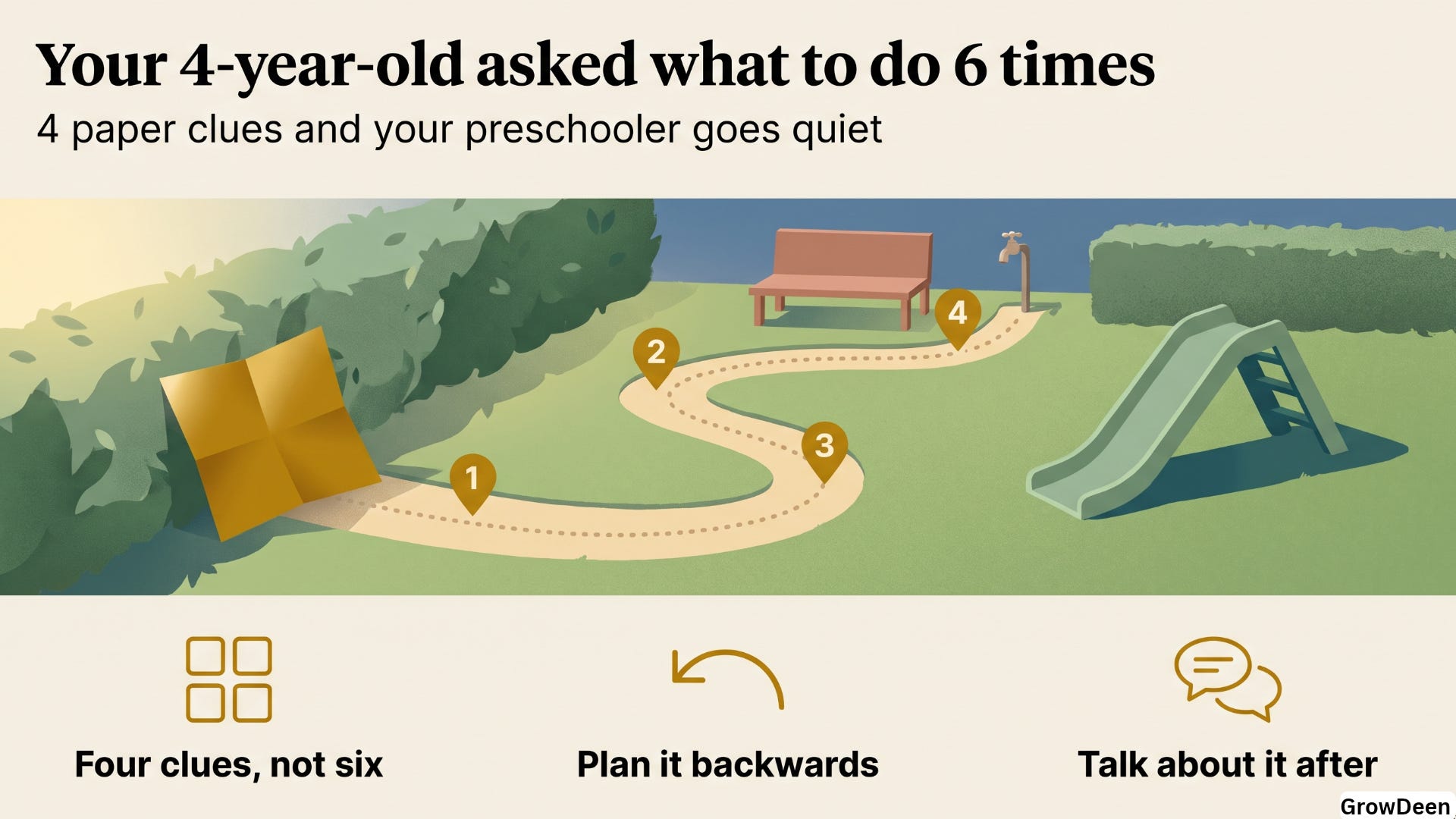
Your four-year-old has asked what to do six times
It is nine in the morning. The baby has finally gone down, you have had half a cup of tea, and the question is coming round again like a dripping tap.
So you do what works. You crouch down, you suggest the thing you always suggest, you offer the box of toys they asked for in Ramadan and have not touched since. And it does not land. Your child looks at the box, looks at you, and asks what to do.
That moment is not a failure of your imagination. Most of us reach for the tablet somewhere around the eighth ask, and then feel the small sting of it for the rest of the morning. You are not short of love or effort. You are short of a plan that costs nothing.
Here is what the next forty minutes could look like instead. A pencil. Four scraps of paper. One wooden spoon hidden under a slide. And a child who will not speak to you for half an hour because they are too busy thinking.
There is one part of this that almost every parent skips, and it happens after the treasure is found. Keep that in mind as you read, because it is the piece with the strongest evidence behind it, and it takes five minutes.
Why this guide is different
Every recommendation here is traceable to a named source: the World Health Organization’s activity guidance, the American Academy of Pediatrics report on play, the Canadian Paediatric Society’s position on outdoor risk, and a randomised trial of 1,903 children on outdoor time and eyesight [2,3,4,8].
The Islamic layer is not decoration at the end. Looking closely at created things is something the Qur’an actually commands, and what your child does with a beetle under a stone is the smallest version of it.
You already have the free Clue Trail Pack from the top of this page. It holds a backwards trail planner you fill in, a sixty-second hazard sweep with the exact words to say, and a reflection card for the end of the hunt.
The fifteen minutes before your child knows anything is happening
Everything that makes a hunt work happens before you call your child over.
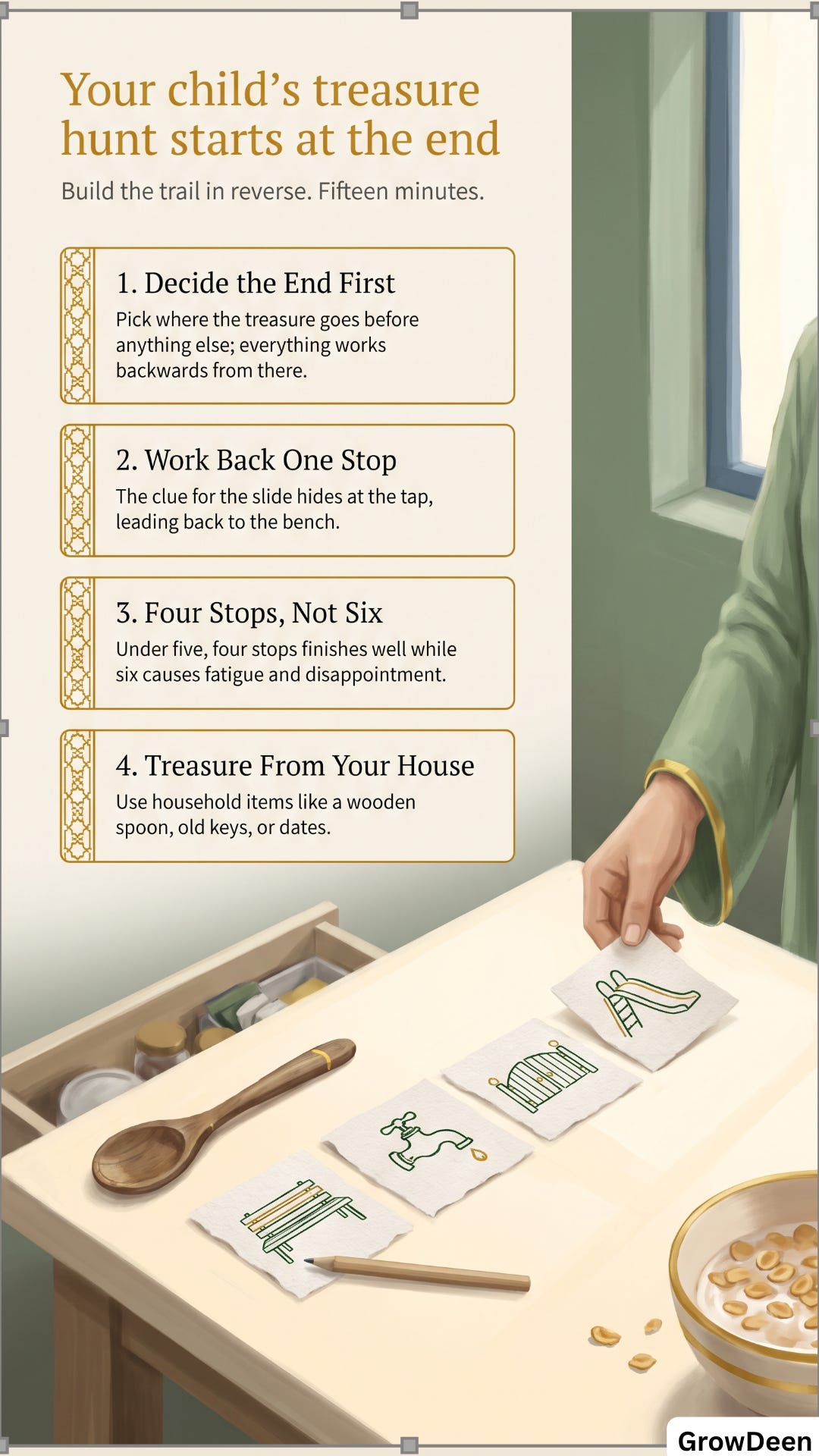
Start at the end. Decide where the treasure goes, then build the trail in reverse. If the treasure goes under the slide, the clue pointing to the slide hides at the water tap. The clue pointing to the tap sits on the bench. The clue pointing to the bench is the one you put in your child’s hand at the start. Four or five stops. Six is too many for anyone under five, and the last ten minutes will be you carrying a disappointed child home.
Draw one picture per stop. One clear object per page, nothing else on the paper. A bench. A tap. A gate. Objects and places work far better than people or animals here for a plainly practical reason: a four-year-old can match a drawn bench to a real bench in about a second, and cannot match a stick figure to anything. This also keeps the game clear of the scholarly discussion about drawing living creatures, which Muslim households hold different positions on and which is worth putting to a trusted scholar rather than settling from an article.
The treasure comes from your house, not a shop. A bright ball. A wooden spoon. An old set of keys. A small bag of dates. A child who finds a wooden spoon under a slide is delighted in a way that has very little to do with the spoon.
Then walk the route yourself. Glass, needles, animal mess, open water, anything within reach of traffic: those are reasons to move a clue, not reasons to watch more carefully. Hide everything while someone else keeps your child busy. Keep one duplicate clue in your pocket, because at some point your child will walk past a piece of paper four times and you will want to produce it casually.
And before any of it, say the boundary out loud. Point at the two trees, the fence, the gate. Have your child point back at them. Thirty seconds, and you stop being the person who shouts across a park.
Clue one, and the four things happening at once
Hand over the first clue and step back.
What looks like a child wandering a garden is four processes running together. They have to hold a picture in working memory while their legs are moving. They have to compare it against every surface in front of them. They have to reject the things that nearly match. And they have to remember which bush they already checked.
The Center on the Developing Child at Harvard University groups this cluster together and compares it to an air traffic control system in the brain, the set of abilities that lets a person plan, focus attention, switch gears and juggle tasks. Nobody is born with them [1]. They get built in early childhood through repetition that looks, from a kitchen window, like nothing at all.
There is a second thing happening in the body. The World Health Organization asks that three and four year olds get at least 180 minutes of physical activity across a day, with at least 60 of those minutes at moderate to vigorous intensity, no more than one hour of screen time, and ten to thirteen hours of sleep [3]. Children’s playtime dropped by 25% between 1981 and 1997, and the typical preschooler now watches about four and a half hours of television daily [2]. A hunt does not fix that arithmetic. It just moves forty minutes from one column to the other without anyone announcing that exercise is happening.
And then there is something almost nobody mentions to parents at all.
Clue two, and the finding about eyesight nobody tells you
Researchers in Guangzhou randomised 1,903 six-year-olds across twelve schools. Half the schools added one forty-minute outdoor class at the end of each day and encouraged families to get children outdoors after school too. Three years later, 30.4% of the children in those schools had become short-sighted, against 39.5% in the schools that changed nothing [4].
Forty minutes. Outdoors. That is roughly one treasure hunt.
The protection appears to come from daylight itself rather than from running, which means a slow collection walk counts the same as a fast chase. Short-sightedness in children is climbing across much of the world, and outdoor time is one of the few levers a parent actually holds.
Clue two is also where you will want to help, and where you should not. The Canadian Paediatric Society’s 2024 position statement on outdoor risky play argues that adults should aim to keep children “as safe as necessary” rather than as safe as possible, because manageable difficulty is how children learn to cope. It recommends pausing for fifteen to thirty seconds and watching before stepping in, and asking a teaching question instead of repeating “be careful” [8]. “How are you planning to get down from there?” does work that a warning does not.
Fifteen seconds is longer than it sounds when your child is standing on a low wall. Count it anyway.
A short word before clue three
I know four clues sounds simple until you are standing in the kitchen at eight on a Saturday morning trying to remember which one goes where. That is why the free Clue Trail Pack exists: a backwards planner with the slots already laid out, a sixty-second hazard sweep, and a card for the end. The download button is at the top of this page, and there is a full description of what is inside it below. It is there to save you the fifteen minutes of thinking, not to add anything to your list.
Clue three, the one they nearly give up on
Every hunt has one clue that does not land. The drawing was too abstract, or the light changed, or your child simply stopped seeing.
This is the most valuable thirty seconds of the morning, and the easiest to ruin. Step in too fast and your child learns that getting stuck means an adult solves it. Leave it too long and the whole thing curdles into a test they are failing.
What works is help that does not look like rescue. Narrow the search area rather than pointing at the paper. Ask what the picture reminds them of. Walk with them instead of towards the answer. A child who finds the treasure with three hints has had exactly the experience you wanted them to have, because the thing being built is persistence, not accuracy.
The looking is the lesson, not the treasure.
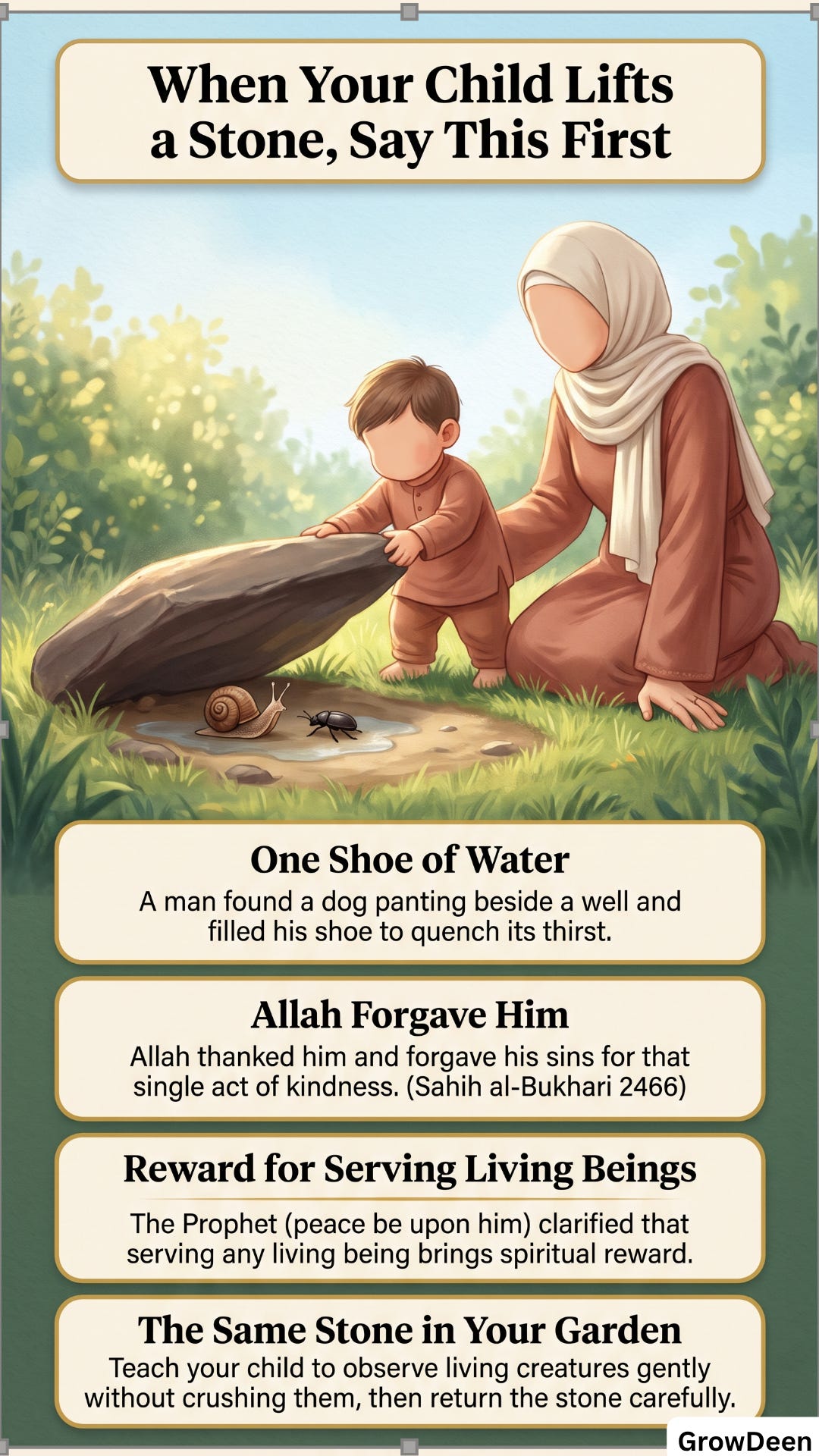
Keep the creatures in mind here too. A snail, a beetle, an ant under a lifted stone: these are the moments where adab is either taught or quietly not taught, and a child who is already excited is unusually open to being told how to handle a living thing.
The five minutes after the treasure, which is the part most parents skip
The treasure is found. The instinct is to clap and head home. Do not.
Researchers at MIT fitted four to six year olds with recorders that counted the words children spoke, the words spoken to them, and the back-and-forth exchanges between child and adult. The number of conversational turns predicted children’s language scores, and activity in Broca’s area of the brain, far better than the raw number of words a child heard. The effect held regardless of parental income or education [7].
So the debrief is not a courtesy tacked on the end. On the evidence, it may be the highest-value five minutes of the whole morning.
Sit on the bench. Ask which clue was hardest. Ask what they thought it was at first. Ask what they saw on the way that they did not expect. Then stop talking and wait. The waiting is what turns a question into a turn.
Support Muslim Parenting Lab ❤️
Would you like the reward of every parent who acts on what they read here? Fund it with the button below and it is yours.
The Prophet صلى الله عليه وسلم said whoever guides to good has a reward like the one who does it. (Sahih Muslim 1893a)
Looking closely is not a break from tarbiyah
Allah says of Himself that He “spread the earth and placed therein firmly set mountains and rivers,” that He made pairs of every fruit, and that He covers the day with night. The verse closes: “Indeed in that are signs for a people who give thought” [10].
Tafsir Ibn Kathir reads this as Allah demonstrating His power and wisdom over the lower world. Water runs from those mountains and springs, and from that same water come fruits and plants differing in colour, shape, taste and scent. Day and night pursue one another, each overtaking the other as it leaves. Ibn Kathir says these are signs for people who reflect on them and recognise the Creator’s power and will behind them.
The tafsir is addressed to adults. It mentions neither children nor play, and the connection here sits at the level of principle rather than subject. A four-year-old crouched over a pointed leaf, turning it to see both sides, is doing the earliest and smallest version of the looking that verse asks for. That is not time borrowed from your child’s tarbiyah. It is where tarbiyah starts.
The hunt teaches a second thing, and it costs nothing. Abu Hurairah reported that the Prophet ﷺ described a man who found a dog panting and licking mud beside a well, recognised the thirst he had just felt himself, climbed back down, filled his shoe with water and gave it to the animal. Allah thanked him for it and forgave him. Asked whether there was reward in serving animals, the Prophet ﷺ said that there is a reward for serving any living being [11].
Say Bismillah when you hand over the first clue, and Alhamdulillah out loud when the treasure is found. Two seconds each. Your child learns that finding something good and thanking Allah for it belong together.
Changing the hunt to fit your child
For two and three year olds, clue-following is usually still out of reach. Run a collection hunt instead: a bag, and a short list you read aloud. A round pebble. A pointed leaf. A yellow flower. A feather. Then sit down and sort through it together. A three-year-old can draw a circle after being shown how, string large beads, and ask who, what, where and why questions [5], which is precisely what a collection hunt runs on.
For three and four year olds, picture clues sit exactly right. By four, many children can name a few colours, say what comes next in a story they know, and draw a person with three or more body parts [6]. A child who can do those things can read a drawing as an instruction about the real world. Keep the trail short and stay in sight.
For five and six year olds, written clues work with help. One short sentence per card. A child will decode three words to win a prize with an energy no reading worksheet has ever produced. A rough map of the park with an X on it adds a second skill on top of the first.
For children with additional needs, adjust the number of stops, the distance between them and the amount of help you give, rather than deciding the game does not suit your child. Some children do best with one clue and one short walk. For some, the treasure stays visible the whole time and the walk towards it is the game. What matters is that your child reaches something they had to work for.
Four things that do not bend
Match the treasure to the smallest child present. Most children who die from choking are under five, and two thirds of those deaths are babies under one. Coins, marbles, small balls and toy pieces account for the most choking deaths among objects, and balloons stay a risk up to age eight [9]. If a toddler is along for the walk, the treasure has to be too big to fit in a mouth.
Do not build a hunt that works as a test. Help early, and make the help look like teamwork.
Do not let it become a race between siblings. Different colour clues for each child, or let the older one hide the treasure and run the hunt themselves.
Do not over-sweeten the prize. If the treasure is always chocolate, the chocolate becomes the point and the searching stops being the fun part.
One useful detail from the milestone research: by three, most children will avoid touching something hot after being warned [5]. Warnings do land at this age. They land when they are specific, and when they arrive before the child is already running.
When to raise it with a doctor
A game like this sometimes surfaces something you had half-noticed and never named. If your child cannot match a simple picture to a real object by four, disengages within seconds every single time, does not turn to their name during the game, or seems to be squinting at things that are plainly in view, write it down and raise it at the next appointment.
Bring the specific thing you saw. A doctor can work with “she walked past that bench three times and did not see the paper sitting on it.” There is much less to do with “I think something might be wrong.”
None of that should sit in your chest while you play. It should mean you trust yourself when something keeps nagging.
The Clue Trail Pack
If you have read this far, you are the kind of parent who takes an ordinary Saturday morning seriously. That says something about you worth saying out loud.
Inside the Clue Trail Pack (one comprehensive PDF, 3 pages):
Page 1: The Backwards Trail Planner. A fill-in sheet that walks you through building the trail in reverse, with the treasure slot at the top and four numbered clue slots running back to the one you hand over first, plus four blank clue boxes to draw in and cut out. It is a single sheet you fill in at the kitchen table in under ten minutes and then take outside with you.
Page 2: The Sixty-Second Sweep and the Words to Say. A tick-box route check covering the hazards worth moving a clue for, the boundary script to say out loud before you start, and the four debrief questions to ask when the treasure is found. The part with the strongest evidence behind it is the easiest to skip in the rush to go home, so it is printed where you will see it.
Page 3: Look, Don’t Crush. A reflection card carrying the Qur’anic verse on the signs in the earth with Ibn Kathir’s explanation, the narration of the man who watered a thirsty dog, and three short lines on what to say to your child when they lift a stone and find something alive underneath.
This isn’t just a PDF to download and forget. It’s a tool designed to stay in your kitchen drawer, where you’ll actually use it when you need it most.
The Clue Trail Pack is what every subscriber receives with each article. We cover the whole span of raising Muslim children, all backed by scientific research and rooted in Islamic wisdom.
Do this in the next five minutes
Go and find the treasure. Not the hunt, just the object. Open a kitchen drawer, take out one thing your child would be pleased to find under a slide, and put it somewhere you will see it on Saturday morning. That is the whole task. The planning gets much easier once the object exists.
May Allah make the small efforts light on you and heavy on your scales.
Send this to the one person you already thought of
Think of one person right now: the sister at the masjid who said her four-year-old is on the tablet more than she would like, the friend whose WhatsApp messages are all about a child who will not settle to anything, the cousin in a flat with no garden who thinks that rules her out.
Send it to her today. Not as advice, and not because you have it figured out. Because a fifteen-minute plan is a small, real thing to hand someone who is tired, and the looking is the lesson, not the treasure.
Frequently asked questions
Q: What age can a child actually do a treasure hunt?
A: Picture clues usually work from about three and a half, and reliably by four. Below that, run a collection hunt instead: a bag, and a short spoken list of things to find. Most two and three year olds can manage that happily, and it builds the same looking-and-sorting muscles [5].
Q: How many clues should a treasure hunt have?
A: Four or five for a first attempt with a preschooler. Six is where it tips over for most children under five, and a hunt that ends in tears is worse than no hunt. You can always add a stop next time.
Q: What should I use as the treasure?
A: Something from your own house. A bright ball, a wooden spoon, an old set of keys, a bag of dates. The excitement comes from the finding, not the object. Keep it too big to fit in a toddler’s mouth if a younger sibling is along [9].
Q: Can you do a treasure hunt indoors or without a garden?
A: Yes. A hallway, a stairwell, two rooms and a balcony all work, and so does a stretch of park if you have no outdoor space at home. You lose the daylight benefit, which matters more than people realise [4], so when the weather allows it, outside is worth the walk.
Q: What do I do when my child gets stuck on a clue?
A: Wait fifteen to thirty seconds before you say anything, then narrow the search area rather than pointing at the answer. “It’s somewhere between the gate and the bench” keeps the finding theirs. The Canadian Paediatric Society recommends asking a question instead of issuing a warning or a solution, and the same principle applies here [8].
Q: Is this actually educational, or just a way to pass time?
A: Both, and the first one is doing more than it looks. Searching exercises working memory, attention and self-correction at the same time, the cluster Harvard’s Center on the Developing Child compares to an air traffic control system [1]. The five-minute conversation afterwards is where the language gains sit [7].
References
[1] Center on the Developing Child at Harvard University. Executive Function and Self-Regulation.
[2] American Academy of Pediatrics. (2018). Want Creative, Curious, Healthier Children with 21st Century Skills? Let Them Play. Summarising Yogman M., Garner A., Hutchinson J., Hirsh-Pasek K., Golinkoff R.M., “The Power of Play: A Pediatric Role in Enhancing Development in Young Children,” Pediatrics, 142(3), e20182058.
[3] World Health Organization. (2019). Guidelines on physical activity, sedentary behaviour and sleep for children under 5 years of age.
[4] He M., Xiang F., Zeng Y., Mai J., Chen Q., Zhang J., Smith W., Rose K., Morgan I.G. (2015). Effect of Time Spent Outdoors at School on the Development of Myopia Among Children in China: A Randomized Clinical Trial. JAMA, 314(11), 1142-1148.
[5] Centers for Disease Control and Prevention. Important Milestones: Your Child By Three Years. Last reviewed 16 May 2026.
[6] Centers for Disease Control and Prevention. Important Milestones: Your Child By Four Years. Last reviewed 16 May 2026.
[7] Romeo R.R., Leonard J.A., Robinson S.T., West M.R., Mackey A.P., Rowe M.L., Gabrieli J.D.E. (2018). Beyond the 30-Million-Word Gap: Children’s Conversational Exposure Is Associated with Language-Related Brain Function. Psychological Science, 29(5), 700-710.
[8] Beaulieu E., Beno S.; Canadian Paediatric Society, Injury Prevention Committee. (2024). Healthy childhood development through outdoor risky play. Paediatrics & Child Health, 29(4), 255-261.
[9] American Academy of Pediatrics. Choking Prevention. HealthyChildren.org.
[10] Qur’an, Surah Ar-Ra’d 13:3, Saheeh International translation. Tafsir Ibn Kathir for the same verse.
[11] Sahih al-Bukhari 2466, narrated by Abu Hurairah, Book 46, Hadith 27.
We combine scientific research with Qur’an and authentic Sunnah, and we cite our sources. Even so, this is general guidance and no substitute for a doctor who can examine your child.