


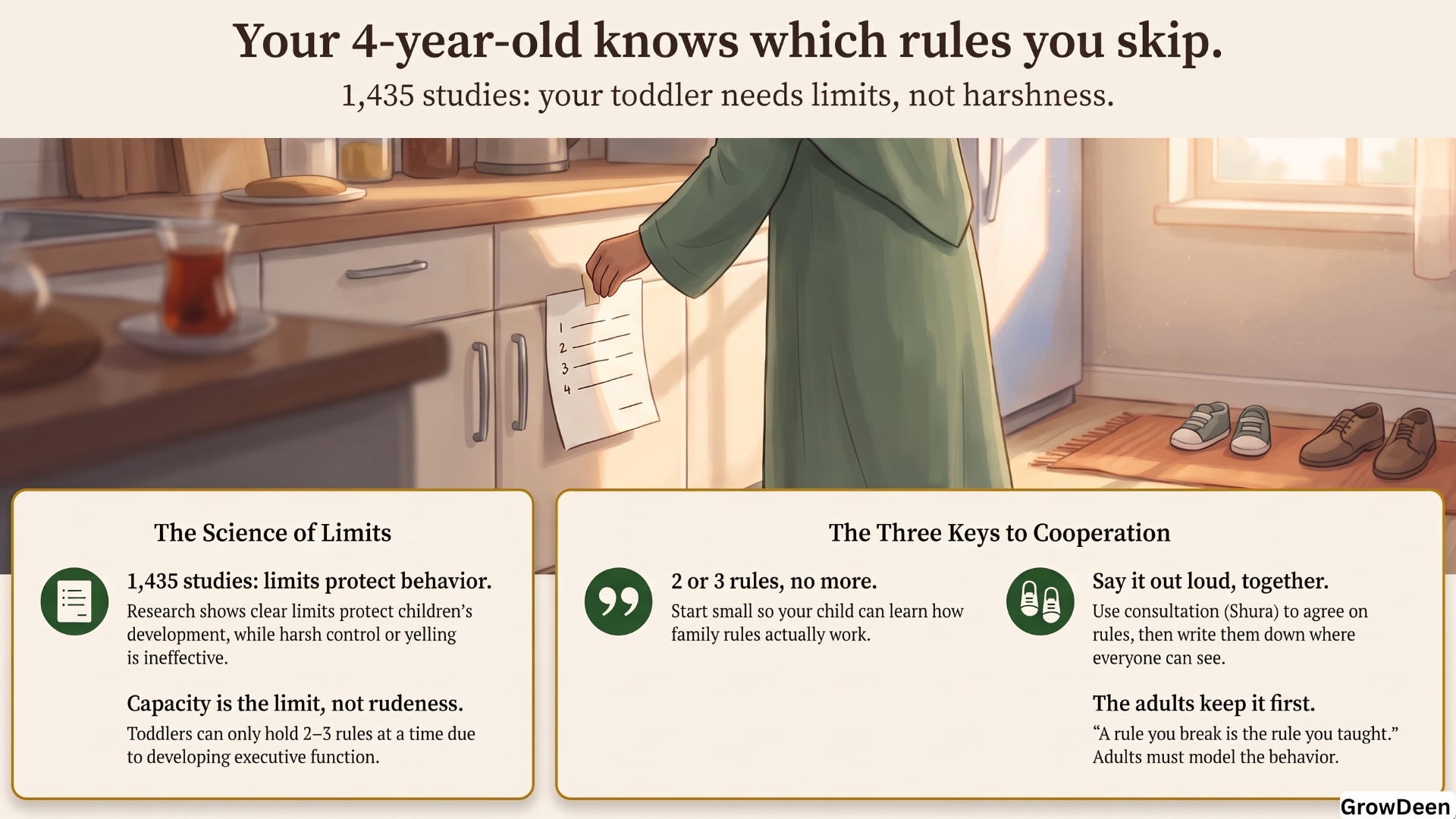
Rules are not the problem. A meta-analysis of 1,435 studies found clear limits protect children’s behaviour, while harsh control does the opposite. [1]
Three pages. Fridge-ready. Print it tonight.
It is 7:40pm on a Tuesday. You have asked twice already, calmly, in the voice the parenting article told you to use. The third time your voice does something you did not plan. And afterwards, standing in the kitchen, you think the thing you never say out loud: I have told him this rule a hundred times.
Here is what almost nobody tells you. He may not know the rule exists.
Not because he wasn’t listening. Because in most homes, the rules were never actually said. They live in an adult’s head, get enforced when that adult has energy, and go quiet when they don’t. Children are extremely good at detecting that difference. What looks like defiance is very often a child running an experiment on a rule that has never behaved the same way twice.
So here is the question worth carrying through the rest of this: why does a child break a rule they can recite back to you word for word? The answer is not stubbornness, and it changes what you do on Tuesday night.
Why This Guide Is Different
Built on clinical evidence, not opinion. The guidance here comes from a 1,435-study meta-analysis on parenting dimensions, the CDC’s parenting programme, Harvard’s Center on the Developing Child, and the American Academy of Pediatrics. [1,2,3,4]
Rooted in a Qur’anic command about the parent, not the child. You will find one verse and one narration that most parenting articles never reach for, both about the adult who sets the rule rather than the child who breaks it.
You already have the free House Rules Kit from the top of this page. Three printable pages that do the twenty minutes of work this article asks of you, so you are not starting from a blank sheet.
The Real Villain Is the Unwritten Rulebook
Every household runs on rules. The trouble is that in most homes nobody has ever written them down, said them aloud, or agreed them together.
So each person is working from a private edition. The father’s copy has a rule about shoes. The mother’s copy has a rule about shouting. The six year old’s copy is being reverse-engineered, in real time, from which adult is in the room and how tired they look. Nobody is being difficult. There is simply no shared text.
That is the villain of this article, and it is worth naming plainly, because it is not your child and it is not you. It is the unwritten rulebook.
When a household finally writes one, four specific failures stop happening. Here they are, in the order they usually bite.
Failure One: The Rule Was Never Actually Said
Think about the last rule you enforced. Now ask whether there was ever a moment when you sat down, said it out loud, and everyone in the room agreed to it.
For most families, the honest answer is no.
This matters more than it sounds. Allah describes the believers as those “whose affair is by consultation among themselves” [5]. Shura is usually discussed at the scale of a community. It belongs just as naturally in a living room, and a household that practises it produces rules its members recognise as theirs rather than as something that happened to them.
The practical version takes about ten minutes. After Maghrib, on a weekend, with something nice to eat. Ask what makes evenings hard in this house. Ask what each person wishes the others would stop doing. Children from about three can join in, and what they say is usually sharper than what the adults say.
Then write it down. Four or five lines on one sheet, stuck where everyone walks past. For children who cannot read, draw the rules, or photograph your child doing the right thing and put that on the wall instead.
Written rules end a surprising number of arguments, because the argument about what the rule actually was disappears.
Failure Two: The Rule Was Worded as a Complaint
“Stop being rough with your brother” tells a child what to stop. It does not tell them what to start.
A three year old hearing that sentence has no replacement behaviour to reach for. So the next available option is the one they just used, which is why the same correction gets delivered four times in one evening.
The CDC’s guidance on this is specific: state the acceptable behaviour immediately, so a child knows what is expected rather than only what is forbidden. [3]
Which means rewriting the sentence already forming in your mouth:
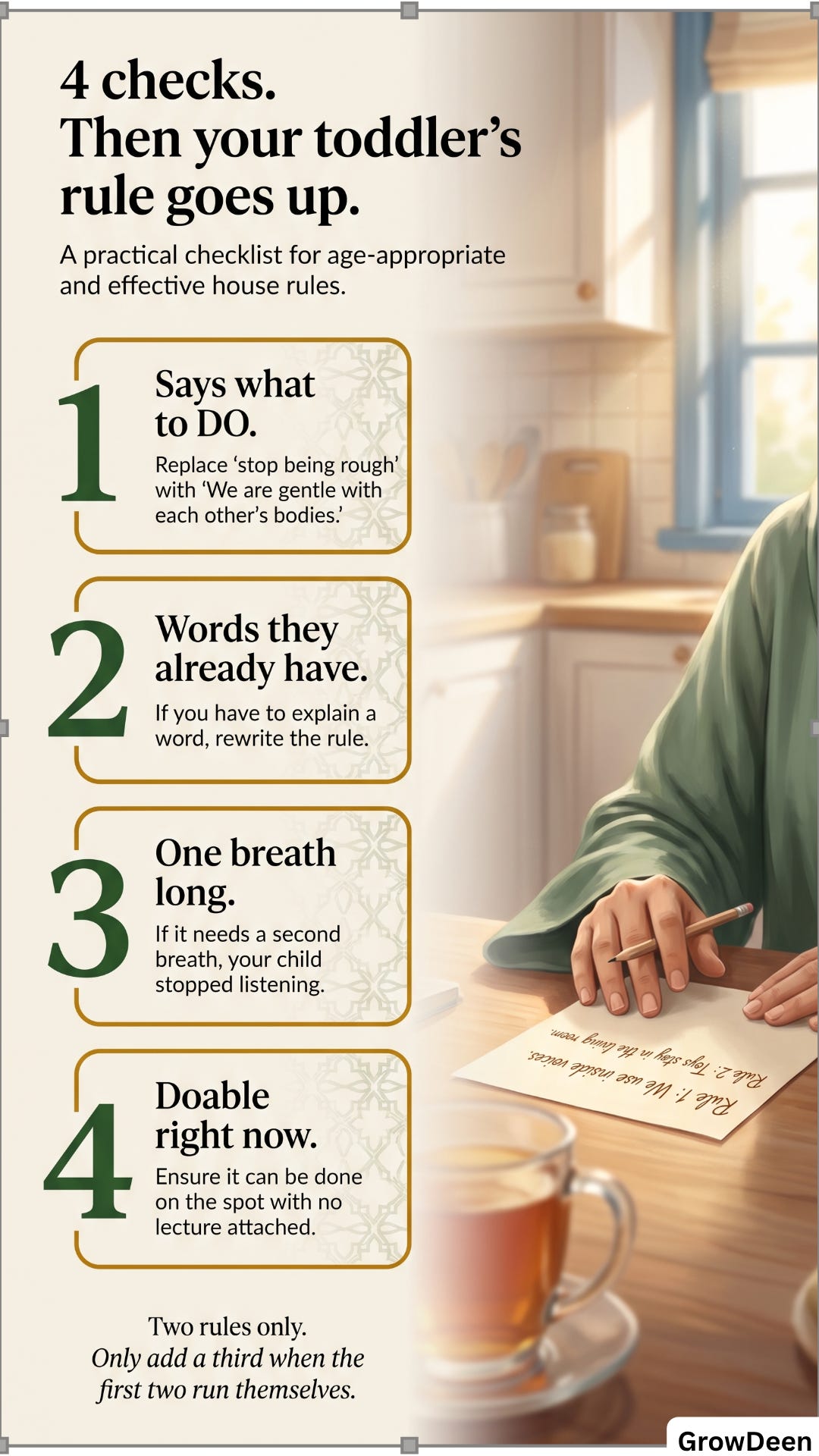
“Stop being rough with your brother” becomes “We are gentle with each other’s bodies.”
“Don’t shout in the house” becomes “We use our quiet voice indoors.”
“Why is there mud everywhere” becomes “Shoes come off at the door.”
“Stop interrupting” becomes “We wait until the other person finishes speaking.”
Four features make a rule hold. It describes the behaviour you want. It uses words your child already has. It is short enough to say in one breath. And it can be done immediately, in the room, without a lecture attached.
Sometimes a prohibition really is clearer. “We do not use words that hurt” holds better than any positive rewrite of it. Use that form when the positive version turns into a paragraph.
Failure Three: There Are Simply Too Many
You know the feeling of listing five expectations at the front door and watching your child’s eyes go somewhere else halfway through.
That is not rudeness. It is capacity.
The CDC puts a number on what is realistic: toddlers and preschoolers can learn and hold only two or three rules at any one time, and it recommends beginning with a single rule so a child can learn how family rules work before more arrive. [3]
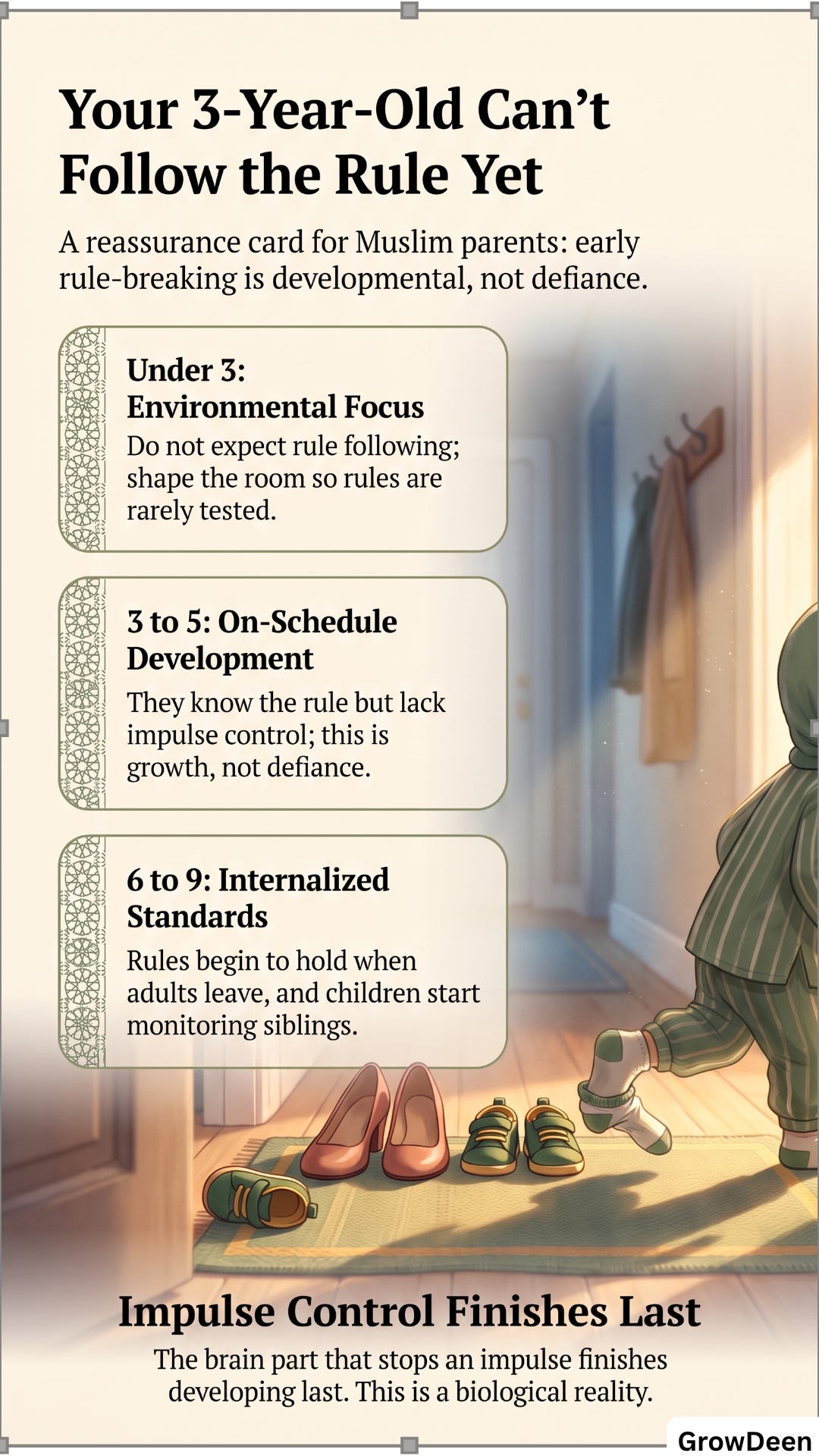
The reason is neurological. The Center on the Developing Child at Harvard University describes the underlying capacities as executive function and self regulation, resting on working memory, mental flexibility and self control, and notes that children are born not with these skills but with the potential to build them slowly, from infancy into early adulthood. [4]
A three year old who runs toward the road after being told nine times is not defying you. The braking system is still under construction.
What this looks like at each age:
Under three. Do not expect rule following. Arrange the room so the rule is rarely tested, and repeat one or two short phrases in the moment. Gentle hands. Sit to eat.
Three to five. The language is there. The memory and the impulse control are not. [4] Children this age know the rule and break it anyway, and what helps is a reminder, not an argument. Never rely on a safety rule to keep a small child safe. Stay away from the road is a useful phrase and a poor substitute for holding a hand.
Six to nine. Rules start to hold when you are not in the room. This is also the age children begin noticing whether a rule is applied evenly across siblings, and they will tell you about it.
Ten and up. Expect negotiation. A child this age can follow a rule and disagree with it at the same time, which is a developmental gain rather than a discipline problem. Swapping the word rules for expectations helps with teenagers, because it reads as guidance rather than command. Sleep rules earn particular attention, since parental practices around bedtimes have been associated with adolescent sleep outcomes in systematic review. [6] Rules about devices work best alongside the wider emotional climate of the home rather than as isolated restrictions. [7]
Children with additional needs. Where a rule governs how people in the family treat one another, it applies to everyone, and holding to that communicates equal standing. Where a rule depends on a capacity a child does not yet have, adjust it.
Pick two. Add a third when the first two run themselves.
I know that is a lot to hold in your head at 7:40pm on a Tuesday. That is why the free House Rules Kit exists: three printable pages that turn all of this into something you fill in once and stick on a cupboard door. The download button is at the top of this page, and there is a full description of what is inside it below.
Failure Four: The Adults Do Not Keep It
Nobody writes this part down. It is not only about your child’s behaviour. It is about the knot in your stomach when you catch yourself doing the exact thing you told them not to do.
If the rule is that shoes come off at the door, the adults take their shoes off at the door. If devices stay out of bedrooms, the adults’ phones stay out too. A rule the parents exempt themselves from still teaches the child something. It teaches them that rules follow power rather than principle.
A rule you break is the rule you taught.
Small promises belong in this category too. A child who learns that “if you do that again, we are leaving the park” is usually an empty sentence has been trained to ignore it.
And then there is the version of this failure that nobody warns you about: two adults, one rule, two different levels of enforcement. A rule that one parent holds and the other quietly waives is worse than no rule, because it teaches a child to route around the household rather than live inside it. The CDC is direct here. All caregivers need to be following the same rules. [3] That includes grandparents on weekends, an older sibling left in charge for an hour, and the parent who is not usually the one saying no.
Have that disagreement privately, and settle it before the rule goes on the wall. If the two of you cannot settle on a rule, leave it off the list. Three rules both adults will hold beats eight where half are optional depending on who is home.
So Why Do They Break a Rule They Can Recite?
Here is the answer to the question from the top.
A young child cannot tell the difference between a rule that is real and a rule that was said once in an irritated voice. The only way to find out is to try it and watch what happens.
If your response is the same on the tenth attempt as it was on the first, the rule gets filed as real and the testing stops. If your response moves with your mood, the testing continues, because it is still producing useful information.
This is why the CDC places follow through alongside consistency and predictability as one of the three ingredients of household structure. [3] The follow through is not the punishment. It is the evidence.
It also explains something that unsettles a lot of parents: breaches often spike in the first week after a new rule appears, then fall away. That spike is the test running. Holding steady through it is what converts a stated rule into a settled one.
When the rule does break, the sequence that works is short. Name the rule once, calmly. Give the do instead. Apply the consequence you agreed in advance, without a lecture attached. Then repair, once everyone is calm, with a hug or a du’a together.
Agree consequences while the house is peaceful. Consequences invented mid crisis are almost always too large to carry out, which is how parents end up backing down and teaching a child that rules soften under pressure.
And nothing here requires harshness to work. A meta-analysis covering 160,927 children found spanking significantly linked to 13 of 17 child outcomes examined, every one of them in the detrimental direction [8], a picture confirmed by a Lancet review of prospective studies [9]. The American Academy of Pediatrics puts it plainly: aversive strategies, including all forms of corporal punishment and yelling at or shaming children, are minimally effective in the short term and not effective in the long term. [2]
Review the List Every Few Months
Rules go stale. A bedtime that fitted a five year old is wrong for an eight year old, and a rule written when one parent worked evenings needs rewriting when the shift changes.
Look at the list at any transition: a new baby, a house move, a new school, the start of Ramadan. Ramadan suits this especially well, because the household routine is being rebuilt anyway. Hold the same short majlis. Keep what is working, retire what is not, and let your children see that a rule can be changed by asking rather than by breaking it.
Most difficulties with family rules are ordinary and settle with consistency. Speak with a doctor or a qualified child psychologist if your child’s behaviour is causing significant distress at home or school, if aggression is escalating, or if you find yourself losing control of your own responses more often than you are comfortable with. Asking early is part of taking the means, and it sits alongside tawakkul rather than against it.
What Allah Asks of the Parent Before the Child
Before a rule ever reaches your child, it passes through you.
Allah says: “O believers! Why do you say what you do not do? How despicable it is in the sight of Allah that you say what you do not do!” [10] According to Tafsir Ibn Kathir, this verse refutes those who fail to fulfil their promises, and supports the position of several scholars of the Salaf that fulfilling a promise is obligatory. Ibn Kathir then cites the narration in the Two Sahihs listing broken promises among the signs of hypocrisy. [10]
Every rule on your cupboard door is a promise made in public by the people who wrote it.
The Prophet ﷺ showed how an agreement is properly made. ‘Ubadah ibn as-Samit narrated that the Prophet ﷺ said to a group around him: “Swear allegiance to me that you will not associate anything with Allah, that you will not steal, that you will not commit unlawful intercourse, that you will not kill your children, that you will not bring forth a slander you have fabricated, and that you will not disobey in what is right.” ‘Ubadah added that they then gave their pledge on those terms. [11]
Notice the form. Each commitment was named aloud and accepted by people who heard exactly what they were agreeing to. Nothing was assumed, and the binding clause reached only as far as what is right.
That is what your ten minutes after Maghrib is reaching for.
Inside the House Rules Kit
If you have read this far, you are the kind of parent who takes the shape of your home seriously, as care rather than control. That tells me something about you.
Inside the House Rules Kit (one PDF, 3 pages):
Page 1: The Rule Wording Test. A fill-in card where you write your two or three rules, then run each one through four printed checks before it goes on the wall, with a worked example already completed so you can see what a passing rule looks like.
Page 2: The Two-Adult Agreement Sheet. A page both caregivers fill in separately, then compare side by side, covering who enforces what, which rules are non-negotiable, and what happens when one of you is not home. Signed by both at the bottom.
Page 3: The Promise You Posted. Two reflection cards, in English, built on the Qur’anic command about saying what you do not do and on the agreement the Prophet ﷺ named aloud and had accepted openly.
This isn’t just a PDF to download and forget. It’s a tool designed to stay on your kitchen cupboard, where you’ll actually use it when you need it most.
This House Rules Kit is what every subscriber receives with each article. We cover the whole arc of raising Muslim children, all backed by scientific research and rooted in Islamic wisdom.
If you’re a Muslim parent who wants both evidence-based guidance AND Islamic perspective, subscribe for free so future resources arrive in your inbox before you need them.
Subscribe free for parenting resources backed by both science and Sunnah, guidance so unique you literally can’t get it anywhere else. No spam, no clutter, just resources that matter.
Do This in the Next Five Minutes
Pick one rule you enforced today. Say it out loud in the form you want it kept: “We are gentle with each other’s bodies.” Then ask yourself whether every adult in your house kept that rule today. That is the whole exercise. A rule you break is the rule you taught.
Share This With Someone Who Needs It
Think of one person right now: the sister who told you at the school gate that evenings in her house have become a shouting match, the friend whose WhatsApp voice notes sound exactly like your last year, the cousin raising children alone who has nobody to agree the rules with.
This article could give their evenings back. Share it with them today, not as advice-giving, but as companionship. Sometimes the most loving thing we can do is hand someone the words they have been looking for.
Frequently Asked Questions
Q: How many family rules should we have? A: Two or three at most if your children are under five. The CDC is clear that toddlers and preschoolers can only learn and hold two or three rules at any one time, and it suggests starting with just one. [3] Add a third once the first two run themselves without reminders.
Q: At what age can a child actually follow rules without being reminded? A: Around six to nine, rules start to hold when you are not in the room, though reminders still help. Before that, your child knows the rule and breaks it anyway, because the memory and impulse control are still developing. [4] That is normal, not defiance.
Q: What should I do when my child breaks a rule? A: Name the rule once, calmly. Give them what to do instead. Apply the consequence you agreed in advance, without a lecture. Then repair once everyone is calm. Decide those consequences while the house is peaceful, never mid crisis.
Q: Is it okay to smack a child who keeps breaking the rules? A: The evidence is strongly against it. A meta-analysis covering 160,927 children linked spanking to 13 of 17 outcomes examined, all in the harmful direction [8], and the American Academy of Pediatrics states that corporal punishment, yelling and shaming are minimally effective short term and not effective long term. [2] For Islamic questions on discipline, put them to a trusted scholar who knows your circumstances.
Q: What does Islam say about family rules? A: The Qur’an describes believers as those who conduct their affairs by mutual consultation [5], and it warns severely against saying what you do not do [10]. Together those establish the shape: rules agreed out loud, and kept first by the adults who set them.
Q: My husband and I disagree about the rules. What now? A: Settle it privately before the rule goes on the wall, and leave off anything the two of you cannot settle. The CDC is direct that all caregivers need to follow the same rules. [3] Three rules both of you will hold beats eight that depend on who is home.
Q: How often should family rules change? A: Review every few months, and at any transition: a new baby, a house move, a new school, the start of Ramadan. Letting children see a rule change through asking teaches them that rules are negotiable through conversation rather than through breaking them.
References
[1] Pinquart, M. (2017). Associations of parenting dimensions and styles with externalizing problems of children and adolescents: An updated meta-analysis. Developmental Psychology, 53(5), 873-932.
[2] Sege, R.D., & Siegel, B.S. (2018). Effective Discipline to Raise Healthy Children. Pediatrics, 142(6), e20183112.
[3] Centers for Disease Control and Prevention. Tips for Creating Rules; Tips for Building Structure. Essentials for Parenting Toddlers and Preschoolers.
[4] Center on the Developing Child, Harvard University. Executive Function and Self-Regulation.
[5] Quran, Surah Ash-Shura 42:38
[6] Khor, S.P., McClure, A., Aldridge, G., Bei, B., & Yap, M.B. (2021). Modifiable parental factors in adolescent sleep: A systematic review and meta-analysis. Sleep Medicine Reviews, 56, Article 101408.
[7] Geurts, S.M., Koning, I.M., Vossen, H.G., & van den Eijnden, R.J. (2022). Rules, role models or overall climate at home? Relative associations of different family aspects with adolescents’ problematic social media use. Comprehensive Psychiatry, 116, Article 152318.
[8] Gershoff, E.T., & Grogan-Kaylor, A. (2016). Spanking and child outcomes: Old controversies and new meta-analyses. Journal of Family Psychology, 30(4), 453-469.
[9] Heilmann, A., Mehay, A., Watt, R.G., et al. (2021). Physical punishment and child outcomes: A narrative review of prospective studies. The Lancet, 398(10297), 355-364.
[10] Quran, Surah As-Saf 61:2-3 — with Tafsir Ibn Kathir (Abridged) on 61:1-4
[11] Sahih al-Bukhari 18, Book of Belief, narrated by ‘Ubadah ibn as-Samit. Graded Sahih (Muttafaqun Alayhi)
This article is for general guidance and does not replace medical advice. Follow your doctor’s guidance for your own child.