

Adults step back in after about two seconds. In children aged four to six, the number of conversational turns predicted language skill and Broca’s area activity better than the total number of words they heard. [1]
Three pages. For the next question you ask.
She was almost there.
You asked what happened at nursery. She started, stopped, looked at the ceiling the way she does when a word is somewhere just behind her teeth. Two seconds of nothing. So you helped. “Did you play with Maryam?” And she said yes, and the nine-minute story you were about to get turned into one word.
You were not being impatient. You were being kind. That is what makes this so hard to see.
Here is the question worth carrying through the rest of this article: why can your four-year-old talk for nine unbroken minutes about a worm she found, and then go completely silent when you ask her one direct question? The answer is at the bottom, and it is not shyness.
Why this guide is different from a milestone checklist
- Every developmental claim here comes from ASHA, the CDC, a 2018 MIT study in Psychological Science, and the clinical guideline on ear fluid, with the years and the numbers attached rather than summarised away. [1][2][3][11]
- The Islamic anchor is not decorative. The Qur’an contains a direct instruction to stop hastening someone’s speech, and the person told to stop was the Prophet ﷺ himself. [14][15]
- You already have the free Five-Second Pack from the top of this page: a timing card, a story mat your child points at, and a reflection page with three lines to fill in.
What a five-year-old can do with words that a three-year-old cannot
By the fifth birthday, most children are producing sentences that are grammatically correct most of the time, using at least one irregular plural like feet, handling yesterday and tomorrow accurately, and telling a story with characters and at least two events that connect. [2][3][5] They hold a conversation across more than three back-and-forth exchanges. They recognise rhyme.
At four, the bar sits lower: four-word sentences, one thing recalled from the day, an answer to “what is a coat for”. [3]
The distance between those two lists is a single year, and almost all of it is built in ordinary conversation rather than in anything that looks like teaching.
Children reach these points at different ages and in roughly the same order. [5][8] A child three months behind on one item and ahead on two others is not a child in trouble.
And when researchers finally measured which part of the talking mattered, the answer surprised nearly everyone.
Why conversational turns beat word count
A team at MIT scanned children aged four to six and counted two separate things: how many words each child heard, and how many back-and-forth turns each child took. Turns predicted both language skill and activity in Broca’s area. Raw word count did not account for the difference, and the pattern held across income groups. [1]
Harvard’s Center on the Developing Child calls the same process serve and return, the reciprocal exchange that shapes how brain circuitry gets built in early childhood. [4]
A meta-analysis of vocabulary work with young children found an average gain close to one standard deviation, with the strongest results when the adult had been trained in how to run the interaction. [13] The same analysis reported, soberly, that it did not close the gap for children who were both at risk and living in poverty. [13] Conversation at home does a great deal, and it does not substitute for everything else a family may be short of.
So the input is not the problem in most homes. The turn is.
The two seconds that cost you the sentence
Here is what goes wrong, and it is almost universal.
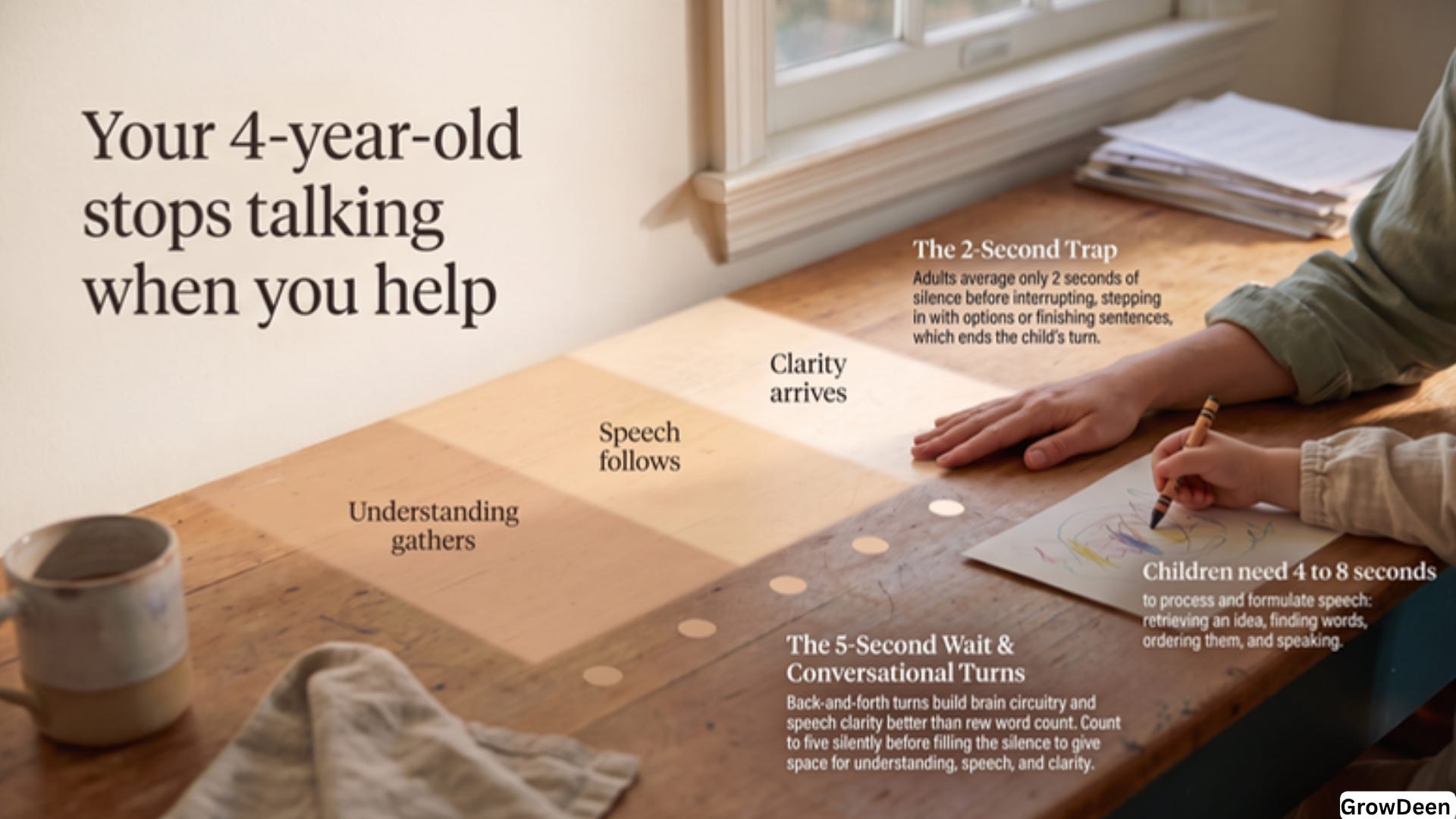
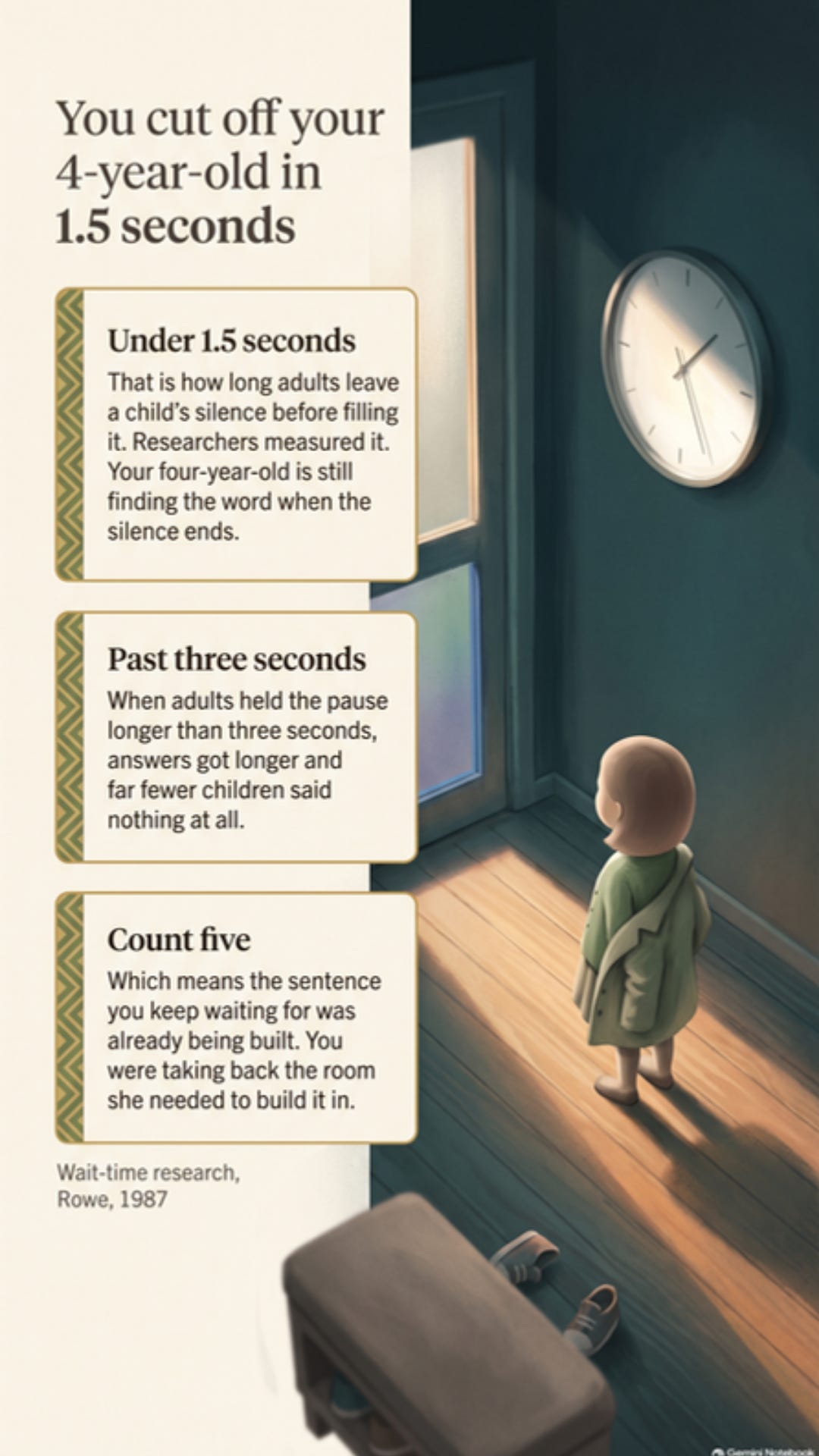
You ask a question. Your child needs to retrieve the idea, find the words, order them, and start the sentence. That takes a four-year-old somewhere between four and eight seconds. Most adults cannot tolerate more than about two seconds of silence from a child, so we fill it. We rephrase. We offer a multiple choice. We finish it.
Each of those is a small kindness, and each one ends the turn. The child did not get to produce a sentence. You produced it and she agreed to it.
Count five. Out loud in your head, slowly, while looking somewhere other than her face. Five seconds feels absurd the first time and ordinary by the fourth day.
That is the whole intervention. There is no app for it.
When the grammar goes wrong, the system is working
Your child says “they wants to go.” Something in you wants to correct it.
Do not. She has extracted a rule about verb endings and is applying it everywhere, including the places where English refuses to cooperate. [6][7] That is a rule engine running, not a rule engine failing. By five, sentences stretch to around nine words, children join clauses with and or because, and many can say the same thing in active or passive form without ever being taught the difference. [2][7]
Say the correct version back inside your reply and carry on. “Yes, they want to go, let’s find their shoes.” You do not announce it and you do not pause for it.
The same restraint applies to pronunciation. By about four and a half a stranger should understand nearly every word your child says. [8] Fing for thing, den for then, and amblance for ambulance are all ordinary at this age. [7][8] The one thing that genuinely slows this down is the family adopting the cute version, so the child hears the wrong form from the people she copies most.
But before you accept any explanation for unclear speech, there is something a lot of parents never check.
The check almost nobody runs
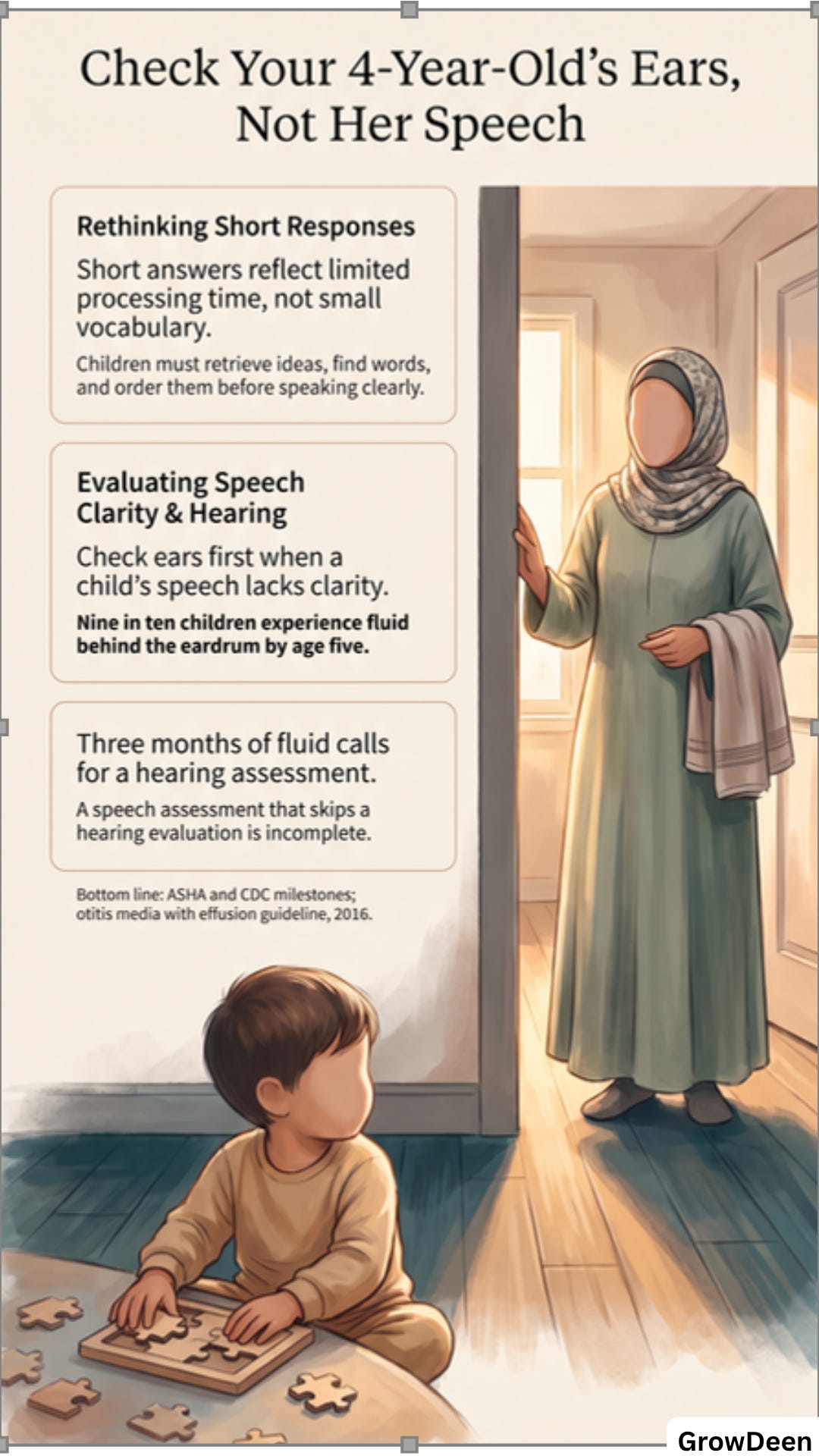
Fluid behind the eardrum, glue ear, is close to universal in early childhood. Around nine in ten children have had otitis media with effusion by the age of five. [11]
Most of the time it causes no pain and no fever. There is nothing for you to notice. What it does cause is hearing that fluctuates, which means your child may have been listening to speech through a wall, on and off, for months.
The clinical guideline is specific. When fluid persists for three months or longer, an age-appropriate hearing assessment should be obtained, and families of children with fluid in both ears and documented hearing loss should be counselled about the possible effect on speech and language development. [11]
If her speech is unclear, if she creeps the volume up, if she mishears instructions, or if she has had repeated ear infections, ask for a hearing check before you accept anything else as the reason. A speech assessment that has not ruled out hearing is an incomplete assessment.
If two languages live in your house
Someone has probably told you to drop one. Usually someone with no training.
Children acquiring two languages from early childhood pass through the same stages and progress at the same rate as children acquiring one. [12] Mixing both inside a single sentence, which is the thing that worries parents most, is a normal feature of bilingual speech rather than evidence of confusion. It is a child reaching for whatever gets the message across. [12]
Most of the anxiety comes from a counting error. A bilingual four-year-old’s vocabulary gets measured in English, found smaller than a monolingual child’s, and recorded as delay. Her words are spread across two systems. Count both.
Dropping the home language costs something that has nothing to do with linguistics. It is the language of her grandparents, and of du’a said out loud in your kitchen.
There is one more thing worth sharing before the Islamic side of this.
I know five seconds sounds like nothing until you are standing in your own kitchen trying to hold it. That is why I put together the free Five-Second Pack — a timing card for the counting, a story mat your child points at while she tells you her day, and a reflection page. The download button is at the top of this page, and there is a full description of what is inside it below.
Support Muslim Parenting Lab ❤️
Would you like one parent, somewhere, to be guided because of you? Fund the articles that reach them, with the button below.
The Prophet ﷺ said one person guided through you is better for you than red camels, the greatest wealth of that time. (Sahih al-Bukhari 3701)
What Allah told His Messenger ﷺ about hastening speech
Every parent who has finished a child’s sentence has done it out of love. Which makes it worth knowing that the Qur’an contains a direct instruction to stop hurrying someone’s speech, and the person told to stop was the Prophet ﷺ.
Ibn Abbas described how the Prophet ﷺ would strain to catch the revelation and move his lips rapidly, trying to hold it before it slipped away. [15] The answer came: “Move not your tongue with it, [O Muhammad], to hasten with it... Indeed, upon Us is its collection [in your heart] and [to make possible] its recitation... Then upon Us is its clarification [to you].” [14]
According to Tafsir Ibn Kathir, this lays out an order. The first phase is collection, which he explains as Allah gathering it in the chest. Recitation follows, and the instruction at that stage is to listen and pay attention. Clarification comes last. [14]
The verse is about revelation, not about children, and nothing more is being claimed here than the principle it carries: hastening was discouraged in a case where the outcome was already guaranteed.
Your four-year-old is moving through something with a comparable order. Understanding gathers first, speech follows, clarity arrives last. Her words need your silence, not your help.
What this looks like at 6pm on a Tuesday
Ask one open question instead of three closed ones. “What was the funniest thing today?” rather than “Did you have a good day?”
Then count five.
Ask for the day in sequence, because sequencing is the weakest part of a five-year-old’s storytelling. [10] “Tell me about today. Start with waking up.” Help only when she genuinely stalls, not when she pauses.
Say Bismillah and Alhamdulillah out loud and slowly, and leave the gap for her to join rather than saying it for her. Recite Qur’an where she can hear it; children this age absorb rhythm and sound patterns from whatever they hear often. [10]
Tell a story from the Qur’an at bedtime and ask for it back tomorrow night. The retelling is where the work happens, not the telling.
Name the feeling during a fight with her brother. “You are frustrated because she took it before you had finished.” That hands her the exact words at the one moment she needs them most, and a child who can say frustrated has an alternative to hitting.
And the answer to the question from the top: she talks for nine minutes about the worm because nobody is waiting for her. A direct question is a request for production under time pressure, with an adult watching the clock in two-second increments. Remove the clock and the sentences come back.
The Five-Second Pack
If you have read this far, you are the kind of parent who would rather change your own habit than audit your child. That tells me something good about you.
Inside the Five-Second Pack (one comprehensive PDF, 3 pages):
Page 1: The Five-Second Card — a thumb-sized counting strip showing what your child is doing in each of the five seconds you are waiting, plus the three moments in a day when the wait matters most — designed as a card you can keep on the fridge or in your coat pocket, where the hard pauses happen.
Page 2: The Story Mat — a four-box mat your child points at while telling you about her day, with a prompt line under each box and a say-it-back strip along the bottom — so a five-year-old’s wandering story gets a visible spine, in under ten minutes at the table.
Page 3: Not Hastening — the verse Allah revealed when His Messenger ﷺ was hurrying revelation, with Ibn Kathir’s explanation of the three phases, and three blank lines where you write the three sentences you most often finish for your child — a page for the parent, not the child.
This isn’t just a PDF to download and forget. It’s a tool designed to stay on your fridge and at your table — where you’ll actually use it when you need it most.
This Five-Second Pack is what every subscriber receives with each article. We cover the full journey of raising Muslim children, all backed by scientific research and rooted in Islamic wisdom.
Do this in the next five minutes
Tonight, ask your child one open question. Then put your tongue behind your teeth and count to five before you say anything else. Once. That is the whole assignment.
May Allah place barakah in your patience, loosen your child’s tongue, and make the waiting easier than it feels in the moment.
Share this with someone who needs it
Think of one person right now: the mother at the school gate who said her four-year-old “doesn’t really talk to her”, your sister who finishes her son’s sentences without noticing, a friend who has been quietly worried since the last nursery report.
This article could change one habit in their house tonight. Share it with them today — not as advice, but as company. Sometimes the most loving thing we can do is pass on the thing nobody told us either.
Frequently Asked Questions
Q: How long should I wait for my 4-year-old to answer a question?
A: Count five seconds. Most adults step in after about two, which is faster than a four-year-old can retrieve the idea, find the words and start the sentence. The waiting feels much longer to you than it does to her.
Q: My 4-year-old says “they wants to go.” Should I correct her?
A: No. That error means she has worked out a rule about verb endings and is applying it everywhere, including where English breaks the rule. [6][7] Say the correct version back inside your reply and move on, without announcing it. For more detail, see “When the grammar goes wrong, the system is working” above.
Q: Is it normal for a 4-year-old to say “fing” instead of “thing”?
A: Yes, that one is ordinary at four, along with den for then and amblance for ambulance. [7][8] By about four and a half, a stranger should understand nearly every word she says. [8]
Q: Will raising my child bilingual delay their speech?
A: No. Children learning two languages from early childhood go through the same stages at the same rate as children learning one, and mixing both in a sentence is normal rather than a sign of confusion. [12] Count her vocabulary across both languages, not just English.
Q: When should I worry about my 4-year-old’s speech?
A: Speak to your doctor if your four-year-old is not using sentences of four or more words, or cannot follow a two-part instruction like “put the ball down and get your shoes”. [3] For a five-year-old, the markers are not using short sentences, trouble holding a conversation, or being unable to follow a multi-step instruction. [3] Go sooner if she has lost a skill she previously had.
Q: Does unclear speech mean my child needs a hearing test?
A: It is the first thing to rule out. Around nine in ten children have had fluid behind the eardrum by age five, it often causes no pain, and it makes hearing fluctuate. [11] Ask for a hearing check before you accept any other explanation. For more detail, see “The check almost nobody runs” above.
Q: How many words should a 5-year-old be saying?
A: Word counts are the wrong measure at this age. What matters is sentences that are mostly grammatically correct, a story with at least two connected events, and a conversation sustained across more than three back-and-forth exchanges. [2][3]
References
[1] Romeo, R.R., Leonard, J.A., Robinson, S.T., West, M.R., Mackey, A.P., Rowe, M.L., & Gabrieli, J.D.E. (2018). Beyond the 30-million-word gap: Children’s conversational exposure is associated with language-related brain function. Psychological Science, 29(5), 700-710.
[2] American Speech-Language-Hearing Association. Communication Milestones: 4 to 5 Years.
[3] Centers for Disease Control and Prevention. Learn the Signs. Act Early. Important Milestones: Your Child By Four Years and By Five Years.
[4] Center on the Developing Child, Harvard University. Serve and Return Interaction Shapes Brain Circuitry.
[5] Nemours KidsHealth. Language Development: 4 to 5 Year Olds.
[6] Hoff, E. (2013). Language development (5th edn). Cengage Learning.
[7] Owens, R. (2018). Language development: An introduction (10th edn). Pearson.
[8] Petty, K. (2016). Developmental milestones of young children (Rev. edn). Redleaf Press.
[9] Westby, C. (2018). Social-emotional bases of pragmatic and communication development. In N.C. Singleton & B.B. Shulman (Eds), Language development: Foundations, processes and clinical applications (3rd edn, Chapter 6). Jones & Bartlett Learning.
[10] Whitehead, M. (2010). Language and literacy in the early years 0-7. Sage Publications.
[11] Rosenfeld, R.M., et al. (2016). Clinical Practice Guideline: Otitis Media with Effusion (Update). American Academy of Otolaryngology-Head and Neck Surgery Foundation.
[12] Bilingualism and multilingualism in young children, drawing on the research of Dr Fred Genesee, McGill University. Montreal Children’s Hospital.
[13] Marulis, L.M., & Neuman, S.B. (2010). The effects of vocabulary intervention on young children’s word learning: A meta-analysis. Review of Educational Research, 80(3), 300-335.
[14] Qur’an, Surah Al-Qiyamah 75:16-19 (Saheeh International), with Tafsir Ibn Kathir.
[15] Sahih al-Bukhari 5, narrated by Ibn Abbas via Sa’id bin Jubair. Graded: Sahih.
We combine scientific research with Qur’an and authentic Sunnah, and we cite our sources. Even so, this is general guidance and no substitute for a doctor who can examine your child.