

Background television costs your child 636 adult words an hour. [6] And the words lost matter less than the conversational turns lost with them. [4]
For the nights the words will not come.
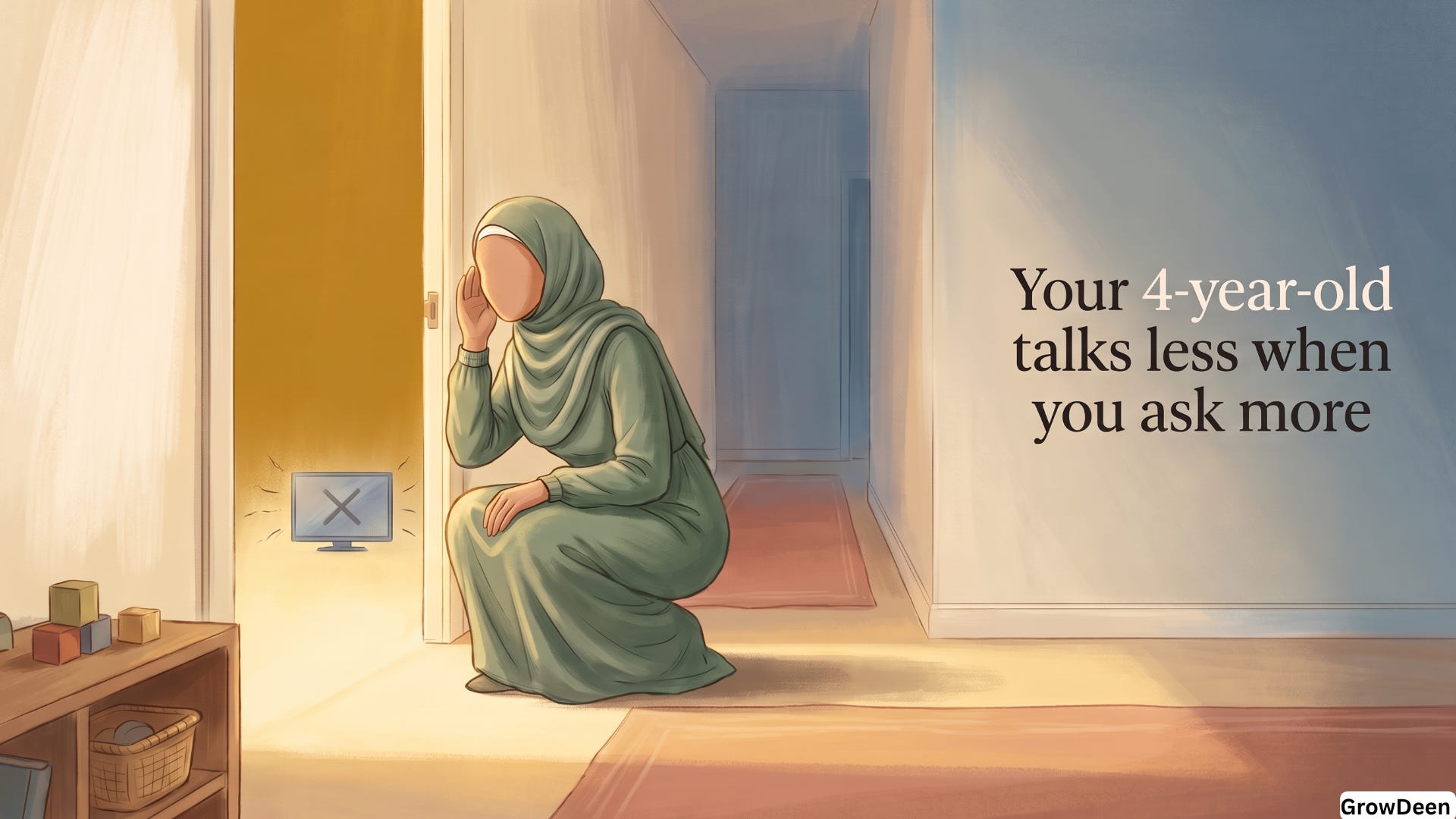
You asked her four questions in a row.
What colour is that one. What is this called. Can you say it properly. Tell Baba what you did at nursery. By the fourth, she had slid halfway off the chair and was studying the underside of the table with great attention. The kitchen got quieter the harder you worked at it.
Most of us have run that exact sequence. It feels like the engaged thing to do, which is what makes it so disorientating when it produces less talking rather than more.
And then on Saturday, in the back of the car, she narrated eleven minutes of uninterrupted commentary to a window about a dog she saw once. Nobody asked her anything. Nobody was even looking at her. Hold onto that, because it is the whole answer, and it arrives near the end of this article.
What makes this approach different
Every claim here is tied to named research with a year attached, including CDC and ASHA milestone guidance, a 2018 brain-imaging study on conversational turns, and a 2016 population study on how common language disorder actually is.
The Islamic material is not a closing paragraph bolted onto parenting advice. It sets the frame the rest of the article works inside, and the verse used places the ability to understand speech in the category of a declared bounty.
You already have the free Pause Pack from the top of this page, which turns the one habit in this article into something you can measure at your own kitchen table this week.
What should a 3 to 4 year old be able to say?
Put the two ends of this year side by side and the size of the shift becomes obvious.
At three, the CDC expects a child to hold a conversation with at least two back-and-forth exchanges, to ask who, what, where and why questions, to say what is happening in a picture when asked, to give her own name, and to be understood by other people most of the time. [1]
By four, the bar has moved a long way. Sentences of four words or more. An account of one thing that happened during her day. An answer to a question like “What is a coat for?” And lines reproduced from something she has heard many times, a short surah before bed or the same story told the same way every night. [2]
ASHA fills in what parents actually notice. Location words become reliable, so inside, on and under stop being guesswork. Little grammatical words appear, and “dog” turns into “the dog”. Speech smooths out around the fourth birthday, and most listeners follow her, though a few late sounds are still settling. [3]
Almost none of that vocabulary was taught to her, which is the part most parents find surprising.
She is lifting words out of adult conversation she was never invited into. She hears “underneath” while you are on the phone, guesses the meaning from what is happening in the room, files the guess, tries it out three days later, and quietly revises when the result lands strangely. Comprehension runs years ahead of production, which is why she can follow an instruction containing a word she cannot yet say.
Three families of word tend to surface in this particular twelve months. Joining words, among them because, so, if and when. Family terms, so your sister becomes khala or aunty rather than a first name. And category words such as animals, clothes or vegetables, which only arrive once a child can hold the idea that several unlike objects share one label.
The grammar arrives on its own schedule too. Possessives show up: “Baba’s keys.” Past and present sit side by side in one breath. Sentences grow a second half hinged on a reason, and “I’m not eating that because it’s slimy” is a small argument, correctly built.
Which brings us to the thing that makes parents panic.
Why has my child started saying “runned” instead of “ran”?
A child who said “ran” perfectly at two and a half starts saying “runned” at three and a half. The same thing happens to “goed”, “comed”, “foots” and “mouses”. It sounds exactly like going backwards.
It is the opposite, and the reason matters.
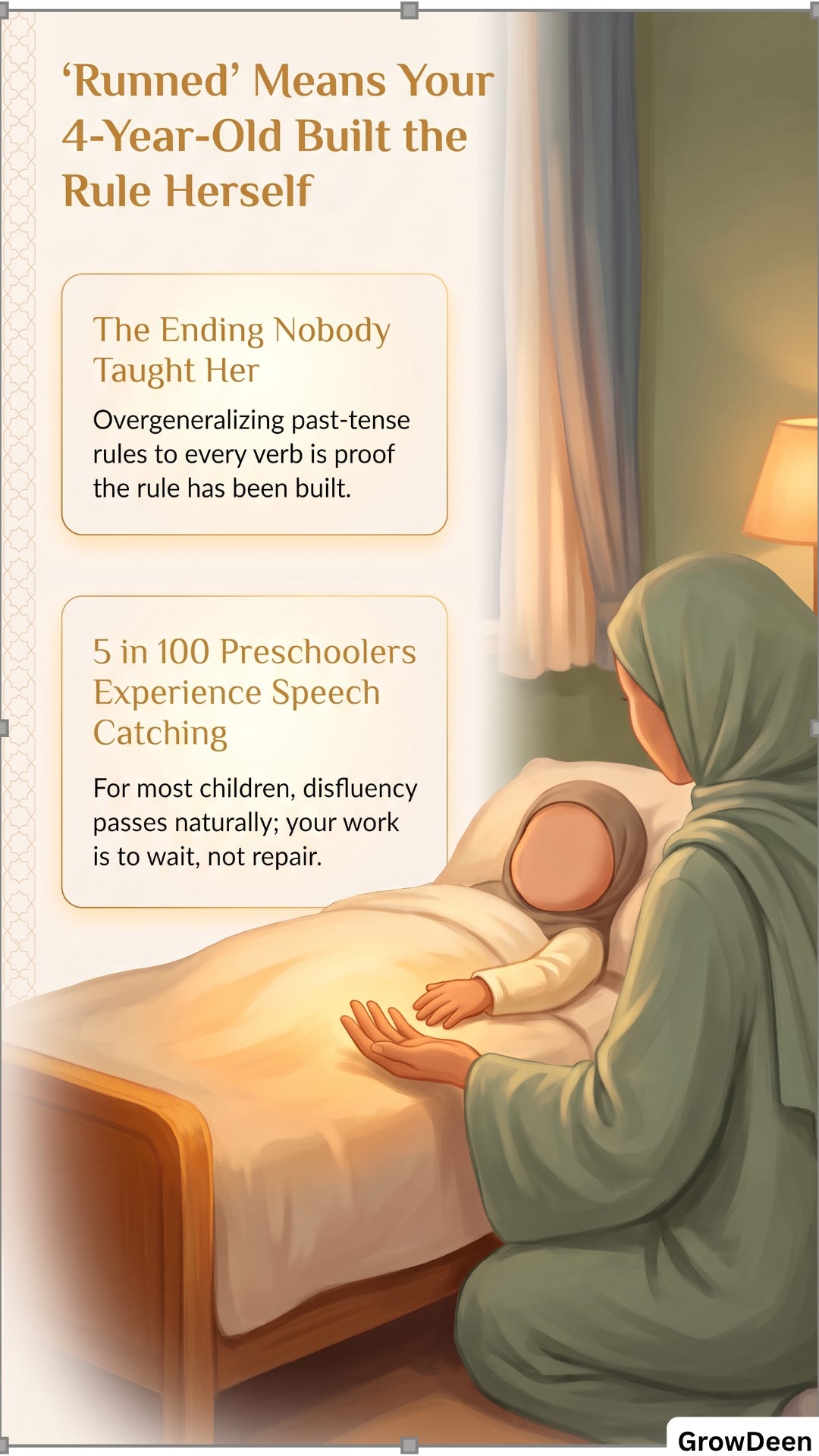
She has extracted a rule. Past tense takes an ending. Having worked that out without being taught it, she is now applying it across the board, including to the awkward verbs that refuse it. English is stuffed with such refusals. She has not yet memorised which verbs break the pattern, and that gap is precisely the evidence that she is running a system rather than reciting a list of remembered words.
So the error is a receipt. It tells you the rule got built.
Negatives stay tangled a while longer. Ask “Don’t you want to come?” and you may get “I don’t not want to come.” Pronouns, by contrast, usually settle this year, and I, you and me are generally handled correctly by four.
None of that needs correcting. But there is one thing in this year that does deserve a closer look.
Is it normal for a 4 year old to stumble over words?
This is the one that sends parents to a search engine at midnight, and it is rarely explained to them properly.
Somewhere between two and a half and five, roughly five in every hundred children pass through a period of disfluency. [9] Speech catches. Words repeat. A sentence starts, stalls and restarts. It often turns up in the same months as the biggest vocabulary surge, which is not a coincidence, because the ideas have outrun the machinery that delivers them. Children typically swing in and out of it, fluent for a fortnight, bumpy for a fortnight.
Most of it clears on its own. Onset at four or later is more likely to persist than onset at two or three, and a family history, being a boy, or having another speech difficulty alongside it all raise the odds of it continuing. [9]
Now the part that actually matters, because what parents do in those weeks changes the outcome, and the instinctive responses are mostly the wrong ones.
Telling a child to slow down, to take a breath, or to think about what she wants to say before she says it are all specifically unhelpful. [9] So is finishing her sentence, however kindly you mean it. Each one tells her that the way she is currently talking is a problem to be managed, and a four-year-old who believes that starts talking less.
What helps is taking the pressure out of the room. Turn some of your questions into comments, because a comment does not demand a performance. Let the silence sit while she gets there. Slow your own speech down and leave longer gaps between your turns, which hands her a pace to match instead of an instruction to follow. If she knows she is stumbling, say so plainly and without alarm. [9]
Notice what every one of those has in common. They are all things you stop doing.
Counting what you actually do at a dinner table is harder than it sounds, because the jumping-in happens faster than thought. That is why the free Pause Pack exists. It gives you a way to measure your own turns across five ordinary slots in a day, and a wordless picture strip your child narrates while you say nothing at all. The download button is at the top of this page, and there is a full description of what is inside it below.
Does talking more to my child actually build her language?
For years the advice to parents was volume. Say more words. Narrate everything. Then the research caught up with the question of what kind of talking was doing the work, and the answer rearranged the advice.
A team led by Rachel Romeo and John Gabrieli, publishing in Psychological Science in 2018, recorded the home language environments of children aged four to six and then scanned their brains. They measured two things separately: how many words each child heard, and how many back-and-forth conversational turns each child took part in. The turns carried the effect. Children with more of them showed greater activation in Broca’s area while processing language, and that activation predicted their scores on standardised language assessments. The relationship held even after family income was accounted for. [4]
Harvard’s Center on the Developing Child calls the same mechanism serve and return, the reciprocal exchange that builds the circuits language later runs on, and notes that the sustained absence of those exchanges is itself a threat to a child’s development. [5]
So the unit of growth is not the word. It is the turn.
And a turn needs two halves. Yours, then hers. Which means every time you fill her half, you have not added language to the room. You have removed one.
This is also why background noise deserves more attention than it gets. A study of 329 young children wearing recorders through their ordinary days found that every hour of audible television in the house was associated with around 636 fewer words spoken to the child by an adult woman, alongside measurable drops in the child’s own vocalisations and in conversational turns. [6] Nobody in those homes was watching it. It was simply on, and it quietly ate the talk.
WHO guidance for three and four year olds caps sedentary screen time at one hour a day, says less is better, and recommends reading and storytelling with a caregiver in its place. [8] A screen produces language. It never waits for a turn, and waiting for a turn is where the growth happens.
Their sentences grow in the pause you leave.
Support Muslim Parenting Lab ❤️
Would you like a small amount of yours grown into something enormous? Give what you can spare with the button below.
The Prophet ﷺ said Allah grows a charity the size of a date until it is like a mountain. (Sahih al-Bukhari 1410)
The Islamic framework for a child’s speech: a bounty before a checklist
Parents rarely stop to call a child’s talking a gift. The Qur’an does exactly that, and puts the statement in the mouth of a prophet.
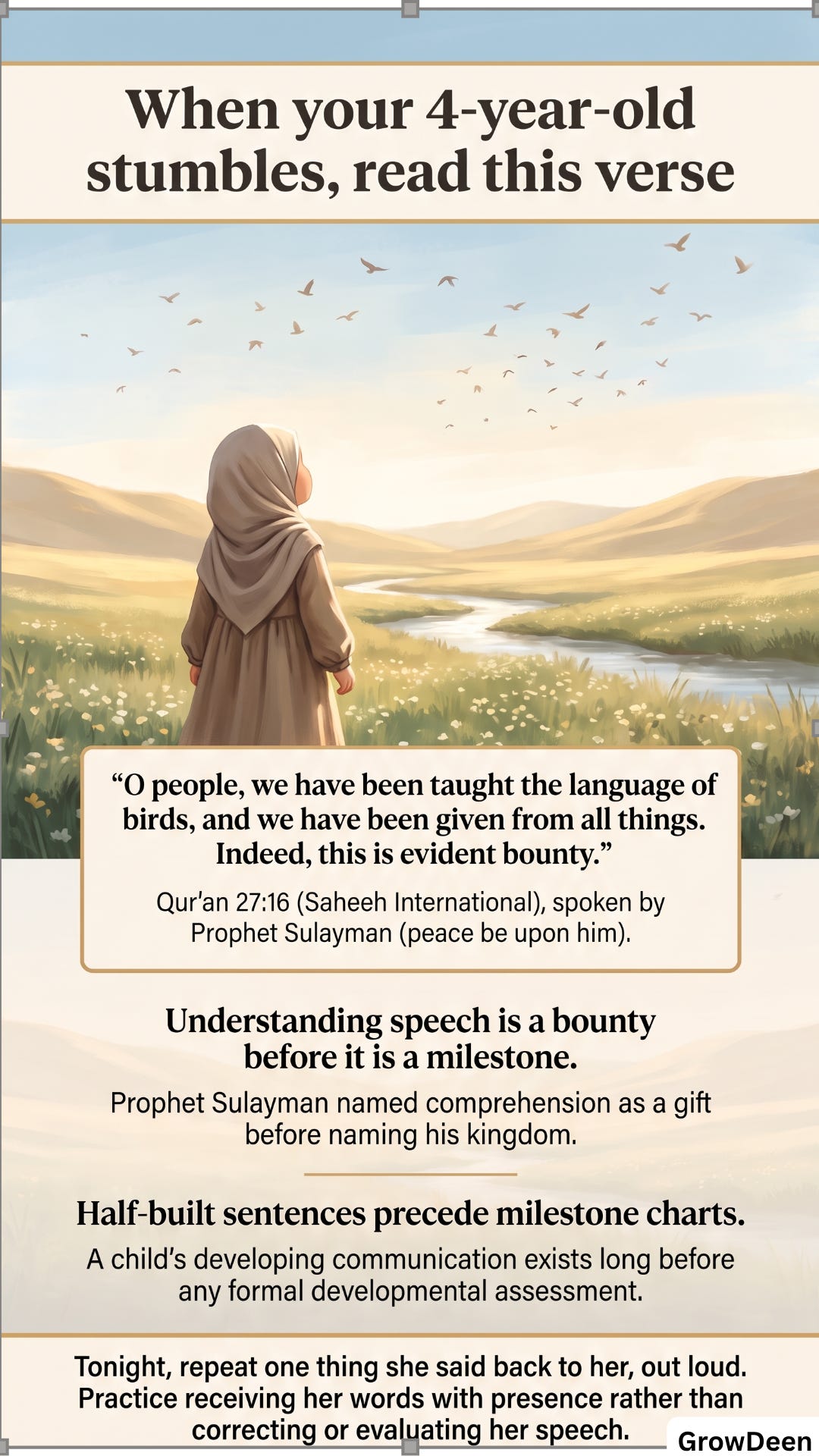
Sulayman (peace be upon him) opened an address to his people by naming what he had been given: “O people, we have been taught the language of birds, and we have been given from all things. Indeed, this is evident bounty.” [12] According to Tafsir Ibn Kathir, the ability to understand the speech of birds and animals had been granted to no other human being, and Sulayman’s public declaration of it was an acknowledgement that the capacity came from Allah rather than from anything he had earned. [13]
Sit with the shape of that for a moment. Understanding speech is classed as a bounty so plain it needs no argument, and the response modelled is to say so out loud rather than take it quietly for granted. A parent in the fourth year of a child’s life is watching a smaller version of the same gift arrive in their own kitchen, and the Qur’anic response to it is shukr before audit.
The Prophet ﷺ supplies the method. Aisha described his speech as so clear that anyone wanting to count his words could have done so. [14] Not hurried, not compressed, paced for the person receiving it.
Which is the same instruction the research gives, arriving from a different direction entirely. Slow down and leave room.
What should I do at home tonight?
Shared reading does more of this work than any other single habit. The American Academy of Pediatrics revised its position in 2024, describing reading aloud with children from infancy onward as a parenting practice whose benefits reach well past literacy into relationship and brain development, and noting that touchscreens tend to deliver a passive experience without the interactive quality a physical book carries. [7]
But reading with a four-year-old improves the moment it stops being a recital. Stop mid-page. Ask what she thinks happens next. Then wait, and keep waiting past the point it gets uncomfortable.
A handful of other habits are worth building into ordinary days:
Narrate your own actions while you perform them. Wudu, cooking, hanging washing. Sequence words come from sequences.
Recite Qur’an aloud where she can hear it, returning to the same short surahs often enough that she starts joining in. Repeated sound patterns are how young children absorb phonology.
Tell stories rather than only reading them. Accounts from the Qur’an and the seerah, in your own words, let you pitch the vocabulary exactly where she currently is.
Attach gentle adhkar and spoken repetition to transitions: leaving the house, getting into the car, settling at night.
Take the “why” questions seriously as often as you can manage, and say plainly when you do not know.
Count to five in your head before you speak again. Preschoolers need several seconds to assemble a sentence, and most adults step in at about two.
That last one is the whole article compressed into one habit, and it is the one the Pause Pack is built around.
What should I stop doing?
Correcting pronunciation head-on does very little and tends to make a child self-conscious about the thing you want her to do more of. Recasting gets you the same result without the cost. She says “He runned fast”, you say “He did, he ran so fast”, and she hears the correct form sitting inside an ordinary reply that did not stop to point at her.
Stop turning talk into assessment. A run of “What colour is that? What is this called? Say it properly” converts a conversation into an exam, and children volunteer less under exam conditions. That dinner table at the top of this article was an exam.
Stop completing her sentences, even when you are certain you know the ending and the bus is leaving.
And stop comparing her out loud to a cousin who talks more. Preschoolers understand a great deal more of that remark than adults assume.
Does raising a child in two languages delay speech?
Plenty of Muslim households are raising children across two or three languages, often with Arabic somewhere in the mix, and worry that the load is slowing everything down.
It is not. ASHA states directly that using your languages with your child will not cause or worsen speech and language problems, and that a secure foundation in one language supports the acquisition of another. Mixing grammar or vocabulary from both inside a single sentence is a normal feature of multilingual use rather than evidence of confusion. [11]
What that does mean is that a count of turns matters more than a count of languages. Five minutes of real back-and-forth in Bengali is worth more than twenty minutes of English narration she is not answering.
When should I be worried about my 4 year old’s speech?
Most of the variation at this age is ordinary. A specific subset is worth acting on, and the list is short enough to hold in your head.
Speak to your doctor, paediatrician or local health professional if your child is not putting three words together by three, is not producing sentences of four words or more by four, cannot manage a two-part instruction such as “put the toy away and sit down”, is frequently hard for family and friends to understand, or has lost a language skill she previously had. [1][2] A referral to a speech-language pathologist follows from there, and ASHA also recommends assessment by an audiologist, because hearing sits upstream of everything else in language. [3]
Two things are worth holding together here, because parents usually hear only one of them.
Some sounds are simply late. L, th and r commonly stay imperfect past four, and ASHA groups sh, ch and s with them. [3] A child who is fully intelligible and still says “wabbit” is almost certainly on schedule.
At the same time, language disorder is a great deal more common than most parents realise. A population study of children at school entry led by Courtenay Norbury found that 7.58 per cent met criteria for language disorder of unknown origin, which the authors described as roughly two children in every class of thirty. [10] Raising it with a doctor is not an overreaction. It is arithmetic.
Acting early is also how taking the means works alongside tawakkul rather than against it.
So why does she talk more in the car?
Because in the car, nobody takes her turn.
Nobody is watching her mouth, and no question is sitting there waiting for a correct answer. The adult face that would normally be two feet away, poised to supply the word the second she hesitates, is turned toward the road. So the silence sits unfilled for long enough that she fills it herself, and then she keeps filling it, because nothing interrupts.
You cannot reproduce a car at the dinner table. But you can reproduce the one ingredient that makes it work, which is a pause long enough to be hers.
Their sentences grow in the pause you leave.
The Pause Pack: what is inside it
If you have read this far, you are the kind of parent who went looking for an explanation rather than a reassurance. That tells me something good about how this child is being raised.
Inside the Pause Pack (one comprehensive PDF, 3 pages):
Page 1: The Turn Counter. A one-page tally sheet for measuring conversational turns, not words, across five ordinary slots in your day, with bands at the bottom showing what a low, typical and strong count looks like at this age. It is designed as a printable sheet you can keep on the fridge with a pencil tied to it, so the counting takes no preparation on a day you have none.
Page 2: The Tell-Me Strip. A six-panel wordless picture sequence of an ordinary household morning, drawn for your child to narrate while you say nothing at all, with four short parent prompts printed down the margin for the moments she stalls. You can run a full narrative practice session in under ten minutes without preparing a single sentence yourself.
Page 3: A Bounty, Not a Test. Two reflection cards in English, one carrying the verse where Sulayman (peace be upon him) names the understanding of speech as an evident bounty, the other carrying Aisha’s description of the Prophet ﷺ speaking slowly enough to be counted. Each card has a short note on the moment to reach for it, which is usually the evening you catch yourself auditing your child instead of listening to her.
This is not a PDF to download and forget. It is built to live on the fridge and on the floor beside your child, where the counting and the narrating actually happen.
The Pause Pack is what every subscriber receives with each article. Muslim Parenting Lab covers the full span of raising Muslim children, from the newborn weeks through the school years, with every recommendation tied to named research and rooted in the Qur’an and Sunnah.
Your micro-action for tonight
Tonight, ask your child exactly one question. Then count to four in your head before you say anything else. Not three. Four. Most of us break at two, and the sentence you were about to hear was arriving at second four.
May Allah make the words your children learn in your house a means of good for them, and grant you the patience that the waiting asks for.
Share this with someone who needs it
Think of one person right now: the sister in your WhatsApp group whose four-year-old has started repeating the first sound of every sentence, and who has not said anything about it to anyone because she is frightened of what it means.
This article would tell her that most of it clears on its own, and that the three things she is probably doing to help are the three things to stop. Send it to her today, the way you would have wanted somebody to send it to you.
Frequently asked questions
Q: How many words should a 4 year old be saying? A: Milestone guidance at this age measures sentences and conversation rather than counting vocabulary, because the sentence is the better signal. By four, look for sentences of four words or more, an account of one thing that happened in her day, and an answer to a question like “What is a coat for?” [2] If those are there, the raw word count takes care of itself.
Q: Is it normal for a 4 year old to stutter? A: Yes, for a period. Around five in every hundred children go through a disfluent stretch between two and a half and five, and most of it resolves without treatment. [9] Onset at four or later is more likely to persist, so mention it to your doctor rather than waiting it out alone. For the full picture, see “Is it normal for a 4 year old to stumble over words?” above.
Q: Should I correct my child’s pronunciation? A: Not directly. Recast instead, so “He runned” gets answered with “He did, he ran so fast.” She hears the right form without being stopped and pointed at, which matters because children who feel assessed talk less.
Q: Will raising my child bilingual delay her speech? A: No. ASHA states that using your languages with your child will not cause or worsen speech and language problems, and that a strong foundation in one language supports learning another. [11] Mixing both languages inside one sentence is normal multilingual behaviour, not confusion.
Q: How much screen time is okay for a 3 or 4 year old? A: WHO guidance sets a ceiling of one hour of sedentary screen time a day and says less is better. [8] Worth knowing separately: television left on in the background, with nobody watching, was associated with around 636 fewer adult words spoken to the child per hour. [6] The off switch may matter more than the viewing rules.
Q: When should I see a speech therapist for my 4 year old? A: Raise it with your doctor if she is not using sentences of four words or more, cannot follow a two-part instruction, is often hard for family to understand, or has lost a skill she previously had. [1][2] Ask for a hearing assessment at the same time. [3] Language disorder affects around 7.58 per cent of children at school entry, so the concern is far from unusual. [10]
References
[1] Centers for Disease Control and Prevention. Milestones by 3 Years, Learn the Signs. Act Early.
[2] Centers for Disease Control and Prevention. Milestones by 4 Years, Learn the Signs. Act Early.
[3] American Speech-Language-Hearing Association. Communication Milestones: 3 to 4 Years.
[4] Romeo, R.R., Leonard, J.A., Robinson, S.T., West, M.R., Mackey, A.P., Rowe, M.L., & Gabrieli, J.D.E. (2018). Beyond the 30-Million-Word Gap: Children’s Conversational Exposure Is Associated With Language-Related Brain Function. Psychological Science, 29(5), 700-710.
[5] Center on the Developing Child, Harvard University. Serve and Return.
[6] Christakis, D.A., Gilkerson, J., Richards, J.A., et al. (2009). Audible television and decreased adult words, infant vocalizations, and conversational turns: a population-based study. Archives of Pediatrics & Adolescent Medicine, 163(6), 554-558.
[7] American Academy of Pediatrics (2024). Literacy Promotion: An Essential Component of Primary Care Pediatric Practice. Pediatrics.
[8] World Health Organization (2019). Guidelines on Physical Activity, Sedentary Behaviour and Sleep for Children Under 5 Years of Age.
[9] American Academy of Pediatrics. Stuttering in Toddlers & Preschoolers: What’s Typical, What’s Not. HealthyChildren.org.
[10] Norbury, C.F., Gooch, D., Wray, C., Baird, G., Charman, T., Simonoff, E., Vamvakas, G., & Pickles, A. (2016). The impact of nonverbal ability on prevalence and clinical presentation of language disorder: evidence from a population study. Journal of Child Psychology and Psychiatry, 57(11), 1247-1257.
[11] American Speech-Language-Hearing Association. Learning Two Languages.
[12] Qur’an, Surah An-Naml 27:16.
[13] Ibn Kathir. Tafsir Ibn Kathir, Surah An-Naml 27:16 commentary.
[14] Sahih al-Bukhari 3567, 3568. Narrated by Aisha. Graded: Sahih.
We combine scientific research with Qur’an and authentic Sunnah, and we cite our sources. Even so, this is general guidance and no substitute for a doctor who can examine your child.