

Soiling after four is usually overflow around a blockage. Functional constipation affects roughly 9.5% of children worldwide. [1]
Three pages. Fridge-ready. Print it tonight.
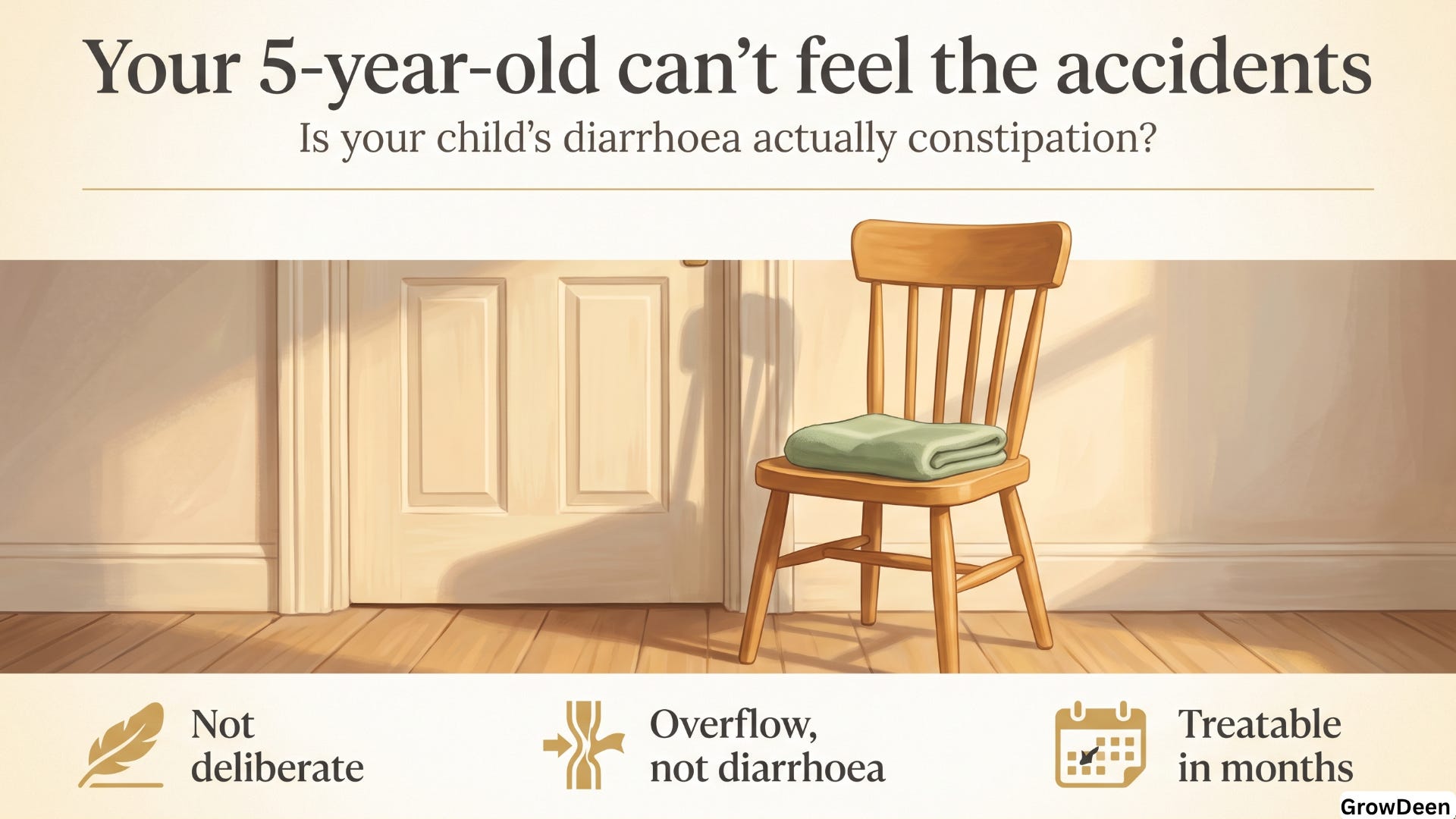
A child comes out of the bathroom and says nothing happened. The underwear says otherwise. The room says otherwise.
And the child, asked directly, says they did not know.
That sentence is where most families start arguing with the wrong thing. It sounds like a lie. It is almost always a straight report of what the child experienced, which was nothing at all.
Why this guide is different from a general article on soiling
Every clinical claim here is traced to a named source: a thirty-five-study meta-analysis on prevalence [1], the NICE guideline on childhood constipation [2], and a systematic review on prognosis that puts actual numbers on recovery [7].
The Islamic material is verified rather than decorative. One verse and one hadith, both checked at source this week, with the tafsir and the grading printed so you can click through and confirm them yourself.
You already have the free Bowel Reset Kit from the top of this page, a three-page printable built for the bathroom door and the appointment, not for a reading list.
The first misreading: it looks like diarrhoea
The stool that leaks is often loose. Loose stool reads as diarrhoea, and diarrhoea gets treated at home by cutting fibre and waiting it out.
Underneath, the opposite is happening.
Stool that has sat too long in the rectum loses water and hardens into a mass that cannot pass. Newer, softer stool arriving from above finds a route around it and leaks out. Clinical guidance describes this pattern precisely: loose, smelling considerably worse than ordinary stool, and passed without sensation [2].
So a family treating diarrhoea is feeding the blockage that caused it.
The second misreading: the child seems fine
No straining. No crying. No obvious pain.
A rectum that has slowly adapted to being permanently full generates far less discomfort than one that is acutely loaded. The absence of distress is a feature of the condition, not evidence against it.
The same adaptation explains the part parents find hardest to accept. Stretch receptors in a chamber that is always full stop producing the sharp signal that sends a child to a toilet [3][4]. The signal is gone. A child who cannot feel the event cannot anticipate it, cannot report it, and cannot be instructed out of it.
The third misreading: it looks like a choice
This is the one that does real damage, because it changes how a household behaves toward a child.
Nothing about this is chosen. The physical capacity to notice and respond has been removed by a treatable condition, and every parenting technique aimed at the will is aimed at the wrong target. Clinical guidance makes the practical version of this explicit: any behavioural element in treatment must be negotiated with the child and non-punitive [2].
Punishment, shaming, withdrawal of warmth and charts built around staying clean are all pointed at a function the child does not currently control.
Take this to a doctor, and do it this week
Everything above exists to get you to this paragraph.
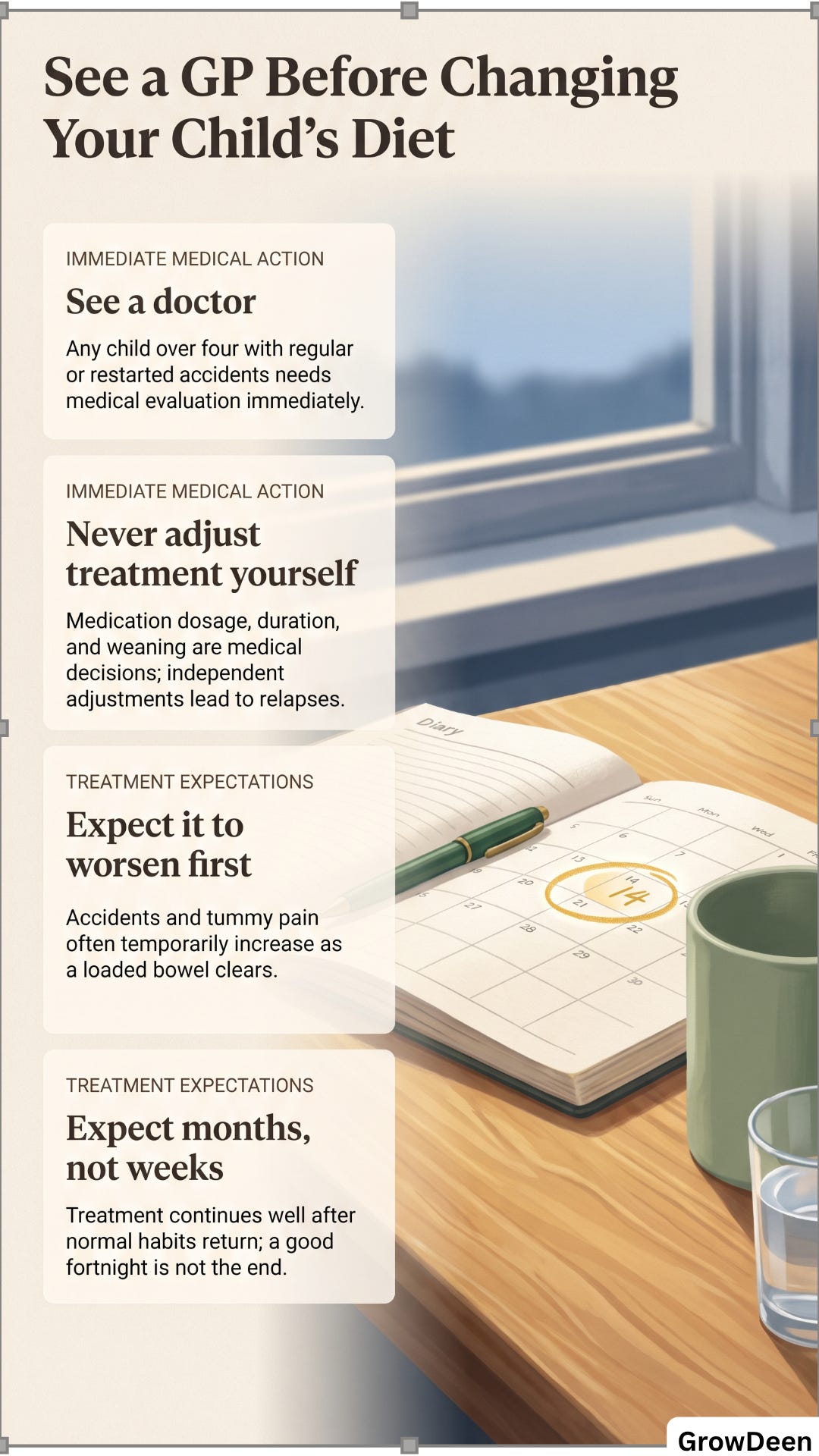
A child over four who cannot reliably control when and where they pass stool needs to be seen by a doctor. So does a child who was clean for a long stretch and has started having accidents again. So does any child you suspect of being constipated, soiling or not.
Do not hold this back while you try other things first. Clinical guidance states directly that dietary change should not be the first-line treatment for this condition, and that what addresses it is laxative treatment combined with a supportive, non-punitive routine [2]. Fibre and water support that treatment. They do not replace it. Six months of adjusting breakfast is six months of a rectum stretching further.
At the appointment the clinician takes a history, examines the child, and checks for the small set of warning signs that would point away from ordinary constipation toward something needing urgent onward referral [2]. If the bowel is loaded, clearing it comes first. Which medicine, how much, how long, and how to stop are decisions that clinician makes for your specific child. They do not transfer between families and they are not safely taken from a search engine.
If you read one line in this article twice, read that one.
A free kit for the weeks after the appointment
The appointment is short. The treatment is long, and most of it happens in your bathroom at seven in the morning with nobody there to remind you what the clinician said.
That is what the Bowel Reset Kit is for. Three printable pages: a daily rhythm card for the bathroom door, a symptom and appointment log the clinician can actually read, and an Islamic reflection card for the parent carrying this. The download button is at the top of this page, and there is a full description of what is inside it below.
What Islam says about an involuntary act
Underneath the laundry, many parents are carrying a quieter question about character. Is this defiance. Is a child answerable for this.
Allah addresses unintentional acts directly. In Surah Al-Ahzab, inside a passage correcting how people had been naming children in their care, the verse states: "And there is no blame upon you for that in which you have erred but [only for] what your hearts intended." [Qur'an 33:5] [11]
Tafsir Ibn Kathir applies the clause first to that specific case, where a person who has made a real effort to learn a child's parentage and still errs carries no sin. He then widens it, supporting the reading with the Qur'anic treatment of unintentional oaths, with the supplication asking not to be held to account for forgetting or erring, and with narrations in which mistakes and forgetfulness are pardoned for this Ummah [12]. The principle running through those texts is that moral weight attaches to intent.
A child whose rectum has stopped sending a signal forms no intention about what follows. The act is involuntary in the strict sense, and it sits outside the territory of sin and disobedience.
That is not a kindness offered to soften a hard week. It is the accurate reading, and it is the ground everything else in this article stands on.
What the months after the appointment actually look like
Three things catch families off guard, and each one causes people to stop early.
Symptoms can worsen first. As a loaded bowel starts moving, soiling and abdominal pain may increase before they settle. Guidance instructs clinicians to warn families about this specifically [2], which tells you how routinely it surprises people.
The timescale is long. Treatment continues for weeks after a regular habit returns, which for many children means several months in total, and some need considerably longer. Stopping abruptly is advised against, and the reduction is managed gradually by the clinician [2]. No meaningful response by around three months is the trigger for referral to someone with particular expertise [2].
Recovery is common without being guaranteed. A systematic review of prognosis found roughly 60.6% of children free of symptoms after six to twelve months of follow-up, with around 49.3% recovered and off laxatives in the same window [7]. Those figures argue for starting early and finishing properly. They also explain why a good fortnight is not a finished course.
International treatment guidance here was updated in 2026 by the European and North American paediatric gastroenterology societies, replacing the 2014 version [5][6]. A clinician working from current guidance has more to offer than a decade-old summary found online.
Support Muslim Parenting Lab ❤️
Is there someone you have lost who you would still like to send a reward to? Give in their name with the button below.
Asked whether he could give charity for his late mother, the Prophet ﷺ said: yes, give on her behalf. (Sahih al-Bukhari 2760)
What helps at home alongside the treatment
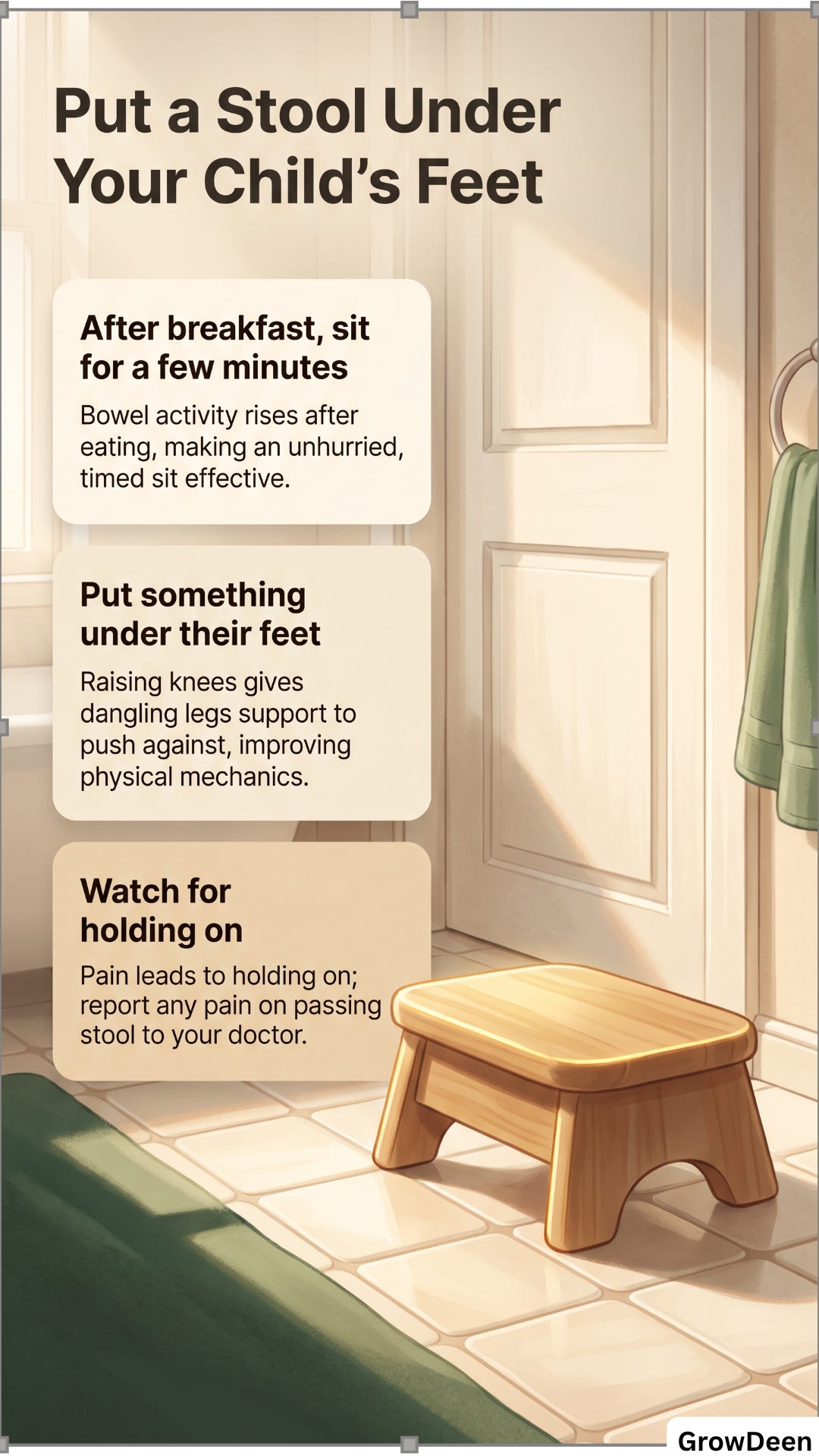
Sit the child on the toilet after meals for a few minutes, without pressure. Bowel activity rises after eating, and an unhurried scheduled sit is part of standard supportive management [2].
Put a step stool under their feet. Feet hanging in mid-air have nothing to brace against, and raising the knees slightly changes the mechanics of the whole act.
Watch for withholding. A child hurt by a hard stool holds on to avoid a repeat, and holding on is what produced the problem originally. Pain on passing stool is information the clinician needs.
Keep a simple log if your clinician asks for one. It beats memory at the next appointment by a wide margin.
Keep the diet balanced with adequate fluid and fibre, which supports treatment and helps prevent relapse, while remembering it will not do the work alone [2].
Two points of context worth holding. Toilet training frequently takes longer for children with developmental delay, which is ordinary rather than a warning sign. Constipation and faecal incontinence also occur more often in children with ADHD and in autistic children [9][10], so raise bowel symptoms early with the clinician who already knows your child.
Guarding your child's dignity while this runs
A child in this situation knows something is wrong well before anyone names it. They register the changed bedding, the sleepover they are not allowed, the pause when they walk into a room. Real distress is documented, and emotional or behavioural difficulties alongside the soiling are well described [3][8].
Islam attaches reward to covering what another person would not want exposed. 'Abdullah ibn 'Umar reported that the Prophet ﷺ described a chain of reciprocal mercies, including that "whoever brought his (Muslim) brother out of a discomfort, Allah will bring him out of the discomforts of the Day of Resurrection", and "whoever screened a Muslim, Allah will screen him on the Day of Resurrection." [Sahih al-Bukhari 2442] [13]
Those two clauses describe the two halves of what this asks of a parent. Relieving a Muslim's discomfort is the rewarded act, and the discomfort in front of you is a treatable condition in your own child, which makes pursuing the treatment the religious act rather than a worldly distraction from one. Screening a Muslim means not exposing what they would not want exposed.
In practice:
The people who need to know are the people who provide care. The doctor, a school nurse, a teacher who manages a change of clothes. The list ends there.
Accidents do not go in the family group chat, do not come up at dinner in front of guests, and do not become an illustration in a conversation about your difficult week.
Siblings are told plainly that this is a medical problem under treatment and that teasing about it is not permitted in the house.
Cleaning happens without commentary. A child can help as part of an ordinary routine, never as a consequence.
Spare clothes travel in the bag the way a water bottle does.
Tawakkul sits inside all of this, in the right position. The means Allah placed within reach are a clinician, a diagnosis and a course of treatment. Taking hold of them is what comes before leaving the outcome with Allah. Make du'a on the way to the appointment and on the way home.
Inside the Bowel Reset Kit
If you have read this far, you are the kind of parent who wanted to understand this before responding to it. That is the whole difference between a household that treats this and a household that polices it.
Inside the Bowel Reset Kit (one comprehensive PDF, 3 pages):
Page 1: The Daily Rhythm Card. The four fixed points of a treatment day, written as a sequence a tired parent can follow at speed, with the after-meal sit, the step-stool check and the two things to watch for set out in order. Designed as a laminated card for the back of the bathroom door, where the decisions actually get made.
Page 2: The Appointment Log. A two-week grid for stool type, soiling episodes, pain and medicine given, plus a short prompt list of what to tell the clinician and what to ask before you leave. So you arrive at the review with a record instead of a recollection, in under two minutes a day.
Page 3: No Blame Upon the One Who Erred. An Islamic reflection card carrying Qur'an 33:5 with its source, the two clauses of Sahih al-Bukhari 2442 on relieving discomfort and screening a Muslim with the grading printed, and four short lines on what satr looks like in a household managing this. For the parent, not the child.
This is not a PDF to download and forget. It is built to stay on the bathroom door and in the appointment bag, where you will actually reach for it.
The Bowel Reset Kit is what every subscriber receives with each article. Muslim Parenting Lab covers the full arc of raising Muslim children, every piece backed by current research and rooted in Qur'an and Sunnah.
One thing to do in the next five minutes
Open your calendar and book the appointment. Not a reminder to book it. The appointment.
If the surgery is closed, write the number and the opening time on a note and put it where you will stand tomorrow morning.
May Allah place barakah in your effort, accept your intention, and make the care you give more protective and more rewarded than it feels in the moment.
Share this with the person you just thought of
Think of one person right now. A sister who mentioned laundry she could not explain. A friend whose seven-year-old has started coming home with a spare uniform. Someone at the masjid who went quiet when school trips came up.
They are probably managing this alone and probably believe their child is choosing it. This article could end that belief in ten minutes and get a child to a doctor. Send it today, not as advice, but because you know something they have not been told.
Frequently asked questions
Q: Why can't my child smell their own soiling?
A: Continuous exposure to the same smell dulls a person's awareness of it, and in this condition the stool is also passing without any sensation at all [2]. Asking a child whether they can smell it is asking for information their body is not giving them.
Q: Is soiling after age four normal, or is something wrong?
A: It is common enough to have a recognised name and a treatment pathway, and it is not something to wait out. Any child over four who cannot reliably control when and where they pass stool should be seen by a doctor [2].
Q: My child has loose stools. Can they still be constipated?
A: Yes, and this is the most common misreading of the whole condition. Loose stool leaking around a hard mass is a classic sign of constipation rather than evidence against it [2]. See "The first misreading" above.
Q: How long does treatment for childhood constipation take?
A: Longer than most families expect. Treatment continues for weeks after a regular habit returns, often several months in total, and some children need considerably longer [2]. Around 60.6% of children are free of symptoms at six to twelve months [7].
Q: Should I punish or use a reward chart for soiling accidents?
A: No. Clinical guidance requires that any behavioural element be negotiated with the child and non-punitive [2], because accidents in this condition are involuntary. Charts built around staying clean target something the child does not currently control.
Q: Can I just add more fibre and fruit instead of seeing a doctor?
A: Diet supports treatment but does not replace it. Guidance states directly that dietary change should not be used as the first-line treatment for this condition [2].
Q: Is seeking medical treatment a weakness in tawakkul?
A: The opposite. The means Allah placed within reach are a clinician, a diagnosis and a course of treatment, and taking hold of them is what precedes leaving the outcome with Allah. The Prophet ﷺ described relieving a Muslim's discomfort as a rewarded act [13].
References
[1] Koppen, I.J.N., Vriesman, M.H., Saps, M., Rajindrajith, S., Shi, X., van Etten-Jamaludin, F.S., Di Lorenzo, C., Benninga, M.A., & Tabbers, M.M. (2018). Prevalence of functional defecation disorders in children: a systematic review and meta-analysis. The Journal of Pediatrics, 198, 121-130
[2] National Institute for Health and Care Excellence. (2010, updated 2017). Constipation in children and young people: diagnosis and management. NICE guideline CG99
[3] Rajindrajith, S., Devanarayana, N.M., & Benninga, M.A. (2013). Review article: faecal incontinence in children: epidemiology, pathophysiology, clinical evaluation and management. Alimentary Pharmacology & Therapeutics, 37(1), 37-48
[4] Benninga, M.A., Nurko, S., Faure, C., Hyman, P.E., St. James Roberts, I., & Schechter, N.L. (2016). Childhood functional gastrointestinal disorders: neonate/toddler. Gastroenterology, 150(6), 1443-1455
[5] Tabbers, M.M., DiLorenzo, C., Berger, M.Y., Faure, C., Langendam, M.W., Nurko, S., Staiano, A., Vandenplas, Y., & Benninga, M.A. (2014). Evaluation and treatment of functional constipation in infants and children: evidence-based recommendations from ESPGHAN and NASPGHAN. Journal of Pediatric Gastroenterology and Nutrition, 58(2), 258-274
[6] Gordon, M., de Geus, A., Boruta, M., Banasiuk, M., Benninga, M.A., Borrelli, O., Darbari, A., Dore-Stites, D., Gould, M., et al. (2026). ESPGHAN/NASPGHAN guidelines for treatment of functional constipation in children aged 0-18 years. Journal of Pediatric Gastroenterology and Nutrition
[7] Pijpers, M.A.M., Bongers, M.E.J., Benninga, M.A., & Berger, M.Y. (2010). Functional constipation in children: a systematic review on prognosis and predictive factors. Journal of Pediatric Gastroenterology and Nutrition, 50(3), 256-268
[8] Trajanovska, M., King, S.K., Gibb, S., & Goldfeld, S. (2018). Children who soil: a review of the assessment and management of faecal incontinence. Journal of Paediatrics and Child Health, 54(10), 1136-1141
[9] McKeown, C., Hisle-Gorman, E., Eide, M., Gorman, G.H., & Nylund, C.M. (2013). Association of constipation and fecal incontinence with attention-deficit/hyperactivity disorder. Pediatrics, 132(5), 1210-1215
[10] Peeters, B., Noens, I., Philips, E.M., Kuppens, S., & Benninga, M.A. (2013). Autism spectrum disorders in children with functional defecation disorders. The Journal of Pediatrics, 163(3), 873-878
[11] Qur'an, Surah Al-Ahzab 33:5 (Saheeh International)
[12] Ibn Kathir. Tafsir Ibn Kathir, Surah Al-Ahzab 33:5 commentary
[13] Sahih al-Bukhari 2442. Book 46 (Oppressions), Hadith 3. Narrated by 'Abdullah ibn 'Umar. Graded: Sahih
We combine scientific research with Qur’an and authentic Sunnah, and we cite our sources. Even so, this is general guidance and no substitute for a doctor who can examine your child.