

Money habits are mostly set by age seven [1]. And pocket money handed over with no conversation attached changes nothing at all [2].
Three jars. Print it before Friday's coins.
You did everything the advice said.
You picked an amount. You paid it on the same day every week. You bought the jars and you wrote the labels yourself. And on Saturday morning your five year old spent the whole lot on a plastic thing that lost a wheel before lunch.
So you are standing in the kitchen wondering whether any of this is teaching her anything, or whether you are just handing over money once a week and telling yourself a story about it.
That feeling is worth taking seriously, because it is pointing at something real. Here is the question underneath it, and it is the one this whole article is built to answer. Why does the same weekly coin turn one child into a saver and another into a spender?
Why this guide is different
Every claim here is traced to a named source, including a thirty-year study of a thousand children and a national review of how money habits form before age seven.
The Islamic framing goes past a verse bolted onto parenting advice. It uses the Qur'anic standard for when wealth is released to the young, read through Tafsir Ibn Kathir, and it corrects one piece of mainstream advice that quietly shifts a parent's obligation onto a child.
You already have the free Three Jars Pack from the top of this page, which gives you the jar labels, the exact four questions to ask on a Friday, and a reflection card for the parent.
The thing that is actually being tested
Picture the moment the coins change hands. Your daughter has them. For about four seconds she is deciding, and you can watch her do it. Her face goes still.
What she is running in that moment has a name. The Consumer Financial Protection Bureau builds its whole model of adult financial capability on three building blocks, and the earliest one, executive function, forms in early childhood rather than in the teenage years [3]. Executive function is the equipment for holding a goal in mind while something shiny sits within reach.
That equipment keeps developing long past five.
Then a study followed a thousand children for three decades and found something that should change how you feel about the bad Fridays.
What a thousand children showed about the bad Fridays
The Dunedin study tracked 1,037 people born in New Zealand from birth, measuring self-control again and again between the ages of three and eleven, then assessing them at thirty-two. Children who scored lower on self-control became adults with weaker financial planning and more trouble with credit and money management.
That part is bleak and you probably expected it. Read the next sentence twice.
Children whose self-control improved across childhood did better financially as adults than their early scores had predicted [4].
The trajectory mattered more than the starting point. Your daughter who blew it all on Saturday is not a finished product. She is a child at the beginning of a measurable, movable curve, and the thing that moves it is practice at a scale small enough to survive.
A separate review from the University of Cambridge, commissioned by the UK Money Advice Service, found that the core behaviours shaping adult financial decisions, including planning ahead and holding out for something wanted, are mostly in place by around seven [1]. The two findings fit together without strain. The window is early, and inside that window the direction of travel is still yours to influence.
The amount is the part parents agonise over, and it barely matters
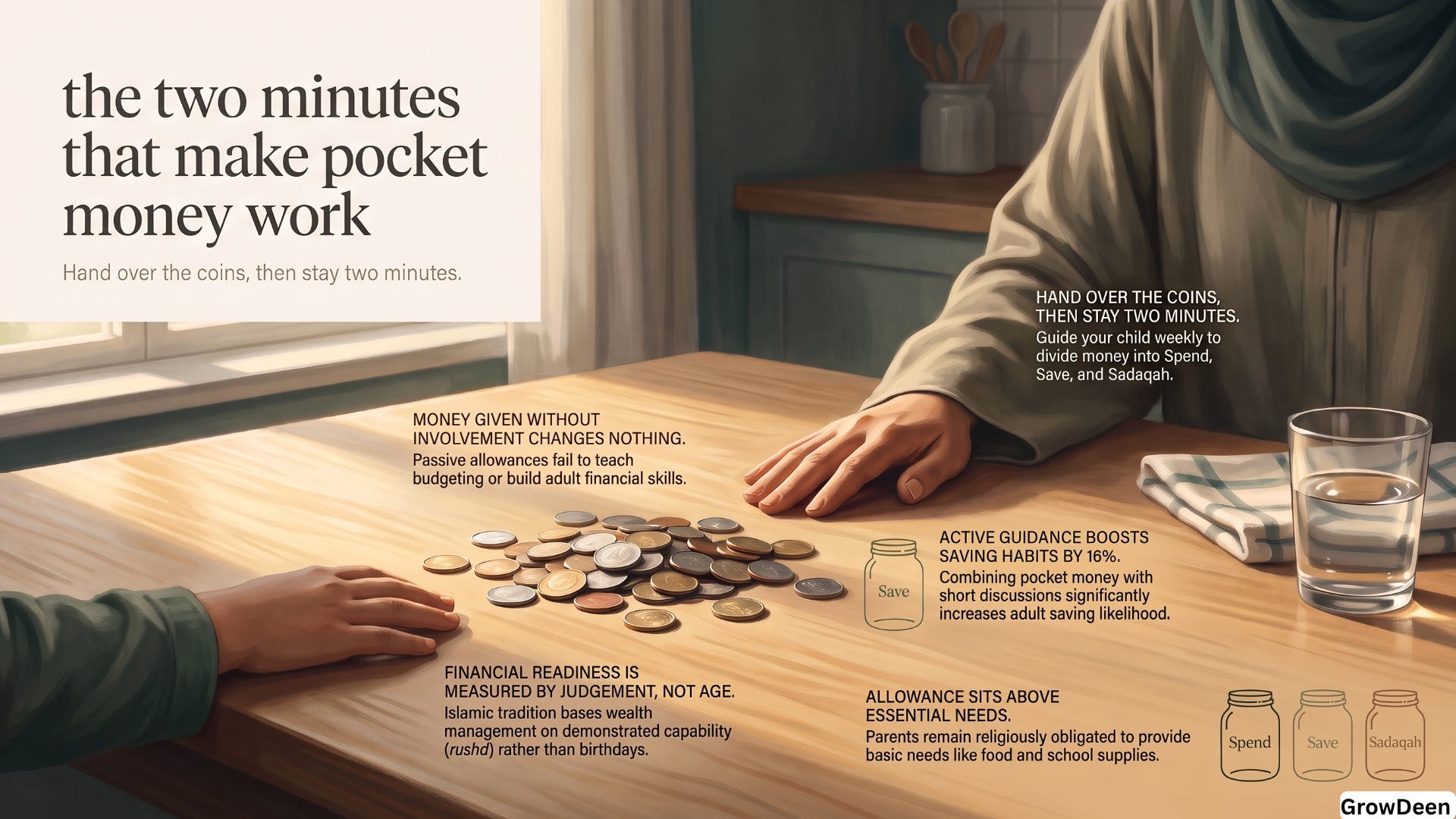
Bucciol and Veronesi went through household data from the Netherlands looking for what actually predicts whether a child grows into an adult who saves. Parents who taught their children about saving raised the odds of adult saving by 16 percent and raised the amounts saved by about 30 percent. The strongest approach combined three elements: giving pocket money, staying involved in how it got spent, and talking about saving and budgeting.
Then the finding that reframes the whole topic. Pocket money given on its own, with no conversation and no involvement, did nothing [2].
Read that again if your household currently runs on the silent transfer. Most do.
So the villain here is not your child's self-control and it is not the size of the amount. It is the hands-off allowance: the belief that money given is money taught. A wider study of pocket money and financial socialisation lands in the same place, treating pocket money as an instrument of socialisation rather than an education in itself [5].
Hand over the coins, then stay two minutes. That sentence is the whole method.
There is an older standard for this, and it is stricter
You want to know what age to start. Islam answers a better question than that one.
Allah says: "And test the orphans [in their abilities] until they reach marriageable age" [Qur'an 4:6] [8]. The verse goes on to say that where the guardian perceives sound judgement, rushd, the young person's property is released to them.
The subject of that verse is the guardianship of orphans and the handing over of inherited property. It is not a ruling about weekly allowances, and reading it as one would be a misuse of it. The mechanism inside it, though, is exactly the mechanism you have been looking for.
Ibn Kathir reports from Ibn Abbas, Mujahid, al-Hasan, as-Suddi and Muqatil bin Hayyan that testing the orphans means testing their intelligence. On the condition of rushd he records Sa'id bin Jubayr's reading, that it means finding them sound in their religion and sensible with their money, and he notes the position of the scholars of fiqh that the wealth is handed over once the young person reaches that standard [10].
Wealth is released on evidence, not on a birthday.
Which means somebody has to build the test. Pocket money is that test, at a size where failing it costs a plastic wheel.
Notice how closely this tracks the research. The guardian in Surah An-Nisa does not transfer wealth and walk away. He observes, he tests, he stays answerable, and he loosens control as judgement shows itself. Two completely separate bodies of knowledge, arriving at the same structure from opposite directions.
The line Islam draws that most money advice crosses
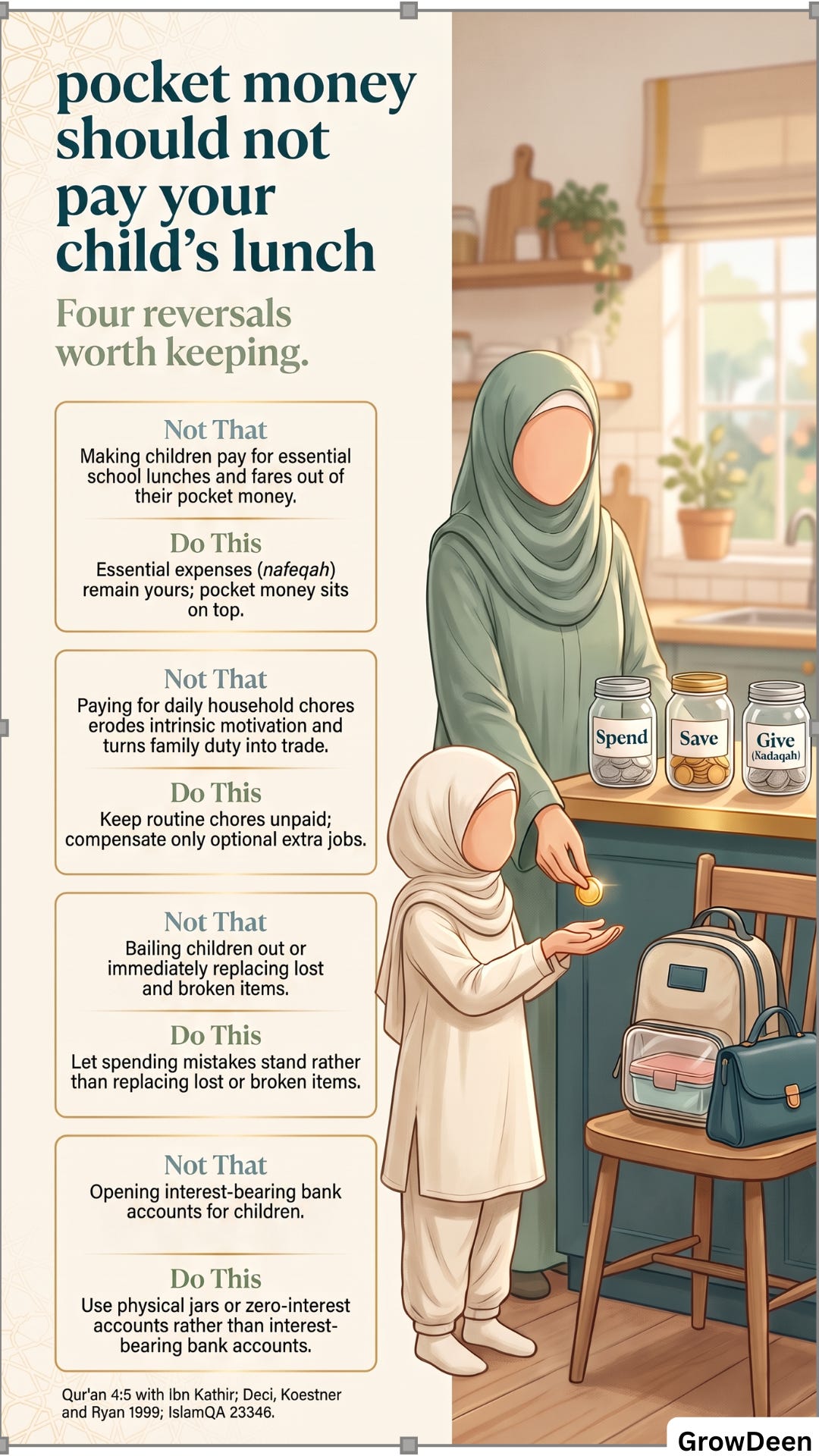
Standard parenting advice says pocket money should start covering a child's lunches, bus fares, or school bits and pieces. Before you adopt that, there is a limit worth knowing.
Allah says: "And do not give the weak-minded your property" [Qur'an 4:5] [9]. The verse continues by instructing that this wealth, which Allah made a means of sustenance, must still be used to feed and clothe those people, and that they are to be spoken to with kind words.
Ibn Kathir, commenting on the passage, records Ibn Abbas putting it plainly: a person should not hand to his wife or children the wealth Allah placed in his charge, but should hold it, look after it, and be the one who provides their food, clothing and needs from it. He also notes that withholding control of wealth from those unable to manage it applies in part on grounds of youth, because the young are not yet capable of sound decisions about money [10].
Those lunches and fares sit inside nafaqah, the obligation to provide for the people in your care. That obligation does not move to a six year old on the day you start paying her weekly.
Pocket money sits on top of provision.
A child whose lunch depends on her own budgeting has not been handed a lesson in money management. She has been handed an adult's job in a body too small for it, and the worry that produces usually outlasts whatever skill she picks up along the way.
Is she ready?
Age is a weak signal. Watch instead for whether she can hold these ideas:
Things cost money, and money comes from somewhere.
Money spent does not come back because she wishes it would.
Waiting can buy something better than what is available today.
The first two are enough to begin with a very small amount. The third makes a savings goal workable.
Three jars, and the one most households skip
Set up three places for the money to go. Jars, envelopes, tins, whatever your kitchen already owns.
One holds what she will spend soon. One holds what she is saving towards, named out loud. One holds sadaqah.
That third jar carries more weight than the other two together, and it is the one that usually gets left out. Think about how it feels when your child gives something away without being made to. Speaking from the pulpit about charity and about restraint from asking others for help, the Prophet ﷺ said: "The upper hand is better than the lower hand" [Sahih al-Bukhari 1429, graded Sahih] [11]. He then identified the upper hand as the giver's and the lower as that of the one who asks.
The narration addresses adults, charity and begging rather than children's allowances. Character, though, is laid down long before anyone explains it. A child who drops a coin into the sadaqah jar each week before she touches the spending jar is practising what it means to be the upper hand, and she is absorbing something about order: that giving happens first, rather than out of whatever survives the week.
Let her pick where it goes. A masjid box, a well-digging appeal, a family she knows is having a hard month. Choosing is most of the learning.
Support Muslim Parenting Lab ❤️
Would you like a deed that keeps earning for you after you die? Start one in a few seconds with the button below.
The Prophet ﷺ named ongoing charity and beneficial knowledge among the three things that keep counting after death. (Sahih Muslim 1631)
Where the saving should actually sit
Most general advice at this point tells you to open a bank account so she can watch the number climb. For a Muslim household that needs amending, because what makes the number climb is interest, or riba.
IslamQA states that depositing money in a bank in return for interest is riba and describes it as a major sin. Where a person has no other safe place to keep money, depositing it without taking any interest is permitted, and any interest credited to the account must not be used personally but given away to those in need [12].
For a child's pocket money the practical version is short. Use a jar, a tin, or an account that pays nothing. Interest your bank adds without being asked is not hers to keep. Questions about your particular bank, your country, or interest already credited belong with a trusted scholar rather than with a general article.
The jar has an accidental advantage anyway. A jar visibly fills. A figure on a screen conveys close to nothing to a five year old.
One more thing before the practical part
Nobody holds a thirty-year study, a Qur'anic principle and a four-question Friday script in their head while a child is tipping coins across a counter.
That is what the free Three Jars Pack is for. Jar labels you cut out and stick on, the exact four questions for the two minutes, and a reflection card for you rather than for her. The download button is at the top of this page, and there is a full description of what is inside it below.
Should you pay for chores?
Households split on this and neither side is being unreasonable.
One view holds that everyone contributes because everyone lives here, and that paying for ordinary chores turns a family duty into a trade. The other holds that money should follow effort, so a child learns that income comes from work.
The evidence leans one way. The meta-analysis by Deci, Koestner and Ryan found that tangible rewards offered for doing a task tend to erode intrinsic motivation for that task [6]. In a kitchen that means a child who clears the table because she likes order and because it is her share of the household can have that reason quietly swapped for a weaker one. Stop paying and the table stops getting cleared.
Many families land on a split that works. Routine contributions go unpaid, because they come with belonging to a family. Jobs outside the routine, clearly optional, can be paid. Cleaning the car. Emptying and sorting a cupboard.
If you do attach money to regular chores, keep the chores fixed and the expectations explicit, so the arrangement does not decay into a weekly negotiation over the going rate for a bin.
Let the mistake stand
At some point she will spend the lot on something that breaks before the week is out. Allow it.
A spending mistake made at six, with her own small money, is the cheapest financial tuition available anywhere. Stepping in to replace the money removes the only part of the episode with teaching value in it. Offer something short and true instead: that is disappointing, it happens, there will be more on Friday.
Work on pocket money and budgeting has found that children's grasp of money management improves when they are handling money themselves rather than being told about it [7].
Two instincts are worth resisting. Do not bail her out, and do not deliver the analysis afterwards. A brief conversation the next day lands considerably better than a debrief in the shop doorway.
What a coin in a child's hand means
A small coin looks like nothing. Islam treats the handling of wealth as consequential enough to be watched daily.
The Prophet ﷺ said that two angels descend every day, one asking Allah to compensate the person who spends in His cause, the other asking for the ruin of the one who hoards [Sahih al-Bukhari 1442, graded Sahih] [13]. The narration sets generosity and withholding against each other as live dispositions, each attracting its own supplication. A child does not need the theology of that to absorb its shape. What she needs is a household where giving happens visibly and often, so the disposition forms before anyone sits her down to explain it.
Set beside that the standard from Surah An-Nisa, where Ibn Kathir records that wealth is released to the young once they are found sound in their religion and sensible with money [10]. Islam does not treat financial competence as a morally neutral skill. Good judgement about money and soundness in religion sit inside the same condition, as two halves of one qualification.
That is the thing to keep in view while counting out small change on a Friday evening. Budgeting is the smaller half of it. You are shaping how she will one day hold wealth that has been entrusted to her, and the standard she is being prepared for asks about her character as much as her arithmetic.
So what does this look like at six o'clock on a Friday?
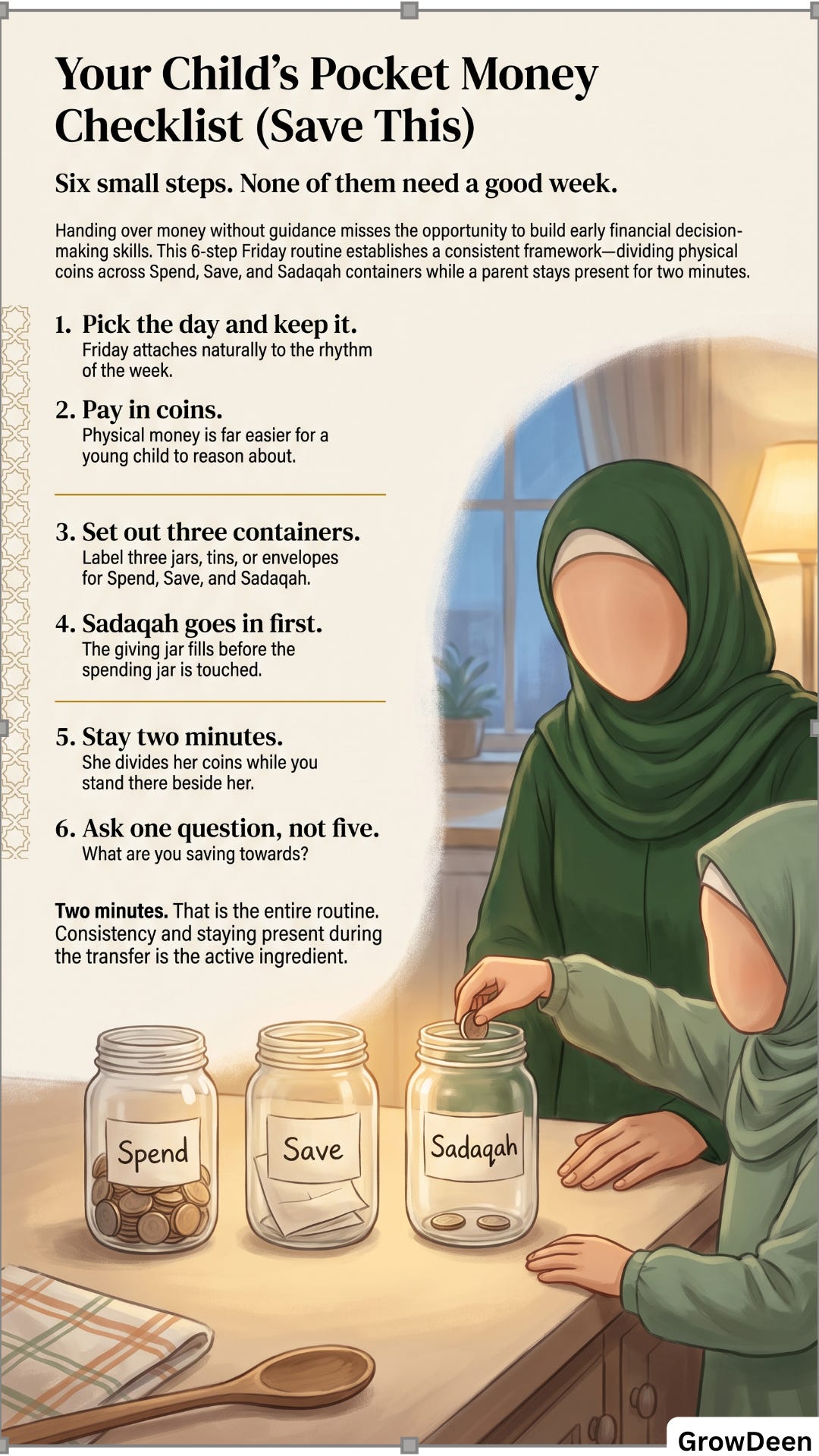
Choose a day and keep it. Friday suits many households and attaches naturally to the rhythm of the week.
Pay in coins where you can, because physical money is far easier for a young child to reason about than a number on a screen. Then stay for two minutes while she divides it across the three jars. Ask one question, not five. What are you saving towards? Where should this month's sadaqah go?
That is the entire routine. Those two minutes are the component the research identifies as the active one [2].
Which answers the question from the top of this page. The same weekly coin produces a saver in one house and a spender in another because in one house somebody stayed for the two minutes. Hand over the coins, then stay two minutes.
What to avoid
Expecting pocket money to cover food, transport or school needs. Those remain your obligation [9], [10].
Paying late, or forgetting. Predictability is most of what makes this educational.
Confiscating it as a punishment. That turns a teaching tool into a disciplinary one and weakens both.
Benchmarking against other families. Pay what your household can carry without resentment.
Interest-bearing products for a child's savings [12].
Advancing next week's money. If you do lend, set out how repayment works, so she meets the idea of a debt that has to be cleared.
When to get further guidance
Take questions about your bank, about interest already credited, or about money a child has inherited or received as a substantial gift to a trusted scholar. Wealth held on behalf of a minor carries rulings of its own that differ from household pocket money.
If your child shows lasting distress around money, hoarding behaviour, or worry that seems out of proportion, raise it with your doctor or a qualified child professional. This article is general education and does not substitute for advice about your own child.
Your Three Jars Pack
You have read this far because you want the handover to teach her something. That says something about you.
Inside the Three Jars Pack (one comprehensive PDF, 3 pages):
Page 1: The Jar Label Set. Three cut-out labels, Spend, Save and Sadaqah, each carrying the one sentence to say the first time your child uses that jar, plus a blank line where she writes what she is saving towards in her own handwriting, designed as a cut-and-stick sheet you set up once and never think about again.
Page 2: The Friday Two-Minute Card. The four questions in the order that works, with the ten-rung Saving Ladder your child colours in one rung at a time as her Save jar fills, so the two minutes that make pocket money work actually happen, even on the weeks you are tired.
Page 3: The Upper Hand Reflection Card. A short reflection for you rather than for your child, built on the narration that the upper hand is the giver's and on the Qur'anic standard that wealth is released to the young once sound judgement is found in them, and the full source references so you can check them yourself.
This is not a PDF to download and forget. It is built to live on the inside of the cupboard door above the jars, where you will actually see it on a Friday evening.
The Three Jars Pack is what every subscriber receives with each article. We cover the whole span of raising Muslim children from birth onwards, all of it traced to named research and rooted in Qur'an and Sunnah.
Before you close this tab
Go and find three containers. Any three. Jars, mugs, envelopes, the tins the dates came in. Put them on the counter where you will see them tomorrow. That is the five-minute version, and the labels in the pack will fit whatever you picked.
May Allah place barakah in what passes through your hands, and in the small hands learning from yours.
Share this with someone who needs it
Think of one person right now. The sister who mentioned her seven year old asks for something in every single shop. The friend whose children got Eid money and nobody knows where it went. The cousin who keeps saying she should start pocket money and keeps not starting.
Send it to her today. She will be standing in her own kitchen on a Friday evening soon enough, and two minutes is a small thing to pass along.
Frequently Asked Questions
Q: What age should I start giving pocket money?
A: There is no fixed age, and age turns out to be the wrong thing to watch. Start when your child understands that things cost money, that spent money does not come back, and ideally that waiting can get her something better. For many children that lands somewhere around four or five.
Q: How much pocket money should a 5 year old get?
A: Whatever your household can carry without strain, paid on a predictable day, small enough that running out before the week ends is survivable. The amount is close to arbitrary. What changes outcomes is whether you stay and talk about it [2].
Q: Should I pay my child for doing chores?
A: Most families do better keeping routine chores unpaid and paying only for optional jobs outside the routine. Research on rewards found that paying for a task tends to weaken the motivation a child already had for it [6], so the table gets cleared only as long as the payments continue.
Q: Can I put my child's savings in a bank account?
A: Use an account that pays no interest, or a jar. Interest is riba, and IslamQA states that interest credited to an account must not be used personally but given to those in need [12]. For anything specific to your bank or your country, ask a trusted scholar.
Q: Should pocket money pay for school lunches and bus fares?
A: No. Those sit inside your obligation to provide, and Ibn Kathir records Ibn Abbas stating that a parent holds that wealth and provides food and clothing from it rather than handing it over [10]. Pocket money goes on top of provision, never in place of it.
Q: My child spends it all the same day. Am I doing something wrong?
A: Almost certainly not. That is the lesson running correctly, at the cheapest price it will ever cost. Do not replace the money and do not deliver a lecture. Say something short and kind, and let Friday come around again.
References
[1] Whitebread, D., & Bingham, S. (2013). Habit Formation and Learning in Young Children. Money Advice Service / University of Cambridge.
[2] Bucciol, A., & Veronesi, M. (2014). Teaching children to save: What is the best strategy for lifetime savings? Journal of Economic Psychology, 45, 1-17.
[3] Consumer Financial Protection Bureau. (2016). Building Blocks to Help Youth Achieve Financial Capability: A New Model and Recommendations.
[4] Moffitt, T.E., Arseneault, L., Belsky, D., Dickson, N., Hancox, R.J., Harrington, H., Houts, R., Poulton, R., Roberts, B.W., Ross, S., Sears, M.R., Thomson, W.M., & Caspi, A. (2011). A gradient of childhood self-control predicts health, wealth, and public safety. Proceedings of the National Academy of Sciences, 108(7), 2693-2698.
[5] Béres, D., Mészáros, A., Hanák, Z., & Németh, E. (2024). The role of pocket money in the financial socialization of young people. International Journal of Business & Society, 25(3), 1253-1272.
[6] Deci, E.L., Koestner, R., & Ryan, R.M. (1999). A meta-analytic review of experiments examining the effects of extrinsic rewards on intrinsic motivation. Psychological Bulletin, 125(6), 627-668.
[7] Garyn-Tal, S. (2024). Giving children pocket money to help them understand economic principles in personal budget management and reduce gender gaps in financial matters: Does it work? International Social Science Journal, 74(253), 1033-1048.
[8] Qur'an, Surah An-Nisa 4:6 (Saheeh International).
[9] Qur'an, Surah An-Nisa 4:5 (Saheeh International).
[10] Ibn Kathir. Tafsir Ibn Kathir, Surah An-Nisa 4:5-6 commentary.
[11] Sahih al-Bukhari 1429. Narrated by Ibn Umar. Book 24 (Zakat), Hadith 32. Graded: Sahih.
[12] IslamQA, Fatwa 23346. Ruling on depositing money in the bank, and interest.
[13] Sahih al-Bukhari 1442. Narrated by Abu Huraira. Book 24 (Zakat), Hadith 45. Graded: Sahih.
We combine scientific research with Qur’an and authentic Sunnah, and we cite our sources. Even so, this is general guidance and no substitute for a doctor who can examine your child.