

Children aged 1 to 2 need 11 to 14 hours of sleep a day and 3 to 4 year olds need 10 to 13, in both cases with regular sleeping and waking times. [1]
Print it before tonight’s worst hour.
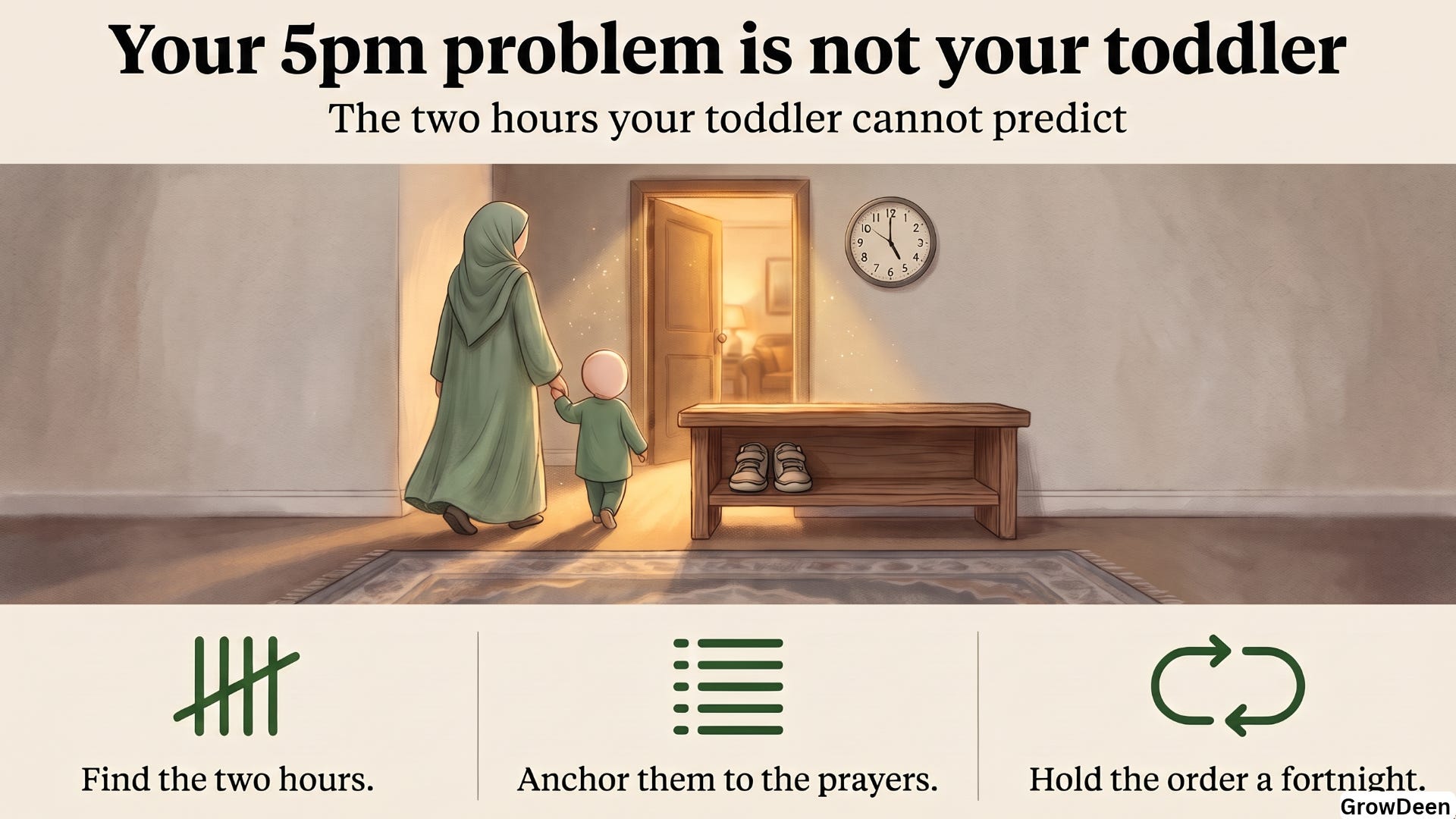
Nobody warns you about 5pm.
The house is fine at four. By twenty past five there is a child on the floor by the shoe rack, a pan starting to catch, and a question about whether anyone has seen the other sock. You are not short of parenting knowledge in that moment. You are short of a plan that runs without you.
You were not doing anything wrong. Most of the advice aimed at that hour is about how to respond once it has gone wrong, which is the one moment when nothing you say is going to land well.
Why This Guide Is Different From Generic Routine Advice
Every recommendation here is tied to current evidence: World Health Organization sleep guidance from 2019, a 2026 Harvard working paper on stability in early childhood, and peer-reviewed work on household chaos and child behaviour. [1][2][3]
The Islamic layer is structural rather than decorative. Your household already runs on five fixed daily anchors, and this guide builds the routine onto them instead of asking you to maintain a separate system.
You already have the free Hard Hours Pack from the top of this page, so the method arrives as something you can print and use tonight rather than as information to remember.
What Your Child’s Body Is Doing While You Repeat Yourself
A young brain treats repetition as information.
From before birth, a child’s brain and body read the patterns around them and use those patterns to work out what kind of place they have arrived in. [2] When meals, naps and bedtime land at roughly the same point each day, the system learns the shape and starts preparing for the next part before it arrives. When the same events turn up at random, the stress response stays partly switched on, because unpredictability reads to a small child as a reason to stay alert. [2]
So the child melting down at bath time is often not objecting to the bath.
The child did not know the bath was coming. Cooperation needs spare capacity, and a child who has spent the afternoon braced has very little spare capacity left by the time you need their arms in a sleeve.
This is also why the same sentence works on Tuesday and fails on Saturday. On Tuesday it was one step in a sequence. On Saturday it arrived out of nowhere as a demand from a parent, and a four-year-old objects far more strongly to a demand than to a pattern.
The research lands in the same place. In a study of household chaos, daily routines turned out to be the specific link between a disorganised home and the behaviour problems parents reported, which matters because routines are the part a family can change without changing anything else about their circumstances. [3] Earlier work found family routines and rituals tied to how the whole household functions, not only to how the children behave. [4] Paediatric guidance says it in a line: children do best when routines are regular, predictable and consistent. [5]
Start With Two Hours, Not Twenty-Four
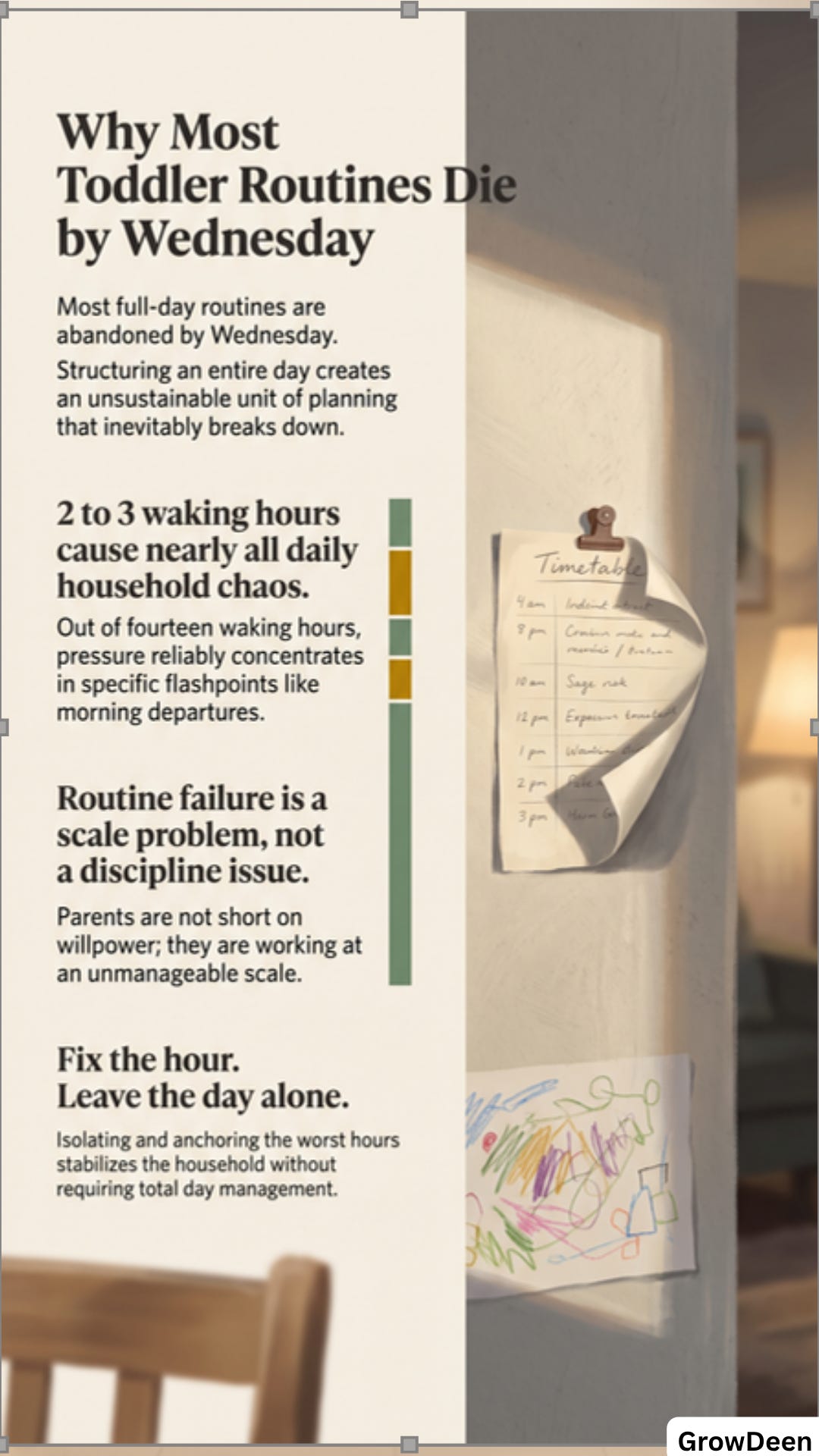
Most routine plans die at exactly this point. Somebody writes out a whole day on a Sunday evening, and by Wednesday the whole thing is abandoned, because a whole day was never the unit that needed fixing.
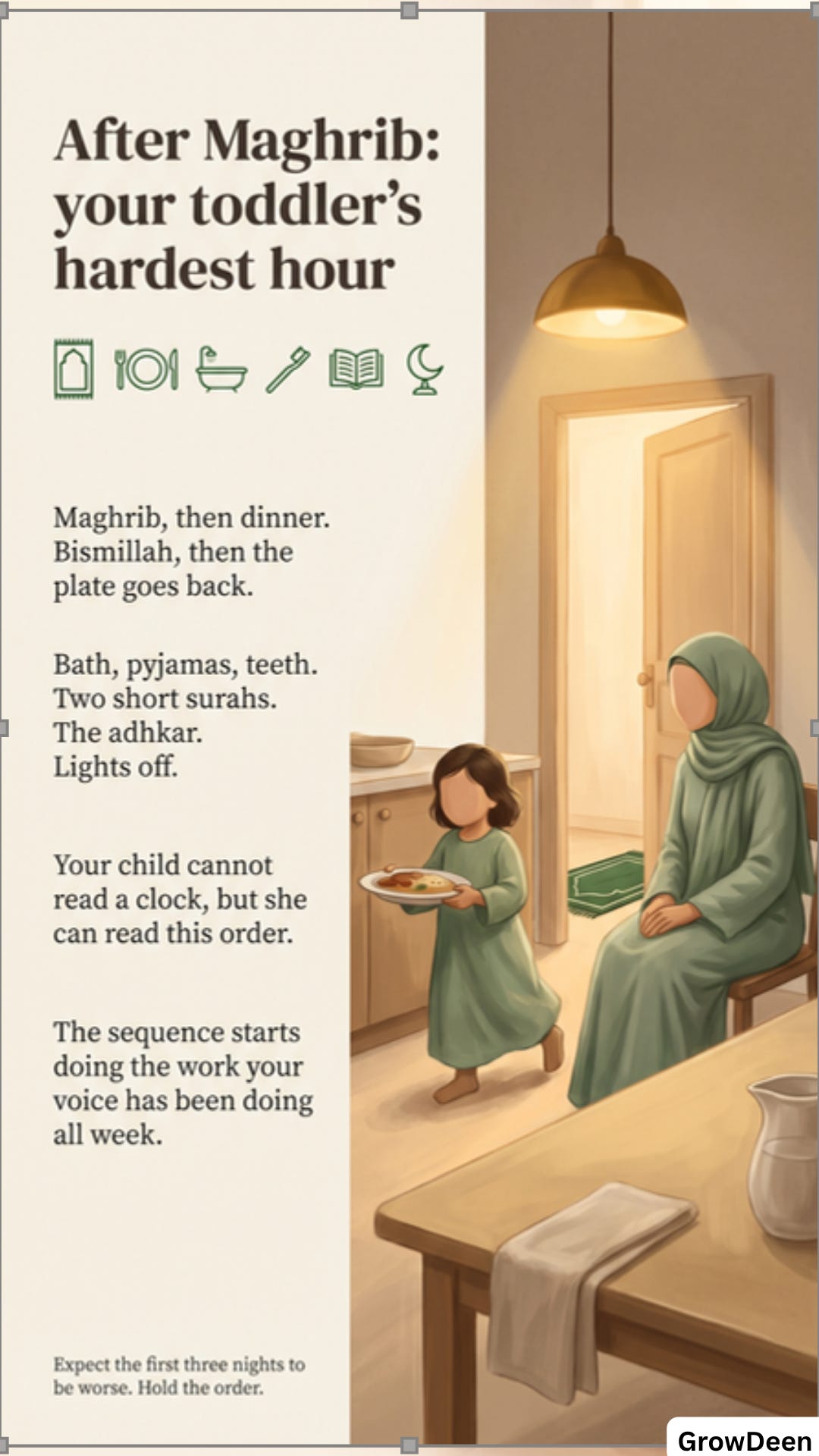
Pick the two stretches where your household reliably comes apart. For most families that is the hour before leaving in the morning and the hour after Maghrib. Time pressure concentrates there, and a routine earns its keep exactly where the pressure is. [5] Early intervention practice with young children rests on the same observation: you teach inside the ordinary repeating moments of family life, because that is where the child already is and where the skill will actually get used. [6]
Two hours is also a number you can hold. Twenty-four is not.
Three Moves That Make An Hour Hold
Link one task to the next. Shoes go on the rack on the way to the bathroom for wudu. Pyjamas come out while the bath fills. A dull task attached to one that already happens gets remembered, first by you and later by your child.
Protect the downtime inside the hour. A rest, a nap, or a long stretch of play nobody is supervising belongs in the sequence rather than in the gaps around it. Children who are rested behave better and overscheduled children behave worse. [7]
Put the limit inside the routine instead of announcing it. If screen use is capped, the cap lives in the order of the evening: after wudu, before the bedtime du’a, one short programme. The routine carries the rule, so you are not the one imposing it every single night.
I Know This Is A Lot To Hold At 5pm
I know this is a lot to remember, especially in the hour when you are cooking, answering someone and looking for a shoe at the same time. That is why I put together the free Hard Hours Pack, a printable set that helps you find your household’s two worst hours and fix a sequence for them. The download button is at the top of this page, and there is a full description of what is inside it below. It is designed to live where the hard hour actually happens, which is usually the kitchen wall.
Sleep, Food And Play: The Floor Underneath The Routine
A routine that organises the day but starves it of rest has solved nothing.
WHO guidance for the under-fives gives the sleep figures with a condition attached that often gets dropped. Children aged one to two need eleven to fourteen hours including naps. Three and four year olds need ten to thirteen. In both cases the guidance specifies regular sleeping and waking times, which means the hours and the regularity are a single recommendation rather than two. [1]
The same guidance keeps screens away from children under two entirely, and holds two to four year olds to no more than an hour, with less being better. [1] For a Muslim household there is a second filter over the first: what is on the screen should be Islamically suitable, music-free and parent-approved, and it should sit inside the routine rather than patch a hole in it.
Play belongs in the same group as sleep and food. Children who have slept enough, eaten properly and had real time to play behave better, and that finding survives almost every study that goes looking for it. [7]
One more number worth knowing. When researchers introduced a consistent nightly bedtime sequence to families, young children’s sleep improved and so did their mothers’ mood. [8] The routine is not only something you do for the child.
Teaching The Sequence To Someone Who Cannot Tell The Time
Children under five learn a routine the way they learn everything at that age, through short instructions repeated in the same words.
Keep the phrasing fixed. “First we clean teeth. Then Baba reads.” Toddlers follow simple explanations that stay consistent, and they stop following when the wording changes shape every evening. [5] Say what comes next rather than what just went wrong.
Give the reason in language your child owns. “We eat early on Thursdays so we reach Qur’an class on time” lands. A three-year-old cannot hold half an hour as a unit, so “only thirty minutes of screen time” teaches nothing, while “we watch one programme” teaches the entire rule in four words.
Warn before transitions. A child deep in something needs notice before it ends, and two minutes of warning prevents a surprising share of the evening’s arguments.
Turn The Adhkar Into The Signposts
Every transition in a Muslim home already has words attached to it, and this is the point where a daily routine and tarbiyah stop being two separate projects.
Bismillah before eating. Alhamdulillah after. Salaam on walking through the door. The du’a for leaving. The adhkar before sleep. Each marks a boundary between one part of the day and the next, which is exactly the information a young child needs to feel time moving in an orderly way.
Used like this they add nothing to your list. They are the markers that tell your child what has ended and what has started, and a child who says Bismillah at every meal has picked up a routine, a sunnah and a habit of remembering Allah in one motion, without a single lesson being delivered.
For the morning signal, let the adhan do the work rather than a song. During the day, a sand timer, a lamp on a timer or one repeated phrase will do the job. Qur’an recitation played softly, gentle adhkar or a story told by a parent settles a room far more reliably than background noise, and none of it needs music.
Support Muslim Parenting Lab ❤️
Would you like the most rewarded kind of charity there is? Use the button below now, while you are well, rather than later.
Asked which charity is best, the Prophet ﷺ said the one given while you are healthy, not deferred until death is near. (Sahih al-Bukhari 1419)
Praise The Thing, Not The Child
Once the sequence exists, the aim is a child who runs it while you are in another room.
Make it visible first. Draw the steps as a picture chart and fix it at your child’s eye level in the room where the routine happens, because a chart on an adult noticeboard is a chart nobody consults. Drawing it together is worth the afternoon, since the conversation while you draw teaches the sequence a second time.
Hand over the parts your child can own. A three-year-old can carry a prayer mat. A four-year-old can set the table or fill the water jug. Chores build real competence and give a young child a genuine position in the household, which motivates better than any sticker system. [7]
Then name the exact behaviour. “You put your shoes on the rack without being asked. Good remembering.” Research revisiting how praise affects children’s own motivation suggests vague, person-directed praise can undercut the very thing it is meant to encourage, while specific praise for effort and method supports a child’s willingness to keep going unprompted. [9]
There is a shukr dimension here that is easy to walk past. A home where the good thing gets said out loud is a home where a child learns to notice good things and name them.
What Breaks A Routine
Rigidity breaks it first. A routine that cannot bend around illness, travel, guests, Ramadan or one bad night will be gone by the second month, and paediatric guidance warns equally about the other extreme, where a schedule is so tight that a child is left no choice inside it. [5]
Changing everything at once breaks it next. Fix one stretch of the day. Hold it a fortnight. Then look at the next.
Using a screen as the transition tool breaks it quietly. Devices move into the gaps in family routines very easily, particularly in the first two years, and they rarely move back out. [10] A screen used to get through bath time becomes a condition of bath time.
Treating forgetting as defiance breaks the child’s part of it. A four-year-old who forgets a step has forgotten a step. Re-teach it.
Age By Age
Under 12 months, the routine is yours to hold. Keep feeds, naps and the bedtime sequence in a recognisable order and keep waking times steady. [1] Your baby is learning the pattern long before being able to take part in it. [2]
One to two years, the sequence gets learned and the cooperation stays patchy. Narrate each step as it happens, and offer two acceptable options instead of an open question, because “blue cup or green cup” removes most of the stalling. [5]
Three to five years, your child can run short chains alone. Picture charts suit this age, and so do small jobs with real consequences for the family. The bedtime adhkar can become your child’s to lead.
Six to eight years, hand over more, including some say in how the evening runs. Children who held routines early adjust more easily once school, Qur’an classes and outside commitments start competing for the same hours.
When A Routine Is Not The Answer
Routines help with ordinary behaviour. They are not treatment, and some situations need more than a better evening.
Speak to your doctor if your child’s sleep is badly disturbed night after night, if behaviour changes suddenly or becomes extreme, if your child loses skills already gained, or if you have concerns about speech, hearing or development. Ask early rather than waiting to see whether it settles. Seeking treatment is part of taking the means, and taking the means sits alongside tawakkul rather than against it. If your own exhaustion has reached the point where daily life is hard to manage, that is worth raising with a health professional too. This article is general guidance and does not replace medical advice.
The Islamic Framework For Daily Rhythm: Constancy Before Intensity
Allah describes a particular group in Surah Al-Ma’arij: “Except the observers of prayer” [11], “Those who are constant in their prayer” [11]. Tafsir Ibn Kathir records more than one reading of that constancy. One, which he attributes to Ibn Mas’ud, Masruq and Ibrahim an-Nakha’i, is that they guard the prayer’s appointed times and its obligatory parts. A second is that they pray with stillness rather than haste. A third is that they are consistent in their deeds generally. [11]
Set that against an ordinary family evening. The quality being praised is not intensity, and it is not a burst of effort in Ramadan followed by nine months of drift. It is the same act, at its time, without rushing.
Islam places an order on acts that carry no obvious weight at all. Aisha, may Allah be pleased with her, reported that the Prophet ﷺ liked “to start from the right side on wearing shoes, combing his hair”, and in his purification and his affairs generally. [12] Shoes and hair. A sequence was still worth keeping.
A parent who fixes the order of one evening hour is doing something the Sunnah already treats as worth doing, in a home where five prayers have been marking out the day the whole time.
The Hard Hours Pack
If you have read this far, you are the kind of parent who would rather fix the hour than survive it. That is worth saying out loud.
Inside the Hard Hours Pack (one comprehensive PDF, 3 pages):
Page 1: The Flashpoint Finder. A five-day tally grid that identifies which two hours of your week actually break down, with eight common flashpoint markers to tick and a short scoring box that names your household’s two worst hours by Friday. It is designed as a kitchen-wall sheet you can fill in standing up, with one hand.
Page 2: The Anchor Swap Card. A two-column reference pairing each transition in your day with the fixed anchor that marks it, covering the five prayer anchors, the adhkar that sit at each boundary, and a menu of non-musical transition signals. You can fix a whole evening’s sequence in fifteen minutes without writing a plan.
Page 3: Constancy Before Intensity. An Islamic reflection card carrying Qur’an 70:22-23 with Tafsir Ibn Kathir’s reading of what constancy in prayer means, alongside the narration of Aisha, may Allah be pleased with her, on the Prophet ﷺ beginning with the right side in his ordinary affairs. It is framed for the parent who has just abandoned their fourth routine and needs to know that small and repeated is the standard being asked of them.
This is not a PDF to download and forget. It is built to stay on the kitchen wall, where the hard hour actually happens.
This Hard Hours Pack is what every subscriber receives with each article. We cover the full span of raising Muslim children, all backed by current research and rooted in Qur’an and Sunnah.
One Thing To Do In The Next Five Minutes
Go and look at your calendar for the last week, then answer one question out loud: which hour of the day did you raise your voice in most often? Write that hour on a piece of paper and stick it to the fridge. That is the hour you are fixing. Everything else in your day can stay exactly as it is.
Share This With Someone Who Needs It
Think of one person right now: the sister whose evenings you have heard about in the masjid car park, or the friend who sends messages at 9pm that read like the end of a long fight.
This article could give them back an hour of their day. Send it to them today, because you know exactly what that hour feels like.
Frequently Asked Questions
Q: How long does it take for a new routine to work with a toddler?
A: Give any new sequence a full fortnight before you judge it, and expect the first three or four nights to look worse rather than better while your child tests whether the order is real. Keep the steps and the wording identical during that period, because changing either resets the clock.
Q: What should a 2-year-old’s daily routine look like?
A: Anchor it to things that already happen at fixed points: waking, the prayers, meals, nap, bath, bed. Aim for eleven to fourteen hours of sleep including naps, with steady sleeping and waking times. [1] A two-year-old does not need a timetable, only a reliable order.
Q: Do routines really improve children’s behaviour, or is that just a parenting cliché?
A: The evidence is better than most parenting claims. Daily routines were found to be the specific link between household chaos and children’s behaviour problems. [3] Paediatric guidance is unambiguous that children do best with routines that are regular and predictable. [5]
Q: How do I build an Islamic daily routine for my child without it feeling forced?
A: Attach it to what is already there instead of adding a religious layer on top. Bismillah at meals, salaam at the door, the adhkar before sleep, and the five prayers as the frame for everything else. A child who meets the same words at the same moments is learning the deen and the routine at once.
Q: My routine collapses every weekend and in Ramadan. Am I doing it wrong?
A: No, and a routine that cannot survive a changed week was built too tightly. Keep the order of steps stable even when the clock times move, because the sequence is what your child is actually learning.
Q: At what age can a child follow a routine without being reminded?
A: Most children can run a short chain of two or three familiar steps alone somewhere around three to five, especially with a picture chart at their eye level. Below that, assume you are the one holding the sequence and narrate it as you go.
Q: Is screen time ever acceptable inside a routine?
A: WHO guidance recommends no screen time at all for children under two and no more than an hour for two to four year olds, with less being better. [1] If you use it, give it a fixed slot in the sequence rather than deploying it to get through a difficult moment, because a screen used to survive bath time becomes a condition of bath time. [10]
References
[1] World Health Organization. (2019). Guidelines on Physical Activity, Sedentary Behaviour and Sleep for Children Under 5 Years of Age.
[2] Early Childhood Scientific Council on Equity and the Environment. (2026). From Resources to Routines: The Importance of Stability in the Developmental Environment, Working Paper No. 4. Center on the Developing Child at Harvard University.
[3] Larsen, K.L., & Jordan, S.S. (2020). Organized chaos: Daily routines link household chaos and child behavior problems. Journal of Child and Family Studies, 29(4), 1094-1107.
[4] Dickstein, S. (2002). Family routines and rituals: The importance of family functioning: Comment on the special section. Journal of Family Psychology, 16(4), 441-444.
[5] Flais, S.V. (2024). The Importance of Family Routines. American Academy of Pediatrics, HealthyChildren.org.
[6] McWilliam, R.A. (2010). Routines-Based Early Intervention: Supporting Young Children and Their Families. Brookes Publishing.
[7] Agazzi, H., Shaffer-Hudkins, E.J., Armstrong, K.H., & Hayford, H. (2020). Promoting Positive Behavioral Outcomes for Infants and Toddlers. Springer.
[8] Mindell, J.A., Telofski, L.S., Wiegand, B., & Kurtz, E.S. (2009). A nightly bedtime routine: Impact on sleep in young children and maternal mood. Sleep, 32(5), 599-606.
[9] Corpus, J.H., & Good, K. (2020). The effects of praise on children’s intrinsic motivation revisited. In E. Brummelman (Ed.), Psychological Perspectives on Praise (pp. 64-71). Routledge.
[10] Lev, Y.B., & Elias, N. (2020). Digital parenting: Media uses in parenting routines during the first two years of life. Studies in Media and Communication, 8(2), 41-48.
[11] Qur’an, Surah Al-Ma’arij 70:22-23 (Saheeh International), with Tafsir Ibn Kathir.
[12] Sahih al-Bukhari 168, narrated Aisha, may Allah be pleased with her. Kitab al-Wudu, Book 4, Hadith 34. Graded: Sahih.
We combine scientific research with Qur’an and authentic Sunnah, and we cite our sources. Even so, this is general guidance and no substitute for a doctor who can examine your child.