

Research from Harvard’s Center on the Developing Child shows the first five years form more neural connections than at any other point in the human lifespan and 8–9 months is one of the most intense windows of all. [1] This guide shows you what’s happening inside your baby right now, what to do about it, and what the Sunnah shows us about meeting them in these moments.
Here is what nobody tells you about this stage.
Your baby didn’t suddenly become clingy, demanding, or difficult. Their brain grew.
In the weeks between eight and nine months, something shifts quietly inside your baby that changes everything visible on the outside. They start searching for you when you leave the room. They cry when someone unfamiliar reaches for them. They call out with real intention, babbling sounds that feel like they are on the edge of becoming words. They pull themselves up on whatever they can reach, wobbling and triumphant.
None of this is a phase to push through. It is exactly what is supposed to be happening.
When I studied the research from Harvard’s Center on the Developing Child, one finding stopped me: the brain builds more neural connections in the first five years of life than at any other time — and the months around eight and nine are among the most architecturally significant of all. [1] What your baby does today, what they hear, who responds to them, what language surrounds them — it all goes directly into that building.
That is both a remarkable privilege and a real responsibility.
Why This Guide Is Different From Generic Baby Milestone Lists
Every recommendation is rooted in current evidence from the AAP, CDC, and peer-reviewed research, including Zubler et al.’s 2022 updated developmental surveillance tools. [2]
This isn’t just a milestone checklist — it connects what science shows about your baby’s developing hearing, sight, and cognition to what the Qur’an tells us about those exact gifts, and how the Prophet ﷺ modelled meeting children where they are.
You’ll get a free Your Baby’s 8–9 Month Development Pack to keep — a printable tool with a milestone tracker, a daily Qur’an immersion guide, and a tarbiyah intentions card. Keep reading to download it at the end.
What Is Actually Happening at 8–9 Months
The thing about this stage is that the most significant developments are invisible.
Yes, you can see your baby crawling, pulling to stand, clapping, and reaching. But underneath all of that visible activity, two cognitive leaps are happening that explain almost everything you are observing.
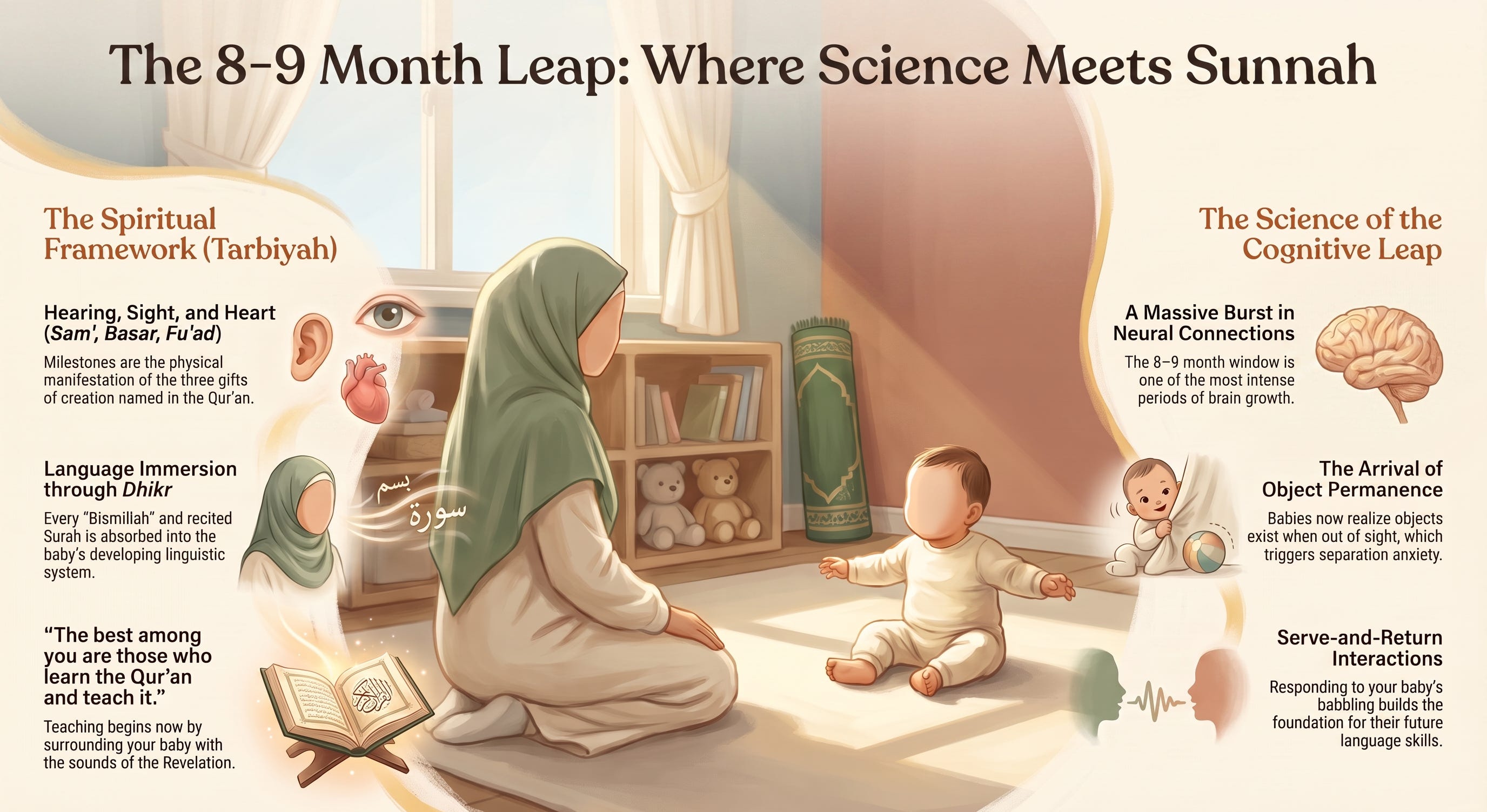
Object permanence is emerging. Before this, when you left the room, you were simply gone from your baby’s world. Now your baby knows you exist behind that door — and they want you back. [3] This is why separation anxiety intensifies at this stage and why your baby will search for a toy you have hidden under a cloth. It is a cognitive achievement. Celebrate it.
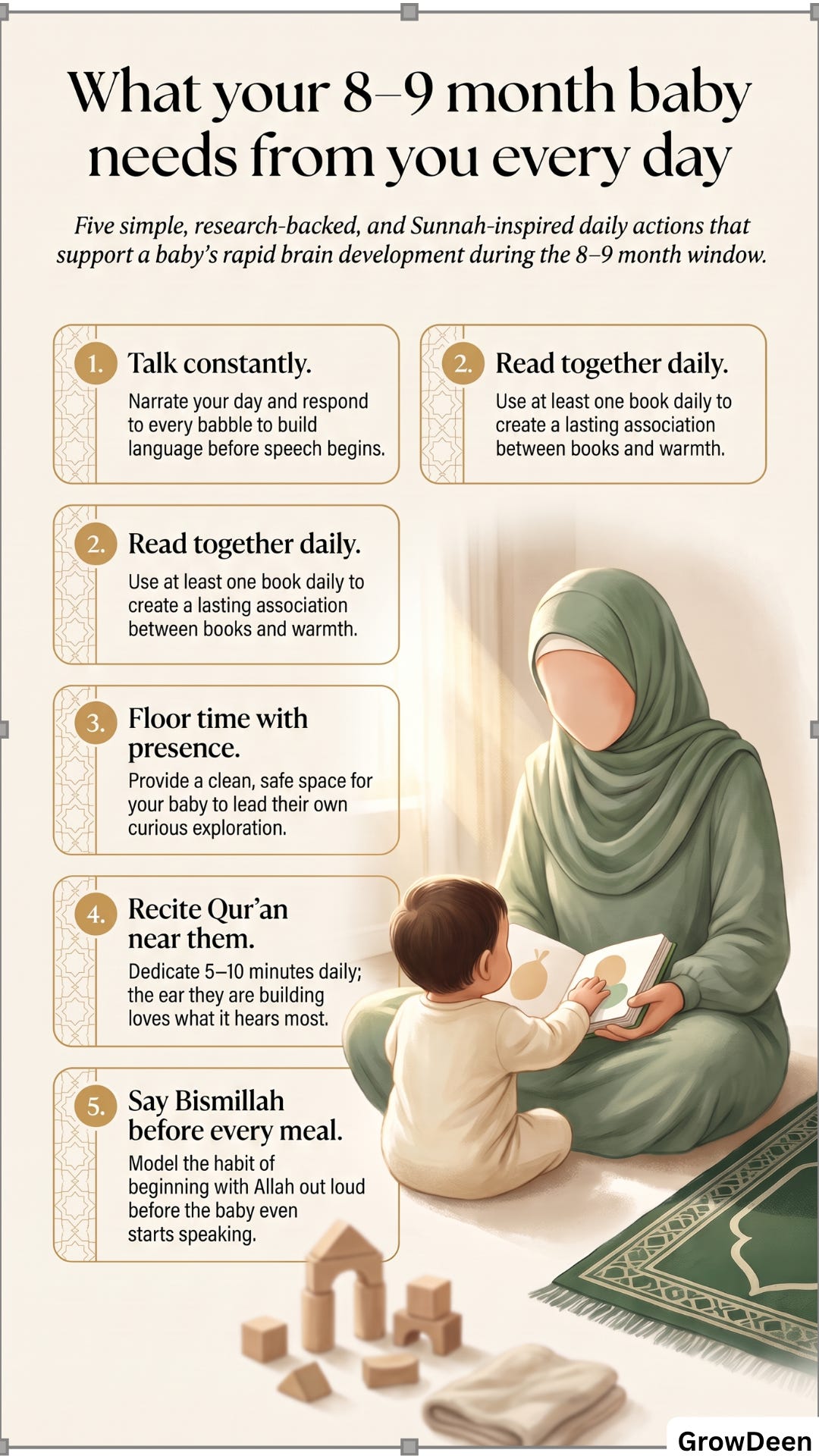
Language comprehension is beginning. Your baby cannot speak yet, but they are linking specific words to meanings. When you say their name, they turn. When you say “no” with a clear tone, they pause and look at your face. When you point at something and name it, they follow. [4] Every word you say around them right now is entering their developing linguistic system — whether you intend it to or not.
Here’s what that means practically: the Bismillahs, the Alhamdulillahs, the Qur’an you recite at Fajr — your baby is absorbing it all. Long before they can speak, they are learning what language sounds like in your home.
What Your Baby Is Doing (and What It Means)
Babbling at this stage is not random. The repeated syllables — “mamama,” “bababa,” “dadada” — are proto-language, the building blocks of speech being laid one exchange at a time. When you respond to your baby’s babbling, you participate in what researchers call serve-and-return interaction: one of the most powerful drivers of language development available to a parent. [1] [4]
Crawling is your baby’s first real independence. Some babies bottom-shuffle, some belly-crawl, some go hands-and-knees classic. All of it builds the spatial awareness and physical confidence that comes next. A safe, enriched floor space is everything at this stage — a clean prayer mat, natural wooden objects, soft books with texture and contrast.
Pulling to stand is your baby’s body preparing for walking. They will do it repeatedly, get stuck at the top unable to lower themselves safely, and cry about it. Most solve the descent within a week or two. Your furniture needs to be stable. Their environment needs to be patient.
Finger foods are entering the picture. Breastmilk or formula is still the primary nutrition source, but soft, small foods — mashed vegetables, ripe fruit, soft-cooked pasta — are increasingly part of the picture. [5] Say Bismillah before every meal, out loud, every time. Before speech, your baby is present in that intention.
I know this is a lot to hold in your head when you’re also managing nap windows, food introductions, and whatever developmental leap woke everyone up last night. That’s exactly why I created the Your Baby’s 8–9 Month Development Pack — a three-page printable PDF you can actually use when it matters. Keep reading to get it at the end of this article.
The Islamic Framework for This Stage: Hearing, Sight, and the Heart
When I read Surah Al-Mulk, I find myself thinking about what it means to watch these three things develop in a baby. Allah says: “Say, ‘He is the One Who brought you into being and gave you hearing, sight, and intellect — yet you hardly give any thanks.’” [Qur’an 67:23] [6]
According to Tafsir Ibn Kathir, this verse names three gifts Allah bestowed at the inception of human creation: the capacity to hear, to see, and to understand — what Ibn Kathir describes as “intellects and powers of reasoning” residing in the heart. [6]
At eight months, your baby turns toward your voice. Their eyes follow you across the room. Their face changes when they figure something out. These are not just milestones. They are the gift of hearing, sight, and heart — sam’, basar, and fu’ad — appearing before your eyes, one connection at a time.
The Prophet ﷺ said: “The best among you are those who learn the Qur’an and teach it.” [Sahih al-Bukhari 5027] [7] Teaching does not begin when a child can hold a pencil. It begins in the sounds your baby is absorbing right now. Every time you recite near them, you are already a teacher. And that is among the finest things a person can be.
Warning Signs Worth Knowing
Speak with a paediatrician if your baby at nine months is not: making eye contact, turning toward voices, babbling, responding to their name, rolling, sitting independently, or showing emotional responses to people around them. [2]
If your baby has lost skills they previously had, contact a paediatrician promptly. Regression — not slow development, but the loss of something already there — always warrants attention.
Your Baby’s 8–9 Month Development Pack
If you’ve read this far, you’re the kind of parent who takes these months seriously — not because you’re anxious, but because you understand that right now matters. That tells me something beautiful about you.
Inside the Your Baby’s 8–9 Month Development Pack (one comprehensive PDF, 3 pages):
Page 1: 8–9 Month Milestone Tracker — A clean, print-ready checklist covering motor, communication, cognitive, and social milestones drawn from the AAP’s 2022 evidence-informed milestone guidelines — organised into four categories so you can track what’s emerged, what’s in progress, and what to watch for, without needing to Google anything.
Page 2: Your 7-Day Qur’an Immersion Starter Guide — A simple, daily plan showing how to weave five to ten minutes of Qur’an recitation into your existing routine at eight to nine months — during feeds, floor time, before naps, and at bedtime — with suggested short surahs and the research on why this stage is the most powerful time to begin.
Page 3: “He Gave You Hearing, Sight, and Heart” — A Tarbiyah Intentions Card — Built on Qur’an 67:23 and Sahih al-Bukhari 5027, this printable card carries one intention for each of the three gifts Allah names: what you will let your baby hear, what you will show them, and what seeds of understanding you will plant this month. Designed to keep beside your prayer mat or on your fridge as a daily reminder of what this season of parenting is really for.
This isn’t just a PDF to download and forget. It’s a tool designed to stay in your space — where you’ll actually reach for it when you need it.
This pack is what every subscriber receives with each article in our series. We cover the full first five years of Muslim parenting — and beyond — all grounded in research and rooted in Islamic wisdom.
If you want evidence-based guidance that also nourishes your iman, subscribe free so future resources arrive before you need them.
Subscribe free for parenting resources backed by both science and Sunnah — guidance so unique, you literally can’t get it anywhere else. No spam, no clutter, just resources that matter.
Before you keep reading — do this one thing.
Tonight, before your baby goes to sleep, recite one short Surah near them. Surah Al-Ikhlas. Three times. It takes less than a minute. And you will have begun something.
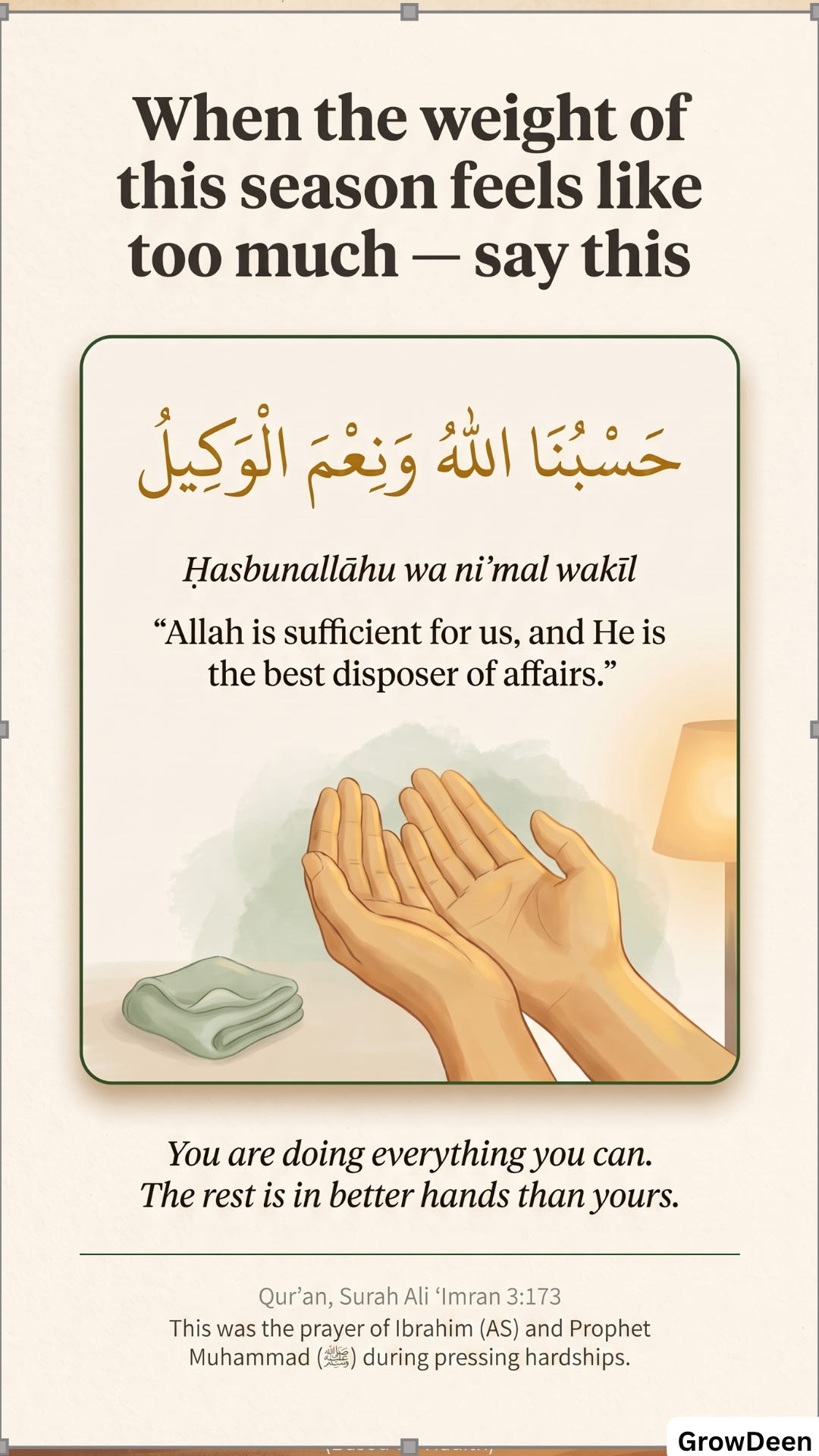
May Allah place barakah in these months — in what your baby is growing into, and in what you are becoming as a parent.
Share This With Someone Who Needs It Today
Think of one person right now: a new mother in your family, a friend in a WhatsApp group who mentioned last week that her baby is suddenly clinging and she doesn’t know why, a sister who just started solids and is overwhelmed by the pace of it all.
This article could bring her clarity. Share it with her today — not as advice, but as company. Sometimes the most loving thing we can do is pass along something that helped us feel less alone.
Frequently Asked Questions
Q: What are the main milestones for an 8-month-old baby?
A: At eight months, most babies are rolling in both directions, beginning to crawl or move along the floor, sitting independently without support, babbling with repeated syllables like “mama” and “dada,” and showing clear recognition of familiar faces. [2] Object permanence is also emerging — they will now search for a hidden toy. For a full breakdown by category, see the milestone section above.
Q: Why is my 8-month-old suddenly so clingy?
A: This is one of the most common questions at this stage, and the answer is actually reassuring. Around eight to nine months, babies develop object permanence — the understanding that people and things still exist when out of sight. [3] So when you leave the room, your baby now knows you are somewhere and wants you back. It is a sign of healthy attachment and cognitive growth, not a regression.
Q: Is separation anxiety at 9 months normal?
A: Completely normal, and developmentally expected. Separation anxiety typically peaks between eight and eighteen months, as babies become cognitively aware of your absence but have not yet developed the temporal understanding that you will return. [3] Consistent, warm goodbyes and reliable returns are what build trust over time.
Q: What foods can I give my 8-month-old?
A: At eight months, breastmilk or formula remains the primary nutrition source, but your baby is ready for a growing range of soft textures. [5] Think mashed vegetables, ripe banana, cooked lentils, soft-cooked pasta, and well-cooked egg. Avoid anything that is a choking risk — hard, round, or sticky foods. When in doubt, check with your paediatrician about progression for your individual baby.
Q: How can I help my baby’s language development at 8–9 months?
A: The most powerful thing is responsive conversation — talking to your baby constantly, naming everything you do, and responding warmly to their babbling. [1] [4] Researchers call this serve-and-return: your baby initiates (babbles or points), you respond (speak or gesture back), and this back-and-forth builds neural pathways for language. Reading together daily also contributes significantly, even before your baby understands words.
Q: When should I worry about my 9-month-old’s development?
A: Speak with a paediatrician if your baby is not making eye contact, not responding to their name, not babbling, not rolling or sitting independently, or not showing social responses like smiling. [2] If your baby has lost skills they previously had — that is the signal to seek help promptly. Early support makes a meaningful difference. Trust your instincts.
References
[1] Center on the Developing Child at Harvard University. (2021). Three principles to improve outcomes for children and families (2021 update). Harvard University. https://developingchild.harvard.edu/resources/report/three-principles-to-improve-outcomes-for-children-and-families/
[2] Zubler, J.M., Wiggins, L.D., Macias, M.M., et al. (2022). Evidence-informed milestones for developmental surveillance tools. Pediatrics, 149(3), Article e2021052138. https://doi.org/10.1542/peds.2021-052138
[3] Ainsworth, M.D.S., Blehar, M.C., Waters, E., & Wall, S.N. (2015). Patterns of Attachment: A Psychological Study of the Strange Situation (Classic Ed.). Psychology Press. (Original work published 1978.)
[4] Onigbanjo, M.T., & Feigelman, S. (2020). The first year. In R. Kliegman & J.W. St Geme III (Eds), Nelson textbook of pediatrics (22nd edn, pp. 151–156). Elsevier.
[5] National Health and Medical Research Council (NHMRC). (2012, updated 2015). Infant feeding guidelines: Information for health workers. NHMRC. https://www.nhmrc.gov.au/about-us/publications/infant-feeding-guidelines-information-health-workers
[6] Qur’an, Surah Al-Mulk 67:23 — https://quran.com/67/23 | Tafsir: Ibn Kathir, I.U. (n.d.). In Tafsir Ibn Kathir. Alim.org. https://www.alim.org/quran/tafsir/ibn-kathir/surah/67/20/
[7] Sahih al-Bukhari 5027 — Graded: Sahih — https://sunnah.com/bukhari:5027
[8] Centers for Disease Control and Prevention (CDC). (2023). Important milestones: Your baby by nine months. CDC. https://www.cdc.gov/ncbddd/actearly/milestones/milestones-9mo.html
Thanks for like
Great