

By age four, children in the most language-rich homes have heard more than 30 million more words than children in the quietest ones (Hart & Risley, 1995) [1]. This guide shows you the exact talking, reading, and writing activities — by age and stage — that close that gap using nothing but your voice, a crayon, and ten minutes a day.
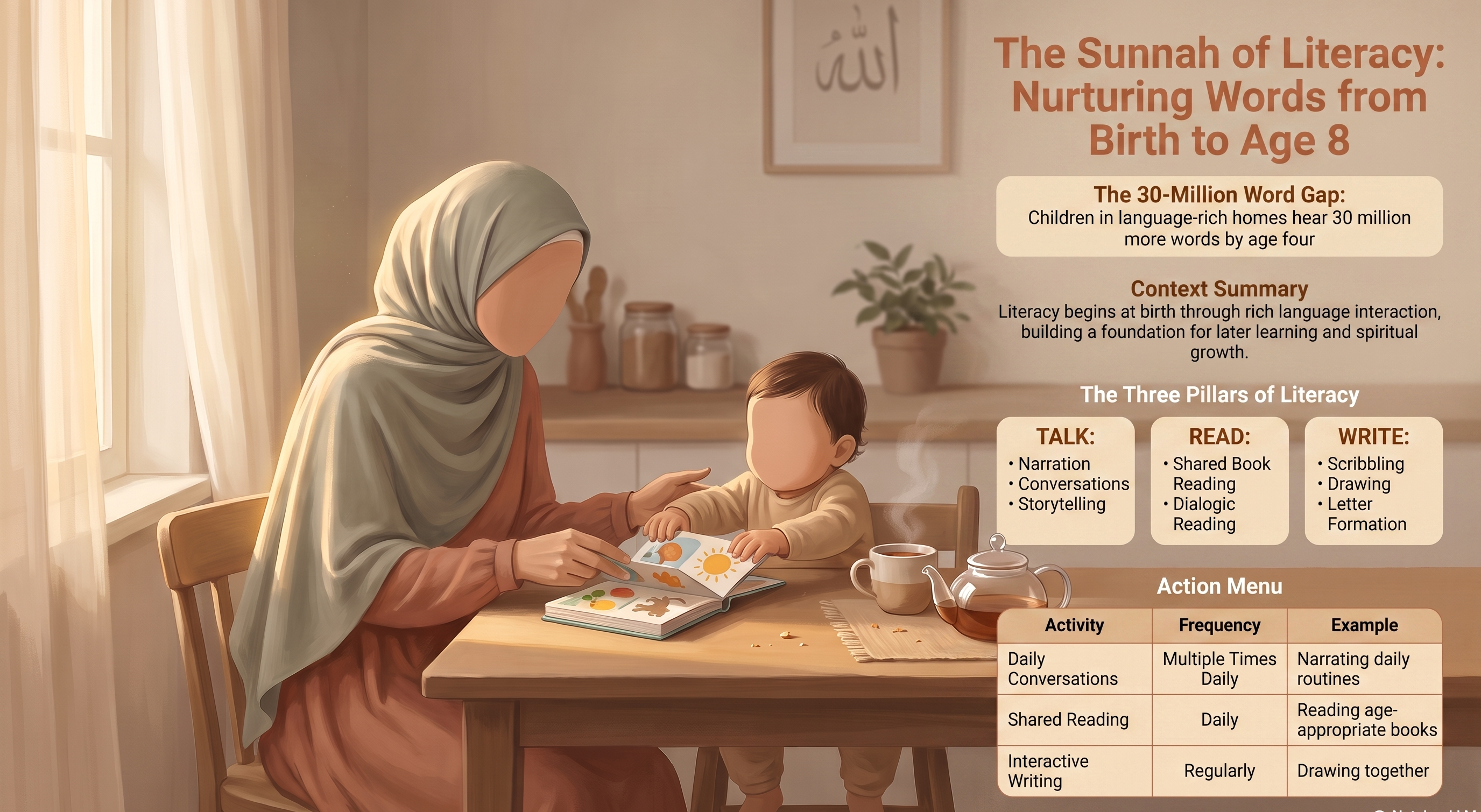
You don’t need a classroom to teach a child to read. Most of it happens somewhere else entirely — in the bath, at the dinner table, halfway through a walk to the corner shop when your toddler stops dead to stare at a dog.
That’s the part people miss.
Literacy doesn’t start with an alphabet chart. It starts with a parent’s voice, repeated a thousand ordinary times, until the sounds start meaning something.
I know you’re probably thinking, “One more thing to add to the list?” I felt that way too, until I realized this isn’t a new task — it’s just paying attention to what you’re already doing anyway. When I looked at the research on this, one number stopped me: children raised in language-rich homes hear over 30 million more words by age four than children raised in quieter households [1]. Talking with a child, not just at them, changes how a young brain organizes language [2].
WHY THIS GUIDE IS DIFFERENT
What Makes This Approach Different
Real Research, Not Guesswork — Every activity here is grounded in developmental science from Harvard’s Center on the Developing Child, the American Academy of Pediatrics, and the National Early Literacy Panel [1][2][3][4].
An Islamic Framework Woven Throughout — This isn’t just “reading tips” — it’s about honouring the pen that Allah Himself swore an oath by, and following the example of a Prophetic companion who was taught to write as a child.
A Free Printable You’ll Actually Use — You’ll get a free Little Scribes Literacy Activity Pack to keep on the fridge or in the diaper bag — not just information, but a tool designed for the moments literacy actually happens.
Why the Ordinary Moments Matter So Much
There’s a well-known study from the 1990s that still shapes how researchers talk about early language: children raised in language-rich homes hear tens of millions more words by age four than children raised in quieter households, and that gap shows up later in vocabulary and reading ability [1]. The exact number gets debated among researchers — but the underlying finding holds up. Talking with a child, not just at them, changes how their brain organizes language [1][2].
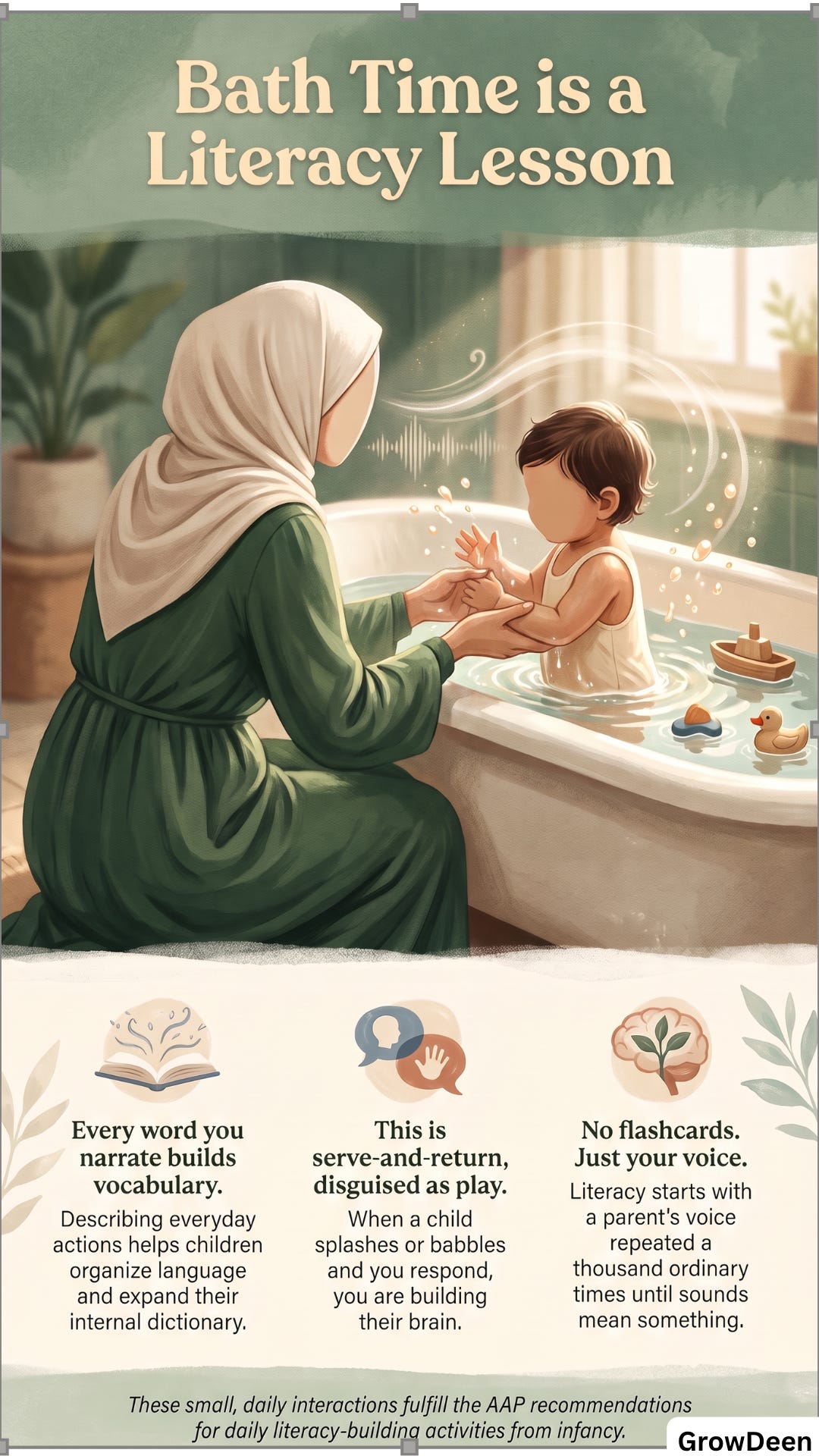
The Harvard Center on the Developing Child calls this “serve and return” — a baby babbles, you respond, the baby babbles again. That loop, repeated constantly, is what actually builds the neural architecture for language [2].
Here’s what surprised me most: it sounds almost too simple to matter. It matters enormously.
The American Academy of Pediatrics has leaned into this so heavily that it now recommends literacy-building activities — shared reading, responsive talk, exposure to print — starting in infancy and continuing as a daily habit right through primary school [3]. Not once a week. Daily.
The research on phonological awareness backs this up too: children who play with rhyme and sound patterns early tend to find the mechanics of reading easier once formal instruction starts [4][5].
None of this requires equipment. It requires you, showing up, saying the same rhyme for the fortieth time without rolling your eyes.
An Honour Older Than the Research
Here’s something worth sitting with. Long before any of this research existed, the Qur’an had already elevated the very tool a child uses to write. Allah says: “Nun. By the pen and what they inscribe” (Qur’an 68:1) [6]. He swears an oath by it — the pen. According to Tafsir Ibn Kathir, the reference is understood plainly: the actual, physical pen used for writing, honoured as the means by which knowledge is recorded and carried forward through time [6].
So when your five-year-old is dragging a crayon across a page, badly, gripping it wrong, pressing too hard — that’s not a mess to manage. That’s the instrument Allah swore by, in a small hand, doing exactly what it was made to do.
When was the last time you watched your child scribble and actually saw it that way?
Babies, Toddlers, and Preschoolers: Birth to Five
Talk. Then talk more.
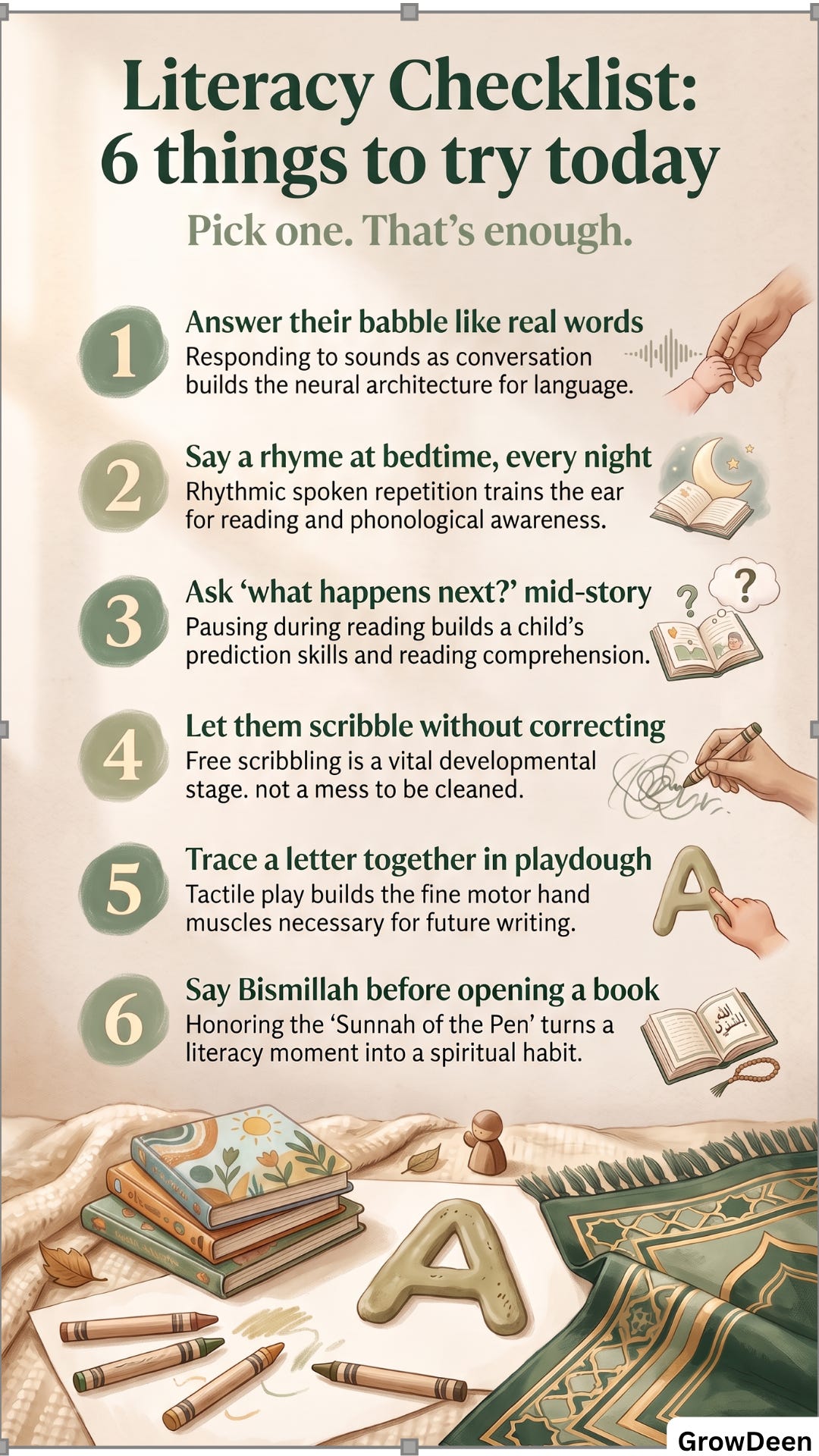
Rhyme belongs in your everyday speech, not just in books — “snug as a bug in a rug” while you tuck them in, “time for bed, sleepyhead” on repeat. Rhyme trains a young ear to hear the small sound-pieces inside words, and that skill turns out to be one of the strongest early predictors of how easily reading clicks later on [4].
Many families use rhythm and repetition to build this — the same words, said the same way, over and over. Rather than reaching for melody-based songs, Muslim households often lean on the rhythm already built into gentle Qur’an recitation, spoken adhkar, and rhythmic phrases delivered without music. It does the same developmental job while keeping the sound of the home aligned with what the family values.
When your baby babbles “wa wa,” don’t just smile — answer it. “You want water? Here.” That’s the serve-and-return loop again, and it’s one of the most consistently supported drivers of early language growth in the research [2].
Invent sounds together — a duck, a car engine, a cat. Go on sound hunts during errands: “What can you hear? A door. A bird.” With preschoolers, colour-based “I Spy” (”I spy something green”) stretches vocabulary without feeling like a lesson.
Reading, the unhurried way.
Look for books with rhyme, rhythm, repetition — the kind where a toddler can guess what’s coming and shout it out before you get there. Let them turn the pages themselves, trace the words with a finger even though the marks mean nothing to them yet. That’s not wasted motion — it’s print awareness building quietly in the background, the slow realization that squiggles carry meaning [4].
Lift-the-flap books, touch-and-feel books — anything that adds a sensory layer keeps a very young child in the moment instead of wandering off. Ask predictive questions mid-story: “What happens next?” Tie the book back to something your family actually did. Let them act a scene out physically if they want to. Movement paired with language sticks.
Scribbling is not a problem to fix.
Let your child scribble on cards, old envelopes, whatever’s around. That scribbling is a real, necessary developmental stage — not a mess that needs correcting. Trace pre-drawn letters in a different colour. Roll letters out of playdough. Use magnetic or puzzle letters. All of it builds the small-muscle control handwriting eventually needs.
Match household objects to their printed names — a homemade game using things you already own. When your child draws something and tells you what it is, write their exact words underneath. That single act shows them, concretely, that spoken words can become written ones. And let them “write” a letter to a grandparent, even if it’s just scribbles folded into an envelope. Watching that letter get opened and celebrated teaches a child that writing reaches people.
Support Muslim Parenting Lab ❤️
Is there something in your record you would like wiped? Give any amount today with the button below.
The Prophet ﷺ said charity extinguishes sin as water extinguishes fire. (Jami’ at-Tirmidhi 2616, hasan)
School-Age Children: Five to Eight
Talk with more structure now.
Word games earn their keep here — “I spy something starting with F,” or rhyming prompts like “What rhymes with car?” Build invented words together from a single sound: turn “mo” into moan, mope, moat. This kind of play strengthens phonemic awareness, one of the core mechanical skills behind fluent reading [4][5].
Have real conversations about time — the recent past (”What was the best part of school this week?”), the near future (”What’s the plan for Saturday?”). These conversations stretch a child’s ability to use language to sequence events and hold onto memory, skills that show up again later in written storytelling.
Reading together, but let them do more of the work.
Talk about favourite characters after a story. Explain unfamiliar words as they come up rather than skating past them. Take turns reading page by page, and when a word trips your child up, sound it out together instead of just supplying it. Try alphabet books. Encourage them to make their own storybook — drawings with a few written words attached. Turn errands into a literacy hunt: letters and words on shopfronts, road signs, cereal boxes. And go to the library. Regularly. Free borrowing and story-time sessions expose a child to a wider range of books than any single household could ever stock [3].
Writing that feels like play, not homework.
Rearrange the letters of a word and test which combinations are real — “bat” becomes “tab,” but not “abt.” Fridge magnets make good message boards. Once lower and upper case feel comfortable, have your child practice their own name on cards and gifts. Bring them into writing shopping lists, simple menus, or a pretend story. Point out different kinds of print when you’re out together — shop signage, movie posters, road markings — and talk about how print changes depending on where it shows up. Make a small book together, one word per page, matched to a drawing your child made.
But knowing the activities is only half the picture. Here’s why this matters more than it seems on the surface —
What to Avoid
Don’t turn reading or writing into a correction session — a scribble is a stage, not an error. Resist comparing your child’s pace to another child’s; literacy develops unevenly and normally between children the same age. Screens shouldn’t stand in for talking, reading, or playing together — passive viewing doesn’t build the same skills as live, responsive interaction [3]. And be wary of leaning on melody-based songs as your primary rhyme tool; rhythmic spoken repetition, adhkar, and Qur’an recitation give the same developmental benefit inside an Islamically grounded home.
When to Speak With a Professional
Most literacy development happens at a wide, normal range of paces. Still, it’s worth speaking with your child’s doctor, teacher, or a qualified speech and language professional if your toddler shows little interest in books or being talked to by around 18 months to two years, if a school-age child struggles noticeably more than peers to recognize letters or blend sounds, if reading or writing tasks trigger distress that feels disproportionate, or if a skill your child once had seems to disappear. An early check-in doesn’t mean something’s wrong. It means your child gets the right support at the right time.
I know this is a lot to hold in your head, especially when you’re managing homework, dinner, and bedtime in the same 90 minutes. That’s why I’ve created a free Little Scribes Literacy Activity Pack — a printable guide with an age-banded activity menu, a verified Islamic literacy resource shopping list, and a Sunnah reflection card. Keep reading to download it at the end of this article — it’s designed to live on your fridge, not in a forgotten folder.
The Sunnah of the Pen: What a Young Companion Teaches Us About Literacy
As Muslim parents, we tend to think of literacy as a school subject — something that starts with a workbook. But the Qur’an got there first, and it got there with an oath. “Nun. By the pen and what they inscribe” [Qur’an 68:1]. According to Tafsir Ibn Kathir, this is understood plainly as the literal pen used for writing, honoured as the instrument by which knowledge is preserved and passed forward through generations. Allah did not need to swear by the pen. He chose to.
What strikes me most, though, is that this honour wasn’t abstract in the Prophet’s ﷺ own life — it was given, quite deliberately, to a child. Zayd ibn Thabit narrates: “The Messenger of Allah ﷺ ordered me to learn the writing of the Jews... So I learnt it, and only a fortnight passed before I mastered it” [Sunan Abi Dawud 3645, Hasan Sahih]. Zayd was young. The Prophet ﷺ gave him a real task, trusted him with it, and watched him rise to it in a matter of weeks. That same boy later became the principal scribe of revelation and, after the Prophet’s ﷺ death, the compiler of the Qur’an itself.
There’s something for us in that. When you sit beside your own child tracing a letter for the twentieth time, you’re echoing a pattern the Prophet ﷺ himself set: purposeful attention now, for a benefit that may not show itself for years. What’s beautiful is that the research on early, consistent practice and the Sunnah of Zayd’s fortnight of mastery point at the same truth from two directions: small children, given real attention and real tasks, rise further than we expect. May Allah make every scribble, every traced letter, and every bedtime story a means of barakah for our children.
If you’ve read this far, you’re the kind of parent who wants more than “read to your kids” — you want to know exactly what to do at each stage. That tells me something beautiful about you.
Inside the Little Scribes Literacy Activity Pack (one comprehensive PDF, 3 pages):
Page 1: Literacy Activity Menu by Age & Stage — A visual reference card listing specific Talk / Read / Write activities for birth–5 and 5–8 years, organized so you can glance at it and pick one thing to do today — designed as a card you can keep on the fridge or in the diaper bag.
Page 2: Muslim Family Literacy Resource Guide — A researched, verified list of Islamic literacy toys, wipe-clean Arabic writing books, and letter-learning games — with real store names, what each product actually contains, and safety notes for younger children — so you’re not scrolling reviews at 11pm trying to figure out what’s actually worth buying.
Page 3: The Sunnah of the Pen — A short reflection card built around Qur’an 68:1 and the story of young Zayd ibn Thabit, with a simple practice reminder for saying Bismillah before reading and Mashallah/Alhamdulillah after a child’s writing effort — something you can keep near your child’s book basket.
This isn’t just a PDF to download and forget. It’s a tool designed to stay in your kitchen or diaper bag — where reading and writing actually happen.
This Little Scribes Literacy Activity Pack is what every subscriber receives with each article. We cover the full journey of raising Muslim children — from newborns to school-age — all backed by research and rooted in Islamic wisdom.
Before you keep scrolling, do this: hand your child a crayon and a scrap of paper right now, and just watch what they do with it for two minutes. Don’t correct. Don’t teach. Just watch. That’s the whole practice today.
May Allah place barakah in every scribble, every story, and every patient repetition — and make the effort you’re putting in today into something that outlasts you.
Think of one person right now: the friend at the masjid whose toddler won’t sit still for a single page, the sister who keeps saying “I don’t know where to even start with reading,” the parent in your WhatsApp group asking what Arabic learning toys are actually worth buying.
This article could hand them something they can use today. Share it with them — not as advice-giving, but as support. Sometimes the most loving thing we can do is pass along what actually worked for us.
FREQUENTLY ASKED QUESTIONS
Q: What age should I start reading to my baby?
A: From birth. The AAP recommends shared reading starting in infancy, not because a newborn understands the story, but because hearing your voice and seeing print builds the groundwork for everything that comes later [3]. For more on early activities, see the birth-to-five section above.
Q: My child scribbles instead of forming real letters — should I correct their grip or letter shapes early?
A: No, not yet. Scribbling is a genuine developmental stage, not a mistake — correcting it too early can make writing feel like a chore instead of play. Let your child scribble freely and offer tracing and playdough letters alongside it, without insisting on correctness.
Q: How much should a five-year-old be able to read or write?
A: There’s a wide, normal range at this age — some five-year-olds are sounding out simple words, others are still learning letter names. What matters more than where your child is right now is consistent daily exposure to talking, reading, and writing play. See “When to Speak With a Professional” above if you’re genuinely unsure.
Q: Can I use Islamic apps for Arabic alphabet learning, or should I avoid screens entirely?
A: A few Islamic Arabic-learning apps exist and can supplement — not replace — hands-on activities. Passive screen time doesn’t build the same skills as live, responsive interaction [3], so treat apps as an occasional extra, not the main method, especially before age two.
Q: How do I raise a bilingual (Arabic and English) reader without overwhelming my child?
A: Bilingual exposure doesn’t overwhelm young children the way many parents fear — consistent, everyday use of both languages, rather than formal lessons, works best. Keep it woven into daily life: English during play, Arabic during Qur’an time and du’as, without pressure to “test” either one.
Q: When should I be concerned about a possible reading or speech delay?
A: If your toddler shows little interest in books or being talked to by 18 months to two years, or a school-age child struggles noticeably more than peers with letters or sounding out words, it’s worth a conversation with your child’s doctor or a speech-language professional. Early support is protective, not alarming — see “When to Speak With a Professional” above.
REFERENCES
[1] Hart, B., & Risley, T.R. (1995). Meaningful Differences in the Everyday Experience of Young American Children. Paul H. Brookes Publishing.
[2] Center on the Developing Child at Harvard University. Serve and Return. Responsive, back-and-forth interaction between caring adults and young children supports healthy brain architecture and early language development.
[3] American Academy of Pediatrics; Council on Early Childhood. (2014). Literacy Promotion: An Essential Component of Primary Care Pediatric Practice. Pediatrics, 134(2), 404–409.
[4] National Early Literacy Panel. (2008). Developing Early Literacy: Report of the National Early Literacy Panel. National Institute for Literacy.
[5] Whitehurst, G.J., & Lonigan, C.J. (1998). Child development and emergent literacy. Child Development, 69(3), 848–872.
[6] Tafsir Ibn Kathir, commentary on Surah Al-Qalam (68:1), via alim.org — the oath by the literal pen used for writing, honouring it as the means of recording and transmitting knowledge.
[7] Sunan Abi Dawud 3645. Narrated by Zayd ibn Thabit. Graded Hasan Sahih by Al-Albani. Verified via sunnah.com.
We combine scientific research with Qur’an and authentic Sunnah, and we cite our sources. Even so, this is general guidance and no substitute for a doctor who can examine your child.