

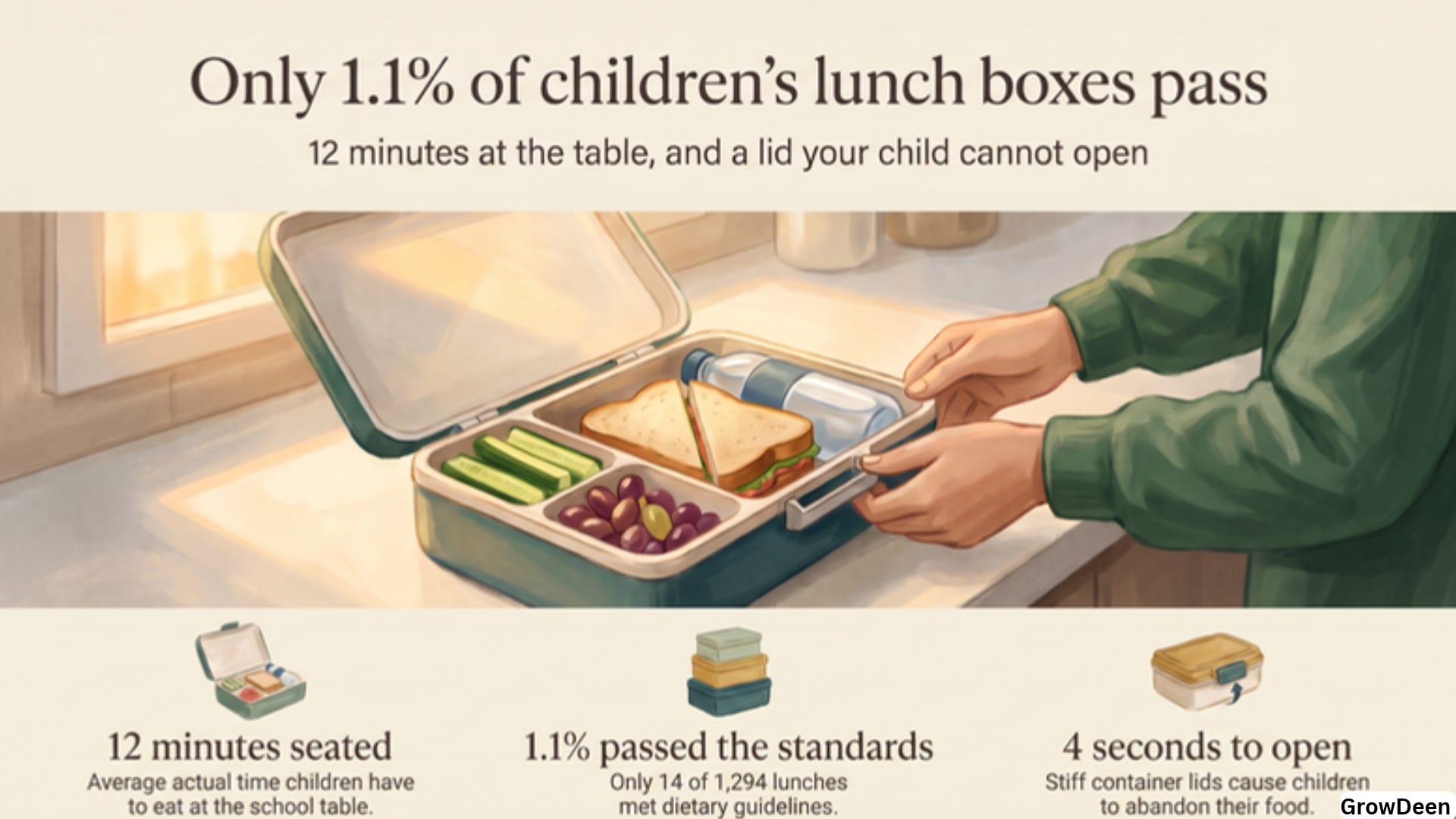
Only 1.1% of packed lunches passed the school food standards. [1] Children seated under 20 minutes ate 12% less of their vegetables. [2]
Printable. Three pages. For the 8-minute morning.
It is 7:10am.
The box is packed. The grapes are quartered, the sandwich is cut into four, the fruit is the good kind she said she liked on Sunday. You zip it shut feeling like you have done the thing properly, because by every measure you were given, you have.
Six hours later it comes back with the fruit untouched and the crisps gone.
You did not do anything wrong this morning. The box was never the part that decides.
What The Research Actually Measured
Researchers at Leeds opened 1,294 lunch boxes belonging to children aged 8 and 9, across 89 primary schools, and scored each one against the food standards their school kitchens were legally bound to meet. Fourteen passed. [1]
Sandwiches were in 85% of boxes. Fruit was in 54%. Vegetables made it into 19%, while crisps or confectionery appeared in 82% and sweetened drinks in 61%. [1]
Hold those last two numbers next to each other. Four out of five boxes contained something sweeter and faster than everything else inside them. Children eat in order of preference, and they eat against a clock.
Which brings us to the clock, because it turns out to be the whole story.
Why This Guide Is Different
It measures the right half. Most lunch box advice ends at the lid. This one is built on the research into what children actually eat once they sit down, including the seated-time study almost no parenting guide cites [2].
The Islamic layer is load-bearing, not decorative. Qur’an 2:197 was revealed about people who set out under-provisioned and called it tawakkul. That verse settles the exact question a tired parent asks at 6:30am, and it is verified here through Tafsir Ibn Kathir [8][9].
You already have the free Lunch Window Pack from the top of this page. Three printable pages: a container test, a twelve-minute build sheet, and a provision card for the door.
The Twelve Minutes Nobody Tells You About
Cohen and colleagues at Harvard did something obvious that almost nobody had done. Instead of measuring how long the timetable said lunch lasted, they measured how long children were actually seated with food in front of them.
Queuing, walking, finding a seat, being dismissed: all of it comes out of the middle.
Children seated for under 20 minutes ate 13% less of their main item and 12% less of their vegetables than children seated for at least 25 minutes. Fruit selection dropped from 57% to 44%. [2]
Your child probably has somewhere between 10 and 15 minutes of real eating time, in a loud hall, with friends already heading for the door.
So a lunch box is not a smaller dinner. It is food built for a short, one-handed window, and every decision below comes from that one constraint.
They eat what they can open.
Three Questions That Fix Most Of It
Ask these about every single item before it goes in.
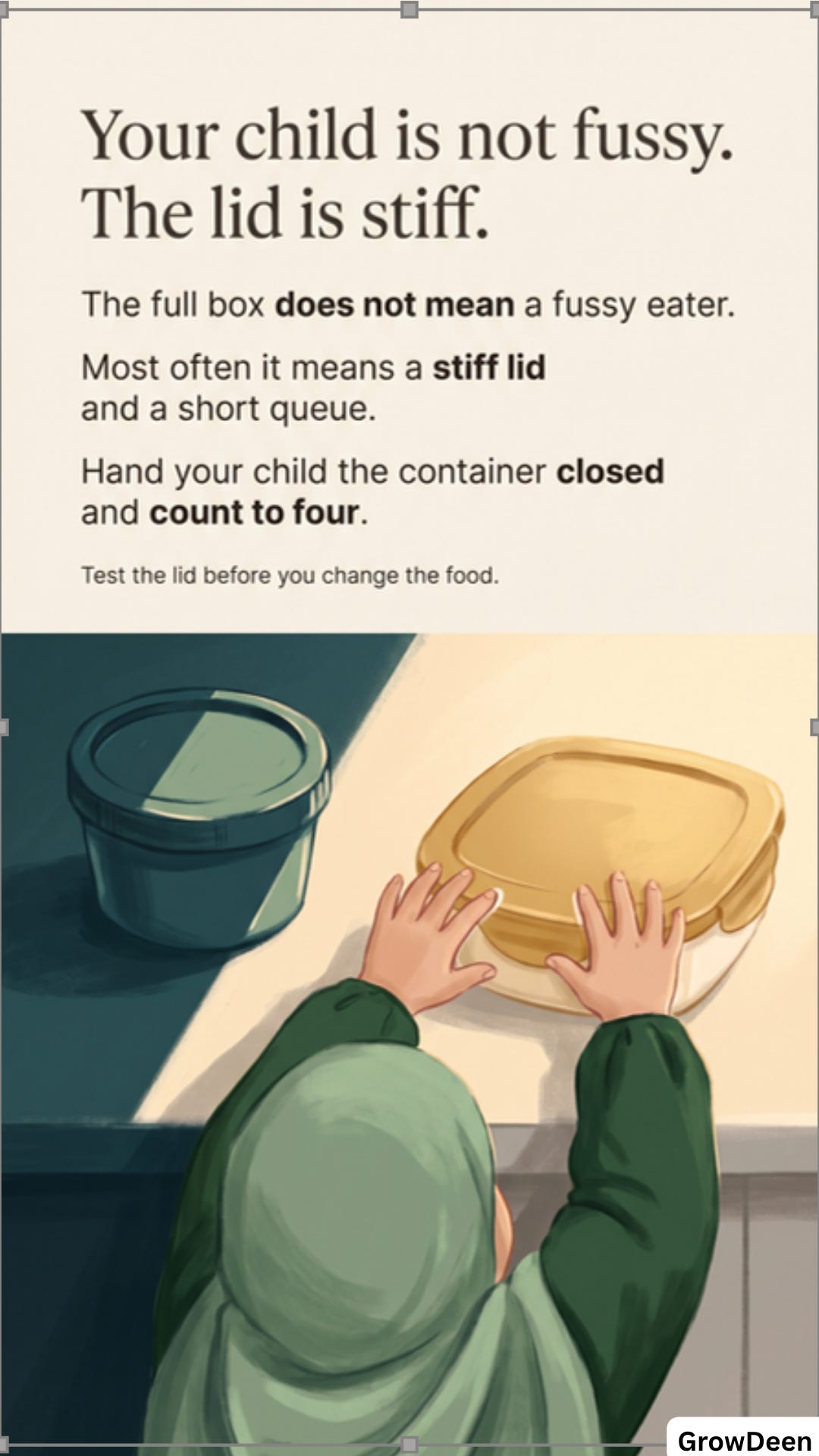
Can she open it alone, fast, with cold hands? Test it at your own kitchen table. If it takes your six-year-old two attempts at home, it gets abandoned at school. This single check recovers more uneaten food than any recipe.
Can it be eaten without cutlery and without sticky fingers? Many children will stop eating entirely rather than sit with messy hands for the rest of break.
If she only eats two things, am I happy with which two? This is the one that quietly solves the vegetable problem. You cannot control the order. You can control what is available to be first.
Building The Box Backwards
Put the vegetables in first, in whatever form takes the least effort to eat. Cucumber batons. Sweet pepper strips. Cherry tomatoes with the seeds squeezed out. Cold steamed green beans. Grated carrot already inside the sandwich rather than sitting next to it in a tub nobody opens.
Then the rest.
Grains: wholegrain bread, pita pockets, wraps, flatbread, seeded rolls, cold pasta, rice, couscous.
Protein: eggs, halal chicken or meat, tinned tuna or salmon, lentils, chickpeas, beans, baked seasoned tofu, nut butters where your school permits them.
Dairy: yoghurt, cheese, milk, with reduced-fat versions suiting children over two.
Fruit: small whole fruit, or larger fruit cut into pieces that go down in one bite.
Cut sandwiches into quarters. Slice the bread thinner than feels right. Use less filling, because an overstuffed sandwich collapses in small hands and gets put down. Drain everything wet, including tinned fruit, tinned beans and tinned fish, since a soggy sandwich is the single most common item to come home whole.
Batch cooking beats clever recipes every time. Savoury muffins with grated courgette inside, pancakes and whole sandwiches all freeze. Drop one in frozen on a weekday morning and it thaws by midday while keeping everything around it cold.
The Drink You Were Not Worried About
Send plain water in a refillable bottle. That part is short.
Juice is the one parents least suspect. The World Health Organization recommends free sugars stay below 10% of total energy for adults and children alike, and notes further benefit, mainly for teeth, below 5%, which is roughly 25 grams a day. [4] One carton can account for most of that before morning break.
The American Academy of Pediatrics is specific by age: none at all under one, no more than 4 ounces a day between one and three, and 4 to 6 ounces between four and six. [5]
If juice appears at all, it belongs at home with a meal. The slow sipping across a school day is what damages teeth, more than the amount.
I Know This Is A Lot To Hold At 6:30am
That is exactly why the free Lunch Window Pack exists. It is three printable pages: a container test you run once at your own table, a twelve-minute build sheet for the mornings your brain is not working yet, and a provision card for the inside of a cupboard door. The download button is at the top of this page, and there is a full description of what is inside it below.
Support Muslim Parenting Lab ❤️
Would you like one parent, somewhere, to be guided because of you? Fund the articles that reach them, with the button below.
The Prophet ﷺ said one person guided through you is better for you than red camels, the greatest wealth of that time. (Sahih al-Bukhari 3701)
Two Safety Rules That Outrank Everything Else
Choking. The American Academy of Pediatrics names whole grapes, nuts and seeds, popcorn, raw carrot sticks, chunks of apple, chunks of meat or cheese, sausages, hard or sticky sweets, marshmallows and thick lumps of nut butter among the foods to keep away from children until around age four, judged against the individual child. [6] Cut food into pieces no larger than half an inch. Quarter grapes lengthways rather than halving them, because a half still fits an airway. Spread nut butter thin. Supervision matters more than all of it, and a school lunch hall cannot promise you supervision, so the cutting has to happen in your kitchen.
Temperature. Bacteria multiply fastest between 40°F and 140°F, and perishable food held in that range beyond two hours should be thrown away rather than eaten. [3] A box in a warm classroom crosses that line easily. Use an insulated bag with two cold sources, one above and one below the perishable items, such as gel packs or a frozen water bottle. Keep the box in the fridge until the last moment. For hot food, fill the flask with boiling water, leave it a few minutes, empty it, then add the food and seal it straight away. [3]
Halal, And Reading Past The Front Of The Packet
Cured products such as salami and mortadella are high in salt and fat, and many are pork-based or carry pork derivatives, which rules them out twice over. Halal-certified processed meats still deserve a look at the salt figure and a place in the occasional column.
On packaged snacks the ingredients list matters more than the claims on the front. Gelatine, animal fats and alcohol-based flavourings turn up in biscuits, sweets and some flavoured yoghurts more often than parents expect. Where an additive is unclear, a trusted scholar or a recognised halal certification body in your region is the right place to ask.
Sweet extras belong to Eid and family gatherings, where they get enjoyed properly, rather than to a Tuesday, where they displace what you actually wanted eaten.
Take Provisions: What The Qur’an Settles About Packing Carefully
There is a question that sits under all of this, and the Qur’an answers it directly.
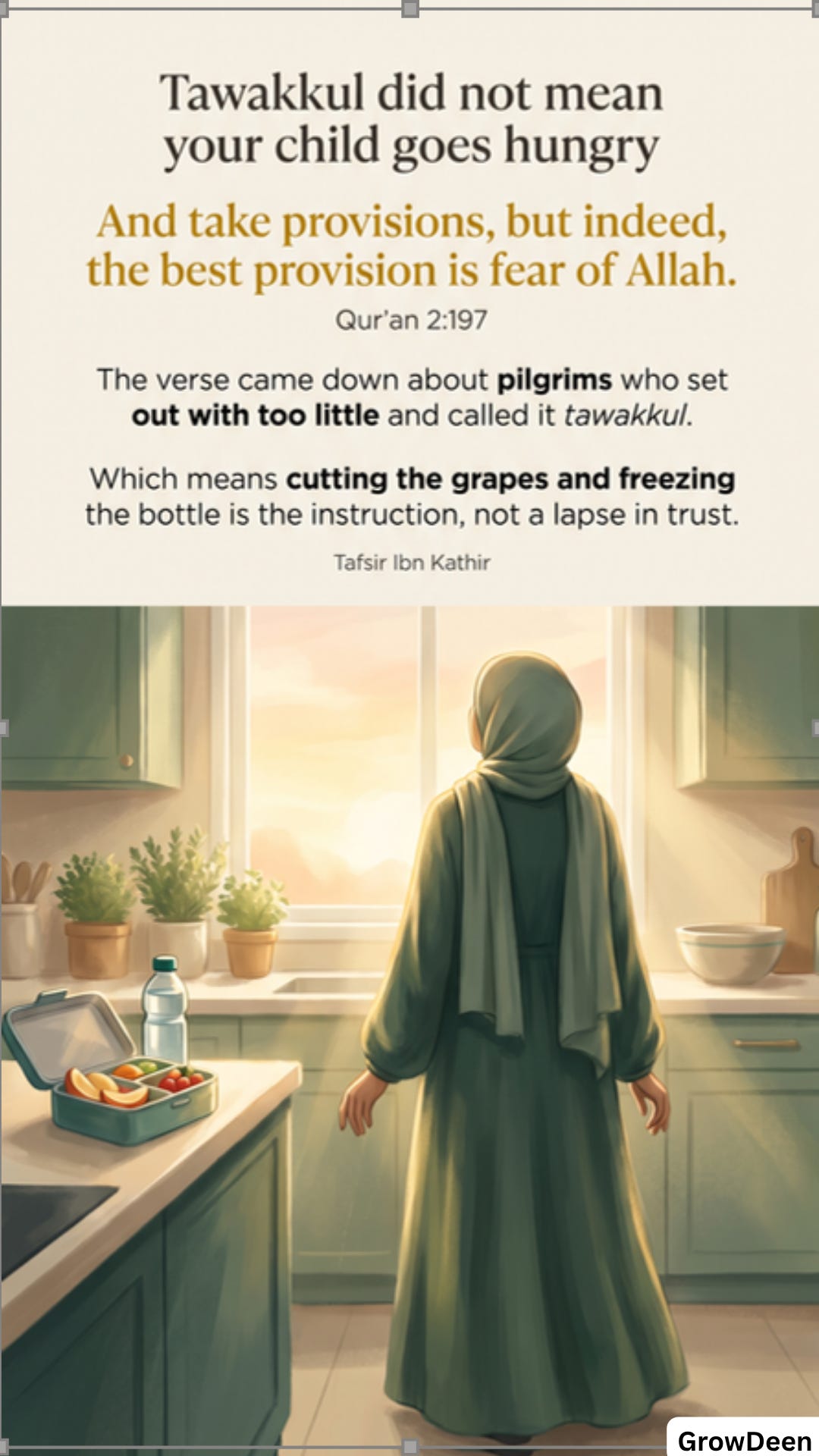
Allah says, “And take provisions, but indeed, the best provision is fear of Allah.” [8] The instruction comes in the middle of the Hajj verses, and the reason behind it is the part worth sitting with. Ibn Kathir records on the authority of Ibn Abbas that pilgrims from Yemen used to set out carrying far too little, saying of themselves that they were people of tawakkul. The verse came down in response to exactly that. [9]
So careful preparation is part of trust. Cutting the grapes, testing the lid, freezing the bottle: that is the instruction, and the casual version was the thing corrected.
The Prophet ﷺ set the reward lower still, at the level of one mouthful. Sa’d ibn Abi Waqqas narrated that he said you are rewarded for whatever you spend seeking Allah’s pleasure, down to a morsel you place in your wife’s mouth. [10] Imam al-Bukhari placed that narration in his chapter on intention, which is the whole point of it. The act is small and domestic, and nobody sees it. The intention is what gets weighed.
Pack it properly, say Bismillah with her before she leaves, and let the morning count for something beyond nutrition.
When The Box Comes Home Full
Say nothing about it.
That is the whole instruction, and it is harder than it sounds at the end of a long day. Commentary on uneaten food attaches anxiety to eating, and anxiety at the table makes fussiness worse. No bargaining. No visible disappointment. Put the same vegetable in again next week without any reference to last time, because acceptance is built through repeated low-pressure exposure, and the calm parent usually wins somewhere around the tenth offer.
Before you decide she refused it, rule out the ordinary explanations. Was the lid too stiff? Was the portion too big for twelve minutes? Did the sandwich go soggy? Was there a queue that ate half of break? Most untouched lunches are a logistics failure rather than a feeding one, and the fix is usually in your kitchen rather than in your child.
Let Her Pack It
A nursery-based cooking programme run with parents and their children reduced food fussiness and increased willingness to try vegetables, with higher tasting scores across the vegetables tested compared with children who did not take part. [7]
The mechanism is not mysterious. A child who washed the tomatoes, chose between two fillings and clicked the lid shut has already decided something about that box. It arrives at school as hers.
Narrow the choice before you offer it. Two fillings and two fruits, from whatever is already in the house. A narrow choice gets decided in seconds and still produces ownership. They eat what they can open, and they open what they packed.
Age By Age
One to two years. Soft and small enough to chew easily. No whole grapes, nuts, popcorn or hard raw vegetables. Cooked vegetable sticks in place of raw. Milk or water only.
Three to four years. Round foods still quartered lengthways. Portions smaller than instinct suggests, offered more often. Bismillah and the right hand become automatic at this age if you hold the line at home.
Five to eight years. Longer days, bigger appetites, more say in what goes in. Appetite swings week to week, which is normal.
When To Speak To A Doctor
Most fussy eating resolves on its own. Speak with your doctor or a registered dietitian if your child is losing weight or has stopped gaining, if she refuses whole food groups for weeks at a time, if she gags or chokes often while eating, if eating causes pain, or if you suspect a food allergy or intolerance. Swelling, a spreading rash or any difficulty breathing needs urgent medical care immediately. This article does not replace advice from your own doctor, who knows your child and her history.
Your Lunch Window Pack
If you have read this far, you are the kind of parent who takes a small daily thing seriously enough to want it right. That is worth saying out loud.
Inside the Lunch Window Pack (one comprehensive PDF, 3 pages):
Page 1: The Sixty-Second Container Test. A one-page test you run once, at your own kitchen table, on every lid and tub you own, with a tick-box grid and a pass mark that matches what a child can manage at speed. Designed as a card you keep inside the cupboard where the lunch boxes live.
Page 2: The Twelve-Minute Build Sheet. A build-in-order grid showing what goes in first, second and third, with cut sizes by age printed beside each row and a cold-pack placement diagram, so you can assemble a complete box in under four minutes on a morning when nothing in your head is working.
Page 3: Take Provisions. Qur’an 2:197 with the revelation context from Tafsir Ibn Kathir, the narration on intention from Sahih al-Bukhari 56, and a short morning intention line to read before you close the lid, turning four minutes of packing into something counted.
It is built to live inside the cupboard door, where you will actually see it at ten past seven.
This Lunch Window Pack is what every subscriber receives with each article. We cover the full ground of raising Muslim children from birth through the early school years, all backed by scientific research and rooted in Islamic wisdom.
Do This Before You Forget
Go to the cupboard where the lunch boxes live. Pick up the container your child uses most and hand it to her right now, closed. Time how long it takes her to open it. If it is more than four seconds, that container is the reason her lunch comes home.
May Allah place barakah in the food you prepare, protect the small bodies you are feeding, and accept four minutes of packing that nobody else will ever see.
Share This With Someone Who Needs It
Think of one person right now. The mother at the school gate who mentioned her son keeps bringing his lunch home untouched. Your sister, who packs beautifully and has started to take the full box personally. The friend who asked you last month what you put in yours.
Send this to her today, because she is doing a careful thing every morning and nobody has told her the part that actually decides it.
Frequently Asked Questions
Q: What should I pack in my child’s lunch box? A: Something from each of the five food groups, with the vegetables packed first and in the easiest form to eat. A wholegrain sandwich, a cut vegetable, a piece of fruit and a yoghurt covers the whole set. Build it around what can be eaten in twelve minutes rather than what looks complete. [1][2]
Q: Why does my child bring their lunch home uneaten? A: Usually it is time or packaging rather than taste. Children get roughly 10 to 15 minutes actually seated, and anything with a stiff lid or sticky hands attached gets abandoned. Run the container test before you change the food. [2]
Q: How do I keep a packed lunch cold and safe until lunchtime? A: Use an insulated bag with two cold sources, one above and one below the perishable food, and keep the box in the fridge until you leave. Perishable food held between 40°F and 140°F for more than two hours should be thrown away. [3]
Q: Is juice okay in a lunch box? A: Plain water is the better default. The American Academy of Pediatrics recommends no juice at all under one year, up to 4 ounces daily for ages one to three, and 4 to 6 ounces for ages four to six. The slow sipping across a school day is what harms teeth most. [5]
Q: Which foods are choking hazards in a lunch box? A: Whole grapes, nuts and seeds, popcorn, raw carrot sticks, chunks of apple, chunks of meat or cheese, sausages, hard sweets and thick lumps of nut butter, until around age four. Cut everything to half an inch or smaller, and quarter grapes lengthways rather than halving them. [6]
Q: How do I get my child to eat the vegetables I pack? A: Pack them first, in the easiest possible form, and let her choose between two options when you build the box. Children who help prepare food show less fussiness and more willingness to try vegetables. Then say nothing when the box comes home full. [7]
Q: Does careful preparation go against tawakkul? A: No. Qur’an 2:197 instructs believers to take provisions, and Ibn Kathir records that the verse was revealed about people who set out under-provisioned while calling themselves people of tawakkul. Preparation is the instruction, not the exception to it. [8][9]
References
[1] Evans, C.E.L., Greenwood, D.C., Thomas, J.D., & Cade, J.E. (2010). A cross-sectional survey of children’s packed lunches in the UK: food and nutrient-based results. Journal of Epidemiology and Community Health, 64(11), 977. https://jech.bmj.com/content/64/11/977
[2] Cohen, J.F.W., Jahn, J.L., Richardson, S., Cluggish, S.A., Parker, E., & Rimm, E.B. Amount of time to eat lunch is associated with children’s selection and consumption of school meal entree, fruits, vegetables and milk. Journal of the Academy of Nutrition and Dietetics. https://www.sciencedaily.com/releases/2015/09/150911094910.htm
[3] United States Department of Agriculture, Food Safety and Inspection Service. (2025). Pack Food Safety with Back-to-School Lunches. https://www.usda.gov/about-usda/news/press-releases/2025/08/05/usda-reminds-families-pack-food-safety-back-school-lunches
[4] World Health Organization. (2015). Guideline: Sugars Intake for Adults and Children. https://www.who.int/news/item/04-03-2015-who-calls-on-countries-to-reduce-sugars-intake-among-adults-and-children
[5] Heyman, M.B., Abrams, S.A., American Academy of Pediatrics. (2017). Fruit Juice in Infants, Children and Adolescents: Current Recommendations. Pediatrics, 139(6). https://www.healthychildren.org/English/news/Pages/AAP-Recommends-No-Fruit-Juice-For-Children-Under-1-Year.aspx
[6] American Academy of Pediatrics. Choking Prevention. HealthyChildren.org. https://healthychildren.org/English/health-issues/injuries-emergencies/Pages/Choking-Prevention.aspx
[7] Garcia, A.L., Brown, E., Goodale, T., McLachlan, M., & Parrett, A. (2020). Nursery-Based Cooking Skills Programme with Parents and Children Reduced Food Fussiness and Increased Willingness to Try Vegetables: A Quasi-Experimental Study. Nutrients, 12(9), 2623. https://www.mdpi.com/2072-6643/12/9/2623
[8] Qur’an, Surah Al-Baqarah 2:197. https://quran.com/2/197
[9] Ibn Kathir, I. Tafsir Ibn Kathir, commentary on Surah Al-Baqarah 2:197. https://quran.com/en/2:197/tafsirs/en-tafisr-ibn-kathir
[10] Sahih al-Bukhari 56, narrated Sa’d ibn Abi Waqqas, Book 2 (Belief), chapter on intention. Graded: Sahih. https://sunnah.com/bukhari:56
We combine scientific research with Qur’an and authentic Sunnah, and we cite our sources. Even so, this is general guidance and no substitute for a doctor who can examine your child.